Wednesday, August 31, 2022


The impact of the Covid vaccine on periods, from increased cramps to pattern disturbances

In the UK nearly 40,000 people had reported a change to their menstrual cycle to the Yellow Card surveillance scheme

The UK has become the first country to approve a dual vaccine, which will tackle both the Omicron variant and the original Covid-19 virus, for use in the autumn.

Described as “a sharpened tool in our armoury as the virus continues to evolve” by Dr June Raine, chief executive of the UK’s Medicines and Healthcare Products Regulatory Agency, the jab will be offered to the over-50s, health workers, carers over 16, those at clinical risk from the age of five upwards, and those who live with someone with a low immune system.

Currently, there has been no announcement of when or if the dual roll-out will be expanded, but if it were, would everyone take another jab?

Although we know immunity wanes over time, after 33 million people have had three vaccinations, and millions already had a likely Covid infection (there have been a recorded total of 19 million positive tests), should we anticipate greater apathy, or even hesitancy for those who experienced short-term side effects and think they can avoid them?

The NHS says side effects can include a sore arm, feeling tired, headaches, feeling achy, feeling or being sick. You may also get a high temperature. Although these do not impact everyone, and should not last longer than a week. There have also been reports of changes to women’s menstrual cycles: heavy bleeding, increased cramps and disturbance to patterns.

In the UK, by May of this year, nearly 40,000 people had reported a change to their menstrual cycle to the Yellow Card surveillance scheme, the medical regulator scheme, to which healthcare professionals and members of the public can report suspected vaccine side effects. And now, several studies have been published which back up these observations.

An American survey published in the Science Advances journal earlier in August involving 39,000 participants aged 18-80, is the largest study so far. It found that 43 per cent of those with regular cycles noticed heavier bleeding after a vaccination (the majority of the sample received Pfizer and Moderna vaccines). This was reflective of two of the authors’ own experiences.

Dr Katy Clancy of University of Illinois, a biological anthropologist who specialises in reproductive health, shared on Twitter in February 2021: “I’m a week and a half out from dose 1 of Moderna, got my period maybe a day or so early, and am gushing like I’m in my 20s again”. Dr Clancy’s graduate student, Katherine Lee said she had “the worst cramps of my life”.

The survey also revealed that those who didn’t expect to bleed – for various reasons, including being postmenopausal – starting bleeding, known as “breakthrough bleeding”.

“Among respondents who typically do not menstruate, 71 per cent of people on long-acting reversible contraceptives, 39 per cent of people on gender-affirming hormones, and 66 per cent of postmenopausal people reported breakthrough bleeding”, the authors wrote. However, 44 per cent of the nearly 40,000 participants reported no change to their periods at all showing that like other side effects, this does not affect everyone.

In Norway, a study by the Norwegian Institute of Public Health also found that heavy bleeding occurred after vaccination – but in just over 13 per cent. This, Ms Lee explained may be due to the immune responses caused by the vaccine, specifically inflammation. And any side effects experienced are believed to be temporary.
The dual vaccine has been approved for use in the autumn (Photo: Hollie Adams/Getty)

As well as looking at changes to bleeding, other studies have looked at impact on period timings. A smaller US study into the relationship between periods and vaccines, using data from period-tracking app Natural Cycles, found that periods were only a day late, and remained roughly the same length. This study, published in Obstetrics and Gynaecology journal, looked at 2,400 vaccinated individuals and compared their data to 1,500 unvaccinated people.

Last month, Dr Victoria Male, a lecturer in reproductive immunology at Imperial College London published a smaller study. Unlike the US or Norway, the UK government hasn’t provided any funding for research in this area, and instead, Male’s research has been done on a “shoestring”, she wrote in The Guardian.

Regardless, she found a similar pattern; there may be a disturbance to periods, including delays, but it is slight and reversible. Her work also pointed to a potential link between regular periods after vaccination for those on the combined pill.

Dr Male pointed to similar historic examples: “Writing in 1549, the Chinese doctor Wan Chhüan casually mentions that inoculation against smallpox (an early procedure similar to vaccination) was liable to bring on menstruation unexpectedly.

“A report from 1913 noted that when a New York hospital started vaccinating its nurses against typhoid, a number of them noticed post-vaccination differences in their [periods].”

Amy, 28, noticed much heavier bleeding and painful cramps after her Covid jabs. At first, she put it down to the stress of the ongoing pandemic. She went on to have the second vaccine, and booster and noticed a similar shift. But would this change her approach to another vaccination, if it were offered?

“I’d rather not have Covid than a bad period”, she tells i. “If more jabs are coming, it would just be nice if we’d be given a bit more of a heads-up about potential impact instead of worrying [that] something has gone wrong.”

Chantell, 36, experienced a late period and, when it did arrive, it lasted longer than normal. She is more reluctant than Amy, although concedes she would take another vaccine. Chantell has had Covid-19 twice, and each time it was mild. “I’m more annoyed by the inconvenience of it, than worried about how ill I’d be” she says. “Women have always had to endure bad periods, it’s just been part of the course”.

Lily, 24, had a far heavier period post-vaccine than normal but said taking the vaccination is the “responsible thing to do” if she wants to see her grandparents. The women say their periods have subsequently returned to normal.

Dr Clancy, Dr Male, and Ms Lee have all stressed that the surveys and studies are as much an awareness raising exercise as important data collection. Just as many were warned about short-term flu-like symptoms as a vaccine reaction, warning people that periods may be irregular, heavier or more painful prevents unnecessary worry and panic. It can also help take oxygen out of any false and unfounded infertility rumours.

Women are well used to issues around their health being underfunded, under researched and misunderstood. We only need to look at discussions about the risk of blood clotting caused by the AstraZeneca vaccine which meant under 30s were offered an alternative jab, but many women pointed out that the contraceptive pill has much higher risks of thrombosis yet has never received such outcry. That was because, many said, only women took the drug.

Throughout the numerous WhatsApp groups of women I posed the question to, spanning women in their 20s to their 40s, the response was fairly resounding – a difficult period wouldn’t stop them from getting another Covid vaccine, particularly as there was no evidence that the disruption had any link to infertility or long-term problems, one woman pointed out.

Dr Male is keen for these studies not to put women off getting vaccinated: “Would I let these findings put me off getting vaccinated? Well, I got vaccinated while analysing these results, so no! The study results align with others, finding that post-vaccination changes to periods are small and quickly reverse.

“For anyone who is particularly worried about the findings, it is also worth remembering that catching Covid can affect periods, so the most important thing you can do is try to avoid getting Covid”.

Turkey signals new rules of engagement to Syrian Kurds, Damascus

Turkish strikes on Syrian government troops and overt Kurdish attacks on targets inside Turkey signal that both sides are changing the rules of the game as Ankara eyes normalization with Damascus.


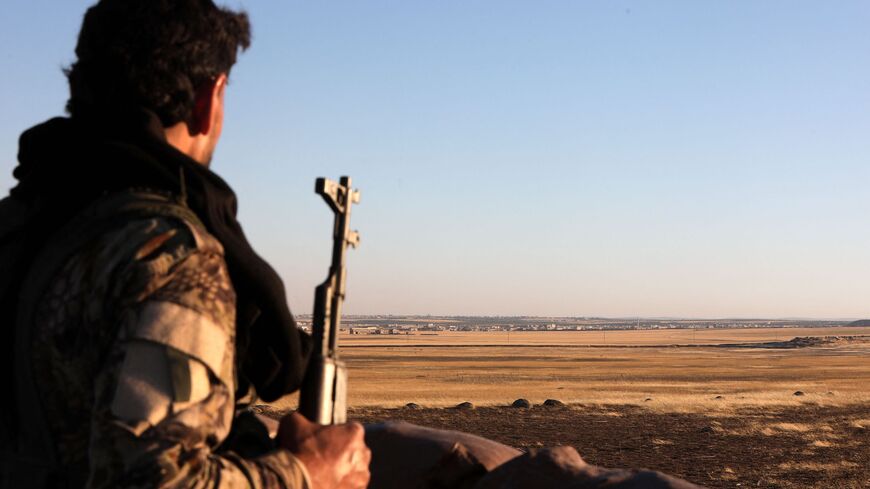
A Turkey-backed fighter looks out from a military position in the Syrian area of Jibrin in Aleppo's eastern countryside toward the Kurdish-controlled area of Tal Rifaat on July 19, 2022. - 
BAKR ALKASEM/AFP via Getty Images

Fehim Tastekin
@fehimtastekin
August 22, 2022


Ankara’s reconciliation overtures to Damascus have been accompanied by growing Turkish attacks on Syrian Kurdish and government forces along the border — a sign of new engagement rules in a border strip extending 32 kilometers (20 miles) into northern Syria that President Recep Tayyip Erdogan wants to see as a “safe zone.”

The attacks resonate as a message that Ankara will not tolerate Syrian army positions that amount to indirect cover or support for the Syrian Democratic Forces (SDF) and its main component, the Kurdish People’s Protection Units (YPG), which Turkey insists should be removed from the border strip. The SDF and YPG appear to have changed the rules of the game as well, mounting overt attacks on Turkish border posts and patrols, something they have hitherto avoided.

Erdogan’s talk of fence-mending with Damascus followed his Aug. 5 meeting with Russian President Vladimir Putin in Sochi and Russian capital flows to Turkey. Back in 2016, he had said that Turkey’s military thrust into northern Syria aimed to end the rule of Syrian President Bashar al-Assad, whom he described as a “tyrant wrecking state terror” on his people. Now, Erdogan says the issue for Ankara “is not about defeating or not defeating Assad.”

The issue, he argues, is about the threat of terrorism — a reference to the Syrian Kurdish forces, which Turkey equates with the Kurdistan Workers Party, the armed Kurdish outfit that has fought Ankara since 1984. In remarks to reporters on Aug. 19, Erdogan took a swipe at Washington’s collaboration with the SDF, charging that “the United States and coalition forces have been primarily nourishing terrorism in Syria.” He said he told Putin that Turkey and Russia should step up cooperation “to carry out a fight against terrorism,” and added, “We don’t want to prolong further the process here. We don’t have an eye on Syria’s territory. … The regime should comprehend that.”

Turkey, Erdogan stressed, “is in contact with Russia on every step it takes” in Syria. “We wished to work more efficiently with Iran as well, but this did not materialize,” he added.

Regarding Syria’s future, Erdogan voiced hope that a new “constitution will be drafted as soon as possible and steps will be taken to resolve the grievances of the people.” Recalling that Turkey hosts nearly 4 million Syrian refugees, he said, “The process might be much more auspicious from now on. … Political dialogue or diplomacy between states should never be discarded.” He called for “more advanced steps with Syria,” which, he said, would help “foil many ploys” against Muslim nations in the region.

In a further reflection of the U-turn in Ankara’s rhetoric, Numan Kurtulmus, deputy chair of Erdogan’s Justice and Development Party, said, “Presenting the issue as an issue between Turkey and the Syrian regime is extremely wrong. It’s an issue between the Syrian regime and its people.”

On the ground, however, Turkey has continued to send military reinforcements to Syria, and Turkish forces and their Syrian rebel allies have stepped up coordinated attacks on Kurdish forces along contact lines in Tal Rifaat, Manbij, Ain al-Issa, Kobani and Tal Tamer. The attacks appear to be Ankara’s reminder that the prospect of peace with Damascus is conditioned on jointly fighting the Kurds. They seem to also be a message that Turkey will continue to target Kurdish forces in the border strip and Damascus should accept that as of today.

Following the accords that put an end to Turkey’s Operation Peace Spring in northeastern Syria in 2019, Turkey had acquiesced to Syrian government forces moving north to the Turkish border as part of understandings with the SDF. But it seems it will no longer accept deployments that serve to camouflage the YPG or SDF presence near the border.

In a staggering sign to that effect, the Turkish military hit a base used by Syrian soldiers in an area west of the Kurdish-populated border town of Kobani on Aug. 16. Three soldiers were killed and six others injured in the strike, according to Syrian sources. Turkey’s Defense Ministry said the strike was a response to a deadly mortar attack on a Turkish border post. Yet, there was no information that the mortar was fired from the base of the Syrian soldiers. That the retaliation targeted the Syrian army rather than the SDF is thought provoking.

Furthermore, a Turkish drone targeted government forces at the Menagh military airport in the north of Aleppo province the following day, reported the Syrian Observatory for Human Rights, with no immediate information about casualties. On Aug. 18, two Syrian soldiers were reportedly wounded in Turkish attacks near Tal Tamer in Hasakah province, a region where Turkish shelling had left another pair of soldiers injured on Aug. 12. In Aleppo alone, the observatory tallies seven Turkish attacks on areas where government and Kurdish forces are both present since July.

As for Kurdish-held areas, the attacks have been akin to a war in recent months, short of only a ground offensive to complete the picture. According to an Aug. 18 report in the Syrian daily Al-Watan, Turkish drones have carried out 52 strikes in SDF-controlled areas this year, killing 53 people, including five civilians, and injuring at least 86.

On the evening of Aug. 18, four girls were killed and 11 others injured while playing volleyball at a UN education center in Hasakah in a drone attack that the de facto Kurdish-led autonomous administration in the region blamed on Turkey. The commander of the US-led coalition forces in Syria and Iraq condemned the attack without naming a perpetrator.

The escalation has seen the SDF extend its firing range toward the Turkish border. On Aug. 8, its media office claimed that 23 Turkish soldiers had been killed in three attacks along the border in the Turkish province of Mardin. There was no statement about casualties from the Turkish side, but it was the first time the SDF claimed responsibility for an attack despite previous exchanges of fire at the border.

In another statement on Aug. 18, the SDF said its forces had taken “a series of efficient actions against the occupying Turkish army in response to its attacks” and vowed to continue to do so. It claimed killing six soldiers near a border outpost in the Turkish province of Sanliurfa, targeting another border outpost in Gaziantep and killing a soldier in an attack on an armored vehicle at the border in Mardin.

On the Turkish side, officials said a soldier was killed and four others injured in the Aug. 16 attack on the border outpost in Sanliurfa. This was the attack to which Turkey responded by bombing the Syrian army base near Kobani. In the second attack claimed by the SDF, mortars landed on an empty field. A mortar attack on the same border outpost in Gaziantep had left a soldier dead and three others wounded on May 12. No casualties were reported in the Aug. 10 attacks at the border in Mardin.

A Kurdish source knowledgeable of the matter told Al-Monitor, “The SDF has for the first time claimed responsibility for retaliatory attacks. There have been exchanges of fire previously, but they would be stopped upon requests from Russia and the international coalition. The SDF has now changed the rules of engagement because the United States and Russia — the guarantors of the 2019 accords — have failed to prevent Turkey’s attacks. This has been the case for about a month.”

Back in 2019, months before Turkey seized control of the northeastern border strip between Tal Abyad and Ras al-Ain in Operation Peace Spring, SDF commander Mazloum Abdi had told a group of journalists in Hasakah, including this author, that a Turkish attack would spark a full-scale war along the entire border. The clashes ultimately remained contained to the targeted region, as had happened in Afrin in 2018. The Kurdish restraint stemmed from concerns over giving Turkey a pretext for an all-out occupation, also reflecting the United States’ breaking influence.

Neuroscience: Brain stimulation improves memory for at least one month

Nature Neuroscience

August 23, 2022


Electrical brain stimulation for 20 minutes on four consecutive days can improve two different types of memory in individuals 65 years and older for at least one month, according to a study published in Nature Neuroscience. This non-invasive method to enhance memory may help to improve daily activities as the global population rapidly ages.

Remembering something for a short period of time — such as a platform number when catching a train — requires working memory, whereas recalling where you left your car in the airport parking following a holiday is an example of long-term memory. Individuals vary greatly in their performance of these types of memory, with performance tending to decrease with age.

Robert Reinhart and colleagues aimed to improve both types of memory in 150 individuals aged between 65 and 88 years old. The authors delivered electrical currents through electrodes embedded in a cap worn by participants as they heard, and immediately recalled, five lists of 20 words. On the basis of previous research, the authors targeted two specific brain regions with two distinct stimulation frequencies. Targeting the inferior parietal lobule at a frequency of 4 Hz was found to improve recall of the words from the end of the list — indicative of storage in working memory — whereas targeting the dorsolateral prefrontal cortex at 60 Hz improved recall of words at the beginning — reflecting storage in long-term memory. Participants with the lowest cognitive performance at the start of the study benefited the most from brain stimulation.

Further research is needed to determine whether these effects can last beyond one month, and whether these specific methods can also enhance memory function in individuals with impaired cognition due to brain disorders and in those at risk for dementia.

Banking on clean energy instead of climate chaos

BY IVAN FRISHBERG, OPINION CONTRIBUTOR - 08/20/22
THE VIEWS EXPRESSED BY CONTRIBUTORS ARE THEIR OWN
AND NOT THE VIEW OF THE HILL
FILE – Solar panels stand in the Quilapilún solar energy plant, a joint venture by Chile and China, in Colina, Chile, Aug. 20, 2019. Chile has long held itself out as a global leader in the fight against climate change and now nearly 22% of Chile’s power is generated by solar and wind farms, putting it far ahead of both the global average, 10%. (AP Photo/Esteban Felix, File)

Congress passing the most ambitious climate bill in U.S. history is cause for celebration, which some estimates say can reduce the country’s emissions by as much as 40 percent. But even with this much-needed breakthrough, the U.S., other countries and the private sector have delayed reducing emissions for so long that the door to limit warming to 1.5 degrees Celsius, necessary to avoid the worst impacts of climate change, is still closing. Breaching this goal of the Paris Agreement means more extreme weather events displacing millions of people, costing hundreds of billions of dollars and exacting an unacceptable human toll. The Paris Agreement slipping out of reach is not an excuse to cease action now. Instead, the closing door on 1.5 degrees is a wake-up call to mobilize across the economy and redouble our work. This is especially true of policymakers at every level and the financial sector and will remain true even after adoption of the Inflation Reduction Act (IRA). 

As the new IRA law is enacted, a new climate pathway is needed that leads with action and tough choices from the government and private sector, rather than feel-good talking points. The private sector, and especially the banking industry, has begun to set the right targets but is still too heavily invested in activities and industries that are loading more carbon pollution into the atmosphere. The amount of capital finance from banks that gets allocated to fossil fuel projects is a major driver of the globe’s worsening climate predicament. The world’s 60 largest banks have loaned nearly $742 billion to 100 corporations expanding fossil fuel operations in just the last year and a total of $4.6 trillion to fossil fuels since 2015 (the year the Paris Agreement was adopted). Capital expenditures for upstream oil and gas are climbing and evaluation of more than 100 of the largest emitters shows that no companies in their analysis are meeting investor expectations for climate aligned capital allocation.

By foot dragging, society has lost the luxury of enacting a managed transition and must now confront a series of increasingly challenging decisions and trade-offs. Russia’s war on Ukraine should serve as an example of the economic and security damage caused by failing to transition away from fossil fuels quick enough, rather than as an excuse to double down on fossil fuels as some have argued. These trillions of dollars in fossil fuels translates into unjust global politics and climate-warming pollution that is putting the goals of the Paris Agreement out of reach. 

Changing the trajectory of billions of dollars in investments will require regulations from policymakers to establish standardized benchmarks for disclosure and correct for market inefficiencies like negative externalities. The Securities and Exchange Commission’s (SEC) proposed climate risk disclosure law, which helps create more transparency on climate risks, is an example of policy that can help mitigate the risks and support capital formation for the transition we need to make. While many banks are on record in support of more transparency and disclosures, particularly in a voluntary context, very few have spoken out in public support of the SEC’s proposed rulemaking and many, in fact, have sought to weaken and delay a final rule. It’s easy to espouse the right sentiment. But we need big financial institutions to do a lot more. This includes explicit support for the Inflation Reduction Act.

How do we move forward? For starters, not all banks are investing in fossil fuels today, and many lenders are increasingly doubling down on the benefits of renewable energy. More banks need to establish transparent net-zero targets in their financing operations. Most importantly, these pledges must be met with transformative action that match the ambition of the pledges and detailed transition plans with short-term benchmarks to measure progress. Banks and financial firms must aggressively use their expertise and political capital to push policymakers for the big and bold policies that we need to decarbonize the economy.

Alarming new research from the Institutional Investor Group on Climate Change looking at 27 global banks is clear that “the banking sector needs to substantially accelerate its decarbonization efforts to align with a 1.5 [degree] pathway.” Banks who lead the way on the clean energy transformation are poised to reap economic benefits by embracing the transformation and get ahead of the decisions that will be made for us. Congressional action on climate change is encouraging and the news that the 1.5-degree target is slipping out of reach is sobering. It will increasingly be the source of anger, fear and frustration. But it should also fuel the impulse to double down on climate action. With the 1.5-degree door closing, another window can open: It’s time for us to change how we bank on the future of our planet.

Ivan Frishberg is the chief sustainability officer for Amalgamated Bank.

Alberta regulator denies feedlot application near popular recreational lake


EDMONTON — An Alberta regulatory body has turned down an application to expand a feedlot near a popular recreational lake.

In a decision released today, the Natural Resources Conservation Board has denied a plan from G&S Cattle to build a 4,000-head feedlot near the shores of Pigeon Lake, south of Edmonton.

The board says the proposal is not an appropriate use of the land and would have unacceptable effects on the community.

It concludes the feedlot, which would produce up to 36 tonnes of manure a day, would be within Pigeon Lake's watershed and would pose a threat to its water quality, already an issue for the lake.

The board says the proposal would also violate the municipality's land use plan.

Pigeon Lake is home to about 5,800 seasonal and permanent residents and attracts about 100,000 visitors a year to its leafy setting, beaches, boating and fishing.

The proposal was vigorously opposed by local residents and environmental groups.

The Canadian Press
Nuclear policy 'U-turns' bullish for Canadian uranium producer Cameco

Jeff Lagerquist -

Governments from Japan to South Korea to California are making policy "U-turns" on nuclear power as the cost of energy soars in some of the world's largest economies. Uranium industry experts say the trend will tighten a market where production is already below demand.

A tank with filled uranium solution is seen at Inkai uranium mine near Taikonur settlement in southern Kazakhstan June 5, 2010. Uranium stocks have soared following Japanese Prime Minister Fumio Kishida's announcement last week that his country would restart idled nuclear plants.
(REUTERS/Shamil Zhumatov)© Provided by Yahoo Finance Canada

Uranium stocks soared following Japanese Prime Minister Fumio Kishida's announcement last week that his country would restart idled nuclear plants, and focus on the development of next-generation reactors.

Toronto-listed shares of Cameco (CCO.TO)(CCJ), one of the world's largest uranium producers based in Saskatchewan, have climbed more than 30 per cent since then. Denison Mines (DML.TO), another Canadian producer, has added nearly 34 per cent.

It's a massive shift in Japanese public opinion, which has been sharply against nuclear power since the deadly 2011 disaster at the Fukushima Daiichi Nuclear Power Plant. The incident inspired Germany to follow Japan's lead in phasing out its power plants, and caused a protracted slide in the price of uranium. Now, with winter on the way, both countries are facing an energy crisis as benchmark prices for natural gas and other commodities hit record highs due to Russia's war in Ukraine.

"If Japan thought they had another solution to this problem, they probably would have gone to that solution," Nick Piquard, vice-president and portfolio manager of Horizons ETFs said in an interview. "This translates to an even more bullish perspective in countries like China and India that are building nuclear power plants, and don't have the history that Japan does."

Whether it's the deepening energy crisis in Europe, Tesla (TSLA) boss Elon Musk calling those who would shut down reactors "anti-human," or the infamous Reddit forum r/wallstreetbets musing about spiking uranium prices, it's hard to ignore the radioactivity-bullish mood of those invested in a nuclear-powered future.

Toronto-based Sprott Asset Management has seen its Physical Uranium Trust (U-UN.TO) rise about 20 per cent since the Japanese prime minister's Aug. 24 announcement. Last December, chief executive officer John Ciampaglia called for the strong returns his fund saw in 2021 to continue this year as nuclear acceptance spreads.

He says while Japan's recent "policy U-turn" is the most significant recent boost for the sector, similar shifts in South Koreaand California should not be ignored.


California’s Diablo Canyon nuclear power plan has been slated to close in 2025 since 2016.
(Photo by David McNew/Getty Images)© Provided by Yahoo Finance Canada

California's Diablo Canyon nuclear power plant has been slated to close in 2025 since 2016. Governor Gavin Newsom, a longtime proponent of shutting down the plant, has openly supported keeping the state's only operational nuclear power facility open.

Related video: Japan Turns Back To Nuclear Power As Fuel Prices Soar
Duration 1:04  View on Watch

"What politicians have figured out is that we've loaded a lot of intermittent power into the grid over the last 20 years, and that's been a good thing. But it's not a magic bullet," Ciampaglia told Yahoo Finance Canada in a recent interview.

"You need backup baseload power generation to offset the intermittency of renewables. There are only three ways to do that. You can burn natural gas. You can burn coal. Or you can have nuclear power plants."

Ciampaglia says snap decisions to extend the life of nuclear power plants pose major challenges. For example, enriching uranium into usable nuclear fuel requires a long production cycle, with utilities typically making purchases years in advance.

"A lot of that end fuel, about 40 per cent of it, is actually produced in Russia," he said. "Most utilities are not entering into new supply agreements with Russian enrichment firms. But they are continuing to accept delivery under previous contracts. The reason is that there's no spare capacity in the West."

"Then you have other countries like the U.K. and India saying we're going to build more power plants," Ciampaglia added. "You can start to see the cumulative effect on what the future demand for uranium will look like."

He estimates an averaged-sized plant requires about half a million pounds of uranium per year for its base load fuel. Last year, he says roughly 130 million pounds were mined, while total demand reached about 180 million pounds. The difference came from secondary supplies.

"All of that excess inventory is coming to an end," Horizons' Piquard said. "So, we really have a big production shortfall here."

He says "the big winner here is Cameco." The Canadian uranium producer has been a long-term fuel supplier to the Japanese nuclear market, and has active contracts with Japanese utility customers.

A company spokesperson told Yahoo Finance Canada that it's too early to gauge how quickly demand will pick up due to Japan's announcement, noting some utilities have maintained an inventory of fuel, and so far only 10 reactors have been restarted in the country.

"In addition to Japan's announcement, in recent weeks and months, we have seen several jurisdictions – including Germany, Belgium and California – revisit their plans to ramp down or phase out nuclear energy generation. When ideology is removed from the equation and the serious challenges of climate health and energy security rise to the fore, the ability of nuclear power to deliver safe, reliable, affordable, zero-emission baseload electricity simply can't be ignored," Cameco government relations and communications director Jeff Hryhoriw wrote in an email.

"We are presently seeing perhaps the best market fundamentals Cameco has ever witnessed in the nuclear energy sector," he added. "Primary uranium supply is falling, with many mines having reached the end of their productive capacity and depressed prices that have not incentivized new supply for the past several years."

Piquard and Ciampaglia agree that the price of uranium will have to climb significantly to spur new production.

"If you want to bring a new mine online for the first time, that might require uranium prices of US$70 or US$75 or US$80," Ciampaglia said. "Not US$50."

Jeff Lagerquist is a senior reporter at Yahoo Finance Canada. Follow him on Twitter @jefflagerquist.

Download the Yahoo Finance app, available for Apple and Android.
Gorbachev, who redirected course of 20th century, dies at 91

MOSCOW (AP) — Before Mikhail Gorbachev came along, the Soviet Union seemed an immovable superpower in perpetual antagonism to the United States. With a breathtaking series of reforms, Gorbachev changed all that — and redirected the course of the 20th century.


© Provided by The Canadian Press

Alongside Ronald Reagan and Margaret Thatcher, Gorbachev was a key protagonist in a global drama that many thought impossible and, for those who lived through it, seemed almost surreal.

Under Gorbachev, the Berlin Wall crumbled, thousands of political prisoners were released and millions of people who had known only communism got their first real taste of freedom. But he was unable to control the forces he unleashed — and ultimately waged a losing battle to salvage a crumbling empire.

Gorbachev died Tuesday at a Moscow hospital at 91.

Although little known outside Sovietologist circles before he became leader in 1985, he quickly became a dominant and charismatic figure on the world stage. The splotchy purple birthmark on his bald pate made him instantly recognizable, and his vigor stood in sharp contrast to the recent run of aged and barely articulate Kremlin leaders.

His vision of remaking the Soviet Union into a more humane and flexible country had the power of the epochal. By 1990, he had won the Nobel Prize for his “leading role” in ending the Cold War and reducing nuclear tensions.

But a mere year later, he was the sad and bewildered embodiment of failure. The country had fallen apart in his hands, and at home he was derided, despised and increasingly shunted aside as irrelevant.

His power hopelessly sapped by an attempted coup against him in August 1991, Gorbachev spent his last months in office watching republic after republic declare independence until he resigned on Dec. 25, 1991, and the Soviet Union wrote itself into oblivion a day later.

Many of the changes, including the Soviet breakup, bore no resemblance to the transformation that Gorbachev had envisioned when he became the Soviet leader in March 1985.

By the end of his rule, he was powerless to halt the whirlwind he had sown. Yet Gorbachev may have had a greater impact on the second half of the 20th century than any other political figure.

“I see myself as a man who started the reforms that were necessary for the country and for Europe and the world,” Gorbachev told The Associated Press in a 1992 interview shortly after he left office.

“I am often asked, would I have started it all again if I had to repeat it? Yes, indeed. And with more persistence and determination,” he said.

Russians blamed him for the 1991 implosion of the Soviet Union — a once-fearsome superpower whose territory fractured into 15 separate nations.

His run for president in 1996 was a national joke, and he polled less than 1 percent of the vote. In 1997, he resorted to making a TV ad for Pizza Hut to earn money for his charitable foundation.

His former allies deserted him and made him a scapegoat for the country’s troubles.

“In the ad, he should take a pizza, divide it into 15 slices like he divided up our country, and then show how to put it back together again,” quipped Anatoly Lukyanov, a one-time Gorbachev supporter.

Gorbachev never set out to dismantle the Soviet system. He wanted to improve it.

Soon after taking power, he began a campaign to end his country’s economic and political stagnation, using “glasnost,” or openness, to help achieve his goal of “perestroika,” or restructuring.

In his memoirs, he said he had long been frustrated that in a country with immense natural resources, tens of millions were living in poverty.

“Our society was stifled in the grip of a bureaucratic command system,” Gorbachev wrote. “Doomed to serve ideology and bear the heavy burden of the arms race, it was strained to the utmost.”

Once he began, one move led to another: He freed political prisoners, allowed open debate and multi-candidate elections, gave his countrymen freedom to travel, halted religious oppression, reduced nuclear arsenals, established closer ties with the West and did not resist the fall of communist regimes in Eastern European satellite states.

But the forces he unleashed quickly escaped his control. Long-suppressed ethnic tensions flared, sparking wars and unrest in trouble spots such as the southern Caucasus region. Strikes and labor unrest followed price increases and shortages of consumer goods.

In one of the low points of his tenure, Gorbachev sanctioned a crackdown on the restive Baltic republics in early 1991. The violence turned many intellectuals and reformers against him.

Competitive elections also produced a new crop of populist politicians who challenged Gorbachev’s policies and authority. Chief among them was his former protege and eventual nemesis, Boris Yeltsin, who became Russia’s first president.

Related video: Mikhail Gorbachev, former Soviet leader, dies at 91
Duration 2:24   View on Watch

“The process of renovating this country and bringing about fundamental changes in the international community proved to be much more complex than originally anticipated,” Gorbachev told the nation as he stepped down.

“However, let us acknowledge what has been achieved so far. Society has acquired freedom; it has been freed politically and spiritually. And this is the most important achievement, which we have not fully come to grips with, in part because we still have not learned how to use our freedom.”

There was little in Gorbachev’s childhood to hint at the pivotal role he would play on the world stage. On many levels, he had a typical Soviet upbringing in a typical Russian village.

But it was a childhood blessed with unusual strokes of good fortune.

Mikhail Sergeyevich Gorbachev was born March 2, 1931, in the village of Privolnoye in southern Russia. Both his grandfathers were peasants, collective farm chairmen and members of the Communist Party, as was his father.

Despite stellar party credentials, Gorbachev’s family did not emerge unscathed from the terror unleashed by Soviet dictator Josef Stalin: Both grandfathers were arrested and imprisoned for allegedly anti-Soviet activities. But, rare in that period, both were eventually freed.

In 1941, when Gorbachev was 10, his father went off to war, along with most of the other men from Privolnoye. Meanwhile, the Nazis pushed across the western steppes in their blitzkrieg against the Soviet Union. They occupied Privolnoye for five months. When the war was over, young Gorbachev was one of the few village boys whose father returned.

By age 15, Gorbachev was helping his father drive a combine harvester after school and during the region’s blistering, dusty summers. His performance earned him the order of the Red Banner of Labor, an unusual distinction for a 17-year-old.

That prize and the party background of his parents helped him land admission in 1950 to the country’s top university, Moscow State. There, he met his wife, Raisa Maximovna Titorenko, and joined the Communist Party.

The award and his family’s credentials also helped him overcome the disgrace of his grandfathers’ arrests, which were overlooked in light of his exemplary Communist conduct.

In his memoirs, Gorbachev describes himself as something of a maverick as he advanced through the party ranks, sometimes bursting out with criticism of the Soviet system and its leaders.

His early career coincided with the “thaw” begun by Nikita Khrushchev. As a young Communist propaganda official, he was tasked with explaining the 20th Party Congress that revealed Soviet dictator Josef Stalin’s repression of millions to local party activists. He said he was met first by “deathly silence,” then disbelief.

“They said: ‘We don’t believe it. It can’t be. You want to blame everything on Stalin now that he’s dead,’” he told the AP in a 2006 interview.

He was a true if unorthodox believer in socialism. He was elected to the powerful party Central Committee in 1971, took over Soviet agricultural policy in 1978 and became a full Politburo member in 1980.

Along the way, he was able to travel to the West, to Belgium, Germany, France, Italy and Canada. Those trips had a profound effect on his thinking, shaking his belief in the superiority of Soviet-style socialism.

“The question haunted me: Why was the standard of living in our country lower than in other developed countries?” he recalled in his memoirs. “It seemed that our aged leaders were not especially worried about our undeniably lower living standards, our unsatisfactory way of life, and our falling behind in the field of advanced technologies.”

But Gorbachev had to wait his turn.

Soviet leader Leonid Brezhnev died in 1982, and was succeeded by two other geriatric leaders: Andropov, Gorbachev’s mentor, and Konstantin Chernenko. It wasn’t until March 1985, when Chernenko died, that the party finally chose a younger man to lead the country. Gorbachev was 54.

His tenure was filled with rocky periods, including a poorly conceived anti-alcohol campaign, the Soviet military withdrawal from Afghanistan and the Chernobyl nuclear disaster.

But starting in November 1985, Gorbachev began a series of attention-grabbing summit meetings with world leaders, especially U.S. Presidents Ronald Reagan and George Bush, which led to unprecedented, deep reductions in the American and Soviet nuclear arsenals.

After years of watching a parade of stodgy leaders in the Kremlin, Western leaders practically swooned over the charming, vigorous Gorbachev and his stylish, brainy wife.

But perceptions were very different at home. It was the first time since the death of Soviet founder Vladimir Lenin that the wife of a Soviet leader played such a public role, and many Russians found Raisa Gorbachev showy and arrogant.

Although the rest of the world benefited from the changes Gorbachev wrought, the rickety Soviet economy collapsed in the process, bringing with it tremendous economic hardship for the country’s 290 million people.

In the final days of the Soviet Union, the economic decline accelerated into a steep skid. Hyper-inflation robbed most older people of their life’s savings. Factories shut down. Bread lines formed — and popular hatred for Gorbachev and his wife grew.

But the couple won sympathy in summer 1999, when it was revealed that Raisa Gorbachev was dying of leukemia. During her final days, Gorbachev spoke daily with television reporters, and the lofty-sounding, wooden politician of old was suddenly seen as an emotional family man surrendering to deep grief.

Gorbachev worked on the Gorbachev Foundation, which he created to address global priorities in the post-Cold War period, and with the Green Cross foundation, which was formed in 1993 to help cultivate “a more harmonious relationship between humans and the environment.”

He took the helm of the small United Social Democratic Party in 2000 in hopes it could fill the vacuum left by the Communist Party, which he said had failed to reform into a modern leftist party after the breakup of the Soviet Union. He resigned from the chairmanship in 2004.

He continued to comment on Russian politics as a senior statesman — even if many of his countrymen were no longer interested in what he had to say.

“The crisis in our country will continue for some time, possibly leading to even greater upheaval,” Gorbachev wrote in a memoir in 1996. “But Russia has irrevocably chosen the path of freedom, and no one can make it turn back to totalitarianism.”

Gorbachev veered between criticism and mild praise for Russian President Vladimir Putin, who has been assailed for backtracking on the democratic achievements of the Gorbachev and Yeltsin eras. He said Putin had done much to restore stability and prestige to Russia after the tumultuous decade following the Soviet collapse.

He did, however, protest growing limitations on media freedom and in 2006 bought one of Russia’s last investigative newspapers, Novaya Gazeta, with a businessman associate.

“We should — this is one of our goals — promote the newspaper’s qualitative development in the interests of democratic values,” he said, tacitly criticizing the Kremlin’s efforts to bring Novaya Gazeta and other independent media outlets to heel.

Gorbachev ventured into other new areas in his 70s, winning awards and kudos around the world. He won a Grammy in 2004 along with former U.S. President Bill Clinton and Italian actress Sophia Loren for their recording of Prokofiev’s Peter and the Wolf, and the United Nations named him a Champion of the Earth in 2006 for his environmental advocacy.

He had a daughter, Irina, and two granddaughters.

Jim Heintz, The Associated Press
Pizza Hut, luxury luggage and Spitting Image: How Mikhail Gorbachev became an unlikely cultural icon

Kevin E G Perry - Yesterday 

shutterstock_1845553594.jpg© Shutterstock / Mario Breda

Mikhail Gorbachev walks into a Pizza Hut. The year is 1997, six years after the end of the Soviet Union, and the leader who oversaw its dissolution is in Moscow’s Red Square to star in one of the strangest television adverts ever produced. After taking a seat alongside his granddaughter Anastasia Virganskaya, Gorbachev is spotted by two men at a nearby table and a debate over his legacy ensues. “Because of him we have economic confusion!” claims a dour, middle-aged man. “Because of him we have opportunity!” fires back the younger of the pair, perhaps his son. Certainly the two are intended to represent a generational gap. While the elder complains about political instability and chaos, the younger talks of freedom and hope. It’s left to an older woman to settle the debate. “Because of him, we have many things…” she says, “…like Pizza Hut!” On that, they can all agree. The advert ends with the whole restaurant standing to chat: “Hail to Gorbachev! Hail to Gorbachev!”

Gorbachev, who has died after a "serious and long illness" at the age of 91, was not the most obvious candidate to wind up as a pizza salesman. That was sort of the point. Pizza Hut had spent the decade using high-profile figures to generate attention-grabbing advertising campaigns. In 1995, Donald Trump appeared alongside then-wife Ivana in an ad that concluded with the punchline: “Actually, you’re only entitled to half.” The following year, England defender Gareth Southgate wore a paper bag over his head in a commercial that mocked his crucial penalty miss at Euro ‘96. As a former world leader and towering figure in 20th century history, however, Gorbachev was at another level entirely. Former Pizza Hut advertising executive Scott Helbing recalled that at the time Gorbachev was hired, the company “needed an idea that truly traveled across continents” for a “global campaign that would play in any country in the world.” That’s more or less what they got, although ironically one country where the advert was never shown was Russia itself.

Why did Gorbachev agree to flog pizzas? The same reason anybody does: he needed the money. After leaving office Gorbachev had started his own non-profit organisation, The Gorbachev Foundation, and before long was using his platform to become an outspoken critic of his successor as Russian leader, Boris Yeltsin. In retaliation, Yeltsin systematically removed the organisation’s means of support and reduced their office space in Moscow. Gorbachev saw the Pizza Hut money – which unconfirmed reports put in the region of $1m – as a way of protecting his beloved foundation. “At the time, I had some financial problems with my foundation so I did an advertisement for Pizza Hut,” Gorbachev told France 24 in 2007, shooting back at the idea that making adverts was beneath him. “I got the maximum, because I needed to finish the building. The workers started to leave. I needed to pay them.”

Related video: Old Pizza Hut ad goes viral after soviet leader Mikhail Gorbachev's death
Duration 3:54  View on Watch

Although Gorbachev was paid well, the money didn’t last. A year later, in 1998, he announced he had lost his savings in the financial crash. Meanwhile the political openness he had hoped to steer his country towards began to evaporate after Vladimir Putin took office in 2000. Some in the West have pointed to Gorbachev’s Pizza Hut appearance as embodying the triumph of capitalism over communism, but to others it signifies nothing more than the emptiness at the heart of popular culture. In 1998, Infinite Jest author David Foster Wallace referenced the advert in his essay “Big Red Son”. “There seems to be this enormous unspoken conspiracy where we all pretend that there’s still joy,” wrote Wallace. “That we think it’s funny when Bob Dole does a Visa ad and Gorbachev shills for Pizza Hut. That the whole mainstream celebrity culture is rushing to cash in and all the while congratulating itself on pretending not to cash in. Underneath it all, though, we know the whole thing sucks.”

The Pizza Hut spot, strange as it is, was not to be Gorbachev’s last or most incongruous outing as a brand spokesperson. In 2007 he appeared in a print advert for French luxury brand Louis Vuitton, photographed by Annie Leibovitz in the back of a car beside the Berlin Wall. Twenty years earlier, President Ronald Reagan had famously used a speech in Berlin to implore: “Mr Gorbachev, tear down this wall!” Gorbachev justified his appearance this time on the grounds that he was using the money to buy equipment for a centre that treated children with leukaemia. “This is the most recent and maybe best-equipped centre in Europe,” he told France 24. “But we needed some money.”

As well as his appearances in adverts, Gorbachev was also a regular fixture of television comedies during the Eighties and Nineties. Despite the reforms he brought to Russia, Gorbachev was depicted as an old-style Soviet leader on long-running satire Spitting Image. The puppet version of his distinctive birthmark was reshaped to resemble a hammer and sickle. Meanwhile in the 1996 The Simpsons episode “Two Bad Neighbors”, Gorbachev (voiced by Hank Azaria) arrives to find former President George HW Bush wrestling with Homer Simpson. “I just dropped by with present for warming of house,” he sighs in broken English. “Instead, find you grappling with local oaf.”

In the wake of Gorbachev’s death, tributes have poured in from a wide range of pop cultural figures. The Terminator actor Arnold Schwarzenegger described the former Russian leader as “one of my heroes”. Meanwhile, former children’s television presenter Timmy Mallett recalled how Gorbachev had inspired him to travel to Red Square in 1990 to explain Russian politics to children. Just as in a certain Pizza Hut a quarter of a century ago, there seems once again to be a whole crowd shouting: “Hail to Gorbachev!”

Mikhail Gorbachev’s 1991 resignation speech was one of the greatest of the 20th century

Isabel Sepulveda - Yesterday 


100 greatest speeches of the 20th century


The 20th century was one of the most varied, hopeful, and tumultuous in world history. From the Gilded Age to the beginning of the Internet Age—with plenty of stops along the way—it was a century punctuated by conflicts including two World Wars, the Cold War, the War in Vietnam, and the development of nuclear warfare. At the same time, the 20th century was characterized by a push for equality: Women in the United States received the right to vote after decades of activism, while the civil rights movement here ended the era of Jim Crow, inspired marginalized groups to take action, and introduced this country to great leaders like Martin Luther King Jr. and Malcolm X.

Hundreds of people have used their voices along the way to heal, inspire, and enact change with speeches that helped to define these poignant moments in world history. Stacker has curated a list of 100 of the greatest speeches from the 20th century, drawing from research into great American speeches as determined by 137 scholars of American public address, as well as other historical sources. What follows is a gallery of speeches from around the U.S. and the world dealing with the most pressing issues of the day. 

Text of Gorbachev’s Resignation Speech
December 25, 1991


MOSCOW (AP) _ Following is the text of President Mikhail S. Gorbachev’s resignation speech broadcast on national television Wednesday night, as translated by The Associated Press.

Dear compatriots, fellow citizens, as a result of the newly formed situation, creation of the Commonwealth of Independent States, I cease my activities in the post of the U.S.S.R. president.

I am making this decision out of considerations based on principle. I have firmly stood for independence, self-rule of nations, for the sovereignty of the republics, but at the same time for preservation of the union state, the unity of the country.

Events went a different way. The policy prevailed of dismembering this country and disuniting the state, with which I cannot agree. And after the Alma-Ata meeting and the decisions made there my position on this matter has not changed. Besides, I am convinced that decisions of such scale should have been made on the basis of a popular expression of will.

Yet, I will continue to do everything in my power so that agreements signed there should lead to real accord in the society, (and) facilitate the escape from the crisis and the reform process.

Addressing you for the last time in the capacity of president of the U.S.S.R. I consider it necessary to express my evaluation of the road we have traveled since 1985, especially as there are a lot of contradictory, superficial and subjective judgments on that matter.

Fate had it that when I found myself at the head of the state it was already clear that all was not well in the country. There is plenty of everything: land, oil and gas, other natural riches, and God gave us lots of intelligence and talent, yet we lived much worse than developed countries and keep falling behind them more and more.

The reason could already be seen: the society was suffocating in the vise of the command-bureaucratic system, doomed to serve ideology and bear the terrible burden of the arms race. It had reached the limit of its possibilities. All attempts at partial reform, and there had been many, had suffered defeat, one after another. The country was losing perspective. We could not go on living like that. Everything had to be changed radically.

That is why not once - not once - have I regretted that I did not take advantage of the post of (Communist Party) general secretary only to rule as a czar for several years. I considered it irresponsible and amoral. I realized that to start reforms of such scale in a society such as ours was a most difficult and even a risky thing. But even today I am convinced of the historic correctness of the democratic reforms which were started in the spring of 1985.

The process of renovating the country and radical changes in the world community turned out to be far more complicated than could be expected. However, what has been done ought to be given its due. This society acquired freedom, liberated itself politically and spiritually, and this is the foremost achievement which we have not yet understood completely, because we have not learned to use freedom.

However, work of historic significance has been accomplished. The totalitarian system which deprived the country of an opportunity to become successful and prosperous long ago has been eliminated. A breakthrough has been achieved on the way to democratic changes. Free elections, freedom of the press, religious freedoms, representative organs of power, a multiparty (system) became a reality, human rights are recognized as the supreme principle.

The movement to a diverse economy has started, equality of all forms of property is becoming established, people who work on the land are coming to life again in the framework of land reform, farmers have appeared, millions of acres of land are being given over to people who live in the countryside and in towns.

Economic freedom of the producer has been legalized and entrepreneurship, shareholding, privatization are gaining momentum. In turning the economy toward a market it is important to remember that all this is done for the sake of the individual. At this difficult time, all should be done for his social protection, especially for senior citizens and children.

We live in a new world. The Cold War has ended, the arms race has stopped, as has the insane militarization which mutilated our economy, public psyche and morals. The threat of a world war has been removed. Once again I want to stress that on my part everything was done during the transition period to preserve reliable control of the nuclear weapons.

We opened ourselves to the world, gave up interference into other people’s affairs, the use of troops beyond the borders of the country, and trust, solidarity and respect came in response. We have become one of the main foundations for the transformation of modern civilization on peaceful democratic grounds.

The nations and peoples (of this country) gained real freedom to choose the way of their self-determination. The search for a democratic reformation of the multinational state brought us to the threshold of concluding a new Union Treaty. All these changes demanded immense strain. They were carried out with sharp struggle, with growing resistance from the old, the obsolete forces: the former party-state structures, the economic apparatus, as well as our habits, ideological superstitions, the psychology of sponging and leveling everyone out.

They stumbled on our intolerance, low level of political culture, fear of change. That is why we lost so much time. The old system collapsed before the new one had time to begin working and the crisis in the society became even more acute.

I am aware of the dissatisfaction with the present hard situation, of the sharp criticism of authorities at all levels including my personal activities. But once again I’d like to stress: radical changes in such a vast country, and a country with such heritage, cannot pass painlessly without difficulties and shake-up.

The August coup brought the general crisis to its ultimate limit. The most damaging thing about this crisis is the breakup of the statehood. And today I am worried by our people’s loss of the citizenship of a great country. The consequences may turn out to be very hard for everyone.

I think it is vitally important to preserve the democratic achievements of the past years. They have been paid for by the suffering of our whole history, our tragic experience. They must not be given up under any circumstances or any pretext, otherwise all our hopes for the better will be buried. I am saying all this straight and honest. It is my moral duty.

Today I’d like to express my gratitude to all citizens who supported the policy of renovating the country, got involved in the implementation of the democratic reforms. I am grateful to statesmen, public and political figures, millions of people abroad, those who understood our concepts and supported them, turned to us, started sincere cooperation with us.

I am leaving my post with apprehension, but also with hope, with faith in you, your wisdom and force of spirit. We are the heirs of a great civilization and its rebirth into a new, modern and dignified life now depends on one and all.

I wish to thank with all my heart all those who have stood together with me all these years for the fair and good cause. Some mistakes could surely have been avoided, many things could have been done better but I am convinced that sooner or later our common efforts will bear fruit, our nations will live in a prosperous and democratic society.

I wish all the best to all of you.