Sunday, January 05, 2025

STATEHOOD OR INDEPENDENCE 

Fury at Private Power Giant as Puerto Rico Suffers New Year's Eve Blackout


"People have been angry for a while now," said one San Juan resident. "This is just what we needed to end the year."

"LUMA needs to fix the grid or get the hell out of Puerto Rico."


People cross a dark street in San Juan, Puerto Rico after a major power outage hit the island on December 31, 2024.
(Photo: Ricardo Arduengo/AFP via Getty Images)


Jake Johnson
Dec 31, 2024
COMMON DREAMS

The latest failure of Puerto Rico's privatized power grid on Tuesday plunged much of the island into darkness on New Year's Eve, sparking fresh anger toward the system's for-profit operators and political leaders who sold off the U.S. territory's public utility company.

Tuesday's outage left over a million people without power, according to local officials. LUMA Energy, the Canadian American firm in charge of power transmission and distribution on the island, said in an update posted to social media on Tuesday afternoon that it is "working closely with Genera PR and other generators to restore power as quickly and safely as possible."

Genera PR, a subsidiary of the New York-based gas company New Fortress, received a multimillion-dollar, decade-long contract last year to operate Puerto Rico's power generators. In 2021, Puerto Rico's government—under the leadership of Gov. Pedro Pierluisi—chose LUMA to take over the island's power transmission and distribution operations in the wake of Hurricane Maria. The 15-year contract agreement, when it was announced, was loudly decried by advocacy groups as "terrible."

"In its singular pursuit of American investors, the local government has ignored political protests and demonstrations, disregarded the concerns raised by opposition political parties, and ignored studies that caution against privatizing the public power utility," Pedro Cabán, a professor in the Latin American, Caribbean, and U.S. Latino Studies Department at the University at Albany, wrote for The American Prospect last year. "For many Puerto Ricans, the Pierluisi government seems intent on converting the archipelago into a dystopia for its people."

"LUMA has Puerto Rico in an energy stranglehold, and Puerto Ricans shouldn't have to put up with continued subpar service."

The Associated Pressquoted Puerto Ricans expressing their frustration over the New Year's Eve blackout, which came months after an outage left 350,000 people without power.

"It had to be on the 31st of December!" exclaimed a man identified as Manuel, who said Tuesday was his birthday. "There is no happiness."

AP noted that the latest blackout "fanned simmering anger against Luma and Genera PR... as a growing number of people call for their ouster."

Camille Rivera, founder of La Brega Y Fuerza—a New York-based advocacy group that works to organize Puerto Ricans on the U.S. mainland—said in a statement Tuesday that "LUMA needs to fix the grid or get the hell out of Puerto Rico."

“Almost 25 years into the 21st century, it is ridiculous that Puerto Rico's power grid has failed its people again," said Rivera. "Puerto Ricans deserve answers and accountability from LUMA for this latest fiasco."

"LUMA has Puerto Rico in an energy stranglehold, and Puerto Ricans shouldn't have to put up with continued subpar service," Rivera added. "In 2025, it should be out with the old and in with the new—we have to fundamentally address the energy crisis facing Puerto Rico, reevaluate Luma's role as an energy provider, and build more sustainable solutions."

Conservative Gov.-elect Jenniffer González Colón, who is set to take office on Thursday, wrote on social media that "we can't keep relying on an energy system that fails our people."

AP reported that the incoming governor has "called for the creation of an 'energy czar' to review potential Luma contractual breaches while another operator is found."

Jeanette Ortiz, a resident of San Juan, toldThe Guardian on Tuesday that "the blackouts have been worse" since the privatization of the island's power grid.

"People have been angry for a while now," said Ortiz. "This is just what we needed to end the year."

Puerto Rico hit by New Year’s Eve blackout after power grid fails

A massive power outage hit nearly all of Puerto Rico early Tuesday as the US territory was preparing to celebrate New Year's Eve. The local energy distribution company blamed the blackout on the failure of an underground power line, with officials saying that it could take up to two days to restore power.


Issued on: 31/12/2024 
FRANCE24
By: NEWS WIRES
Car headlights light up a dark street in San Juan, Puerto Rico after a major power outage hit the island on December 31, 2024. 
© Ricardo Arduengo, AFP


A blackout hit nearly all of Puerto Rico early Tuesday as the U.S. territory prepared to celebrate New Year’s, leaving more than 1.3 million clients in the dark. Officials said it could take up to two days to restore power.

The outage hit at dawn, plunging the island into an eerie silence as electrical appliances and air conditioners shut down before those who could afford generators turned them on.

“It had to be on the 31st of December!” exclaimed one man, who only gave his name as Manuel, as he stood outside a grocery store in the capital of San Juan, grumbling about the outage that coincided with his birthday. “There is no happiness.”

Nearly 90% of 1.47 million clients across Puerto Rico were left in the dark, according to Luma Energy, a private company that oversees electricity transmission and distribution.

Luma said in a statement that it appears the outage was caused by a failure of an underground power line, saying it is restoring power “in the quickest and safest way possible.” A Luma spokesman told The Associated Press that the incident was under investigation.

The blackout fanned simmering anger against Luma and Genera PR, which oversees the generation of power in Puerto Rico, as a growing number of people call for their ouster.

Governor-elect Jenniffer González Colón, who is set to be sworn in on Jan. 2, has called for the creation of an “energy czar” to review potential Luma contractual breaches while another operator is found.

Meanwhile, Gov. Pedro Pierluisi said he was in touch with Luma and Genera PR, adding on X that “we are demanding answers and solutions.”

Puerto Ricans began to plan ahead.

“I'll go to my balcony. That's where I'll sleep,” Raúl Pacheco said with a shrug, as the 63-year-old diabetic sat on a walker nursing an injured foot.

Lack of maintenance

Julio Córdova, a municipal worker, said he got dressed by the light of his cellphone and planned to buy candles.

“This affects me because I had plans. It couldn't have been yesterday or tomorrow?" he said, shaking his head as he raked leaves.

While blackouts are rare in Puerto Rico, the island struggles with chronic power outages blamed on a crumbling power grid that was razed by Hurricane Maria, a Category 4 storm in September 2017.

The system, however, was already in decline after years of lack of maintenance and investment.

Only recently did crews start making permanent repairs to Puerto Rico’s power grid following Hurricane Maria. The island continues to depend on generators provided by the U.S. Federal Emergency Management Agency to help stabilize the grid.

In November, Puerto Rico’s government asked U.S. officials for permission to keep using more than a dozen portable generators for two additional years.

Some Puerto Ricans took the latest outage in stride.

“They're part of my everyday life,” said Enid Núñez, 49, who said she ate breakfast before work thanks to a small gas stove she bought for such events.

Meanwhile, Puerto Rico's Electric Power Authority struggles to restructure more than $9 billion in debt, the largest of the island's government agencies.

(AP)
PRISON NATION U$A

Family of Robert Brooks Says Killing by Prison Guards Must Be 'Catalyst for Change'

"We are demanding that every single person, every single thug, that had anything to do with the death of Robert Brooks be fired and arrested," said one advocate.


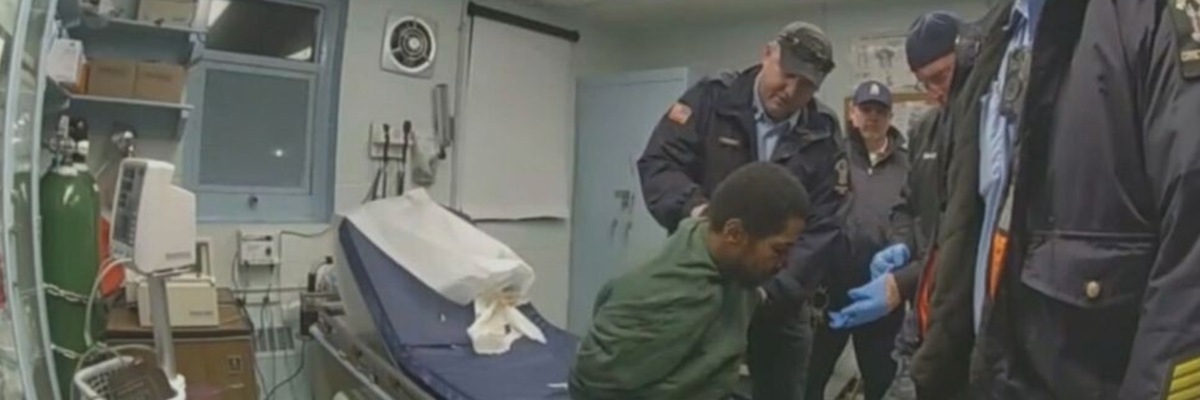
Robert Brooks was pronounced dead on December 10, 2024, the day after he was beaten by several correctional officers at Marcy Correctional Facility in Oneida County, New York.
(Photo: screenshot)

Julia Conley
Dec 31, 2024
COMMON DREAMS

As family members and supporters held a vigil at Monroe County Jail in Rochester, New York, on Monday night, inmates in the prison cells above them flashed their lights on and off in solidarity with Robert Brooks, who suffered an apparently fatal beating at a facility more than 100 miles away earlier this month.

Body camera footage of Brooks being savagely beaten by 14 correctional officers and prison staffers at Marcy Correctional Facility was made public on Friday by New York Attorney General Letitia James.

The video, which was taken on December 9 from body cameras worn by four of the staffers, showed officers choking Brooks, one person kicking him and forcing him onto an exam table, one punching his upper body, and two officers dragging his limp body over across the room and trying to hoist him up against a window.


Brooks, who was 43, was pronounced dead the following day at a hospital. An autopsy report has not yet been released. A preliminary report from the medical examiner's office showed "concern for asphyxia due to compression of the neck as the cause of death, as well as the death being due to actions of another."

At the rally on Monday, his son, Robert Brooks Jr., said Brooks "had a loving, generous heart and a special concern for young people" and said the family's "deepest wishes are that my father's death will not be in vain."

"His killing must be a catalyst for change," he said.

Brooks' father also spoke at the vigil, decrying the actions of both the people who beat his son and of a nurse at the facility who, according to the video, stood by and watched while the beating took place.

"When you have taken the law officers' oath of honor, the Hippocratic oath, or the Florence Nightingale Pledge for nurses, but you participate or sit idly by smiling and chatting as if this was just another day at the office, while a man is being beaten to death, that's evil," he said. "Between 2016 and 2019, approximately 15,679 fathers, daughters, mothers, and sons died in state prisons. They say 47% died from illnesses—I don't believe it. After watching that video, there is nothing they can tell me that I will believe."

Brooks was more than halfway through serving a 12-year sentence for assault, which he had been serving at nearby Mohawk Correctional Facility. He was moved to Marcy on the day of the attack, The New York Timesreported.

The Correctional Association of New York, the state's independent prison watchdog, completed a report on Marcy in 2022, finding that 70% of inmates reported racial bias among staff members. Brooks was Black and the officers in the video—like 91% of the prison's staff members, according to the 2022 report—were white.

Four out of five inmates reported having experienced or witness abuse my correctional officers or other staffers, with one saying physical abuse was "rampant" and reporting that an officer had told him Marcy was "a hands-on facility."

The Timesreported on Saturday that at least three of the guards implicated in Brooks' beating had previously been named in federal lawsuits filed by inmates who they attacked; one plaintiff was left using a wheelchair after the beating and another was disfigured.

Elizabeth Mazur, an attorney who is representing Brooks' family, told Rochester-based CBS affiliate that the reports about the officers raise "questions about you know whether there's a real cultural problem that's been allowed to fester at Marcy or sort of within the prison system in general."


"The way that Mr. Brooks was killed is just horrifying," she said. "It's terrible enough to lose a loved one, especially an incarcerated loved one when the family knows that they weren't with them during their final moments, but I think it's especially hard to know that you've lost a loved one this way—to this kind of senseless act of violence."

The family is planning to file a civil lawsuit in the future, Mazur said.

Rallies were also held to demand justice for Brooks in New York City, with supporters gathering outside Gov. Kathy Hochul's office.


"We are not going to sit down and just pray, and just hope," said Rev. Kevin McCall, a community activist. "We are demanding that every single person, every single thug, that had anything to do with the death of Robert Brooks be fired and arrested."

The New York State Department of Corrections and Community Supervision said Monday that 13 people involved in the attack have been suspended without pay, while one person has resigned.


HAPPY NEW YEAR

'Historic': NC Gov. Cooper Commutes 15 Death Sentences

Calling Cooper "courageous," executive director of the state's ACLU noted that with this decision, the Democrat "has commuted more death sentences than any governor in North Carolina's history."


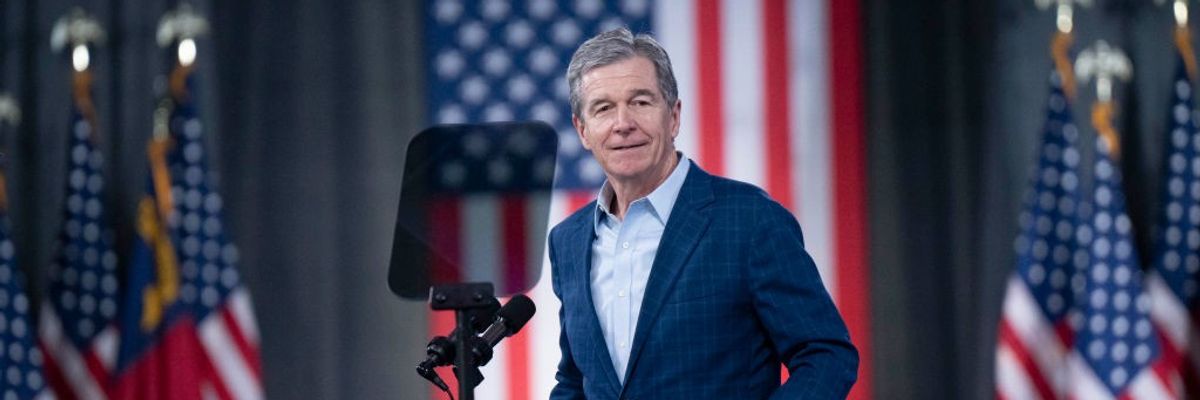
Democratic North Carolina Gov. Roy Cooper speaks before U.S. President Joe Biden arrives at a campaign rally in Raleigh on June 28, 2024.
(Photo: Allison Joyce/Getty Images)

Jessica Corbett
Jan 01, 2025
COMMON DREAMS

Death penalty abolitionists are praising former North Carolina Gov. Roy Cooper for one of his final actions in office: The Democrat on Tuesday commuted the sentences of 15 men on death row to life in prison without the possibility of parole.

Term-limited Cooper—who passed the torch to Democratic Gov. Josh Stein on Wednesday after eight years in office—announced the decision following a campaign by racial justice advocates and outgoing President Joe Biden's decision last week to commute the sentences of 37 people on federal death row to counter an expected killing spree under President-elect Donald Trump.

Although no executions have occurred in North Carolina in nearly two decades due to ongoing litigation, Cooper received clemency petitions from 89 of the 136 people on death row in the state, according to his office. After reviewing each case, the governor—who previously served as the state's attorney general for 16 years—granted 15.

"These reviews are among the most difficult decisions a governor can make, and the death penalty is the most severe sentence that the state can impose," Cooper said in a statement. "After thorough review, reflection, and prayer, I concluded that the death sentence imposed on these 15 people should be commuted, while ensuring they will spend the rest of their lives in prison."


Welcoming the announcement, Chantal Stevens, executive director of ACLU of North Carolina, said that "with this action, Gov. Cooper has commuted more death sentences than any governor in North Carolina's history and joins the ranks of a group of courageous leaders who used their executive authority to address the failed death penalty."

"We have long known that the death penalty in North Carolina is racially biased, unjust, and immoral, and the governor's actions today pave the way for our state to move towards a new era of justice," Stevens continued. "This historic decision, following President Biden's decision to commute the sentences of 37 people on federal death row, reflects growing recognition that the death penalty belongs in our past, not our future."

"With 121 people still on death row in our state, we know there is much more work to be done to realize that vision, and the ACLU of North Carolina will continue to advocate for the end of the death penalty once and for all," she added.


Stevens' group as well as the national ACLU's Capital Punishment Project, the Center for Death Penalty Litigation (CDPL), the Legal Defense Fund (LDF), and Durham attorney Jay H. Ferguson have represented Hasson Bacote, who brought the lead case challenging the death penalty under North Carolina's Racial Justice Act (RJA).

Bacote, a 38-year-old Black man convicted of first-degree murder in Johnston County in 2009, was among those who had their sentences commuted on Wednesday. According to Cooper's office, the other 14 men are:Iziah Barden, 67, convicted in Sampson County in 1999;
Nathan Bowie, 53, convicted in Catawba County in 1993;
Rayford Burke, 66, convicted in Iredell County in 1993;
Elrico Fowler, 49, convicted in Mecklenburg County in 1997;
Cerron Hooks, 46, convicted in Forsyth County in 2000;
Guy LeGrande, 65, convicted in Stanly County in 1996;
James Little, 38, convicted in Forsyth County in 2008;
Robbie Locklear, 52, convicted in Robeson County in 1996;
Lawrence Peterson, 55, convicted in Richmond County in 1996;
William Robinson, 41, convicted in Stanly County in 2011;
Christopher Roseboro, 60, convicted in Gaston County in 1997;
Darrell Strickland, 66, convicted in Union County in 1995;
Timothy White, 47, convicted in Forsyth County in 2000; and
Vincent Wooten, 52, convicted in Pitt County in 1994.

"We are thrilled for Mr. Bacote and the other... people on death row who had their sentences commuted by Gov. Cooper today," said Cassandra Stubbs, director of the ACLU's Capital Punishment Project. "This decision is a historic step towards ending the death penalty in North Carolina, but the fight for justice does not end here. We remain hopeful that the court will issue a ruling under the state's Racial Justice Act in Mr. Bacote's case that we can leverage for relief for the many others that still remain on death row."

The North Carolina General Assembly passed the RJA, which barred seeking or imposing the death penalty based on race, in 2009. Although state legislators then repealed the law in 2013, the North Carolina Supreme Court ruled in 2020 that those who had already filed claims under it should still receive hearings.

Bacote's evidentiary hearing began last February, and the court heard closing arguments in August. LDF senior counsel Ashley Burrell noted Tuesday that "the RJA hearing demonstrated that racial bias infiltrates all death penalty cases in North Carolina, not just Mr. Bacote's and those in Johnston County."

Shelagh Kenney, deputy director of the Durham-based CDPL, similarly said that "Mr. Bacote brought forth unequivocal evidence, unlike any that’s ever been presented in a North Carolina courtroom, that the death penalty is racist."

"Through years of investigation and the examination of thousands of pages of documents, his case revealed a deep entanglement between the death penalty and North Carolina's history of segregation and racial terror," Kenney added. "We are happy Mr. Bacote got the relief he deserves, and we hope Gov. Cooper's action will be a step toward ending North Carolina's racist and error-prone death penalty for good."


NC Newslinereported that "the commutations came as inmates in North Carolina face a ticking clock on the death penalty, which has been on hold for nearly 20 years amid challenges to the punishment's legality. Should the courts in North Carolina rule against those challenges, executions could resume with haste, as dozens of the state's death row inmates have exhausted all other avenues for appeal."

Separately on Tuesday, Cooper announced commutations for 54-year-old Brian Fuller, who has served 27 years after being convicted of second-degree murder in Rockingham County, and 63-year-old Joseph Bromfield, 63, who has served 34 years after being convicted of first-degree murder in Cumberland County. They will both become parole eligible immediately.

Cooper also pardoned 43-year-old Brandon Wallace, who was convicted of conspiracy to traffic cocaine and marijuana in Lee County in 2007, and 53-year-old John "Jack" Campbell, who was convicted of selling cocaine in Wake County in 1984


The decisions capped off Cooper's two terms as governor, during which he often had to contend with Republicans' veto-proof legislative majorities. Due to that experience, the Democrat frequently faces speculation that he may pursue federal office.

"If you're going to run for public office again, you must have your heart and soul in it, you must have the fire in the belly," Cooper toldThe Associated Press in December, explaining that he plans to spend the next few months considering his future. "I'm going to think about how I can best contribute to the things that I care about."


Medicare for All Tops Sanders' Prescription to 'Make America Healthy Again'

"Our real problem is not so much a healthcare crisis as it is a political and economic one," he wrote in an op-ed.


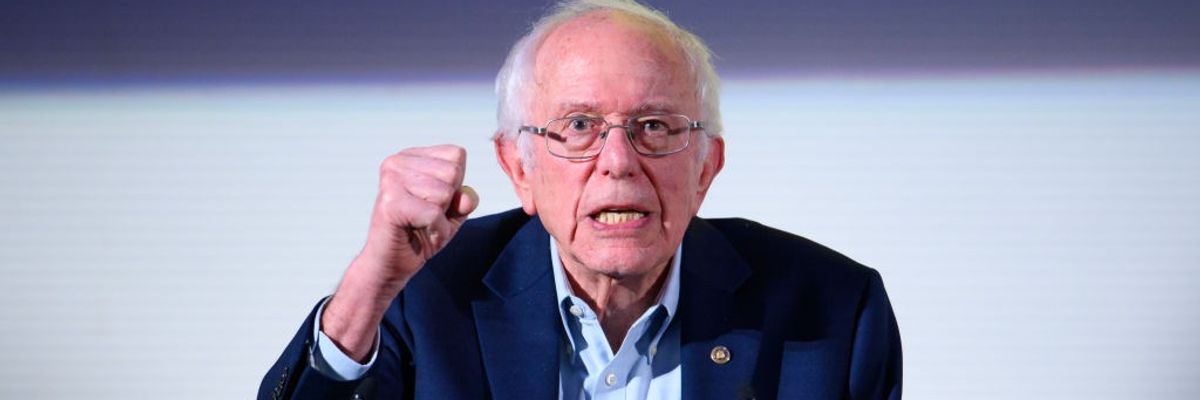
Sen. Bernie Sanders (I-Vt.) attends the event "Bernie Sanders: It's OK To Be Angry About Capitalism" at Royal Geographical Society on February 22, 2024 in London, England.
(Photo: Joe Maher/Getty Images For Fane)

Olivia Rosane
Jan 01, 2025
COMMON DREAMS

Independent Vermont Sen. Bernie Sanders has an ambitious New Year's resolution: a nine-point policy proposal to "Make American Healthy Again" by reforming the United States' "broken and dysfunctional healthcare system."

In an op-ed published in The Guardian on Tuesday, Sanders said his ideas were informed by his time serving as the chair of the U.S. Senate's Health, Education, Labor, and Pensions Committee, which will end in 2025.

"We are the wealthiest nation on Earth," Sanders wrote. "There is no rational reason as to why we are not the healthiest nation on Earth. We should be leading the world in terms of life expectancy, disease prevention, low infant and maternal mortality, quality of life, and human happiness. Sadly, study after study shows just the opposite. Despite spending almost twice as much per capita on healthcare, we trail most wealthy nations in all these areas."

"Working-class Americans live far shorter lives than the rich because of the stress of trying to survive on a paycheck-to-paycheck existence."

Sanders first prescription for a healthier nation? Medicare for All.

"Healthcare is a human right," Sanders argued. "The function of a rational healthcare system is to guarantee quality healthcare to all, not huge profits for the insurance industry. The United States cannot continue to be the only wealthy nation that does not provide universal healthcare."

The other eight reccomendations on Sanders' list are:Lower the cost of prescription drugs;
Paid family and medical leave;
Reform the food industry;
Raise the minimum wage to a living wage;
Lower the workweek to 32 hours with no loss of pay;
Combat the epidemic of loneliness, isolation, and mental illness;
Address the climate and environmental crisis; and
Create a high-quality public education system.

Sanders also sent the list in an email to supporters on December 27 with the introduction, "Here's a New Year's resolution" and tweeted out the first six proposals in a statement on December 24.


The Vermont senator's renewed call for Medicare for All comes as the assassination of UnitedHealthcare CEO Brian Thompson last month—and the explosion of anti-insurance industry dark humor it sparked—has highlighted persistent flaws in the country's private health-insurance system.

In the aftermath of the killing and the online response, Sanders called for a political movement to reform the nation's healthcare system.

"Killing people is not the way we're going to reform our healthcare system," he said at the time. "The way we're going to reform our healthcare system is having people come together and understanding that it is the right of every American to be able to walk into a doctor's office when they need to and not have to take out their wallet."

Sanders' agenda is also a clear rejoinder to Trump supporter Robert F. Kennedy Jr.'s Make America Healthy Again (MAHA) campaign. Kennedy, who President-elect Donald Trump has tapped to lead the Department of Health and Human Services, has a record of pushing dangerous health-related conspiracy theories, in particular by questioning the effectiveness and safety of vaccines. While Kennedy has voiced criticisms of the food, agriculture, and chemical industries shared by many environmentalists, he has also advocated for harmful practices such as drinking raw milk and downplayed the climate emergency.

Trump has signaled that any environmental policies Kennedy might implement during his administration would take a backseat to his commitment to Big Oil.

"Bobby, stay away from the liquid gold," he said in his election night victory speech. "Other than that, go have a good time, Bobby."

Sanders, in contrast, made tackling the climate emergency one of his priorities and called out the fossil fuel industry specifically.

"The fossil fuel industry cannot be allowed to continue making us sick, shortening our lives, and destroying the planet," he wrote Tuesday.

He also emphasized working conditions as a public health issue.

"Working-class Americans live far shorter lives than the rich because of the stress of trying to survive on a paycheck-to-paycheck existence," he wrote in his call for a higher minimum wage.

In general, Sanders argued that it was not possible to tackle health without tackling corporate power.

"Our real problem is not so much a healthcare crisis as it is a political and economic one," he wrote in The Guardian. "We need to end the unprecedented level of corporate greed we are experiencing. We need to create a government and economy that works for all and not just the wealthy and powerful few."

In his email to supporters, Sanders spoke even more directly about the need to "take on powerful special interests who make billions in profits by making us sick and shortening our lifespans."

He portrayed wealthy individuals and corporations as the force ultimately standing in the way of a healthier nation.

"The truth is that their ideology of greed requires them to want more, and more, and more. And if that greed makes us sicker or shortens our lives, that's the price they require us to pay," he wrote. "But we say NO. We are fighting back. We can and will create a government and economy that works for all, and not just the few. We can and will create a society which enhances human health and well-being, and not the wealth and power of the billionaire class."


ICYMI

In Blow to Open Internet, Federal Appeals Court Strikes Down Biden FCC's Net Neutrality Rules

The ruling creates a "dangerous regulatory gap that leaves consumers vulnerable and gives broadband providers unchecked power over Americans’ internet access," said one advocate.


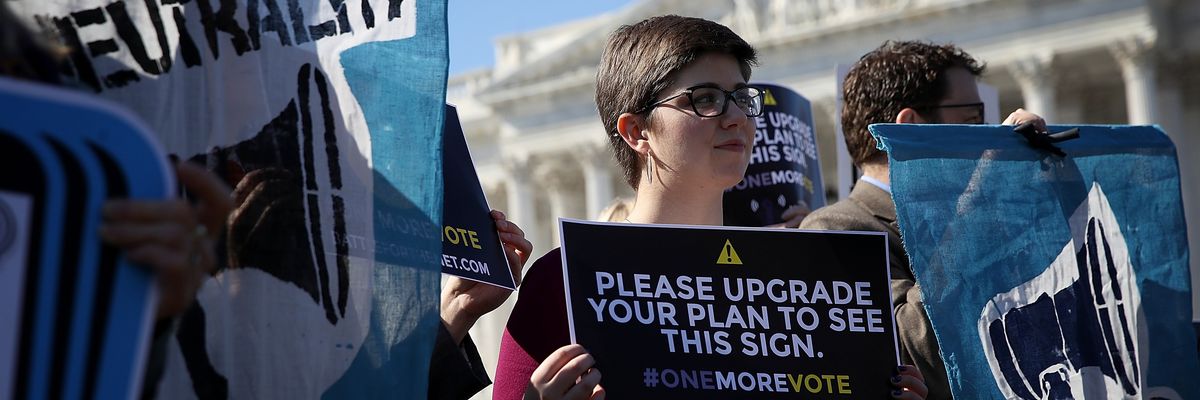
Proponents of an open and unregulated internet attend a news conference at the U.S. Capitol February 27, 2018 in Washington, D.C.
(Photo: Win McNamee/Getty Images)


Julia Conley
Jan 02, 2025
COMMON DREAMS


Citing last year's U.S. Supreme Court decision that stripped federal agencies of their regulatory powers, an all-Republican panel on the U.S. Court of Appeals for the 6th Circuit on Thursday ruled that the Federal Communications Commission lacks the authority to reinstate net neutrality rules.

The panel ruled that broadband is an "information service" instead of a "telecommunications service," which is more heavily regulated under the Communications Act, and said the FCC did not have the authority to prohibit telecommunications companies from blocking or throttling internet content and creating "fast lanes" for certain web companies that pay a fee.

Last April the FCC voted to reinstate net neutrality rules, which were first introduced under the Obama administration but were repealed by former Republican FCC Chair Ajit Pai, who was appointed by President-elect Donald Trump.


The ruling cited by the 6th Circuit panel was Loper Bright Enterprises v. Raimondo, which overturned the so-called Chevron doctrine last year. Under the decades-old legal precedent, judges have typically deferred to federal agencies' reasonable interpretation of a law if Congress has not specifically addressed an issue.

"Applying Loper Bright means we can end the FCC's vacillations" between imposing and repealing net neutrality rules, said the judges on Thursday.


The ruling serves as "a reminder that agencies are going to be neutered across any and all industries," said one observer.


John Bergmayer, legal director for the free expression and digital rights group Public Knowledge, said that by "rejecting the FCC's authority to classify broadband as a telecommunications service, the court has ignored decades of precedent and fundamentally misunderstood both the technical realities of how broadband works and Congress' clear intent in the Communications Act."

The ruling creates a "dangerous regulatory gap that leaves consumers vulnerable and gives broadband providers unchecked power over Americans’ internet access," added Bergmayer. The decision could harm the FCC's ability to protect against everything from broadband privacy violations to threats to universal service programs for low-income and rural households.

Matt Wood, vice president of policy and general counsel for another media justice group, Free Press, said the ruling was "just plainly wrong at every level of analysis."

"In April, the FCC issued an order that properly restored the agency's congressionally granted oversight authority to protect people from any [internet service provider] discrimination and manipulation. That commonsense FCC order tried to ensure that the companies providing America with the essential communications service of this century don't get to operate free from any real oversight," said Wood.

Companies and industry groups that sued over the regulations, including the Ohio Telecom Association, "baselessly claim that any regulation will hurt their bottom line," Wood added. "Treating broadband like a common-carrier service does nothing to dampen or dissuade private investment in this crucial infrastructure. And the question for any court interpreting the Communications Act must be what is in the public's best interest, not just one industry sector's financial interests."

The groups, along with FCC Chair Jessica Rosenworcel, called on Congress to take legislative action to protect internet users and small web businesses from discrimination.

"Consumers across the country have told us again and again that they want an internet that is fast, open, and fair. With this decision it is clear that Congress now needs to heed their call, take up the charge for net neutrality, and put open internet principles in federal law," Rosenworcel said.

Congress must "clarify the FCC's authority—and responsibility—to protect the Open Internet and broadband users," said Bergmayer.

Bergmayer also noted that the ruling leaves states' ability to enforce their own net neutrality laws in place, and said the group "will continue to look to states and local governments to help lead on broadband policy."
  BANKS BEHAVING BADILY  

Morgan Stanley Latest Wall Street Giant to Ditch Net-Zero Coalition


Earlier this week, Bank of America and Citigroup also said they were leaving the Net-Zero Banking Alliance.


Morgan Stanley offices at Canary Wharf financial district on 5th November 2024 in London, United Kingdom.
(photo: Mike Kemp/In Pictures via Getty Images)

Eloise Goldsmith
Jan 02, 2025
COMMON DREAMS

On Thursday, the Wall Street titan Morgan Stanley became the latest financial institution to leave the Net-Zero Banking Alliance, a United Nations-convened group of banks committed to "aligning their lending, investment, and capital markets activities with net-zero greenhouse gas emissions by 2050."

The defections keep piling up. Earlier this week, Bank of America and Citigroup said they were leaving the alliance, and earlier in December Goldman Sachs Group and Wells Fargo announced they were doing the same.


“We will continue to report on our progress as we work towards our 2030 interim financed-emissions targets,” Morgan Stanley toldBloomberg in an email.

While Morgan Stanley didn't offer an explanation for the exit, according to Reuters, financial firms have repeatedly found themselves in the crosshairs of some members of the GOP who argue that corporate efforts to limit fossil fuels run afoul of antitrust law.

Last summer, the Republican members of the House Judiciary Committee published a report accusing financial institutions colluding to impose "radical environmental, social, and governance (ESG) goals on American companies." Their probe was largely focused on another climate group, Climate Action 100+, which is made up of financial institutions who strive to engage companies they invest in on climate issues. That coalition has also experienced a number of defections.

In December, 11 GOP-led states sued three asset managers in federal court, arguing that the firms had "artificially constrained the supply of coal, significantly diminished competition in the markets for coal, increased energy prices for American consumers, and produced cartel-level profits" for the firms in violation of antitrust law.

Despite the stated goals of the Net-Zero Banking Alliance, Morgan Stanley and other firms who are a part of the alliance have remained a major financial life lines for fossil fuel companies.

According to a report published by a group of NGOs in 2023, 56 of the largest banks in the Net-Zero Banking Alliance—including Morgan Stanley—have provided nearly $270 billion in the form of loans and underwriting to more than 100 "major fossil fuel expanders," from Saudi Aramco to ExxonMobil to Shell.


Aid Coalition Warns Millions of Civilians at Risk as Israel and US Bomb Yemen

"It is civilians in Yemen who pay the ultimate costs," humanitarian groups warned following a flurry of airstrikes by Israel and the United States.


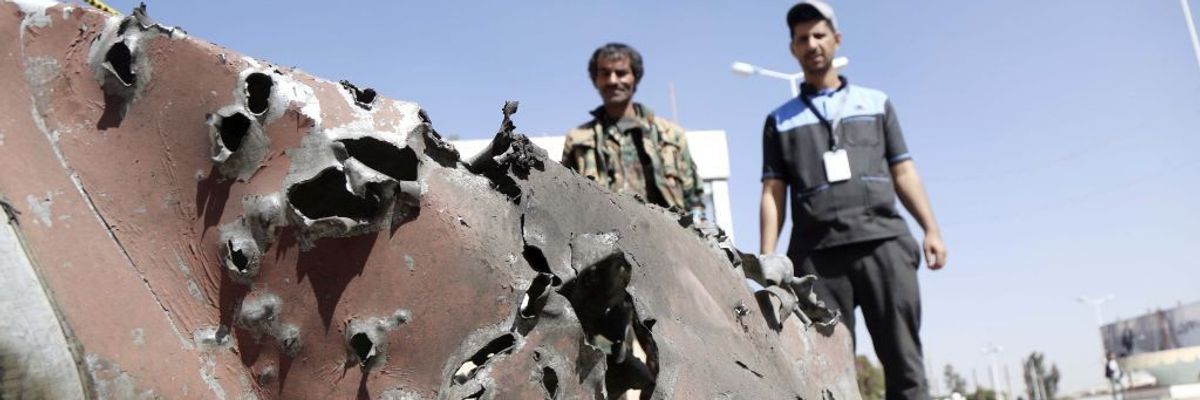
Damage is pictured at Sana'a International Airport following an Israeli airstrike on December 27, 2024.
Photo by Mohammed Hamoud/Anadolu via Getty Images

Jake Johnson
Jan 01, 2025
COMMON DREAMS

Dozens of humanitarian aid groups warned Tuesday that millions of Yemeni civilians are in danger as Israel and the United States carry out new airstrikes on the impoverished country, which is already ravaged by years of sustained attacks from a U.S.-backed Saudi-led coalition.

The aid groups said in a joint statement that they are "deeply concerned about the airstrikes on critical civilian infrastructure, including Sanaa International Airport, power stations in Sanaa and Hodeidah Governorates, and seaports in and near Hodeidah"—a reference to Israeli strikes on December 26.

"These attacks on vital infrastructure serve as a stark reminder of the importance of respecting international humanitarian law, particularly the need to protect critical civilian air and maritime gateways that are indispensable to the survival of millions of Yemenis," the groups said, noting that the airport Israel targeted is "a much-needed delivery point for humanitarian aid in a country where around half of the population (anticipated to rise from 18 million to 19.5 million people in 2025) are in need of assistance—77% of whom are women and children."

"We call on all actors to adhere to international humanitarian law, to ensure the protection of civilian infrastructure that provide critical essential services indispensable for the survival of millions of civilians in Yemen. The consequences of attacks on civilian facilities will be severe and long-lasting for Yemeni civilians, already suffering exhaustion from a decade-long conflict," the groups continued. "We further urge every actor to de-escalate, recognizing that it is civilians in Yemen who pay the ultimate costs."

The coalition's statement came on the same day the U.S. military carried out airstrikes on Yemen, characterizing the attacks as part of an "effort to degrade Iran-backed Houthi efforts to threaten regional partners and military and merchant vessels in the region."

Some progressive members of the U.S. Congress have argued that the Biden administration's repeated attacks on Yemen without congressional authorization are illegal. U.S. President Joe Biden admitted last January that American airstrikes in Yemen have not successfully deterred Houthi rebels from attacking vessels in the Red Sea—but said the strikes would continue regardless.

Israel, for its part, pledged to inflict a "miserable fate" on the Houthis in response to the group's recent drone and ballistic missile attacks.

Mohammed Abdulsalam, a spokesperson for the Houthis, said Tuesday that the latest flurry of U.S. strikes represent "a blatant violation of the sovereignty of an independent state, and blatant support for Israel to encourage it to continue its crimes of genocide against the people of Gaza."

Drop Sitereported that across Yemen, people view the U.S. and Israeli attacks "as primarily harming civilians," echoing the concerns of aid groups.

"This attack harms no one but the people and their livelihoods," said Hodeidah resident Muhammad Alwi.
Now 'Things Get Much Worse': Palestinian Rights Movement Under Threat as Trump Returns

"This administration will likely be coming very quickly to try to take down the Palestinian rights movement," said a Jewish Voice for Peace Action leader.


Demonstrators march toward the Trump International Hotel & Tower demanding an end to Israeli attacks on the Gaza Strip after the presidential election in Chicago, Illinois, on November 6, 2024.

(Photo: Jacek Boczarski/Anadolu via Getty Images)

Jessica Corbett
Jan 02, 2025
CPMMPN DREAMS

Victims of violence by U.S.-armed Israeli forces and advocates for Palestinian rights across the United States are sounding the alarm over Republican President-elect Donald Trump's looming return to the White House and GOP control of Congress.

President Joe Biden, Vice President Kamala Harris, and the divided 118th Congress have faced intense criticism for giving Israel diplomatic and weapons support to kill at least 45,581 Palestinians in the Gaza Strip over the past 15 months and attack Lebanon, Syria, and Yemen. The outgoing Democratic administration and lawmakers have also faced backlash for their response to anti-war protests, particularly on U.S. university campuses, some of which were met with police brutality.

However, recent reporting in the United States and Israel has highlighted fear about promises from Trump and his Republican Party that, as the Israeli newspaper Haaretzput it last week, a "quick and complete" crackdown "on pro-Palestinian sentiment in America will be a defining factor of his administration's early days."

"The Palestinian rights movement is very clear-eyed in understanding that it is very likely that this Trump administration will mean that things get much worse for Palestinians."

Beth Miller, political director of the advocacy group Jewish Voice for Peace Action, toldPolitico on Wednesday that "the Palestinian rights movement is very clear-eyed in understanding that it is very likely that this Trump administration will mean that things get much worse for Palestinians."

"This administration will likely be coming very quickly to try to take down the Palestinian rights movement," Miller added.

Leaders with the Adalah Justice Project and Arab American Institute also noted concerns about efforts to silence advocates and even dismantle organizations—some of which are already underway. In November, 15 House Democrats joined all but one Republican in voting for the so-called Terror-Financing and Tax Penalties on American Hostages Act (H.R. 9495).

The legislation would enable the U.S. Treasury Department to revoke the tax-exempt status of any nonprofit it deems a "terrorist-supporting organization" without due process. Advocates for various causes have condemned what they call the "nonprofit killer bill."

Although H.R. 9495 never made it through the Democrat-held Senate, Republicans are set to take over the chamber on Friday. The GOP will also retain control of the House, which during this session has repeatedly voted to conflate criticism of Israel with antisemitism, or discrimination against Jews.

In addition to likely facing a new wave of legislative attacks—potentially spearheaded by GOP leaders like incoming House Foreign Affairs Committee Chair Brian Mast (R-Fla.), a U.S. military veteran who has volunteered with the Israel Defense Forces and denied the existence of "innocent Palestinian civilians"—rights advocates in the United States could be targeted by key officials in the next Trump administration.

As Haaretz recently detailed, former Florida Attorney General Pam Bondi, Trump's second choice to lead the U.S. Department of Justice (DOJ); Sen. Marco Rubio (R-Fla.), his nominee for secretary of state; and Rep. Elise Stefanik (R-N.Y.), his candidate for ambassador to the United Nations, have expressed support for deporting pro-Palestinian protesters who have student visas.

Although former federal prosecutor Kash Patel, Trump's pick to direct the Federal Bureau of Investigation, "doesn't have much of a record on campus protests, he is most notorious for his desire to remove any of Trump's critics and doubters from the national security apparatus," the newspaper noted. "Further, Patel's experience as the National Security Council's senior director of counterterrorism during Trump's first term positions him to crack down on pro-Palestinian sympathizers."


Haaretz also highlighted comments from Harmeet Dhillon, Trump's pick to lead the DOJ's Civil Rights Division, and Linda McMahon, his nominee for education secretary, as well as Project Esther: A National Strategy to Combat Antisemitism—an October proposal from the Heritage Foundation, the right-wing think tank that is also behind the sweeping Project 2025 policy agenda.

"The virulently anti-Israel, anti-Zionist, and anti-American groups comprising the so-called pro-Palestinian movement inside the United States are exclusively pro-Palestine and—more so—pro-Hamas," states the Project Esther report. "They are part of a highly organized, global Hamas Support Network (HSN) and therefore effectively a terrorist support network."

Two co-chairs of the Heritage-backed National Task Force to Combat Antisemitism, James Carafano and Ellie Cohanim, wrote earlier this week at the Washington Examiner that "Project Esther is a blueprint to save the U.S. from those utilizing antisemitism to destroy it."

"The objective is to dismantle the infrastructure by denying it the resources required for its antisemitic activity," they argued. "Targeting the groups and organizations that receive the funding and deploy it to their grassroots followers who engage in antisemitic activity, the useful idiots we see on college campuses, for example, will divorce the means from the opportunity, thereby rendering these activists incapable of threatening U.S. citizens."

Posting the piece on X—the social media platform owned by billionaire Trump ally Elon Musk—Carafano declared that "when Donald Trump starts to take on the global intifada he will need partners. We will need to be there."
Outrage Over Global 'Silence' as Israel Continues Ethnic Cleansing in Gaza

"History will reveal those who spoke out against this genocide, and those who did not," said one rights group.

A Palestinian medic carries an injured child from an ambulance to Al-Ahli Baptist Hospital for treatment following an Israeli attack on the Shuja'iyya neighborhood in Gaza City, Gaza on January 1, 2025.
(Photo: Dawoud Abo Alkas/Anadolu via Getty Images)


Julia Conley
Jan 02, 2025
COMMON DREAMS

A pediatrician working in Gaza was among those on Thursday who condemned "how deaf the world has become to repeated cries" from people in the enclave as Israel continues its assault and humanitarian aid blockade, which has plunged parts of Gaza into famine conditions, according to experts.

"I'm watching children die in every possible way whether it's violence, cold, hunger, disease—all directly as a consequence of a carefully orchestrated Israeli military campaign that has been enabled by the United States and other countries that are turning a deaf ear and blind eye," Dr. Tanya Haj-Hassan toldAl Jazeera.

At least seven infants have died of hypothermia in the enclave in recent days, their families among 1.9 million people who have been forcibly displaced by Israel's bombardment of Gaza. With 92% of housing units destroyed or damaged, people across Gaza have resorted to living in makeshift tents that don't protect them from wind, heavy rain, and cold nighttime temperatures.

"I struggle for words to describe how horrific the situation has become and how deaf the world has become to repeated cries from humanitarian workers, and mostly from Gazans themselves," said Haj-Hassan. "They have documented on a daily basis their own genocide and have been killed for doing so."

Paula Gil, president of the Spanish chapter of Doctors Without Borders or Médecins Sans Frontières (MSF), said Israel's U.S.-backed assault has reduced Gaza to "a death trap."

"This does not happen in a vacuum. The hypocrisy and complicity of Israel's allies is allowing the social fabric of Gaza to be destroyed with impunity."

"Families are surviving in makeshift shelters made of wood, plastic, and mattresses," she told Al Jazeera. "Now the cold and the storms have arrived. How will they face the winter in these conditions?"

Haj-Hassan's and Gil's comments came as Israel bombed the coastal area of al-Mawasi, a so-called "humanitarian zone" that has nevertheless been attacked by the Israel Defense Forces numerous times. At least 63 Palestinians were killed in attacks across Gaza on Thursday, including 12 in al-Mawasi.

A report by the Palestinian Central Bureau of Statistics (PCBS) on Wednesday showed that around 100,000 Gaza residents have left the enclave since Israel began its assault in October 2023 and more than 45,000 people have been killed, while 10,000 are missing and presumed dead.

Those statistics mean that the population of Gaza is down 6% since Israel's current escalation started.

Israel, said the PCBS, has "raged a brutal aggression against Gaza targeting all kinds of life there; humans, buildings, and vital infrastructure... Entire families were erased from the civil register. There are catastrophic human and material losses."

Human rights groups have said Israel's relentless bombardment of Gaza and its recent ground offensive in northern Gaza—where Israeli military leaders seek to execute the so-called Generals' Plan to forcibly displace everyone in the area and kill anyone who remains through starvation or other means—amounts to ethnic cleansing.

"As the world watches in silence, the far-right government of indicted war criminal [Israeli Prime Minister] Benjamin Netanyahu is carrying out its intentional campaign of slaughter, mass destruction, forced starvation, and ethnic cleansing in Gaza," said the Council on American Islamic Relations. "History will reveal those who spoke out against this genocide, and those who did not."

The U.S. government—the largest international funder of the Israel Defense Forces, has continued to give political and material support to Israel as it has bombarded and blockaded Gaza, making more than 100 weapons transfers to the Israeli government.


"This does not happen in a vacuum," said Gil. "The hypocrisy and complicity of Israel's allies is allowing the social fabric of Gaza to be destroyed with impunity... There is no future. There is no hope. In Gaza, humanity is being destroyed and we cannot look away."

Gaza hospital chief held by Israel becomes face of crumbling healthcare

Gaza Strip (Palestinian Territories) (AFP) – Israel's raid on a major Gaza hospital and the arrest of its director over alleged links to Hamas have drawn global attention to the war-ravaged territory's crumbling healthcare system.

Kamal Adwan hospital chief, Hossam Abu Safiyeh, checking an injured child on October 24, 2024 amid the ongoing war in Gaza © - / AFP

 31/12/2024 - 

For weeks, as fighting escalated around the Kamal Adwan Hospital in northern Gaza's Beit Lahia area, its head Hossam Abu Safiyeh made desperate appeals to the international community to intervene and stop the violence "before it is too late".

In the early hours of Friday, the Israeli military launched a major raid on the hospital, describing it as "one of the largest operations" it had conducted since the war in Gaza broke out in October last year.

The raid ended a day later, with the military announcing that it killed more than 20 militants and arrested over 240, including Abu Safiyeh on suspicion of "being a Hamas operative".

Since then, the whereabouts of the 51-year-old paediatrician have been unknown.

The World Health Organisation has said Kamal Adwan hospital has been out of service ever since, a massive blow to the healthcare system in northern Gaza, where tens of thousands live under ongoing Israeli bombardment.

His family believes he is being detained at the Sde Teiman military base in the Negev desert, near Gaza.

'Deadly attacks'


"This detention centre is notorious for the mistreatment of prisoners," his son, Idris Abu Safiyeh, said in a video message on Monday evening.

"We have received testimonies from released detainees who reported that he was subjected to humiliation and abuse," he said. "He was reportedly forced to strip".

Despite repeated attempts by AFP, the Israeli military has declined to specify Abu Safiyeh's location. It has also not responded to allegations of his abuse.

Several other medical staff of Kamal Adwan Hospital were detained in the raid as well.

"There is no justification for these arrests other than a desire to destroy the healthcare system," Mahmud Bassal, spokesman for Gaza's civil defence agency, told AFP. He described the situation as "catastrophic and tragic."

On Tuesday, a United Nations report revealed that Israeli strikes on and near hospitals in Gaza have led to the near total collapse of the healthcare system in the Palestinian territory of 2.4 million people.

"Israel's pattern of deadly attacks on and near hospitals in Gaza, and associated combat, pushed the healthcare system to the brink of total collapse, with catastrophic effect on Palestinians' access to health and medical care," the UN human rights office said in a statement.

'Hero in a white robe'


Israeli officials have repeatedly accused Hamas of using the territory's hospitals as command and control centres for launching attacks against Israeli forces.

Abu Safiyeh's family has urged the international community to pressure Israel for his prompt release -- and their message has resonated.

The World Health Organisation led by its chief, Tedros Adhanom Ghebreyesus, has called for the "immediate release" of the hospital director.

Rights group Amnesty International has echoed the call, saying Abu Safiyeh had been the "voice of Gaza's decimated health sector".

Healthcare professionals across the world have also urged for his release, rallying on social media under the hashtag #FreeDrHussamAbuSafiya.

He was praised as a "hero in a white robe" in several social media posts for continuing his work amid an intense Israeli military campaign in northern Gaza.

Since October 6, Israeli forces have intensified their land and sea assault on northern Gaza, saying it was aimed at preventing Hamas from regrouping there.

According to the US-based NGO MedGlobal, which employs him, Abu Safiyeh lost a teenage son in an Israeli air strike in late October, while he himself was injured in the leg days later.

From a hospital bed, he, however, declared in a video that the injury would not deter him from fulfilling his mission, "whatever the cost".

© 2024 AFP
Far-Right Israeli Lawmakers Demand 'Complete Cleansing' of Northern Gaza

The Knesset members are urging the Israeli military to destroy all sources of water, food, and energy—and to kill "anyone not flying a white flag of surrender." 

THEY HAVE KILLED THEIR OWN WAVING A WHITE FLAG


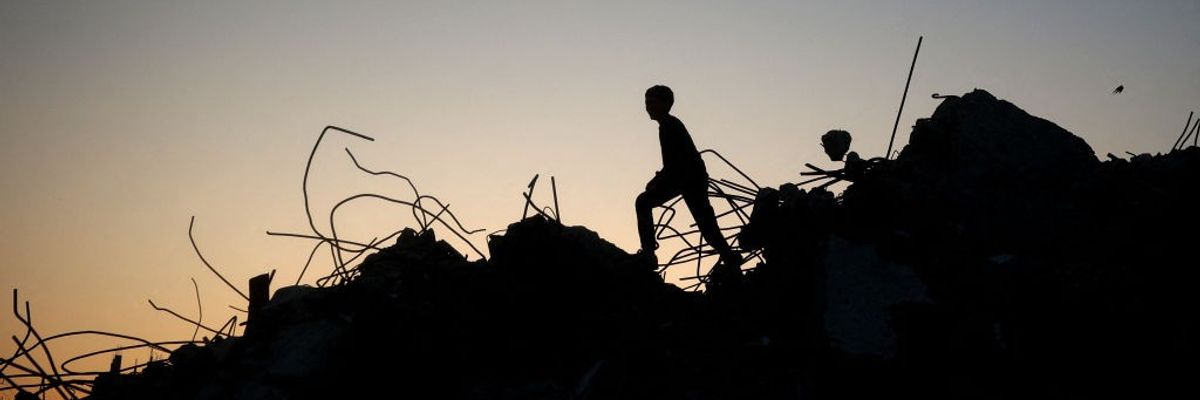
A Palestinian child plays amid the rubble of destroyed buildings at the Bureij refugee camp in Gaza, Palestine on January 2, 2025.
(Photo: Eyad Baba/AFP via Getty Images)

Brett Wilkins
Jan 03, 2025

At least seven far-right members of the Knesset, Israel's parliament, are calling on the country's defense minister to order the total destruction of northern Gaza's food, water, and energy sources—most of which have already been obliterated by 15 months of relentless attacks—and the killing of any Palestinian who isn't clearly surrendering to the attackers.

In a letter to Israeli Defense Minister Israel Katz dated December 31, the lawmakers assert that the Israel Defense Forces' (IDF) campaign to forcibly expel Palestinians from northern Gaza—which critics have called ethnic cleansing—"isn't being done properly" and is not "achieving the war objectives as defined by the government, which is the dismantling of Hamas' governing and military capabilities."

According to a translation by international humanitarian law expert Itay Epshtain on Thursday, the letter calls on the IDF to:Destroy all energy sources including fuel, solar systems, generators, and power lines;
Destroy all food sources including warehouses, water, and water pumps; and
Lay siege and remotely kill everyone not flying a white flag of surrender.

That last demand apparently includes men, women, and children. IDF troops would then "enter gradually for a complete cleansing of the enemy's nests," according to the letter.


Lawmakers who signed the letter and their party affiliations include: Avraham Bezalel (Shas), Amit Halevi (Likud), Limor Son Har-Melech (Jewish Power), Osher Shkalim (Likud), Zvi Sukkot and Ohad Tal (Religious Zionism), and Nissim Vaturi (Likud).

Vaturi, the deputy Knesset speaker, previously called for Gaza to be "wiped off the face of the Earth" and argued for Israel to "stop being humane" and "burn Gaza now," because "there are no innocents there."

Notably, the lawmakers' letter does not mention anything about freeing the more than 60 hostages believed to be alive and imprisoned by Hamas and possibly other groups in Gaza.

As Israeli journalist Bar Peleg reported Friday from the Jabalia refugee camp:
When the soldiers and officers in Jabalia are asked about their mission, the answer is destroying Hamas and its infrastructure, until the last terrorist is laid to rest. When they are asked, "And what about the hostages?" One soldier answered, "That concerns us, like it does everyone, but it isn't a part of our operational considerations."

Northern Gaza is already in ruins. As Peleg noted, "not a single habitable building remains" in Jabalia. Nearly all homes, hospitals, schools, and other infrastructure have been destroyed or damaged.

"Look at the extent of the destruction and annihilation here," one IDF officer said. "No one has done this before."

An IDF officer recently toldHaaretz that one commander, Brig. Gen. Yehuda Vach, seeks to personally execute the so-called Generals' Plan—a blueprint for the starvation and ethnic cleansing of Palestinians from northern Gaza—by besieging and expelling 250,000 Palestinians from the area. United Nations officials estimate that more than 100,000 Palestinians have been forced from northern Gaza, even as the IDF says it disavows the Generals' Plan.

IDF troops, Palestinian witnesses, international medical volunteers, and others have described alleged war crimes including the indiscriminate killings of Gazans of all ages throughout the embattled strip.

Israel's "complete siege" of Gaza has also caused the sickening and starvation of hundreds of thousands of Gazans. At least dozens of children and babies have died of malnutrition or hypothermia.


Israeli policies and actions, as well as written and spoken calls for the destruction of Gaza and its people, have been presented as evidence in the South African-led genocide case against Israel currently before the International Court of Justice in The Hague, Netherlands.

Israeli Prime Minister Benjamin Netanyahu and Yoav Gallant, his former defense minister who ordered the siege of Gaza, are fugitives from the International Criminal Court, which in November issued arrest warrants for the pair and Hamas leader Mohammed Diab Ibrahim Al-Masri.

Israel's 455-day bombardment, invasion, and siege of Gaza has left at least 165,000 Palestinians dead, maimed, or missing, according to officials there.