Thursday, April 03, 2025

 AU CONTRAIRE

Will Trump Keep His Promise to End the War in Ukraine?


Ironically, it was the US under President Trump which has broken with the US national security establishment’s bi-partisan strategy of incremental encirclement and escalation against Russia. That break offered Europe the opportunity to escape the trap created by its past lack of policy vision. Instead, Europe has proved plus royaliste que le roi (more royal than the King) and has remained loyal to the US national security Deep State.

— Thomas Palley

In her recent “Threat Assessment” testimony before the Senate Intelligence Committee, Director of Intelligence Tulsi Gabbard reasonably described Russia as a “formidable competitor.”  However, in keeping with Trump’s desire for improved diplomatic and economic relations with Moscow, she avoided the word “adversary.” And, in a thinly disguised reference to Biden’s “Ukraine Project,” Gabbard said that Russia has gained significant information about US intelligence and weapons from the Ukraine war. As for Biden’s plan to weaken or overthrow Putin, Gabbard concluded that the Russian leader “is presently less likely to be replaced than at any point in his quarter-century rule.” Gabbard’s assessment was considerably at odds with those under Biden, which referred to Russia’s “malign influence” and a threat to the United States and its allies. Most important is the conclusion that “This grinding war of attrition will lead to a steady erosion of Kyiv’s position on the battlefield, regardless of any U.S. or allied attempt to impose new and greater costs on Moscow.”  This is not an equivocal statement, and Trump surely knows it’s true.

One encouraging consequence of the report is that it leaves Democrats and liberals in the awkward position of supporting not just a lost cause but one that’s increasingly becoming known as a war provoked by the United States. Those who’ve long asserted that Ukraine was used as a proxy have been provided further vindication — as if any was needed — by the “expose” in the New York Timestitled “The Partnership: The Secret History of the War in Ukraine.” The roughly 13,000-word piece is “secret” only if one relies on the Times as their only source of information. In any event, the article details how American military and intelligence officers shaped Ukraine’s strategy.  Planning began with the US and Ukraine at a clandestine meeting in Wiesbaden, Germany, in 2022, a gathering known “only to a small circle of American and allied officials.” As the war progressed, “One European intelligence chief recalled being taken aback by how deeply enmeshed his N.A.T.O. counterparts had become in the Ukraine operation. They are part of the kill chain now.”

One surely unintended takeaway for the reader from the Times’ investigation is US hubris. According to the authors, the Biden administration provided everything to Ukraine but boots on the ground, and the effort was succeeding until the Spring of 2023. At that point, Ukrainian generals went rogue, became disobedient, and denied their US overlords a devastating victory over Russian forces. The latter are barely stick figures waiting to be chopped down by Ukrainian forces, who the omniscient American advisors have been giving every advantage.  Zelensky also receives his share of the blame because he was too obsessed with good PR to be an effective wartime leader.

Notably, none of the 300 (mostly anonymous) interviewees were Russian, so that perspective is absent. Not surprisingly, there’s neither a scintilla of remorse nor even a tacit admission of the price Ukrainians paid for allowing their country to be used by the United States in this manner.  Finally, one is forced to wonder whether this duplicitous account of the war will be the “blame game” narrative for the Democrats when the war is lost.

Checkmate in Ukraine isn’t imminent, but nothing can be done to prevent the loss of this US-initiated war.  Putin has a strong hand to play, and all indications point toward the conclusion that the longer the fighting continues, the more territory will fall to Russian advances. Whether Trump will be able to end the war remains an open question. We know that Starmer, Macron, Mertz (once he assumes the German chancellorship), and Zelensky all seek to sabotage peace. And in Kyiv, the Azov Battalion has morphed into the Third Army Brigade, and its leader is Andriy Biletsky, today’s Stephan Bandera. He and his Hitler-worshipping Nazi followers oppose any negotiations with Russia and will continue some rearguard action until they are finally vanquished.

Trump also faces strong opposition from neoliberal warhawks like Waltz and Rubio. I sense that if Trump wants an actual peace settlement—and I believe he does—he must instruct more capable and trustworthy negotiators that Moscow sees Ukraine as an existential threat and its demands are non-negotiable. Russia is clearly winning and continues to absorb more territory. Finally, I wouldn’t bet against Trump going back on his promise and walking away from the Ukraine Project, leaving the remaining parties to resolve matters.

Because the billionaire sector of the US ruling class behind Trump has a different world order in mind, the present iteration of European oligarchs find themselves up that proverbial creek without paddles. Trump isn’t even bothering to say, “Thank you for your service in fighting Russia” because he knows these vassals enthusiastically cooperated with a doom-to-fail war that killed well over a million soldiers. In a final desperate attempt to save themselves, Europe’s soon-to-be politically extinct vassals want Trump to give them a “security guarantee” before inserting their own “peacekeepers” into Ukraine. That will never happen

Some critics have employed words like delusional, crazy, and stupid to describe European leaders. However, it’s more accurate to say that these heads of state are so heavily invested in the fable, the fiction of the “Russian threat,” for over seventy years in order to maintain their junior accomplice role with Washington.  Thomas Palley argues they have become a “US foreign policy satrap, a condition which still endures.” These leaders are certainly not “stupid,” and they know that if the truth about the “Ukraine project” gains traction — and Trump seeks closer relations with Russia — suspicions will rise within the European public that Russophobia was manufactured and remains a hoax.

Finally, as I have argued in the past, what makes Ukraine so difficult to grasp is the edifice of lies, the false narrative about the “Russian threat” that is so pervasive in the popular mindset and used to disguise the actual motives behind US imperialism. Political scientist Michael Parenti once characterized this as “suppression by omission,” in this case, the entire context of the war in Ukraine.  We must use every means to bring those omissions to light.

Gary Olson is Professor Emeritus at Moravian College, Bethlehem, PA. Contact: glolson416@gmail.com. Per usual, thanks to Kathleen Kelly, my in-house ed. Read other articles by Gary.


NATO, More Militarism No Defense Against US Expansionists


Reprinted from Yves Engler’s website.

If you believe Donald Trump might invade you should be calling for Canada to withdraw from NATO. The alliance won’t defend Canada, has enabled US interference and gobbles up resources.

During a recent meeting with NATO Secretary General Mark Rutte, US President Donald Trump questioned the border and Canadian sovereignty. He said, “if you look at a map, they drew an artificial line right through it, between Canada and the U.S. … somebody did it a long time ago, many many decades ago, and (it) makes no sense.” Trump also repeatedly said Canada should be a US state, noting “to be honest with you, Canada only works as a state.”

Sitting next to the US president, Rutte stayed silent. A bit later Trump suggested Rutte might assist him in taking part of NATO member Denmark, noting “I’m sitting with a man who could be very instrumental. You know Mark, we need that for international security.” Rutte replied, “when it comes to Greenland yes or not joining the U.S. I would leave that outside for me this discussion because I don’t want to drag NATO in that.”

Rutte doesn’t seem to want to commit even rhetorically to defending alliance members’ sovereignty. Even if Rutte had interrupted Trump and told the US president his comments were inappropriate the idea that NATO would defend Canada from a US invasion is ridiculous. Latvia and Estonia will not send troops to repel a US invasion. Nor will France or the UK.

Will Canada send troops to defend Greenland if Trump takes it from NATO member Denmark? Does anyone think that would that be a good idea?

Article 5 of the NATO Charter is not clear on what collective defence entails. It says an attack against one member “shall be considered an attack against them all.” But it doesn’t stipulate what the response should be, noting only that each member state must take “such action as it deems necessary, including the use of armed force.” Article 5 has only ever been invoked after the September 11, 2001, attacks in the US.

In the past NATO has undercut Canadian sovereignty. Unbeknownst to most Canadians, NATO was employed by Washington to topple a government in Ottawa. When Prime Minister John Diefenbaker didn’t provide unconditional support during the October 1962 Cuban Missile Crisis, US President John F. Kennedy used NATO as part of a multifaceted effort to precipitate the downfall of his minority Conservative government. On January 3, 1963, the outgoing commander of NATO, US General Lauris Norstad, came to Ottawa on an unplanned visit in which he claimed Canada would not be fulfilling her commitments to the alliance if the country did not acquire nuclear warheads. It was part of a series of moves by the Kennedy administration to weaken Diefenbaker, which led to the fall of his government. During the subsequent election campaign, Kennedy’s top pollster, Lou Harris, helped longtime external affairs official Lester Pearson defeat Diefenbaker.

NATO continues to undercut Canadian sovereignty. It’s used to justify purchasing expensive offensive kit (think F-35s and surface combatant warships) that are a drag on resources. The alliance also undermines Canadian defense since it promotes a forward military posture. In recent years Canada has participated in NATO maritime operations in the Baltic and Black seas. In 2018 Canada took charge of NATO Mission Iraq. About 200 Canadian troops were deployed there.

For the past eight years Canada has led a NATO battlegroup in Latvia. About 700 Canadian soldiers are stationed on Russia’s border. There are also Canadian troops elsewhere in Eastern Europe as part of NATO aligned deployments.

NATO has entangled Canada in, what former UK Prime Minister Boris Johnson labelled, a “proxy war” that has devastated Ukraine. Ottawa has donated over $4 billion in military assistance and $6 billion in other types of assistance in a bid to continue the fight until the last Ukrainian. While Russian violence is condemnable, NATO provoked the war through its interventionist, antidemocratic, moves.

When NATO promoted Ukraine’s accession to the alliance in 2008 most Ukrainians opposed joining. Subsequently, NATO countries supported the ouster of elected President Viktor Yanukovych who passed legislation codifying Ukrainian neutrality. As John Mearsheimer warned in 2015, NATO was “leading Ukraine down the primrose path and the end result is that Ukraine is going to get wrecked.”

Pro-NATO commentators generally ignore the alliance’s provocations. They oppose Donald Trump’s – who often says the quiet part out loud – bid to end the conflict in Ukraine. Simultaneously they’ve been upended by Trump’s crass attacks on Canada and have suddenly become wary of US power. While they’ve begun criticizing Canada’s military dependence on the US, they continue to support militarism and imperialism.

In a sign of the crisis faced by militarists the opinion section of last Saturday’s Globe and Mail published a long article headlined “WANTED: NEW ALLIES: Successive Canadian governments have leveraged our close relationship with Washington to get the most out of our low defense spending. This long-standing approach cannot continue.” Next to it the paper published Thomas Homer Dixon’s “If you want peace, prepare for war” and a column by a Royal Military College professor headlined “Canada needs to develop its own nuclear program”.

The militarists/imperialists can’t see an option outside of militarism and global hierarchy. Their calls to establish a NATO without the US is an excuse for more militarism and prolonging the conflict in Ukraine. It would do little to protect Canada.

While there may be an argument for developing a guerrilla type defense structure, membership in NATO undercuts this country’s moral standing. Canada’s best defense against an invasion is making sure hundreds of millions of people in the US and elsewhere know this country is not their enemy.

Support Yves’ work. Donate Now.

Yves Engler is the author of Stand on Guard for Whom? A People’s History of the Canadian Military and twelve other books.


NATO is Breaking apart


On April 2, Reuters headlined “US officials object to European push to buy weapons locally,” which means that Trump’s demand for Europe to increase greatly its ‘defense’ spending is, indeed, part of his plan to keep the boom in the U.S. stock markets going. This needs to be understood in the relevant context:

Though none of the mainstream press reported the fact in 2017, Trump started his Presidency in 2017 by making the biggest armaments-sale in history: $400 billion in U.S.-made weapons to Saudi Arabia over the next ten years, which would keep the by-far-most profitable segment of the U.S. stock markets — the ‘defense’ sector — booming, and therefore keep American billionaires (whom those corporations benefit enormously in every possible way) continuing to grow their personal fortunes at a much faster clip than the U.S. economy itself grows (which has been quite sluggish — below the global average for all countries); and, this way, the fortunes of billionaires will continue to thrive even if the U.S. economy doesn’t (as has been the case now for at least the past 25 years).

Right now, Trump is promising to stop America’s apparently ceaseless creation of, and participation (such as in Ukraine) in, foreign wars, but he isn’t reducing — and is instead actually increasing — America’s ‘defense’ (aggression) expenditures while cutting virtually everything else (the federal expenditures that don’t help billionaires); and, in order to do this beyond the 2027 end-date of his $400 billion weapons-sale to the Sauds, he is trying to get America’s colonies (‘allies’), such as Europe, Japan, South Korea, etc., to increase their armaments-purchases from American firms such as Lockheed Martin — the firms whose sales-volumes are especially important to America’s billionaires, the people who control the U.S. Government. This is why he doesn’t want Europeans to grow their own ‘defense’ industries.

If a European nation will allow foreign (especially American) billionaires to benefit from its sharp increase in armaments-purchases, this won’t hurt ONLY their own domestic billionaires, but it will ALSO be sending those manufacturing jobs to America and thereby boost America’s economy at the expense of the local economy. For Trump to be requesting them to do that is to insult not only that country’s billionaires but also its residents.

This is not the only reason why NATO might soon break apart. For example: Trump is determined to take Greenland for the U.S. Government — to expand the U.S. to include Greenland. However, polls show that around 85% of Greenlanders are opposed to that, and Trump is also saying that if they won’t willingly comply, then he will do it militarily. Greenland is a Danish colony, and Denmark is a part of NATO. If the U.S. invades Greenland, then how will other countries in NATO feel about that? It would present the U.S. blatantly as aggressor against a NATO member-nation — the very nation that had previously been supposedly their chief protector. What would this do to NATO?

The U.S. Congress is, according to the U.S. Constitution, supposed to be the ultimate determinant of whether or not U.S. military forces invade another country; but, so far, there has been prevailing silence from Congress about Trump’s threat against Greenlanders and even Danes — not the outrage that would prevail if America were still governed under its Constitution.

We are entering the twilight zone. Will it turn out to be the end of the U.S. empire — the end of the largest empire in all of world history? It could — especially if Congress remains silent about what has been happening. The longer this silence continues, the deeper into it we are getting.

This is certainly a weird moment in world history. Of course, ultimately, NATO will end, but the question is when and how. NATO had started on 25 July 1945 as a sentiment and resulting decision by Truman, and was then born in 1949, but is probably near its end now, and the public don’t know it because lots of ‘history’ that has been told in The West is false.

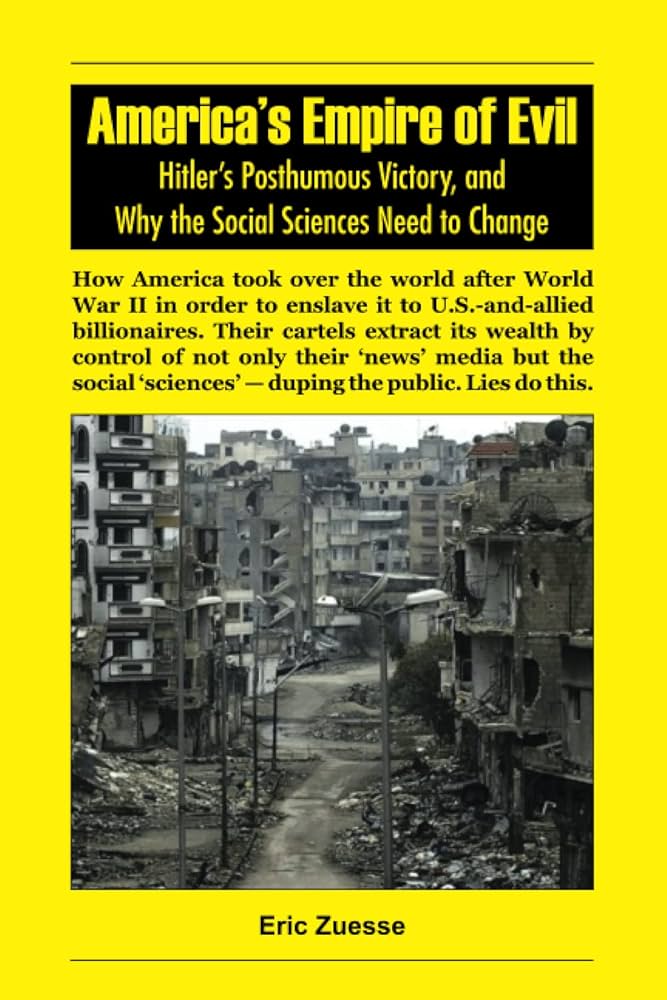
Eric Zuesse is an investigative historian. His new book, America's Empire of Evil: Hitler’s Posthumous Victory, and Why the Social Sciences Need to Change, is about how America took over the world after World War II in order to enslave it to U.S.-and-allied billionaires. Their cartels extract the world’s wealth by control of not only their ‘news’ media but the social ‘sciences’ — duping the public. Read other articles by Eric.

Secrecy and Virtue Signalling: Another View of Signalgate


There has been a fascinating, near unanimous condemnation among the cognoscenti about the seemingly careless addition of Jeffrey Goldberg of The Atlantic to the chat chain of Signal by US National Security Advisor Michael Waltz. Condemnation of the error spans the spectrum from clownish to dangerous. There has been virtually nothing on the importance of such leaks of national security information and the importance they serve in informing the public about what those in power are really up to.

Rather than appreciate the fact that there was a journalist there to receive information on military operations that might raise a host of concerns (legitimate targeting and the laws of war come to mind), there was a chill of terror coursing through the commentariat and Congress that military secrets and strategy had been compromised. Goldberg himself initially disbelieved it. “I didn’t think it could be real.” He also professed that some messages would not be made public given the risks they posed, conceding that Defense Secretary Pete Hegseth’s communications to the group “contained operational details of forthcoming strikes on Yemen, including information about targets, weapons the US would be deploying, and attack sequencing.”

This seemingly principled stance ignores the bread-and-butter importance of investigative reporting and activist publishing, which so often relies on classified material received via accident or design. Normally, the one receiving the message is condemned. In this case, Golberg objected to being the recipient, claiming moral high ground in reporting the security lapse. Certain messages of the “Houthi PC small group channel” were only published by The Atlantic to throw cold water on stubborn claims by the White House that classified details had not been shared.

The supposed diligence on Goldberg’s part to fuss about the cavalier attitude to national security shown by the Trump administration reveals the feeble compromise the Fourth Estate has reached with the national security state. Could it be that WikiLeaks was, like the ghost of Banquo, at this Signal’s feast? Last year’s conviction of the organisation’s founding publisher, Julian Assange, on one count of conspiracy to obtain and disclose national defence information under the Espionage Act of 1917, or section 793(g) (Title 18, USC), might have exerted some force over Goldberg’s considerations. Having been added to the communication chain in error, the defence material could well have imperilled him, with First Amendment considerations on that subject untested.

As for what the messages revealed, along with the importance of their disclosure, things become clear. Waltz reveals that the killing of a Houthi official necessitated the destruction of a civilian building. “The first target – their top missile guy – we had positive ID of him walking into his girlfriend’s building and it’s now collapsed.” Vance replies: “Excellent.”

As Turse reminds us in The Intercept, this conforms to the practices all too frequently used when bombing the Houthis in Yemen. The United States offered extensive support to the Saudi-led bombing campaign against the Shia group, one that precipitated one of the world’s gravest humanitarian crises. That particular aerial campaign rarely heeded specific targeting, laying waste to vital infrastructure and health facilities. Anthropologist Stephanie Savell, director of the Costs of War project at Brown University, also noted in remarks to The Intercept that fifty-three people have perished in the latest US airstrikes, among them five children. “These are just the latest deaths in a long track record of US killing in Yemen, and the research shows that US airstrikes in many countries have a history of killing and traumatizing innocent civilians and wreaking havoc on people’s lives and livelihoods.”

The appearance of Hillary Clinton in the debate on Signalgate confirmed the importance of such leaks, and why they are treated with pathological loathing. “We’re all shocked – shocked!” she screeched in The New York Times. “What’s worse is that top Trump administration officials put our troops in jeopardy by sharing military plans on a commercial messaging app and unwittingly invited a journalist into the chat. That’s dangerous. And it’s just dumb.” As a person with a hatred of open publishing outlets such as WikiLeaks (her own careless side to security was exposed by the organisation’s publication of emails sent from a private server while she was Secretary of State), the mania is almost understandable.

Other countries, notably members of the Five Eyes alliance system, are also voicing concern that their valuable secrets are at risk if shared with the Trump administration. Again, the focus there is less on the accountability of officials than the cast iron virtues of secrecy. “When mistakes happen, and sensitive intelligence leaks, lessons must be learned to prevent that from recurring,” Canadian Prime Minister Mark Carney stated gravely in Halifax, Nova Scotia. “It’s a serious, serious issue, and all lessons must be taken.”

Former chief of Canada’s intelligence agency, Richard Fadden, was even more explicit: “Canada needs to think about what this means in practical terms: is the United States prepared to protect our secrets, as we are bound to protect theirs?”

Signalgate jolted the national security state. Rather than being treated as a valuable revelation about the latest US bombing strategy in Yemen, the obsession has been on keeping a lid on such matters. For the sake of accountability and the public interest, let us hope that the lid on this administration’s activities remains insecure.

Binoy Kampmark was a Commonwealth Scholar at Selwyn College, Cambridge. He lectures at RMIT University, Melbourne. Email: bkampmark@gmail.comRead other articles by Binoy.

Five Ways the Signal Leak Could be Trouble for Trump


The real crime in the leaked principals group discussion of the upcoming U.S. military strikes on Yemen and the Houthi was the U.S. military strikes on Yemen, strikes U.S. President Donald Trump says will continue “for a long time.” As is always the case in American strikes, though, there will be little criticism of that and no price to pay.

There are five ways, though less serious, that the leaked conversation could cause trouble for the Trump administration.

The first is that having the conversation on the open-source Signal was not only careless but possibly illegal. The New York Times says, “It is highly unusual and possibly illegal for sensitive military plans to be discussed on a messaging app, rather than by a more secure means of communication.” Jeffrey Goldberg, the editor in chief of The Atlantic, who was included in the Signal meeting, reports that “[t]he Signal app is not approved by the government for sharing classified information.” He says that, according to several national-security lawyers, “by coordinating a national-security-related action over Signal, [they] may have violated several provisions of the Espionage Act, which governs the handling of ‘national defense’ information.”

The second is that, despite defensive claims that they did not reveal any top secret or classified material, they did.

Trump defended his team, saying that the information discussed in the Signal chat was not classified. Defense secretary Pete Hegseth insisted that no war plans were discussed. But publication of Hegseth’s posts make it clear that he revealed real-time details and operational sequencing of launch times of F-18’s and drones and when strikes would start at least half an hour before U.S. warplanes launched and two hours before strikes began. He also revealed that there would be “[m]ore strikes ongoing for hours tonight.”

Releasing details of when warplanes would take off and when bombs would be dropped is not only possibly illegal, but definitely reckless. It blatantly ignored “military doctrine about operational security,” Air Force and Navy fighter pilots told the New York Times.

When targets are revealed, the enemy can relocate them. More importantly, as one former Air Force pilot told The Times, “When you disclose operational security, people can get killed.” A former Defense Department official said that revealing launch times and aircraft types “could have jeopardized pilots’ lives if it had been released or obtained.” A former Navy squadron commander explained that if “the Houthis learned the precise time of strikes and that they would be conducted by carrier-based attack planes in the northern Red Sea, they could have repositioned and prepared air defenses” that others explained are “capable of engaging fighter jets.”

The third is that Trump administration officials seem to have lied under oath. Director of national intelligence Tulsi Gabbard told a Senate Intelligence Committee hearing that “There was no classified material that was shared in that Signal group.” The director of the Central Intelligence Agency, John Ratcliffe, testified that “My communications, to be clear, in the Signal message group were entirely permissible and lawful and did not include classified information.” Though Ratcliffe may be telling the truth about his own comments, the published posts testify that those answers, made under oath, are misleading at best and dishonest at worst.

The fourth is that the posts reveal that war crimes may have been committed. In one post, national security advisor Mike Waltz updates the group that “The first target – their top missile guy – we had positive ID of him walking into his girlfriend’s building and it’s now collapsed.” The target was struck in a civilian building. Presumably, people other than the target, innocent civilians, were also in the building.

That civilian targets have been struck is not novel. Twenty-one out of thirty-eight strikes have hit civilian targets, including ports and roads that supply food and medicine, a medical center, a school, a university, Bedouin tents and residential areas have been hit. What is novel about the possible war crime revealed in the leaked posts is that it is not regarded as a regretful accident but accepted and celebrated. U.S. vice president J.D. Vance responds to the news with one word: “Excellent.” Ratcliffe calls it “A good start.” Waltz texts emojis of a fist, an American flag and fire.

And finally, the carelessness and disregard for operational security could worry American allies and create concern about sharing secret information. Ben Hodges, former commander of U.S. forces in Europe, said, the disregard for security procedure could “cause allies to be very reluctant to share analysis and intelligence” and cause them to “assume America can’t be trusted.”

Close American intelligence partners have raised questions. Richard Fadden, a former Canadian national security advisor, says “This is very worrying. Canada needs to think about what this means in practical terms: is the United States prepared to protect our secrets, as we are bound to protect theirs?” Canadian prime minister Mark Carney commented that “When mistakes happen, and sensitive intelligence leaks, lessons must be learned to prevent that from recurring…. It’s a serious, serious issue, and all lessons must be taken.” Media in other countries that share intelligence with the U.S. are asking similar questions.

Though the real crime in the conversation will go unquestioned and unpunished, the leaked top-level discussion of the principals group could lead to a number of less serious issues that could cause trouble for the Trump administration.

Ted Snider is a regular columnist on U.S. foreign policy and history at Antiwar.com and The Libertarian Institute. He is also a frequent contributor to Responsible Statecraft and The American Conservative as well as other outlets. To support his work or for media or virtual presentation requests, contact him at tedsnider@bell.net.

AU CONTRAIRE


Veterans For Peace Delegation Visits Nicaragua


Call for Solidarity and Truth in the Face of Disinformation

Image by Gerry Condon

In a powerful demonstration of international solidarity, seven members of Veterans For Peace (VFP) visited Nicaragua in mid-to-late March as an official VFP delegation. Veterans from five U.S. states flew to Nicaragua on March 19 for a week-long visit to community clinics, regional colleges, vocational schools, youth groups and mayors in several Nicaraguan cities, including the capital Managua, Matagalpa, Masaya and Ciudad Sandino. The veterans were most impressed to learn that Nicaragua, the third poorest country in the western hemisphere, is providing free, high quality healthcare and education for all its people.

Delegation participants were VFP vice president Joshua Shurley, VFP Board member Gerry Condon, VFP Communications Director Chris Smiley, At-Large member Alvin Glatkowski, and Daniel Shea, Douglas Ryder and Michael Kramer, presidents of their respective VFP chapters in Portland, Oregon; Raleigh/Durham, North Carolina, and Northern New Jersey.

The Veterans For Peace delegation had a wonderful exchange with the Juventud Sandinista youth group, young women and men who are dedicated to continuing the Nicaragua’s unique revolution.

One of the most striking aspects of the trip was the delegation’s visit to a Casa Materna maternity and birthing center in Matagalpa. Nicaragua has reduced maternal mortality rates by 80% since 2007. These centers reflect the government’s dedication to ensuring that every Nicaraguan mother and child has access to life-saving healthcare.

“What a difference it makes when a government prioritizes the needs of the poorest and most vulnerable,” said Joshua Shurley, vice president of Veterans For Peace. “And what a contrast to the U.S., where things are moving in exactly the opposite direction.”

Nicaragua Withstands U.S. Sanctions and Hybrid Warfare

Nicaragua’s achievements are all the more impressive given the brutal economic sanctions imposed by the U.S. Nicaragua’s resilience in the face of this economic warfare is partly a result of its focus on “food sovereignty,” as 90% of the food that Nicaraguans eat is grown in Nicaragua. Also notable is Nicaragua’s commitment to sustainable energy. Over 70% of Nicaragua’s energy needs are met by wind, solar, geothermal and hydroelectric.

Nicaragua has a long history of resisting U.S. imperialism. The delegation was able to visit the home of Nicaragua’s national hero, Augusto Cesar Sandino, who led an army in the 1920s that kicked out the U.S. Marines. Sandino is the namesake of the Sandinista National Liberation Front (FSLN) and the Sandinista Popular Army (EPS), which overthrew the U.S.-backed dictator Somoza in 1979 and fought the U.S.-backed “Contras” throughout the 1980s.

The Veterans For Peace delegation traveled to sites in Masaya where brutal violence occurred during the U.S.-backed attempted coup in 2018. Western media portrayed these events as a Nicaraguan government crackdown on peaceful protesters. However, the delegation heard a different story from Masaya residents: the so-called “peaceful protesters” were actually violent mobs, a key element of hybrid warfare (aka “color revolution”) funded through shadowy arms of the U.S. intelligence sector.

“U.S. imperialism has not yet given up on undermining and overthrowing the Sandinista revolution,” said VFP Board member Gerry Condon. “Our job as peace-loving veterans is to tell the truth about the remarkable achievements of the Nicaraguan people.”

Nicaragua is Ranked Sixth in the World in Gender Equality

The veterans were highly impressed by Nicaragua’s deep commitment to achieving gender equality. The Nicaraguan Constitution dictates that half of all political parties’ candidates for political office must be women. If a mayor is a man, the vice-mayor must be a woman, and vice versa. The same goes for every government ministry. At the highest level, Nicaragua now has a co-presidency that is filled by a man and a woman. Nicaragua is rated First in gender equality in the Americas, and Sixth in the world.

As the U.S. continues to grapple with the mounting challenges of authoritarianism, mass deportations, and the dismantling of social services, the Veterans For Peace visit to Nicaragua underscores that solidarity between peoples of different nations can help break through the disinformation promoted by powerful interests and reveal how the struggles of ordinary people are interconnected.

“We have some serious problems at home in the U.S. – even veterans’ healthcare is under attack,” said Douglas Ryder, a veteran of the U.S. war in Vietnam. “We can learn a lot from Nicaragua’s commitment to take care of all its people, beginning with those most in need.”

Veterans For Peace is a national organization founded in 1985 by military veterans opposed to the Reagan administration's war against the people of Central America. It includes men and women veterans of all eras and duty stations spanning the Spanish Civil War, World War II, Korea, Vietnam, Panama, Persian Gulf, Bosnia, Afghanistan, Iraq, other conflicts and periods in between. Read other articles by Veterans for Peace, or visit Veterans for Peace's website.


Everyday in America is April Fool’s Day


The US is a peace-loving country that promotes harmony across the globe and treats other countries with respect.

The US has the greatest respect for international law. It meticulously honors its treaties, and uses the UN to constructively resolve any disputes between nations.

The enormous wealth of the US is shared equitably across its population and is instrumental in keeping the standard of living for all citizens at peak levels.

All US citizens enjoy equal opportunities for a good life, self-improvement and comfort, and a better future for coming generations.

The political leaders of the US are exemplary: intelligent, well-informed elected officials of the highest integrity and concern for the general welfare, lead the nation.

Our success as the greatest experiment in self-government has made democracy in the US a model for the rest of the world.

Elections in the US are free, fair and transparent. The widest possible range of views and opinions are available for a lively national conversation, and choice at the polls.

US citizens are well-informed and actively engaged in determining the policies and direction of the country. Their voice is heard and heeded by their representatives.

Equality and human rights are among the most valued guiding principles. Everyone equally enjoys the benefits of living in the US, regardless of race, creed, or gender.

Media in the US is objective, fair, and balanced, keeping Americans well-informed of all sides of important issues. Every point of view gets equal exposure to the public.

The economic policy of the US is sound, responsible, and responsive to the needs of the citizenry. The US economy is thriving, benefiting everyone.

Corporations play a vital role in keeping Americans healthy, wealthy, and wise. They stoke the engine of economic development and wealth creation.

Good-paying jobs offering satisfying and esteem-building work are in abundance. Employees are rewarded for their high productivity and work ethic.

High-quality, affordable health care by the most successful health care industry in the world, is available to everyone.

The US puts great emphasis on infrastructure, thus works aggressively to repair and renovate its shared assets: roads, bridges, airports, the internet, public transportation.

Research and development is valued and generously funded, keeping America on top of its competitors in the international marketplace.

A solid education is available to everyone, regardless of economic status or class. A smart, educated citizenry keeps the US in the lead internationally.

The regulatory agencies of the US are scrupulous in protecting everyday citizens from the predations of big corporations, keeping our food, water, and air safe and healthful.

The US works diligently at protecting the environment, guarding against pollution and resource depletion.

The US has the best judicial system in the world. Everyone is treated fairly by the courts, promoting justice, and equality before the law.

God is on our side. It’s in the Bible.

Okay … had enough?

Most people in the US remain fooled but the rest of the world is waking up to the fantasy bubble Americans live in. Like George Carlin said, “That’s why they call it the American Dream, because you have to be asleep to believe it.”

John Rachel has a B.A. in Philosophy, has traveled extensively, is a songwriter, music producer, neo-Marxist, and a bipolar humanist. He has written eight novels and three political non-fiction books. His most recent polemic is The Peace Dividend: The Most Controversial Proposal in the History of the World. His political articles have appeared at many alternative media outlets. He is now somewhat rooted in a small traditional farming village in Japan near Osaka, where he proudly tends his small but promising vegetable garden. Scribo ergo sumRead other articles by John, or visit John's website.