Sunday, July 27, 2025

Oh, Darn, the Ultimate Victims Have Cornered the Market on Nazism


Bloodied' Israeli Flag in Milan Angers Visitors to Expo - Algemeiner.com

Reference:  Chosen Trauma and Terrorism: The Jewish Victim Narrative

 The purpose of this research paper was to investigate the justification of Jewish terrorism against the Palestinians, through the lens of chosen trauma. Through qualitative research, it was deduced that chosen trauma is the result of victimization and large-group identity. Hence, the psychological domain of collective victimhood and Sigmund Freud’s Group Psychology were employed to elaborate on this concept. It was deduced that the process and acceptance of victimization are dynamic and are a result of stages since it calls for the collective recognition of trauma by large groups. Large group identity becomes stronger upon attacks or threats from external groups, and attacks generate collective victimhood. The resulting concept is that; the perceived harm is stored in the collective memory of large groups, and they aspire to seek revenge. It was also presented that, shared tragedy is transmitted through generations by virtue of “depositing”. The psychological domain of transgenerational transmission of trauma argues that through depositing, the parties become free of the traumatic images and deal with their mental conflicts. The result is chosen trauma, whereby a collective sense of entitlement for the purpose of recovering from ancestral collective trauma is reflected. Along these lines, the Jewish Holocaust survivors passed down the trauma of concertation camps, torture, and sexual violence across generations. Present-day Jews aspire to avenge the Holocaust by maintaining domination over Jerusalem and current Israeli land. As a result, the Palestinian community which challenges the aspiration of Jews is a victim of state-sponsored terrorism.

In retaliation, Palestinians are victims of expulsions, killings, military occupation, forced detention, war crimes, and human rights violations. Despite being called out by various international organizations, Israel is able to justify its actions under the realm of chosen trauma. Hence, the notion of chosen trauma is employed to justify Jewish atrocities against the Palestinians.
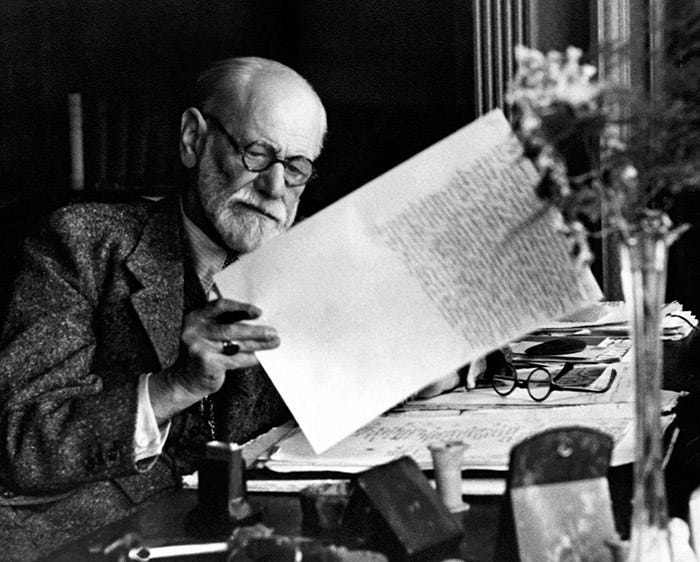
Freud as Talmudist - Jewish Review of Books

But Freud testified that “my father allowed me to grow up in complete ignorance of everything that concerned Judaism.” Some scholars have made much of the fact that Jacob once gave his son a Bible with a Hebrew inscription, but when the adult Freud was given a book with a Hebrew message, he replied that he was entirely unable to read it. The belief that one’s children would be more burdened than fortified by Jewish knowledge was shared by many Jewish parents in the nineteenth and twentieth centuries, in Brooklyn and Tel Aviv no less than in Vienna.

As for religious faith, Freud of course had none, identifying on occasion with Jewish unbelievers like Heinrich Heine and Baruch Spinoza. A strict rationalist, he theorized in The Future of an Illusion (1927) that the origins of religion lay in “the terrifying impression of helplessness in childhood,” which “aroused the need for protection—for protection through love—which was provided by the father.” God is the imaginary father adults call on to avoid confronting “the full extent of their helplessness and their insignificance in the machinery of the universe.” But “men cannot remain children forever,” Freud says, demanding that we emancipate ourselves from faith.
Freud as Talmudist

War

The Oxford Dictionary defines a “tragedy” as a play “concerning the downfall of the main character”. This main character is often referred to as the “tragic hero.” “Tragic heroes typically have heroic traits that earn them the sympathy of the audience, but also have flaws or make mistakes that ultimately lead to their own downfall.”

Literature is littered with tragic heroes — beginning with Lucifer of Judeo-Christian mythology, later Shakespeare’s Macbeth, Camus’ Clamence, and more recently Walter White of the TV series Breaking Bad. And so is real life: US President Richard Nixon, actor Bill Cosby, and cyclist Lance Armstrong. All people who gained support, success, fame, admiration, and power — only to lose it all because of the abuse of that power. Sometimes the tragic hero can be a nation.

The eyes of the world have watched the unfolding story of Israel over the past 75 years. What many saw as an inspirational tale in its early years has slowly turned into a tragedy — and the hero into a bully.

Bad bad Jewish New York Confused Writing, “almost”  ALWAYS: A Jewish Stance of Eternal Victimhood Fails Us All — The suffering of Jews doesn’t mean that Jews can’t make others suffer.

I grew up in the shadow of the Holocaust in a mainly Jewish community in New York. There were also South Africans who’d fled apartheid, as well as Persian Jews who’d been forced out of Iran after the Shah fell. Fleeing oppression tends to create an open-minded, liberal community — one that I have been proud to be part of traditionally, if not religiously — or, conversely, it can create a community that dangerously closes ranks, which I find particularly telling today when looking at what Israel is perpetrating in Gaza.

These effing so-called Jewish and Liberal New Yorkers are Bonkers in Yonkers: above quote.

The Israeli government has pivoted to a new deflection: The famine in Gaza is not the result of Israel’s publicly announced March 2 blockade of all food entering Gaza, nor is it connected to the Israeli- and U.S.-backed Gaza Humanitarian Foundation (GHF), which replaced the UNRWA aid system Israel shut down with its own militarized version in late May. Instead, according to the new Israeli campaign, the blame lies with the United Nations. “Hundreds of aid trucks have entered Gaza with Israel’s approval, but the supplies are standing idle, undelivered,” the Israeli Ministry of Foreign Affairs declared on X. “The reason? The UN refuses to distribute the aid.”

Clearly sensing a turning-point in world opinion, as the death toll from starvation mounts exponentially in Gaza, Israel brought dozens of sympathetic journalists to a crossing to wage a PR campaign on Thursday.
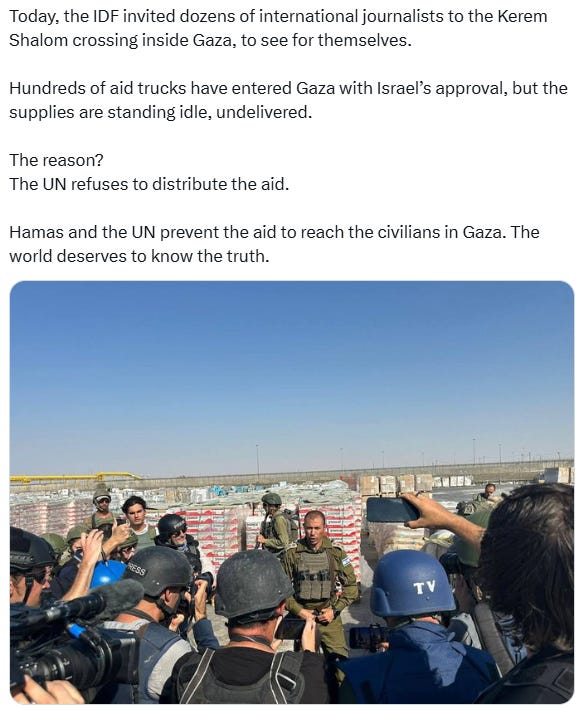
Comment on X: Bushra Shaikh — You haven’t let any International Journalists into Gaza freely since the aggression began. So IDF-controlled journalists in a 2-hour tour is not journalism. Try again, rabid liars.

Netanyahu gifts 'golden pager' to Trump; Know ‘hidden meaning’ behind Bibi’s gift

Oh, more than rabid liars. Rabid misanthropes, and they turned the Vice President into this glorifying Dipshit Faux Man, and what and who are these journalists who won’t attack the Vice President  and President Trump or his POTUS: Adolph “bibi” Mileikowsky.

Myriam François sits down with journalist Ahmed Shihab-Eldin to confront the media’s complicity in power — and the price of telling the truth. From abused children to erased journalists, this is a brutal exposé on how mainstream media narratives are shaped, sanitised, and sold. We break down how coverage of Gaza and Palestinian lives is distorted — and why “mistake” is the media’s favourite euphemism for mass murder.

Image

Nah, Jewish folk don’t control the White Man’s House and Minyan, or Higher Education:

Hudson Whittaker was a Chicago blues musician who performed under the name Tampa Red. One of his finest compositions, entitled “Don’t Deal with the Devil,” opens with the following warning:

When you dealin’ with the devil
Everything you do is wrong
You’ll drive away your lover
And keep all your things in pawn…
Don’t deal with the devil, cuz it ain’t no way to win.

Zionist Jews are the Collective Devil:

Fucking Military Industrial Complex and so-called Business Chlamydia Capitalism Schools:

Stanford Graduate School of Business, long considered among the most elite MBA programs in the world, is facing a storm of internal criticism from students who say the academic experience has fallen far short of expectations. In a series of interviews with Poets&Quants, current MBA students voiced concerns about outdated course content, a disengaged faculty culture, and a broken curriculum structure that they say leaves them unprepared for post-MBA careers — and worse, dilutes the reputation and long-term value of a Stanford degree by producing scores of grads unprepared for the modern world of work.

“We’re coming to the best business school on Earth, and the professors can’t teach,” says a rising second-year MBA student and elected member of the school’s Student Association. “We’re not learning anything. The brand is strong, but there’s nothing here to help you build discernible skills.”

a man in a black military uniform sits at a desk behind microphones

Albino head of the War Lord’s SNAKE:

“I firmly believe that the technology that we need to deliver Golden Dome exists today.”

Yep, there goes the neighborhood: A draft of President Dwight D. Eisenhower’s farewell address shows changes made around a reference to the military industrial complex at the Eisenhower Presidential Library in Abilene, Kansas, the U.S., December 10, 2010.
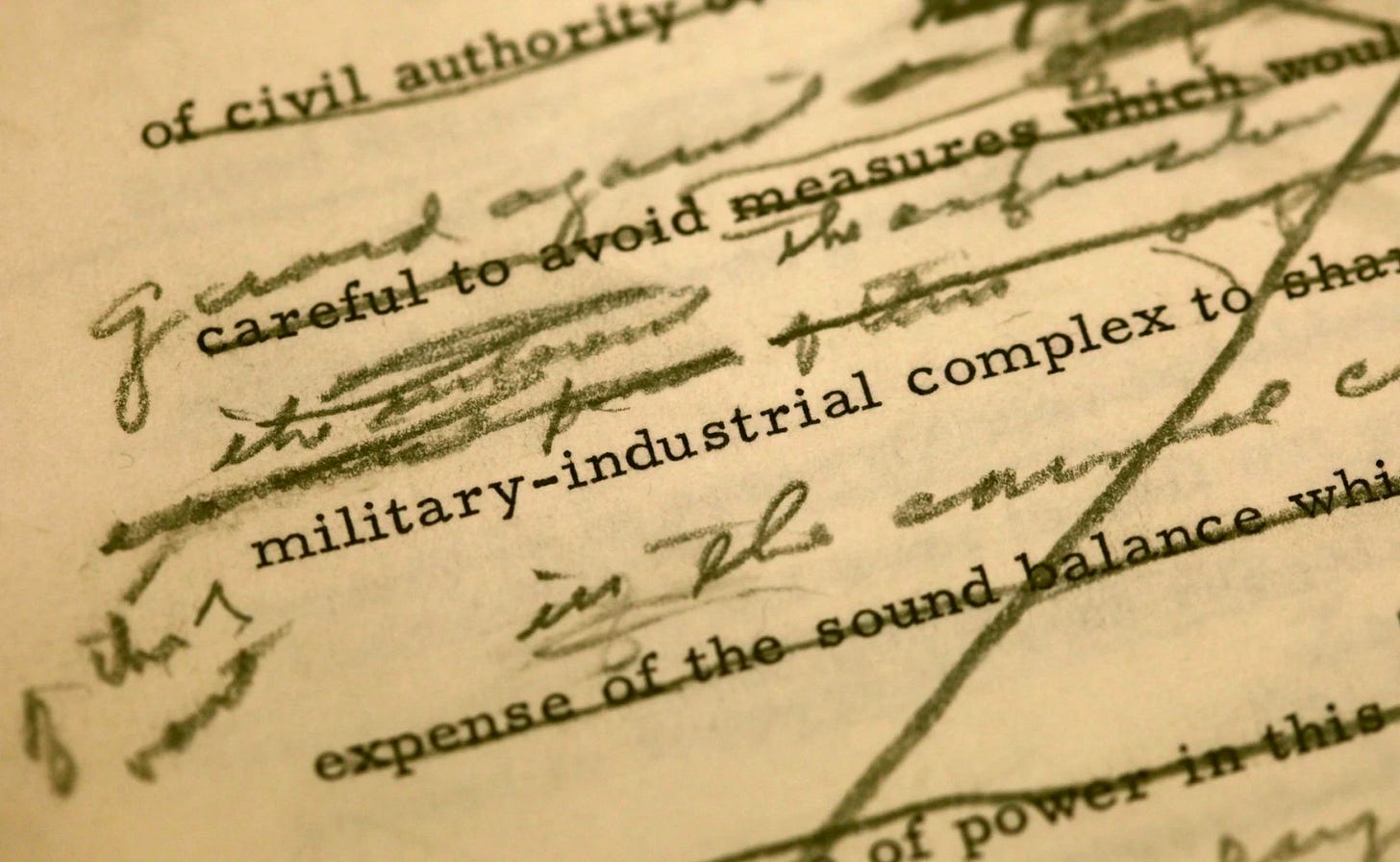
A draft of President Dwight D. Eisenhower's farewell address shows changes made around a reference to the military industrial complex at the Eisenhower Presidential Library in Abilene, Kansas, the U.S., December 10, 2010. /AP

The head of the Trump administration’s Golden Dome program says the technologies needed to create an ambitious space-based missile defense system are already in existence.

U.S. Space Force General Michael Guetlein, Vice Chief of Space Operations, was tapped by President Trump to lead the Golden Dome project on May 20 and was confirmed by the U.S. Senate on July 17. His role will be to oversee the development and procurement of technologies for Golden Dome, a planned missile defense system that can shoot down incoming hypersonic, cruise, and ballistic missiles from space.

This is devolution. Apartment Buildings Bombed.
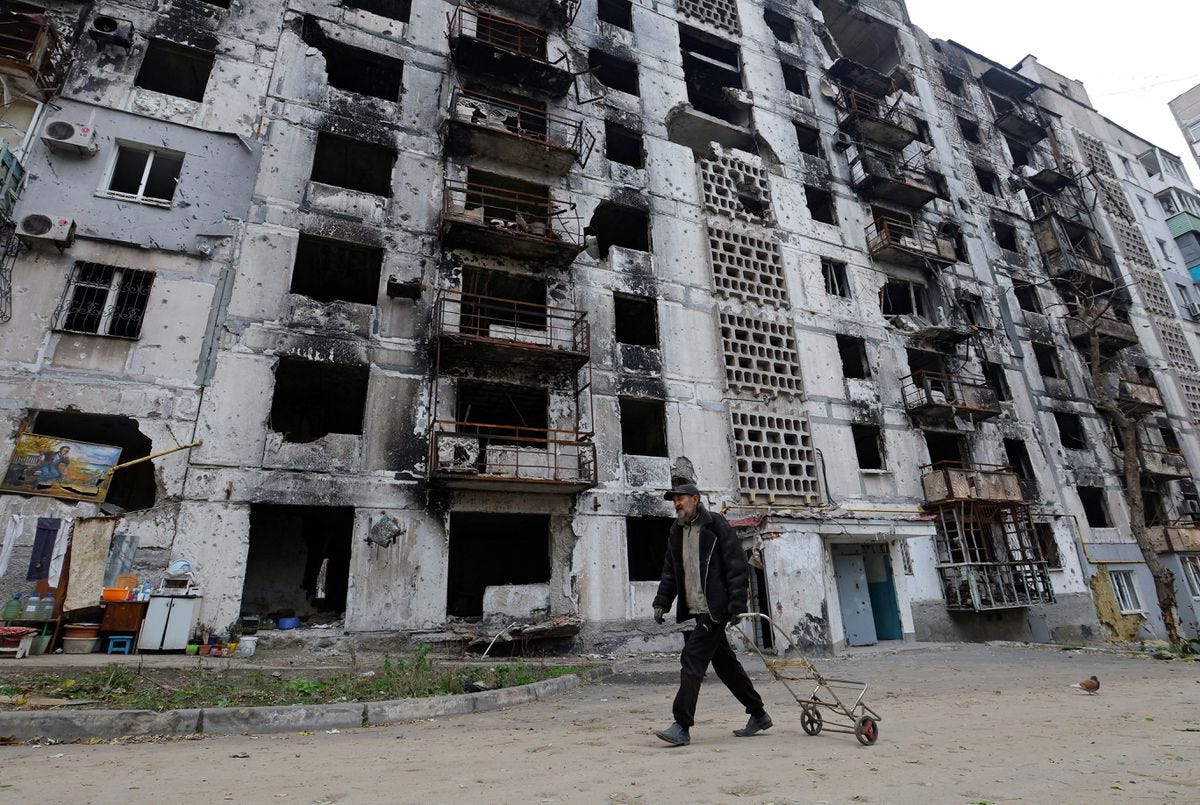
A man walks past an apartment building heavily damaged in the Russia-Ukraine conflict, in Mariupol, Ukraine, November 16, 2022. /Reuters

“American-style democracy advocates that everyone has one vote, but ordinary voters simply cannot compete with the campaign investment paid by the big financial groups in the military-industrial complex,” said Zhang Tengjun, deputy director of the China Institute of International Studies Asia Pacific.

Another powerful tool of the military-industrial complex is its ability to shape elite discussions on national security issues by funding foreign policy think tanks.

At least 14 of the 15 think tanks represented in House Armed Services Committee hearings from January 2020 to September 2022 accepted arms industry cash, according to “US government and defense contractor funding of America’s top 50 think tanks” report by Bee Freeman, a research fellow with expertise in lobbying and money in politics at the Quincy Institute for Responsible Statecraft.

“Think tanks are supposed to shape government policies in an unbiased manner, free from the influence of big money that can distort in-house policy planning,” said Stephen Semler, cofounder of Security Policy Reform Institute, a grassroots-funded U.S. foreign policy think tank.

However, many of the most influential think tanks have been compromised by the same financial interests as Congress, including military contractors, Semler argued.
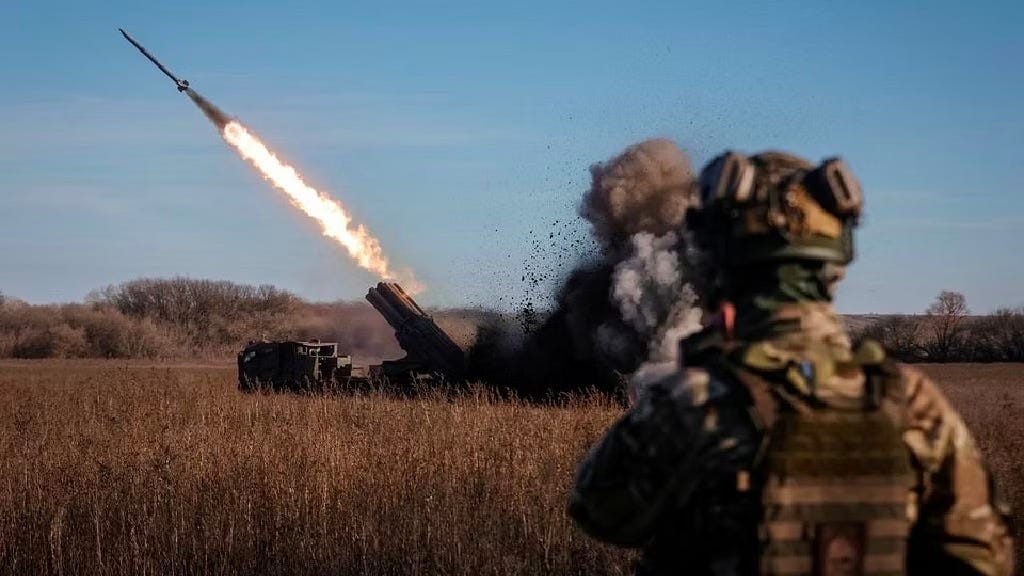
Ukrainian servicemen use a Bureviy multiple launch rocket system at a position in Donetsk region, Ukraine, November 29, 2022. /Reuters

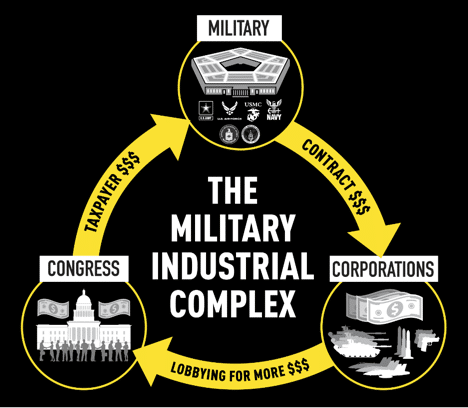
Weapons contractors are the main financial beneficiary.One-quarter to one-third of all Pentagon contracts in recent years have gone to just five major weapons contractors, including Lockheed Martin and Boeing, according to research from the Watson Institute at Brown University.

The direct military sales by U.S. companies rose nearly 50 percent in fiscal year 2022 from the previous year, data released by the U.S. State Department shows.
MIC

Deaths and injuries from such wars have reached the tens of millions. The number of estimated deaths from the post-9/11 wars in Afghanistan, Iraq, Pakistan, Syria, and Yemen is eerily similar to that from the wars in Vietnam, Laos, and Cambodia: 4.5 million.

The numbers are so large that they can become numbing. The Irish poet Pádraig Ó Tuama helps us remember to focus on:

one life
one life
one life
one life
one life
because each time
is the first time
that that life
has been taken.
MIC 2

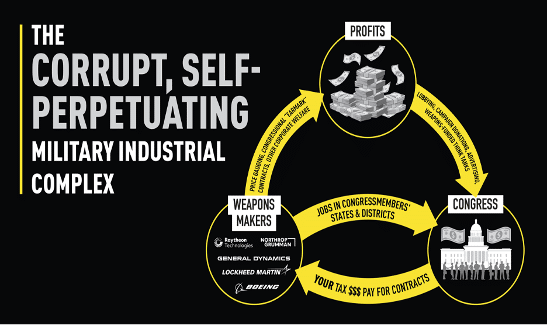
As the MIC has fueled wars abroad, so it has fueled militarization domestically. Why, for example, have domestic police forces become so militarized? At least part of the answer: since 1990, Congress has allowed the Pentagon to transfer its “excess” weaponry and equipment (including tanks and drones) to local law enforcement agencies. These transfers conveniently allow the Pentagon and its contractors to ask Congress for replacement purchases, further fueling the MIC.

Seeking new profits from new markets, contractors have also increasingly hawked their military products directly to SWAT teams and other police forces, border patrol outfits, and prison systems. Politicians and corporations have poured billions of dollars into border militarization and mass incarceration, helping fuel the rise of the lucrative “border-industrial complex” and “prison-industrial complex,” respectively. Domestic militarization has disproportionately harmed BlackLatino, and Indigenous communities.

KYIV, UKRAINE - APRIL 28: Smoke rises after missiles landed at sunset on April 28, 2022 in Kyiv, Ukraine. The mayor of Kyiv, Vitali Klitschko, said on his Telegram account that Russian strikes hit the lower floors of a residential building in the Shevchenkivskyi district. The attack coincides with today's visit to Kyiv by UN Secretary-General Antonio Guterres. (Photo by John Moore/Getty Images)

You think? Reducing military spending would rein in U.S. debt and improve global security

What’s missing? All the defunding and tax payer coffer smash and grabs: Education, roads, bridges, medical clinics, rural doctors, health care for all — single payer — public transportation, more parks, less clear cutting and mountaintop removal, mitigating all the destruction caused by US industries (microplastics, poisons, forever chemicals, disease, CAFOs, fenceline communities), arts, sciences, ecology and marine and estuary restoration, wildland fire fighting, ocean inundation, wet bulb temperature deaths and stress, and MORE MORE MORE.

What’s dragging down and/or missing in your community? Too many pigs/cops? ICE raids? Cost of housing or lack thereof?

An end to this?

Getty Images Donald Trump with his girlfriend (and future wife) Melania Knauss, Jeffrey Epstein and Ghislaine Maxwell in Florida in 2000

Watch: “It’s exhausting” – Epstein accuser talks to the BBC about files saga

And so the Jewish Project toward Gazafication and Israelification of the world continues:

Why Was There More Outrage for Colbert’s Cancellation Than for 2 Million Palestinians Starving in Gaza?

The liberal establishment gave outsized attention to Colbert compared to the increasingly dire hunger in Gaza.

A perfect fucking target. Oh, Larry Silverstein is on the job, after his billions in bilking 9/11 and the Jewish and Israeli insurance scam:

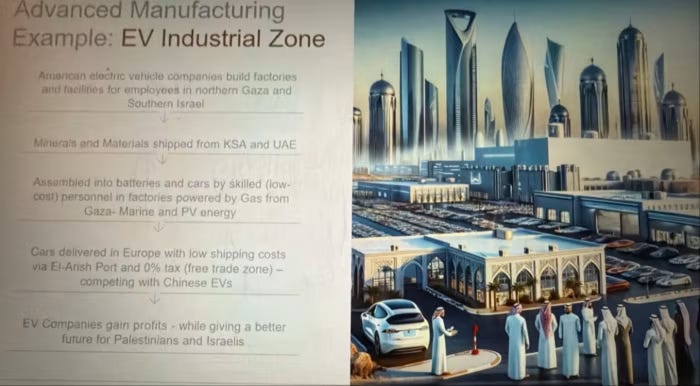
Concept for postwar Gaza from the project “Great Trust” in which the Tony Blair Institute participated to develop a postwar Gaza plan that envisaged kick-starting the enclave’s economy with a “Trump Riviera” and an “Elon Musk Smart Manufacturing Zone.” It proposed paying half a million Palestinians to leave the area and attracting private investors to develop Gaza..

Yeah, business schools?

In her 60-page report, Albanese writes that her research “reveals how the forever-occupation has become the ideal testing ground for arms manufacturers and Big Tech… while investors and private and public institutions profit freely.”

Her point was underscored by the Israeli arms firm Rafael, which issued a promotional video of its Spike FireFly drone that showed it locating, chasing and killing a Palestinian in what it called “urban warfare” in Gaza.

As the UN special rapporteur points out, quite aside from the issue of genocide in Gaza, western companies have been under a legal and moral obligation to sever ties with Israel’s system of occupation since last summer.

That was when the world’s highest court, the International Court of Justice, ruled Israel’s decades-old occupation was a criminal enterprise based on apartheid and forcible transfer—or what Albanese refers to as policies of “displacement and replacement.”

Instead, the corporate sector—and western governments—continue to deepen their involvement in Israel’s crimes.

It is not just arms manufacturers profiting from the genocidal levelling of Gaza and the occupations of the West Bank and East Jerusalem.

Big Tech, construction and materials firms, agribusiness, the tourism industry, the goods and services sector, and supply chains have also got in on the act.

And enabling it all is a finance sector—which includes banks, pension funds, universities, insurers and charities—keen to continue investing in this architecture of oppression.

Albanese describes the mosaic of companies partnering with Israel as “an eco-system sustaining this illegality.” — Israel’s Genocide Is Big Business And It’s The Face Of The Future
One of my Substack followers mentioned how I didn’t have a rant against the Jews of Murdering Maiming Occupying Raping Starving Poisoning Thieving Israel that day. Shit dawg, there’s always room for more critiques of Jews.
In a rare public comment, Jewish tech leader Sergey Brin strongly criticized the United Nations, calling it “deeply offensive” and “transparently antisemitic” after a UN report accused tech companies like Google of

The Washington Post reported that, in the wake of Albanese’s report, Google’s co-founder, Sergey Brin, called the UN “transparently antisemitic” in a chat on a staff forum.

Lakota Language

Dirty languages of the white races:

March in Lakota History - Lakota Times

Educator, musician, activist, and creator of First Voices Radio, Tiokasin Ghosthorse. Tiokasin is a member of the Cheyenne River Lakota Nation of South Dakota, and shares deep wisdom from the Lakota worldview, language, and traditions.

He explores ways for us to redefine our relationship with Mother Earth, moving away from a mindset of separation and domination towards one of interconnectedness, mutual becoming, and intuition. Tiokasin shares how we can be more in tune with Earth’s natural rhythm to become more present in the now and more connected to the future.

The Indigenous way of being involves an openness to seeing and feeling our ancestors—not just our human ancestors, but also the earth itself. Tiokasin stresses the need for us to de-center humans in order to reconnect with nature, and demonstrates how understanding the living Lakota language can affect a cultural mindset shift in that direction.

*****

[Jewish freighters on the Santa Fe Trail with hired Kiowa Indian scouts.]
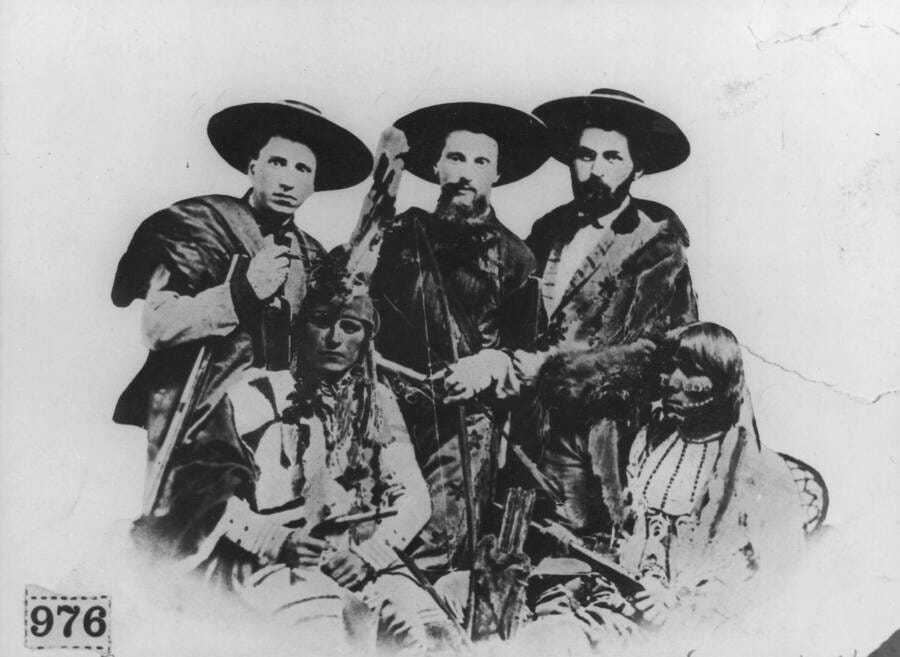
David S. Koffman: The title The Jews’ Indian is a play on a Robert Berkhofer, Jr.’s book from 1978, The White Man’s Indian: Images of the American Indian from Columbus to the Present.

I read that book in grad school and I liked the way that it forced the reader to think about the subject and the object. This was a book that was not about Native Americans. It was looking at white people’s representations of Native Americans.

I took this on as a similar project, but thought it important to disaggregate the category of “white man” and look specifically at Jews, with the hopes that other people might also look at sub-aggregates of colonists. Because people, for the most part, have seldom taken on colonial-settler identities. They think of themselves as Portuguese immigrants, or as Catholics, or as Mormons, but not “settlers.”

My interest is in seeing colonial actors as people who had ordinary economic and political concerns, who are desperate in their own way. I think that this study forces us to reckon with some of the political and moral ambiguities of settler-indigenous relations. Jews in the 19th century, like many others who arrived in the frontier West seeking to eke out a living, were often fleeing hunger, political violence, and disenfranchisement. Though they arrived as more powerful than Native Americans, they were not official state actors—they were, in a certain sense, refugees. We tend to think of the agents of settler-colonialism as military or political elites who created the conditions for expansion. But many were just pawns in the larger process. Jewish-Indigenous encounters were complicated; it’s not really a matter of good guys and bad guys, even though there are beneficiaries and losers.


HIPS Journalists: Honorable Intelligent Persistent Sane: Abby Martin and Gaza and MIC

She was gracious enough to talk to an old commie who is broadcasting on the Oregon Coast — where the forest meets the ocean and Grateful Dead Birkenstock Lovers still love Kamala


And who wouldn’t want this journalist in the trenches fighting with you for truth?

It was an honor to have her on my show, which airs July 30, 6 pm PST at KYAQ.org. Finding Fringe. DV gets the show early! Listen here.

And, remember, Gaza now, but China in 2027, we will see blood. These fucking war lords and tech LGBTQ+ and straight/cis fucking devils want war with China.

TWENTY TWENTY SEVEN — the year of the GOAT: The US is conducting intensive military exercises around the Pacific on a scale, intensity and tempo, not seen since the Cold War. In the meantime, frontline US and NATO troops are actively deploying and rehearsing war. Some top-level US officials have calendared 2027 as the date for war to start. Is the die already cast for war with China?

Here, Abby Martin signed on to this petition, as I did, and this was 10 months (Jan 2023) before the most current Jewish State of Murdering Maiming Starving Polluting Poisoning Thieving Occupied Palestine GENOCIDE:

DSA International Committee

Open Letter to US Congressional Representatives marking our opposition to the US Innovation and Competition Act (USICA) January 25, 2022

WASHINGTON, DC: The undersigned chapters and members of the Democratic Socialists of America and other allied organizations and individuals strongly condemn Congress’s use of industrial policy and other elements of the proposed US Innovation and Competition Act (USICA) to counter China as part of a new Cold War fueled by US imperialist interests, which further destabilizes geopolitical relations and jeopardizes efforts toward greater global cooperation on issues affecting everyone worldwide.

We call on members of Congress to oppose this aggressive escalation and push back on the narratives that have fueled rising anti-Chinese sentiment in the US, marked by increased anti-Asian racism and violence. We oppose the USICA and other legislation that calls for increased military budgets, further militarization of the Asia Pacific region, and fosters anti-Chinese propaganda efforts, all based on nothing more than perceived threats to US geopolitical interests. Elected members of the US Congress have the duty to prioritize the needs and concerns of their working-class constituents instead of those of arms manufacturers and defense contractors who have fueled decades of endless war at the expense of genuine global cooperation and common prosperity for working-class people everywhere.

We believe that US industrial policy should not be built upon imperialist ambitions that serve only to drag the world into a new Cold War. We believe that working people in the US and elsewhere deserve policies that invest in public works programs, climate resilience, infrastructure, healthcare, and more. The US Innovation and Competition Act is not created for those purposes; instead, it is overwhelmingly focused on preserving US global hegemony by fabricating narratives aimed at painting China as a threat and riling up global conflict in an effort to undermine an increasingly multipolar world. If enacted, the bill would ramp up interference in the sovereignty of nations throughout the world, establish an anti-Chinese federal bureaucracy, intensify the militarization of US global policies, and continue the legacy of US industrial policy being weaponized against socialist movements globally. This legislation will promote confrontation and conflict with China, escalate the potential for military conflict between nuclear powers, and hinder global cooperation needed to address critical issues like climate change.

For these reasons, we strongly condemn the USICA and urge members of Congress to oppose the bill and call for an end to US policies that threaten hundreds of millions of people in the Asia Pacific region and could spiral into worldwide conflict.

Abby Martin and I talked about the fact that this empire of chaos, terror, amnesia and in my words, empire of agnotology, is on crack and Ritalin. In a 24-hour news cycle, there are literally hundreds of stories on the WWW that would be of interest to journalists and educators like myself and hard-working media mavens like Abby.

[Fifty Fucking Years Ago, published.]

One My Lai Massacre (500 killed, dozens wounded, raped, maimed) every week in Gaza. Where is the outrage? Real time genocide, as they say, Cell Phone/Telegram/TikTok produced fucking genocide:

Stop calling this “Netanyahu’s war” when the overwhelming majority of Jewish Israelis support the genocide. This is a fully radicalized society—that’s why Boycott, Divestment, and Sanctions are necessary. on X, Abby Martin

Michael Fakhri, UN Special Rapporteur on the Right to Food, has been warning of this — and argues there is an obligation to act:

“We knew that Israel had intended to starve the Palestinians in Gaza since October 9, 2023 when Israel announced explicitly its plan to starve the Palestinians in Gaza. For 20 months, the governments of the world were on notice and had many opportunities to stop what’s happening. There are arrest warrants issued by the International Criminal Court for the war crime of starvation against Netanyahu and former Minister of Defense Gallant. In fact, the International Court of Justice itself in January, recognized there is famine and starvation in Gaza. That creates a mandatory obligation. Countries MUST act to stop starvationSo it creates a legal obligation for every country in the world to step in and end this starvation and famine in Gaza today. So what must happen now? Governments can [should] act through the General Assembly because the United States keeps exercising its veto at the Security Council. When that happens, the General Assembly has the authority to call upon peacekeepers to accompany humanitarian convoys into Gaza to protect the convoys and bring aid.”

This below was Goddamn Five Months Ago:

Abby was just in Bogota, for that fiasco: The Hague Group. Listen to her go off on those countries that didn’t even sign on, that is, in the interview above.

She said that of all the folks she’s interviewed for her various platforms, but mostly Empire Files, the grassroots activists and organizers and on the ground folk she most closely aligns to. Or empathizes with, and/or valorizes with a small “v”. But Corbyn is her hero.

Bring in the fucking navies, man, all those logistics personnel to get the food, meds, doctors/nurses, clean water, psychologists, media, tents and prefab homes to these people NOW!

A CALL TO CONSCIENCE: AN APPEAL TO THE LEADERS OF THE WORLD

The tragedy unfolding in Gaza is a test of our shared humanity. Entire families are being murdered. Children — even babies — have been killed. Others are wasting away from hunger. This appalling disregard for human life and dignity must end, for it is a violation of the most basic moral code.

Malaysia calls on all world leaders to act with urgency. Every government that believes in international law, every nation that claims to value human life, must speak with one voice.

In this regard, I urge all those with influence over Israel to find the courage to act decisively. I especially appeal to US President Donald Trump to use that influence to press for an immediate end to the killing, stop the indiscriminate bombings, and ensure that humanitarian aid reaches those in need without obstruction.

This is the hour for moral leadership. This is the time to uphold the values we claim to defend.

Malaysia stands ready to work with all nations—North and South, East and West—to bring relief to Gaza, and to restore the basic principles of humanity. Let us not be remembered as those who stood by. Let us be guided by our conscience, to answer suffering with compassion, and to pursue peace for the sake of our humanity.

ANWAR IBRAHIM

Malaysian Prime Minister Anwar Ibrahim delivers a speech.

I’ve followed Project Censored for a time, having my various college students tap into that, those 25 most under-reported and de-platformed or just not covered stories annual recognition (in the mainstream press, that is).

Project Censored

She appeared in this flick:

I gave her the honorific that she, like so many others, not only know what that leash is, but she and others just yank out the bloody peg holding truth back.
“The U.S. military is the largest institutional polluter in the world. There is no corporation or industry that compares to the damage and devastation done by the U.S. war machine,” Martin told Watchdog host Lowkey.

She’s got skin-kin-amigos-colleagues in the game — she did that documentary years ago, 2019. Gaza Fights For Freedom

Yes indeed, her work with Telesur is what got Empire Files up and running, and the sanctions against Venezuela, that forced EF to go to a subscription basis.

Abby Goes to Palestine

Sources and Links

Videos

Podcasts

Support Abby’s Work

We did not get into the new documentary on the military industrial complex under the umbrella of US’s Military:

She’s making the rounds now as the film is about to be final edited, cut, sound-enhanced and soon to be released:

 

There’s emphasis on the carbon and polluting and poisoning footprint of the military, for sure. I want to get into other issues tied to the +Military Legal Retail Energy Oil Chemical Mining Education Surveillance Prison Policing Finance Banking Real Estate Entertainment PR Congressional Transportation Ag Pharma Medical COMPLEX.

All the harms done not just through direct kinetic forces shooting and sniping, but the overall psychological harm, that collective consciousness of trauma, that epigenetic force of a military and the uniforms and badges and pips and medals and camo and flyovers and complete saturation of military mindset as well as the first hand, second hand and third hand damage wars do to entire generations and beyond.

Forget about just the toxins and the depleted uranium and land mines. It’s the terror of those drones, or the threat of war, or the respective countries in USA’s and 14 Eyes’ gun sights having to spend time and resources and valuable human lifetimes to fend off the enemy, or the threat of war, or coup or sanctions.

We need a Military Madness Offensive Weapons footprint calculator like we do for water (water footprint) or ecology (ecological footprint). Even those two standard bearers of sustainability education do not put in the PSYCHOLOGICAL and SOCIOLOGICAL harms done to places without water or those places with degraded and deadly water caused by industrial and post-industrial (data centers, AI, etc) for- profit endeavors.

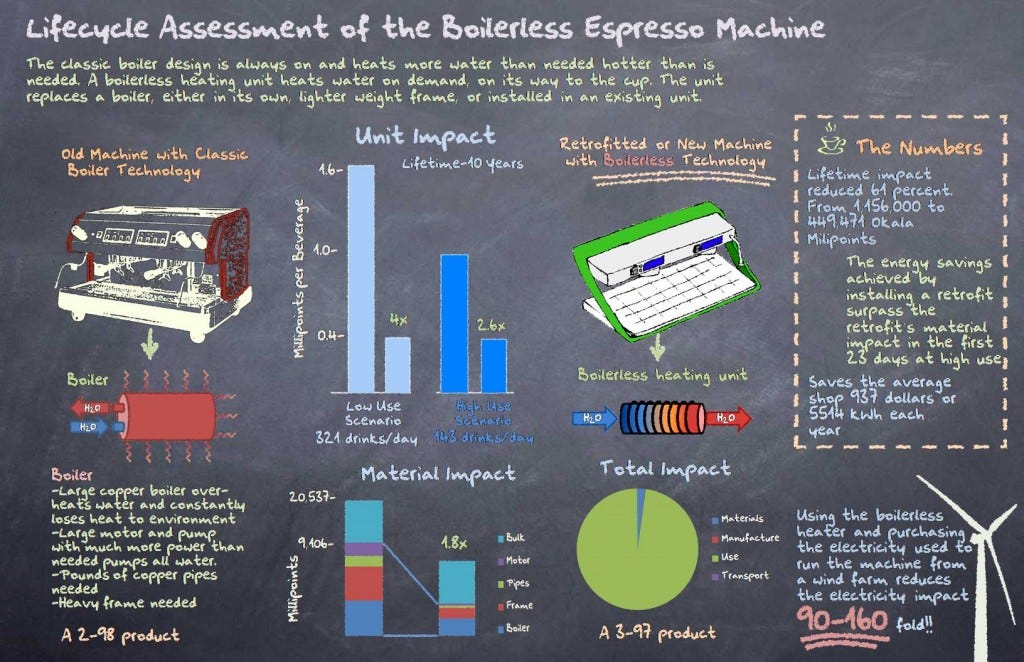
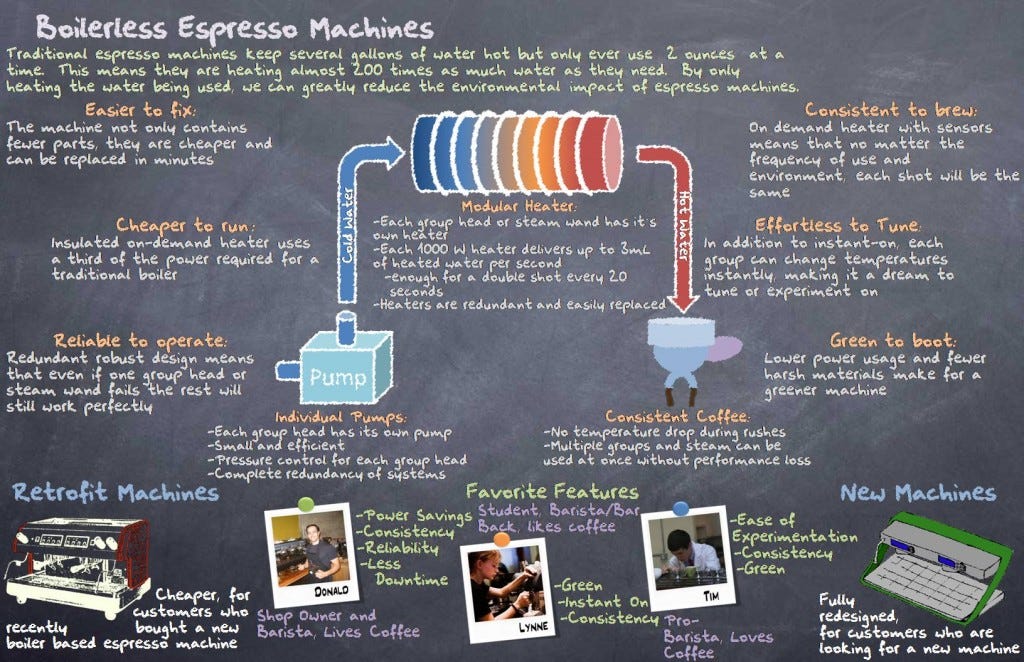
Do this for each part and paint smear on a B-2 bomber. Life Cycle Analysis/ Assessment of a coffee maker? Or the coffee that gets put into that Kureig? Oh, that is a fun experiment — where the coffee is grown, how, by whom, in which system of exploitation, which systems, who owns the finca, who works the finca, which Western company owns the brand, and then where the coffee fruit goes, or gets dried and then roasted, and then the criss-cross of all this raw product throughout the global chain, and then, packaging, transporation, marketing, middle men, and alas, in that Trader Joe’s as Trader Joe’s brand organice (is that beyond organic, or shade tree or frair trade or co-op locally owned coffee?)

Check out this WordPress piece:

Life Cycle Assessment of Espresso Machines

Life Cycle Assessment of Espresso Machines

Life Cycle Assessment of Espresso Machines

Life Cycle Assessment of Coffee Production Ben Salinas December 18, 2008

So, let’s do the same thing for just ONE US Mercenary product, hell, just a bloody set of boots, which ones, Timberline?

[Belleville Boot Company and Rocky Boots were recently selected to supply the U.S. Army with about 36,700 pairs of newly-designed Jungle Combat Boots.]

U.S. Army Boots Get an Upgrade | Incredible Polyurethane

This system of destruction — the greatest polluter and enemy of the earth — relies on that complex +Military Legal Retail Energy Oil Chemical Mining Education Surveillance Prison Policing Finance Banking Real Estate Entertainment PR Congressional Transportation Ag Pharma Medical COMPLEX. And relies on the thousands of Boeing’s and GE’s and all the cool companies on planet earth who are hiring cool kiddos and youth and adults to do the bloody Faustian Bargain.

Hell, in fact, some of those major Defense/Offensive Industries have parent and partner companies, so, at GE, for example, you can work on sustainability:

15.5MW offshore wind turbine ...

About GE Vernova

GE Vernova Inc. (NYSE: GEV) is a purpose-built global energy company that includes Power, Wind, and Electrification segments and is supported by its accelerator businesses. Building on over 130 years of experience tackling the world’s challenges, GE Vernova is uniquely positioned to help lead the energy transition by continuing to electrify the world while simultaneously working to decarbonize it. GE Vernova helps customers power economies and deliver electricity that is vital to health, safety, security, and improved quality of life. GE Vernova is headquartered in Cambridge, Massachusetts, U.S., with approximately 75,000 employees across approximately 100 countries around the world. Supported by the Company’s purpose, The Energy to Change the World, GE Vernova technology helps deliver a more affordable, reliable, sustainable, and secure energy future.

 

(Photo by Sebastien SALOM-GOMIS / AFP) (Photo by SEBASTIEN SALOM-GOMIS/AFP via Getty Images)

So your brother is at the other division of GE:

The General Electric GAU-8/A Avenger is ...

(GE) has a history of involvement in the military and defense industry, including the production of weapons and military equipment. While GE Aerospace focuses on engines and related systems for aircraft, they also have a history of manufacturing weapons and weapon systems. GE produced the M134 Minigun and the GAU-8 Avenger cannon, among other systems. They also supplied components and systems for various military aircraft and naval platforms. GE has also been involved in the development of jet engines for military aircraft.

We all get folded into this evil machine, this war machine, at every level, even all those community colleges with drone programs! Here, from California, where Abby and her family reside:
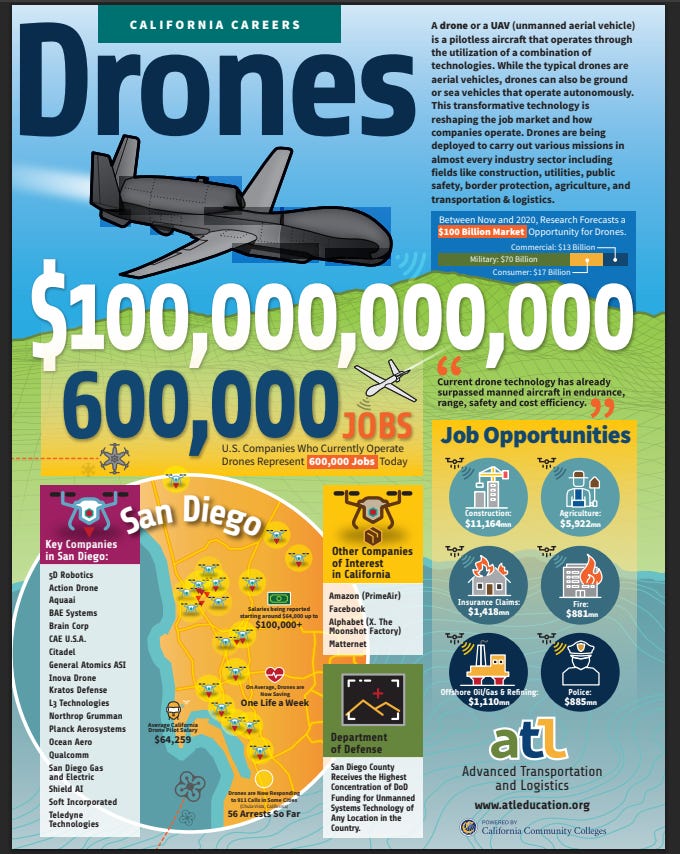
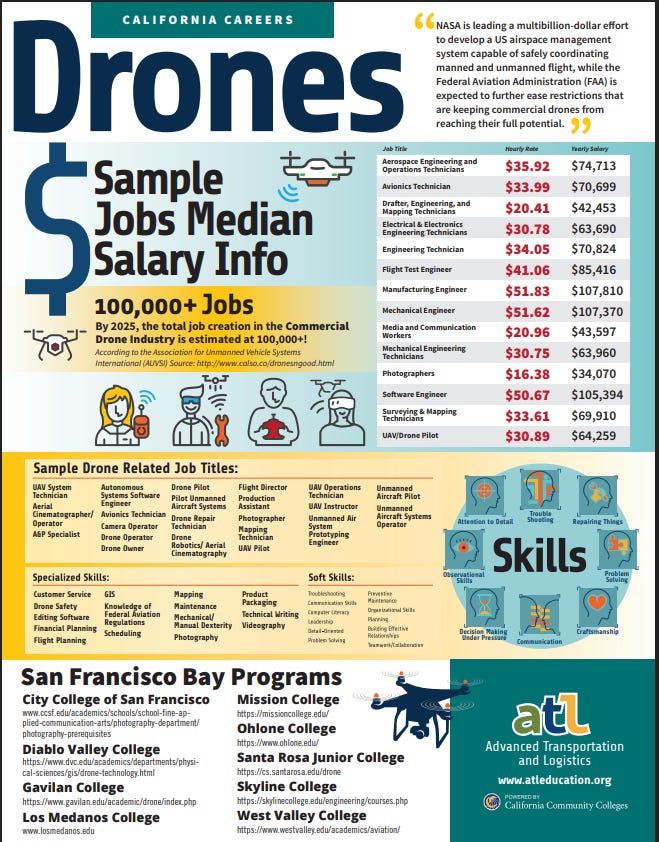
City College of San Francisco (Link)
Diablo Valley College (Link)
Gavilan College (Link)
Los Medanos College (Link)
Mission College (Link)
Ohlone College (Link)
Santa Rosa Junior College (Link)
Skyline College (Link)
West Valley College (Link)

Mt. San Antonio College (Link)

Santa Ana College (Link)
Coastline College (Link)
Orange Coast College (Link)
Cypress College (Link)
Fullerton College (Link)

In Israel, ‘Death to Arabs’ chants are common—but ‘Death to leftists’ is also heard. To ultranationalists, leftists are AIDS and Arabs are the common cold. You have to purge those tying your hands before carrying out the final solution — Abby Martin on X

Paul Haeder's been a teacher, social worker, newspaperman, environmental activist, and marginalized muckraker, union organizer. Paul's book, Reimagining Sanity: Voices Beyond the Echo Chamber (2016), looks at 10 years (now going on 17 years) of his writing at Dissident Voice. Read his musings at LA Progressive. Read (purchase) his short story collection, Wide Open Eyes: Surfacing from Vietnam now out, published by Cirque Journal. Here's his Amazon page with more published work AmazonRead other articles by Paul, or visit Paul's website.

Prospects for the Continuation of Life on Earth and of the Human Species


In the July 12, 2024 issue of the scientific journal Nature, an article was published by nineteen co-authors, entitled, “The nature of the last universal common ancestor and its impact on the early Earth system.” The article describes the current status of research into the origin of life on Earth, and the latest available evidence, based upon DNA data, the fossil record and isotope tracing. It demonstrates the remarkable, and even astonishing accomplishments of current state-of-the-art scientific inquiry into the origins of life on Earth.

The evidence discussed in the article points to a single Last Universal Common Ancestor (LUCA) as the original organism from which all life existing on earth today is descended and the appearance of this ancestor roughly 4.2 billion years ago. That ancestor appears to have been what is called a “prokaryote-grade anaerobic acetogen,” in other words, a very simple single-celled organism, neither male nor female and not requiring oxygen to survive. It procreates simply by creating copies of itself. Such cells continue to exist today, and our bodies contain large numbers of them.

As astonishing and significant as this statement is, it is important to recognize what it does not say. First, it does not say that other life forms did not precede LUCA. In fact, these even more primitive life forms (or pre-life chemistry) are presumed to have existed and evolved into LUCA, but we have no traces of them.

Second, LUCA is not presumed to have been the only existing life form at the time, but rather the only one that survived and evolved into all earthly life forms that exist today. To put this into perspective, let’s remember that our entire pre-human population of 900,000 years ago fell to only 1280 individuals, and remained that size until 117,000 years later, before starting to increase again. Furthermore, the entire human race today can trace its ancestry to a single woman, who existed around 200,000 years ago. Every human being alive today shares her DNA.

Both of these examples illustrate the fact that not all of the branches of a family tree ultimately bear fruit, so that even if the family is large, many individual members will themselves have no descendants. The continuation of my line, for example, depends entirely upon my two grandsons, who may or may not have children. That’s not unusual. Every family can ultimately trace its line to a single ancestor. In the case of LUCA, therefore, the common ancestor of all life on Earth is simply the one that survived. Others surely existed, but left no offspring that exist today.

The evolution of LUCA and the laws of evolution

Obviously, LUCA did not remain unchanged. It evolved into many other species and forms of life, through the processes first described by Charles Darwin. In fact, as the Nature article sets forth, it evolved into all other forms of life living today on Earth. How did it do that? Simply by following the laws of evolution. These laws have been described by many naturalists and biologists. The most famous of these laws with respect to evolution, is the law of natural selection, first articulated by Charles Darwin in his book, The Origin of Species. With some editing on my part to allow for the more recent discovery of DNA and its role in what Darwin called heredity, it can be stated as follows:

Evolutionary Law #1: Natural selection is the process by which an individual member of a species passes along traits encoded in its DNA to its offspring. To the extent that these traits contribute to the survival of the offspring, they propagate themselves (and therefore the species).

Natural selection operates over generations to select for the traits that help a species to survive, and to select out the traits that do not. This is often called “survival of the fittest,” with “fittest” being a relative term, depending on changes in the environment in which the species lives. In some cases, the entire species dies out, which we call extinction, when, for example a change in habitat is too great or too abrupt for natural selection to save the species. Some examples of extinct species are the trilobite, the Irish elk, and the Hawaii Chaff Flower. In other cases, one species can evolve into more than one, when populations of a species are isolated from each other for a long time in habitats that alter them in different ways. A common example is the donkey or burro and the horse.

The factors at play in evolution and extinction are many. Some examples are:

  • climate change
  • cataclysmic events
  • loss of habitat
  • invasive competing species
  • loss of food source
  • physical isolation of a species, or a population with the species

By the same token, some of the traits by which species propagate themselves in order to adapt to these changes are:

  • strength
  • speed
  • rapid maturation
  • defensive mechanisms
  • access to prey or nourishment
  • aerial flight
  • prolific distribution of seed or offspring
  • ability to store nutrients
  • access to sexual propagation
  • ability to survive hardship and deprivation

All of these are fairly obvious, but it is their common thread that can be consequential in ways that are well-known but not yet fully explored. That common thread is competition. All organisms compete with each other – both within and between species – for resources and sustenance, including food, shelter, mates/procreation, protection, etc. This is true for fungi and single-celled organisms as much as for higher species. It is a well-known, universally accepted statement (or law, if you prefer). It permeates the behavior of all life forms, including (obviously) the human species. It can also be stated as a second Law of Evolution:

Evolutionary Law #2: All living things compete for their existence with all other living things.

The role of cooperation

But does natural selection operate by competition alone? What about cooperation, such as symbiosis and other mutually beneficial relationships between organisms of both the same and different species?

There’s no doubt that cooperation is a factor, but what is its role? We can begin this line of inquiry by examining what eventually happened with LUCA. For well over a billion years, LUCA and its descendants remained prokaryotes. Evolution was not static during this time, but it was exceedingly slow, and dependent to a vastly greater extent upon chance mutations and interactions other than mating, which did not yet exist.

Nevertheless, prokaryotes eventually graduated to eukaryotes – single cells with a nucleus housing the DNA – sometime between 2.7 and 1.8 billion years ago. This means that for a minimum of 1.5 billion years, LUCA did not to evolve beyond simple anaerobic single-celled organisms with no nucleus. This is not to say that prokaryotes did not evolve at all during that time, only that before the appearance of eukaryotes, the potential of natural selection was not apparent. This all changed with eukaryotes – a fundamentally new form of life, containing a nucleus housing the DNA.

Eukaryotes were capable of combining with each other to form offspring that were a combination of two parent cells, and not merely copies of a single parent. As a result, the offspring would have combinations of the DNA from the two parents, and thus be different from either of them. This drove faster evolution, and eventually developed into male and female types, as well as a categorical distinction between plants, animals and fungi, starting as early as 1.5 billion years ago, with plants consuming carbon dioxide and expelling oxygen, and animals and fungi consuming oxygen and expelling carbon dioxide. Even more significant, eukaryote cells began to cluster in ways where some could specialize in certain functions – such as digestion and protection – that served other members of the cluster, and vice versa. These colonies of cells with specialized functions exist today in organisms like the Portuguese man o’war, and bear some resemblance to colonies of insects like ants, termites or bees. In any case, these clusters of eukaryotes can be considered early examples of cooperation, and these first cooperative groups of eukaryotes eventually evolved into the first multi-celled organisms, both plants and animals.

Competition vs. cooperation

There is no question that both competition and cooperation are inherent in all life forms on Earth, and that the origin of cooperation may be said to begin with the transition from prokaryotes to eukaryotes, some 2 billion years ago. It is no wonder that they are both part of our DNA, so to speak.

But I would argue that competition is in fact the only driving force in evolution. Why? Let me begin with a reductionist argument. Let us suppose that an organism exists that does not compete for its existence against organisms that do compete? With no motivation to defend itself against other organisms, how fast would it simply cease to exist?

But if that is self-evident, how can cooperation exist at all? The answer is that cooperation confers an advantage to the organisms that engage in it. It was true for the early eukaryotes, and it is true for social alliances today, from wolf packs to human nations and bee hives.

But what is the nature of the advantage that cooperation confers upon the organisms that engage in it? The simple answer is that it enhances the ability to compete. In French they say, “l’union fait la force.” Unity makes strength. Strength for what purpose? To compete.

Ungulates form herds. Why? For protection. Nations form alliances for the same reasons. Criminals form gangs. Wolves form packs. Fish form schools. Bees form hives. Eukaryotes form colonies and eventually multi-celled organisms. But the purpose is always the same: to compete more effectively, to survive and to pass one’s genes to one’s offspring. Cooperation is a means of competition, not an alternative to it, as far as natural selection is concerned. Life does not compete in order to cooperate; it cooperates in order to compete. This may be stated as:

Evolutionary Law #3: All living things cooperate in varying degrees with each other for mutual advantage over other living things.

Obviously, none of this is directly relevant to questions of morality, ethics, justice or religion. Right and wrong, as well as good and bad, are questions which must be answered in a different type of discussion. The analysis that is presented here is devoted to what is or is not, with respect to evolution and where it is leading the human species, life on Earth, and potentially life throughout the universe. I am not addressing the question of what should or should not be. But it always helps to start with what we know, in order to look at the effects and consequences.

The emergence of technological species

We come now to the question of the human species and its evolution. We know that evolution has led life in many different directions during its long history on Earth. It began in the sea, migrated onto land, and eventually into the air, as well. It has developed life forms that generate poison and perfume, change color at will, grow horns, fangs and armor and many other means and strategies for defending themselves, gaining advantage over other organisms, and propagating themselves. Evolution can be a very powerful process.

We are, nevertheless, at a particularly momentous juncture in the history of evolution. I refer not so much to the development of the human species per se as to the development of technology in the hands of the human species. Humans are of course the primary and almost exclusive agent of technology on Earth, and they are exceptional in its natural history. We tend to think of intelligence as the primary reason for the ascendance of the human species. But we know that other species possess intelligence as well, including cetaceans, corvids, elephants and cephalopods. And we can’t be sure about the power of their intelligence, their linguistic abilities, and their abilities to function in organized groups. Their intelligence and communication skills, as well as their social organization and life cycles may be so different that it can be hard to gauge their capabilities.

But the octopus is the only other intelligent organism that possesses anything like our hands, and cephalopods are handicapped by a very short lifetime and a lack of social structure. Our ability to fashion, with our hands, new and artificial objects and machines and to harness energy, i.e. technology, is unique. We are clearly the first technological species on this planet. This is why I prefer to emphasize the contribution of technology, rather than brain development or intelligence per se toward the age in which we find ourselves. Let us remember that our brains are essentially the same as they were tens of thousands of years ago. The last major change was the development of human language, which required some rewiring of the brain, but not a lot, because it had already proceeded in that direction, as it has in other species. Current estimates are that the capacity for modern language in Homo sapiens evolved prior to 135,000 years ago, but actual modern language may not be much older than 100,000 years. On the other hand, tool making is millions of years old. Neither tool making nor intelligence nor language nor even hands are unique to the human species, but the convergence of them is. And clearly, these capabilities have fed off each other in a systematic way, even if none of them has resulted in major physical changes in our species.

Some of this can be inferred from the growth and spread of human population, especially during the last 60,000 years or so. Equally astonishing has been the parallel and roughly simultaneous development of agriculture, urban architecture, and written languages, even in the Americas, which could not have known what was happening on the other side of the world. The reasons for this are not likely to be organic changes, since we are essentially the same organism everywhere on Earth. The process and the convergence appear to be largely self-driving, once all the elements are in place, perhaps when human settlements reach a critical size that creates a level of interaction that is in some ways exponential. No other species achieved these breakthroughs.

The process has now brought about the Age of Technology, which is accelerating at breakneck speed, challenging our efforts to keep up with and adapt to it, and potentially relegating our participation to that of mere cogs in a system controlled by algorithms, technical managers and organizations like Cambridge Analytica, who discovered that humans could be controlled to a significant degree through their electronic devices. The onset of the age may have begun with the first stone tool kits of hominids, millions of years ago, but today it has progressed to where technology increasingly drives itself, with humans as the pollinators of developments such as AI, artificial life forms and exploration of both the farthest and innermost reaches of the universe. We are often unprepared for the consequences. Most of us try to keep up, but it requires increasing vigilance to stay ahead of the forces arrayed to manipulate us and turn us into mere fuel for the vast machinery that is technology today. Think about your interaction with your smartphone. Who is controlling whom?

Perhaps most of this is the inevitable result of the convergence of forces that formed our species and its societal dynamics. Nevertheless, it is in our interest to try to understand what is happening to our species and our planet – and beyond – to the best of our abilities. This is a unique time in the history of life on earth, and it is due to the evolution of our species and its capabilities. Intelligent species existed in the distant past, especially among dinosaurs, but while we have found their remains, we have never found any signs of civilizations or technologies produced by them. And we surely would have, if they existed. Apparently, the convergence of developments that resulted in a species capable of creating a technological society has never existed on Earth until now.

Similarly, we have no confirmed signs of technology from other worlds, either on our planet or on the others that we have investigated thus far. At most, we have speculation about unexplained phenomena that remain unexplained, which has been true since the beginning of time. But we have no objects on Earth that could not have been produced on Earth, whereas we have transported earth-made artifacts to several other bodies in our solar system, which could not have been produced on those bodies. Where is the space junk from extraterrestrial civilizations?

A similar question was famously asked by nuclear physicist Enrico Fermi in 1950 at a gathering of his fellow scientists. After some debate about life on other planets, they concluded that it must exist, because there is nothing particularly unique about Earth. Planets with life may be rare, but there are so many planets in the universe that ours cannot be the only one to produce life. Even one in a million allows for a vast number. Furthermore, even though it took Earth more than 4 billion years to create its first technological species capable of interplanetary – and potentially interstellar – travel, there is no reason to think that we are necessarily the first in the entire universe, much less the only one. In fact, the odds are hugely against this being the case. This is the point at which Fermi asked his famous question, known as the Fermi Paradox, “Then where are they?”

This is more than an idle question. It is a troubling mystery and refers to an uncomfortable fact that deserves an answer. Why is there no evidence of any contact with extraterrestrial civilizations? Why would such civilizations not have left their traces during the billions of years of our planet’s existence? If we can find one-celled organisms from the earliest times, how much easier is it to find alien space junk? Even if aliens found our planet not worth very much of their time, how much more interesting are the moon and Mars, where we left our space junk? It is simply inconceivable that Earth would not have been visited, nor that we are the very first technological species to exist in all the universe.

The answer to Fermi’s question may help give us an idea about where we are headed as a technological species, and I believe it is possible to at least partially provide such an answer using the facts and analysis already discussed thus far. I apologize in advance if the answer is not to your liking; it is not to mine, either.

The evolutionary ceiling

What worries me is that there may be a law of evolution that has the effect of blocking technological species from developing beyond a certain point – that a technological species hits a ceiling above which it cannot rise, and that this law is the same everywhere in the universe, because the laws of evolution operate the same throughout the universe, as do the laws of physics. If we could pass that point, we would make contact with other technological species from other planets. But the available evidence points to the conclusion that no species anywhere in the universe develops beyond that point. Why?

Does it have anything to do with competition being the prime mechanism behind natural selection and cooperation secondary? I don’t know, but the idea that human nature is fundamentally different from the nature of all other life seems flawed and unrealistic to me. We’re not that different. The laws of the universe are universal.

Hollywood is full of films, like Dr. Strangelove and Don’t Look Up, about apocalyptic and post-apocalyptic visions of the world. We all agree that they have a plausible basis, because we know the power of existing weaponry and the potential to use it, as well as the weakness of human will. Our species is entirely capable of wreaking terrible destruction on our planet, and destroying many of its species, including our own. In fact, a significant number of species already trace their extinction to human activity. Did technological species on other planets and star systems meet the same fate? Is there a law of nature and evolution that dictates that when a technological species reaches a certain point of development, it destroys itself or sets itself so far back in development that it requires a long, arduous crawl to recover, at which time it once again hits its evolutionary ceiling? Perhaps we should take Hollywood more seriously.

We certainly have the means to accomplish such an apocalyptic outcome: nuclear war, climate change, biological warfare (such as experimental disease strains), chemical warfare, even artificial intelligence. If extraterrestrial civilizations have the same experience, this would certainly explain the absence of contact from or with them. But is it a law of evolution?

I believe that a strong case can be made that it is, that it is built into the nature of life and the primary mechanism of natural selection, as a corollary to Evolutionary Law #2, that all living things compete for their existence with all other living things. I therefore propose Evolutionary Law #4 as follows:

Evolutionary Law #4: When a technological species achieves the capability of self-destruction, its primary competitive drive sooner or later causes the exercise of this capability.

Is an evolutionary ceiling hanging over our heads like a sword of Damocles? Do natural laws of evolution dictate that sooner or later we will bring catastrophe upon ourselves? If so, how close are we to that point? In the last 2 million years, have we ever invented a weapon that we have not used? The answer is no, we haven’t.

The spectacular and unprecedented changes through which we are now living appear to be accelerating geometrically and perhaps exponentially. Compared to the period of the existence of life on Earth, the Age of Technology is no more than a split second, but its acceleration seems without constraint. My analysis is a modest attempt to suggest that there may in fact be a limit – an unplanned direction in which we may be headed, and which may be directed by universal laws that we as yet understand poorly.

Let me ask six questions for which I do not have answers but which may illustrate the problem.

  1. How likely is it that we will stop inventing new means of destroying ourselves, either in part or in whole, whether deliberately or not?
  2. How likely is it that all the nations of the world will agree to destroy all technology that endangers our entire species?
  3. How likely is it that we will live with the tools of our own destruction for the indefinite future without using them, either by accident or on purpose?
  4. If we agree to measures that will make us safe, how long will all the nations of the world abide by them, with no “Samson option” that destroys everyone?
  5. If we achieve the previous objectives, how likely is it that we will manage to keep the means of destruction out of the hands of actors that are not party to the agreements?
  6. If we manage to adhere to all of these control measures for ten years, how much longer will we be able to do so? Another 10 years? Another 50 years? Another 100 years? Another 1000? 10,000? 100,000? Will we really keep all of these weapons under control indefinitely?

We have no previous experience with this point in our evolutionary history. Nothing to compare it to. If or when we hit the Evolutionary Ceiling, what will it look like? Will we destroy all life on Earth? Will we destroy all human life plus some other species? Will we destroy ourselves only to the point of leaving behind enough population remnants to rebuild slowly, in the absence of the technological tools to which we will have become accustomed? If we succeed in rebuilding, will we find ourselves hitting the same Evolutionary Ceiling as before? In that case, will the result be as bad or better or worse than the first time, or is it totally unpredictable?

As I said, we have nothing to guide us. For us this is the first time in our planet’s history (and possibly the last) to face this situation. We also have no guidance from the rest of our galaxy or universe, at least not yet.

I don’t know about you, but I would find it very comforting to receive visitors from other planets telling and showing us that there is another option and explanation for Fermi’s Paradox.

  • Image credit: NASA.
Paul Larudee is a retired academic and current administrator of a nonprofit human rights and humanitarian aid organization. Read other articles by Paul.

When Love Is locked

In the divine tapestry of creation, color is not merely pigment—it is poetry. Each human hue whispers of the Creation’s ingenuity, each skin tone a stanza in the sacred hymn of life. And yet, humanity has tarnished this gift, not only misinterpreting color, but misusing it to justify exclusion, superiority, and division.

The Betrayal of Divine Intention

If Creation painted us in earth’s full spectrum, who gave us the brush to redraw it in shades of exclusion? The problem lies not in our diversity, but in how we weaponize it. Color has too often been turned into caste; belief into boundary. And when skin and scripture become gatekeepers to love, something sacred is lost.

Region, Religion, and Restricted Love

Across communities—Muslim, Jewish, Hindu, and Christian alike—interfaith relationships often face resistance. A person may be cherished, yet denied partnership simply because of religious difference. This isn’t a condemnation of any one faith—it’s a call to all of them.

Consider the story of John, a man who brought Mariama, the woman he loved, from West Africa to the United States. They envisioned a shared life. Yet Mariama’s mother traveled all the way from Guinea to forcibly separate them—because John would not convert to Islam. The heartbreak wasn’t just theirs. It was the consequence of a system where love must pass through theological gatekeeping to be deemed acceptable.

Spirituality Versus Religious Dogma

John identifies as spiritual—not religious—a seeker of truth and compassion beyond rigid doctrine. But when love must conform to dogma, we must ask: Are we preserving faith, or strangling it? Must devotion be validated by religious identity to be sanctified? Should our spiritual traditions demand uniformity at the expense of unity?

Toward a Theology of Human Dignity

Let us reimagine our religions not as gates, but as gardens. Let faith serve love—not restrain it. Let skin be sacred. Let belief be fluid. Let marriage be a union of souls, not just scriptures.

We must honor Creation not through exclusion, but through empathy.

Love should not be conditional. It should be courageous.

The Final Cry

In an increasingly divided world, this article speaks to the urgent need for interfaith compassion and the reclaiming of love from the grip of exclusion. It is a call to soften the edges of doctrine, to widen the gates of empathy, and to remember that love, in its truest form, transcends creed.

Sammy Attoh is a Human Rights Coordinator, poet, and public writer. A member of The Riverside Church in New York City and The New York State Chaplains Group, he advocates for spiritual renewal and systemic justice. Originally from Ghana, his work draws from ancestral wisdom to explore the sacred ties between people, planet, and posterity. Read other articles by Sammy.


Ethnic Cleansing in the United States


Until 1492, all of North America belonged to its many indigenous peoples. With the coming of Europeans, that began to change. Said Europeans came as conquerors and colonial settlers. They brought new diseases which massively depopulated the indigenous nations. The ubiquitous abuses, which European and Euro-American governments perpetrated against the Indigenes, were “justified” with racial and religious prejudices. By 1900, the Indigenes had been: expelled from most of their lands, decimated, impoverished, and marginalized. Official United States history generally evades what was actually done and by whom.

Land cessions. Relevant history.

Colonial period. Between 1565 (when Spain established, in Florida, the first permanent European colony in what was to become the 48 contiguous United States) and 1783 (when the United States gained its independence from Britain), Euro-American colonial settler-states forcibly displaced the indigenous nations from most of the land east of the Appalachian divide. Said displacements were often effectuated through violent military action, often in wars provoked by abusive colonial-settler impositions upon their indigenous neighbors. Most of the displaced Indigenes, who survived, were thusly forced to relocate to territory further west.

US claims. During the War for United States Independence, some of the indigenous nations (and/or their internal factions) remained neutral, while others eventually took one side or the other. Of the latter, many more sided with the British than with the United States, because Britain (wanting to avoid costly armed conflicts) had attempted to protect indigenous territory from incursions by Euro-American land speculators and frontier settlers. With the end of the War in 1783, the United States laid claim to sovereignty over all of the territory between the Appalachian divide and the Mississippi River. At first, the US claimed the right to take ownership of all of the land in this new territory based upon a purported “right of conquest”. Naturally, the indigenous nations refused to accept either the claim of US sovereignty or the purported right of Euro-Americans to take their land.

Treaty cessions. As the United States seized indigenous land in response to pressure from wealthy land speculators and racist demagogues, war was the inevitable result. The US government soon recognized that negotiations for land cessions was an easier and far less costly means for enforcing the claimed sovereignty and obtaining the coveted land. In such negotiations, all of the advantages were with the US side, which used those advantages to gradually obtain nearly all of the coveted territory thru a series of unequal treaties. The treaties were, of course, always written: by the US side, in the language of the Euro-Americans, and using interpreters chosen by the US. US government agents (who often were territorial military governors) used intimidation, coercion, deceit, bribery, and exploitation of conflicts within and between the indigenous nations. Although the indigenous nations were paid for the land, that pay was a small fraction of its actual value and commonly included promised annuities. Said annuities were often subsequently withheld in order to extort cessions of additional territory. Moreover, the US side routinely recognized an indigenous go-between, who was willing to comply with US demands, as agent (or purported “Chief”) of an indigenous nation even though said go-between often had no authority to act for that nation. Naturally, the resulting treaties were generally fraudulent.

Principal source: Robert M Owens: “Indian Land Cessions” (encyclopedia.com, © 2019).

Land speculators. Until the middle of the 19th century, for Euro-Americans with money, the most popular and usual place to invest was in land, especially land on the frontier yet to be settled by Euro-Americans. Wealthy Europeans also often invested in such American land. Naturally, wealthy land speculators cast covetous eyes upon land owned and occupied by the indigenous peoples. Said land speculators were leading instigators of Euro-American aggressions and wars against the indigenous nations, aggressions thru which such lands were acquired by the governmental authority. Of course, “valid” title to land in frontier areas could only be obtained from the colonial governments or later the federal government. Politically connected land speculators used their influence with provincial and federal office-holders to purchase, on especially favorable terms, grants of large tracts of land newly extorted from the indigenous nations. Then, after the Indigenes had been expelled, said grant holders would contract surveys and sell the land in small lots at a great markup over their privileged purchase price. A notable example is the case of western New York.

Preemption. In the 1784 Treaty of Fort Stanwix, the US acknowledged that ownership of western New York belonged to the Six Nations Confederacy. A 1786 agreement to resolve conflicting claims over this territory gave its governance to New York, but gave to Massachusetts a preemptive right to buy the land from the Haudenosaunee. In 1788, Oliver Phelps and Nathaniel Gorham purchased (from Massachusetts) that preemptive right over nearly all of New York west of Seneca Lake (6 million acres occupying 14 present-day counties). The price was $1 million, but it was to be paid in Massachusetts scrip then worth about 20 cents on the dollar. The scrip rose in value to par, and Phelps and Gorham were then unable to complete payment. When they defaulted after having made their first of three payments, purchase rights over the western 2/3 (that is the part west of the Genesee River) reverted to Massachusetts. In 1791, Robert Morris (then the richest man in the US, also a signer of the Declaration of Independence, and [like half of his fellow signers] a slave owner) purchased the rights over most of that 2/3 (for $333,333.33).

Dispossession
. In 1792 and 1793, Morris contracted the sale of most (3,250,000 acres) of his subject land to the Holland Land Company (a syndicate of wealthy investors in Amsterdam, Netherlands). In order to deliver clear title, Morris had to buy the land from the Haudenosaunee, its actual owners. In 1797, their agreement to sell (for $100,000) was fraudulently extorted in the Treaty of Big Tree thru a combination of: (1) threat that the US would likely not recognize their ownership rights, and (2) bribery of their leaders and negotiators. As a concession, the Haudenosaunee were left with 200,000 acres (about 6%) for reservations. The Holland Land Company hired a survey (cost $71,000) and divided the land into lots which it then sold between 1801 and 1840.

End result. Massachusetts, which had never paid anything to the Haudenosaunee, received from 9 to 15 cents per acre (respectively from Morris and Phelps-Gorham). The surveyors were paid about 2.2 cents per acre. The actual owners, the Haudenosaunee, received about 3 cents per acre. The land in post-survey lots was then sold, initially at $2.75/acre. Thus, the land speculators (Morris and the Holland Land Company) apparently received, between them, gross profits in excess of $2.50/acre.

Principal sourceWikipedia: “Treaty of Fort Stanwix” (1784) (2025 April 06); “Treaty of Hartford” (1786) (2025 July 11); “Phelps and Gorham Purchase” (2025 July 13); “Holland Land Company” (2025 July 10); “Treaty of Big Tree” (2024 February 26).

Purchasers. Land, in the fully settled eastern part of the newly independent United States, was mostly all privately owned, and it was relatively expensive. Consequently, working tenant farmers and farm laborers generally could not afford to purchase farms there. Meanwhile, land in the western frontier areas possessed certain relative disadvantages; specifically: less of it had been cleared of woods, its roads and other transportation infrastructure were few and crude, and access to markets and established Euro-American communities was more distant and difficult. So, whenever land became available on the western frontier, it was relatively cheap. With every tract of territory ceded by the Indigenes to the US, the federal government asserted ownership of the ceded land. In the old Northwest Territory (Ohio, Michigan, Indiana, Illinois, and Wisconsin), the Indigenes received pennies per acre for their land, which the US government then surveyed and offered at auction to individual family farmers at prices of no less than $1.00 or $2.00/acre, often after having previously sold large tracts to wealthy politically-connected speculators at lower prices. The speculators, who never settled on the land, purchased it only to re-sell at a sizable mark-up to later settlers. Moreover, such speculators were a major influence on US policy to take the land from its indigenous peoples, as they (along with racist demagogues and war-profiteering military contractors) lobbied their friends in government to induce said government to seize and/or extort ever more cessions of territory from the indigenous nations. [3]

Principal source: Paul W Gates: “Land Speculation” (encyclopedia.com, © 2019).

Interracial relations. In order to justify the dispossession of the original owners and to obscure the fraud and theft utilized in the process, the proponents (land speculators, other advocates of US expansionism, and their apologists) routinely resorted to rationalization, misrepresentation, and bigotry.

Firstly, although there was brutality on both sides in the “Indian” wars (invariably provoked by the Euro-American side), the expansionists dehumanized the Indigenes by one-sidedly vilifying them as murdering heathen savages.

Secondly, they portrayed white settlement as bringing civilization to an untamed wilderness and falsely portrayed the indigenous peoples as incapable of making productive use of the land. In fact, the indigenous peoples throughout almost the whole of the territory between the Atlantic Ocean and the Mississippi River were farmers, who cleared tracts of the woodland in order to raise the crops which included their staple foods (maize [corn], beans, and squash) plus various other vegetables. Meat obtained in the hunt was a supplement to the staples. If the Indigenes did not clear as much of the woodland as the Euro-Americans, this was: because their lower population density and their land rotation practice made it unnecessary; and (until after European contact) because they lacked the steel saws and axes and the draft animals of the Euro-Americans, which made forest removal much easier.

Despite the disparaging propaganda against the indigenous peoples, most settlers sought to avoid conflict with the remaining local natives. Some, as attested in contemporary reports, went further and established neighborly and mutually beneficial trade relations with neighboring Indigenes. It was the avaricious profiteering men of wealth and power who created the conditions for ethnic cleansing and genocidal policies.

Principal sources:

Jack Lynch: “A Principal Source of Dishonor: Indian Policies in Early America” (C W Journal, 2009 Spring).

R Douglas Hurt: “Agriculture, American Indian” (encyclopedia.com, © 2019).

Charles Pierce is a social-justice activist (since his youth in the early 1960s), a former/retired labor activist (union steward & local officer), and currently a researcher and writer on history and politics. He can be reached at cpbolshi@gmail.comRead other articles by Charles, or visit Charles's website.