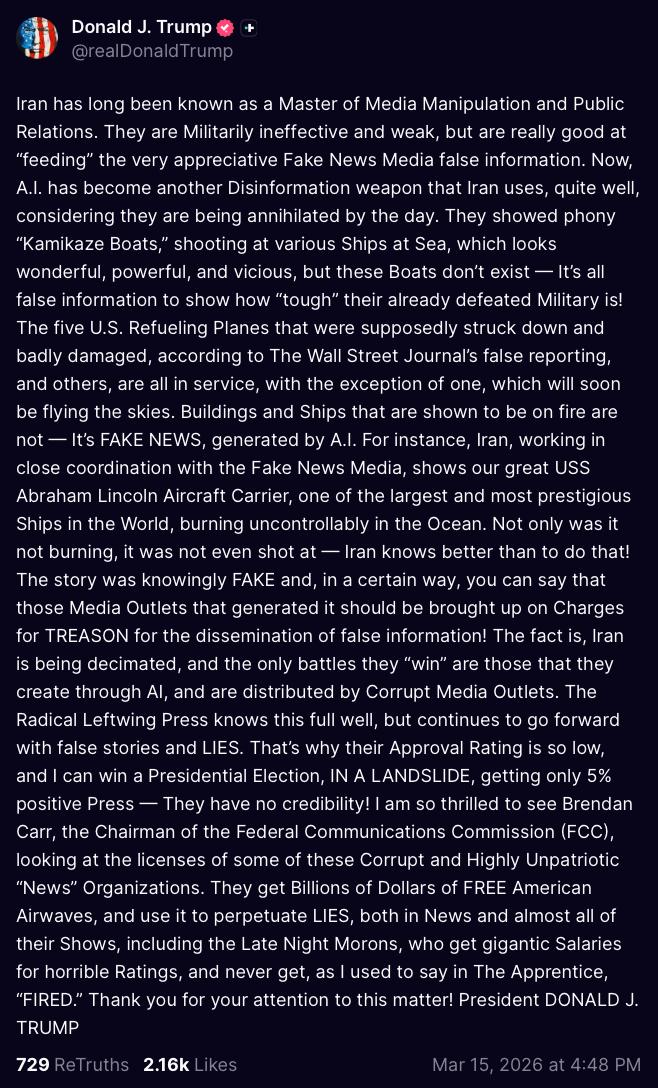
Under increasing pressure as the war in Iran is not going according to plan, Trump lashed out, claiming all footage of Iranian strikes, burning ships, and downed aircraft is AI-generated. He also threatened the press with treason charges for reporting confirmed military losses in an active war in a post on social media.
A Pentagon spokesperson told CNN: “Due to operations security, we are not going to comment on the status of specific capabilities in the region.”
US bases, airfields and crucial THAAD radar stations have been destroyed by unexpectedly effective Iran missile strikes in the last two weeks, The Economist reports after reviewing the images. Tehran had aimed at “the eyes, the ears and the arteries of the entire American military architecture in the region” the magazine said.
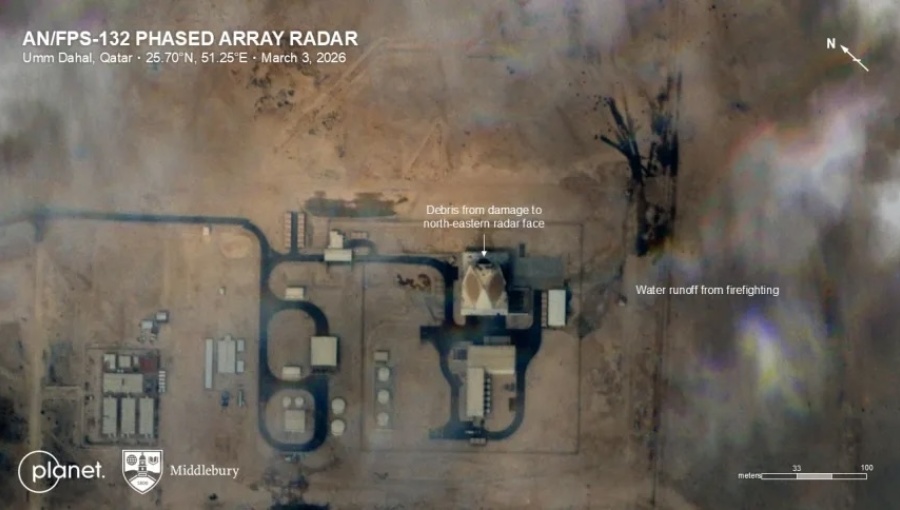
Early commercial imagery shows extensive damage to all four of the AN/TPY-2 THAAD air missile defence radar stations in the region, leaving US forces partially blind to Iran’s long-range ballistic missile attacks that can otherwise penetrate much of the US and Israeli air defences. The US has scrambled to dismantle its remaining four THAAD radar stations in the Indo-Pacific region and ship them to the Middle East.
Last week, US President Donald Trump called on the US press to stop reporting on the damage Iran was causing for national security reasons.
Planet Labs — one of the world’s largest commercial satellite imaging providers — has “voluntarily” imposed a 96-hour delay on imagery from the Middle East before extending the restriction to a 14-day blackout covering allied bases, Gulf states and several conflict zones.
At the THAAD station in Muwaffaq Salti Air Base in Jordan, worth half a billion dollars, satellite analysis shows two large impact craters measuring roughly 4m across near the installation, with the radar complex reportedly reduced to rubble.
Similar damage was reported to the other stations at sites in Israel’s Negev desert, Qatar at Al Udeid Air Base, the UAE near Al Dhafra, and the Prince Sultan Air Base in Saudi Arabia. Without their radar, the THAAD interceptor missiles are effectively made useless.
Imagery circulating online also suggested damage at Saudi Arabia, where five KC-135 aerial refuelling tankers were said to have been damaged.
Other targets successfully hit have included US bombers and fighter jets standing on the tarmac at a US base in the UAE as well as the US Fifth Fleet headquarters in Bahrain and Al Udeid Air Base in Qatar. One set of images was claimed to show structural damage to a CIA facility in Riyadh.
Trump has denied the US has suffered any serious setbacks and claimed the Iranian military has been “100% destroyed”.
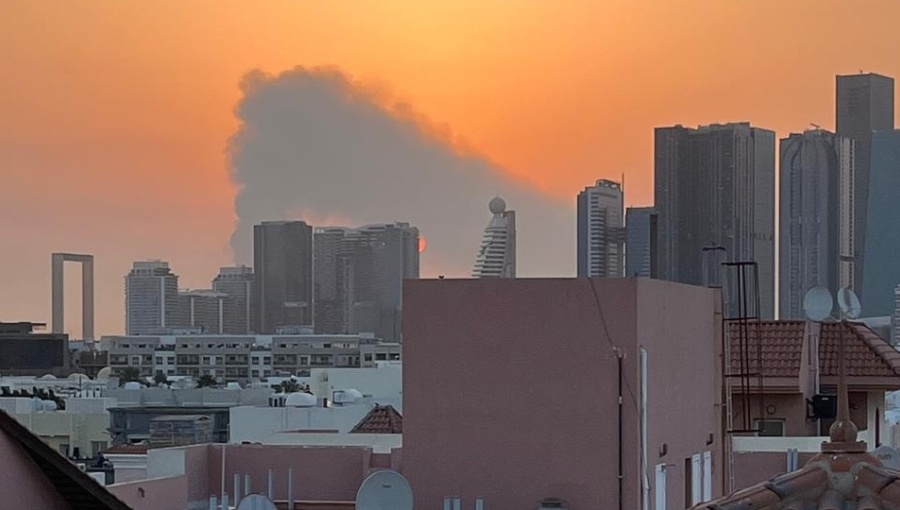
A drone strike hit Dubai International Airport on the morning of March 16, while one person was confirmed to be killed in a separate missile strike on Abu Dhabi.
While the UAE’s airspace was closed after the initial drone and missile strikes originating in Iran, the country has since gradually reopened its airspace, with Emirates, Etihad, Air Arabia and flydubai announcing limited flight resumptions. Still, repeated incidents have continued causing temporary aviation disruptions.
The airport strike ignited a fuel tank, prompting the temporary suspension of flights as a precautionary measure, Dubai Media Office confirmed via X.
Dubai Civil Defence teams contained the fire with no injuries reported, according to the Dubai Media Office. Dubai Airports subsequently diverted some flights from Dubai International Airport to Al Maktoum International Airport whilst operations were disrupted.
At 10:08 local time, Dubai Media Office confirmed the gradual resumption of some flights to selected destinations. "Passengers are advised to check with their airlines for the latest updates regarding their flights," the update warned, noting that not all flights were guaranteed to proceed as scheduled.
That same morning, Abu Dhabi authorities confirmed that a missile hit a civilian vehicle in the Al Bahyah area, resulting in the death of a Palestinian national.

No comments:
Post a Comment