Sunday, August 10, 2025


Athlete mental health support from coaches “under explored” in research amidst deselection concerns


Review of 104 studies shows little research focused on athletes’ access to mental health support or semi-formal sources such as coaches


University of Birmingham


A paper published in BMJ Open today (Friday 8 August) led by researchers from the University of Birmingham highlights how few studies conducted into athlete help-seeking for mental health have looked into support provided by semi-formal sources such as coaches, with the majority of research conducted on formal sources.

The team reviewed 104 relevant studies conducted around the world and found that while many athletes experience mental health issues, they face unique sport-specific barriers when seeking help and guidance. The review mapped the research on athletes’ views on access to support, their attitudes toward seeking it, and their past experiences from formal and semi-formal sources of support.

Kirsty Brown, PhD student, from the University of Birmingham and lead researcher said:

“We know that athletes’ face specific barriers to seek help for mental health. By mapping the research on athletes’ views on access, attitudes and experiences of support, this research uncovers more about the process of help-seeking in athletes, and where further research is required.”  

“Our new research highlights that while there is a growing academic understanding of how sports people experience mental health support, there are still unexplored areas in the research that leaves many questions unanswered about how athletes’ utilize formal and semi-formal sources of support. It is essential that these support networks understand the unique needs of athletes and are equipped to provide mental health support and signposting.”

Formal or semi-formal support?

Athletes may rely on coaches for semi-formal support with mental health despite stigma and deselection concerns, but a new study highlights little research has been conducted in this “crucial” area.


Most of the research focused on formal sources of support (55%) such as psychologists or counsellors, with only 2% of papers looking at athlete interactions with semi-formal support such as coaches or academic advisors. 26% both formal and semi-formal were looked at.

Attitudes to seeking help

Athletes’ attitudes to seeking support for their mental health was the most researched area among the studies that the team looked at, with 79% of papers investigated incorporating this question.

Notably, access was the least studied area with less than a third (32%) of papers investigating this issue, despite being a foundational factor in help-seeking behaviour.

Where next?

In addition, the study highlights gaps in studies looking at athlete help-seeking in lower-income and non-Western contexts, where cultural and structural barriers may differ. The team suggest that future research should also explore semi-formal sources of support more thoroughly, especially given their accessibility and potential influence on athletes’ willingness to seek help. Additionally, a more consistent use of validated help-seeking measures and established psychological help-seeking theories and frameworks would strengthen study comparability and impact.

Professor Jennifer Cumming from the University of Birmingham and senior lead author of the study said:

"This is important research to understand where more focus is needed. For us to have the best possible models of support for athletes, it’s important that we have a strong evidence base to work from.”


Destructive cosmic airbursts likely more common than previously believed


A 12,800-year-old layer with cometary dust, microspherules, and platinum anomaly recorded in multiple cores from Baffin Bay


University of California - Santa Barbara


(Santa Barbara, Calif.) — Touchdown airbursts — a type of cosmic impact that may be more common than the crater-forming, dinosaur-killing kind — remain somewhat less understood. UC Santa Barbara Earth Science Emeritus Professor James Kennett and collaborators continue to make the case that these high-energy events deserve closer attention. 

“Touchdown events can cause extreme damage through very high temperatures and pressures,” Kennett said. “And yet they don’t necessarily form a crater, or they form ephemeral surface disturbances, but they’re not the classic major craters that come from direct impacts.”

In four recently published papers, Kennett and co-authors presented evidence for several cosmic airbursts of different ages — events in which the impactor, such as a comet, explodes above ground, sending heat and shockwaves to the Earth’s surface.  From the North Atlantic deep-sea floor to a site of an ancient desert civilization, these papers present a bevy of new evidence in support of the extremely high temperatures and pressures associated with these events. The so-called impact proxies include rare elements and minerals derived from the comet itself, molten glass and spherules formed from terrestrial materials at high temperatures, and shocked quartz, which displays patterns of cracks in this very hard material.

New evidence in the marine record
In a study published in the journal PLOS One, the research team reports, for the first time, the discovery of impact proxies in ocean sediments associated with the Younger Dryas Impact Hypothesis (YDIH). These records are described in several deep-sea cores in Baffin Bay, located off the western coast of Greenland.

“Baffin Bay is very significant because it’s the first time we’ve found evidence for the Younger Dryas cosmic impact event in the marine record,” Kennett said. According to this hypothesis, a fragmented comet exploded above Earth some 12,800 years ago, triggering an anomalous global cooling period called the Younger Dryas, the extinction of many large animals, and human population and cultural changes. Because the comet was fragmented, the impacts of several bodies resulted in areas of widespread burning evidenced in a “black mat” carbon-rich sediment layer. The layer, which has been found mostly in the Northern Hemisphere at sites across the Americas and Europe, also contains peak abundances of platinum and iridium, as well as metallic melt spherules, shocked quartz, and minerals fused together forming meltglass.

“They’re preserved in marine sediments as deep as about 2,000 meters,” Kennett said. The presence of these proxies doesn’t say anything in particular about the actual shocks, he explained, but rather illustrate their force, reach and allude to the event’s subsequent climatological impacts. “The material was thrown up into the atmosphere, and was globally transported and deposited in a broadly distributed layer that we earlier have described.”

Potentially the first known crater of Younger Dryas Boundary (YDB) Age
Impacts with Earth by extraterrestrial material vary in magnitude from the daily bombardment of Earth by tons of fine extraterrestrial dust to the dinosaur killers that occur on a timescale of tens of millions of years. Because the more extreme events leave their marks on Earth in the form of craters, much of the “gold standard” evidence of cosmic impacts is aligned with these structures and the character of associated material. As a result, proving the occurrence of a touchdown airburst becomes a challenge, given that there are typically no deformations in the landscape. This makes it very difficult to prove such an occurrence in the same way that the Chicxulub crater off Mexico’s Yucatán Peninsula has been linked to the massive impact that led to the extinction of dinosaurs.

“Previously, there has been no evidence for the Younger Dryas boundary (YDB) event of any crater or possible crater,” said Kennett. “So these events are more difficult to detect, especially when they are older than a few thousand years and after being buried, leave little or no superficial evidence.”

However, a shallow seasonal lake near Perkins in southeast Louisiana could be the first known such crater formed during the YDB. Reporting in the ScienceOpen journal Airbursts and Cratering Impacts, the research team followed up on a speculation first made in 1938 by the property owner that the seasonal lake could be an impact crater based on its shape and a “crater-like rim raised about 1 meter above the surrounding terrain.” It wasn’t until 2006 that the sediments in and around the shallow depression began to be examined for impact proxies; from then until 2024, the team also examined sediment from several lake cores, finding spherules, meltglass and shocked quartz, which they determined by radiocarbon dating to support the Younger Dryas impact event. Nevertheless, the researchers said that “further research would be beneficial for testing the hypothesis that the lake/depression resulted from a cosmic impact.”

Tunguska and Tall el-Hammam revisited
Shocked quartz — grains of quartz that show fractures and cracks that could only have been produced by high temperatures and pressures — have long been considered evidence for impact. However, this line of reasoning has typically been reserved for the larger crater-forming impacts, which tend to form parallel fractures in this hard material. In a pair of papers in Airbursts and Cratering Impacts, the researchers continue to bolster their argument for a range of fracture patterns that could be indicative of airbursts. To do so, they examined sediments from the site of the Tunguska event — an airburst that occurred over Siberia in 1908, and revisited evidence from Tall el-Hammam, the site of a major ancient city in the Levant that is thought to have experienced a similar-sized event about 3,600 years ago.

“The interesting thing about Tunguska is that it is the only recorded historical touchdown event,” Kennett said, and indeed, there are documented eyewitness reports of a fireball in the sky, and photographs of flattened trees. However, for all the studies of the fallen trees and the soils at the impact site, there had up until now been little effort in search of cosmic impact proxies. This study is the first comprehensive evidence of airburst/impact proxies at Tunguska.

The researchers’ analysis of Tunguska revealed shocked quartz grains with the telltale planar deformations and fractures, some filled with meltglass. In addition, they found impact-produced spherules and melted metal and carbon. The high energies related to this impact may also have produced small ground depressions, now existing as swamps and lakes.

Meanwhile, they also expanded their evidence for a proposed Middle Bronze Age-era airburst over Tall el-Hammam in the southern Jordan Valley. In addition to previous reporting of the usual suspects of spherules, carbon, meltglass and rare minerals, the researchers have described shocked quartz with a variety of fracture patterns similar to those in Tunguska sediments, including the classical parallel cracks, but also web-like, curved and sub-planar fissures, indicative of a range of high pressures and directionality resulting from the blast.

Taken together, these papers point to the idea that cosmic impacts, and in particular touchdown airbursts, may occur more often than previously thought.

“They’re far more common, but also possess much more destructive potential than the more localized, classic crater-forming asteroidal impacts.” said Kennett. “The destruction from touchdown events can be much more widespread. And yet they haven’t been very well studied, so these should be of interest to humanity.”

Saturday, August 09, 2025

Scandal-Plagued Prison Company Celebrates “Pivotal Opportunity” Under Trump


CoreCivic’s CEO says the “Big Beautiful Bill” has “changed dramatically the activity of ICE and securing bed capacity.”

August 7, 2025

Security fencing surrounds the CoreCivic, Inc. California City Immigration Processing Center in the Kern County desert ahead of the facility reopening as a federal immigrant detention facility.
PATRICK T. FALLON / AFP via Getty Images

On CoreCivic’s second quarterly earnings call, the private prison company’s CEO told participants that they’re in an “unprecedented environment” due to the Trump administration’s mass deportation campaign.

“Our business is perfectly aligned with the demands of this moment,” said CoreCivic CEO Damon T. Hininger. “We are in an unprecedented environment with rapid increases in federal detention populations nationwide and a continuing need for solutions.”

Trump’s anti-immigrant agenda has given the private prison industry much to celebrate. During the second quarter of 2025, CoreCivic’s revenue from its contracts with ICE rose about 17 percent from last year’s second quarter, from $151 million to over $176 million. The company’s net income for the second quarter was over $38 million, an increase of more than 100 percent from last year.

“Nationwide ICE detention populations were 57,861, the highest detention populations ever recorded by ICE, which has been our largest customer for over 10 years,” Hininger said. “We know the demand from ICE will increase.”

The company says it expects the so-called One Big Beautiful Bill Act to bring in even more business. The legislation provides U.S Immigration and Customs Enforcement (ICE) with $45 billion for building new immigration jails, including lock-ups to detain families.

Related Story

Anti-Immigrant Agenda Means “Unprecedented Growth Opportunities” for GEO Group
On the company’s earnings call, one participant congratulated executives on “the positive news.”  By Elizabeth Weill-Greenberg , Truthout August 6, 2025

“Congress reached final resolution on federal funding for border security through the ‘One Big Beautiful Act’ that is historically unmatched,” Hininger told participants, adding that the legislation is “a pivotal moment for funding related to our industry.”

“The passage of the One Big Beautiful Bill Act has changed dramatically the activity of ICE and securing bed capacity,” he went on.

ICE’s campaign to hire 10,000 employees is “very important for two reasons,” Hininger said. “One, it is another sign of the intensity of ICE behavior with the passage of the One Big Beautiful Bill Act. Two, this increase in law enforcement personnel will obviously raise the level of individuals arrested and the requirement for detention capacity.”

Many human rights advocates have warned that the legislation would be a financial boon to the private prison industry, which, as the Brennan Center for Justice pointed out, includes “significant financial supporters of GOP candidates for Congress as well as the president’s election campaign.” In 2024, Hininger donated more than $300,000 to Trump and the Republican National Committee, according to Truthout’s analysis of Open Secrets’ data.

CoreCivic has been repeatedly accused of operating inhumane and dangerous lock-ups. A bombshell investigation by The Guardian revealed that the FBI is investigating an alleged drug smuggling ring at CoreCivic’s Cibola County Correctional Center (CCCC) in New Mexico. People in ICE custody make up about 30 percent of the lock-up’s population. An investigation by The Guardian also revealed that at least 15 people detained at the facility died “prematurely.”

One person detained at CCCC told The Guardian that he and a friend were threatened by another detainee when they were accidentally given an envelope that contained “strips of paper” that were likely Suboxone.

“He told us, ‘This paper is mine,’” the man recounted to The Guardian. “He then said, ‘I’ll give each of you $500. Accept it, or I’ll kill you.’”

Just days before CoreCivic’s earnings call, the mother of a man incarcerated at CoreCivic’s South Central Correctional Facility in Tennessee sued the company, alleging that they failed to protect her son who was killed by another detainee the day before he was scheduled to go home. In April, a jury awarded a man over $27 million after he was severely beaten by another incarcerated person while imprisoned at CoreCivic’s Crossroads Correctional Center, also in Tennessee.

The FBI investigation and deaths were not mentioned on CoreCivic’s earnings call, which focused on celebrating the company’s growing opportunities to lock up record numbers of people.

“We have had a tremendous, tremendous first half of 2025 as you see from the financial performance,” Hininger said in his closing remarks. “We’re going to have a very strong year as we end 2025 and going into 2026.”


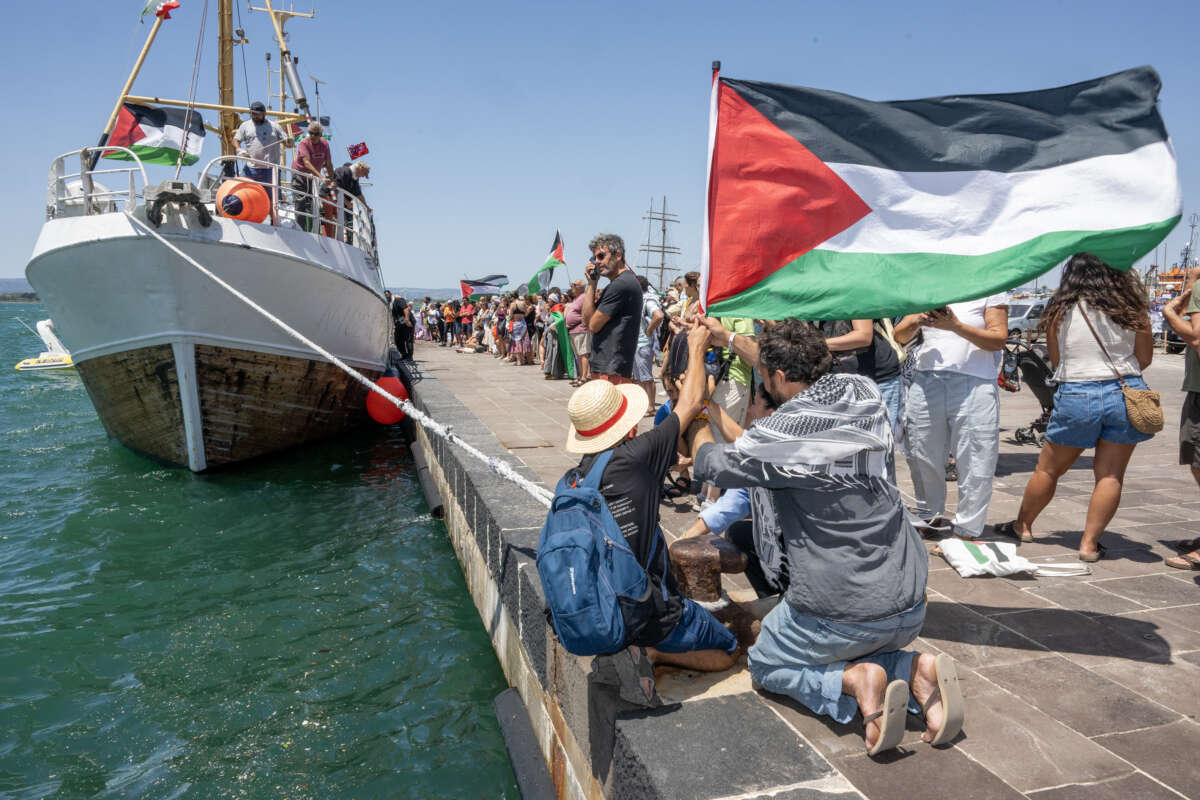
Journalist Detained From Gaza-Bound Aid Ship Reports Israel for Kidnapping


Antonio Mazzeo filed a complaint against the Israeli government at the Rome Tribunal for kidnapping and mistreatment.
August 8, 2025

People gather with Palestinian flags around the Freedom Flotilla ship "Handala" ahead of the boat's departure for Gaza at a port in Syracuse, Sicily, southern Italy, on July 13, 2025.GIOVANNI ISOLINO / AFP via Getty Images


The Handala, a Freedom Flotilla Coalition ship, set sail to Gaza from Gallipoli, an Italian city on the coast of Puglia, on July 20. Its aim was to bring humanitarian aid — including food, medicine, and toys — to the Palestinian population under Israeli siege. Twenty-one people from around the world took part in the mission, attempting to break the naval blockade that Tel Aviv has maintained for nearly two decades. Just weeks earlier, Israeli naval forces had boarded and seized another vessel from the same group, the Madleen, with Greta Thunberg on board, in international waters. On the night of July 26 to 27, Israeli forces repeated the action, intercepting the Handala and illegally deporting the entire crew. Antonio Mazzeo, an Italian journalist, was among those on board. In this exclusive interview for Truthout, Mazzeo discusses his experience, the crew’s journey, and what motivated the difficult and dangerous mission. The interview that follows has been edited for clarity and length.

Andrea Umbrello: Can you describe what happened on the Handala’s final day, before and after the Israeli navy arrived?

Antonio Mazzeo
Photo: Courtesy of Antonio Mazzeo

Antonio Mazzeo: Saturday, [July] 26 was quiet. We knew it would be a long day, but we stayed calm. In the afternoon, an Israeli Heron drone circled low over the boat for more than an hour. Only then did we realize for certain that Israel was watching us closely. Soon after, we learned two ships carrying special forces had left Haifa. We prepared for anything, even an armed attack. We tried to steer the ship south, asking the Egyptian authorities for permission to enter their territorial waters to reach Gaza. We were given permission to land in Egypt, but that wasn’t our goal. When the Israeli ships became visible on the horizon, we sat on the deck wearing our life jackets, ready to face what was to come. The commandos arrived on fast rubber boats and boarded the Handala. They found us sitting side by side, our hands open as a sign of peace, singing the famous Italian resistance song “Bella Ciao.” There was no violence or abuse; in fact, the soldiers tried to be courteous. The journey aboard the Handala, now occupied by about 30 commandos, lasted nearly 12 hours. We were taken to the port of Ashdod, where the police took us into custody. From that moment on, everything changed, and the ongoing harassment, mistreatment, insults, and violations of our most basic rights began.

What happened after you landed in Israel?

We were taken to a large hall for the first of many body searches, the seizure of our backpacks, and photo identification. Then 18 of us were made to sit in a semi-circular room, watched over by brutal and violent police. It was the last time we were able to share the Handala mission together. One by one, they took us to interrogation booths where the interrogations took place and we were notified of our arrest. Then we were transferred to cramped cells at police stations near Ben Gurion Airport in Tel Aviv, or in a maximum-security detention center that has housed thousands of Palestinian prisoners.

Related Story

Amazon Labor Union Leader Chris Smalls Released From Israeli Prison
Smalls, the only Black person on a crew hoping to break Israel’s blockade on Gaza, was beaten by Israeli officers. By Sharon Zhang , Truthout  July 31, 2025

The interrogations were conducted by police with strong ideological prejudices, who did not hold back insults or threats. My interrogator tried to belittle the political and humanitarian value of our mission. “But do you know how many children Hamas has killed?” he yelled at me when I explained that the Handala wanted to deliver aid and stuffed animals to Palestinian children. “Have you ever taken aid to Syria or Africa?” When I replied that I didn’t have to justify to the Israeli state what I had done or planned to do, he screamed incomprehensible phrases for over five minutes. I asked the translator and my lawyer for a summary, but they advised me to let it go. For me, it was important to formally contest the accusation and declare that I would report Israel for kidnapping upon my return to Italy. I left Israel as soon as I could because I had set out to get to Gaza to see the eyes of the children of Gaza, not the hate-filled eyes of Israel’s fascio-Zionist police. I spent another 24 hours in detention, in three different cells in Ashdod, at a police station near Ben Gurion Airport, and in a police center on the outskirts of Tel Aviv. Everywhere I was stripped, searched, and completely deprived of my personal belongings. In 24 hours, I was offered two glasses of water and a sandwich.

What were the conditions of your detention?

The first detention facility where I spent almost three hours, two of which were in total isolation, was a cage inside a two-by-two-meter cell. It was hot and there was a noisy air conditioner that did little good. The second cell was in a police station, a cramped, windowless room with a concrete bed and a filthy toilet. It was myself, Jacob Berger, another U.S. activist, and two journalists from Al Jazeera. There were insects everywhere and the air felt suffocating. After a couple of hours, Jacob and I were transferred to Tel Aviv to a cell we ironically called a “five-star hotel” compared to the previous ones. A reinforced concrete bunk bed was the only furniture. We stayed there until 4:00 in the morning. Then they took us to the airport, to a large room where, under guard, we slept on blankets and sofas with about 10 immigrants without legal status, most of them from Asia. With us was also Emma Fourreau, a French parliamentarian and a member of the Handala crew.

In those hours, my only thought was for my Palestinian brothers, for thousands of minors who have spent entire parts of their lives imprisoned, tortured and often without even an accusation to defend themselves against.

The Freedom Flotilla Coalition confirmed that U.S. human rights defender Christian Smalls was physically attacked by seven uniformed officers immediately upon entering Israeli custody. They choked him and kicked his legs, leaving clear marks of violence. Did you witness similar acts of violence against him or other activists?

I know what the legal team that visited Chris in the detention center reported, and I can attest to the especially violent behavior of the police during the landing in Ashdod. There was a strong sense of racism among the police at the port. The most vulnerable were him, being of African descent, and the other activists of Arab origin. If U.S. citizens received different treatment, it’s perhaps because they lacked adequate consular assistance. A country that declares war against anyone who “offends” its citizens or interests has abandoned the seven American activists. Chris was one of them and we unfortunately know the level of violence he suffered. This indifference finds its reason in the fact that Washington — along with Brussels, Strasbourg, Paris, Berlin, and Rome — have the blood of the Palestinian people on their hands. [These countries] provide the weapons for the genocide, and make key facilities available, like the U.S. base in Sigonella in my Sicily, which offers operational, logistical, and strategic support. [These countries] also support [Israel] politically and diplomatically, legitimizing crimes, abuses, and unheard-of violations.

What’s next for you?

I will continue to do what I have done my whole life: analyze and denounce Israel’s crimes, the military-industrial-financial-academic system that governs it and feeds apartheid and genocide, and especially the very serious responsibilities of partner countries, first and foremost my own: Italy…. I would do a mission like the Handala’s again, with the utmost conviction and the same hope of reaching Gaza.


This article is licensed under Creative Commons (CC BY-NC-ND 4.0), and you are free to share and republish under the terms of the license.


Andrea Umbrello
An Italian multimedia journalist, Andrea Umbrello tells frontline stories through articles published in international outlets, podcasts, and photojournalism. Balancing rigor and empathy, they’ve spent years documenting Palestinian issues, human rights violations, and social injustices worldwide. Their work on human migration and discrimination aims to foster critical reflection on frequently overlooked subjects.
FEMA Tells Staff to Work for ICE or Risk Getting Fired

Trump has previously said that disaster relief should fall to the states and that he hopes to eliminate FEMA altogether.
August 8, 2025

A civilian search and rescue team member, left, gives a hand to a member of a FEMA urban search and rescue team as they hike along the Broad River in the aftermath of Hurricane Helene on October 2, 2024 near Chimney Rock, North Carolina.Sean Rayford / Getty Images

On August 5, the Federal Emergency Management Agency, known as FEMA, told approximately 100 staffers that they had been reassigned to Immigration and Customs Enforcement — and that if they refused to comply with their reassignment, they could be fired.

“If you choose to decline this reassignment, or accept but fail to report for duty, you may be subject to removal from Federal service as provided in 5 U.S.C. § 7513,” the email reads.

A Department of Homeland Security (DHS) spokesperson told The American Prospect that “select FEMA employees will temporarily be detailed to ICE for 90 days to assist with hiring and vetting” of new ICE agents. The department has said it plans to hire 10,000 new agents, and is offering new recruits a signing bonus of up to $50,000 and student loan forgiveness of up to $60,000. Although the agency claims it’s been inundated with applications, soon after launching the recruitment campaign, DHS removed age restrictions on all positions. During an appearance on Fox & Friends, Noem encouraged 18-year-olds to apply.

While ICE receives unprecedented levels of funding and embarks on a hiring spree, the Trump administration has shredded virtually every other federal agency and fired thousands of federal workers.

Related Story


DHS Head Noem Prioritized Instagram Pics Over FEMA Requests for Texas Floods
It took Noem four days to respond to requests from FEMA, delaying access to some search and rescue tools. By Chris Walker , Truthout July 10, 2025

When it comes to FEMA, President Trump has said that disaster relief work should fall to the states and that he plans to eliminate the agency altogether. President Jimmy Carter created FEMA in 1979, and in 2003, it was moved to DHS.

“We want to wean off of FEMA, and we want to bring it down to the state level,” Trump said in June. “A governor should be able to handle it, and frankly, if they can’t handle it, the aftermath, then maybe they shouldn’t be governor.”

In April, the Trump administration eliminated FEMA’s Building Resilient Infrastructure and Communities (BRIC) program, and sought to reallocate $4 billion in unspent funds that Congress had authorized for the program. On August 5, a federal judge temporarily blocked the administration’s plans. The program, the judge wrote in his ruling, “is designed to protect against natural disasters and save lives.” An investigation by CBS News revealed that two-thirds of the counties that lost BRIC funding went to President Trump in the 2024 election.

FEMA’s response to the deadly flash floods that tore through Central Texas on July 4 was catastrophic, in part because Noem had instituted a policy that requires her to personally sign off on expenditures over $100,000.

The New York Times reported that DHS let contracts to the companies that staff its disaster relief hotline lapse on July 5, which led to hundreds of contractors being fired. The funding for the call centers was finally restored on July 10, but by then thousands of flood victims had been unable to access assistance from the hotline. An NPR investigation revealed that on July 6, 7, 8, 9 and 10 FEMA answered just over 15,000 of the approximately 55,000 calls it received.

“Put yourself in the shoes of a survivor: You’ve lost everything, you’re trying to find out what’s insured and what’s not, and you’re navigating multiple aid programs,” Jeffrey Schlegelmilch, the director of the National Center for Disaster Preparedness at Columbia University, told the Times. “One of the most important services in disaster recovery is being able to call someone and walk through these processes and paperwork.”

During this time, on July 6, Noem posted images of herself on Instagram, The Daily Beast reported. She asked her followers: “Which one do you like for the official Governor’s portrait to hang in the South Dakota State Capitol?”

Noem also delayed search and rescue efforts. Multiple sources told CNN that Noem did not approve the deployment of Urban Search and Rescue teams until July 7, and delayed approving the use of aerial imagery. More than 130 people died in the flooding.

“She broke it on purpose,” Rep. Jared Moskowitz (D-Florida), a former emergency manager, said of Noem during an appearance on MSNBC. “So that when it fails this summer, she can say, ‘Oh, see, we told you — FEMA doesn’t work.’”
Hegseth under fire for endorsing Christian nationalist


Defense secretary nominee Pete Hegseth departs following a meeting on Capitol Hill in Washington, U.S., November 21, 2024. REUTERS/Nathan Howard

August 08, 2025  
ALTERNET


In his short time as U.S. Secretary of Defense, Pete Hegseth has tested the boundaries of the separation between church and state at the Pentagon. On Thursday night, he took things a step further by promoting an interview of Christian nationalist pastor Doug Wilson—the leader of the church Hegseth follows—who has called for America to become a Christian nation, and the world a Christian one.

“All of Christ for All of Life,” Hegseth posted on social media, from an account marked with a grey checkmark that says, “This account is verified because it’s an affiliate of @DeptofDefense on X.”

That post accompanied a CNN interview (below) of Pastor Wilson. CNN billed the segment as “The Christian nationalist pastor with ties to Defense Secretary Pete Hegseth.”

“Women are the kind of people that people come out of,” Wilson unapologetically told CNN.

“It doesn’t take any talent to simply reproduce biologically,” he continued. “The wife and mother, who is the chief executive of the home, is entrusted with three or four or five eternal souls.”

Wilson also believes women should not have certain leadership roles, and should not be allowed to vote.

Secretary Hegseth has brought his religious worldview into the Defense Department, literally, holding and hosting a specifically Christian monthly prayer meeting during work hours inside the Pentagon. During the first meeting, called “Secretary of Defense Christian Prayer & Worship Service,” Hegseth’s pastor from Tennessee, Brooks Potteiger, was the main speaker, according to a New York Times report.

The Times also reported that “the service is part of an increasing infusion of overt Christian evangelization in official government events during Mr. Trump’s second term.”

In their interview with Pastor Wilson, CNN reported, “Wilson is part of a broader Christian nationalist movement making inroads with the Trump administration, with a newly created faith office led by evangelical pastor Paula White-Cain, and people seen right outside the White House entrance, praying and speaking in tongues.”

Critics expressed concern and outrage over Secretary Hegseth’s post.

Attorney Barbara Comstock, a Republican and former U.S. Congresswoman, wrote: “Not unnoticed that @petehegseth, the most unqualified and insecure SecDef, has retweeted this piece that includes extremist men advocating that the right to vote be taken away from women and women must submit to men (apparently even if they are cheaters?) This is the Hegseth worldview.”

“Here’s the United States Secretary of Defense seemingly endorsing a call for the repeal of the 19th Amendment & and an end to women voting? Not surprising when you consider his very well documented views,” remarked Brandon Wolf, national press secretary for the Human Rights Campaign.

“It’s incredibly disturbing that Pete Hegseth attends a church, and openly praises its leadership, which advocates for repealing women’s right to vote and re-criminalizing homosexuality. If you want to live in an authoritarian, theocratic state, move to the Middle East. I hear it’s lovely there,” commented journalist Brad Polumbo.

“As an American Jew, I do not feel comfortable when the Secretary of Defense posts messages like this. America is a majority Christian country, but the America I want to live in is not an explicitly Christian country,” wrote Barron’s columnist, CBS News contributor, and CEO Isaac Stone Fish.

“The Secretary of Defense is literally promoting a Christian Nationalist. We are losing our country right before our eyes,” remarked radio host and legal analyst Barry Markson.

See Secretary Hegseth’s social media post and video below or at this link.