Wednesday, August 20, 2025

'Keeps me up at night': Veterans fear Trump is gunning for another 'Kent State' massacre


August 20, 2025
ALTERNET

Salon reports war veterans are leery of President Donald Trump looking to capitalize on his military presence in residential neighborhoods and bedroom communities in California and now Washington, D.C.

“… [I]it cannot be dismissed as improbable, given the conditions on the ground and what we already know about the most powerful man in the world: the prospect of American troops, in American cities, opening fire on American citizens — and that blood on the streets could be viewed not as a tragedy but as plain good politics,” reports Salon writer Charles Davis.

“It definitely keeps me up at night,” said U.S. Marine Corps veteran Janessa Goldbeck, CEO of pro-democracy nonprofit Vet Voice Foundation. “I don’t want to speculate what’s in his brain, but just taking the evidence as it is — what he said during the Black Lives Matter protests; the fact that he’s taking this maximalist approach to deploying troops — he is eager to create escalatory situations.”

Davis reports Trump actually wanted bullets fired in 2020, during the George Floyd protests.

“Can’t you just shoot them?” Trump asked, targeting protestors connected to the “Black Lives Matter” movement.

Former Defense Secretary Mark Esper, wrote in his memoir that he “had to figure out a way to walk Trump back.” Months later, Esper was fired for “insufficient loyalty.”

Davis said Trump no longer has “Mark Esper to tell him ‘no.’”

“The likes of Mark Milley, the former chairman of the Joint Chiefs of Staff (who describes Trump as ‘a total fascist’), and John Kelly, his former White House chief of staff (who warned that his former boss is an aspiring ‘dictator’), have been replaced by far-right ideologues and mediocre functionaries,” said Davis.

Second-term Trump is instead surrounded by people like White House adviser Stephen Miller and Defense Secretary Pete Hegseth, “who are eager to demonstrate their loyalty and inflict pain on the president’s domestic enemies,” Salon reports.

But are National Guard members who may have signed up for free college in exchange for laying down sandbags during a natural disaster willing to serve a 79-year-old strongman’s political agenda? In the heat of the moment, the once-unthinkable is not outlandish, Davis said.

“That may not necessarily be so bad, from the president’s perspective,” Added Davis. “It is, again, exactly what he wanted the last time he deployed troops in the nation’s capital, when there were still officials around him who possessed some sense of honor and personal dignity. We don’t have people like that today.”


And there’s no promise the public would blame the president, Davis said. When the Ohio National Guard shot and killed four unarmed students protesting the Vietnam War on the Kent State campus in 1970, a majority of Americans blamed the kids. Just 11 percent blamed the killers, according to a Gallup survey. Local reactionaries even interrupted the students’ memorial service, chanting: “Kent State Four! Should have studied more!”

“I think it’s likely that you’re going to have an altercation, and it could be politically advantageous to the president to have some sort of disturbance,” said Christopher Purdy, an Iraq War veteran and founder of The Chamberlain Network, which encourages former members of the military to speak out in defense of democracy.

Read the full Salon report at this link.


Text messages reveal how hard Fox News 'worked' for Trump in 2020: court documents


August 20, 2025
ALTERNET

New court documents reveal Fox News’ most prominent on-air news personalities made clear their desire to help President Donald Trump win the 2020 presidential election, according to The New York Times.

A $2.7 billion defamation lawsuit against Fox Corporation by voting technology company Smartmatic upended a tranche of documents on Tuesday showing Fox personalities Jeanine Pirro, Jesse Watters and Maria Bartiromo were determined to help Trump. In one text message, Watters — now host of “Jesse Watters Primetime” on Fox News, said to host Greg Gutfeld: “Think about how incredible our ratings would be if Fox went ALL in on STOP THE STEAL,” a reference to a disinformation campaign to overturn the results of the election.


The Times reports Pirro, a Fox News host who is now the U.S. attorney for Washington, D.C., under Trump, told Republican National Committee chair Ronna McDaniel in a text in the months preceding the 2020 election that: “I work so hard for the President and party.”

READ MORE: 'Will be up for 15 more minutes': Trump official admits Putin gave president a time frame to call in

Smartmatic claims Pirro had been pushing for a pardon from Trump for her ex-husband.


The documents also reveal a text from Bartiromo to Trump’s personal lawyer Rudolph W. Giuliani pertaining to the Nov. 12, 2020 election results saying: “I want you to overturn this.”

Smartmatic argues that Fox News faced a viewer backlash after calling Arizona for Joe Biden, and seized upon a narrative about election fraud to save its viewership, despite knowing the claims were untrue. Smartmatic is accusing Fox News of knowingly implicating it, along with another company, Dominion Voting Systems, in false claims of vote-rigging in the 2020 election in its effort to save its viewership.

The Times reports the internal communications from Smartmatic’s case show Fox executives, including owner Rupert Murdoch, became increasingly concerned about the audience reaction to its election coverage. According to the filings, Murdoch said in an email to Fox News chief executive Suzanne Scott in the days after the election: “Getting creamed by CNN! Guess our viewers don’t want to watch it.”
by Taboola
Sponsored LinksYou May Like

Alberta: The Time It Takes To Break Even On Solar Panels Is PlummetingSavvy homeowners are taking advantage of incentives to install solar panels...SunValue


READ MORE: 'Crazy is the new normal': New MAGA 'takeover' likely to 'hit' your wallet 'very quickly

But Murdoch and others did not believe the voter fraud claims, according to emails and text messages from the filings.

Dominion also sued Fox for defamation in a similarly-styled case and settled their case for $787.5 million in 2023.


Fox attorneys told the Times that Smartmatic’s business and reputation were already suffering prior to the election and that Smartmatic “grossly inflated its damage claims to generate headlines and chill free speech.”

Both Smartmatic and Fox News have asked the judge to rule on the case without a trial. Judge David B. Cohen is expected to issue his decision in the coming months.

Read the full New York Times report at this link.
What an old folktale can teach us about the 'annoying persistence' of political comedians: scholar


Image via Screengrab

August 20, 2025 

Fear of reprisals from the Trump administration has made many people cautious about expressing their opinions. Fired federal workers are asking not to be quoted by their name, for fear of losing housing. Business leaders are concerned about harm to their companies. Universities are changing their curricula, and scholars are self censoring.


But one group has refused to back down is the hosts of America’s late night comedy shows.

Jon Stewart and the rest of The Daily Show team, for example, have been scathing in their coverage of the Epstein case. John Oliver continues to amass colorful analogies for describing the president and his actions. After the “Late Show” was canceled, ostensibly due to financial reasons, host Stephen Colbert was defiant: “They made one mistake – they left me alive!

We may think of being loud, persistent, and edgy as the modern comedians’ job. However, unrelenting, critical humor has a long history in folklore.

I’m a scholar who examines the intersections between culture and politics and I teach a class on “Humor and Power.” A timeless folktale, known as “The Bird Indifferent to Pain,” can help us understand why comedy fans enjoy the annoying persistence of the jester, and explain why this trope has endured across cultures for centuries.
The invincible rooster

“The Bird Indifferent to Pain” belongs to a genre known as “formula tales.” Such tales consist of repeated patterns or chains of events, often with rhymes weaving through them. “The Gingerbread Man” captures this style perfectly with its infectious, teasing rhyme – “Run, run, run as fast as you can…”

“The Bird Indifferent to Pain” also stars a persistent and irritating creature. In most versions, a bird – often a rooster – angers a master or king for singing too loudly or saying the wrong things. The king comes up with elaborate punishments, but the bird always seems indifferent to them, responding to each move with an increasingly defiant and sometimes vulgar rhyme. At the end, the king cooks and eats the rooster, but the bird flies unharmed out of his body, rhyming and singing ever more.

Because folklore is shared casually across cultures and languages, it’s hard to tell when and where this tale first originated. However, folklorists have identified versions all over the world, from Tajikistan in Central Asia to India and Sri Lanka in South Asia, as well as Sudan in northeast Africa.


Armenia’s famous poet Hovhannes Tumanyan collected one version of this tale, which he titled “Anhaght Aklore” or “The Invincible Rooster.” In this version, a rooster finds a gold coin, and boasts about it from the rooftop: “Cock-a-doodle-doo, I’ve found gold!” When the king’s servants take the gold, the rooster continues crowing defiantly: “Cock-a-doodle-doo … the king lives on my account!” Frustrated, the king orders his servants to return the money. But the rooster still won’t shut up: “The king got scared of me!”

Finally, the king orders him slaughtered for dinner. “The king has invited me to his palace!” the rooster boasts. While he’s cooked, he claims the king is treating him to “a hot bath.” Served as the main course, he crows, “I’m dining with the king!”

The tale reaches its climax when the rooster, now in the king’s belly, complains about the darkness. The king, driven to fury by the persistent voice, orders his servants to cut open his own stomach. The rooster escapes and flies to the rooftops, crowing triumphantly once more: “Cock-a-doodle-doo!”

Tumanyan doesn’t tell us what happens to the king after that.

My great-grandmother told us a Turkish version of this tale, featuring a rooster defying his “bey,” or master, in the 1980s. Her rooster crowed in rhyming couplets and used some naughty words to describe the master’s digestive system. Plus, in her version, the master’s behind – and not his stomach – tore open during the bird’s escape. We were obsessed with this story and begged her to tell it over and over.Hovhannes Tumanyan’s ‘The Invincible Rooster’

The power of persistent irritation


What makes this tale, and its many variations, so compelling across languages and centuries? Why do so many cultures enjoy the rooster’s humorous defiance and literal indifference to punishment?

In our case, as children, we were drawn in by the rhythm of repetition and rhyme. The rooster’s colorful language held a delightful sense of transgression. Children also often identify with animals because of a shared vulnerability to adults’ power. Therefore, it is significant that the bird, the weaker of the two parties, survives the ordeal, whereas the master’s fate is uncertain. But the rooster doesn’t merely survive – he thrives and keeps on squawking. This is a story of hope.

In fact, when I told Tumanyan’s version to my 6-year-old son, he said he loved the rooster’s optimism.

Modern American popular culture contains many jocular characters that resemble this folkloric bird, who is delightfully impervious to pain, from cartoon characters such as the Road Runner – an actual bird – to the foulmouthed, self-regenerating antihero Deadpool.

Today’s political comedians, I argue, are using the rooster’s tactics as well.

Release or resistance?

Debates about political humor often circle back to its purpose. Scholars debate whether anti-authoritarian humor is just a coping mechanism, or whether can it spark change.

Psychologist Sigmund Freud believed humor’s main function was “release”: jokes offered a way to reveal our unacceptable urges in a socially acceptable way. A mean joke, for example, allowed its teller to express aggression without risking serious repercussions.

Philosophers Theodor Adorno and Max Horkheimer argued that humor in corporate capitalist media was a mere safety valve, siphoning off protest and releasing righteous outrage as laughter.

Anthropologist James Scott, however, gives jokesters more political credit. In his 1992 book “Domination and the Arts of Resistance,” Scott agreed that authorities allow some dissident humor as a safety valve. But he also identified a powerful “imaginative function” in humorous resistance. Humor, he claimed, can help people envision alternatives to the status quo.

Scott pointed out that release and resistance need not be mutually exclusive. Instead of reducing the chance of actual rebellion, comedy could serve as practice for it.

Authorities do perceive some danger in comedians’ output. In countries with fewer free speech protections, comedians may face more serious repercussions than a stern tweet.

In the case of Colbert, President Donald Trump’s gleeful response to the show’s cancellation, and his suggestion that others will be “next up,” shows just how seriously some political figures take comedic critique. At the very least, they are irritated.

And the story of the “Bird Indifferent to Pain” reminds us that sometimes the best a jokester can do is to keep irritating the bowels of the system, singing all the way.

Perin Gürel, Associate professor of American Studies, University of Notre Dame

This article is republished from The Conversation under a Creative Commons license. Read the original article.
Center for Food Safety Condemns Lack of Action on Pesticides in Draft MAHA Commission Report

Tuesday August, 19 2025
Center for Food Safety


WASHINGTON - Late last week, a leaked draft of the second report from the Make America Healthy Again (MAHA) Commission was released. Center for Food Safety (CFS) is extremely disappointed with the draft, which lacks concrete or meaningful recommendations to improve pesticide regulation. The MAHA Commission was supposed to identify and address causes of chronic disease in children, with a focus on limiting exposure to pesticides and ultra-processed foods, but it appears the MAHA Commission has capitulated to the pressure of agriculture lobbyists and the pesticide industry in its latest report.

In the first MAHA Commission report from May, the Commission explicitly identified impacts of pesticides like glyphosate and atrazine on children's health. Yet the leaked draft of the August report offered zero follow-up. Instead, there is only a single line on pesticides generally in the draft, which instructs the Environmental Protection Agency (EPA) to "ensure that the public has awareness and confidence in EPA's robust pesticide review procedures." However, recent news does not instill confidence in the EPA's review procedures. Since the release of the May report, EPA has proposed to greenlight several concerning new pesticides, and to re-approve the volatile herbicide dicamba for the third time, despite courts twice already holding its prior approvals unlawful. Over 1,000 scientists were fired from the EPA's Office of Research and Development in March. EPA's own federal oversight office highlighted the politicization of science at the agency during the first Trump administration.

"The MAHA Commission has turned its back on Americans desperate for action to combat the overuse of pesticides. Despite the Commission's previous recognition of the overuse of pesticides in America's industrial food system and the potential harm these toxins are causing children, public health, and the environment, they have now capitulated to the pressure of agriculture lobbyists and the pesticide industry. The health of our children and our farmworkers cannot wait around for the Commission to find its way. The Center for Food Safety will continue to undertake legal actions to push the EPA to actually do its job of protecting human health and the environment from the harms of pesticides," said Sylvia Wu, Co-Executive Director of the Center for Food Safety.

CFS is the nation's leading public interest law firm working to protect human health and the environment from the harms of industrial agriculture and has worked diligently for over 25 years to limit the impact of toxic pesticides on America's food system. Our scientific reports first highlighted pesticides' driving role in the species extinction crisis, like the decline of monarch butterflies. Our public interest litigation is responsible for precedent-setting decisions regarding pesticide regulation, and for for the cancellations of numerous notorious insecticides, herbicides, and fungicides.

A groundbreaking 2024 settlement required EPA for the first time to test all pesticides for their endocrine-disrupting effects, which can impair fertility and immune function and cause cancer. In 2022, we achieved a historic victory against glyphosate when the Ninth Circuit Court of Appeals sided with CFS and overturned the Environmental Protection Agency's (EPA) decision that glyphosate was safe for humans and imperiled wildlife. As a result, EPA lacks a lawful human health safety finding for glyphosate to support its ongoing use. Another sweeping victory was a federal court revoking approval of the notoriously volatile pesticide dicamba, which has caused unprecedented damage to millions of acres of crops and wild plants. CFS is now working to challenge dicamba's recently proposed re-registration. Every third bite of food requires bee pollination, and when bee populations began to plummet in part due to a new form of insecticide called neonicotinoids, CFS led the first successful cases challenging their approvals. And for several years CFS has been challenging in court the highly controversial and dangerous herbicide atrazine, a known hormone-disruptor, with exposure linked to birth defects, multiple cancers, and fertility problems.


Center for Food Safety's mission is to empower people, support farmers, and protect the earth from the harmful impacts of industrial agriculture. Through groundbreaking legal, scientific, and grassroots action, we protect and promote your right to safe food and the environment. CFS's successful legal cases collectively represent a landmark body of case law on food and agricultural issues.
CRIMINAL CAPITALI$M; THE GRIFT

Ousted DOJ Lawyer Says Bondi Appointees Let Corporate Lobbyists 'Rule' Over Antitrust Enforcement


Roger Alford, who was fired over his objections to a corrupt tech merger last month, said MAGA lobbyists and DOJ officials are "determined to exert and expand their influence and enrich themselves."


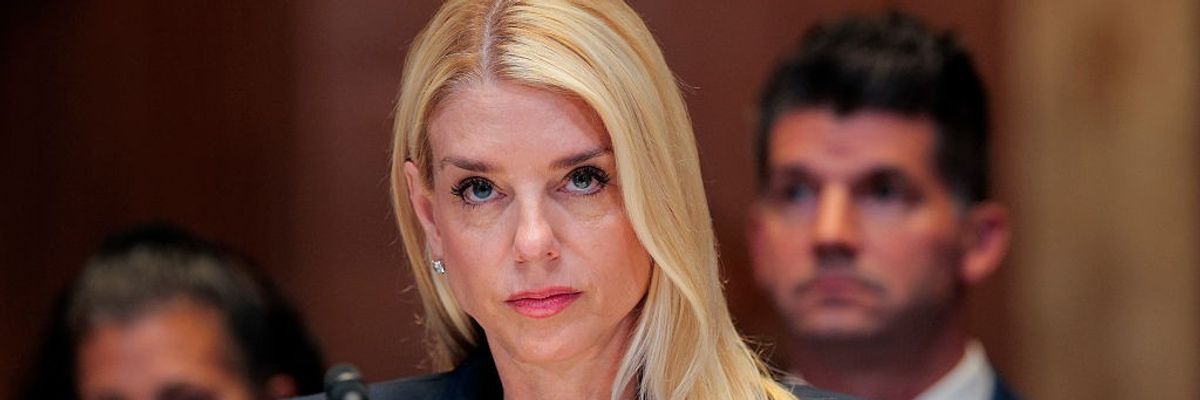
US Attorney General Pam Bondi testifies before the Senate Appropriations Committee Subcommittee on Commerce, Justice, Science, and Related Agencies in the Dirksen Senate Office Building on June 25, 2025, in Washington, DC.
(Photo by Chip Somodevilla/Getty Images)


Stephen Prager
Aug 19, 2025
COMMON DREAMS

An antitrust lawyer fired from the US Department of Justice last month accused Attorney General Pam Bondi's underlings on Monday of giving MAGA-aligned corporate lobbyists the ability to "rule" over antitrust enforcement.

Roger Alford, formerly the deputy assistant attorney general in the DOJ's antitrust division, was ousted in July, reportedly for "insubordination" after he objected to the involvement of politically connected lobbyists in the $14 billion merger between Hewlett-Packard Enterprise (HPE) and Juniper Networks.

The DOJ had sued in January to block the merger, arguing that HPE's acquisition of Juniper would unlawfully stifle competition, raise prices for consumers, and harm innovation, since the two entities control over 70% of the wi-fi relied on by large companies, hospitals, universities, and other entities.

But that suit was resolved in June in what the Capitol Forum described as a "highly unusual settlement" in which Bondi's chief of staff, Chad Mizelle, overruled the DOJ's antitrust chief, Assistant Attorney General Gail Slater, to allow the deal to settle.

At the time, left-wing consumer advocates, like Nidhi Hegde, executive director of the American Economic Liberties Project, argued that the deal was "a corrupt and politically rigged merger settlement," which came after political operatives tied to Trump lobbied on behalf of the company.

Despite still describing himself as a staunch MAGA loyalist, Alford likewise feels that the settlement was a "scandal."

In a speech delivered Monday at the Technology Policy Institute in Aspen, Colorado, he said senior DOJ officials "perverted justice and acted inconsistently with the rule of law" by allowing "corrupt lobbyists" to hijack the process.

According to disclosures from HPE, it hired multiple top Trump allies as lobbyists to advocate for the merger. These included MAGA influencer Mike Davis—a right-wing critic of Big Tech and a notorious legal operative responsible for many of Trump's judicial nominations—and Arthur Schwartz, a close adviser and confidante to Donald Trump, Jr. and JD Vance.

According to reporting from the conservative writer Sohrab Ahmari in UnHerd last month, which cites one unnamed senior official, the DOJ's merger settlement was the product of "boozy backroom meetings between company lawyers and lobbyists, on one hand, and officials from elsewhere in the Department of Justice, on the other."

As Ahmari explained:
"Boozy backroom deal" here isn't a figure of speech, by the way. It captures what literally took place, according to the former official, who described a meeting between government officials and lobbyists that took place at one of Washington's "private city clubs" over cocktails.

In an essay for UnHerd adapted from his speech, Alford berated these "MAGA-in-name-only lobbyists and the DOJ officials enabling them," who he said are "determined to exert and expand their influence and enrich themselves as long as their friends are in power."

The current DOJ, Alford continued, has allowed for the "rule of lobbyists" to supplant the "rule of law." While he says this was not true of those idealists serving with him in the antitrust division—including his embattled former boss, Slater—he says that others in the DOJ showed "special solicitude" to lobbyists they perceived to be on the "same MAGA team."

"Too often in the current DOJ," he said, "meetings are accepted and decisions are made depending upon whether the request or information comes from a MAGA friend. Aware of this injustice, companies are hiring lawyers and influence-peddlers to bolster their MAGA credentials and pervert traditional law enforcement."

Alford makes a distinction between these corrupt officials and those he calls "genuine MAGA reformers" who "strive to remain true to President Trump's populist message that resonated with working-class Americans."

While he does not group Bondi in with the officials he deems corrupt, he does blame her for having "delegated authority to figures—such as her chief of staff, Chad Mizelle, and Associate Attorney General-Designee Stanley Woodward—who don't share her commitment to a single tier of justice for all."

"Some progressives may blanche at Alford's praise for [US President Donald] Trump's populist messaging, and insistence that it has been subverted by top DOJ officials selling out to lobbyists," writes David Dayen in the American Prospect.

But Dayen notes that Alford's audience is not progressives and that he is instead "attempting to reach the president and his inner circle by playing on Trump's demand for total loyalty."

The merger between HPE and Juniper can still be stopped under the Tunney Act, which requires it to be reviewed by a federal judge to determine whether settlements brought in federal "antitrust" cases are in the "public interest."

While the Capital Forum says this process is typically a "rubber stamp," they wrote that "given the settlement's atypical substance and process, plus third parties who may be motivated to intervene and a judge who may be inclined to approach the review skeptically, what's normally a quick judicial signoff could turn into a fraught process with wide-reaching implications."

"Indeed, the court should block the HPE-Juniper merger," Alford said. "If you knew what I know, you would hope so, too."
Putin's Craven Inept Poodle: Bonkers Across the Board


Trump prepares to greet Putin in his big-boy knee pads.

Photo-shopped image on Bluesky

Abby Zimet
Aug 20, 2025

Further

Huh. Turns out Donny’s despot bestie playdate was not a show of historic statesmanship - See the red carpet! Hear the planes roar! - but a debacle, a cringe self-own, an inglorious "hostage video in real time" as a "nuclear orange" felon beamed, clapped, lurched and excitedly greeted a war criminal "like a happy puppy." Still no deal, then or later, "but there's a good chance of getting there." (Where?) Consensus: "He invited a dictator onto U.S. soil just to get his shit rocked.”

More than eight bloody months after repeatedly boasting and blustering about ending Russia's war against Ukraine on his first day in office - "Day One. Only me." - Trump's bungled Alaska "summit" was a bloated, feckless photo-op that, while showcasing the power of an internationally shunned war criminal, "produced nothing for Trump and gave Putin most of what he was looking for" in what was deemed "a freak show of power inverted." In the end, nothing changed: "Putin's poodle" quickly abandoned the idea of the ceasefire he and Ukraine had long demanded as a key step to peace - he'd just told reporters on the flight he wanted to see it "today" - and the "severe consequences" he'd threatened without one, folded like a cheap deck of cards, and landed in the same unjust stalemate: If Zelensky gave up large chunks of his country, including the vital Donbas area, Putin won't illegally take any more land and would halt the bloodshed. JoJoFromJerz: "One nation, under Putin, with servitude and shame for all."

Before that ignoble coda, the convicted felon tried in his own, ghastly, gaudy way - "like someone ordered totalitarian chic from Amazon" - to woo the indicted war criminal. Putin is wanted by the ICC for kidnapping tens of thousands of Ukrainian children and other war crimes - never mind his political opponents oddly falling out of windows etc - and had U.S sanctions waived to legally land in the U.S. for the first time in 10 years. In his honor, Trump had U.S. soldiers on their hands and knees rolling out an actual red carpet for "the most murderous dictator of the 21st century,” a surreal sight called "disgusting." At his arrival, U.S. war planes flew overhead, and he got to ride in the presidential "Beast," which may or may not now sport bugs. After waddling out to the tarmac sweating in his rumpled suit and radioactive-orange makeup like "a traffic cone dipped in fryer oil," Trump stood slouching on said carpet; at Putin's approach he grinned and clapped "like a trained seal" as a smiling Putin swaggered towards him.

They met briefly. They spoke briefly at a presser - Putin first, longer, in Russian though on U.S. soil, Trump under three minutes - and took no questions. Both were subdued, and left Alaska within an hour. A scheduled lunch - filet mignon, crème brûlée - was cancelled, even though it was "In Honor of His Excellency Vladimir Putin, President of the Russian Federation." Then Trump rushed to spin what was widely deemed "nothing short of a debacle." He sputtered, "There's no deal till there's a deal." He called it "a very successful day in Alaska! Everybody wants to deal with us!" He claimed "it was determined by all" - aka Putin - the best way to end the war is "a Peace Agreement, not a mere Ceasefire," and it's on Zelenskyy to "get it done." He declined to note the whole farce was largely a result of envoy/former slumlord Steve Witkoff, who doesn't speak Russian, badly misinterpreting Putin's stance. He announced he was now "heading back to the United States" - from Alaska, which is in the United States.

The reviews were scathing. One headline: "Faceplants in Alaska." "Trump gifts Putin more time to grind down Ukraine," read one lede. Also, "Nothing says standing up to Russian aggression quite like welcoming the aggressor on a red carpet and applauding him," "For those who feared the summit on Ukraine might resemble Chamberlain’s appeasement of Hitler in 1938, the reality was worse," "Putin meets with high-level asset," "Putin got one hell of a photo op," "Putin got a PR coup, Trump got nothing," "Summits usually have deliverables - this meeting had none," "Seinfeld summit, about nothing," "This is what capitulation looks like. It was grotesque pageantry," "Trump isn’t fighting for peace in Ukraine, he’s managing Russia’s victory." A flood of memes echoed them: Images of the two men with, "Putin and his dog," "Find someone who looks at you like Trump looks at Putin," "They are absolutely sleeping together," "Awaiting those consequences Donnie," "Drumpf meets his boss to get his orders," "God help us."

Even Fox seemed worried by reports of U.S. aides looking stressed, anxious, "almost ashen, even shell-shocked." Under the chyron, "President Trump Continues Pursuing Global Peace" (and trying to complete a full sentence), one host cautiously noted, "The way it felt in the room was not good...It did not seem things went well" before adding "that's the picture we have right now" but of course Trump would never "enable something that would make him look weak.” Also, nothing is ever his fault. Thus, The New Republic reported he was "furious the media won't report on the incredible concessions he wrested from Putin - oh wait, there are none." Even as Russian media lauded Putin's glitzy reception signaling "utmost respect" and a "huge diplomatic victory," Trump whined: "If Russia raised their hands and said, 'We give up, we concede, we will GIVE Ukraine (and) America Moscow...the Fake News (would) say this was a (bad) day for Donald J. Trump...These people are sick! Thank you for your attention to this matter!!!”

In fact, in one final, sloppy indignity, his flunkies were so not paying attention they left behind in a printer at the business center of an Alaskan hotel eight pages of State Department briefings for the meeting. They included locations and times of summit events, names and phone numbers of U.S. staff and U.S. and Russian leaders, the plan for POTUS to give Putin an “American Bald Eagle Desk Statue," the lunch menu and a helpful phonetic pronunciation for "Mr. POO-tihn." A White House aide dismissed the glitch as not a security breach like all the others, but for many it added to the sense of "the intertwining elements of tragedy and farce" that make up this regime and show, "Trump has no cards." Alaska and its failings, writes Anne Applebaum, are the sorry culmination of a larger dysfunction, from Witkoff's incompetence to DOGE's dismantling of U.S. foreign-policy tools, agencies and the cadre of skilled personnel who knew how to use them. "The U.S. has no cards," she says, "because we’ve been giving them away."Sorrowfully, it must be noted, at the behest of an unfit, rabid, malignant narcissist who spent the time en route to his gazillionth golf trip Sunday feverishly re-posting unhinged memes from MAGA fans proclaiming him, "The Promise Keeper," "The leader we need," "G.O.A.T. The Legend." "We Love You, President Trump," they cooed. "You are such a blessing," "I trust this man more than anyone," "The best part of waking up is Donald Trump is President," and, per QAnon, "Democrats are the party of hate, evil and Satan." Also, "Peace Through Strength," with an AI Trump and lion. "Anyone can make war, but only most courageous (sic) can make peace."( For their part, Russia Today trolled America and the world by posting a video of an armored vehicle driving through Ukraine flying a Russian and a U.S. flag.) Set the next day to host Zelenskyy and seven more European leaders, Trump bragged of his "Big day at the White House"; ever thin-skinned, he also scolded his imaginary critics by insisting, “I know exactly what I’m doing."

In an unprecedented move, Zelensky wisely brought along his impressive bodyguards - the leaders of France, Germany, Britain, Italy, Finland, NATO and the E.U. - as a sort of intervention against Trump's bullying and idiocy. The fact he could marshal so much firepower in so short a time suggested "something went very wrong in Alaska," and much of Europe was alarmed enough they felt the need to confront "an American president who now wholly represents the interests of Russia against Ukraine, Europe, and arguably his own country." Zelensky wore a black suit, deemed fabulous, to shut up any petty sticklers for protocol; the others likewise carefully chatted, tip-toed, maneuvered around the volatile Mr. Magoo whose dangerous ravings had brought them there, trying to pretend it was normal when he, say, interrupted a photo shoot to show off his dumb ear-nicking portrait - "That was not a great day" - or dragged in Macron and Zelensky, whose country is burning, to admire his fecking collection of Trump 2028 hats.

There was much more. He boasted about the fictional six wars he's "ended without a ceasefire" (not and not), including one in "The Republic of Condo." Clearly panicked about facing voters who increasingly oppose everything he does - 38% approve, and the effects of his tariffs and deportations are just kicking in - he heeded his bestie Putin's advice and vowed to get rid of "scam" mail-in ballots "no other country has," except dozens of them, including Russia, because "Democrats cheat at levels never before seen!" This, to European leaders, despite the longstanding fact there is zero evidence of widespread voter fraud here, which is why media outlets have paid out nearly $900 million for publishing lies about the 2020 election he legit lost but nonetheless keeps yammering about. "You go in, they even ask me for my license plate for identify," he raved. "I said, 'I don't know if I have it.' They said, 'Sir, you have to have it.' And nobody has it." Heather Cox Richardson: "This" - and all the rest - "is bonkers across the board."

He also bragged about D.C., where "we went from the most unsafe place anywhere to a place that now, people, friends are calling me and they’re saying, ‘Sir, I want to thank you, my wife and I went out to dinner last night for the first time in four years, and Washington is safe, and you did that in four days.'" Also, thanks to armed, masked thugs roaming the streets, another friend's son, "a great golfer, and he came in fourth yesterday in the big tournament" went to dinner in DC where "it's busier than they’ve been in a long time," except for multiple reports the number of diners has plunged over 30%: "The city is dead." Again, he's raving to Europe's leaders there to push back against his Kremlin talking points and advocate for a ceasefire in Ukraine. By late afternoon, he didn't recognize and couldn't find Finland's President Stubb, who was sitting directly across the table from him, and responded to E.U. head Ursula Von Der Leyen's concerns about kidnapped Ukrainian children by crowing about his trade deals.

"It's like watching a dog try to do trigonometry equations," wrote one online sage of our depraved Toddler-In-Chief. And it goes on. In the middle of their meeting, Trump left to call Putin; they reportedly talked for 40 minutes. Later, he told Sean Hannity he didn't make the call in front of the others because "I thought that would be disrespectful to President Putin." On Tuesday, with the adults gone, he called into Fox and blasted Ukraine for getting invaded by Russia: "You don’t do that. You don’t take on a nation that’s 10 times your size." He praised Putin - "There's a warmth there, there's a decent feeling" - who just approved the largest Russian attack of the month on the central Ukrainian city of Kremenchuk. At some point, he upped his peace deals from six to seven. And he happily noted the European leaders came because "they have respect for our country again...Everybody wants to be here. When I made the call, they came." It was Zelenskyy who asked them to come. Of course it was. Try to stay sane-ish.


'Complete 180' and 'hot mic moment': Brutal CNN supercut reveals how Trump got played by Putin


Image via Screengrab.
August 18, 2025 |
ALTERNET


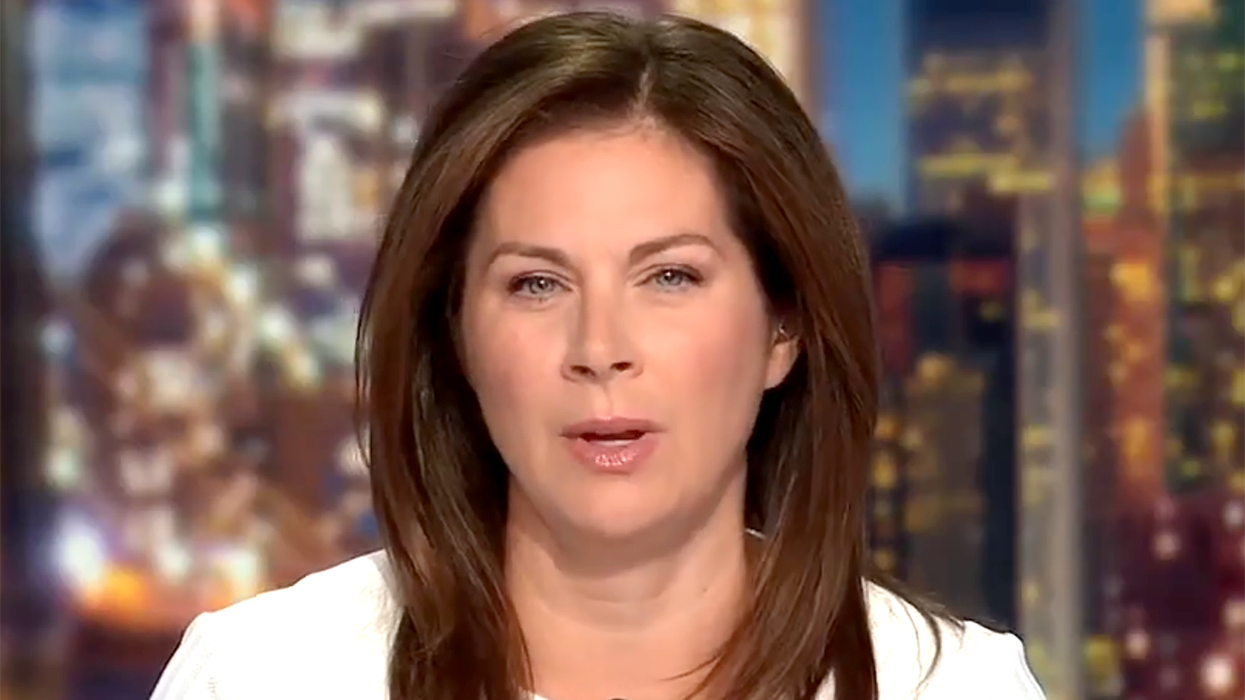
A CNN segment on Monday revealed President Donald Trump’s “complete 180” on a cease fire in Ukraine and a “hot mic moment” about Russian President Vladimir Putin wanting to “make a deal for Trump,” host Erin Burnett reports.

Burnett spoke at length about Trump’s Monday meeting with Ukrainian leader Volodymyr Zelensky and several European leaders — a meeting Burnett said stood in stark contrast to the “literal red carpet” Trump rolled out for Putin.

Burnett noted Zelensky’s approach to Monday’s meeting with Trump, pointing out the Ukrainian president sang Trump’s praises, in contrast to the fiery Oval Office meeting between the pair in February.

READ MORE: 'You sold us out': MAGA congresswoman 'disgusted' by boos and jeers at New York event

“Zelensky has always said thank you,” Burnett said. “... So I think that's important to say. But in the case of what we saw today, that was a whole lot of ‘thank you’s’ to assuage Trump's ego as Trump appeared today to flip-flop on something crucial, which is also worth highlighting because he is now echoing Putin in saying that a cease fire isn't necessary.”

“Before Trump met with Putin last week, he was unequivocal that a cease fire was exactly what was required,” Burnett explained, playing a clip of Trump saying exactly that.

“Well, that seems to be a complete 180,” the host said of Trump’s position Monday. “And Trump tonight is echoing Putin in another issue. A hot mic moment, actually, that he didn't expect us all to hear.”

Burnett then played a clip of Trump saying “I think [Putin] wants to make a deal. Do you understand that? As crazy as it sounds."

“You hear what he said?” Burnett asked. “‘I think he wants to make a deal for me.’ So he's saying Putin wants to make a deal for Trump now.”

“Okay, just take a deep breath here,” she continued. “Because if Putin wanted a deal or peace in any way, shape or form, he could have had it at any point. he could actually have never gone into this invasion of a neighboring country to begin with. But but he hasn't stopped it. Not any time in the past years, because he wants Ukraine. It is core to his entire being, and any peace deal that he signs will not change that.”

Watch the video below or at this link.


Alaska’s Munich: The Trump–Putin Summit Rewarded Aggression and Betrayed Ukraine

AUGUST 18, 2025


Christopher Ford argues this is the collapse of the ‘pivot’ towards Ukraine and the consolidation of the Trump–Putin Axis.

Two weeks ago, Washington signalled a hard turn against Moscow.  President Trump’s public outrage at Russia’s killing of Ukrainian civilians was so intense he claimed to have ordered two US nuclear submarines closer to Russian waters —accompanied by promises of harsh new sanctions. Commentators billed it as a ‘pivot’ toward Ukraine.

The pivot was a sham; it never happened.

Trump moved to replace direct aid to Ukraine with a business arrangement in which European governments pay the full cost of weapons – notably air defence. It was a grotesque spectacle of Trump profiteering from Ukraine’s vulnerability – which he helped manufacture. There was no major surge of military aid even through sales to Europe to give to Ukraine.

Trump’s threat of “severe tariffs” on Russia and its oil customers ultimately materialised only as tariffs on India, sparing China, Turkey, and others — a move widely seen in Asia as about trade relations rather than support for Ukraine. In July, he set a 2nd September deadline for Russian progress toward peace, shifting it to 7th–9th August , before abruptly replacing talk of severe consequences with talk of which Ukrainian territories should be ceded to Russia.

The deadline passed without consequence; instead, Trump sent special envoy Steve Witkoff to Moscow on 6th August, where Putin offered no concessions and repeated maximalist annexation demands — a meeting Trump hailed as “great progress.” The next day, the Alaska summit was announced, and in the lead‑up Trump repeatedly asserted that Ukraine would need to surrender territory to reach a deal.

On the eve of the Alaska summit, Russia again struck Ukraine with 85 Shahed drones and an Iskander missile, killing civilians and wrecking infrastructure. On the front lines, its forces continued their offensives, with no new US sanctions, keeping the war machine running.

Against this backdrop, the summit produced four clear outcomes — all to Moscow’s benefit and all to Ukraine’s detriment:

1. Normalisation of relations with Russia

The red‑carpet welcome, warm personal exchanges and Trump’s public praise marked a new stage in rehabilitating Vladimir Putin internationally. Both men hailed the talks as “extremely productive” and “very warm.” Putin invited Trump to Moscow for the next round.

2. Sanctions Off the Table

Measures once billed as inevitable have vanished. In a post‑summit Fox News interview, Trump confirmed that “because of what happened today,” punitive action was no longer under consideration. US leverage evaporated in a single afternoon.

3. Pressure on Ukraine to Surrender Territory

Trump admitted in the same interview to Sean Hannity (Fox News) that he and Putin had “largely agreed” on land‑swap terms, leaving it to Kyiv to accept or refuse. This reframes the aggressor’s demands as Ukraine’s responsibility, shifting blame for any failure to secure peace to Ukraine and rewarding Russia’s invasion.

4. Ceasefire no longer required

The immediate ceasefire which Trump demanded Ukraine agree to under coercion that cost many lives, with no reciprocal pressure at all on Putin – has been abandoned. Now Trump has adopted entirely the Russian position for a so-called permanent peace agreement.

In substance and symbolism, Alaska was not a step toward restraining Russian aggression — it was a step toward accommodating it. The supposed pivot to Ukraine has dissolved into a deeper reproachment with Russia.

Any new sanctions meant to punish Russia’s war of conquest are gone, justice for war crimes are gone, and the burden of ending the war has been transferred from the perpetrator to the victim.

For all Washington’s own hypocrisy and its chequered history of adherence to the post‑war legal order it helped create at Nuremberg, hosting Putin — a wanted war criminal — marks a new low.  Let us remember that Putin is wanted for the abduction of thousands of children from Russian‑occupied areas of Ukraine into the Russian Federation. 

The summit handed the Kremlin a victory, and replayed the 1930s appeasement script that rewarded aggression and emboldened rising authoritarians. It is arguable that the post‑war international order is effectively over, with a collapse of its core principles and weakening of institutions in the face of rising authoritarianism and unchecked aggression.

This is the Trump–Putin Axis of Reaction in action: a strategic realignment that normalises an indicted war criminal, dismantles pressure against his regime, and demands Ukraine pay the price for a ‘peace’ that entrenches Russian occupation.

European leaders have praised Trump and the Alaska summit, Keir Starmer saying that Trump’s “leadership in pursuit of an end to the killing should be commended.” This accommodating of Trumpist reaction plays into his hands — bolstering the fake image he wants to project while camouflaging his actual assistance to Kremlin goals. Casting him as a credible peacemaker despite his readiness to normalise relations with Putin without real concessions, legitimises Trump in undermining Ukraine’s sovereignty and emboldens Russia. It also weakens the labour movement and those defending democracy in the USA itself.

There is an alternative to betrayal.

For an entire year we were told the city of Pokrovsk in the Donbas region would fall to Russia – a year on, despite being starved of aid, Ukraine still holds the city. This and other towns and cities must not be handed over to Russian occupation. The Ukrainian resilience should prove that there is potential for an alternative to betrayal if the actual aid Ukraine needs to secure a just peace was provided.

There is an alternative, one the labour movement needs to assert as set out in the Ukraine Solidarity Campaign’s vision of Another Ukraine is Possible – Free From Occupation. The labour and trade union movement, and civil society and the Labour Government must reject any settlement legitimising Russia’s occupation, and rally military, financial, and diplomatic support. This means boosting arms supplies, seizing Russian assets, cancelling Ukraine’s debt and enforcing tougher sanctions. International justice must prosecute war crimes and secure a return of the abducted children.

The path forward should be not in appeasing the new authoritarians but in supporting a democratic and united Ukraine – one free from oligarchs and occupiers.  That means resisting territorial conquest and standing with those in Ukraine fighting for social justice, equality, and self‑determination — a future built on solidarity, not surrender to new forms of fascism.

Christopher Ford is Secretary of the Ukraine Solidarity Campaignon whose site this article first appeared.


NORTH AMERICAN WIDE

JBS Doesn’t Deserve a Place in Our Markets or on Our Plates

Even in industrial meat production, an industry known for its corruption and poor conditions, JBS stands out for the scope and severity of its violations.


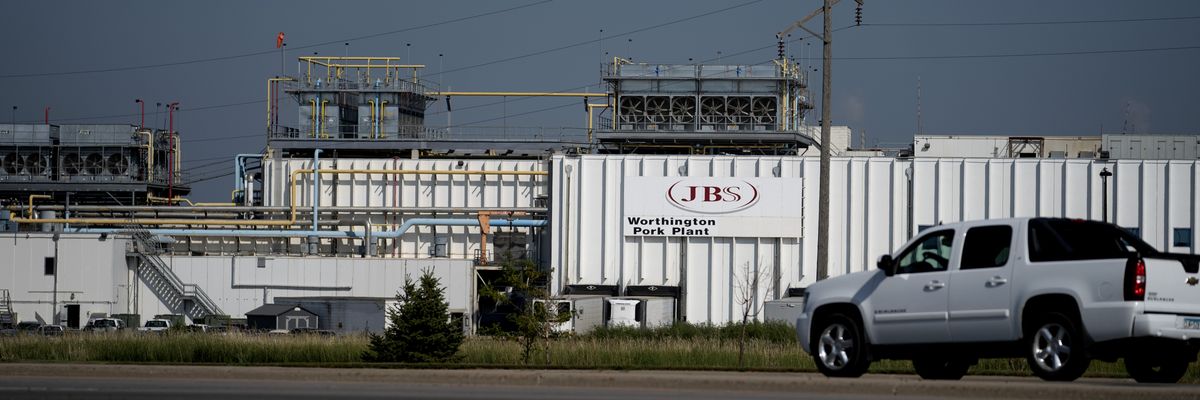
The expanse of JBS pork processing plant sits at the northeast corner of Worthington, Minnesota on September 4, 2019.
(Photo by Courtney Perry/For the Washington Post)


Cameron Harsh
Aug 20, 2025
Common Dreams


Earlier this summer, JBS, the world’s largest meatpacking corporation, was approved to list on the New York Stock Exchange. The move was celebrated in business media as a milestone of corporate growth and a testament to the leadership of JBS’ 33-year-old CEO of their US division Wesley Batista Filho. But behind the headlines lies a far more troubling story, one of exploitation, impunity, and environmental devastation that should not be ignored.

Turning a blind eye to abuses at a company as large and powerful as JBS is dangerous, with the harms extending far beyond the meatpacking industry. Consumers, advocates, and investors must stop normalizing this behavior. We have the power and the responsibility to demand better.

JBS has built its empire not through innovation or sustainability, but through exploitation. Price fixing, child labor, wage theft, bribery, tax avoidance, deforestation, animal cruelty—these are not isolated scandals. They are core ingredients of JBS’ business model. And while many corporations would work to correct and address their abuses, JBS has repeatedly treated legal penalties and reputational damage as just another cost of doing business.

Even in industrial meat production, an industry known for its corruption and poor conditions, JBS stands out for the scope and severity of its violations. The company recently agreed to pay over $80 million to settle a beef price-fixing lawsuit. Earlier this year, the company was cited for illegally employing migrant children, some as young as 13, on overnight cleaning shifts in its slaughterhouses. Meanwhile, workers across its global operations report being injured, silenced, or discarded when they speak up.

We must stop sending the message that corporations can endanger workers, break the law, and destroy the environment without consequence, as long as they remain profitable.

A recent federal lawsuit filed by Salima Jandali, a former safety trainer at JBS’ Greeley, Colorado plant, alleges that she faced racial and religious harassment, was retaliated against for raising safety concerns, and was pressured to falsify injury reports. Her allegations closely mirror a separate class action lawsuit filed by Black workers at another JBS facility in Pennsylvania who describe enduring racist slurs, being passed over for promotions, and working in unsafe conditions.

Beyond the factory floor, JBS has long been linked to illegal deforestation and environmental destruction in the Amazon, both directly through its supply chains and indirectly through pressure on local ecosystems. The company’s climate footprint is staggering, with greenhouse gas emissions that rival those of entire countries. And yet, instead of reckoning with this impact, JBS continues to expand production and avoid accountability.

In Brazil, where the company is headquartered, the recent passage of most of the so-called “devastation bill” further weakens environmental safeguards and accelerates the damage. Now that President Luiz Inacio Lula da Silva approved the bill, even with some environmental restrictions, it continues to grant free rein to agribusiness giants like JBS that profit from the destruction of forests and the displacement of Indigenous communities.


This is not a case of a few bad actors or isolated scandals. JBS has thrived because of weak enforcement, political influence, and a financial system that rewards short-term gains over long-term responsibility.

Just months before its New York Stock Exchange (NYSE) debut, JBS subsidiary Pilgrim’s Pride made a $5 million donation to the Trump-Vance Inaugural Committee. This is the context in which JBS was allowed to access US capital markets. Even though top proxy advisory firms, including Glass Lewis and Institutional Shareholder Services, urged shareholders to vote against the listing, citing serious governance concerns and lack of transparency, their warnings were ignored, and just this June, JBS began trading on the NYSE.

JBS now generates over $39 billion a year from its US operations alone, profits that are often routed through tax havens in Luxembourg, Malta, and the Netherlands. And when caught breaking the law, JBS often faces only minor consequences that rarely match the scale of the harm.

We must stop sending the message that corporations can endanger workers, break the law, and destroy the environment without consequence, as long as they remain profitable. There is another path forward. Consumers, advocates, and investors need to reject this status quo and demand change.

That starts with consumers actively choosing not to buy JBS products. Investors can divest from JBS and urge their asset managers to do the same. Universities, pension funds, and retirement plans can reexamine whether their portfolios are supporting a company with this kind of track record. At the same time, policymakers must push for stronger corporate accountability, not just in meatpacking, but across industries that harm people and the planet.

JBS should not be rewarded with more money, more access, and more influence. Instead, we must make JBS the example and let it serve as a warning about the costs of putting profit above all else. The future of our food system, our environment, and our communities depends on drawing the line and holding it.


Our work is licensed under Creative Commons (CC BY-NC-ND 3.0). Feel free to republish and share widely.


Cameron Harsh is the interim executive director at World Animal Protection US.
Full Bio >
Trump's War on Clean Energy Could Be His Downfall... If the Dems Exploit It

Team Trump has mishandled American energy policy in every possible way literally since day one, setting the stage for higher electric bills.


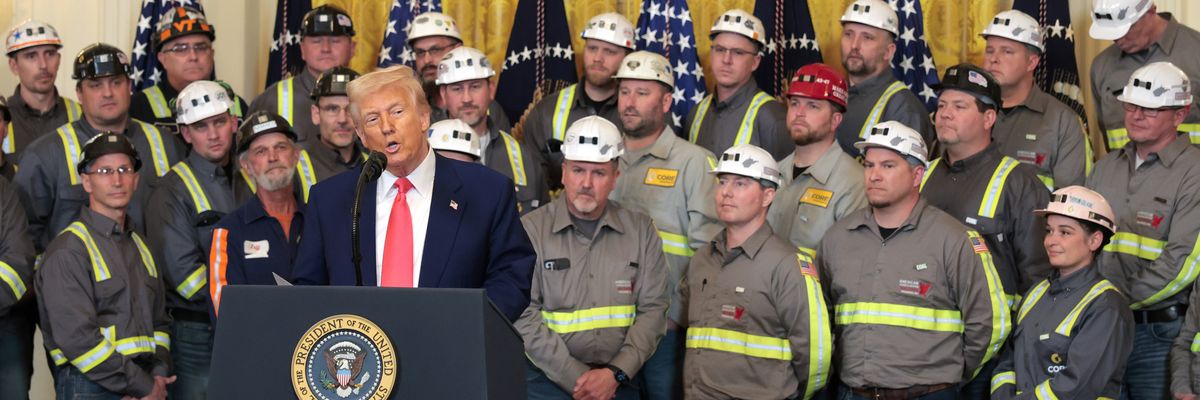
US President Donald Trump speaks alongside coal and energy workers during an executive order signing ceremony in the East Room of the White House on April 8, 2025 in Washington, DC
(Photo by Anna Moneymaker/Getty Images)


Bill Mckibben
Aug 20, 2025
The Crucial Years

The next two elections should be decided on the great questions of democracy versus authoritarianism, openness versus racism, science versus ignorance. But my guess is that electric bills may play at least as large a role.

And that should be a good thing for the forces of virtue, because team Trump has mishandled American energy policy in every possible way literally since day one—they’re setting up a debacle. But as we should know by now, Democrats are particularly good at turning debacles into nothingburgers. So let me try and lay out the script right now.

Let’s go back to US President Donald Trump’s first day in office. He declared an “energy emergency” because the production and “generation capacity of the United States are all far too inadequate to meet our Nation’s needs. We need a reliable, diversified, and affordable supply of energy to drive our Nation’s manufacturing, transportation, agriculture, and defense industries, and to sustain the basics of modern life and military preparedness.” If we didn’t get more electricity in particular, the White House said, we would fall behind China in the AI race, with disastrous consequences.

You can debate whether or not we need new AI data centers (My guess is that the technology has been oversold, and that we’re actually going to see fewer of them developed than people think). But you can’t debate two things.

Trump’s crusade against clean energy is obviously idiotic—windmills don’t cause cancer. But it’s more than idiotic—it’s the reason you’re paying more for electricity.

One, the obvious way forward for this country was to develop more sun, wind, and batteries. We know this because it’s what this country, and every other country around the world, had been doing for the last two years. More than 90% of new electric generation around the world last year came from clean energy, momentum that continued through the first quarter of the year. This was not because everyone in the energy business had “gone woke.” Texas, after all, installed more renewable capacity than any other state last year. It was because you could do it cheaply and quickly—we live on a planet where the cheapest way to make power is to point a sheet of glass at the sun.

But, two, the Trump administration immediately began to do absolutely everything in in its power to stop this trend and to replace it with old-fashioned energy—gas, and coal. They have rescinded environmental regulations trying to control fossil fuel pollution, ended sun and wind projects on federal land, cancelled wind projects wherever they could, ended the Inflation Reduction Act tax credits for clean energy construction and instead added subsidies for the coal industry. Again—short of tasking Elon Musk to erect a large space-based shield to blot out the sun, they’ve done literally everything possible to derail the transition to cheap clean energy.

And as a result, electricity prices are starting to skyrocket. If you don’t believe me, listen to this excellent recitation of a power bill in the style of Faulkner from a fellow with an excellent beard. And they are skyrocketing because our power systems are not moving into the new world.

For example: Trump issued an executive order designed to “reinvigorate America’s Beautiful Clean Coal Industry,” which explained that:
Our Nation’s beautiful clean coal resources will be critical to meeting the rise in electricity demand due to the resurgence of domestic manufacturing and the construction of artificial intelligence data processing centers. We must encourage and support our Nation’s coal industry to increase our energy supply, lower electricity costs, stabilize our grid, create high-paying jobs, support burgeoning industries, and assist our allies.


This is nonsense on a cracker, of course, and a new independent report last week found that consumers will be paying an extra $3-$6 billion dollars a year for the privilege of keeping coal-fired power plants open past their expiration dates:
Forcing utilities to continue to operate unneeded and costly coal-fired power plants past their planned retirement increases the electric bills paid by homeowners and businesses. It also undermines the competitiveness of US businesses such as manufacturing by raising electric rates.

Anyone who pays an electricity bill in any region outside the Northeastern US could be footing the bill. Electricity costs could increase by tens if not hundreds of millions of dollars per year in most states.


If you want more detail on this topic, by the way, David Roberts has a very fine interview with the (very fine name) Frank Rambo, who also points out that the coal-fired power plants they’re trying to keep open are not just the most expensive possible source of electric but among the least reliable:
Now, the thing about coal, as it’s been circling the drain, the coal plants that are left are running much less. They’re not running as these baseload where you run it, you might dial it down at night when demand for electricity is lower, but you’re basically always running it.

They are now running much less. They’re running more where they’re having to cycle through, to cycle on and off. And a coal-fired boiler is not built to operate that way. Again, it’s a 20th-century resource for a 21st-century grid, and that causes a lot of maintenance issues. So that they have to—all of a sudden it’s called a "forced outage."

They have to take it offline. So it’s somewhat ironic they are relying on—the DOE is relying on —the one, one of the resources that’s becoming less and less reliable.


Anyway, this level of corruption and incompetence—remember, all this is happening because candidate Trump literally told the fossil fuel industry they could have anything they want if they gave massive contributions to his campaign, and then they did—should open up his party to scrutiny and to scorn. At some level Democrats are figuring this out—as the Washington Post said last week, they have lots to work with, beginning with Trump’s promises that electric bills would fall:
“Under my administration, we will be slashing energy and electricity prices by half within 12 months, at a maximum 18 months,” he told an audience in North Carolina in August 2024.

Trump’s first 12 months aren’t over yet. But so far, the data show prices trending in the wrong direction. And Democrats are keen to make Trump pay for that.

They are crafting an argument that not only have prices not come down but the sweeping tax and spending law Trump signed into law in July will make energy costs worse.


In fact, as NPR reported recently, electricity costs are now climbing twice as fast as inflation, which should give the Dems a huge opening. And indeed the Senate Dems have put together a bill that would cut those costs. But take a look at the press release from Sen. Chuck Schumer (D-N.Y.)—really, just look at the headline—and ask yourself if the Dems have really figured out the snappy rhetoric they need to take advantage of the situation.

I’d say the real danger is the GOP will go on the attack instead, blaming electricity price hikes on their favorite target, Joe Biden. You can already see it happening—here’s Murdoch’s New York Post trying to blame Biden (and New York Gov. Kathy Hochul and New Jersey Gov. Phil Murphy) for being Green New Dealers. (Ironic, since they’ve actually done much to disappoint enviros in their states). And here’sTrump’s Energy Secretary (and former fracking exec) Christ Wright yesterday moaning that it’s all Joe Biden’s fault:
“The momentum of the Obama-Biden policies, for sure that destruction is going to continue in the coming years,” Wright told Politico during a visit to wind- and cornrich Iowa. Still, he said: “That momentum is pushing prices up right now. And who's going to get blamed for it? We're going to get blamed because we're in office.”


This is all inane. Wright was standing in Iowa, which has some of the lowest electric rates in the country—the average Iowan will spend 39% less on electricity than the average American. Why? Because it produces 57% of its electricity from the wind, the second-biggest wind state in the country. The same thing is true across the country. Here’s Stanford professor Mark Jacobson, explaining the math in the Wall Street Journal:
How do the 12 highly renewable states rank in terms of electricity prices? Ten of them are among the 19 states with the lowest electricity prices. Seven are among the 10 states with the lowest prices. South Dakota, with renewables supplying 95% of demand, has the ninth-lowest electricity price. North Dakota (52% renewables) has the lowest. More renewables mean lower prices.

Only California and Maine have high renewables and high prices. Why? California’s industrial price of natural gas, needed for electricity backup, is routinely the third highest in the US and twice the US average. Plus, utilities have passed to customers the costs of wildfires from transmission-line sparks, undergrounding transmission lines, the San Bruno and Aliso Canyon gas disasters, retrofitting gas pipes following San Bruno, and keeping the Diablo Canyon nuclear-power plant open.

California’s use of more renewables and batteries in 2024 than in 2023 increased grid reliability, however, as evidenced by 52% lower spot electricity prices this March to June, versus the same period in 2023. This slowed retail electricity-price rises.

More renewable electricity generators and batteries reduce energy prices. Even in states with high electricity prices caused by other factors, renewables and battery storage keep prices lower than they otherwise would be.


So Democrats need to get good at saying this. They need props—solar panels, batteries. They need sound bites. They need lots and lots of solar installers speaking up, and lots of people with solar on their roofs holding up their teeny tiny bills for the camera. The Dems need to be on the offensive, and sometimes they need to be offensive. The basic line: Trump’s crusade against clean energy is obviously idiotic—windmills don’t cause cancer. But it’s more than idiotic—it’s the reason you’re paying more for electricity.

The Department of Energy literally put out a tweet last month with a picture of a hunk of a coal and the legend “She is the moment.” But in fact coal is 18th-century technology, and gas is 19th-century technology, and now we’re in the 21st century where people know how to intercept the rays of the sun and the breeze in the air and turn them into the cheapest electricity the world has ever seen. And Trump’s getting in the way of that.

© 2025 Bill McKibben


Bill Mckibben
Bill McKibben is the Schumann Distinguished Scholar at Middlebury College and co-founder of 350.org and ThirdAct.org. His most recent book is "Falter: Has the Human Game Begun to Play Itself Out?." He also authored "The End of Nature," "Eaarth: Making a Life on a Tough New Planet," and "Deep Economy: The Wealth of Communities and the Durable Future."
Full Bio >