Saturday, March 07, 2026


The Unbreakable Message


Quantum communication is no longer a physics thought experiment. It’s being deployed right now, and it’s going to change who controls secrets, who wins wars, and who you can trust online.


There is a physics rule that changes everything about how we think about secrets. It goes like this: you cannot observe a quantum system without disturbing it. Not because our instruments are clumsy. Not because we haven’t built good enough technology yet. Because the universe, at its most fundamental level, does not allow it.

This sounds like an obscure footnote in a physics textbook. It is not. It is the foundation of a communications revolution that is quietly unfolding right now, one that promises to make certain kinds of messages genuinely, physically impossible to intercept without detection. Not hard to intercept. Not expensive to intercept. Impossible to intercept.

Governments know this. China has already built a 2,000-kilometer quantum communication network between Beijing and Shanghai, and in 2017 demonstrated satellite-based quantum communication over 1,200 kilometers.1 The European Union has a continent-wide quantum network in development. The United States, Japan, South Korea, and the UK all have major national programs running. Banks in Europe and Asia have piloted quantum-secured trading links. The technology exists. It works. The question is no longer whether quantum communication reshapes the world, but when and on whose terms.

So let’s talk about what this actually is, who it matters to, and why you should be paying attention even if you have never thought about a photon in your life.

The physics, explained without the physics

Every time you send a message today, whether it’s a text, a bank transfer, or a classified government cable, it gets scrambled using mathematics. The scrambling is based on mathematical problems that are very hard to solve, specifically, factoring enormous numbers into their prime components. Break the math, and you read the message. This is the foundation of essentially all modern encryption.

The problem is that “very hard” is not the same as “impossible.” It just means that today’s computers would take longer than the age of the universe to crack the code. Tomorrow’s computers might not. And right now, governments and intelligence agencies around the world are almost certainly storing encrypted communications they’ve intercepted, banking on the possibility that a sufficiently powerful quantum computer, once built, will let them reach back through time and read messages that were sent years or decades ago.

Security researchers have a name for this: harvest now, decrypt later. It is not paranoia. It is a rational strategy that any serious intelligence service would pursue.

Quantum communication offers a fundamentally different kind of security that doesn’t rely on mathematics at all. It relies on physics. Three ideas are at the heart of it.

The first is quantum superposition. A normal computer bit is either a zero or a one. A quantum bit, called a qubit, can be both simultaneously, until the moment you measure it, at which point it settles into one or the other. Think of it like a coin spinning in the air. It’s not heads or tails yet. It’s both.

The second is quantum entanglement. Two particles can be linked in such a way that measuring one instantly determines the state of the other, no matter how far apart they are. Einstein called this “spooky action at a distance” and spent years refusing to believe it was real. Decades of experiments have confirmed that it is.2 When you measure one entangled particle, its partner responds instantly, across any distance.

Einstein called it “spooky action at a distance.” Decades of experiments have confirmed that it is very real, and very useful.

The third is the no-cloning theorem, which states that you cannot perfectly copy an unknown quantum state. This one sounds technical but its implications are enormous: if you intercept a quantum message and try to read it, you have to measure the quantum particles carrying that message, and the act of measuring changes them. The message arrives at the other end subtly altered, and the people communicating know immediately that someone was listening.

Put these three things together, and you get Quantum Key Distribution, or QKD, the core technology of quantum communication. Instead of relying on mathematical complexity to protect a secret key, QKD relies on physics. Alice and Bob, as cryptographers conventionally call the two parties communicating, exchange individual photons, particles of light, to generate a shared secret key. If Eve, the eavesdropper, intercepts those photons to measure them, she inevitably disturbs them. Alice and Bob detect the disturbance. They throw out the compromised key and try again. Eve gets nothing.

The first QKD protocol, known as BB84, was proposed by Charles Bennett and Gilles Brassard in 1984.3 It took decades to go from a theoretical proposal to working hardware. That hardware now exists and is being deployed. Commercially. Today.

THE KEY ENGINEERING PROBLEM

Photons carrying quantum information are absorbed and scattered as they travel through fiber-optic cable. Classical systems solve signal loss by amplifying the signal at intervals, but you cannot amplify a quantum state without copying it, which the no-cloning theorem forbids. “Quantum repeaters,” devices that extend the range of quantum networks using entanglement swapping and quantum memory, are the central unsolved engineering challenge. Most experts expect them to mature within a decade, at which point the range limitations that currently restrict quantum networks will largely disappear.

Why militaries are racing to deploy this

If you want to understand who is taking quantum communication most seriously, look at who is spending the most money on it. The answer is the same institutions that have always cared most about the integrity of secret messages: militaries and intelligence agencies.

The nuclear problem

The most consequential application is one that almost nobody publicly discusses: securing nuclear command-and-control systems. The communications chain between a national leader and nuclear forces must work flawlessly under any circumstances, including a decapitation strike, and must be impossible to fake or intercept. A spoofed launch order is among the worst imaginable scenarios in international security. A quantum-secured nuclear command network would provide a layer of physical assurance that classical encryption, which relies on mathematical complexity, cannot match.

The submarine problem

Communicating with submarines is one of the oldest unsolved problems in naval warfare. Current very-low-frequency radio systems are slow, have limited bandwidth, and emit signals that can be detected. Researchers are investigating quantum optical channels using blue-green wavelengths of light, which penetrate seawater, as well as satellite-to-submarine quantum links. The strategic value of maintaining covert, reliable, quantum-secured communication with ballistic missile submarines, platforms whose entire purpose is to be undetectable, is obvious.

The “harvest now, decrypt later” arms race

Every major intelligence service is almost certainly recording encrypted communications today that they cannot yet read, hoping that advances in quantum computing will eventually let them crack the encryption retroactively. This is a race with an uncertain finish line. Quantum communication sidesteps the race entirely. A message transmitted via QKD cannot be harvested for later decryption, because any interception is immediately detected and the key is discarded. Nations that move their most sensitive communications onto quantum networks first gain a permanent, physics-guaranteed communications advantage over those that don’t.

Sensing the invisible

Quantum communication’s military significance extends beyond sending messages. Related quantum technologies promise to detect things that are currently invisible. Quantum-enhanced radar using entangled photons can detect objects with sensitivity beyond classical radar, with potential applications against stealth aircraft. Quantum gravimeters can detect submarines, underground bunkers, and tunneling activity through subtle gravitational signatures, without emitting any detectable signal. Quantum inertial navigation provides GPS-accurate positioning without GPS itself, which is vulnerable to jamming and spoofing. Several militaries have demonstrated operational prototypes of these systems. They are not theoretical.

Nations that move their most sensitive communications onto quantum networks first gain a permanent, physics-guaranteed advantage over those that don’t.

What this means for the rest of us

Quantum communication will not stay in the hands of militaries and governments. The same technology that secures launch codes eventually secures everything else. Here is where it goes next.

Your money

Financial institutions were among the first civilian adopters of QKD technology, for the obvious reason that they move enormous amounts of money over networks that are constantly under attack. Several European and Asian banks have completed QKD pilot programs for high-value interbank transactions. Central Bank Digital Currencies, which dozens of governments are actively developing, will need communication security that cannot be undermined by future quantum computers. QKD is the natural fit.

Your medical records

Genomic data is uniquely personal and permanently sensitive. Unlike a compromised password, you cannot change your DNA. The same is true of much medical information. As hospitals, research institutions, and pharmaceutical companies share increasingly sensitive data across networks, the case for quantum-secured medical communications becomes harder to dismiss. Attacks on hospital networks are already a routine feature of the threat landscape. Quantum communication offers a way to significantly reduce their reward.

The power grid, the water supply, and the internet itself

Real-world cyberattacks on power infrastructure in Ukraine and water treatment facilities in the United States have demonstrated that critical infrastructure is genuinely vulnerable. The control systems managing these facilities, known as SCADA systems, communicate over networks that are poorly secured by most conventional standards, let alone quantum ones. Quantum-secured communication links between control centers and field equipment would add a layer of protection that is physically guaranteed rather than dependent on software patches and mathematical assumptions.

A different kind of internet

The most transformative long-term vision is the quantum internet: a global network layer that distributes entanglement between nodes, enabling quantum-secured communication between any two points on Earth. This would not replace the classical internet but would add a quantum layer that changes the security architecture of global communications fundamentally. Researchers have demonstrated small quantum networks in city-scale experiments. The path to a global quantum network runs through the quantum repeater problem, and most researchers expect that problem to be solved within the next decade.4

When that happens, the most exciting possibility is not just secure communication. It is distributed quantum computing: quantum processors in different cities, connected by quantum networks, sharing entanglement to perform calculations that no single machine could execute. The implications for drug discovery, materials science, climate modeling, and artificial intelligence are difficult to overstate.

The geopolitics nobody is talking about

There is a quiet competition underway that deserves more public attention than it receives. China has made quantum communication a national strategic priority in a way that few other countries have matched. The Beijing-to-Shanghai network is operational. The Micius satellite is flying. Chinese research output in quantum communication has grown dramatically over the past decade.

The United States has responded with significant DARPA investment and a classified set of programs whose scope is unknown. Europe is building the EuroQCI network across member states, aiming for operational capability by the late 2020s.5 Japan, South Korea, Singapore, and the UK all have serious national programs.

What is at stake in this competition is not merely communications security for individual governments. It is the architecture of the global information environment for the coming century. Whichever nations establish their quantum networks first, develop compatible standards, and build the infrastructure that others depend upon will have a structural advantage analogous to the advantage the United States gained by building the backbone of the early internet.

The risk of fragmentation is real. If Chinese and Western quantum network standards develop in isolation, the result could be a quantum communication divide that mirrors and deepens existing geopolitical fault lines, a world in which Beijing’s quantum network and Washington’s quantum network are incompatible, and nations must choose sides not just politically but technologically.

What comes next, and when

Quantum communication won’t appear on your smartphone next year. The hardware is still expensive, the range without repeaters is limited, and the data rates are low. For now, QKD handles key exchange rather than high-bandwidth data transmission, which means it works alongside classical encryption rather than replacing it.

But the trajectory is clear, and it follows the same curve as every disruptive, transformative technology before it. First, deployment at high-value, fixed strategic links where cost is not the primary consideration: national command authorities, financial institution interconnects, nuclear facilities. Then, as hardware miniaturizes and quantum repeater technology matures, expansion to a wider range of government and commercial users. Then, over the longer horizon, something approaching ubiquity.

The honest timeline for widespread consumer quantum communication is probably two to three decades. The timeline for quantum communication to become a defining feature of strategic competition between major powers is already here. The race is on.

The physics is real. And the message that cannot be intercepted is closer than most people realize.

ENDNOTES:

  • 1
    Juan Yin et al., “Satellite-Based Entanglement Distribution over 1200 Kilometers,” Science 356, no. 6343 (2017): 1140-1144.
  • 2
    John Bell, “On the Einstein Podolsky Rosen Paradox,” Physics 1, no. 3 (1964): 195-200. 
  • 3
    Charles H. Bennett and Gilles Brassard, “Quantum Cryptography: Public Key Distribution and Coin Tossing,” in Proceedings of IEEE International Conference on Computers, Systems, and Signal Processing (New York: IEEE, 1984), 175-179.
  • 4
    Stephanie Wehner, David Elkouss, and Ronald Hanson, “Quantum Internet: A Vision for the Road Ahead,” Science 362, no. 6412 (2018): eaam9288.
  • 5
    European Commission, “European Quantum Communication Infrastructure (EuroQCI),” Digital Strategy, 2023.
Robert W Malone MD, MS is president of the Malone Institute whose mission is to bring back integrity to the biological sciences and medicine. The Malone Institute supports and conducts research, education, and informational activities. Contact: info@maloneinstitute.orgRead other articles by Robert, or visit Robert's website.

The Dark Horse That Could Deliver the World's First Fusion Reactor

  • Germany has become a surprising dark horse in the race for commercial nuclear fusion by committing €1.7 billion in funding to build the world's first commercial fusion reactor.

  • German company Proxima Fusion is partnering with the Free State of Bavaria, RWE, and Max Planck Institute for Plasma Physics to build a stellarator fusion power plant aimed at demonstrating net energy gain.

  • The race for commercial fusion is increasingly moving toward public-private partnerships, driven by the accelerating need for energy, partially fueled by the AI boom.

The race is on to achieve commercial nuclear fusion. While the technology was first conceptualized a full century ago, the ambition to replicate the process that powers our sun here on Earth has only recently exited the realm of sci-fi ambitions into reality. Fueled in part by the accelerating need for energy thanks to the AI boom, nuclear fusion is receiving more attention and investment dollars than ever before, and breakthroughs are starting to pile up. While China and the United States are leading the charge in a high-stakes battle for commercial fusion supremacy, a surprising dark horse may be about to take the lead.

Germany has taken major steps forward in the development of what could soon be commercially viable nuclear fusion facilities in the past few years. In 2025, German Chancellor Friedrich Merz unveiled new action plan for the nation’s energy industry, which included €1.7 billion ($1.98 billion) in funding to build the world’s first commercial nuclear fusion reactor. This ambition comes as a surprise, as Germany has long been one of the world’s staunchest and most vocal opponents of nuclear (fission) energy. 

But Germany, Europe’s largest economy, needs to be bold if it wants to meet its own decarbonization goals. Sarah Klein, commissioner for fusion research at the Fraunhofer Institute for Laser Technology in Aachen, told DW last October that investing in fusion technology is a "smart long-term strategic bet” that “keeps Germany at the forefront of a global technology race.” She added that in tandem with renewable energy development, nuclear fusion is “crucial for ensuring energy sovereignty after the phaseout of fossil fuels.”

Related: Trump’s Secret Weapon in the Rare Earth War

And now, Germany’s ambitious plan is already coming together. German company Proxima Fusion has signed on to help build the first stellarator fusion power plant in Europe. The firm inked a Memorandum of Understanding with the Free State of Bavaria, RWE, and Max Planck Institute for Plasma Physics (IPP) that lays out a roadmap for achieving commercial fusion as soon as possible. When the stellarator becomes operational in the coming decade, Proxima Fusion has stated that it will be the first stellarator to demonstrate net energy gain, the most critical breakthrough point for modern fusion models.

Francesco Sciortino, co-founder and CEO of Proxima Fusion, says that the deal “marks the starting point of an industrial ecosystem that consolidates existing and new know-how in Europe and anchors value creation here. This marks the beginning of a long-term industrial growth trajectory over the coming decades, creating new export opportunities for Germany and Europe.”

Not only would this mark a major win for Germany and for Europe in the fusion wars, it would be a win for a new fusion landscape characterized by public-private partnerships. Until recently, nuclear fusion research was such a lofty and expensive undertaking that only deep-pocketed governments could possibly fund prototypes to further research and development in the field. But the race for commercial nuclear fusion has increasingly gone private in recent years as Wall Street gets involved and startups begin to diversify the field

Related: The U.S. Just Took a Giant Step in The Rare Earth Race With China

“The potential of fusion technology for the energy supply of the future is enormous. Thanks to an excellent research landscape and the start-ups that have emerged from it, such as Proxima Fusion, Germany can take on a key role,” Dr. Markus Krebber, CEO of RWE, was recently quoted by Interesting Engineering. 

“That is why it is good that the federal and state governments are jointly pushing this topic forward in order to build the world’s first commercial fusion power plant in Germany. We at RWE are happy to support this. Our decommissioning site, with its existing infrastructure combined with our operational expertise, offer ideal conditions to give Germany time and cost advantages in international competition.”

If Germany achieves commercial fusion before any other country, it will be a major upset to what has largely been a race between the United States and China. The two global superpowers have been trading off fusion breakthroughs for years now, and both Donald Trump and Xi Jinping are eager to establish dominance in the sector. But while China and the United States have gotten all the spotlight, Europe’s slow and steady approach may very well win in the end. 

By Haley Zaremba for Oilprice.com


Tanker Squeeze Adds Insult to Oil Injury amid Iran War

  • Tanker markets are under extreme strain, with VLCC rates exceeding $420,000 per day and very few supertankers available in the Persian Gulf as insurance cancellations and security risks reduce traffic through the Strait of Hormuz.

  • Structural constraints are worsening the shortage, including sanctions on Russian tankers, consolidation in the tanker market, and Sinokor’s growing control over available VLCC capacity.

  • Prolonged disruption could force major production shut-ins, with Iraq already cutting 1.5 million bpd and analysts warning that global shut-ins could reach nearly 5 million bpd if Hormuz remains disrupted for several weeks.

Tanker rates are through the roof, movement through the Strait of Hormuz is severely reduced because of war cover cancellations by insurers, and the combination of these developments has sent oil prices flying. Now, there’s a third factor that would likely aggravate the situation further: there are not enough supertankers.

Bloomberg reported the news this week, saying there were between six and a dozen supertankers that were available for booking in the Persian Gulf, if, of course, the potential client was willing to pay the record daily rates and deal with insurance. Twelve supertankers could theoretically be enough to handle one day’s outbound oil traffic – but no more than that. Every supertanker can carry 2 million barrels of crude and, as Bloomberg notes in its report, it takes two days to load.

It is worth noting that the squeeze on supertankers available for loading Middle Eastern oil comes on top of already rising freight rates on the back of tightening sanctions on vessels carrying Russian oil, a consolidation drive in the tanker segment, and the U.S. takeover of Venezuela’s oil industry.

The trend has been going on for a while. Last November, the tanker rates on the route from the Middle East and China hit a five-year high as s traders rushed to find alternatives to Russian crude after the U.S. sanctioned Russia’s biggest oil producers and exporters, Rosneft and Lukoil. Then, in January, rates dipped amid seasonal weakening in trade, only to rebound in February amid growing tensions between the United States and Iran.

Yet there is more. South Korean shipping company Sinokor has been on a supertanker buying spree that has resulted in what Bloomberg called “unprecedented control” over a substantial portion of the world’s supertankers for immediate booking. This has also contributed to higher tanker rates—for routes beginning at the U.S. Gulf Coast. Indeed, Bloomberg reported that Sinokor, along with its partner Mediterranean Shipping Co., “controlled almost all the VLCCs available for hire to load oil from the U.S. Gulf Coast.”

Meanwhile, the freight rate for a supertanker carrying crude oil on the key Middle East-to-China route hit a record high of more than $420,000 per day this Monday, and the rally is likely far from done, seeing as the missile strike exchange between the United States and Israel, and Iran continues unabated for the time being. Average supertanker rates globally have hit over $280,900. There are reports of Iranian forces attacking tankers in the Strait of Hormuz. The security situation, in other words, does not look good.

This means that at some point oil production would get affected, analysts are warning. “With the Strait of Hormuz still inactive, the clock is ticking,” JPMorgan analysts said in a note earlier this week. “If it does not reopen within 21 days, upstream shut?ins could begin.” In fact, upstream shut-ins have already begun in Iraq.

The situation in the Persian Gulf has forced OPEC’s second-largest producer to shut in as much as 1.5 million barrels daily in production, and this could be just the beginning, with further shut-ins likely to bring the total to 3 million barrels daily, according to Iraqi officials. That amount is almost equal to Iraq’s entire export volumes, which average between 3.2 million and 3.4 million barrels daily. Interestingly, the amount of 3 million barrels daily is also approximately equal to the global supply overhang as estimated by the International Energy Agency. And Iraq will not be the only one shutting in production if the war is prolonged.

Indeed, earlier today, JP Morgan analysts released another note, warning that Iraq would be forced to suspend all oil exports in three days and Kuwait has 14 days of storage space. The more time passes, the worse it would get, too, with the bank’s analysts estimating production shut-ins at 4.7 million barrels daily by the 18th day of Hormuz disruption.

What is happening, then, is an already bad situation becoming a lot worse, very fast. Tanker rates were already high to begin with. As the U.S. and Israel started firing missiles at Iran, insurers decided they did not need that risk in their lives, making matters worse. Meanwhile, Sinokor has become the dominant player on that very same troubled tanker market, setting the price for a major alternative oil export route: from the U.S. Gulf Coast. And there are dozens of tankers under sanctions, which limits their availability, to put it mildly.

Some observers make a point of noting that Iran cannot physically block the Hormuz Strait. Yet evidence suggests it does not need to. Just warning that it would attack tankers if they try to enter has been enough: tanker traffic on Monday consisted of one or two mid-sized vessels, per data from Kpler and Vortexa. The oil market should brace up for more blows.

By Irina Slav for Oilprice.com

Octopus CEO Urges UK To Tap North Sea Oil To Stabilize Prices

  • Octopus founder Greg Jackson has warned the UK is facing an energy price shock due to the Middle East conflict and has called for the government to use North Sea resources and strip "expensive distractions" like carbon capture from energy bills.

  • Global gas prices have doubled and UK wholesale electricity prices are up 50pc since the Strait of Hormuz was effectively closed, with the Resolution Foundation warning this could add £500 to energy bills this year.

  • Opposition parties are advocating for easing restrictions on North Sea exploration, and the Chancellor has signaled a commitment to replacing the energy profits levy, though policy is complicated by uncertainty from the Middle East crisis.

Octopus founder and government adviser Greg Jackson has urged Labour to “use what’s available” in the North Sea and rethink its key net zero policies. 

Jackson said the county was “staring down the barrel” of an energy price shock in light of the conflict in the Middle East. 

The Octopus chief executive who is also a member of the industrial strategy advisory council and has shared close ties with key government figures including business secretary Peter Kyle, warned “economic damage” from the crisis was imminent. 

He called on the UK government to ditch “wishful thinking” and “ideology” in order to keep prices stable and the economy afloat. 

“Global gas prices have doubled since Iran effectively closed the Strait of Hormuz, and UK wholesale electricity prices are up about 50pc,” Jackson wrote in The Telegraph.

“Hikes in energy prices are bad enough, but they feed through to inflation, which in turn raises interest rates, compounding the economic damage.”

He added: “We should use what’s available from the North Sea. While the price is set globally, there’s no point shipping gas from the other side of the world when we have it here.

Jackson also suggested that subsidy costs and “expensive distractions” including carbon capture and hydrogen projects should be stripped from energy bills. 

His intervention adds to the pressure on energy secretary Ed Miliband, who has pushed the government into doubling down on net zero efforts. 

Calls for North Sea exploration grow

Opposition parties have pledged to remove restrictions on exploration in the North Sea while President Trump has pressed Sir Keir Starmer into easing taxes on energy giants operating in the area. 

The Resolution Foundation warned that should recent rises in oil and gas prices stick, some £500 could be added onto energy bills later this year. 

Reeves met executives from North Sea oil giants BP, Serica and TotalEnergies in London to discuss energy price rises, fuelling speculation the government could ease regulation on businesses to ease pressures on Britons. 

It is understood the Chancellor said she would look to replace the energy profits levy with another tax mechanism based on revenue and market prices, as previously announced by the government. 

She warned, however, that there was greater uncertainty over policy in the face of the conflict in the Middle East.

A government source said:”The Chancellor was clear with industry that she wants the energy profits levy to come to an end. She has made that promise and she stands by it. Indeed, it was a commitment she wanted to make this week. But the crisis in the Middle East has had real-time consequences on oil and gas prices and it is right that we respond to this.”

Starmer said during Prime Minister’s Questions that the “sprint” to decarbonise the electricity grid was more important to stop the UK from being over-reliant on international markets.

By City AM 

Hormuz Shock Sends China and India Racing for Russian Crude

  • The effective halt of tanker traffic through the Strait of Hormuz has instantly jeopardized more than 1/3 of Asian crude imports, forcing China and India to urgently search for non-Gulf supply.

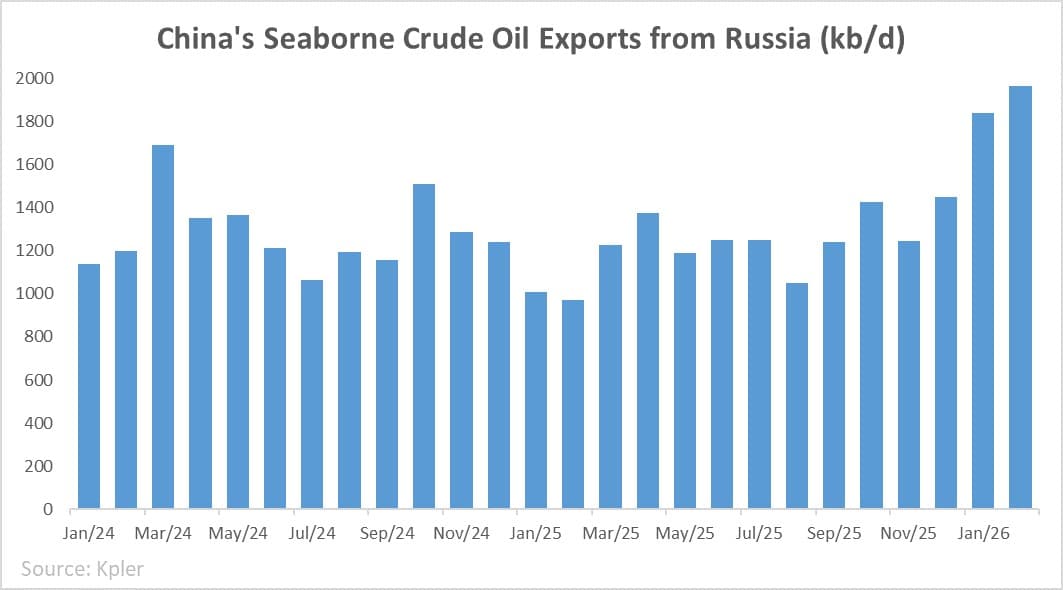
  • As Gulf cargoes stall at sea, Russian crude – already near record flows to China at 1.92 million b/d – has emerged as the most immediate alternative for Asia’s largest oil buyers.

  • Shrinking floating storage and narrowing Urals discounts suggest Moscow may exploit the disruption to tighten supply and drive prices higher by playing Chinese and Indian demand against each other.

The crisis around the Strait of Hormuz has become a severe stress test for both Gulf crude suppliers and their key buyers. Despite repeated assurances from U.S. officials that the waterway was never formally blocked, satellite tracking suggests that no oil or product tankers transited the strait since March 1. The disruption immediately placed the world’s largest importers under pressure. China and India together consume tens of millions of barrels per day, and both remain structurally dependent on Gulf crude. China has steadily expanded purchases of Russian oil since 2022, yet roughly 1/3 of its crude imports originate in the Gulf. India, meanwhile, has been deliberately reducing its earlier heavy reliance on Russian barrels and replacing them with Middle Eastern supplies. With the Iranian crisis unfolding and no quick normalization of Hormuz traffic in sight, both Asian giants may turn to their long-standing supplier in Moscow like never before. The key question is: does Russia have sufficient export capacity to meet the sudden surge in demand?

The shift in India’s purchasing pattern has been particularly visible in recent months. Indian imports of Russian crude declined steadily from 1.85 million b/d in November 2025 to just 1.06 million b/d in February 2026. Much of the remaining flow has been concentrated in a single outlet: the Vadinar refinery operated by Nayara Energy, partly owned by Rosneft. By February, roughly half of the Russian crude delivered to India (around 510,000 b/d out of the 1.06 million b/d total) was imported there. In November 2025, the share was markedly smaller, with 560,000 b/d flowing to Vadinar out of the 1.85 million b/d imported overall. The retreat from Russian supply was largely driven by mounting pressure from Washington, prompting Indian refiners to stop buying Russian barrels. By February 2026 crude from Iraq, Saudi Arabia, the United Arab Emirates and Kuwait accounted for more than half of India’s total imports of 5.18 million b/d, reaching roughly 2.8 million b/d compared with just 2 million b/d in November 2025. The nearly 1 million b/d increase reflected a belief that Gulf crude offered legal stability and relatively low prices. That assumption is now being severely tested, as a significant share of those cargoes is effectively stranded in Gulf waters waiting for safe passage through the Strait of Hormuz. The disruption is likely to force New Delhi to reconsider its recent distancing from Russian supply – assuming those barrels are still available.

China faces a challenge of its own. In February 2026, its seaborne imports of Russian crude reached a new record of 1.92 million b/d. Yet the Iranian crisis affects Chinese refiners on two fronts. Unlike India, China was also a major buyer of Iranian crude, importing roughly 1 million b/d in February. Combined imports from Kuwait, Iraq, the UAE and Saudi Arabia totalled about 3.4 million b/d in the same month. Taken together, the potential loss of Iranian supply and disruption to Gulf shipments threatens more than 1/3 of China’s crude imports. In this context, Russian barrels appear both politically and logistically attractive. Overland pipeline flows and shipments from Russia’s Far Eastern ports offer one of the few large-scale supply channels that bypass the Gulf entirely.

Recent tanker movements underline how the market is already adjusting. A wave of U.S. enforcement actions against Venezuelan oil exports has left a number of numerous VLCCs idle in Asian waters. Many of these vessels had previously been used to collect Venezuelan crude through ship-to-ship (STS) transfers. With those flows disrupted, several of the VLCCs became redundant. Russia appears to have quickly stepped into that logistical vacuum. Although Russian exporters rarely relied on VLCCs in the past, at least 8 such vessels are currently positioned in the Arabian Sea and near Singapore, either en route to China or waiting offshore. There’s 12 million barrels of medium sour Urals alone that are carried by VLCCs, not counting Russia’s Far Eastern grades, surpassing the previous record carry of 9.8 million barrels from February 2023. Most of the cargoes they carry are already committed to Chinese buyers, offering little hope for India’s supply concerns.

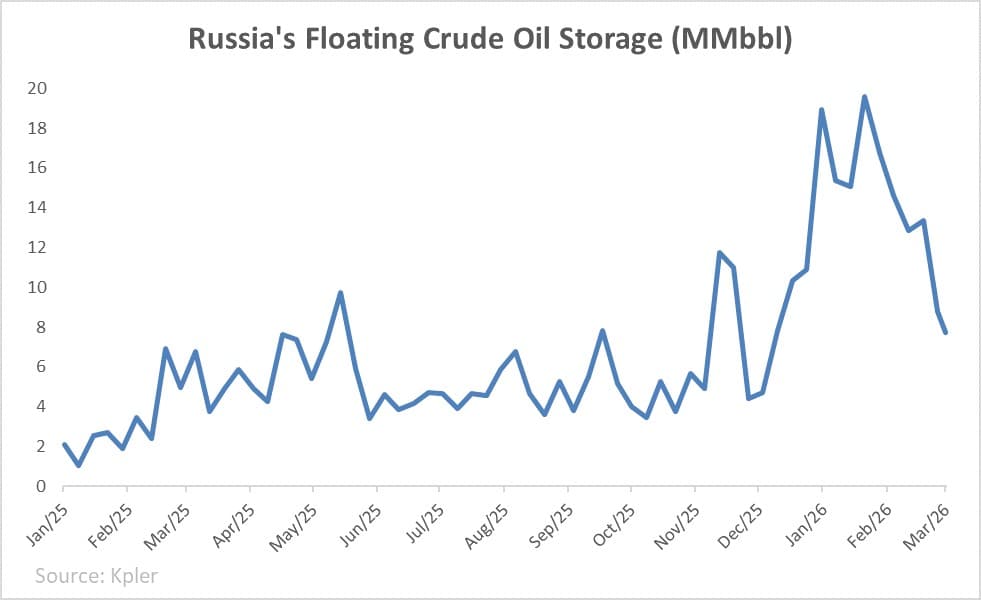
How much of the spare Russian oil is available now? Floating storage suggests that Russia’s spare export capacity may be limited. Inventories of Russian crude at sea climbed steadily through late January 2026, reaching about 19.6 million barrels. Since then, they have declining continuously. By early March, only 12 vessels remain in floating storage, holding roughly 7 million barrels in total, and several of those tankers are already anchored near Chinese ports awaiting a signal to offload. In other words, the pool of unsold Russian crude available on short notice has shrunk significantly.

Pricing dynamics are shifting as well. Market insiders report that the Hormuz disruption has narrowed the discount of Russia’s Urals grade to Brent from roughly $10/bbl to $5-6/bbl. At the same time, Russia itself may soon have additional crude available for export because domestic refining activity has slowed. Russian refinery throughput fell from about 5.5 million b/d in December 2025 to roughly 5.15 million b/d in February 2026. Part of the decline followed drone strikes on two refining facilities, including the Volgograd refinery (300,000 b/d capacity) and the Ukhta refinery (80,000 b/d capacity). Planned maintenance at several other plants scheduled for March and April is expected to further reduce domestic crude demand, potentially freeing additional barrels for exports.

Moscow’s most likely strategy in the current environment will be to play its two largest Asian customers against each other. In previous months, Russian exporters often stored unsold cargoes in tankers near Singapore or along the Chinese coast, a tactic that unintentionally signalled oversupply and widened price discounts. The current market situation is markedly different. With most floating cargoes already allocated and supply chains disrupted across the Gulf, the next wave of Russian barrels is not yet visible. That scarcity gives Russian sellers leverage to raise prices by pointing to strong demand from competing buyers. For both India and China, the Hormuz crisis may therefore lead to the same conclusion: Russian crude remains one of the few reliable alternatives – but it may no longer come as cheaply and abundantly as before.

By Natalia Katona for Oilprice.com

Reliance Industries Pivots Back to Russian Oil with U.S. Waiver

India’s largest private refiner, Reliance Industries, is sounding the market for buying Russian crude, an anonymous source told Bloomberg on Friday, after the United States on Thursday issued a temporary one-month license to India allowing it to purchase Russia-origin crude loaded on vessels before or on March 5. 

Even before the waiver was issued, India was considering returning to buying Russian crude amassed in floating storage in Asia as the war in Iran and Tehran’s retaliatory strikes in the region have severely disrupted oil flows from the Middle East.   

India, the world’s third-largest crude importer, depends on Middle East supply for about 60% of its imports, and the de facto halted tanker traffic in the Strait of Hormuz has put severe pressure on its supplies. 

So the U.S. Treasury’s Office of Foreign Assets Control (OFAC) on Thursday issued a general license to India for Indian refiners to buy Russian crude loaded on any vessel, including blocked vessels, on or before March 5, 2026, until April 4, 2026.  

Currently, as many as 15 million barrels of Russia-origin crude are sitting on tankers close to India – in the Arabian Sea and Bay of Bengal – while another 7 million Russian crude barrels are idling near Singapore, per vessel-tracking data compiled by Bloomberg. 

Related: No Missiles, No Drones: What Happens When Rare Earths Stop Flowing?

Before the U.S. sanctions on Russia’s top producers Rosneft and Lukoil in October 2025, Reliance Industries of Indian billionaire Mukesh Ambani was the biggest buyer of Russian crude oil, importing more than 500,000 barrels per day (bpd) thanks to a long-term deal with Rosneft.   

However, the Indian refiner halted all Rosneft purchases in the wake of the U.S. sanctions and took to procuring crude from non-Russian sources.

Now Reliance Industries has a one-month window to buy Russian crude that’s on tankers and, most importantly, these tankers are not blocked in the Strait of Hormuz. 

The largest private refiner in India plans to use that window to buy part of the Russian oil and process it at a refinery unit producing fuels for the domestic Indian market, according to Bloomberg’s source. 

A separate unit processing fuels for exports will continue to use non-Russian crude, as the EU enacted on January 21 a ban on imports into the bloc of petroleum products obtained in third countries that are derived from Russian-origin crude oil. 

By Charles Kennedy for Oilprice.com 


Wall Street Demands Clarity on Trump’s Hormuz Rescue Plan

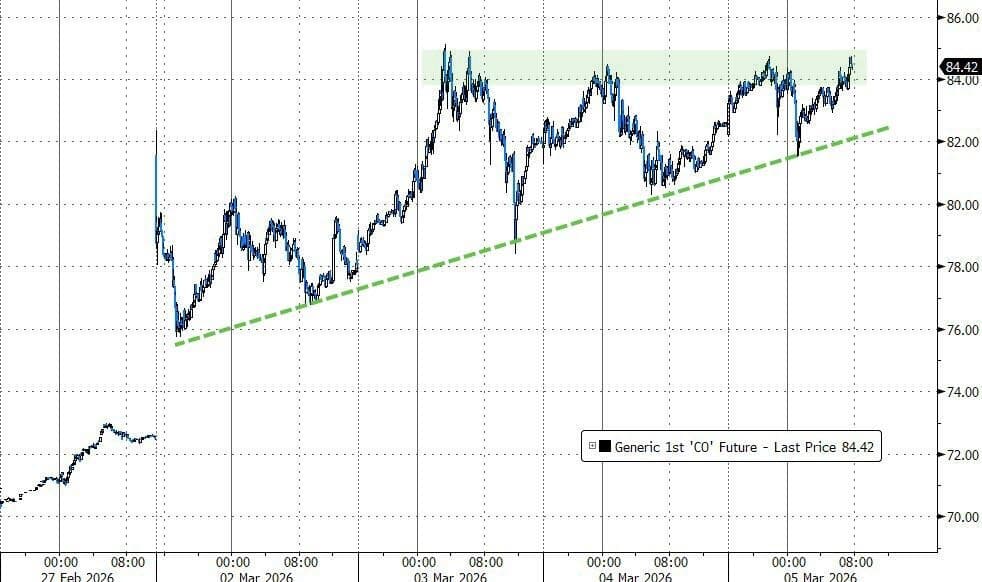
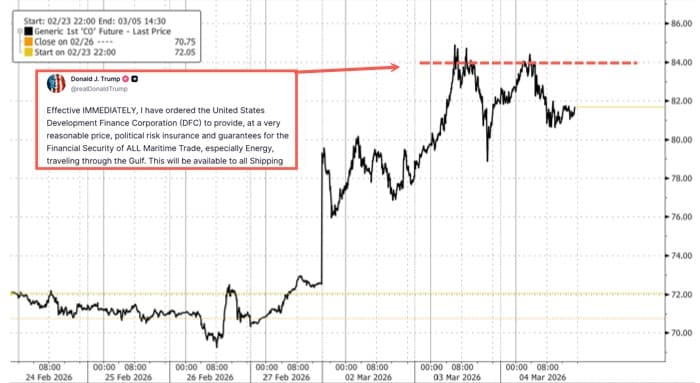
It's been a wild ride in crude over the past few days, with Brent crude futures were capped near $84 a barrel on Tuesday afternoon before sliding down to the $81 level late Wednesday afternoon, only to surge back up to $84 this morning...

...as shipping industry insiders and Wall Street analysts await exact details on the Trump administration's proposal to keep tankers transiting the Strait of Hormuz. The critical maritime chokepoint remains paralyzed, raising the risk of an energy shock in parts of the world that rely heavily on those flows, particularly in Asia.

President Trump wrote in a Truth Social post that the U.S. will provide insurance for "ALL Maritime Trade" through the U.S. Development Finance Corporation (DFC) and will provide Navy escorts "if necessary."

The shutdown is already hitting global energy flows:

Now comes the hard part, with the shipping industry and Wall Street analysts all asking the same question: how will every tanker transiting the Arabian Sea through the Gulf of Oman, into the Strait, and onward to the Persian Gulf be protected by U.S. or allied air or naval forces? 

"Nothing is sure and we need immediate clarity," said Khalid Hashim, managing director of Precious Shipping Pcl, a Thai firm that owns bulk carriers.

Hashim said, "Lives are at risk, cargoes are at risk, ships are at risk. We need immediate cover that protects us from all this."

While some shipowners say they're mulling over joining escorted convoys, many remain very cautious, noting that escorts do not eliminate the risk of the IRGC's asymmetric warfare, such as the use of drones.

Related:How China’s Rare Earth Ban Backfired into a U.S. Tech Breakthrough

Analysts also question whether the Trump administration has done enough planning to make the proposal bulletproof in the near term. Overall, the market sees Trump's plan as a temporary fix to restart flows in the Strait, with Brent crude futures capped at $84 since the announcement and currently trading around $81. 

UBS analyst Benjamin Benson, "Improved risk sentiment following US President Trump's announcement on maritime insurance and US Navy security support further aided the recovery in prices." 

Current activity in the Strait of Hormuz:

"The core thing shipowners are thinking about is the real risk of loss," said Karnan Thirupathy, partner at Kennedys Law LLP, who specializes in commodities and shipping. "No one goes into the trade if the risk of loss is simply too high."

RBC Capital Markets LLC analysts noted, "President Trump's comments about insurance and tanker escorts caused a pullback in oil prices, we question how much planning has been done on the insurance backstop thus far and think there could be a number of challenges in executing this plan quickly." 

Wall Street Journal noted by late afternoon that the Trump administration was in talks with one major insurance broker about how to get ships moving through the Strait of Hormuz: 

A team from insurance broker Marsh Risk met with administration officials Tuesday and offered to help the U.S. government create an insurance mechanism that could lower shipping risk and make insuring ships more affordable, said Marcus Baker, the firm's global head of marine, cargo and logistics. Energy prices have soared since Iran warned it could start attacking ships in the strategic waterway, slowing oil shipping to a standstill.

"Providing protection for all tankers operating in areas currently threatened by Iran is unrealistic as this would require a very high number of warships and other military assets," Bimco security analyst Jakob Larsen noted. 

Let's remind readers that the U.S. and its allies had a difficult time securing the Bab el-Mandeb chokepoint, where Houthi rebels repeatedly launched missiles and drones at commercial ships linked to the U.S. and Israel. That certainly matters now. It also comes as the U.S. and its allies are burning through significant volumes of air-delivered munitions in Operation Epic Fury.

By Zerohedge.com