Saturday, March 14, 2026


The Inner Cabinet and the Outer Media


“One thing was certain, that the white kitten had had nothing to do with it — it was the black kitten’s fault entirely.” Lewis Carroll, Through the Looking-Glass


PRE SCHRODINGERS CAT


Anyone who is not sick at heart and raging over the slaughter of over 165 young Iranian girls at a school by the American-Israeli monsters waging war on Iran is depraved and evil. It sickens me to state something so obvious, but I am afraid it is true that many are not distraught by the news. A nod to “how terrible” and on with the war is a common response for those who even know about it, not just because of moral indifference, but because of the acceleration of digital news reporting that disappears today before it has become tomorrow. The young girls are forgotten with each passing day in the U.S. and Israel – but not in Iran. For war criminals Trump and Netanyahu, the death of those children is a joy on the way to further slaughter of the innocent.

On the other hand, there are many in this functionally illiterate U.S.A., with its functionally illiterate president, who have probably never heard of this war crime. And U.S.-Israeli war crimes are so common that they come and go like ripples on a stream, like a scroll through a “smart phone.” Little penetrates the propaganda bubble, and when it does, it is quickly replaced by the illusion that once these bad guys are swept out of office, these wars will end because our good guys will return in the game of musical chairs to make all copacetic. Peace will reign, as in Iraq, Libya, Syria, Ukraine, Gaza, etc.

I repeat a question I have asked before, but to what avail, I know not: Why do Americans think the United States has 750+ military bases in over 80 countriessupported by a bipartisan consensus? The answer is blatant except for idiots and those willfully blind, and there are plenty of both.

The United States is an imperial warfare state, and these bases exist to wage wars around the world, as the U.S. has done.  End of story.

The Jeffrey Epstein Files release, aside from diverting the public’s attention from Iran, Ukraine, etc., has caused many people to contemplate how certain rich and connected people conspire behind the scenes for nefarious sexual purposes, but also to manipulate financial and political matters. To the most naïve, the naming of so many prominent people – university presidents, politicians, bankers, et al. – in this criminal club is very surprising.

Yet, more perversely, the Epstein long-running serial (not the reality for the victims of the sexual abuse) is entertainment in Neil Postman’s sense of Amusing Ourselves to Death, the title of his prescient 1985 book wherein he argued television had redefined the modern sense of reality, truth, and intelligence; had achieved the status of myth, “a way of thinking so deeply embedded in our consciousness that it is invisible”; that had turned everything into entertainment. Narcoticized by their technological obsession, he argued, people were losing themselves in a fantasy world of unending diversions, as television news was becoming entertainment and all a show, the business of show business. In Postman’s words: “Americans are the best entertained and quite likely the least well-informed people in the Western World.” Facts, data, and the delusive “news of the day” were abundant, but all in the fragmented and pseudo context of televised amusement.

One can only scream in accord when contemplating today’s digital internet Screen Society in which mini-televisions accompany people everywhere in the form of cell phones, keeping them constantly entertained with pointillistic nanosecond “news” catered to their personal tastes and devoid of any context.

While the inner workings of the imperial ruling class might not usually involve as much sexual abuse as the Epstein Serial, or what the journalist Pepe Escobar calls “the Epstein Syndicate,” its members have long conspired to control their wealth, power, and political domination of the masses. Waging wars, globalizing their control (which began in earnest circa 1985), and filling the coffers of the military-industrial complex they own are prime goals. Many of these vile creatures, of course, in their hubris, thinking they are in full control, have entered a trap of international espionage and sexual blackmail, as is evident in the Epstein case, where the presumed controllers are the controlled.

Despite their wealth and power, their little boy minds and sexual avidities have drawn them to “pleasure islands” where they have been exposed as jackasses braying their little boy innocence. They thought Epstein and his intelligence handlers in Israel, Britain, and the U.S were offering them deeper access to the Syndicate’s Inner Cabinet, but they failed to see the trap doors. Yet now that the Epstein “scandal” has received partial exposure, aside from the few that must be sacrificed to appease the public, most skate and profit mightily. It’s an old game of propaganda as a palimpsest.

Just the other day, I had coffee with a friend whose family ties to these imperial ruling class criminals go back more than a century. We discussed his life as a dissident within his wealthy family’s connections to the CIA, the Rockefellers, Morgans, Harvard, the Kennedy assassinations, the industrial corporations essential to the warfare state and massive profits (G.E., General Dynamics, Lockheed, etc.), Wall Street, the banks, corporate media, Big Tech, and so on ad infinitum. Many details of a gross world of privilege, betrayal, and endless lies, where all the insiders know and associate with each other despite different political parties; what, if you were a sensitive child with a conscience, would repulse you, as it did my friend.

We could call it the Old School Wasp Ruling Class, except that old is new, and White Anglo Saxon was never just that, but connected early on to Zionism and its wealthy supporters in and out of government, here and in Israel. Endless connections that most people alive today know nothing about. The hypocrisy involved is appalling and staggering.

The moneyed elite’s hatred for ordinary people is extreme, and their use of the word “democracy” to cover their crimes is routine. Their proclivities have been inculcated in them within the unreal bubble of filthy lucre and its cultural trappings by their parents and reinforced by those toadies who kiss their asses for access to their worlds of ease and glitz. The same is true for the new billionaires who have recently joined the club and are surrounded by sycophants and tongue-hangers.

One of the saddest realities of political life is the way people are fooled again and again by the propaganda these people and their media at the entertainment circuses that they own, and that pass lies for news feed them. That it is the same slop, dished out endlessly by different media cooks, means nothing. The conservative media simply shout for war and more war, while the liberals play both sides (anti-war and pro-war) against the middle in a hypocritical manner to support the wars that the U.S. wages endlessly. The most insidious garbage is swallowed by those who consider themselves “intellectuals” and highly educated.

When my friend mentioned one of his parents’ famous associates, Walter Lippmann, who would stay at their home when he was young, I was reminded of Edward Bernays and others who laid the foundations for today’s mind control. Lippmann, a prominent journalist termed the “Father of Modern Journalism,” and Bernays, the so-called “Father of Public Relations,” were two heavyweight insiders who, beginning in the 1920s, laid the groundwork for U.S. government and corporate propaganda as it exists today. Their work extended into the 1970s. Bernays, the paradigm for the propagandist on the inside, and Lippmann, the model for the slick journalist on the outside, each worked his side of the invisible fence.

The conscious and intelligent manipulation of the organized habits and opinions of the masses is an important element in democratic society. Those who manipulate this unseen mechanism of society constitute an invisible government which is the true ruling power of our country. . . .
     We are governed, our minds are molded, our tastes formed, our ideas suggested, largely by men we have never heard of. Our invisible governors are, in many cases, unaware of the identity of their fellow members in the inner cabinet. (my emphasis)

Edward Bernays penned those words in 1928 to open his book, Propaganda. They perfectly summarize the truth of how the U.S. is ruled.

Bernays was Sigmund Freud’s double nephew (his mother was Freud’s sister, and his father was Freud’s wife’s brother). He was born in Vienna, Austria, but his family moved to New York when he was very young. He worked as a propagandist for the U.S. government during World War I. He coined the term “the engineering of consent,” and for many decades worked behind the scenes for the major corporations (General Electric, the American Tobacco Company, United Fruit, etc.), politicians, and the U.S. government to manipulate the public’s mind – e.g. convincing women to smoke by calling cigarettes “torches of [women’s] freedom” and helping the CIA in its 1954 coup in Guatemala against the democratically elected President Jacobo Árbenz, and so much more. He was a master shadowy manipulator and anti-democrat who served the interests of the imperial ruling class and was highly respected by it for his techniques of propaganda and mind control that rendered reality “virtual” in the service of power.

Lippmann, while considered a journalist and public intellectual, and who, unlike Bernays who worked almost exclusively behind the scenes as a member of the “inner cabinet,” labored for “the inner cabinet” mostly from the outside-in through his newspaper columns. In books that the average newspaper reader didn’t read, he advocated a similar elitist credo to Bernays, advocating that the government use symbols and movies to prevent the public from independent thought and to control them emotionally. In an early book, Drift and Mastery: An Attempt to Diagnose the Current Unrest (1914), whose words could have been written today by snide elitists, the CIA and its assets (and have in similar words), he wrote:

The sense of conspiracy and secret scheming [among the public] which transpires is almost uncanny. ‘Big Business,’ and its ruthless tentacles, have become the material for the feverish fantasy of illiterate thousands thrown out of kilter by the rack and strain of modern life. It is possible to work yourself into a state where the world seems a conspiracy and your daily going is beset with an alert and tingling sense of labyrinthine evil. Everything askew – all the frictions of life are readily ascribed to a deliberate evil intelligence, and men like Morgan and Rockefeller take on attributes of omnipotence, that ten minutes of cold sanity would reduce to barbarous myth.

Both Lippmann and Bernays thought of ordinary people as nasty creatures that had to be controlled through lies and deception. They were pioneers of the inside-outside technique of propaganda, which has long been used by the government and its media allies to confound ordinary people. By inside-outside, I mean that for propaganda to be effective, those using it need to have many working secretly to develop and exercise techniques of deception like Bernays and the CIA, and public media figures like Lippmann, who reinforce the lies but in a seemingly “reasonable” way from the outside. The latter group is employed by large media companies that are either owned outright by the very rich or by massive international media monopolies. The CIA and other American intelligence agencies secretly develop propaganda techniques and have their people placed within all departments of the government (see Understanding Special Operations123 ff.) and throughout the mass media to work the public from the outside. Of course, as is evident from the Israeli genocide in Gaza and its joint evil war with the U.S. against Iran, Israel and its Mossad play a large part in this as well, not only influencing Trump and the U.S. Congress, but also much of the U.S. government and media, where they have placed many assets.

A homely basketball analogy is apt for describing how the propaganda game is played: One successful basketball strategy, known as “Inside-Out,” is to have players drive to the basket to begin the game, which forces the defense to contract near the basket, in turn opening up scoring opportunities from the outside. It is simple but effective, depending, of course, on the players’ ability to shoot and make some baskets.

Enter Trump, who seems to be and may be clinically insane or just plain evil like his Israeli counterpart, Netanyahu, and who, on the face of it, seems to contradict much of this inside-out approach to controlling the masses. Like a bull escaped from a pen, he just bellows threats and wages wars at home and abroad, seemingly not caring whether or not he convinces the population that his actions are just and in their interest. It’s as if he is announcing to all who voted for him that they were fools to believe for a moment that he wouldn’t start any new wars and would end America’s “endless wars,” and to those who didn’t vote for him, “Fuck you, too.”

In the past, presidents felt compelled to try to justify through propaganda the wars and coups they waged, from Vietnam to Iraq to Libya, etc. No matter how obvious their lies, like Colin Powell holding up a little vial to show how Iraq had weapons of mass destruction (which he later said was a mistake and not a lie to cover his complicity), they told them and used all the propaganda at their disposal to make them sound true, having “journalist” friends and assets provide justifications. Trump seemingly doesn’t care.

Some say it is because he is a complete anomaly and managed to become president twice by some strange twist of fate. If that is so, it would be the first and second time in modern history that it happened. A man with no political experience, a comical reality TV joke, a bombastic fat party boy with weird dyed hair who talks like a version of an East Coast Valley Girl, a womanizer, a very wealthy New York real estate wheeler and dealer, etc. gets the votes of middle Americans who are losing their farms and factory jobs and are angry at the government. All sorts of explanations have been given for this “anomaly,” except that it was not one, except in appearance.

Before Trump was first elected in 2016, it was accepted that one could never be elected president of the U.S. unless one checked off a list of boxes approved by the inner controllers of the Democratic and Republican parties. Independent or small party candidates like Ross Perot, Ralph Nader, and Jesse Jackson were never given a real chance but were viewed as spoilers. In 2000, Trump entered the primaries seeking the Reform Party’s nomination but dropped out. He had no chance, even if he had won it, and he knew it. Then came sixteen years of burnishing his establishment credentials. So by 2016, and then again in 2020 and 2024, he was the Republican Party’s nominee, clearly a member of the establishment’s two-party club that had (and has) a lock on the presidency. He was an insider.

So if this insider is no longer following the traditional propaganda script of inside/outside, it is highly likely that those who control the political parties for the imperial ruling class have invented a new technique of mind control to serve their purposes. Since more and more people are starting to question the conventional propaganda as U.S. society cracks up, a new technique must be added to the old – a turning of things inside-out and further out, so to speak. Give Trump free range to say and do the most outlandish things, the things that many have come to suspect were previously said only by the hidden manipulators like Bernays and the CIA, and one side of the western “free press/media” will rip him for his grotesquely brazen mouth and actions, while the other will praise him. The latter will claim that he has finally liberated the country, while the former will rip him as a maniac. Both, however, are owned by the same imperial ruling class that might disagree over tactics but not U.S. long-term strategy, and knowing Trump got elected because he is a political insider, which they must deny, will be satisfied that the masses are confused, angry, and divided, and therefore more easily controlled.

They call it “transparency,” and no one has to answer the question of why, under Republican and Democratic presidents, the U.S. has 750+ military bases in over 80 countries all around the world from which they have been waging wars for many decades, some of which have recently been attacked by Iran, after the U.S./Israel waged the current savage war of aggression against it in a continuation of The Great Game.

Orwell called it Doublethink in Nineteen Eighty-Four:

To know and not to know, to be conscious of complete truthfulness while telling carefully constructed lies, to hold simultaneously two opinions which cancelled out, knowing them to be contradictory and believing in both of them, to use logic against logic, to repudiate morality while laying claim to it, to believe that democracy was impossible and that the Party was the guardian of democracy, to forget whatever it was necessary to forget, then to draw it back into memory again at the moment when it was needed, and then promptly to forget it again: and above all, to apply the same process to the process itself — that was the ultimate subtlety: consciously to induce unconsciousness, and then, once again, to become unconscious of the act of hypnosis you had just performed. Even to understand the word ‘doublethink’ involved the use of doublethink.

Yes, we are through the looking-glass, but even Alice finally woke up before it was too late.

Edward Curtin: Sociologist, researcher, poet, essayist, journalist, novelist....writer - beyond a cage of categories. His new book is At the Lost and Found: Personal & Political Dispatches of Resistance and Hope (Clarity Press). Read other articles by Edward, or visit Edward's website.

To Stop US Militarism and Criminal Wars, We Need Universal Conscription


Millions of parents and at-risk young people facing a draft would, like Margery Taylor Greene, be shouting, “Over my dead body!!!!”


Driving home from my coffee at the local food co-op in a suburb just north of Philadelphia, I passed by the gas station at the local 7-ll store. Now owned by a Japanese company, 7-11 is one of the largest gas chains in the US.

I found myself thinking how back in the early years of this century, when Venezuela was headed by the hugely popular radical leftist President Hugo Chavez, a brash and charismatic former junior officer in the Venezuelan Army who was elected and re-elected four times to lead the county. Some Americans boycotted the chain’s petrol pumps because they used gas from Citgo, a company majority owned by Venezuela. Others like myself, began only filling my car’s tank at 7-11s even if a cheaper gas station was across the street. The reason for both groups’ decisions was that Chavez, a leftist nationalist who nationalized the country’s long US-owned oil companies, and who had been briefly captured in a US-backed but short-lived military coup in 2002, had in 2006 denounced then former president and one-time CIA director George H. W. Bush at the United Nations General Assembly, saying, “Yesterday, the devil came here. Right here. Right here. And it smells of sulfur still today, this table that I am now standing in front of.” He followed by making a sign of the cross and then looking up at the ceiling, his hands held together in prayer.”

Chavez had good reason for denouncing Bush, as in 2002 a military coup backed by the CIA and the US government had taken him captive, holding him at a Venezuelan military base, only to release him when a mass movement of ordinary Venezuelans spontaneously poured into the streets along with many enlisted soldiers all demanding his release and return to the presidential palace.

Both right-wing Republicans and leftists like myself had compelling reasons for making our competing points of view using our wallets.

I’m reminded of that time because at least many Americans were paying attention back then to what the US government was doing in our names in other parts of the world.

These days, not so much.

Today, fully half of this country’s military aircraft fleet and 41 percent of available ships in the US Navy are stationed in and around Iran, which is being bombed and struck by missiles by the US and its US ally Israel. More bombs are were likely dropped on that country of 92 million by just one of the B-52 strategic bombers being used for this unprecedented onslaught than all the explosives expended by both sides during the entire 11 years of the the US Revolutionary War.

Yet wherever I go, in the supermarket, at the Post Office, in Home Depot — even in the food co-op! —there is little evidence that the US is at war with Iran, or even much awareness that it is a war that was launched by the US and Israel (which, because of the US’s provision of $4 billion a year of free weapons, is such a subsidiary of the Pentagon it might as well have an annex there).

In some ways the lack of discourse in the aisles or on the street, the seeming normalcy of the neighborhoods I drive through, which display the vista of a total absence of yard signs denouncing war or calling for peace, resembling the decade of likewise ignored US war on Iraq and Afghanistan.

The US war Vietnam was different. Nearly all people or families and communities then were personally impacted by it, especially by 1965, when I was 16, there was conscription, and the number of US troops fighting in that country, and the number of them coming home in body bags to cities, towns and villages all across the nation was rising. Whether it was young men facing being drafted, or if they had college deferments, their friends who didn’t, their parents, the young wives or girl friends of those drafted or at risk of being drafted, that war was never long out of people’s minds.

President Nixon realized the price he was paying in his popularity for the continuing draft and so, also faced with impeachment and possible conviction for war and election crimes, he ended it in 1973.

A draft resister since I turned 18 in 1967, when I committed myself to refusing military service or even “alternative service,” I was elated by the end to conscription at the time as was most of the anti-war movement, But as I look at the passivity of most of this country’s population during this current conflict—a military action in which the US is the aggressor—I’m rethinking my position.

If, with the White House in the hands of a psychopath who cannot even admit to being to blame as Commander in Chief for a targeted missile strike in the first minutes of his war which flattened a girls’ elementary school, killing 200 people, including teachers and young girls aged 7-12, we aren’t seeing millions of people piling into the streets to demand a halt, I think we really need to return to a military composed

primarily of conscripts. Every American family needs to have a personal stake (for the health and safety of their children) in US foreign policy, and because the trillion-dollar-a-year military budget has such a huge impact on social spending in the US), in domestic policy, too.

The Trump White House is refusing to rule out a draft, and also won’t rule out sending current all-volunteer troops into Iran, and look at the hue and cry that has arisen from the likes of former Trump backer Rep.Margery Taylor Greene: “Not my son! Over my dead body!!!!” With conscription, most mothers and fathers would be saying the same thing.

As long as the only thing angering Americans about Trump’s war crime of launching an illegal war of aggression against Iran is the rising cost of oil, we need to make it clear that the cost of war is paid no for oil but in blood.

Only a universal draft can do that.

Dave Lindorff has written for the NY Times, Nation, FAIR, Salon, London Review of Books and Rolling Stone. Dave cofounded the LA Vanguard, ran the LA Daily News county bureau and was a BusinessWeek Asia correspondent. He currently writes a Substack: ThisCantBeHappening!Read other articles by Dave.
Women of the Rosenstrasse protest challenged the Nazi regime for their detained Jewish husbands’ freedom – and won

(The Conversation) — Couples in interfaith marriages came under intense pressure in Nazi Germany. But women’s protests in February 1943 may have helped save their husbands.


A sculpture by Ingeborg Hunzinger commemorates the Rosenstrasse protest in Berlin. (NikiSublime/Flickr via Wikimedia Commons, CC BY)

Nathan Stoltzfus and Danielle Wirsansky
March 12, 2026

(The Conversation) — On the cold evening of Feb. 27, 1943, Charlotte Israel gathered with a small crowd of women on the Rosenstrasse, a narrow street in central Berlin. They were not Jewish, but their husbands were, and the men had just been arrested in a sweeping roundup of more than 9,000 Berlin Jews. Heinrich Himmler, leader of the SS and an architect of the Holocaust’s murder of 6 million Jews, called this arrest a “de-judaization of the Reich.”

Nearly 2,000 of those arrested had non-Jewish wives and were crammed together in a building on the Rosenstrasse. Israel and the other women who had gathered outside resolved to return the next day. Early the next morning, as she approached Rosenstrasse in search of her husband, Annie Radlauer heard a chorus of voices growing louder as she drew nearer: “Give us our husbands back!” The vigil, which sometimes grew into collective protests, continued off and on until March 6.

This protest still raises questions about how Hitler ruled and about attempts to rescue German Jews.


Families under pressure


Under the Nuremberg Laws of 1935, Nazi Germany banned marriage and sexual relations between Jews and people it considered “Aryans,” and it ratcheted up pressures for already married couples to divorce.

In most of these marriages, the non-Jewish partners were Christian women who faced enormous social stigma and political threats. Their households were considered “Jewish,” and the Gestapo could storm their homes, day or night, in a terrifying search.

Jewish women married to gentile men, on the other hand, lived under the protection of an “Aryan household,” and virtually all were exempted from wearing the yellow star that Jews in Germany were required to wear from 1941 onward. Yet their husbands were pressured by restrictions to their careers.

Jews married to Christians did face persecution, and at least hundreds of them were murdered in the Holocaust. The Gestapo deported Jews whose spouses had divorced them to labor and death camps, intending that they would never return.


Over the decade leading up to Rosenstrasse, however, as many spouses refused the pressure to divorce, the regime created temporary exemptions. Intermarried couples with Christian children were classified as “privileged” Jews, for example, exempt from wearing the yellow star. And until Himmler’s February 1943 campaign, even “non-privileged” Jews who did wear the star were “temporarily” held back from deportations.


Courage on the street


That February’s mass arrests are sometimes referred to as the “Factory Action,” since many Jews were arrested at work. But others were snatched from home or from the street if seen wearing the star.


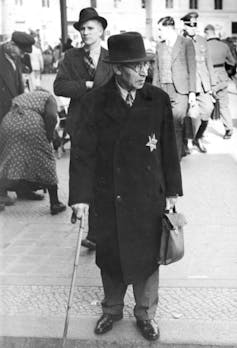
Laws in Nazi Germany forced Jewish people to wear a yellow Star of David badge from 1941 onward.
Bundesarchiv, Bild 183-R99993/German Federal Archives via Wikimedia Commons, CC BY-SA

The women and girls who gathered on Rosenstrasse were not political activists. They were wives, mothers and children trying to keep their families together under a murderous dictatorship. Their protest was unusual for its public visibility, since non-Nazi public gatherings were outlawed. Eyewitnesses recalled the women shouting for the release of their husbands and moments when guards threatened to shoot if protesters did not clear the street.

Most of the imprisoned Rosenstrasse Jews were released on March 6. American intelligence reported that Himmler’s action was discontinued “because of the protest which such action aroused.”

Meanwhile, 7,000 other Jews arrested in the same roundup – Jews not shielded by family relationships with non-Jews – were deported to Auschwitz, with many murdered.
Weighing the impact

Some scholars see the protest as tipping the balance to save the 2,000 men’s lives – based, in part, on events leading up to Rosenstrasse.

On Dec. 6, 1942, Adolf Hitler had authorized Joseph Goebbels, in his role as district leader of Berlin, to “ensure that the unprivileged full Jews are taken out of Germany,” likely to be murdered. And Nazi officials had promised Auschwitz’s Buna work camp thousands of skilled Jewish laborers – a quota that was not met because of the Rosenstrasse Jews’ release.


But Germany’s defeat in the Battle of Stalingrad by February 1943, coinciding with an increase in Allied bombing raids, sent public morale plunging. That made public opposition a bigger concern for the regime, especially for Goebbels, the propaganda minister. On March 6, he wrote that he had discontinued the deportation of the Rosenstrasse prisoners because “large throngs” gathered to side with the Jews.

During the decade since Hitler took power, women married to Jewish men defied scornful social, economic and political pressure, day after day. Some historians see their refusal to comply – even putting their lives on the line for their families – as causing Hitler to make a series of concessions.

Other scholars, however, say this runs “a danger of dramatically underestimating the power of the Nazi regime.” Gestapo terror suppressed all outward resistance, they argue, and a street protest could not have influenced policy.

This interpretation holds that the regime never intended to send the Rosenstrasse Jews to Auschwitz or elsewhere in the east but was holding the men to register them and select some for labor in Berlin.

Never before or after did the regime imprison Jews for such purposes. In any case, these protesters could only have had influence because they were not Jewish. Any Jewish resistance, such as the famous Warsaw Ghetto Uprising that started that April on the eve of Passover, was violently suppressed.

‘We stuck together’

Our research sees intermarriage and the Rosenstrasse protest as significant for several reasons.


First, they highlight how gender shapes expectations about protest and resistance. Nazi society cast women primarily as wives and mothers. Christian women wishing to reunite their families without calling for Hitler’s demise, or the release of all Jews, were harder for the regime to portray as political enemies or criminal agitators.

Today, a pillar commemorates the women’s protest.
Adam Carr/English Wikipedia via Wikimedia Commons

Second, the protest underscores the importance of visibility. Much of Nazi persecution relied on secrecy and masking genocide with bureaucratic language and routines. In Germany, deportations to killing sites or forced labor camps were often carried out quickly, with limited public exposure. A protest in the center of Berlin made secrecy impossible.

Third, the Rosenstrasse protest illuminates the range of responses available, in certain circumstances, to ordinary people living under Hitler. While armed resistance movements have received extensive attention, protests rooted in family and community operated differently. For example, Hitler compromised with German women who publicly protested orders to leave their families in order to evacuate cities being bombed by the Allies. Nazi officials appeased protesters opposing the removal of crucifixes from German schools.

The Rosenstrasse protest has become part of wider conversations about women-led resistance in World War II – alongside actions such as sheltering their Jewish neighbors, serving as couriers for underground networks or using workplaces and churches to quietly obstruct Nazi policies.

Decades later, Holocaust survivor Margot Graebert remembered what was at stake on Rosenstrasse. Her father and sister were held there, and her mother brought her to the protest. In the years before, “We’d seen so many families (of intermarriage) split up … and we stuck together.”

Rosenstrasse was not only a public protest but also a struggle to keep families from being torn apart: Above all, the women were fighting for the return of their own husbands and relatives. Its outcome does not change the scale of Nazi persecution or suggest that the regime tolerated dissent. But we argue that Rosenstrasse and its testimonies still matter today – not as a simple story of triumph but as a revealing debate about what protests could and could not accomplish under Nazism.

Nathan Stoltzfus is co-founder of the Rosenstrasse Civil Courage Foundation.

(Danielle Wirsansky, Ph.D. Candidate in Modern European History, Florida State University. Nathan Stoltzfus, Dorothy and Jonathan Rintels Professor of Holocaust Studies, Florida State University. The views expressed in this commentary do not necessarily reflect those of Religion News Service.)


The Conversation religion coverage receives support through the AP’s collaboration with The Conversation US, with funding from Lilly Endowment Inc. The Conversation is solely responsible for this content.
Just Catholic


In Trump's Iran conflict, it's prosperity gospel vs. the Quran


(RNS) — Opposing philosophies, distilled from two ancient sacred texts, are colliding in horrific ways.


Motorbikes drive past a billboard depicting Iran’s late Supreme Leader Ayatollah Ali Khamenei, center, handing the country’s flag to his son and successor, Ayatollah Mojtaba Khamenei, right, as the late revolutionary founder Ayatollah Ruhollah Khomeini stands at left, in a square in downtown Tehran, Iran, Tuesday, March 10, 2026. 
(AP Photo/Vahid Salemi)

Phyllis Zagano
March 12, 2026
RNS

(RNS) — The 1979 collapse of the Iranian monarchy coincided with the publication of Christopher Lasch’s blockbuster book of ideas, “The Culture of Narcissism,” a critique of American celebrity, grandiosity and spiritual emptiness. In retrospect, the book explains the reasons Iran’s young radicals rose up against the Shah’s regime and the results of the revolution that put the first ayatollah, Ruhollah Khomeini, in power. It may also explain the reasons for the current war.

In the United States, a narcissistic “cult of the self,” as Lasch puts it, tended then (and clearly tends now) to self-aggrandizement and an unhealthy focus on personal image and consumption. The current administration is a case study of the problem, even as it wraps itself in so-called Christian nationalism.

In pre-revolutionary Iran, the overwhelming wealth of the monarchy, combined with aggressive modernization, presented Iranians with a worldview tilted toward an unattainable consumerism. They overthrew the Shah and his petrodollar trappings and replaced him with the austere presence of the supreme leader, a position that now appears to have become hereditary.


RELATED: America’s moral power is the first casualty in Iran

The face of the United States is the narcissistic — some say sociopathic — president who, though elected, can only be said to reign from the Oval Office, surrounded by gold leaf and billionaires. The face of Iran is the third in a series of hard-line clerics, Mojtaba Khamenei, who has replaced his father, Ayatollah Ali Khamenei, who replaced Khomeini.

Some call this Israel’s war. To be sure, the United States’ and Europe’s interests in the Persian Gulf are enough to keep the bullets flying, but do not kid yourself. It is about money. The prosperity gospel is alive and well, promising good things, including actual material benefits, for those who believe in the righteousness of the “cause.” In this case, the cause is suspiciously similar to that of the medieval Crusades.

The Quran allows Muslims to fight aggression, as long as noncombatants are not harmed, but Iran’s new supreme leader says his nation will continue avenging “the blood of [Iran’s] martyrs.” Opposing philosophies, distilled from two ancient sacred texts, are colliding in horrific ways, on the macro and micro levels.


President Donald Trump in the East Room of the White House, Feb. 23, 2026, in Washington. (AP Photo/Alex Brandon)

What do the Trump administration, Iranian leadership and Israel have in common?

Nothing, and everything. Iran overthrew its glittering monarchy and replaced it with a stern theocracy. The United States suffers a gold-plated autocracy steeped in Christian apocalypticism. Israel’s leader appears bent on steamrolling the societies of its neighbors, whoever stands in his way. Each country’s constitution seems reduced to mere words.

The losers on all sides are the youth of each country. Beneath all the rubble in Israel, Gaza, Lebanon, Iran and elsewhere in the Middle East are people. Stuck in war’s quagmire are men and women, boys and girls, whose hopes, dreams, lives and limbs have suffered. All this is the result of what may very well be violations of international law, if not of religious doctrine, no matter which religion you are talking about.


RELATED: Is Trump’s fight against Iran a just war?

In the United States, the crassest prosecutor of the conflict, Defense Secretary Pete Hegseth, complains about what he terms “stupid rules of engagement.” Iran’s new supreme leader is called “his father on steroids.” Israel’s Benjamin Netanyahu boasts, “We’re not done yet.”

Actually, we very well may be.

Thiel brings Antichrist lectures to Vatican’s doorstep, and Catholic institutions back away

ROME (AP) — The invitation-only conference in Rome has proven so controversial that Catholic universities initially associated with it have all denied official involvement.


Nicole Winfield
March 13, 2026

ROME (AP) — One of the hottest tickets in the Vatican’s backyard these days is for a four-lecture series on the Antichrist being given by Silicon Valley tech billionaire Peter Thiel.

The invitation-only conference in Rome, from Sunday to Wednesday, has proven so controversial that the Catholic universities initially associated with it have all denied official involvement.

Thiel is a co-founder of PayPal and Palantir, the data-mining company that has been assisting the Trump administration’s migrant deportation crackdown. An early donor to the political career of Vice President JD Vance, Thiel is also deeply interested in the apocalyptic concept of the Antichrist and has written and lectured on it before.

RELATED: Silicon Valley’s Christ-curious moment: The evangelical groups courting tech elites

“Christians debated these prophecies for millennia. Who was the Antichrist? When would he arrive? What would he preach?” he mused in a November essay in the Catholic magazine First Things.

Discussion of the Antichrist by a tech billionaire in the Vatican’s backyard has proven divisive.

Initially, the lectures were reportedly going to be held the Pontifical St. Thomas Aquinas University, the Dominican university in Rome known colloquially as the Angelicum. It is best known these days as the place where a young priest named Robert Prevost, now Pope Leo XIV, wrote his canon law doctoral thesis.

But as word began to circulate in the Italian media about alleged secret lectures on the Antichrist by Thiel at the pope’s alma mater, the Angelicum took its distance: “We would like to clarify that this event is not organized by the University, will not take place at the Angelicum, and is not part of any of our institutional initiatives,” the university said in a statement on its website.

According to an announcement for the event seen by The Associated Press, the lectures were “jointly organized” by an Italian organization, the Vincenzo Gioberti Cultural Association, and the Cluny Institute at the Catholic University of America in Washington.

The Gioberti group, which describes itself as a cultural association dedicated to the renewal of Italian political culture, confirmed it was involved. The association, named for a 19th century Italian Catholic priest-philosopher, said in a statement it believed in promoting research and encounters “based on the great tradition of classical and Christian thought. We believe this heritage is fundamental to addressing the crisis engulfing the contemporary West.”

But CUA distanced itself. “The Catholic University of America is not sponsoring or hosting an event featuring Peter Thiel this month in Rome,” a university spokesperson told AP. “The Cluny Project is an independent initiative incubated at the university.”

The Cluny Institute is a new initiative of the CUA to bring together leaders from the worlds of academia, religion and technology. In 2023, CUA hosted Thiel at its Washington campus for a talk on René Girard, the French academic.

Thiel is known to be somewhat obsessed with the Antichrist — the Biblical term used to describe someone who opposes or denies Christ — and Armageddon — the Biblical final battle between good and evil. Thiel speaks of the concepts in terms of the choices facing humanity to confront the existential risks of the world today.

The Rome lectures appear to follow the blueprint of a four-part lecture series he gave in San Francisco last September. Some of the invitations circulating in Rome, for example, copy the description of the San Francisco event.

“His remarks will be anchored on science and technology, and will comment on the theology, history, literature and politics of the Antichrist. Religious thinkers upon whom Peter will draw include René Girard, Francis Bacon, Jonathan Swift, Carl Schmitt and John Henry Newman,” said one invitation.

Thiel, who co-founded PayPal in 1998, and other entrepreneurs of that era were part of a group dubbed the “PayPal Mafia,” including Tesla CEO Elon Musk, Yelp CEO Jeremy Stoppelman, and YouTube co-founders Chad Hurley and Steve Chen.

After PayPal was sold to eBay in 2002 for $1.5 billion, Thiel then founded the hedge fund Clarium Capital Management and helped launch Palantir Technologies, which recently inked an agreement with U.S. Immigration and Customs Enforcement to streamline the process of identifying and deporting people the agency is targeting.

Thiel was a key advisor and donor to U.S. President Donald Trump during his first administration and has retained some ties to the White House. Palantir is also one of the donors to the White House’s ballroom project and David Sacks, who worked with Thiel at PayPal, is also chair of the President’s Council of Advisors on Science and Technology.

Thiel is also known to be close to Vance. He poured millions of dollars into Vance’s successful primary race for the U.S. Senate, from where Trump named him running mate and eventual vice president. Some see Thiel as a mentor to Vance, a Catholic convert and the most high-profile Catholic in U.S. politics.

Vance’s theological justification for the Trump administration’s crackdown on immigrants, based on an ancient Christian concept of the order of love, received a famous slapdown from Pope Francis just before he died.
RELATED: Antichrist or Armageddon? Peter Thiel rethinks apocalypse from Silicon Valley.

A few months before he was elected pope, Prevost shared an article from a Catholic publication from his now dormant account on X with the headline, “JD Vance is wrong: Jesus doesn’t ask us to rank our love for others.”

Vance attended Leo’s installation and later had an audience with him, during which he delivered a letter from Trump inviting Leo to visit.

___

Associated Press writers Shawn Chen in New York, Pia Sarkar in Philadelphia and Barbara Ortutay in Colma, California contributed.

___

Associated Press religion coverage receives support through the AP’s collaboration with The Conversation US, with funding from Lilly Endowment Inc. The AP is solely responsible for this content.


Notions of ‘Christendom’ often miss the mark – medieval Europe’s ideas about faith and power were not so simple

(The Conversation) — There has never been a singular Christian perspective on how religion, power and politics ought to relate to each other – not even in medieval ‘Christendom.’


A painting in Rome's San Silvestro Chapel depicts Pope Sylvester I and Constantine the Great. (Wikimedia Commons)


Brett Whalen
March 12, 2026


(The Conversation) — During the National Prayer Breakfast on Feb. 5, 2026, Paula White-Cain, senior adviser to the White House Office of Faith, introduced President Donald Trump as “the greatest champion of faith that we have ever had in the executive branch.” Taking the podium after her, Trump declared, “I’ve done more for religion than any other president.”

Should an earthly leader be promoting a heavenly cause? Some of the Americans who say “yes” – by no means all – are likely sympathetic to the ideas and values of Christian nationalism. A blanket term, Christian nationalism ranges in meaning. Some citizens might see themselves as Christian nationalists simply because they are Christian and patriotic. Others, however, assert that the United States is rightfully a Christian nation that ought to be governed by Christian leaders, ethics and laws.


As a historian, I’m aware that Christian nationalism relies upon a selective and often distorted view of American history. As a historian of the European Middle Ages, in particular, I’m interested in another myth of a shared Christian past that seems to lie beneath the surface of some Christian nationalist claims. That’s the idea of the medieval Christian West, also known as “Christendom”: a time before the modern separation of church and state.


1,000 years

What was Christendom? Similar to Christian nationalism, the term can mean different things to different people.

It generally recalls a long period of time – 1,000 years, give or take – between the “fall” of Rome around 500 C.E. and the beginning of the modern era around 1500. Christianity dominated European politics, society and culture. The Middle Ages really were an era when kings ruled in Christ’s name, when the popes of Rome commanded obedience from believers around Europe, and when monasteries played a crucial role in the shaping of values and education.


Pope Leo III crowns Charlemagne as Holy Roman Emperor in 800.

Wikimedia Commons

In recent years, though, I’ve observed puzzling and ahistorical ways that the concept of Christendom has started to appear in certain corners of conservative political thought. That era of Christian dominion is sometimes remembered as a lost age of Christian unity, a time when religion and politics were “properly” aligned.

Such views don’t map neatly onto any partisan position or religious affiliation. The Catholic-inspired website The Josias, for example, a guide “for those who wish to bring their faith into the public square and resist the tides of liberalism, modernism, and ignorance of tradition,” is filled with works by medieval thinkers.

In some conservative Protestant circles, one finds yearnings for the creation of a “new Christendom,” an “American Christendom,” or, as pastor Doug Wilson calls it, “mere Christendom.”

Wilson is the founder of the Communion of Reformed Evangelical Churches – one of which Defense Secretary Pete Hegseth attends. Wilson says that his vision of “mere” Christendom does not entail a return to theocracy but “a network of nations bound together by a formal, public, civic acknowledgment of the Lordship of Jesus Christ, and the fundamental truth of the Apostles’ Creed.”

In his 2023 book “The Boniface Option,” minister Andrew Isker calls for Christians to fight for the creation of “new Christendom.” He also co-authored 2022’s “Christian Nationalism: A Biblical Guide for Taking Dominion and Disciplining Nations.”

From a historical perspective, there are numerous problems with such views of Christendom. For starters, they erase the reality that, while Christian authorities governed Christian-majority kingdoms during the Middle Ages, Europe was also home to Jewish and Muslims communities. They also paper over the fact that medieval Christians themselves never reached a consensus over the proper relationship between worldly and spiritual powers – or, as we might call them today, church and state.
Faith and empire


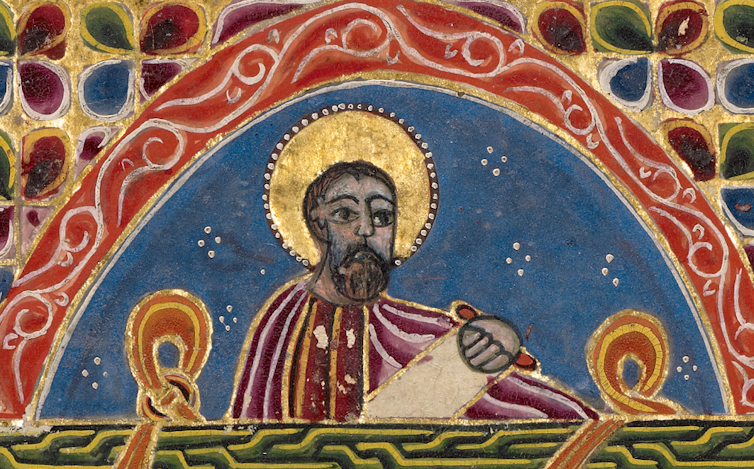
When I teach on religion and politics, I compare two late ancient thinkers whose works left profound legacies on the medieval world: the first historian of the church, Eusebius of Caesarea; and the immensely influential theologian, Saint Augustine.


An illustration of Eusebius of Caesarea in a 17th-century manuscript, created by Armenian artist Mesrop of Khizan.

J. Paul Getty Museum/Wikimedia Commons

Writing in the fourth century, Eusebius celebrated the reign of the first Christian Roman emperor, Constantine, who ruled from 306-337. The story of Constantine’s conversion is famous. As Eusebius told it, the emperor was marching toward Rome during a civil war when he saw a radiant “cross-shaped” vision in the sky, accompanied by the words “by this conquer.” That night, the “Christ of God” appeared to the emperor in a dream and told him to march to war under that sign, which he did with victory.

From Eusebius’ perspective, there was a lot to celebrate about Constantine’s reign. Constantine ended the persecution of Christians unleashed by his predecessors. Under his direction, imperial money flooded into clerical hands, followed by a wave of church building around the empire. The emperor granted bishops legal privileges and tax exemptions, and he called church councils to resolve disputes over Christian doctrine and organization.

In Eusebius’ eyes, this was all part of the divine plan. As he wrote, God had intended since the beginning for the “two shoots” of the “empire” and the “gospel of Christ” to intertwine, grafted together in harmony. Pagan Rome, Eusebius claimed, had subdued the peoples of the world. Under Constantine, its rule was bringing the “good news” of Christianity to all those conquered nations.

This kind of boosterism for Christian monarchs, hailed as “champions of the faith,” would endure throughout the Middle Ages and beyond. The Byzantine Empire, the Carolingian Empire, the Holy Roman Empire, Christian kingdoms from England to Armenia: Supporters saw their worldly power as representing the heavenly power of Christ, the “King of kings.” This was, in effect, a kind of Christian nationalism before the rise of modern nations.


‘Not of this world’

Yet medieval Christian thinkers also maintained skepticism about the ability of temporal princes to realize God’s kingdom here on Earth.

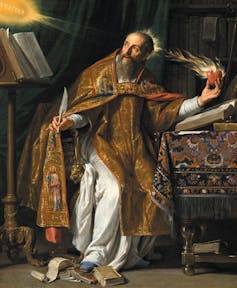
This is where Augustine, who wrote “The City of God” in the early fifth century, comes into the picture. Augustine was a prolific writer and immensely complicated thinker whose views changed across the course of his lifetime. Similar to Eusebius, he believed that God determined the fate of all empires and kingdoms, whether Christian or not.


A painting of Saint Augustine by 17th-century artist Philippe de Champaigne.
Los Angeles County Museum of Art via Wikimedia Commons

Augustine supported the right of rulers to wage “just wars” and use force to maintain public order. Still, the bishop of Hippo hit the brakes on unbridled enthusiasm for the divinely appointed role of earthly empires and kingdoms, even if their rulers were Christian.

Living through the aftermath of Rome’s plundering in 410 by the Visigoths, Augustine keenly appreciated the fact that empires come and go. True happiness for Christian princes didn’t come from seeking their own personal ends: winning battles, gaining the most territory, leaving their thrones to their heirs, and conquering their enemies. It came from putting their “power at the service of God’s mercy” and the greater good. “Remove justice,” Augustine asked in “The City of God,” “and what are kingdoms but gangs of criminals on a large scale?”

In Augustine’s view, which profoundly influenced medieval theologians and political thinkers, this world was the transitory “City of Man,” filled with love of self and lust for domination. What really mattered was the eternal “City of God.” There was nothing wrong with Christian kingdoms, empires and nations, he thought, but there was nothing especially blessed about them, either. After all, hadn’t Jesus said in the Gospels, “My kingdom is not of this world”?

There has never been a singular Christian perspective on the relationship between faith, power and political identities. There certainly wasn’t in the world of medieval Christendom. To suggest otherwise is a fantasy that misrepresents the sophistication of Christian political thought during the Middle Ages – and in the present.

(Brett Whalen, Professor of History, University of North Carolina at Chapel Hill. The views expressed in this commentary do not necessarily reflect those of Religion News Service.)


The Conversation religion coverage receives support through the AP’s collaboration with The Conversation US, with funding from Lilly Endowment Inc. The Conversation is solely responsible for this content.
MAGA ISLAMOPHPOBIA IS HATE SPEECH

Mike Johnson says Rep. Andy Ogles’ anti-Muslim remarks reflect ‘popular sentiment’

(RNS) — Claims that Muslim Americans are seeking to impose Islamic religious law on the country have become popular talking points among Republican lawmakers recently.


U.S. Rep. Andy Ogles, R-Tenn., speaks after being declared the winner in his Republican primary race, Aug. 1, 2024, in Franklin, Tenn. (AP Photo/Mark Humphrey)

Fiona André
March 10, 2026
RNS

(RNS) — A day after Rep. Andy Ogles, R-Tenn., said on social media that Muslims don’t belong in America, House Speaker Mike Johnson, R-La., said that although he questioned Ogles’ choice of words, he pointed to a widely shared sentiment among Americans.

“Muslims don’t belong in American Society. Pluralism is a lie,” Ogles posted on his X account on Monday (March 9).

Johnson told reporters at a congressional retreat in Doral, Florida, on Tuesday that he spoke about Ogles’ remarks with members of Congress and discussed what language they should use on the issue. Ogles’ selection of words, he said, is “a different language than I would use.” Still, Johnson said he believes his comments resonated with many Americans who view Islam as incompatible with American culture.

“There’s a lot of energy in the country and a lot of popular sentiment that the demand to impose Shariah law in America is a serious problem,” Johnson said. “I think that’s a serious issue. Shariah law and the imposition of Shariah law is contrary to the U.S. Constitution.”

Anti-Muslim rhetoric and claims that Muslim Americans are seeking to impose Shariah, or Islamic religious law, on the country have become popular talking points among Republican lawmakers recently, especially in midterm election races. Claims that Muslims are plotting to impose Shariah gained traction in the early 2010s, leading to dozens of anti-Shariah bills being passed in some states.


House Minority Leader Rep. Hakeem Jeffries, D-N.Y., said on X in response to Ogles’ comments, “Disgusting Islamophobes like you do not belong in Congress or in civilized society.”

Richard Grenell, who was appointed by President Donald Trump as special presidential envoy and executive director of Washington’s Kennedy Center, also condemned Ogles’ comments on X, saying, “Stop attacking the First Amendment to the United States Constitution.”

Ogles, who has represented Tennessee’s 5th District since 2023, has been one of the fiercest anti-Muslim voices among Republican lawmakers and announced his plan to introduce a bill in Congress that he refers to as a “Muslim ban,” seeking to limit entry to the U.S. for immigrants from some Muslim-majority countries.

“America’s moral exemplar is a meek carpenter who rose from the dead, not a warmonger with 12 wives and countless slaves. My bill will preserve this truth,” Ogles wrote in a Monday press release announcing the bill, disparaging Islam’s Prophet Muhammad.

The 54-year-old lawmaker is also a member of the newly formed Sharia Free America Caucus, a congressional group that alleges Shariah violates the U.S. Constitution and that has raised concerns about the growing number of mosques across the country, which they see as a sign of Muslims overtaking American society.

Shariah, Arabic for “the path” or “the way,” reflects how God expects Muslims to live their lives. Anti-Shariah campaigns often flatten the concept of Shariah, which can’t be reduced to a set of laws, Khaled Beydoun, a law professor at Arizona State University, previously told Religion News Service.


RELATED: Anti-Shariah conspiracy theories, a staple of 9/11-era rhetoric, resurge around Mamdani

Ogles has made derogatory comments against Muslim Americans before. Last week, he published a video on X depicting an image of the Quran, Muslims’ sacred text, with a red-bolded caption reading “Islam = Incompatible,” presumably referring to the United States.

“We’ve seen it across Europe — I literally was with leaders from across Europe and one of the things they talked about is that they are losing their countries to mass Islamic Muslim migration,” Ogles said in the video.

Ogles also repeatedly attacked New York Mayor Zohran Mamdani’s Muslim faith throughout his campaign, arguing that Mamdani’s true motives were to impose Shariah in New York. Ogles also called for a Department of Justice investigation into Mamdani’s path to citizenship.

“I say NO to Sharia law — which is why I’ve presented an argument to have Mamdani sent back to Uganda based on information he clearly withheld,” he wrote in an October X post.


Islamic schools, more parents sue Texas over exclusion from voucher program

(RNS) — Another Muslim parent whose children’s school was allegedly excluded earlier this month from the program filed a lawsuit against Texas state officials over religious discrimination.


(Photo by Seen/Unsplash/Creative Commons)


Fiona André
March 13, 2026
RNS


(RNS) — Three Texas Islamic schools and a group of parents are suing state Attorney General Ken Paxton and Comptroller Kelly Hancock, marking the second legal challenge this month alleging that schools for Muslim students have been excluded from the new state voucher program.

The second lawsuit, filed on Wednesday (March 11) in the U.S. District Court for the Southern District of Texas, says state officials and the voucher program director, Mary Katherine Stout, have been “unlawfully refusing to approve otherwise qualified Islamic schools for participation” in the school funding program and that it constitutes religious discrimination.

The Texas Education Freedom Accounts program, introduced by the state’s Legislature in 2025, created a $1 billion fund for private school financial aid. An online platform for parents to start applying opened on Feb. 4 (open through March 17), but none of the state’s accredited private Islamic schools have been listed as eligible for reimbursement through the program.

Farhana Querishi, a plaintiff whose children attend Houston Quran Academy, said in a news release that the comptroller’s decision to exclude Islamic schools from the program sent a “troubling message” that the state’s Muslim children and communities had fewer rights than other residents.

“No parent should have to choose between accessing a public education program and raising their child in accordance with their faith,” she said.

The dispute over the program comes amid growing hostility from Republican elected officials in Texas toward the state’s Muslim residents and community leaders, which became a focal point in the state’s Republican primaries.


The Texas Education Freedom Accounts website. (Screen grab)

Last week, Mehdi Cherkaoui, a lawyer and Muslim father whose children’s school is excluded from TEFA, also filed a lawsuit against Paxton and Hancock alleging religious discrimination.


RELATED: Muslim father sues over exclusion of Islamic schools from Texas voucher program

Though Hancock hasn’t commented publicly on the Islamic schools’ exclusion from the program, their absence and past comments he made expressing intentions to exclude them “supports an inference that the School Plaintiffs have been excluded because of their Islamic religious identity,” according to the plaintiffs.

“While Defendants’ silence is formally unexplained, the current posture suggests alignment with recent rhetoric linking all Islamic organizations to ‘terrorism,’” the complaint reads.

In December, after Texas Gov. Greg Abbott designated the Council on American-Islamic Relations, a major Muslim civil rights group, a “foreign terrorist organization” and a “transnational criminal organization,” Hancock sent a letter to Paxton, posted on X, inquiring about the legality of excluding schools with ties to “foreign terrorist organizations” and “transnational criminal organizations.” The comptroller raised concerns that a private school that had hosted a CAIR event might benefit from the voucher program. He also expressed alarm over the possible inclusion of schools with ties to the communist Chinese government.

The attorney general responded that Hancock’s office had “full, exclusive statutory authority” to prohibit schools from participation in the school voucher program. And both made comments on social media about wanting to ensure the program would not fund schools with ties to Islamic terrorist organizations.

In reaction to a Washington Post story published Wednesday about the schools’ exclusion, Abbott commented, “That’s right. We don’t want school choice funds going to radical Islamic indoctrination with historic connections to terrorism.”

Neither Paxton nor Hancock returned RNS’ requests for comments.

The lawsuit argues the comptroller’s decision to bar such schools from applying violates the First Amendment’s free exercise and establishment clauses and the 14th Amendment’s equal protection and due process clauses. Plaintiffs are seeking a ruling halting the exclusion of the schools before the program’s deadline next Tuesday.

RELATED: Texas governor calls CAIR a terrorist organization, says he will enforce penalties

Some parents whose children are enrolled in Islamic schools have entered the program by selecting other schools, while others have refrained from registering, refusing to select a school other than their children’s, the complaints note. After the deadline, the parents who failed to register won’t be considered in TEFA’s lottery, which determines who benefits from the funding.

“They have created a system where Muslim families cannot even select their schools in the application portal, while thousands of non-Islamic private schools remain approved and eligible,” the complaint reads.

The three school plaintiffs, Bayaan Academy, the Islamic Services Foundation and the Eagle Institute Excellence Academy, have not received explanation from the comptroller’s office regarding their exclusion, they said in the lawsuit.

The children of plaintiffs Layla Daoudi, Muna Hamadah and Farhana Querishi are enrolled, respectively, at the Houston Quran Academy, the Islamic Services Foundation and the Eagle Institute Excellence Academy.

Bayaan Academy, a 1,200-student virtual school headquartered in Galveston County, was initially approved for the program after filling out a Google form put out by the comptroller’s office in December. However, it was removed from the list of eligible schools following a news report highlighting that it was one of the few Islamic schools included, according to the suit.

In his lawsuit filed on March 1, Cherkaoui, whose children are enrolled at the Houston Quran Academy, also argued the comptroller’s decision violates the First Amendment’s free exercise, establishment and equal protection clauses as well as the 14th Amendment’s due process clause. His lawsuit also seeks a temporary restraining order to prevent religious discrimination before the March 17 deadline.