US Targets Military on Iran’s Kharg Island Demanding Opening of Hormuz
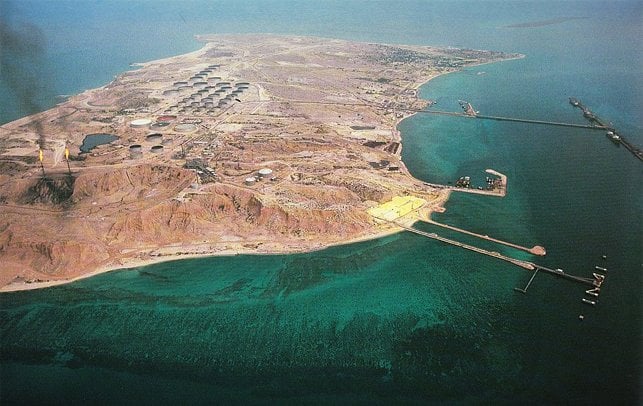
The U.S. military launched strategic bombing on Iran’s Kharg Island, the home of Iran’s oil export industry. In a posting on social media, Donald Trump announced on Friday evening the attack while saying this time it had been limited to military targets, while also demanding free and safe passage in the Strait of Hormuz.
Trump called it “one of the most powerful bombing raids in the history of the Middle East,” while saying that “Iran has no ability to defend anything we want to attack.” He reported that the U.S. “totally obliterated every military target” on the island.
A small island only about five miles in size, it is located in the northern Persian Gulf near Kuwait and serves as the export terminal for the vast majority of Iran’s oil. Since the start of the bombing two weeks ago, Iran had reportedly also opened a southern terminal and was pumping out crude at record levels.
Kharg is located about 15 miles off the coast of the Iranian mainland and about 300 miles north of the Strait of Hormuz. Reports indicated Iran had increased the pace of loading at the terminal in recent days. Shadow tankers and those heading to China were believed to be loading and making their way through the Strait of Hormuz.
”For reasons of decency,” Trump writes, “I have chosen not to wipe out the oil infrastructure on the island. However, should Iran, or anyone else, do anything to interfere with the free and safe passage of ships through the Strait of Hormuz, I will immediately reconsider this decision.”
Centcom or the Pentagon has not yet released further details on the strikes and how they were executed. Earlier in the day, Pete Hegseth had said the U.S. would be intensifying its assaults on targets in Iran. Centcom highlighted that B-2 stealth bombers had been deployed to conduct a mission “delivering long-range fire to not only eliminate the threat from the Iranian regime today, but also eliminate their ability to rebuild in the future.”
Speculation had been building on whether the U.S. or Israel would target Kharg Island. So far, reports are that it had not been targeted during the operations. An unconfirmed story said that the Trump administration was contemplating a series of special forces operations inside Iran, potentially including a raid to seize Kharg Island, according to Axios. Today, The Wall Street Journal reported that a Marine Expeditionary Unit had been dispatched from its base in Japan to join the forces in the region and would be bringing additional sophisticated aircraft to join the forces.
Hegseth said at the Friday morning briefing that the U.S. did not have definitive information that Iran was mining the Strait of Hormuz. It was highlighted that Iranian and possibly Chinese ships were making the transit, while Hegseth said the only thing stopping ships was Iran’s firing missiles, which he said would soon be stopped.
Financial pressure has been building, and concerns over the global economy are rising as oil hovers around the $100 a barrel level and is expected to continue to climb. The Trump administration is taking as many steps as it can to slow the price rise, including a release from the U.S. strategic reserves. It also announced a 30-day waiver of sanctions to permit Russian oil loaded and at sea to be sold.
Reopening the Strait of Hormuz is critical, however, due to the volumes that come from the region and the psychological impact. The Trump administration is saying it is a temporary disruption, saying prices will quickly fall and that the short-term pressure is acceptable to achieve its long-term goals for the region.
Report: US Amphibious Ships with Marine Unit Head to Middle East
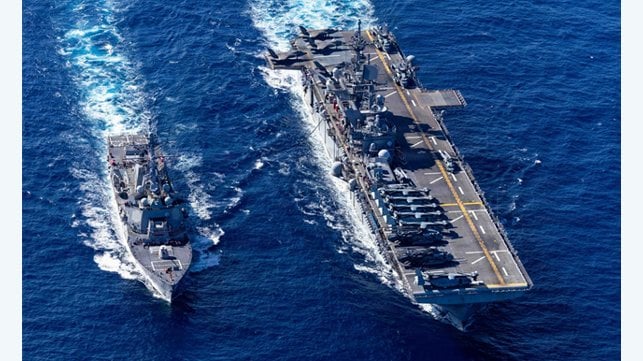
Multiple media outlets are reporting that the Pentagon has approved the redeployment of possibly three USN amphibious vessels, along with a Marine Expeditionary Unit, to the Middle East. It comes as Secretary of War Pete Hegseth said the U.S. was increasing its strikes to the “highest number” while he said the U.S. was “dealing with” the attacks on shipping and the Strait of Hormuz.
Citing information from three sources, The Wall Street Journal broke the news that the Pentagon approved moving a Marine expeditionary unit and more warships to the Middle East. It said the request for the additional capabilities had come from CENTCOM. The Wall Street Journal speculated it could involve up to 5,000 Marines and sailors.
ABC News added additional details, saying that it would consist of three U.S. Navy amphibious ships and a unit of 2,200 Marines. They reported the 31st MEU, based in Japan and which operates in the Indo-Pacific region, has been ordered to head to the Middle East. Satellite pictures appearing online appear to show at least one amphibious ship having departed on March 11 and traveling at high speed.
Speculation is that the force consists of the USS Tripoli (LHA-7), USS San Diego (LPD-22), and USS New Orleans (LPD-18). Typically, this type of deployment would also consist of a transport dock vessel and support ships to carry additional equipment for the Marines.
Donald Trump and Hegseth have not ruled out the use of ground forces, although so far they have said there was no need. All options remain open, according to the reports, but for now, they highlight that the amphibious ships would bring additional advanced aircraft into the region. The MEU includes a squadron of F-35 Flighting II jets and a squadron of the Osprey tilt-rotor aircraft. Speculation is that these could be used in the efforts to secure the Strait of Hormuz.
Hegseth scoffed at reports that the Strait of Hormuz has been mined, saying they did not have any clear evidence of mines. He pointed to ships that have been transiting the shipping lane. He said that the United States “has a plan for every option,” while asserting, “The only thing prohibiting traffic in the strait at the moment is Iran shooting at shipping.” He said the U.S. would not permit the strait to remain “contested.”
Speaking at around the same time today, U.S. Treasury Secretary Scott Bessent told the UK’s Sky News, "My belief is that as soon as it is militarily possible, the U.S. Navy, perhaps with an international coalition, will be escorting vessels through." He also pointed to Iranian and possibly Chinese tankers transiting the strait as proof that it is still open.
Two Tankers Burn Off Iraq After Suspected Drone Boat Strike
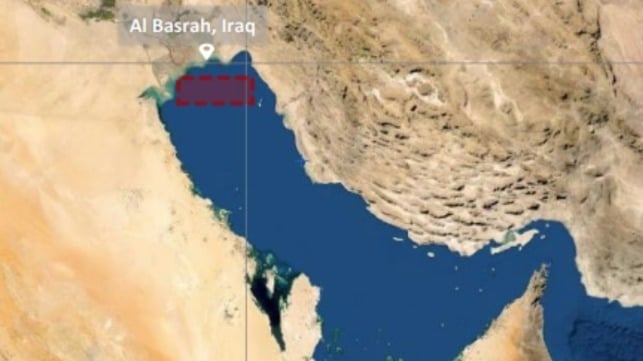
[Breaking] Two tankers have reportedly been hit by unknown projectiles in the Arabian Gulf, according to UK Maritime Trade Operations (UKMTO).
Two ships were reportedly struck at a position just south of Basrah, within Iraqi waters. Bystander video from a nearby vessel suggests that they were adjacent to each other and potentially engaged in an STS transfer at the time of impact. The video shows a spreading pool of burning oil surrounding the vessels.
Iraqi authorities identified the vessels as the LR1 tankers Zefyros and Safesea Vishnu. The former is Greek-owned, and the latter is operated by an Indian-linked, U.S.-based shipping company with offices in New Jersey. One was carrying a cargo of gas condensate from the Basrah Gas Company, an Iraqi JV company part-owned by Shell, according to local Shafaq News.
Iraqi Lt. General Saad Maan told Al-Iraqiya News that the attack was an act of sabotage and a violation of Iraqi sovereignty. Six response vessels were dispatched to rescue the survivors from the two tankers, he said.
According to Lt. Gen. Maan, the body of one deceased seafarer was recovered. Local reports indicate that some of the survivors were injured; assessments were still in progress Thursday morning.
The fire has since been extinguished by Iraqi first responders, according to local reports.
Iraqi authorities say that early signs point to a drone-boat attack. The strike would align with a pattern of Iranian attacks on merchant shipping in the Arabian Gulf; more than a dozen vessels have been hit since February 28, and the number continues to rise.
This story is developing and will be updated as more information comes in.

No comments:
Post a Comment