Showing posts sorted by relevance for query GREEN NAZI. Sort by date Show all posts

Tuesday, May 01, 2007

Green Nazi's


A case of pot, kettle, black.

There is something ironic in this....PM's climate stance worse than appeasing Nazis: Green leader

Oh yeah it's this;


This week Parliament heard one of its strangest speeches ever, the Green-Nazi speech. The author, Liberal Senator George Brandis, was attempting to condemn Greens leader Bob Brown for interjections he made during President Bush's recent address. Evidently inspired by newspaper columnist Andrew Bolt, Senator Brandis quoted from scholarly texts tracing the origins of Green politics right back to the German "Volkish" movement in the mid-19th century. It was a mystical, naturist movement that fused with the age-old hatred of Jews and just 80 years later gave birth to a vegetarian dictator called Adolf Hitler. Senator Brandis warned that just as Hitler came to power by manipulating free elections, so too "the sinister and fanatical views represented by Green politicians can grow and gain strength under the cover of democracy".


And this;
Ecofascism / Fascist Ideology: The Green Wing of the Nazi Party


Or this;

The circuitous travels of the Fischer-Tropsch process, a chemical technique to convert natural gas and coal into liquid fuels, provide an object lesson in historical irony. Used by the Nazis to make oil from coal during World War II, it was commercialized by the century's second-most-odious racial supremacist regime in the 1950s through South Africa's state energy company. Now, that privatized company, Sasol, may help liberate Western democracies (and non-Western ones, like India) from the grip of crude oil produced largely by loathsome authoritarian regime.

Not to forget this;

Himmler's Horticulture

The Nazi story in Germany was a story of biophilia gone bad. A confused and desperate people--suffering from the Versailles Treaty, the loss of World War I, and economic depression--seized, for pride and identity, the imagery of their own blood and soil. It was impossible to spice up "superiority" with architecture (the Greeks and Romans were not Germans) or literature and art (the French and Italians were not Germans). So "blood" (the Teutonic tribes of yesteryear) and "soil" (the plants within the Germanic provenance) became the hooks on which to hang nativism, racism, and self-confidence. The future Germany was to be a pure landscape inhabitated by an untainted race.

Joachim Wolschke-Bulmahn, a major historian of the native plant movement in Germany, claims that native plants "became the landscape architect's swastika." He quotes Alwyn Seifert (a leading German landscape architect during the Nazi period) as saying "nothing foreign should be added, and nothing native should be left out." The ideological attention to pure bloodlines led Nazitime botanists to advocate a "war of extermination" against a foreign impatiens felt to be out-competing the "native" impatiens. With the invasion of Poland, Heinrich Himmler pressed Nazi policy-makers to complete the Reich's Landscape Law to force the exclusive use of native plants within its empire. Nature had been nationalized and became totalitarian and violently enforced. You are as your plants.

Can you be progressive and a Green Nazi?

Anarcho-Green Nazis

As long ago as 1989 Searchlight, the anti-fascist magazine, was running front cover features on what it described as 'the greening of the brownshirts.' For many years former National Front activists have been setting up quasi-green organisations as recruiting fronts for their vile activities, but it is only more recently that the anarchist movement has been targeted as a potential vehicle for Nazi propaganda. Former National Front boss Patrick Harrington has even managed to get a letter published in the latest issue of the American journal Anarchy, in which he writes 'as a life-long vegetarian and pagan, I am genuinely interested in green issues... I do not see any contradiction between this and my other views , indeed I regard them as interlinked.'

A number of anarchists have been won over by this claim and it is these individuals who are most likely to succeed in getting it across to a wider public. The most notorious anarchist convert to National Front style racism is Richard Hunt, the founder of Green Anarchist and the driving force behind the magazine Alternative Green. Hunt vents his racism in anti-Irish rants with headlines such as Off Our Patch Paddy. Alternative Green has also run articles supporting the 'red and brown' united front fighting against democracy in Russia, and currently argues for tough immigration and deportation laws. More sinister still is Richard Hunt's claim that the population must be reduced by 75% if we are to have an ecologically sustainable society. Hunt doesn't make it clear whether he wishes to set up death camps or if people will simply be left to starve to death.


Could Elizabeth May and the Green Party end up like this?

Libertarian National Socialist (Nazi) Green Party

Why not? Like Paul Watson her politics are the new Third way and they represent the declasse middle class, the very base of fascism.

"We recognise that separating humanity from nature, from the whole of life, leads to humankind's own destruction and to the death of nations. Only through a re-integration of humanity into the whole of nature can our people be made stronger . . . This striving toward connectedness with the totality of life, with nature itself, a nature into which we are born, this is the deepest meaning and the true essence of National Socialist thought."

That was Ernst Lehmann, a leading biologist under the Nazi regime, in 1934, and he wasn't alone. Hitler, for one, was an avid vegetarian and green, addicted to homeopathic cures. His regime sponsored the creation of organic farming, and SS leader Heinrich Himmler even grew herbs on his own organic farm with which to treat his beloved troops. HITLER also banned medical experiments on animals, but not, as we know to our grief, on Jewish children. And he created many national parks, particularly for Germany's "sacred" forests.

This isn't a coincidence. The Nazis drew heavily on a romantic, anti-science, nature worshipping, communal and anti-capitalist movement that tied German identity to German forests. In fact, Professor Raymond Dominick notes in his book, The Environmental Movement in Germany, two-thirds of the members of Germany's main nature clubs had joined the Nazi Party by 1939, compared with just 10 per cent of all men. The Nazis also absorbed the German Youth Movement, the Wandervogel, which talked of our mystical relationship with the earth.

Peter Staudenmaier, co-author of Ecofascism: Lessons from the German Experience, says it was for the Wandervogel that the philosopher Ludwig Klages wrote his influential essay Man and Earth in 1913. In it, Klages warned of the growing extinction of species, the destruction of forests, the genocide of aboriginal peoples, the disruption of the ecosystem and the killing of whales. People were losing their relationship with nature, he warned. Heard all that recently? I'm not surprised. This essay by this notorious anti-Semite was republished in 1980 to mark the birth of the German Greens -- the party that inspired the creation of our own Greens party. Its message is much as Hitler's own in Mein Kampf: "When people attempt to rebel against the iron logic of nature, they come into conflict with the very same principles to which they owe their existence as human beings. Their actions against nature must lead to their own downfall."

Why does this matter now? Because we must learn that people who want animals to be treated like humans really want humans to be treated like animals. We must realise a movement that stresses "natural order" and the low place of man in a fragile world, is more likely to think man is too insignificant to stand in the way of Mother Earth, or the Fatherland, or some other man-hating god. We see it already. A Greenpeace co-founder, Paul Watson, called humans the "AIDS of the earth", and one of the three key founders of the German Greens, Herbert Gruhl, said the environmental crisis was so acute the state needed perhaps "dictatorial powers".


Find blog posts, photos, events and more off-site about:
, , , , , , ,

, , , , , , ,

, , , , , ,

Thursday, May 03, 2007

Glass House Politics

This is what happens when you are a politician preaching from a pulpit.

The fallout from Elizabeth May's comments on Neville Chamberlain continues. It is all about religion and religious outrage.

The Conservatives began it in the House of Commons with attacks on the Liberals, quoting from letter's they received from the Jewish lobbyists complaining May's comments some how demeaned the importance of the holocaust. Clearly political support for the Conservatives disguised as faux outrage. Call it pay back for all the nice things Harper has said about Israel and his unconditional support for their war against Lebanon and the Palestinians


I am pleased to extend my warmest greetings to everyone marking Yom Ha’atzmaut, the 59th anniversary of Israel’s independence.
On Yom Ha’atzmaut, you have an opportunity to reflect upon the history of the struggle that led to the birth of the modern State of Israel on May 14, 1948. It is a time to remember the past while renewing your dedication to the challenges of the future. The Jewish people have always faced the task of building a nation of freedom and peace with perseverance and enduring faith. These qualities have helped Israel grow in strength and stature since its formation. Its very existence is a testament to the spirit of its people and the power of hope.
Canada enjoys close ties with Israel, and I know that our relationship will continue to flourish in the years ahead.
On behalf of the government of Canada, please accept my best wishes for a memorable and enjoyable celebration.
Stephen Harper
Prime Minister of Canada

Not to be outdone in sucking up to that lobby the Liberals and NDP joined in throwing stones at May's glass house.

Liberal Leader Stephane Dion said May should withdraw the comment, even though references to weak-kneed Chamberlain are often employed in commentary on environmental or poverty issues.

"We should not use it — for the very reason that in the spectrum of power, the Nazi regime is beyond any comparison," Dion said outside the Commons.

"So I’m uncomfortable with the reference to Chamberlain about anything else than what happened in the Second World War."

NDP Leader Jack Layton said May’s comment was "certainly not something we consider to be wise or appropriate," and added voters will be the ultimate judge.

A shame that, since this was clearly a political effort by the Harpocrites to divert attention away from the failure of the Tories green plan as well as their failures in Afghanistan to protect human rights. While abusing what May actually said.

Of Course the Harpocrites overlooked the fact that the same Jewish lobby that criticized her accepted her apology but gave a dyer warning to politicians who would usurp their right to be the sole arbitrators of the political implications of Nazism. Of course she never did compare Climate Change to the Holocaust, but never mind that small detail.

Bernie Farber, chief executive officer of the Canadian Jewish Congress, said the Green Party leader had telephoned the organization Wednesday to retract and apologize for her comments. The congress had written Ms. May a critical letter about her speech.

"This is probably a lesson for all politicians who are tempted to make comparisons with the Nazis in their speech. They are going to lose the argument every time," said Mr. Farber, adding he was impressed by Ms. May’s sincerity.

And now it has expanded into faux outrage from the Evangelical and Fundamentalist protestants as well for her comments about them too.

Mike Duffy Live: Debating the May controversy

You know the nice folks who are not political except for their lobby against human rights for gays and lesbians, their lobby to oppose a womans right to choose, their lobbying against child care, etc. etc.

"It is time for the Liberal members opposite to stand up against outrageous, hateful, mean-spirited comments by their candidate in Central Nova," Environment Minister John Baird said in Tuesday's question period. "It is inexplicable how they could not stand up against people who bash Christians and invoke Nazi-era atrocities."

But Mr. Harper, referring to a letter from Ed Morgan, the national president of the Canadian Jewish Congress, condemning the May remarks, said he lacks confidence in the Opposition Leader. He said Ms. May has "diminished the Holocaust, used the Nazi analogy that is demagogic and inappropriate, while belittling Canadians of faith.


Gee thats funny considering May is a Christian and she was speaking in Church. How that makes her anti-Christian well its your guess. The reality is of course that the terms; "Christianity and Canadians of Faith" are open to interpretation when used by the Conservatives. They are referring to Evangelical and Fundamentalist Protestants who make up their social conservative base.

By comparing today's approach to the environment to pre-war approaches to the Nazis, Elizabeth May shows insensitivity to context and history. Her comparison of Stephen Harper to Neville Chamberlain is both demagogic and inappropriate, revealing that the Green party leader is still too green to have learned to control her excesses of rhetoric. Further, her belittling of Evangelical Christians, characterizing their theology as "waiting for the end of time in glee," signals a truly dangerous mindset. The Green party leader, who is also an Anglican minister-in-training, demonstrated that she considers herself and her religion to be morally superior to another. And it doesn't matter that she ridiculed the beliefs of a branch of her own religion, rather than those of an altogether different faith.

Ms. May is not giving private lectures to her congregation now that she is running as Green party leader in alliance with the Liberals. She is being heard by a diverse public at large on an important policy issue. She should start respecting all of them.

Ed Morgan, national president, Canadian Jewish Congress, Toronto.


However as we can see those that live in glass houses and those professing in the House of the Lord should be cautious about throwing stones. Because the media is doing a good job of showing that the shoe is on the other foot when it comes to politicians using Neville Chamberlain against their opponents. Proving this is all a tempest in a tea pot that is the Glass House of Commons.

See:

Year of the Pig and the Liberal Green Alliance

Charles Agrees With Elizabeth May

Green Nazi's


Find blog posts, photos, events and more off-site about:
, , , , , , ,

, , , , , , ,

, , , , , ,

Saturday, February 03, 2024

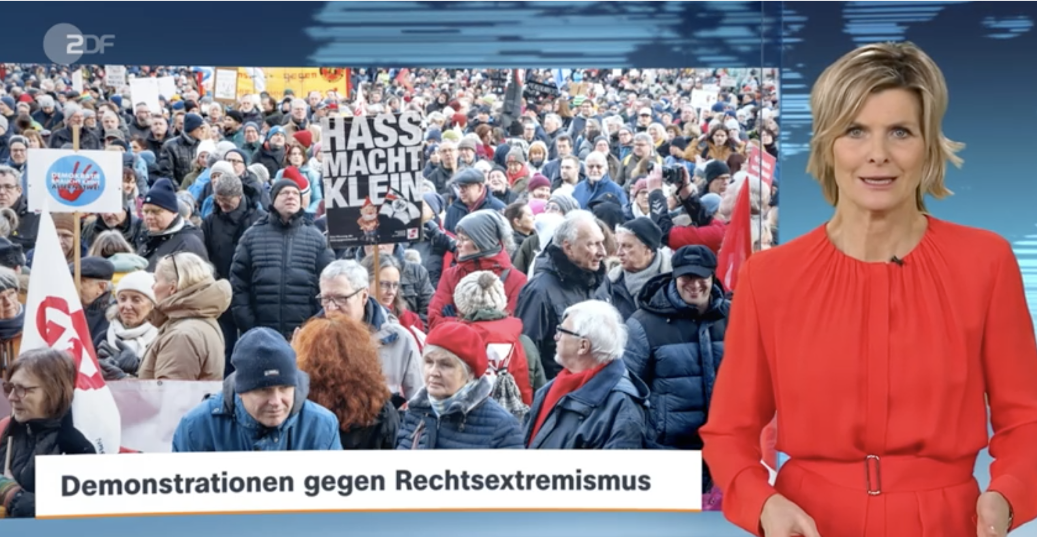
Mass Protests Against the Far Right AfD in Germany
February 2, 2024
Source: Originally published by Z. Feel free to share widely.

Source: screenshot of Germany’s main public TV station’s news, 27th January 2024

It’s early February in 2024 and on the last 3 weekends in January hundreds of thousands of Germans took to the streets and rallied against the far-right AfD. Many politicians, intellectuals and ordinary voters are convinced that the AfD, Alternative für Deutschland (Alternative for Germany), is a true Neo-Nazi party.

In popular parlance the party is also referred to as:AfD = Alternative für Dumkopfe (Alternative for Dummies)
AfD = Abyss for Deutschland
AfD = Aus für Demokratie (The end of democracy)
AfD = Alliance for Demagogues
AfD – Alle faschisten Deportieren (Deport all fascists)

Since the recent Wannsee 2.0 scandal came to light, the AfD is even more widely regarded as a Neo-Nazi party. In 2018 CDU-boss and arch-conservative Friedrich Merz declared, “the AfD are Nazis.”

More recently, the regional CDU leader of Germany’s largest state of North-Rhine-Westphalia and state premier Hendrik Wüst said, “this is a Nazi party.”

A court decided that it was justifiable to call the AfD’s most powerful Führer, Björn Höcke, a Nazi. The AfD’s party deputy, who has no real power but is the pretty face of neofascism, Swiss resident Alice Weidel, has been called a Nazi-Schlampe or Nazi bitch and a court decision allowed that moniker to stand.

Last month, Weidel was forced to fire one of her advisors who had taken part in that secret Wannsee 2.0 meeting where plans were aired to force the elimination or deportation of anyone with a non-Aryan heritage.

It all began in 2013 with a handful of staunchly neoliberal and anti-EU professors of economics who founded the AfD. But today, the AfD is more right-wing than ever before.

To get to where they are today, in 2022 the AfD replicated Hitler’s Night of the Long Knives. Even though nobody was killed, apart from a few character assassinations, the party purged anyone who could possibly move toward the center or be open for compromise with other parties.

This purge eliminated the party’s last moderates. The ideological cleansing of the party took place in the East-German city of Riesa at the AfD’s 2022 party congress. The neofascist core group eradicated the original non-fascist neoliberals and severely weakened the party’s conservative-reactionary wing.

Riesa 2022 strengthened the völkische (read: Neo-Nazis) forces within the party. By 2023, the traditional internal AfD fights between neoliberals, conservatives, and right-wing extremists had ended.

After that, inner-party disputes largely centered around inconsequential issues like which party candidates should be put on a list so they could be elected.

By the end of 2023, in virtually all of Germany’s recent elections as well as in public polling, the AfD was at a historic high, sitting at 20% to 24%, as reflected on German TV’s famous Sunday question that asks Germans: “Which party would you vote for if election day was next Sunday?”

Germany’s normally apathetic political landscape might well have accepted the AfD as a new (neo-fascist) normal for Germany. But then the wave of street protests began. Dramatically, the protests have had their first victory against the party, causing their defeat in an election in Thuringia.

For years, the AfD has been under intense scrutiny by the security services as well by Germans who remember the atrocities carried out by the Nazi regime.

Meanwhile, rafts of analytical acuity have also been applied to the AfD ever since its foundation. Early in its history, the AfD planned the destruction of the CDU, since 1945 Germany’s traditional conservative party. They failed.

Most recently there have also been passionate debates about the possibility of banning the AfD. This has arisen because the AfD has increasingly failed to camouflage its Neo-Nazi ideology.

However, at the moment there is a rather paradoxical development: the simultaneous radicalization and normalization of the AfD. Today it is no longer unthinkable to imagine a political scenario in which the AfD becomes the leading force on the right of Germany’s political spectrum.

Particularly in the former East-Germany, where the AfD is a very serious contender. In the eastern states it might even replace the conservative CDU.

In 2023, the party celebrated its 10th anniversary. In those 10 years the AfD moved even more to the right of the conservative CDU and neoliberal FDP. AfD founder Alexander Gauland was eliminated, and at the same time the simple-minded Beatrix von Storch, great-grandaughter of Hitler’s Finance Minster, has mostly been sidelined – but not for her statement advocating for the shooting of refugees at Germany’s borders!

With Gauland gone and Storch weakened, the Völkisch, i.e. Neo-Nazi, wing of the AfD runs the show. The AfD’s Neo-Nazi wing was only in its nascent stage after the foundation of the AfD. Initially, it played no visible role in the party.

The AfD’s Führer is the cunning hardcore Neo-Nazi Björn Höcke who spread his Nazi ideology under the self-assumed and camouflaging name of Landolf Ladig.

At the beginning of the AfD his Neo-Nazi wing was extremely marginal in terms of quantity and quality. But over time he was able to shape and develop them into a very strong contingent. Today they are “the” absolutely dominating force inside the party.

Since the Riesa congress in the summer of 2022, there is no doubt that the Völkische-Neo-Nazi wing has taken over the AfD’s leadership. The other two currents (reactionary and neoliberal) continue to exist, but their remnants must subordinate themselves to the Neo-Nazis.

Under the Neo-Nazis, anyone making public statements is obliged to use Neo-Nazi buzzwords such as Umvolkung or population exchange, as well as to promote the neo-fascist ideology of racial identity.

Through the use of these framing techniques, it has become obvious that the AfD’s right-wing radicalization has not harmed the party. Rather, the opposite is the case.

Absurdly, the AfD is more right-wing than ever and is also stronger than ever. In the East-German state of Saxony, for example, the AfD is currently at 35% of voter popularity.

Characterized by a strengthening of its Neo-Nazi self-confidence, AfD members themselves have noticed this rather astutely, further boosting their adherence to Neo-Nazi doctrine.

Not surprisingly, mini-Führer Björn Höcke has recently praised what he calls “the party’s ideological consolidation”. Appropriately, the AfD’s top candidate for the upcoming EU election in June 2024, Maximilian Krah, calls his party the “post-Riesa AfD”. Both of them acknowledge and support the far right radicalization of the AfD.

The leap into Neo-Nazism as “the” ideological strategy is working out well for the AfD – rather brilliantly actually. At the same time, their success cannot be seen without the current unpopularity of Germany’s progressive-environmental-neoliberal (SPD-GREEN-FDP) government.

The government’s downward trend in popularity has been strongly supported by Germany’s conservative mass media. The combined force of German conservatism (CDU) and corporate mass-media (Springer) has hit the present government hard and has inspired the AfD.

It has also generated mass support for the AfD as it successfully pretends to be the only true opposition to the government.

This occurred at the same time as the – seemingly – unstoppable normalization of the AfD. The AfD has been able to benefit from the current widespread displeasure about Germany’s so-called traffic light coalition. This has been shown in recent elections in the states of Hessen and Bavaria. In other words, there are currently a few trends that are favorable for the AfD.

The AfD was indeed starting to be perceived as a normal party until its Wannsee 2.0 scandal and its plans for the forced deportation of millions. According to recent public polling, about 27% of voters consider the AfD to be a “normal party”.

In 2016, when the AfD was much more moderate, it was only 17%. In other words, as it becomes more and more Neo-Nazi it is somehow increasingly regarded as a normal political party.

One of the reasons for the public support of the AfD can be found in the fact that the party appears much more disciplined than other parties to the outside world. The AfD’s very own replication of Hitler’s Night of the Long Knives in 2022 has worked in favor of the party. Those who used to challenge the AfD’s Neo-Nazis internally are gone. There is no longer any opposition to the monolithic ideology promulgated by the leadership.

The few internal conflicts that remain no longer penetrate the Putin-inspired iron wall of fear to the outside world. The AfD also offers what on the surface seem to be unifying issues. For example, it takes a different position on the the war in Ukraine than almost all of Germany’s democratic parties.

What works for the Putin-loving AfD is the fact that an increasing number of Germans think that Germany’s federal government is undertaking way too few diplomatic efforts to end a war that Putin wants to extend in order to recover all of Russia’s “lost” territory.

Like the All-Russian Political Party “United Russia”, the AfD remains nationalistic. And it also benefits from the fact that voices critical of Germany’s current government have found an audience inside the AfD.

Recently, the AfD has also received support from Germany’s conservative CDU. What Germany’s conservatives don’t realize is that they are not helping themselves by taking up AfD-related issues and topics. The result is that the conservative CDU/CSU are stagnating in public polls.

Largely by taking up the AfD’s issue of migration, the CDU’s indirect support has moved Germany’s Overton Window of politics to the right. In other words, the AfD is harvesting the seeds of what the CDU/CSU is planting.

The AfD also pretends to offer a stand against billionaire predatory capitalism. This is nothing new as regards political “hall of mirrors” techniques. Historically, Germany’s Nazi party of the 1930s, called itself “socialist” as in “National Socialist German Workers’ Party” (NSDAP).

The illusion created by the names “socialist” and “workers” had its desired effect and attracted those disaffected by the inability of the leftist parties of the day to unite against the fascist right.

Once the NSDAP came to power, thousands of real socialist workers were beaten, tortured, and killed while Germany’s capitalist oligarchs and business elite thrived.

As in the 1930s, so in the 21st Century: the AfD is married to a strict neoliberal ideology. For example, the AfD is against any tax increase for the wealthy. On the whole however, the AfD remains a so-called single issue party. The issue that is their bread and butter is migration.

This plays well into the fear of Germany’s petit bourgeois middle class. For those with right-wing tendencies, the question is not so much whether and how social and economic policies will impact them. The easy answer to every question is: migration.

As a consequence, the AfD exploits the insecure very successfully in their fear of losing out by shouting the Big Lie that mirrors their tortured thoughts: “Migrants will replace me, take my job, take my house, take my car… .”

Self-negativity contains a belief of not being able to win something – not even something small. Unlike in the 1920s, this has nothing to do with class consciousness. Instead, it has a lot to do with xenophobia and – as so often in Germany – with race consciousness.

Meanwhile, it is not even clear whether more people in Germany’s population are actually moving toward the far right or not, compared to, let’s say, a few years ago. Germany’s all-important and most recent Mitte Studies supports this conclusion. At the same time, other surveys contradict the Mitte’s findings.

The problem for the democracy-loving parties is that the recent electoral success of the AfD is showing that there is growing support for Germany’s far right.

This is true almost everywhere, particularly in the eastern portion of Germany. Furthermore, the AfD remains particularly strong among the middle-aged and increasingly also among young voters. On the other side of the coin, Germany’s pensioners are reluctant to support the AfD.

One might even say that if the 60-to-70 year olds currently getting monthly payments from the federal government would support the AfD, an absolute majority for the AfD would already be within reach in some East German states.

At some point in the near future the recent mass rallies against the AfD will show whether or not the seemingly unstoppable growth of the AfD has finally been halted. The next three elections – for the EU’s parliament in June and in the three East-German states of Saxony, Brandenburg and Thuringia later in the year – will also be important indicators for the increasing (un)popularity of the AfD.


ZNetwork is funded solely through the generosity of its readers.DONATE


Thomas Klikauer has over 800 publications (including 12 books) and writes regularly for BraveNewEurope (Western Europe), the Barricades (Eastern Europe), Buzzflash (USA), Counterpunch (USA), Countercurrents (India), Tikkun (USA), and ZNet (USA). One of his books is on Managerialism (2013).

Friday, January 10, 2020


Germany's Green party riding wave of popularity

Once a motley crew of peace activists, Germany’s Green party is now a firm pillar of mainstream politics. All told, the Greens can look back on a successful journey as it celebrates its 40th anniversary.


It certainly was a colorful bunch of people that convened in Karlsruhe on January 12 and 13 in 1980. There were veterans of the 1968 students' movement, environmental activists, anti-war protesters, conservatives, animal rights activists, equal rights activists and communists, to name just a few. Many of the men had long beards and wore brightly colored overalls. Many women wore handmade knit sweaters. When all was said and done, the stage had been set for a new political party that would go on to change the political landscape in Germany. The Greens had been founded.
Opening up a closed party system
Germany's other political parties had never seen anything like it. Since the end of World War II, politics in what was then West Germany had more or less been solely defined by a handful of parties: the Christian Democratic Union (CDU) and its Bavarian sister party, the Christian Social Union (CSU), the Social Democratic Party (SPD) and the Free Democratic Party (FDP).
1983: The year the Greens moved into the Bundestag. Otto Schily (second from right) later switched to the center-left SPD party.
But as early as 1983 the Greens managed to make the leap into Germany's parliament, the Bundestag, where they were received pretty much as oddballs and misbehaved children. A generation that had come of age during the era of student protests in the late 1960s soon slipped into serious functionary roles within The Greens. Otto Schily, a left-leaning lawyer, became a key player in the party's first parliamentary group. In 1985, Joschka Fischer — who had previously been a far-left militant in Frankfurt — became the first Green Party Environment Minister in the German state of Hesse.
Respect for the elders
All that happened a long time ago, but to this day the Greens hold the founding members of their party in high esteem, according to the party's current national managing director, Michael Kellner. "I have great respect for that generation,” he says to DW. "They really changed the country, and themselves too. Now they are growing old with dignity. That's why we're seeing Green party success among voters aged 60 and over.”
The anti-nuclear movement, disarmament and civil rights issues — these were the main platforms that shaped the Greens in the early years.
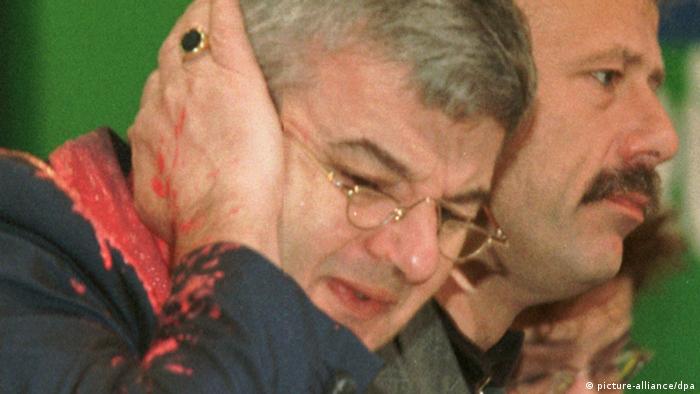
May 1999: Then-Foreign Minister Joschka Fischer is hit by a paint bag at the party conference in Bielefeld.
In 1998, nearly two decades after its founding, the party advanced into the inner realms of power. Joschka Fischer was named foreign minister, and along with its coalition partner, the SPD, the Greens ruled the country for seven years.
It was during this time that the Green party experienced the first major turning point in its history: Fischer endorsed Germany's participation in the Kosovo War — marking the first time since WWII that German soldiers would be involved in a combat mission. The party of strict pacifists were troubled as they reluctantly followed his lead. The frayed unity was illustrated when a protester hurled a bag of paint at Fischer during a party convention.
Coalescing with an eastern counterpart
At the time, Kellner was brand new to the Green party and strongly opposed Fischer's stance. After Fischer's victory at the 1999 party convention in Bielefeld, Kellner thought long and hard about whether he should resign from the party. He ultimately chose to stay on.
What the Greens stood for, at their core, was more important to him "because we introduced a unique idea to politics,” he says, "namely the idea that it's important to people to bring the issues of environmental protection and the preservation of nature, and climate protection, to the center of politics," says Kellner.
"None of the other parties — the Social Democrats, the conservatives or the free-market liberals — were addressing any of that."
Even before all this, when the party was still part of the political opposition, there was another crucial turning point: when the Greens got an eastern kindred spirit. Various civil rights movements, including the New Forum political movement, formed Alliance 90. But it wasn't until much later, in May 1993, that the two parties joined forces to become Alliance 90/The Greens — as they are officially known today.
Even to this day, however, the Greens have yet to really make their mark in eastern parts of the country. The party's election results there are consistently well below those in the west, especially when compared to the major cities of former West Germany.
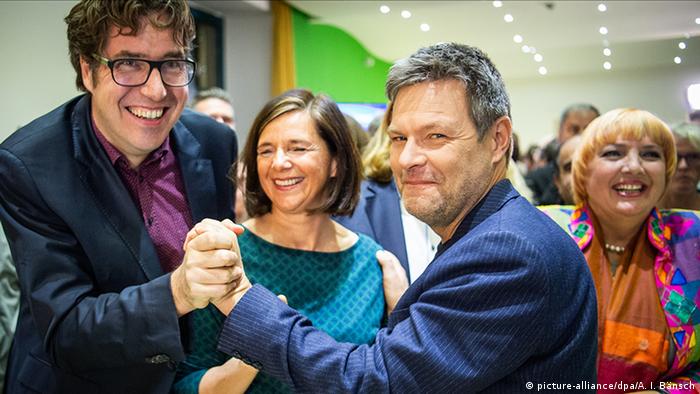
Michael Kellner (left) with and Robert Habeck (right) are leaders within the Green party
2002: The first nuclear power phaseout 
Another milestone under the Greens-led government was the phasing out of nuclear power in Germany. After a long, hard struggle, business and political leaders reached an agreement in 2002 to shut down reactors and phase out nuclear power by 2020. For current party co-leader Annalena Baerbock, then 22, it was a defining moment.
Looking back, Baerbock says it was an example of how politics can trigger change, even when there is big resistance. When the SPD-Greens coalition achieved nuclear withdrawal, "That's when I saw that Greens participation in government achieved what the party has been fighting for for years."
A subsequent government went on to reverse the decision to phase out nuclear power, but then, in the wake of the Fukushima nuclear disaster in 2011, the exit was reinstated and made final. The Green party has since experienced an upswing in the polls and then landed a spectacular win in Baden-Württemberg state elections, with Winfried Kretschmann becoming the first-ever Green Minister-President of any German state.
Annalena Baerbock has co-led the Greens for over two years.
Consistent scores of 20 percent and higher
Ever since climate change climbed to the top of the political agenda, the Greens have consistently scored 20% and higher in the polls, and they co-govern 11 of Germany's 16 states. In European elections last year, they achieved a record-breaking 20.5% of votes among Germans.
They've had a surge in popularity over the past five years. Even though their critics often brand them as a "party of prohibition," many young people are signing up to join, with membership now topping 100,000.
Georg Kurz is one of those members. He's a spokesman for the Greens youth party, and he says he experienced a personal turning point last year. It was then, he says, "When you could see how the times are changing and how more and more people are coming to realize that things can't stay the way they are — that we have to make a fundamental shift."
"In fact, right now, we're in the midst of the most crucial phase in Green party history, Kurz adds. He's referring to the fight to stop climate change. Many observers predict that the Green party has a good chance of once again co-governing the country from the seat of power in Berlin after the next parliamentary elections in 2021. That's an outlook that few could have imagined all those years ago when the party first formed in 1980.
GERMANY'S MAJOR POLITICAL PARTIES — WHAT YOU NEED TO KNOW
Christian Democratic Union (CDU)
The CDU has traditionally been the main center-right party across Germany, but it shifted toward the center under Chancellor Angela Merkel. The party remains more fiscally and socially conservative compared to parties on the left. It supports membership of the EU and NATO, budgetary discipline at home and abroad and generally likes the status quo. It is the largest party in the Bundestag.

WWW LINKS