Showing posts sorted by relevance for query WOMEN. Sort by date Show all posts

Thursday, December 26, 2024


Arîfe Bekir: Women must shape the future of the new Syria

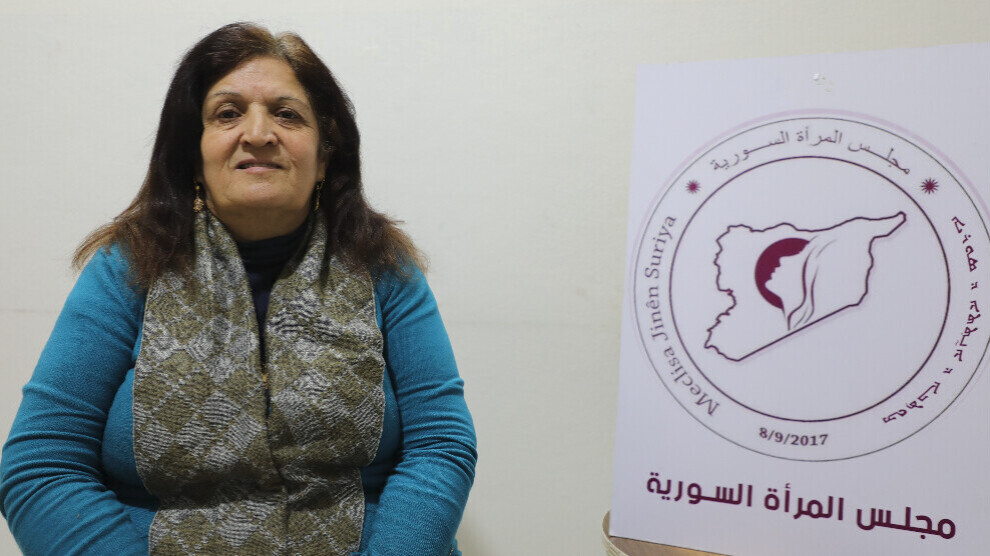
Arîfe Bekir, a member of the board of the Syrian Women's Council, called for women's unity and underlined the importance of anchoring women's rights in a new constitution.


NÛJIYAN ADAR
QAMISHLO
Thursday, 26 December 2024

Since the fall of the Syrian regime on 8 December, concerns about a deterioration in women's rights have increased. The Al-Qaeda offshoot HTS has taken power and, despite moderate words, has already implemented a number of misogynistic measures, such as expelling women from the judiciary. In an interview with ANF, Arîfe Bekir, a member of the board of the Syrian Women's Council, spoke about developments in the country from a woman's perspective.

Arîfe Bekir said that the conditions for women under the Baathist regime were extremely poor, contrary to what the regime reported, and added: "Although women's rights were formally anchored in the Syrian constitution, this had no consequences in practice. Women had no right to make their own decisions; their will was usurped. Although some women were able to hold important positions, this also took place in the shadow of the patriarchal mentality.”

The regime tortured active women and made them disappear

Bekir added: "The (Syrian) Women's Union was unable to be effective because it worked on the basis of the ideology of the Baath regime. The Syrian Women's Council applied to join this union, but were not accepted. In addition, many women were imprisoned by the regime and women who fought for their freedom were tortured. The fate of some women is still unknown. The aim was to break women's free will. Every single woman was deprived of her rights and forced to live within narrow limits."

2011 brought light and shadow for women

Especially after the uprisings in 2011, the situation of women changed in two ways. According to Bekir: "We can actually look at 2011 in two ways. On the one hand, the spread of the spark of the Rojava Revolution and the determined resistance of women are worth highlighting. With the revolutionary achievements of this period, women gained a say in all areas of life. Women were leading a revolution.

On the other hand, thousands of women were killed in clashes between the groups calling themselves the opposition and the Baath regime. There are many Syrian women whose fate is still unknown. In this war, the homes of thousands of women were destroyed, and women were displaced, killed and raped. The year 2011 and the period afterward was an extremely difficult time for women."

Practices in the occupied territories surpass the cruelty of the Baath regime

Bekir underlined that "women suffered heavily in the conflict between the interests of the mercenary groups and the Baath regime. These were groups that ostensibly set out to make a change in 2011, but occupied places like Afrin, Girê Spî, Serêkaniyê, al-Bab and Azaz. And they did not stop there, they continued to murder women, fill their prisons with women. We can say that every day in the occupied territories at least one woman is either murdered or raped. Young boys were forcibly recruited and forced to fight. Underage women were forced to marry. These groups supported polygamy. In fact, the practices of the groups that presented themselves as 'opposition forces' in the territories they occupied have surpassed the Baath regime in cruelty."

Our goal is the unity of women

On 8 September 2017, the Syrian Women's Council was founded. The aim was to unite all women in the country. Bekir explained the organization's intentions: "The Syrian Women's Council was founded with the aim of bringing women together across Syria, reaching out to all women in the country and promoting dialogue. The aim of this council is to create solidarity and unity by addressing the common problems of women. Women from different regions of Syria have the opportunity to support each other and build solidarity networks by sharing their experiences. As women from Syria, our priority is to guarantee women's freedom. In this context, we are actively fighting to defend women's social, economic and political rights. The protection, recognition and preservation of women's own identity are our priority.

Our goals include building a democratic and ecological society based on women's liberation and ensuring a solution to the crisis in Syria through democratic dialogue and decentralized systems. Our priorities include bringing freedom, democracy and justice to all ethnic, cultural and social identities, organizing and educating women and developing a free and equal understanding of life. By supporting the role of women in the new constitution and the dialogue process in Syria, we want to ensure women's rights in all areas. In this context, the implementation of international law, in particular Security Council Resolution 1325 on women, is of the utmost importance."

The resolution is about the position of women in conflicts. Among other things, it aims to guarantee the participation of women at all levels in peace processes, both in the negotiation and in the implementation of peace agreements. In addition, the resolution emphasizes the special need for protection of women and girls in armed conflicts. This particularly concerns protection against sexual and gender-based violence.

Women should write their own constitution

Bekir said that the time had come for the freedom of Syria's women and continued: "We are in a critical and extremely sensitive phase. This is the time of freedom and women. At such a time, all women must unite. All women must come together without distinction. Without the unity of women, without women standing shoulder to shoulder, there can be no freedom.

The main goal of the Syrian Women's Council is to empower women to assert their rights and free themselves from slavery. The future of the new Syria is extremely important for women. We support the construction of a new democratic, equal, just, peaceful and decentralized Syria, a country that guarantees women's rights. There will be a new constitution of Syria, and it is important that women's rights are enshrined in it. A constitution that is created on the basis of a patriarchal mentality will certainly not take women's rights into account. Therefore, women should write their constitution with their own hands."

Women in Suwayda: We must take an active role in building a new Syria


Women attending a conference titled "Building a Citizenship State Together Towards a United Syria where Everyone Wins" held in the Syrian city of Suwayda said that they will take an active role in building the future of Syria.
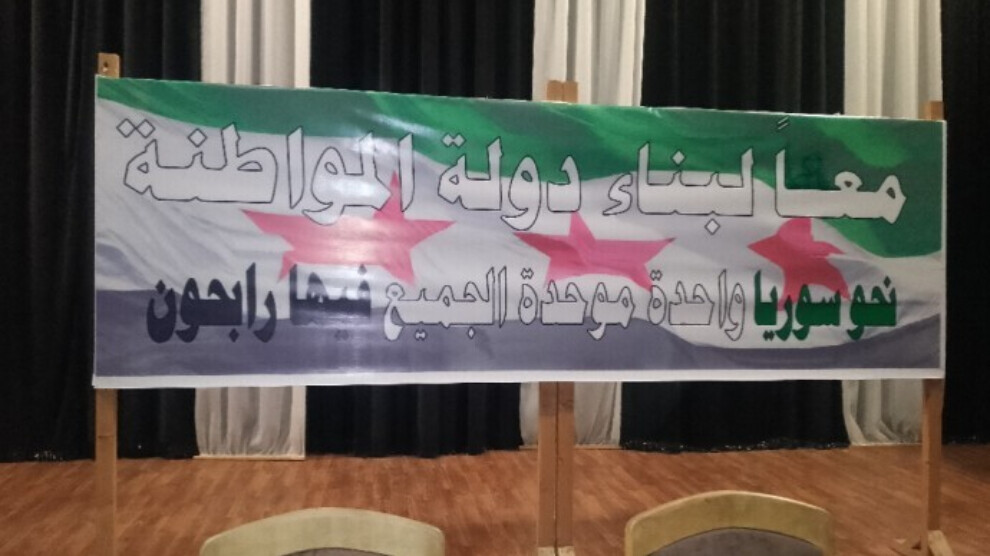

ANF
NEWS DESK
Wednesday, 25 December 2024, 23:45

A conference titled "Building a State of Citizenship Together Towards a United Syria where Everyone Wins" was held in Suwayda, a city in southwestern Syria with a large Druze population. Many citizens attended the conference and shared their thoughts on the future of Syria.

After the fall of the Baath regime and the coming to power of the Interim Government, women in Suwayda emphasized the need for women to participate in all aspects of life and play their political role.

Women must be equal to men

Sulwa Qasim told JINHA news agency: "I was one of the participants in the struggle from the first day of the movement in Suwayda and I have always stood side by side with men. My demand is not only for myself, but for all Syrian women to live in a 'country that benefits everyone'.

Suwayda added: "In this conference we called for the participation of women in all political and legal bodies in accordance with the Constitution and in proportion to their contributions in this field, taking into account that Syrian women are engineers, doctors, mothers, in the civil resistance and shoulder to shoulder with men in all fields of land, industry and life.

Women must not be excluded as second-class citizens. Women must have an equal and active role with men in building a new Syria. Women's participation in parliament and political life is a right that must never be compromised".

Women will play an important role

Lawyer Safaa Al Awam said: "Women are not half of society, but the whole of it, as they have proven their worth over the past 14 years, not only in the city of Suwayda, but in the whole of Syria and the world, because of that they will play an important role in drafting the constitution in the next phase."

Maysa Darwish said: "In the transitional phase, we should not ignore women who have participated in movements and revolutions in the past and present and who play a role in the political sphere, so we must make sure that they are included in all branches of the state, because they will work hand in hand with men in the new Syria to build a new Syria."

Lawyer Hanadi Hudhaifa said: "Since the beginning of the peaceful movement in Suwayda, women have played an active role, showing that women are not only for the home and kitchen."



Wednesday, July 12, 2023


The Communist Women’s International, in English for the First Time


Josefina L. Martínez 
July 11, 2023

An Interview with historians Daria Dyakovona and Mike Taber about their new book with documents from the Communist Women’s International

In January 2023, The Communist Women’s Movement, 1920-1922 was published in English by Brill. A paperback edition will be coming in November from Haymarket Books. The book brings together reports, manifestos, and resolutions of the Communist Women’s Conferences, which took place in those years. The work of more than 600 pages, compiled and edited by Mike Taber and Daria Dyakovona, is the product of research, translation, and editing from the Soviet archives.

The book includes minutes and resolutions of the International Women’s Secretariat and the International Conferences of Communist Women, including the First Conference of Communist Women (July–August 1920), the Second Conference of Women (June 1921), the Conference of Women Correspondents (January 1922), the Second Conference of Women Correspondents (October 1922). It also groups together texts that have been hitherto almost unknown, such as those of the Women’s Conference of the Near East (1921), in addition to texts of communist women’s conferences in Germany, Czechoslovakia, France, Bulgaria, the Dutch East Indies, and Soviet Russia.

These texts bring us closer to the debates that took place among the Communist leaders of different countries over successive meetings, in which they aimed to organize the women’s movement under a socialist and revolutionary perspective. They constitute a contribution to discussions of revolutionary feminism for those who want to know its history, and they serve as reflections on the challenges of the present.

A few days ago, our sister groups in Argentina and Brazil released the book Mujeres, revolución y socialismo (Ediciones IPS) / Mulheres, revolução e socialismo (Edições Iskra) simultaneously in several countries. This new publication, which gathers Marxist writings on women’s emancipation, has similar goals as The Communist Women’s Movement, making it a particular pleasure to interview and exchange ideas with Mike Taber and Daria Dyakovona.

I want to congratulate you on the book. It is a very interesting work. Tell us about the research and editing process. There are writings that were previously unknown; they are findings from the archives. Why publish a work like this today?

Mike: The early Communist women’s movement is virtually unknown today. Even most socialists are unaware of its existence. But as the first truly international revolutionary organization of women, it deserves to be recognized both as a pioneer in the fight for women’s emancipation and as a dynamic force in the Communist International (Comintern) under Lenin. We hope that our new book will help restore the CWM to its legitimate place in history.

Eighty to 90 percent of this volume appears for the first time in English. And the largest single item — the proceedings of the Second International Conference of Communist Women in 1921 — has never appeared before in any language. Typed transcripts of the conference proceedings in German, Russian, and English were obtained by Daria from archives in Moscow, where they had been collecting dust for a century. In preparing these transcripts for publication, we used the English version to a large extent, but it was carefully checked and heavily edited against the Russian and German versions.

Other items in the book were translated straight from Russian or German. A number of German-language items were published originally in Die Kommunistische Fraueninternationale (KFI), a journal published in Berlin under the editorship of Clara Zetkin. The KFI was one of the most well-written, lively, independent-minded, and far-reaching publications of the entire world Communist movement at the time.

Our volume shows readers another side of the early Communist International. It also provides valuable insights into the 150-year history of the Marxist movement with regard to the fight for women’s emancipation.

Daria: The book also includes a section on the CWM around the world, which brings together articles from the KFI on specific activities and campaigns of revolutionary women in different countries, mostly in Europe but also in Asia. We thought it would be valuable for readers to learn about the situation of women workers in different countries and the particularities of Communist work there. Another important piece in the book is the report of the 1921 Near East Women’s Conference held in Tiflis (today’s Tbilisi, Georgia), where the specific situation of “women of the East” was discussed. I can already see that this topic is of great interest not only to Marxists and feminists, but also to scholars and all those who are interested in Asia, Islam, and women’s participation in public life in historical perspective.

Daria, in the introduction, you point out that the Communist Women’s Conferences took as an example the work done by the Zhenotdel, or the Women’s Department of the Communist Party of the Soviet Union. What do you point out about it?

Daria: The Zhenotdel appeared in August 1919, one year before CWM was founded, under the leadership of Inessa Armand and Alexandra Kollontai. The latter would also become a prominent leader of the international movement. But Kollontai was also immediately after the revolution elected People’s Commissar for Social Affairs within the Soviet government, and in this capacity initiated the revolutionary Soviet legislation that would change the lives of women. Women were recognized as equal to men, and equal pay for equal work was guaranteed to them. Marriage became secular, and divorce was legalized on demand for both men and women. The category of illegitimacy of children was abolished. The Soviet state legalized abortion, which was provided free of charge in state hospitals. At the same time, new decrees introduced paid maternity leaves, public childcare, and schooling, as well as public services that lightened the burden of housework. It is based on this quite ahead-of-its-time legislation that the newly formed Zhenotdel started its activities to further advance political, economic, and social rights of women.

In the early 1920s, the Zhenotdel participated in a whole range of activities that women belonging to different social layers could identify with. It set up public canteens, laundries, nurseries, and kindergartens. It ensured recruiting of women into workplaces and helped to organize unemployed women into cooperatives. It led fruitful campaigns against famine, homelessness, illiteracy, domestic abuse, hooliganism, prostitution, epidemics, and much more.

Mike, in the prologue you point out five major achievements of the Communist women’s movement in its first three years of existence. What can you comment on these?

Mike: What comes through clearly in this book is the multifaceted character of the Communist women’s movement and its activities during the years 1920 to 1922:

It educated around women’s oppression through its journals and activities. This effort served to win women to the Communist movement, as well as to educate both male and female Communists around the issue.

It worked to develop women as fully rounded cadres, building their self-confidence and leadership abilities.

It organized sections or departments within parties devoted to this work, with an important degree of autonomy and independent initiative. These were not “women’s caucuses,” however, and Communist men sometimes participated in them.

It built a formidable team of female Communist leaders around the world, and it served as a vehicle for collaboration between them. Its central figures — Zetkin, Kollontai, and Armand — were outstanding Communist leaders who often fail to get the recognition they deserve.

It organized international political campaigns and encouraged Communist involvement in fights to defend women’s rights, from the right to vote to the right to choose abortion.

The significance of the CWM’s record grows even more in light of the fact that these accomplishments were made in face of resistance from many men in the Communist movement. But Communist women had the support of central Comintern leaders, such as Lenin, Trotsky, and Zinoviev. One can see the real progress that was made over the three years this book covers.

The first women’s conference was held simultaneously with the Second Congress of the International. What were the expectations at the time? What were the main issues under discussion?

Daria: The First Conference of Communist Women was organized in the summer of 1920. The Second Congress of the Comintern was held at the same time, and was perhaps much more significant and vaster in terms of participation and discussions than the founding 1919 gathering. For the revolutionary women, it was the first occasion to get together as an international socialist but also women’s emancipation movement. All the delegates at the conference insisted on the link between the end of capitalism and women’s liberation.

The First Conference elaborated its program drafted by Zetkin — the “Guidelines for the CWM.” The movement was to encourage the equal participation with men in all spheres of life — social, political, economic, and cultural — but also in the actual revolutionary fight. Despite the universalist character of the CWM, its “Guidelines” encouraged the use of specific strategies depending on where the work among women was to be carried out: in socialist, capitalist, or precapitalist countries. For socialist countries, Communist Women insisted on the importance of permanent and relentless struggle aimed at improving the lives of women and effectively enforcing their rights. For capitalist countries, the guidelines encouraged educational work among women, struggle for universal suffrage, and participation in national and municipal governments; the fight for the right of women to equal, unrestricted, and free education; the fight for equal pay for equal work by men and women; the fight for social aid for pregnant women, mothers, and children; fight for reform of housing and health care systems; and transformation of housing into a social industry. In countries still at a precapitalist level of development, the guidelines urged women in the first place to fight to overcome the prejudices, morals, practices, and religious and legal rules that reduced women to men’s slaves at home, at work, and sexually.

The second conference was much bigger, albeit in a different political context. What do you highlight from it?

Mike: The CWM’s second conference in 1921 showcased a vibrant, living movement grappling with the challenges before it.

The conference was a freewheeling affair that included lively debates on issues such as women’s suffrage, the relative weight of working women and housewives, and how fights around specific issues (called “partial struggles”) fit into the overall working-class battle against capitalism.

There were also frequent observations and complaints at the conference about women’s status within the Communist movement, and about prejudices they encountered on the part of some male Communists. Many delegates spoke of the need to confront these prejudices, and how best to do so. Perhaps that’s one reason why the proceedings of this conference were not published at the time — unlike just about every other major Comintern gathering during this period. One can speculate as to whether this conference made a few male bureaucrats nervous and uncomfortable!

At this second women’s conference, debates of the Third Congress were also expressed, on the question of the united front or the “revolutionary offensive.” Zetkin defended the same position as Lenin, but not all the delegates held that position, did they?

Daria: The Second Conference was held in the summer of 1921 and indeed in a different political context from 1920. After the failed revolutionary uprising in Germany in March 1921 (usually referred to as the March Action), the conference, like the Third Congress of the Comintern, featured a debate between the adherents and opponents of the “revolutionary offensive.” The adherents of the policy, including the KPD leadership and many of the German women delegates at the CWM conference, supported the failed March Action in Germany and believed that Communists all over the world should start uprisings even if not supported by proletarian masses. Zetkin, like Lenin and many other Comintern leaders, was one of the sharpest critics of this vision. This ideological division found its way into the debates of the Second Conference, and Zetkin was personally attacked. Passionate debates between the adherents of the two contrasted visions of the path to be taken by the workers also characterized the discussions of methods of work among women, including such questions as the participation of Communists in the general women’s fight for equality and cooperation with liberal feminists as well as the base of the CWM.

I am particularly interested in the debates on work among women in the East. What were the main contributions on this issue?

Daria: The agitation, organization, and education work among the “women of the East” had been on CWM’s agenda since its foundation. Eastern women were considered the most oppressed representatives of the female sex, their social and material conditions — the hardest. In 1921, the CWM established the Woman’s Secretariat for the Near East, which was to coordinate work in Western Asia and Turkey. On December 12, this secretariat held a women’s conference in Georgia. The CWM’s policy on women of the East involved flexibility and sensitivity toward the conditions of life and cultural contexts that these women had to face. Communist Women understood that work among women in the East could not be carried out in the same way as in capitalist countries. In the early 1920s, the accent was put on Eastern women’s grassroots initiatives and cooperation between women belonging to different, including nonproletarian, layers in a united-front perspective. The major goal of such an approach was to attract women into cooperatives and workshops that liberated them economically and could also be used as spaces for agitation. Communist women also helped in setting up the infrastructure that would make “women of the East” integrate into social life: workshops, schools, kindergartens, children’s homes, public dining halls, laundry rooms, libraries, reading rooms, etc.

Mike, you point out that, from 1924 to 1926, the communist women’s movement declined. How does this relate to the consolidation of Stalinism in the USSR and in the Comintern?

Mike: The decline of the Communist women’s movement is definitely connected to the rise of Stalinism. The Comintern’s Fifth Congress in 1924, which marked the beginning of the international movement’s degeneration, outlined a perspective of “Bolshevization,” which led to the complete subordination of Communist parties and auxiliary organizations to the Comintern’s leadership in Moscow. An effort to tame the Communist women’s movement was clearly seen at the movement’s Third Conference in 1924, which was held immediately after the Fifth Comintern Congress.

The first two CWM conferences in 1920 and 1921 had set the movement’s main tasks to be participating in struggles for women’s emancipation; seeking ways and means of involving women in social life and political struggle; recruiting and integrating women into the Communist movement; and advocating affirmative-action measures to advance women inside it. At the Third Conference, however, its responsibilities were largely reduced to simply winning women to the Communist movement.

The CWM’s downgraded status was soon registered in practice. Its leading body, the International Women’s Secretariat (IWS), which had been based in Berlin and led by Zetkin, was transferred back to Moscow in early 1924. Its journal, Die Kommunistische Fraueninternationale, was discontinued in 1925. The IWS itself was relabeled the “Women’s Section of the Executive Committee of the Communist International.” The CWM’s Fourth Conference in 1926 would be its last, although the ECCI’s Women’s Section would exist as a largely meaningless body until its formal dissolution in 1935.

The Communist women’s movement’s decline echoed retreats on women’s rights in Soviet Russia under Stalin. Perhaps the best example of this is abortion, which had been decriminalized in Soviet Russia in 1920. This right was taken away in 1936, as abortion was recriminalized.

Daria, you point out that beginning in 1935, the orientation of the Popular Fronts undermined women’s work. In what way?

Daria: Indeed, the shifts in Soviet foreign policy in the 1930s and, perhaps most importantly, the adoption of the Popular Front policy by the Comintern in 1935 affected the work of women. The Comintern then sought alliances with a very large spectrum of anti-fascist political movements, including the center Left and even bourgeois forces, and tried to avoid antagonizing potential allies with its radical gender agenda, such as, for example, abortion, which was recriminalized in the USSR in 1936.

That said, despite the formal dissolution of the CWM and its central secretariat in November 1935, national women’s sections continued to function in most Communist parties. And women there continued the struggle for women’s rights on the national and local levels. During the entire interwar period, Communist women advocated the creation of broader nonparty women’s organizations that would appeal to wider audiences.

Today, people are still fighting for reproductive rights and the right to abortion. How did the Communist women’s movement raise this issue in those years? What legacy does the Communist movement leave for today?

Daria: Reproductive rights were an issue that the Communist Women often discussed, even though the question of abortion was not included into the CWM’s “Guidelines.” In fact, the CWM’s position on abortion was multifaceted. Communist women saw abortion as necessary so long as society was unable to guarantee the material means for a prosperous and happy childhood for all. This did not prevent them from protesting antiabortion laws, which they did in France and even in fascist Italy in the early 1920s. In Germany, Communist women led a campaign against antiabortion laws under a slogan that is still used by proabortion activists around the world: “Your Body Belongs to You.” In Denmark, Communist Women set up the Working Women’s Information Bureau, which provided information on birth control. In Canada, where abortion was then illegal, Communists joined with non-Communist women to demand the decriminalization of fertility control and establishment of mothers’ clinics, which would provide information on contraception and free contraceptives. At the same time, the CWM insisted on the responsibility of the state in protection of motherhood and children and encouraged women to fight for the creation of better legal frameworks and public institutions for working mothers that would facilitate childcare.

As to the legacy of the CWM, more than 100 years after the creation of the movement, abortion is still not a universal right, while maternity leave in many advanced capitalist countries is much shorter than the 16 weeks that the CWM called for. Many other practices, such as childcare facilities at workplace and the freedom to nurse at work, which Communist Women called on the state to introduce, remain an unachieved goal. That said, many countries have adopted and even gone beyond the demands in the sphere of reproductive rights and motherhood protection formulated by the CWM in the early 1920s.

What do these texts offer to the new generations fighting for women’s rights in many countries? You point out that women are still struggling over many of the issues raised by the Communist women’s movement. And also that the texts offer a strategic perspective. Can you explain that?

Mike: Many of the demands raised by Communist women a century ago remain unrealized today and are still issues of struggle: abortion and reproductive rights, childcare, maternal health and facilities, equal pay for equal work, access to education and social services, women’s burden in housework, the sexual double standard, and of course the continuing fight for political and social equality. The continued battles around these questions give added contemporary relevance to the early Communist women’s movement and will be of considerable interest to many readers. One example of such relevance is the article in our book on the fight against the abortion ban in Germany a century ago.

But what the Communist women’s movement above all offers today, as you indicate, are its strategic insights on the fight for women’s emancipation and its relationship to the revolutionary struggle.

One key insight relates to the revolutionary dynamics of the women’s liberation struggle itself. Given the role that women’s oppression and their second-class status play within capitalism, Communist women were absolutely convinced that female emancipation could never be fully achieved under capitalism, and that the working class had to take political power and begin the construction of socialism. Women workers would be among the central fighters in this struggle.

At the same time, Communist women understood that the struggle for women’s emancipation was an integral part of the fight for socialism. It was not to be seen as a diversion from the overall struggle, or viewed as a secondary issue that could be put on the back burner to make way for “more important things.”

These insights, together with the movement’s historical example, deserve study by women’s rights fighters today, as well as by all revolutionary socialists.


Josefina L. Martínez
Josefina is a historian from Madrid and an editor of our sister site in the Spanish State, IzquierdaDiario.es.

Sunday, March 12, 2023

ESSAY
DECOLONIZATION IS WOMEN’S WORK

March 8, 1950—International Women’s Day—Marked the Embrace of a Feminist Battle Against Imperialism


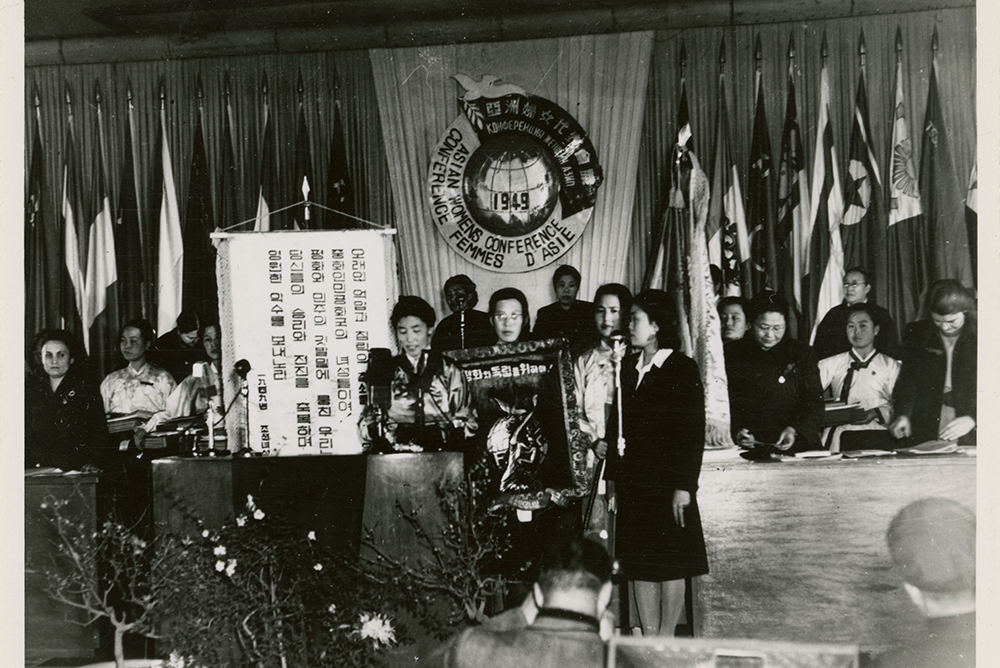
The 12-day Asian Women's Conference in Beijing saw attendees from across Asia, Africa, the Caribbean, and South America and "forged a movement for all women to fight against colonialism and demand equal rights with full sovereignty," gender studies scholar Elisabeth B. Armstrong writes. Pictured above is the Korean delegation for the conference. Courtesy of Sophia Smith Archives, Smith College.


by ELISABETH B. ARMSTRONG | MARCH 8, 2023

It was 1950, and the world was in flames: In Vietnam, Iran, Madagascar, Algeria, West Africa, South Africa, Tunisia, Malaya, Burma, and Cuba, wars of counterinsurgency were being waged against colonial powers that refused to leave. Women, with weapons in their hands and the courage to hide soldiers, grow food for the frontlines, and pass messages across their battlefronts, took part in fighting these wars for independence. At the same time, they sought peace, freedom, and women’s rights.

On March 8, International Women’s Day, they erupted in protests to demand an end to imperialism—the starting point for imagining decolonization as a global culture.

Today, corporate sponsors have sought to commodify International Women’s Day and turn it into women’s access to rule like capitalists. But this 1950 fight for decolonization built a culture that—if you look closely—still fuels the revolutionary spirit, and promise, of the day.

International Women’s Day began as a way to join working-class women’s struggles for basic rights to livelihood with middle-class women’s fight for the vote. At the International Socialist Women’s Congress, held in Copenhagen in 1910, German activist Clara Zetkin proposed holding an international women’s day in March. These meetings and demonstrations incited protests, including the Russian Revolution in 1917. From 1922 onward, the day was mostly celebrated as a holiday in the USSR and socialist countries to honor women’s rights gained under socialism.

The need for a decolonial agenda around International Women’s Day arose from the Global South, during the anti-imperialist Asian Women’s Conference held in Beijing, China, in December 1949. There, attendees found solidarity and carried that spirit back home in countless manifestations of anticolonial feminist activism. During those 12 days in Beijing, women from across Asia, Africa, the Caribbean, and South America forged a movement for all women to fight against colonialism and demand equal rights with full sovereignty. Many women from colonized countries had already joined their countries’ battles to crush colonial occupation. They had their own slogans: Bury the corpse of colonialism! If anyone is oppressed, no one is free! And they demanded that women from colonizing countries dismantle their countries’ war machines.


Women at the conference gathered at the National Art Academy tables. Courtesy of Sophia Smith Archives, Smith College.


Attendees took that charge with them when they got back home. Just two weeks after returning from Beijing, for instance, Jeanette Vermeersch, a parliamentarian and member of the French Communist Party, addressed the French parliament to call for the withdrawal of France from Vietnam: “The Vietnamese people are fighting a just war,” she said, “a war in the defense of your aggression. You are fighting an unjust war, a colonial war, a war of aggression.”

Through networks of anti-imperialist and socialist women’s groups, the message of the Asian Women’s Conference traveled around the world. It would be a global, coordinated refusal of imperialism. The conference resolution spread: Celebrate International Women’s Day, a day for working-class women’s struggles, like never before.

When International Women’s Day arrived, it joined together women from all around the world in the anticolonial struggle for their full emancipation, as women from colonizing countries like France and the Netherlands demanded an end to imperialism in solidarity with women from Vietnam, Indonesia, Tunisia, and beyond. This included the demand that women hold equal rights to fully enfranchised men, not the truncated rights of colonized men with negligible rights to vote, apartheid rules of unfree movement, fettered access to jobs, and stolen lands.

The day punctuated ongoing insurgencies by people who were geographically far from each other, but were bound by common occupiers of colonial nations.
When International Women’s Day arrived, it joined together women from all around the world in the anticolonial struggle for their full emancipation, as women from colonizing countries of France and the Netherlands demanded an end to imperialism in solidarity with women from Vietnam, Indonesia, Tunisia, and beyond.

In Mar del Plata, Argentina, leftist women’s groups—such as the Union of Argentine Women and the Women’s Cultural Group—held the Congress for Peace in dozens of cities around the country to evade the authorities (who had banned their activities) and fight for a decent standard of living and political rights. In Brazil, women chose to protest the high-level U.S. economic delegation visiting Rio de Janeiro. They printed 100,000 leaflets and covered the city with 20,000 posters under the name “Protect Brazilian Petrol” to condemn the economic treaty signed with the United States. Their slogans sought peace and an end to U.S. interference in the Brazilian economy—its own form of neoimperialism—and protested the high cost of living.

Across the world, in Damascus, the Union of Syrian Women led a demonstration of women and children to the parliament to condemn war. Their protests were not without cost. Amine Aref Kassab Hasan, who had recently returned from the Beijing conference, was beaten and arrested, along with two other women and a 5-year-old girl. In Homs, another delegate of the Asian Women’s Conference, Salma Boummi, along with five other women and girls were arrested for a similar protest for peace. But in the face of the Syrian government’s violent response, 13 Syrian women’s organizations presented a memorandum to the Constituent Assembly to demand women’s equal rights, particularly equal pay for equal work. Though they were beaten back, the movement pressed onward.

Anticolonial leaders of the women’s movement, like Celestine Ouezzin Coulibaly (familiarly known as Macoucou) and Baya Allouchiche, took the lead in organizing working-class women in their countries, but also in their regions of North Africa and West Africa, respectively.


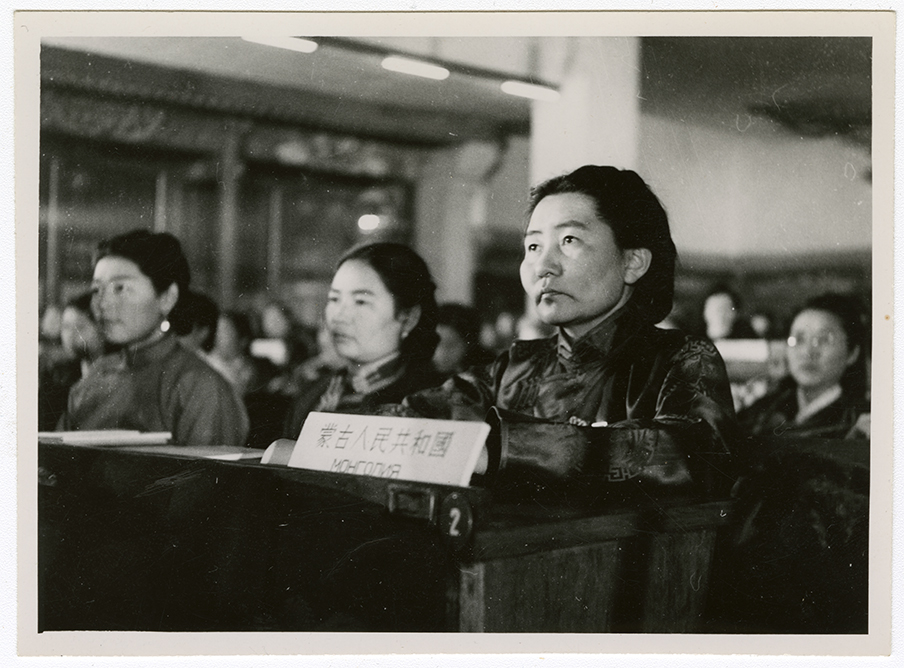
The Mongolian delegation at the conference. Courtesy of Sophia Smith Archives, Smith College.


In Ivory Coast, Coulibaly toured Sudan, Upper Volta, and Ivory Coast to spread the word after attending the Beijing conference. She described the solidarity of women she witnessed, and she told of the success won by communist women in the People’s Republic of China, who drove out an army that had far greater armaments supplied by the Americans. After touring the region, Coulibaly led demonstrations of thousands of women on International Women’s Day in Grand Bassam, the French colonial capital of Ivory Coast, in protest of police repression and the murder of women who, in December 1949, had demanded the release of political prisoners who fought for independence from French colonial rule.

Like Coulibaly, after Allouchiche returned from the Asian Women’s Conference, she galvanized women in Algeria to join the anticolonial struggle. She toured Algeria and Morocco, spending 12 days in the radical province of Oran, where women were not yet organized. She described a world of solidarity among women, one that refused to buckle under the yoke of colonialism nor the yoke of patriarchy. She dared them to imagine: “the sun that has risen in Beijing will shine for us too!” Her speeches held in the month of February tipped the balance toward solidarity and a wage strike among dockworkers. Only a week before International Women’s Day 1950, over 300 Algerian women joined the strike on the docks of Oran to protest poor working conditions and to refuse to load ships with soldiers and supplies for the colonial counterinsurgency frontlines of Vietnam.

Global anticolonial solidarity required resistance in colonial centers. Delegates from the Netherlands, the United States, France, and England who attended the conference in Beijing took direction and brought colonized women’s struggle home. On the same day as the protests in Syria, Lebanon, Ivory Coast, Argentina, Brazil, and Algeria, Dutch women supported dock workers who refused to load ships with American armaments bound for the Dutch occupation of Indonesia by laying in the road and blocking the trucks from reaching the docks. In Enshede, Dutch women connected Dutch peoples’ high cost of living to the priority given in the national budget for military purposes over the needs of the working population of the Netherlands. Bread not Barracks, they shouted.
.
Formal colonialism fell in the decades after the 1949 Asian Women’s Conference. But economic colonialism continues today. Economic blockades have human rights consequences and debt packages dictate national policies. But women’s struggles for decolonization, peace, and equal rights hasn’t ebbed. If we turn our heads to Latin America, one memorable slogan from strikes held on International Women’s Day—“What they call love, we call unpaid work!”—draws the connections between the debt bondage and the need for women to provide structural networks of care. Femicide, drug trafficking, border policing, and U.S. intervention in Central America and Mexican economies have fueled endemic murders of women and girls. We see inspiration, too, from women in Mexico reacting to this, to join their internationalist call against systemic femicide, for “Ni Una Mas!” (Not One More).

International Women’s Day in 1950 revived the fight for anticolonial, anti-imperialist solidarity on the terms of the people most oppressed. Our regional and national women’s struggles are still global, still marked by economic and political colonialism in new forms. Survival for many is still precarious—we have a strong tradition in International Women’s Day to imagine an alternative future without inequity.


ELISABETH B. ARMSTRONG is a professor of women and gender studies at Smith College. Her latest book, Bury the Corpse of Colonialism: The Revolutionary Feminist Conference of 1949, comes out next week from University of California Press.

Tuesday, December 03, 2024

YPJ: We will hold the Turkish state and its mercenaries accountable on the frontlines of resistance

Condemning the captivity of female fighters from the Sheikh Maqsoud and Ashrafieh Protection Forces, YPJ called on young women to join their ranks and take their place on the frontlines of defense: “Only in this way can we protect our land and dignity."


ANF
NEWS DESK
Monday, 2 December 2024, 

During their attacks on North-East Syrian region, the jihadist alliance ‘Syrian National Army’ (SNA) took people from the Kurdish neighborhoods of Aleppo hostage and deported them to the Turkish occupation zone. It is still unclear how many hostages are currently in the hands of terrorists. Women who are members of the Hêzên Parastina Civakî (HPC) and are involved in civil resistance in Sheikh Maksud and Ashrafia are among the victims of kidnapping.

The General Command of the Women’s Protection Units (YPJ) released a statement calling for action to expose the brutality of the Turkish occupation state and its mercenaries on a global scale, revealing the extent of their terrorism and holding Erdoğan and the Turkish occupation state accountable for this war and the atrocities committed against the captured young women.

The YPJ statement calling on international women's and human rights organisations to stand up for the hostages includes the following:.

“Over the past several days, our region, along with all of the Syrian territory, has been subjected to a large-scale attack from multiple fronts. It began in Aleppo, where the Syrian people were left face to face with horrific massacres. Simultaneously, these attacks targeted our areas in North and East Syria, where we have demonstrated relentless resistance against these extensive assaults, particularly in the regions of Shehba and Aleppo. Our people, led by women, have shown great resilience in the face of these attacks.

Our people in Sheikh Maqsoud and Ashrafieh, who have gained extensive experience in resistance and warfare over the years, have once again organized themselves against these assaults. Operating under the name of the Sheikh Maqsoud and Ashrafieh Protection Forces, they have thwarted dozens of attacks by mercenaries of the Turkish occupation state.

Undoubtedly, the war continues on multiple fronts. Unfortunately, several young men and women of the Sheikh Maqsoud and Ashrafieh Liberation Forces have fallen captive to these mercenaries. These barbaric mercenaries, who have no regard for the ethics or laws of war, have heinously violated the dignity of the women prisoners, using them as tools for propaganda on their media outlets. They have shamelessly declared to the captive women that they would once again sell them in slave markets. Such actions are utterly inhumane and must not be tolerated.

As the Women’s Protection Units (YPJ), we strongly condemn the brutal acts of the Turkish occupation mercenaries against the captured women and pledge that we will avenge them. We call upon international organizations, particularly Amnesty International and the International Committee of the Red Cross (ICRC), as well as all women’s and human rights organizations, to fulfill their duties in protecting these women who defended their neighborhoods and cities. We insist on the necessity of safeguarding their rights as prisoners of war.

The atrocities committed today by the Turkish occupation mercenaries against the captured young women mirror those carried out by the terrorist organization “ISIS” in 2014 in Sinjar, Mosul, and Raqqa, where thousands of women were sold in slave markets. These actions represent the patriarchal mindset that reached its peak with “ISIS” and Erdoğan’s mercenaries. They are well aware that Kurdish women have written heroic epics against their barbaric practices, resisting to the very end. This is why their inhumane practices have escalated to the level of outright hostility against women.

We direct our call to women’s rights organizations, civil society organizations, prominent figures, freedom advocates, and democrats to protect the captive women. It is imperative to expose the brutality of the Turkish occupation state and its mercenaries on a global scale, revealing the extent of their terrorism and holding Erdoğan and the Turkish occupation state accountable for this war and the atrocities committed against the captured young women.

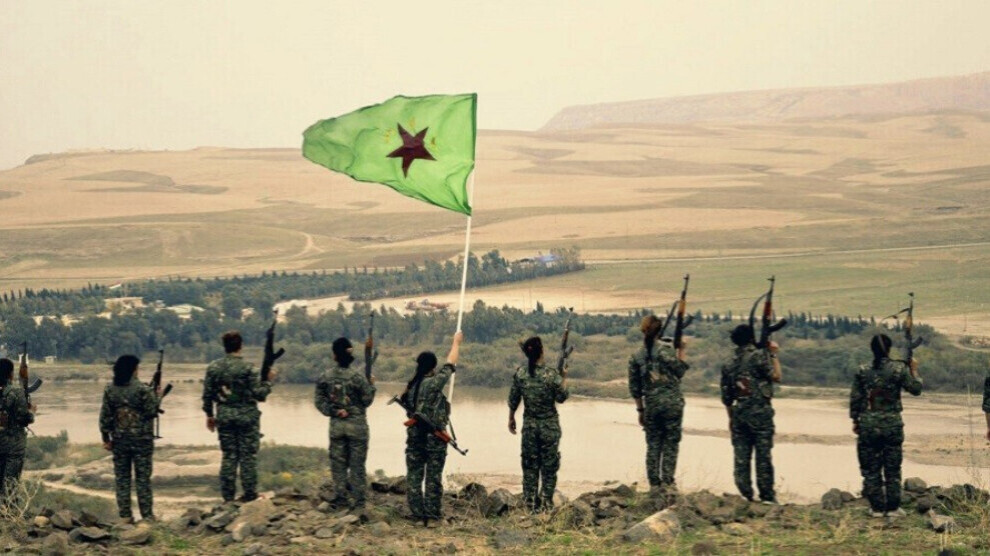
As the Women’s Protection Units (YPJ), we once again condemn the captivity of the female fighters from the Sheikh Maqsoud and Ashrafieh Protection Forces. We affirm that we will hold the Turkish occupation state and its mercenaries accountable on the frontlines of resistance. In this context, during these historic days marked by extensive attacks on our regions and Syria as a whole, we declare that we stand on the frontlines to protect all women and our people. We also call upon all young women, wherever they may be, to join the ranks of the Women’s Protection Units (YPJ) and take their place on the frontlines of defense. Only in this way can we protect our land and dignity.”

YPJ Forum on Women and Protection: We shall transform every day into a day of resistance

Women's movements and organisations participating in the Second Forum on Women and Protection in the Middle East reiterated their commitment to continue and strengthen the struggle in the region.


ANF
TABQA
Tuesday, 26 November 2024

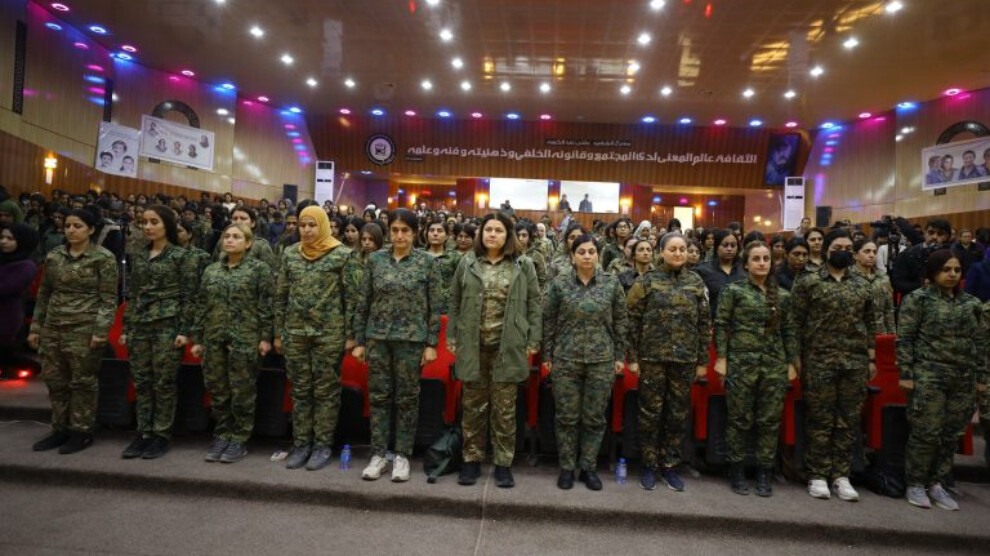
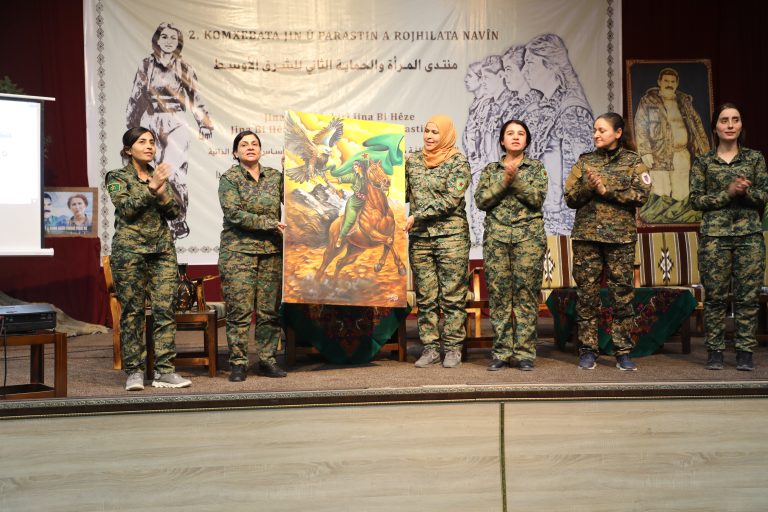
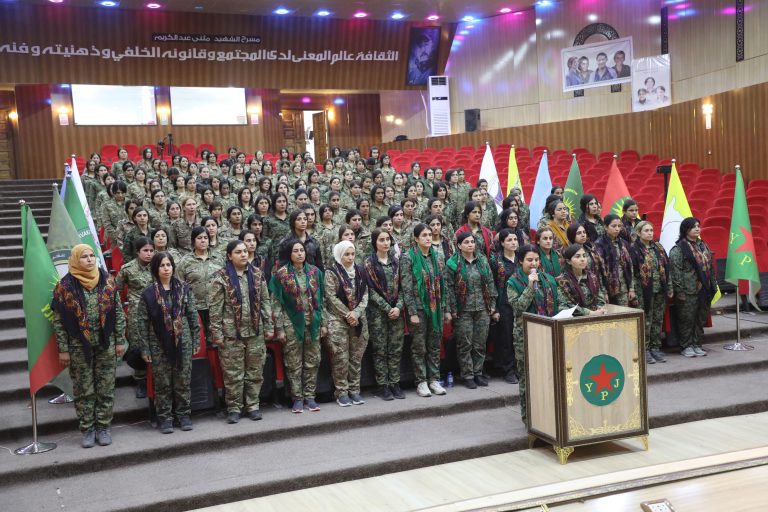
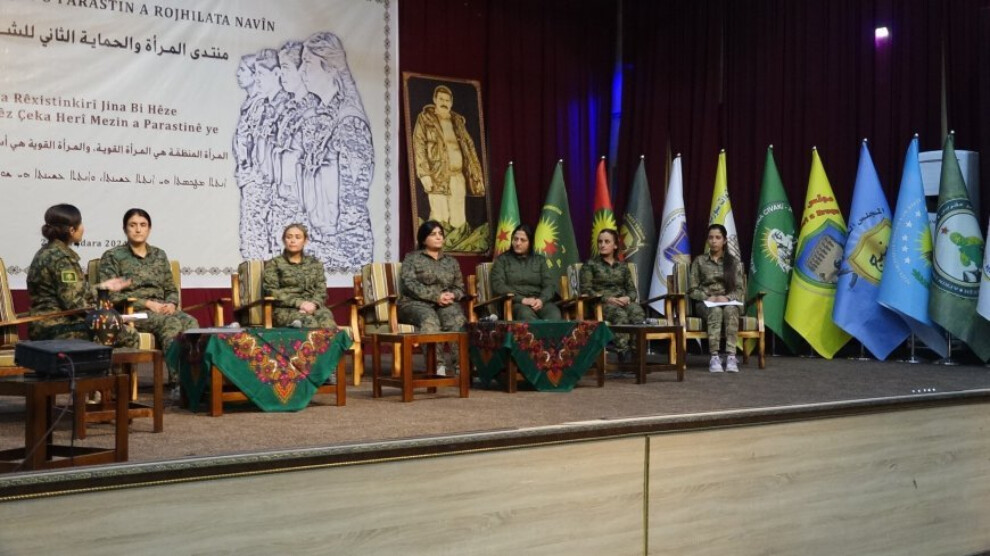
The Women’s Protection Units (YPJ) held the Second Forum on Women and Protection in the Middle East under the slogan “An Organized Woman is a Strong Woman, and a Strong Woman is the Foundation of Self-Protection.”

The forum was held in Tabqa on Monday with the participation of 500 delegates, including women's organisations, YPJ fighters and military council members.


The forum at Tabqa Culture and Art Centre started with a moment of silence, followed by a speech by the YPJ General Commander, Sozdar Dêrik, who said, “We will not let any obstacle affect our struggle. This struggle will lead us to victory.”

Sozdar Dêrik drew attention to the importance of women's emancipation and strengthening their self-defence and said, ‘We need to liberate all women so that they can get their rights, be strong and protected. This has been our primary goal from the beginning.”

Dêrik noted that the wars in the Middle East serve the interests of the powers, not the peoples. Describing the conflicts in many countries such as Lebanon, Syria, Palestine and Yemen as ‘wars of genocide’, Sozdar Dêrik emphasised that women's struggle plays a key role in overcoming the destruction caused by these wars.

Stating that the slogan ‘Jin, Jiyan, Azadî’ (Woman, Life, Freedom) has become a philosophy of freedom for women's movements around the world, Sozdar Dêrik noted that this slogan has been banned in Amed tr: Diyarbakır) in Northern Kurdistan and said that the occupying policies in Turkey aim to suppress the women's struggle.


The forum also discussed Kurdish leader Abdullah Öcalan’s evaluations of the role of women in the democratic transformation of the Middle East, which highlighted the historical importance of women in the struggle for social freedom.

A video message sent by the Party of Free Women in Kurdistan (PAJK) and a cinevision show on women's struggle in Northern and Eastern Syria were also screened.


The forum discussed in detail the protection of women, the strengthening of the culture of self-defence and the leading role of women in the construction of a democratic and ecological society. The forum also discussed efforts to develop strategies to build regional defence mechanisms with the goal of providing a safe and sustainable environment for women.

Following the discussions, the forum ended with the reading of messages, theatre performances and songs. Women's movements and organisations participating in the forum reiterated their commitment to continue and strengthen the struggle in the region.


The final declaration of the Second Forum on Women and Protection in the Middle East includes the following:

“At the outset of this concluding statement, and to ensure it remains a luminous beacon for a world filled with greater justice, freedom, peace, and security, we honor the memory of the Butterflies of Freedom—the Mirabal sisters—and our fallen comrades, who sacrificed their lives in the struggle for freedom. Among them are Martyr Nalîn Mûş, Helîn Karê, Şevîn Karzan, Jiyan Tolhildan, Rojna Aqîd, Leyla Aqre, and Arîn Mîrkan. We extend our deepest respect to their noble spirits, remembering them as towering symbols of sacrifice and unyielding determination. These heroines, who offered their lives on the altar of humanity, are not mere fleeting memories in the history of our people and homeland. Their legacy is a guiding light that strengthens our resolve in defending our dignity and freedom as women.

Through this forum, we renew our commitment to the ideology of Leader Abdullah Öcalan, a symbol of free thought and a pioneer of democratic confederalism. His philosophy embodies sincere camaraderie with women and supports their struggle for liberation. We affirm our participation in the campaign for Öcalan’s physical freedom, believing that his liberation represents the freedom of women and the key to peace and dignity for all peoples.

The Second Forum on Women and Protection convened on November 25, 2024, under the slogan “An Organized Woman is a Strong Woman, and a Strong Woman is the Foundation of Self-Protection.”

It took place during an exceptionally critical juncture, amidst highly sensitive regional and international conditions. The Middle East, due to its strategic location and diverse makeup, has become a theater for global competition and a battleground for the Third World War, with all its devastating consequences. This forum brings together distinguished women leaders and representatives of feminist organizations from various regions to discuss the realities of women’s roles and the enormous challenges they endure as a result of the conflicts ravaging the area.

This global conflict, now an all-encompassing international struggle, has caused catastrophic repercussions for women in the Middle East. Women have not only become victims of the most egregious forms of violence but have also been systematically targeted in these brutal wars, culminating in comprehensive genocidal campaigns. For instance:

In Kurdistan’s mountains, the Free Women’s Troops (YJA-STAR) confront the fiercest assaults, including the use of internationally banned chemical weapons.

In northern and eastern Syria, women face systematic eradication by the Turkish fascist state, which not only unleashes the most barbaric military attacks but also seeks to annihilate the cultural and societal essence of Syrian women to dismantle the resilience of the entire populace.

In Palestine and Lebanon, women bear the brunt of catastrophic wars, enduring occupation and oppression while paying a high price.

In Iranian and Turkish prisons, the situation is even more dire, as women are executed or sentenced to life imprisonment simply for raising their voices for freedom under the slogan: “Women – Life – Freedom.”

Women have never been incidental victims of war and conflict; rather, they have been deliberate targets. By terrorizing women, oppressive forces aim to intimidate societies. By breaking women’s will, they break the will of nations, and by undermining women’s dignity, they undermine the dignity of entire communities. Women, as the foundation of strong, cohesive societies, are directly targeted by forces of war to dismantle societal structures and erode collective strength and resolve.

Yet, despite this grim reality, women remain an inexhaustible source of energy. Like the phoenix, they rise from their ashes, resilient against the tides of time. Women refuse to be mere victims at the altar of monstrous tyranny. They embody a perpetual revolution, resilient against adversity, and unyielding in the face of calamities, with no place for surrender in their vocabulary.

The Free Women’s Troops (YJA-STAR), the Women’s Defense Forces in Eastern Kurdistan (HPJ), the Women’s Units of Shengal (YJŞ), the Women’s Protection Units (YPJ), the Beth Nahrain Syriac Forces, the Khabur Assyrian Guard, and the Women’s Civil Defense Forces (HPC-JIN) in northern and eastern Syria have collectively reflected the essence of women’s reality and strength. These military entities stand as exemplary models of women’s resistance, showcasing their determination to protect their identities. These forces have played a pioneering role in building a defensive system rooted in confederal and communal principles, challenging centralized authoritarianism, and paving the way for democratic societal structures.

These entities have demonstrated an unparalleled ability to transform suffering into a force for resolution, turning tragedy into an opportunity for revival. Women, through these organizations, have become pivotal to constructing a new world based on freedom, justice, and equality. They have emerged as symbols of a humanitarian project that transcends traditional authority, fostering societal relations built on solidarity and collective organization.

Amid these existential challenges, this forum underscores that establishing a women’s defense system within the framework of a Women’s Confederation in the Middle East is not merely an option but an urgent moral and humanitarian necessity. This system will serve as a shield to safeguard dreams of social justice, making our shared struggle a launchpad for building a future of peace and humanity where women lead the journey for freedom and dignity.

Key Discussion Points:

- The impact of the Third World War and escalating conflicts on Middle Eastern women and strategies for addressing these challenges.

- The obstacles facing women in protection and defense.

- Policies and measures required to ensure the protection of women.

- Promoting the culture of women’s self-defense as a tool for empowerment.

- Practical strategies for building local and regional defense mechanisms to protect women and guarantee their active leadership in constructing democratic and ecological societies that uphold women’s freedom.

- Strengthening collaboration with feminist movements to create a safe and sustainable environment for women in the Middle East.

Strategic Recommendations:

- Establishing a Women’s Security and Protection Council in northern and eastern Syria.

- Forming a Women’s Security and Protection Council for the Middle East.

- Strengthening integrated national and regional policies to protect women.

- Developing educational programs to equip women with the skills and knowledge needed to defend their identity and to enhance their capacities in politics and diplomacy concerning protection and defense.

- Sharing intellectual and practical experiences in women’s self-defense to counter systematic genocides and sexual violence.

- Building feminist support networks at local and regional levels to encourage women’s engagement in community security and defense.

- Launching training initiatives to empower women in community defense roles and prepare them for leadership in protecting their communities.

- Collaborating with international feminist organizations to establish joint mechanisms offering support and training for women in conflict zones.

- Enhancing regional cooperation to create shared platforms for exchanging expertise and providing practical solutions to women’s protection issues.

- Developing a regional framework to implement the forum’s recommendations and unify policies for safeguarding women and reinforcing their role in peace-building and societal protection.

- Partnering with global human rights organizations and feminist institutions to direct regional efforts toward creating a safe and free environment for women in the Middle East.

Let these recommendations be the agenda of our united struggle on this International Day for the Elimination of Violence Against Women, reminding us all of the urgent need for solidarity and unity in confronting these genocides. We must not be misled by the false promises and hollow commitments of patriarchal systems. Instead, we shall transform every day into a day of resistance under the banner: “With the Philosophy of ‘Woman, Life, Freedom’, We Will Protect Ourselves.”


Tuesday, November 26, 2024

YPJ Commander: The women-led revolution in Rojava has been a source of inspiration for all women

JIN, JIYAN, ASADI  WOMEN, LIFE, FREEDOM

YPJ Commander Leyla Waşukanî emphasised the importance of the Kurdish women's revolution and struggle and said that women should fight against male-dominated systems in an organised and courageous way.


ANF
NEWS DESK
Monday, 25 November 2024, 18:38

Leyla Waşukanî, one of the commanders of the Women's Protection Units (YPJ), spoke to ANHA about the Kurdish women's revolution and resistance.

Commander Leyla Waşukanî drew attention to the policies of the male-dominated system against women and the resistance of women and said, “First of all, it should be noted that we are faced with a system prevailed by a male-dominated mentality. This system united against the order of the goddess woman, set games and intrigues, and built its cruel order by realising the first conspiracy in history. It is a fact that women and children suffer the most in wars and conflicts. Today, humanity is experiencing the peak of the third world war. In Kurdistan, the Middle East and all over the world, humanity is being abused and the existing conflicts are being fuelled. In the face of these attacks, resistance and a unique struggle is absolutely necessary. Every day we witness the murder of women in society. This is a result of the special war waged by the capitalist nation-state and the small state mentality that is its continuation. At this point, the duty of women is to organise against this system and its dirty war. This is only possible through revolution.”

Referring to the women's revolution, the Rojava Revolution, Leyla Waşukanî said the following: “When the war in Rojava started in 2012, Kurdish women participated in revolutionary activities with all the means at their disposal. When the spark of the war was lit, they organised themselves, took the front lines and fought heroically. They were brave and determined; they stood shoulder to shoulder with men against the most dangerous forces in the world and wrote epics of heroism. This struggle of women influenced everyone. So much so that even brutal gangs such as ISIS were afraid of women and had to say, ‘Women with red shoes (Jinên pêlav sor) are not afraid and will not back down’. This stance of women has been a great source of pride and honour for all of us.

It was the resounding struggle of these brave Kurdish women fighters that led to the Rojava Revolution being recognised as a women's revolution. Even in the harshest conditions, women took on their roles and formed the basis of moral strength and enthusiasm. Women's struggle became a place of respect and admiration. The sacrificial and warrior women's labour has become the legacy of libertarian women's freedom to organise for the future and to build a confederal and democratic society.

We must remember this: Nothing is won for nothing. Sacrificial fighters are needed for an equal and free future. Today, women can proudly and confidently say, ‘We exist and we want our freedom’. As Leader Apo (Abdullah Öcalan) said, ‘If the woman is not liberated through her labour, the man will never be liberated; he will remain a slave.’ Therefore, women must be confident in themselves, grow on their labour and achieve freedom.”

Leyla Waşukanî emphasised the courage of Kurdish women and continued: “The epic heroism of Kurdish women is in front of the eyes of the whole world and this struggle still continues with determination. Kurdish women are known for their relentless courage, pride and self-confidence. From pioneers such women from Dersim, Besê and Zerîfe to Sara, Bêrîtan, Zîlan, Sema, Ezîme, Zinarîn, Meryem, Zehra, followed by Arîn Mîrkan, Rêvan Kobanê, Avesta Xabûr and many more heroic women sacrificed their lives for the sake of their people, their land and their freedom. No matter how great physical and life difficulties women faced, they never backed down or complained. Even in the most difficult moments, they put up resistance without hesitation and reached the highest rank in the struggle for freedom. Kurdish women bravely took part in the front lines and have always been the main force of resistance and struggle.

If women's revolution is being talked about today, this is not just a discourse, but the result of the resistance of women on the battle fronts. The resistance of women on the battle fronts was decisive for the Rojava Revolution to be recognised as a women's revolution. With their courage and sacrifices, women have gained respect. The struggle of Kurdish women in the Rojava Revolution can never be denedi, because this struggle has resonated all over the world and cannot be overshadowed by any dominant mentality.”

The YPJ commander also mentioned the leadership of women in the Kurdish uprisings and said: “Women have always played a pioneering role in Kurdish uprisings and revolutions. Today, young women such as Şervîn, Reyhan, Rojna, Leyla, Jiyan, Sara, Rûken and finally, Kurdish woman Asya Elî, have become the stronghold of resistance and revenge in the heart of Ankara, the capital of Turkey, with the art of guerrilla struggle. Leader Apo says the following about the Kurdish resistance fighter Bêritan Hêvî: ‘In Barzani's war in 1992, weak people like Osman could not resist and surrendered to the enemy. However, the heroic Bêritan did not surrender, she resisted the betrayers. When Gülnaz Karataş, that is Bêritan, ran out of bullets during the battle, she smashed her gun and jumped from Lêlkan Hill in Xakûrkê in order not to fall into the hands of those who sold her.' In Rojava, there were women like Barîn Kobanê; they heroically resisted in order not to fall into the hands of the enemy. Barîn was fully focused on her goal and fought against the gangs until her last breath and joined the caravan of martyrs. Similarly, Avesta Xabûr also fell a martyr with honourable resistance. The struggle of Kurdish women has become a source of inspiration for all women.”

Leyla Waşukanî emphasised that the revolutionary women's struggle had a great impact on all societies and added the following: “The leadership of women in the Rojava Revolution has been a source of inspiration for all women and revolutionary and libertarian forces. Dozens of young women joined the ranks of the revolution and took part in the war. Women were seen as cowards in society. However, it should not be forgotten that Leader Apo persuaded women to stand up, and this in itself is a revolution; it is almost as if it was created out of nothing. Women sacrificed their lives to protect women and society. As we all know, YPJ was founded on this basis and grew day by day. YPJ pioneered all the moves in the Rojava Revolution and continues its struggle with determination.”


MSD: The struggle to end violence against women is an inseparable part of our fight

MSD calls on the international community, human rights organizations, and feminist movements to intensify their efforts to support Syrian women and expose the practices and violations they face, whether by oppressive regimes or occupying forces.


ANF
NEWS DESK
Monday, 25 November 2024

The Syrian Democratic Council (MSD) released a statement marking the International Day for the Elimination of Violence Against Women.

Remarking that November 25th carries significant meaning in the global women's struggle for freedom, dignity, and equality, MSD pointed out that this year’s commemoration comes amidst the rise of systematic violence and gender-based discrimination in various regions around the world.

The statement also shed light on the plight of Syrian women who, it said, are enduring highly complex conditions due to the ongoing war since 2011. “The war has exacerbated various forms of violence and discrimination, including poverty, marginalization, severe abuses such as torture, killing, and enforced disappearance. These conditions are particularly dire in areas under Turkish occupation and its affiliated mercenaries, where severe violations against women are systematically committed.”

The MSD attributed the rise in violence against Syrian women to the dominant patriarchal culture, discriminatory laws, and the devastating consequences of the bloody conflict. It stressed that this painful reality "requires a serious stance from all of us to struggle for change and promote equality."

In the context of women's struggle against all forms of violence, the MSD saluted the resilience of Syrian women and their continuous fight for freedom and democratic change. It stressed that empowering women and guaranteeing their rights is not only a humanitarian issue but also a fundamental condition for achieving peace and sustainable development in Syria.

The MSD called on the international community, human rights organizations, and feminist movements to intensify their efforts to support Syrian women and expose the practices and violations they face, whether by oppressive regimes or occupying forces.

The MSD also urged all Syrian women to unite and work together to align their visions and goals, collaborating to end the violence practiced against them. The MSD stressed that women's participation in the political process and decision-making is not a secondary demand but a necessity for the success of any sustainable political solution in Syria.

The MSD reiterated that "women's freedom is the key to the freedom of society as a whole, and the struggle to end violence and discrimination against them is an inseparable part of our fight to achieve justice and dignity for all Syrians."


Wednesday, November 20, 2024

PKK/YPJ KURDISH FEMINIST DEMOCRACY

Rûken Nexede: Women did not surrender to male-dominated mentality

Rûken Nexede of the KJAR said that the women's struggle in Iran and East Kurdistan continues. Inspired by Öcalan’s philosophy, a great social awakening has taken place.


HEWRÎN CENGAWER
NEWS DESK
Tuesday, 19 November 2024,


East Kurdistan, which is ruled by the Iranian regime, is a focus of women's resistance. The 'Jin Jiyan Azadî' revolution was initiated by the women of East Kurdistan. The region is a place of both determined resistance and the harshest repression. On the occasion of the International Day for the Elimination of Violence against Women on 25 November, Rûken Nexede of the Community of Free Women of Eastern Kurdistan (KJAR) spoke about the prospects of women's freedom struggle.


"An unprecedented level of women's struggle"

First, Rûken Nexede paid tribute to the people who lost their lives in the fight against patriarchy and emphasized that the existence of the International Day for the Elimination of Violence against Women is the result of the anti-patriarchal women's struggle. She spoke about the special level that the women's struggle has reached today, and said: "Today there is a general women's organization, women are discussing confederalism, they are expanding their knowledge of military organization. Women have reached a level in the 21st century for which we can proudly congratulate them on their resistance and uprisings. With the emergence of the apoist movement, many achievements such as the women's revolution, the military organization of women and the science of women have been realized."

"Women have never submitted to patriarchy"

Nexede added: "Throughout history, women have not submitted to patriarchy either spiritually or intellectually. Through Rêber Apo [Abdulla Öcalan], women returned to their true nature and learned how to fight against the patriarchal mentality, organize themselves and build a free life. The apoist women's movement was organized from this awareness and continues to fight on this basis today. Rêber Apo defined the 21st century as the women's revolution. We are proud of all the women's struggles that have taken place up to now. All of these struggles were fought with great difficulties and sacrifices. This struggle was fought by our martyrs like Heval Roza, Heval Sara and Heval Şîrîn in the prisons, mountains, cities and villages. With their heads held high, women emerged from the darkness with the philosophy of Rêber Apo."

"A free life means true love"

Nexede continued: "Rêber Apo described the personality of free women and men in a way that we can see in the sacrificial attitude of Heval Asya and Heval Rojger. Their willingness to make any sacrifice is so meaningful that we do not know how to appreciate them sufficiently. From the personality and actions of these comrades, we can see that a free life means true love. Therefore, I would like to pay tribute to them once again for the level of freedom they have achieved. The way to honor these martyrs is to also attain this level of freedom. In order to build a free life, all women should adopt these actions."

"Every place that Apoism reaches experiences a change"

Nexede said: "With the 'Jin Jiyan Azadî' revolution, women recognized the lost will and power of the people. At the same time, questions arose for both women and men: Who am I, how do I live, what do I live for and where do I live, what is domination, what is violence? This revolution made everyone question themselves. Artists questioned what their art was for; scientists began to investigate what science was and who it served. There was discussion about the extent to which the state was using science for its own interests. Everyone began to ask questions."

"Fear was defeated"

Nexede said: "Families began to question what family meant, what the roots of the family concept were and what it was for. The predetermined role of women, girls and boys was questioned. Students began to question how they learned things and whether it was for life or in the service of the system. Rêber Apo's philosophy brings about change wherever it reaches. The Iranian regime is currently desperate, it has no more resources and is in crisis. The pressure on society is great. Women and young people are massively oppressed under the guise of religion. But people have now seen the true face of this regime, they are taking a stand and fighting without fear. Although they know they may fall as martyrs, they continue to fight, make no compromises and sacrifice themselves for the freedom revolution."

TJK-E: Let's fill the streets with the slogan
 'Jin Jiyan Azadi'

'WOMAN, LIFE, FREEDOM'

TJK-E called on all women to participate in the actions and events they will hold on the occasion of 25 November International Day for the Elimination of Violence against Women.


ANF
NEWS DESK
Monday, 18 November 2024, 12:02

The European Kurdish Women’s Movement (TJK-E) issued a written statement on the occasion of 25 November International Day for the Elimination of Violence against Women.

TJK-E said: “We welcome 25 November 2024, with the slogans ‘Jin, Jiyan, Azadi’ rising all around the world. With the great struggles of women who say another world is possible, the patriarchal-statist system is being shaken from its roots today. On the occasion of 25 November International Day for the Elimination of Violence against Women, we remember with love and respect all women who resisted, worked hard and paid the price on this path, from the Mirabel Sisters to Sara, from Hevrin Xelef to Jîna Amini, who were the expressions of insistence on a free life against the fascist Trujillo regime. Their determination, love and struggle for a free life continues to grow in women’s struggle for freedom today.”

The TJK-E added: “We are going through a time when the Third World War is making itself felt the most. Women are the ones who suffer the most from the reality of war that has seeped into the daily life of society; from the attacks and policies developed by the nation-state, capitalist modernity and the patriarchal system in a multi-layered and multi-faceted manner. The Third World War, which developed as a result of the existence and interests of hegemonic powers, concerns us Kurdish women the most, both because its center is in the Middle East and because misogynist policies are being brought to the top. For this reason, the task of developing our own self-organization, self-policy, self-defense, and creating alternatives in terms of social, economic, cultural and educational aspects, as well as resisting genocidal attacks, is more urgent than ever. This urgency determines the essence of our struggle as Kurdish women.”

We will expand the struggle against attacks

The statement continued: “We, the European Kurdish Women's Movement (TJK-E), are aware that women are targeted in the Third World War, and that women's self-defense must be developed.

We see 25 November as a day when our continuous struggle reached its peak, when women's organization, actions and creations reached their peak.

As Kurdish women living in Europe, we say that we will defeat the trustees who disregard the will of women in Bakur, the execution policies of the Iranian regime, the invasion plans for Rojava, the betrayal in Bashur and isolation in Imrali. On this basis, we call on all women to participate in the actions and events we will hold with great enthusiasm and to make the streets in every country in Europe resound with the slogan “Jin Jiyan Azadi.”

ACTION CALENDAR

The actions and events to be held between November 18-25


Hundreds of men march against violence against women in Qamishlo

Events are being held in many centres in North-East Syria to combat violence against women on the occasion of 25 November, International Day for the Elimination of Violence against Women.


ANF
QAMISHLO
Monday, 18 November 2024

On the occasion of the International Day for the Elimination of Violence against Women on 25 November, the autonomous region of North and East Syria is holding a series of events over several weeks. This year's activities by the women's associations in the region are under the motto ‘Defend yourselves with the Jin-Jiyan-Azadî philosophy’ and aim to raise awareness in society and empower women through education and high-profile actions.

Hundreds of men took to the streets in Qamishlo and staged a march with slogans condemning violence against women.

The march from Sonî Junction to Martyr Rûbar Junction was participated by hundreds of people from civil society organisations and many institutions of the Democratic Autonomous Administration.


A press statement made on behalf of Kongra Star highlighted Kurdish leader Abdullah Öcalan’s thoughts on women's struggle and pointed out that society needs free women.

Referring to the meaning of 25 November, Cewahir Osman said, “The ruling forces impose violence on society in the person of women. Violence against Leader Apo (Abdullah Öcalan) is violence against all women. We say enough is enough and we say that you cannot break our will as a people.”

Another speaker, Xufran Tewkeb, who addressed the crowd pointed out that women struggle for freedom all over the world and stated that violence must be rejected.

Xufran Tewkeb stated that Öcalan’s ideas and philosophy are the source of the struggle for women's freedom and emphasised that women will continue this struggle in the strongest way.


Karasu: Violence against women is a social problem


ANF
NEWS DESK
Monday, 18 November 2024

In the third part of this interview, Mustafa Karasu, member of the KCK Executive Council, talked about the upcoming 25 November, International Day Against Violence Against Women, as well as the 27 November, the anniversary of the founding of the PKK.

The first part of the interview can be read here, the second here.

We are currently approaching an anniversary, namely November 25, the International Day Against Violence Against Women. What do you have to say in this context, especially to men?

The women’s issue is, of course, an important cause. Violence against women is a thousand-year phenomenon. Violence against women is a historical phenomenon, and one can say that it is one of the oldest problems of society. In fact, it is the source of all other problems. The source of social problems is domination over women. And what is dominance built on? It is achieved through violence, through many forms of violence against women. Rêber Apo speaks of the woman as the first colony. She was treated like the first colonized nation. And has since then been oppressed for thousands of years.

In this respect, this problem is more than just the fact that many men have oppressed women and many men have killed women. It is a social problem that concerns the whole society. It is a problem that needs to be solved. Without the elimination of violence against women, without the elimination of the policy of violence against women, in other words, without women being free, society cannot be at peace. Society cannot be healthy. Where there is violence against women, society is sick and unhealthy. It is a great humanitarian problem to inflict violence on the mother, the one who gives birth and raises the child. A woman is part of society, half of it, and violence is particularly practiced against her. Of course, this must be opposed. One cannot be a democrat, a human being, a moral person, or a conscientious person without taking a stand against this.

Violence against women is a social problem. There is this approach among men. It is an approach that feeds on male dominance and is related to morality and conscience. Men have that tendency. It has been implemented in their genes for thousands of years. It has become a culture of belittling women and practicing violence against women. Every man must know that this culture has infected him, and he must get rid of this evil, this ugliness. This is a very important issue.

Rêber Apo has paved the way for the women’s freedom struggle, and there have been important developments in Kurdistan. But still, in Kurdish society, men’s understanding of violence against women continues. He has not been able to get rid of all that dirt and rust. If Kurdish youths and Kurdish men say that they are loyal to Rêber Apo, if they talk about the freedom of the Kurdish people and democracy, they should definitely change their approach towards women. Men, patriots need to get rid of this tendency to violence against women. Otherwise, their patriotism is incomplete. One cannot be a true patriot, democrat, or freedom seeker; one cannot be conscientious or moral if one doesn’t work on getting rid of this.

The issue of violence against women is important. And when I say violence, I mean it in any aspect. Even raising one’s voice against a woman is violence. Generally, men raise their voices to women when something happens. This is a tendency of masculinity, a tendency to dominance. But there are so many more forms of violence, restriction in social life, not seeing women as equal, exclusion, etc.

On the occasion of the approaching November 25th, I commemorate the Mirabal sisters with gratitude and respect. November 25th has become a day of struggle against violence, and it is having a great impact. It has spread to the world. On this occasion, I condemn all violence against women, and I call on all patriots and democrats to fight against violence against women. All patriots in Kurdistan must avoid violence when approaching their wives, children, daughters, and sisters. This is true patriotism.

Another anniversary is also slowly approaching, the founding day of the PKK, on November 27. For decades, it has been said that the PKK is on the verge of being crushed, but again and again it continues to develop and emerge stronger as before. What can you tell us about this, or about the approaching anniversary in general?

The founder of the PKK is Rêber Apo. Rêber Apo founded, developed, and brought the PKK to the present day on the basis of an ideology that has continuously developed and sustained itself from the first to the present day, that is, on the basis of an ideology that integrates itself with society, integrates itself with the people, integrates the struggle, in other words, ensures that the society embraces the people. It has been 46 years now, and there have even been more before that. For more than 50 years, a struggle has been going on. This has created a culture. The PKK is no longer just an organization or a political party.

Today, the PKK is a social culture, a social mentality, a part of society. In other words, society has also become the PKK. That’s why society constantly chanted slogans like “PKK is the people, the people are here.” This is the reality. It is no longer possible to separate the PKK from the Kurdish people. It is not possible to separate it from Kurdish history. It is not possible to separate it from Kurdish culture. The PKK’s survival at this level, its strong existence despite all the attacks, is the result of this. The PKK is a power beyond its current concrete strength. If the attacks against the PKK fail to achieve results, it is because the PKK is a bigger force than it appears. It is a movement deeply rooted in society.

The PKK has always gotten stronger, is getting stronger, and will get stronger. The PKK is the organized form of Rêber Apo’s thought. Rêber Apo’s thought is a thought that will no longer determine the present but the future. The PKK, which is its organized form, will continue its influence in the future. It has militants like Asya Ali and Rojger Helin. These are the values they have created. There is prison resistance; there is the women’s movement. As Rêber Apo said, the PKK is a women’s party. It is a party shaped on values that we cannot list here. It is delusional to think that the PKK can be destroyed through these and those attacks. That is why the reality of the PKK is a reality that needs to be further researched and analyzed.

The PKK has become a reality beyond us. This needs to be seen. If the PKK were just material assets, concrete realities, the PKK would not be able to survive under so many attacks. The PKK has a spirit that keeps it alive. That power, which is beyond its concrete existence, beyond its material existence, sustains the PKK. It keeps us constantly struggling, and by struggling, we constantly yield results. This cannot be prevented by any attack. On this basis, I salute Rêber Apo once again with gratitude and respect for creating such a party. I also remember with gratitude and respect all our martyrs who have brought the PKK to this day. The PKK will struggle by adhering to their memory and will realize their aspirations.