FIRST US SUBMARINE SINKING SINCE WWII

The announcement by US Secretary of Defence Pete Hegseth that a US submarine had achieved the first torpedo sinking of an enemy warship since the Second World War has been presented in Washington as a dramatic milestone of sorts.
The vessel destroyed, the Iranian frigate IRIS Dena, was torpedoed by a US submarine in the Indian Ocean during the ongoing conflict with Iran, leaving dozens injured and scores dead and missing.
But if this is meant to sound like a grand naval moment to mark the upcoming 250th anniversary of the founding of the US, history suggests the scale may be a tad exaggerated.
After all, America’s closest naval ally managed a rather larger and more significant example of what torpedoes fired in wartime can do - back in 1982 - and with considerably less theatrical self-congratulation.
During the April 2 to June 14 Falklands War that year, the British nuclear-powered submarine HMS Conqueror sank the Argentine cruiser ARA General Belgrano with two torpedoes striking the ship – a third torpedo missed – on May 2. The ship went down in less than an hour, taking 323 sailors with it in the process – almost half of Argentina’s total casualties in the war.
The attack itself had a major strategic impact on both sides. The Argentine Navy’s surface fleet effectively withdrew to port for the remainder of the conflict, giving Britain unquestioned naval dominance in the South Atlantic.
Yet the British official tone at the time was notably restrained - almost understated by modern standards.
The UK Defence Secretary at the time, John Nott, speaking in the House of Commons two days later simply said “At about 8 pm London time on 2 May one of our submarines detected the Argentine cruiser General Belgrano, escorted by two destroyers.”
Nott added that “the cruiser posed a significant threat to our task force” and “In the light of this threat, the submarine was ordered to attack the cruiser” before adding almost as an afterthought “The General Belgrano was hit by torpedoes fired by the submarine and is believed to have sunk.”
No triumphant rhetoric. No talk of “historic demonstrations of global reach” as Hegseth opted for.
Just a matter-of-fact statement of naval warfare, and this makes the contrast rather striking.
In Washington in the past 24 hours Hegseth described the sinking of the Iranian vessel as “An American submarine sunk an Iranian warship that thought it was safe in international waters. Instead, it was sunk by a torpedo. Quiet death. The first sinking of an enemy ship by a torpedo since World War II” also adding that the US is winning its war against Iran “decisively, devastatingly and without mercy.”
The difficulty with presenting this as an epoch-making naval achievement, however, is that the Royal Navy managed essentially the same thing more than four decades ago - except the target was a 13,000-tonne cruiser escorted by destroyers and not a lightly armoured and unaccompanied frigate displacing just 1,500 tonnes.
The British engagement over 40-years ago reshaped an entire war at sea, and the announcement sounded closer to a daily shipping forecast than a victory speech.
It is one thing to sink a lone frigate. It is another thing entirely to sink the Belgrano, and then politely mention it before carrying on with the day’s other business.
Iranian warship sunk by US submarine was not in Indian waters
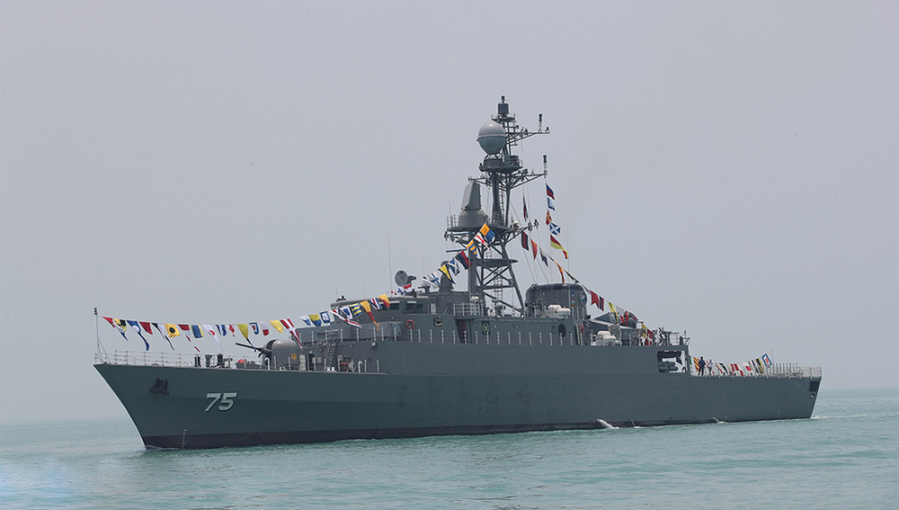
An Iranian warship IRIS Dena was sunk by a US submarine near Sri Lanka on March 4 2026. The attack was carried out by an unnamed hunter killer submarine of the US Navy prowling the Indian Ocean and operating very close to both Sri Lanka and India.
According to a later press briefing by the US Department of War the ship was sunk in international waters using a Mk48 torpedo and marks the first such attack by a US subsurface combatant against a capital ship since the second world war.
The IRIS Dena was a Moudge-class frigate in Iran's regular navy fleet and was in the region after participating in the Indian Navy organised International Fleet Review between February 15-25 2026.
The frigate was sailing back from the event when the US and Israel launched combat operations against Iran on February 28 2026.
According to a report by Reuters, the Sri Lanka Navy has confirmed that it rescued 79 crew members of the crew and gave them medical assistance. However over 100 crew members were unaccounted for.
The sinking of the IRIS Dena was outside India’s territorial waters as well as Exclusive Economic Zone(EEZ), - the reason the Indian Navy was not the first responder. Social Media commentary by Indian users lamented that the war against Iran has now expanded from the Persian Gulf into the Indian Ocean which is roughly the area where India is projected as a net security provider.
However, as under international law India only has security jurisdiction in its own territorial waters as well as some limited influence in transit and use of resources in the EEZ it is unreasonable to expect that the attack could be deterred or intervened in by the Indian Navy.
As such, the vast and technical maritime domain awareness challenges aside, the Indian Navy which falls under the direction of India’s civilian political leadership has not received any orders to take sides in the conflict.
While India is anticipating a disruption in its energy challenges due to the combat operations in the Persian Gulf leading to the closing of the Straits of Hormuz, it has not confirmed if its Navy will escort any oil tankers and other hydrocarbon shipments from the region towards its shores.
India is instead likely to raise its purchases of Russian crude oil and other fuels as required till the crisis in the Middle East ends. While the US administration has previously warned India that it will be slapped with punitive tariffs if it resumes purchases of Russian oil, short term purchases under the fog of war may still happen.
Furthermore, the loss of capital naval ships in the conflict zone may be costlier to India both politically and in terms of reputation than the economic cost of bearing high US tariffs in the short term.

No comments:
Post a Comment