RAGOZIN: The unholy alliance between Ukraine’s far right and the Western defence industry
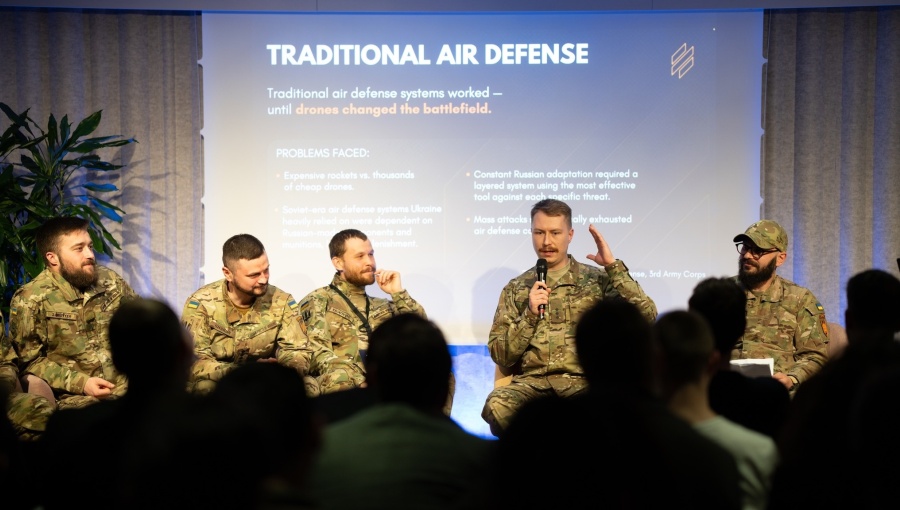
A look at Ukrainian units dealing with cutting-edge unmanned technology reveals an unholy alliance between far-right extremism and the Western defence industry. It came into the limelight during the latest Munich Security Conference, the world’s most prestigious gathering of global security practitioners and military industry bosses.
Here is the backstory. At the end of May 2017, a group of far-right activists stormed Lviv region’s legislature and briefly detained its deputies inside the occupied building. They demanded amnesty for the veterans of the Russo-Ukrainian war who had been jailed for violent crimes inside and outside the war zone.
Only one of the attackers was charged at the end of the day — Mykola “Makar” Zynkevich of the National Corps, the political wing of the Azov Movement, as its members themselves call their vast network of large military units and paramilitary groups.
Fast-forward seven years and the battle-hardened commander Zynkevich appears at a large event organised on the sides of the Munich Security Conference. Zynkevich's unit deals with cutting edge war technology, namely terrestrial robotic systems which aid — and may one day replace — soldiers on the battlefield.
The unit is called NC13, in which NC likely stands for Zynkevich’s political alma mater, National Corps. Number 13 is defined by the Anti-Defamation League as a white supremacist symbol Aryan Circle (A being the first and C being the third letter in the alphabet).
NC13 is part of the 3rd Detached Assault Brigade which currently makes up the core of Ukrainian army’s 3rd Corps. The brigade was founded by the political leadership of Azov Movement, which grew out of Patriot of Ukraine, a white supremacist group at the core of Azov battalion formed in 2014. Its leader, Andriy Biletsky, is now 3rd Corps commander and gets regularly listed among presidential hopefuls in the polls.
The event on the sides of the Munich conference was organised by Snake Island Institute, a Ukrainian think-tank set up by Vladyslav Sobolevsky, formerly the chief of staff at Azov Regiment and deputy chief of staff at the National Corps, the political party.
War beneficiaries
Back in his days as National Corps official, Sobolevsky helped to organise various protests aimed at disrupting the Paris agreements between presidents Volodymyr Zelenskiy and Vladimir Putin that led to a near-full ceasefire throughout 2020 and 2021. These protests were a part of the “No to Capitulation” campaign, announced by Azov Movement leader Andriy Biletsky in October 2019 in response to Ukraine and Russia agreeing upon the Steinmeier formula — an algorithm for the implementation of Minsk agreements proposed by German President Frank-Walter Steinmeier.
On March 12, 2020 Sobolevsky led National Corps activists who violently attacked Zelenskiy’s ally and Security Council deputy head, Serhiy Syvokho, when he attempted to present a pro-peace political platform. Two days later, Sobolevsky led a march of Azov veterans to the Russian embassy. The participants tore up a Russian flag and shot at the embassy from flare pistols in a show which helped to convince the Kremlin that Zelenskiy is helpless against far-right thugs and hence of little value as a negotiator.
The campaign against “capitulation” has succeeded in swaying Zelenskiy who effectively rejected peace on conditions that look infinitely better than what Ukraine can hope for now, after four years of Russia’s brutal all-out invasion. Under the Minsk agreements, Ukraine would have retained full sovereignty over most of its Donbas region as well as formal sovereignty over the smaller part, then de-facto controlled by Russia.
Zelenskiy made a U-turn on relations with Putin at the beginning of 2021 (it coincided with Joe Biden moving into the White House). He embarked on crossing Putin’s key red lines, clamping down on his previously untouchable Ukrainian ally Viktor Medvedchuk and launching a loud campaign to join Nato. Putin responded by starting to deploy troops on the Ukrainian border in March that year.
Despite the president succumbing to the pressure, relations between the Azov Movement and Zelensky’s administration remained tense during the buildup to the all-out invasion in 2021. That year, Sobolevsky led protests against Ukraine’s Security Service arresting a large group of Azov Movement activists in Kharkiv on charges of racketeering and extortion — a pointed attack at the movement’s fledgling business empire. The arrested activists were released at the start of the all-out invasion and went on to form the Kraken special unit under the auspices of Ukraine’s military intelligence (the HUR).
When the 3rd Detached Assault Brigade was reorganised into 3rd Corps in 2025, Kraken joined the corps. Its commanders — one of whom, Serhiy Velychko previously languished in prison in the SBU crackdown — were put in charge of the corps’ drone unit. Another Kraken commander set a drone pilot school called Killhouse Academy which ran a live FPV drone simulator show at the Munich conference event, with no one voicing objections to the propaganda of murder in its very name.
The war in Ukraine allowed people from the far-right fringe jump on a social lift they could have never dreamed about, which makes them key beneficiaries of this conflict — along with Putin’s regime in Russia — and explains their interest in this war running for as long as possible, at best forever.
With Gopniks on board
Times have changed in a big way since 2011, when the BBC Panorama exposed neo-nazi ultras from Metallist Kharkiv accused of violence against people of colour at football matches. At the end of the programme, famous British player Rio Ferdinand called for the boycott of Euro-2012 held in Ukraine. These days, people from this very milieu are warmly welcome at major international events platforms, like the Munich conference.
Coopting far-right extremists and football ultras as a potent street force that could either protect a political regime or help overthrow it is an old political technology. One may recall Arkan’s Tigers, a Serbian paramilitary group that threatened ethnic cleansing in Kosovo back in the 1990s. It was at least partly comprised of the Grobari (Gravediggers), the fans of Partisan Belgrade.
Putin’s regime has been eager to engage both football fans and neo-nazi thugs since the early 2000s — just look at his administration’s dealings with BORN, a neo-nazi group responsible for assassinations of migrants and antifa activists. However many of these former Kremlin allies and FSB volunteer helpers, including people related to BORN, ended up in Ukraine in the heady days of the Maidan revolution. They deemed Ukraine to be closer to their far-right political ideals, while Putin launched a purge of the far right in Russia exactly because of their role in the Maidan revolution.
In social terms, secret services and presidential office operatives engaging with the far right are tapping into the social strata typically described in post-Soviet space as “gopniki”, the nearest English-language equivalent being chavs — low-class young men prone to gang-like behaviour and criminal culture.
A predominantly Russian-speaking city, Kharkiv has its own word for gopniki — syavy. Two opposite paramilitary camps emerged in that city from this social strata — Patriot of Ukraine which grew into Azov movement and Oplot, a pro-Russian group that was instrumental in staging coup attempts in various Ukrainian regions in the spring of 2014. In a pattern characteristic of both Ukraine and Russia, both groups emerged at the conjunction of secret services, organised crime and far right activism.
People like Kraken founder Velychko (he coined the famous ‘Putin khuylo’ or ‘Putin is a dick’ chant when he was a leader of Metallist Kharkiv ultras), couldn’t possibly imagine that he would command a large, Nato-equipped military unit and the Western military-industrial complex would be keen to tap into his unit’s experience.
At the Munich conference, the Snake Island Institute event was opened by former CIA chief David Petraeus. Among the event’s partners, the institute listed Alta Ares which describes itself as “a leading Nato-backed project to reshape the defence of Europe’s eastern flank”, deals with AI-powered drones and takes part in Nato drills. Danish anti-drone equipment manufacturer MyDefence and Rasmussen Global, the PR agency run by former Nato secretary-general Andres Fogh Rasmussen, were on the same list.
The war in Ukraine saw many former far-right activists turn into operators of unmanned fighting systems, primarily drones. Some of these are absolutely open about their political leanings — a fact which the Ukrainian government and its Western funders seem to be entirely okay with. For example, the 422nd drone regiment of the Ukrainian armed forces is called Luftwaffe and displays the Prussian/Nazi Iron Cross symbol on its logo.
Snake Island Institute people are also not the only ones who get hosted by major Western expert platforms like Munich conference. Take Yevhen Karas, the founder of C14 group which has “Fourteen Words” (a neo-nazi slogan) in its name and whose members were accused of conducting political assassinations after the Maidan revolution, including that of the journalist Oles Buzyna. Now a drone regiment commander, Karas was hosted by Chatham House, a leading British think-tank, last November.
Members of the pro-Ukrainian commentariat tend to dismiss the very existence of a nazi problem in Ukraine, even as Kyiv landmark WWII Museum is currently hosting an exhibition dedicated to Russian Volunteer Corps, a far-right unit fighting on Ukraine’s side which draws inspiration from Hitler’s Russian allies of Gen. Vlasov’s Russian Liberation Army and uses the fascist Spayka symbol as its logo. The curator of the exhibition, Aleksey Lyovkin, is a frontman of M8L8TH (Hitler’s Hammer), in which 88 is a neo-nazi slogan which stands for Heil Hitler.
But none of that seems to bother the members of Western security establishment when people from this milieu appear at their prestigious event in Munich, a century after the Beer Hall Putch.
UKRAINIAN NATIONALIST ARMY OUN–UPA AND THE NAZI GENOCIDE
Portugal sells twice as many drones to Ukraine than it ever did to Russia
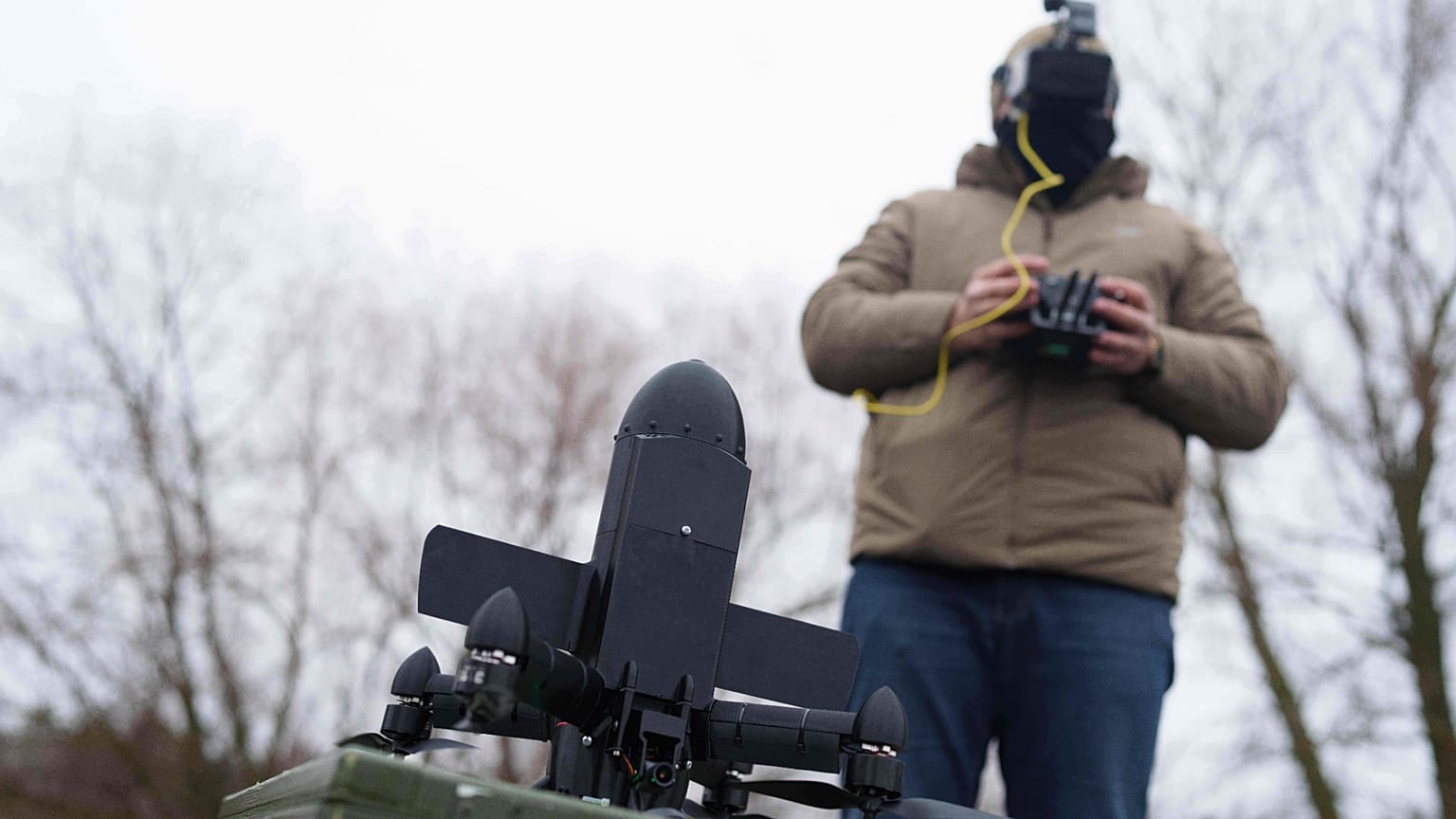
From €4 million in 2022, the year the war began, revenues have soared to €87.3 million in 2025. Portuguese exports to Ukraine, five to ten times lower before the conflict, now represent double the sales to Russia.
Portugal's drone exports to Ukraine have risen sharply since the start of the full-scale invasion of the country by Russia. Portugal is now selling more drones to Ukraine than it ever sold to Russia — and the gap is widening fast.
According to Jornal Económico, revenues from drone sales to Ukraine totalled €4 million in 2022, the year the conflict broke out, rising to €23 million in 2023 and €33 million in 2024.
Growth accelerated sharply in 2025, with revenues reaching €87.3 million. The largest Portuguese drone exporter to Ukraine is Tekever, a company based in Caldas da Rainha.
The surge has reshaped Portugal's broader trade relationships.
Ukraine climbed from 75th to 36th in the ranking of Portugal's export destinations between 2019 and 2025, while Russia fell from 34th to 50th over the same period — a decline surpassed among the top 100 destinations only by Cuba, which dropped 20 places, and Syria, which fell 19.
Before the war, Portuguese exports to Ukraine were five to ten times lower than sales to Russia.
By 2023 and 2024 that gap had narrowed to around 10%, and by 2025 Ukrainian purchases had pulled ahead to double those to Russia.
Overall, Ukrainian purchases from Portugal have jumped 110%, making Ukraine one of very few countries in the top 100 export destinations to record double- or triple-digit growth.
The trend may be further boosted by a deal signed in December between Portugal and Ukraine for the joint production of underwater drones.

No comments:
Post a Comment