Showing posts sorted by relevance for query XMAS SONGS. Sort by date Show all posts

Thursday, January 16, 2020


Baby its cold outside beautifully sung by Johnny Mercer and Margaret Whiting. Contrary to the mass of information and downloadable music displayed on the internet, which is all totally incorrect!! This video portrays the true artists who both sang and recorded this song. Yes it is John Mercer and Margaret Whiting and NOT Doris Day and Bing Crosby. After extensive research this is 100% confirmed and the information, LP and origonal song sheet have been picture copied and included in this video.. Please link to this video if possible and let the world know who the true artists are, for this very famous song.
  • Category

  • Song

  • Artist

    • Johnny Mercer, Margaret Whiting
  • Album

    • All the Best Family Christmas Songs and Carols (100 Classic Original Xmas Hits)
  • Writers

    • Frank Loesser
  • Licensed to YouTube by

    • UMG (on behalf of Backtracks Records); ASCAP, AMRA, LatinAutor, Kobalt Music Publishing, PEDL, CMRRA, and 9 Music Rights Societies

Tuesday, November 26, 2024

 AMERIKA


Political Riptides Threaten to Overwhelm the

Nation


Divide and Conquer


We must always take sides. Neutrality helps the oppressor, never the victim. Silence encourages the tormentor, never the tormented. Sometimes we must interfere. When human lives are endangered, when human dignity is in jeopardy, national borders and sensitivities become irrelevant. Wherever men or women are persecuted because of their race, religion, or political views, that place must–at that moment–become the center of the universe.

—Elie Wiesel, Nobel Peace Prize Speech
Once again we find ourselves approaching that time of year when, as George Washington and Abraham Lincoln proclaimed, we’re supposed to give thanks as a nation and as individuals for our safety and our freedoms.

But how do you give thanks for freedoms that are constantly being eroded?

How do you express gratitude for one’s safety when the perils posed by the American police state grow more treacherous by the day?

How do you come together as a nation in thanksgiving when the powers-that-be continue to polarize and divide us into warring factions?

You can see this struggle—to reconcile the hope for a better, freer, more just world with the soul-sucking reality of a world in which greed, meanness and war continue to triumph—in John Lennon’s two songs, “Imagine” (which exhorted us to “Imagine all the people livin’ life in peace”) and “Happy Xmas (War Is Over)” (which was part of a major anti-war campaign, which were released within months of each other in 1971.

Lennon—a musical genius, anti-war activist, and a high-profile example of the lengths to which the Deep State will go to persecute those who dare to challenge its authority—made clear that the only way to achieve an end to hunger, violence, war, and tyranny is to want it badly enough and work towards it.

All these years later, we still don’t seem to want those things badly enough.

Peace remains out of reach. Activists and whistleblowers continue to be prosecuted for challenging the government’s authority. Militarism is on the rise, all the while the governmental war machine continues to wreak havoc on innocent lives.

For those of us who joined with Lennon to imagine a world of peace, it’s getting harder to reconcile that dream with the reality of the American police state.

Those who do dare to speak up about government corruption are labeled dissidents, troublemakers, terrorists, lunatics, or mentally ill and tagged for surveillance, censorship or involuntary detention.

And then there are those who remain silent while the world falls apart.

By doing nothing, the onlookers become as guilty as the perpetrator.

It works the same whether you’re talking about kids watching bullies torment a fellow student on a playground, passersby watching someone dying on a sidewalk, or citizens remaining silent in the face of government atrocities.

There’s a term for this phenomenon where people stand by, watch and do nothing—even when there is no risk to their safety—while some horrific act takes place: it’s called the bystander effect.

Historically, this bystander syndrome in which people remain silent and disengaged—mere onlookers—in the face of abject horrors and injustice has resulted in whole populations being conditioned to tolerate unspoken cruelty toward their fellow human beings: the crucifixion and slaughter of innocents by the Romans, the torture of the Inquisition, the atrocities of the Nazis, the butchery of the Fascists, the bloodshed by the Communists, and the cold-blooded war machines run by the military industrial complex.

Psychological researchers John Darley and Bibb Latane mounted a series of experiments to discover why people respond with apathy or indifference instead of intervening.

According to Darley and Latane, there are two critical factors that contribute to this moral lassitude. First, there’s the problem of pluralistic ignorance in which individuals in a group look to others to determine how to respond. Second, there’s the problem of “diffusion of responsibility,” which is compounded by pluralistic ignorance. Basically, this means that no one acts to intervene or help because each person is waiting for someone else to do so.

Their findings underscore the fact that evil prevails when good people do nothing.

We see it all the time: when people are vocal about politics but silent in the face of human suffering and injustice, tyranny triumphs.

For instance, psychologist Philip Zimbardo’s Stanford Prison Experiment studied the impact of perceived power and authority on middleclass students who were assigned to act as prisoners and prison guards. The experiment revealed that power does indeed corrupt (the appointed guards became increasingly abusive), and those who were relegated to being prisoners acted increasingly “submissive and depersonalized, taking the abuse and saying little in protest.”

This is how imperial presidents preside over police states.

So, what can we do? Be modern-day Good Samaritans and do your part to push back against the darkness. Recognize injustice. Don’t turn away from suffering. Refuse to remain silent. Take a stand. Speak up. Speak out.

“If you think there is even a possibility that someone needs help, act on it,” advises Zimbardo.  “You may save a life. You are the modern version of the Good Samaritan that makes the world a better place for all of us.”

This is what Zimbardo refers to as “the power of one.” All it takes is one person breaking away from the fold to change the dynamics of a situation.

Here’s what I suggest: this holiday season, do yourselves a favor and turn off the talking heads, shut down the screen devices, tune out the politicians, take a deep breath, then do something to pay your blessings forward.

Find something to be thankful for about the things and people in your community for which you might have the least tolerance or appreciation. Instead of just rattling off a list of things you’re thankful for that sound good, dig a little deeper and acknowledge the good in those you may have underappreciated or feared.

When it comes time to giving thanks for your good fortune, put your gratitude into action: pay your blessings forward with deeds that spread a little kindness, lighten someone’s burden, and brighten some dark corner.

Engage in acts of kindness. Smile more. Fight less. Build bridges. Refuse to let toxic politics define your relationships. Focus on the things that unite instead of that which divides.

Do your part to push back against the meanness of our culture with conscious compassion and humanity. Moods are contagious, the good and the bad. They can be passed from person to person. So can the actions associated with those moods, the good and the bad.

Acts of benevolence, no matter how inconsequential they might seem, can spark a movement.

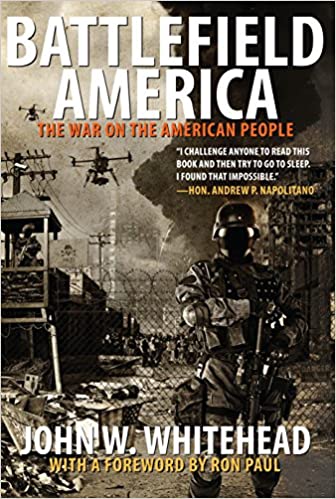
As I make clear in my book Battlefield America: The War on the American People and in its fictional counterpart The Erik Blair Diaries, all it takes is one person to start a chain reaction.

For instance, a few years ago in Florida, a family of six—four adults and two young boys—were swept out to sea by a powerful rip current in Panama City Beach. There was no lifeguard on duty. The police were standing by, waiting for a rescue boat. And the few people who had tried to help ended up stranded, as well.

Those on shore grouped together and formed a human chain. What started with five volunteers grew to 15, then 80 people, some of whom couldn’t swim.

One by one, they linked hands and stretched as far as their chain would go. The strongest of the volunteers swam out beyond the chain and began passing the stranded victims of the rip current down the chain.

One by one, they rescued those in trouble and pulled each other in.

There’s a moral here for what needs to happen in this country if we only can band together and prevail against the riptides that threaten to overwhelm us.FacebookTwitter

John W. Whitehead, constitutional attorney and author, is founder and president of The Rutherford Institute. He wrote the book Battlefield America: The War on the American People (SelectBooks, 2015). He can be contacted at johnw@rutherford.orgNisha Whitehead is the Executive Director of The Rutherford Institute. Read other articles by John W. Whitehead and Nisha Whitehead.

Monday, December 25, 2023

The Christmas Truce of 1914: the day the guns fell silent


Published December 25, 2023

NPR
ARI SHAPIRO, HOST:

In the months after World War I erupted, young men in Europe were killing each other by the tens of thousands. Yet on a frozen Christmas Eve in 1914, the guns briefly fell silent. The Christmas truce has become the stuff of legend, and the story of that poignant day has been told again and again in film, in music, onstage. For the 100th anniversary of the truce in 2014, the British supermarket chain Sainsbury's created this Christmas ad.

(SOUNDBITE OF BOMB EXPLODING)

SHAPIRO: The ad begins on Christmas Eve on a snowy night in a dark, damp trench on the British side of the front. Mail has just arrived.

(SOUNDBITE OF ARCHIVED RECORDING)

UNIDENTIFIED ACTOR #1: (As character) Jenkins, Oakley, Knight.

SHAPIRO: Letters from home, pictures of sweethearts, a thick chocolate bar in blue wrapping. And then from far away comes the sound of German voices singing.

(SOUNDBITE OF ARCHIVED RECORDING)

UNIDENTIFIED ACTORS: (As characters, singing in German).

SHAPIRO: The British join in.

(SOUNDBITE OF ARCHIVED RECORDING)

UNIDENTIFIED ACTORS: (As characters, singing) All is calm. All is bright.

SHAPIRO: "All Is Calm" is an opera by Peter Rothstein based on the truce. The German and British soldiers face each other as they sing "Silent Night" before eventually turning to face the audience as one.

(SOUNDBITE OF ARCHIVED RECORDING)

UNIDENTIFIED ACTORS: (As characters, singing) Sleep in heavenly peace.

SHAPIRO: That song, "Silent Night," has become inextricably linked with the tellings of the truce over the years, so has the striking visual of the first soldier to slowly venture out into no man's land, as John McCutcheon describes here in his 1984 song "Christmas In The Trenches."

(SOUNDBITE OF SONG, "CHRISTMAS IN THE TRENCHES")

JOHN MCCUTCHEON: (Singing) There's someone coming towards us, the front line sentry cried. All sights were fixed on one lone figure trudging from their side. His truce flag, like a Christmas star, shone on that plain so bright as he bravely strode, unarmed, into the night.

SHAPIRO: In the 2005 film "Joyeux Noel," the leaders of each side meet in no man's land.

(SOUNDBITE OF FILM, "JOYEUX NOEL")

ALEX FERNS: (As Gordon) Do you speak English?

UNIDENTIFIED ACTOR #2: (As character) Yes, a little.

FERNS: (As Gordon) Wonderful. We were talking about a cease-fire for Christmas Eve. What do you think? The outcome of this war won't be decided tonight.

SHAPIRO: Slowly, hesitantly, the field between the trenches fills with soldiers.

(SOUNDBITE OF FOOTSTEPS RUSTLING)

SHAPIRO: And then once every soldier recognizes his own fear and relief reflected in the faces that stare back at him, the festivities begin. Soldiers shake hands, introduce themselves, offer cigarettes and bottles to each other.

(SOUNDBITE OF FILM, "JOYEUX NOEL")

UNIDENTIFIED ACTOR #3: (As character) Aye, that's good stuff, Jerry (ph).

UNIDENTIFIED ACTOR #4: (As Jerry) Aye, thank you very much.

SHAPIRO: Even in the 1969 musical satire of World War I, "Oh! What A Lovely War," the truce is depicted with reverence, though they do get a few jokes in.

(SOUNDBITE OF FILM, "OH! WHAT A LOVELY WAR")

UNIDENTIFIED ACTOR #5: (As character) Do you know when the war will end?

UNIDENTIFIED ACTOR #6: (As character) After our spring offensive, I should think.

SHAPIRO: In the music video for his 1983 single "Pipes Of Peace," Paul McCartney played both a German and British soldier who exchange photos of their loved ones in no man's land.

(SOUNDBITE OF SONG, "PIPES OF PEACE")

PAUL MCCARTNEY: (Singing) Let us show them how to play the pipes of peace, play the pipes of peace.

SHAPIRO: But each reimagining ends the same way, war continues.

(SOUNDBITE OF BOMBS EXPLODING)

SHAPIRO: Distant blasts or gunfire brings the inescapable reality back into the impossible moment of peace, sending the men scrambling back to their trenches.

(SOUNDBITE OF SONG, "CHRISTMAS IN THE TRENCHES")

MCCUTCHEON: (Singing) Soon, daylight stole upon us and France was France once more. With sad farewells, we each began to settle back to war. But the question haunted every heart that lived that wondrous night, whose family have I fixed within my sights?

SHAPIRO: In the Sainsbury's ad, a German soldier settles back into the trenches and looks in his pocket to find a chocolate bar wrapped in blue. As wars continue today in Ukraine and Gaza, the idea of a Christmas truce feels as meaningful as ever. Nine years ago, on the 100th anniversary of the truce, I set out to reconstruct the events of that day using the accounts of the people who were there. Here's that story I reported on Christmas Day, 2014.

(SOUNDBITE OF ARCHIVED NPR BROADCAST)

SHAPIRO: Of course, there are no longer any living veterans of World War I to tell this story, but we still have their words in letters and diaries. In some cases, we even have their voices.

(SOUNDBITE OF ARCHIVED RECORDING)

WALTER STENNES: On Christmas Eve, at noon, fire ceased completely on both fronts.

SHAPIRO: These are oral histories that Britain's Imperial War Museum recorded years ago. That was German Army officer Walter Stennes. Here's British soldier Colin Wilson. We've added more recent recordings of the music.

(SOUNDBITE OF ARCHIVED RECORDING)

COLIN WILSON: We heard a German singing every night, of course, in German, naturally.

(SOUNDBITE OF SONG, "SILENT NIGHT")

CHANTICLEER: (Singing in German).

(SOUNDBITE OF ARCHIVED RECORDING)

WILSON: There was all sorts of Christmas greetings being shouted across no man's land to us. These Germans, they shouted out, what about you singing "Holy Night"? Well, we had a go. But of course, we weren't very good at that.

(SOUNDBITE OF SONG, "SILENT NIGHT")

CHANTICLEER: (Singing in German).

SHAPIRO: There's not one single story of the Christmas truce. There are thousands of stories from all up and down the Western Front.

WILLIAM SPENCER: It was all done independently.

SHAPIRO: William Spencer is a military specialist at the British National Archives.

SPENCER: It was little bits and pieces dotted. It wasn't a blanket decision made - right? - we will all get out of our trenches and fraternize with the enemy.

SHAPIRO: In the weeks leading up to Christmas, life was miserable on the front lines. The weather was wet and frigid. The trenches were basically large ditches collapsing and filling with water. Alan Wakefield is a historian at the Imperial War Museum.

ALAN WAKEFIELD: So they do small-scale truces where they actually get out of the trenches and do repair work within sight of each other. Nobody's firing at each other because they're both just trying to make life a bit more bearable. This is the first chance, really, that you're getting to see the enemy because normally, you know, trench war, you're under the ground.

SHAPIRO: So that was mid-December, then Christmas arrives.

(SOUNDBITE OF SONG, "WHILE SHEPHERDS WATCHED")

THE KING'S SINGERS: (Singing) While shepherds watched their flocks by night, all seated on the ground.

SHAPIRO: We've asked our colleagues to read some of the letters and diary entries describing what happened next. A soldier named Ernest Morley writes home, saying his men decided to give the Germans a gift on Christmas Eve, three songs, then five rounds of rapid gunfire. They started with the carol "While Shepherds Watched."

(SOUNDBITE OF SONG, "WHILE SHEPHERDS WATCHED")

THE KING'S SINGERS: (Singing) Good will henceforth from heaven to men begin and never cease.

UNIDENTIFIED PERSON #1: (Reading) We finished that and paused, preparing to give them the second item on the program. We heard answering strains arising from their lines, then they started shouting across to us. Therefore, we stopped any hostile operations and commenced to shout back. One of them shouted, a merry Christmas, English, we are not shooting tonight.

SHAPIRO: Germans lit lanterns and put them up above the trench. Rifleman Morley says the British tried to outdo them.

UNIDENTIFIED PERSON #1: (Reading) Opposite me, they had one lamp and nine candles in a row. And we had all the candles and lights we could muster stuck up on our bayonets above the parapet.

SHAPIRO: On Christmas Day, the sun rises and all is calm. Lieutenant M.S. Richardson writes a letter to his family where he describes German soldiers cautiously emerging from the trenches.

UNIDENTIFIED PERSON #2: (Reading) The situation was so absurd that another officer of ours and myself went out and met seven of their officers.

SHAPIRO: They exchanged gifts in the area between the trenches called no man's land.

UNIDENTIFIED PERSON #2: (Reading) One of them presented me with the packet of cigarettes I sent you, and we gave them a plum pudding. And then we shook hands with them and saluted each other.

SHAPIRO: Some of the soldiers used the day to bury their dead. Second Lieutenant Wilber Spencer watched many of his men fall a week earlier. On Christmas Day, he writes, it was strange to shake hands with the German soldiers who killed his friends.

UNIDENTIFIED PERSON #3: (Reading) They carried over our dead. I won't describe the sights I saw and which I shall never forget. We buried the dead as they were.

SHAPIRO: Wilber took a photograph that day. At the Imperial War Museum, Historian Wakefield shows me the black-and-white image.

WAKEFIELD: The photograph here shows four British soldiers in the foreground beside a grave, a recently dug grave, and a mixed group of German and British in the background actually digging fresh graves for other casualties.

SHAPIRO: The earth is flat and bare with a huge blank sky. A small white cross sticks out of the ground. Whenever the truce is portrayed in songs and plays, there is always a soccer match. So I asked historians to show me accounts of the game.

SPENCER: We don't have any documentary evidence of that.

SHAPIRO: This is Spencer from the National Archives.

SPENCER: There's nothing recorded in the unit war diaries which say a football match took place between this battalion and this particular German infantry regiment.

SHAPIRO: I thought maybe it was just a gap in his collection, so I asked Wakefield at the Imperial War Museum, who has written a book on the subject called "Christmas In The Trenches." He said it's contentious, but ultimately...

WAKEFIELD: The idea of any organized football game is not - doesn't stand up in the documentation.

SHAPIRO: About 30,000 British soldiers were involved in the truce. Wakefield says maybe a hundred played organized soccer games against the Germans. In some places, the two sides held prayer services together. They exchanged mementos, like a small brass button that Wakefield shows me at the museum.

WAKEFIELD: He obviously took that button off his tunic to give it to the British soldier. And he's - the German soldier has put his name and his hometown, which is in Saxony.

SHAPIRO: For war historians, bloodshed is a daily memory. So I asked Spencer how he relates to this one moment of peace.

SPENCER: This is the human side of people in a dehumanizing environment.

SHAPIRO: He says when commanders learned about the truce, they were furious.

SPENCER: Various orders were sent down straight after Christmas in 1914 and were heavily reinforced in December 1915 for this particular occurrence not to happen again.

SHAPIRO: Germans were warned that if they staged another truce, they would be shot. British soldiers were threatened with court martial. But many of the men who took part in the Christmas truce refused to fire on their opponents again until the day other soldiers came to take their place.

(SOUNDBITE OF SONG, "SILENT NIGHT")

CHANTICLEER: (Singing in German).

SHAPIRO: That's a story I reported as a London correspondent in 2014 on the 100th anniversary of the Christmas truce. Transcript provided by NPR, Copyright NPR.

NPR transcripts are created on a rush deadline by an NPR contractor. This text may not be in its final form and may be updated or revised in the future. Accuracy and availability may vary. The authoritative record of NPR’s programming is the audio record.


SEE


Sunday, December 17, 2006

Rebel Jesus


This is one of my favorite Christmas Songs. Cause I am a heathen pagan. Originally recorded by the Chieftans, this MP3 is a very nice version. The song was orignally written by Jackson Browne.

And this is the Rebel Jesus that Hugo Chavez worships when he exocrises the Devil Bush.

A hat tip to Catholicanarchy.He did a great job with the song. This is his second free online cd. Check it out. He is another Canadian Anarchist blogger.

I also like his version of John Lennons Merry Xmas, War is Over. Especially the really discordian choir in the background at the end.

Oh and I found a link on his page to another Canadian Christian Anarchist blog.


Them christian anarchists gotta love em, even if we disagree.

See

Tolstoy

Anarchism


Anarchist

Libertarian

Libertarian Socialism


Libertarian Communism

Mutualism


Find blog posts, photos, events and more off-site about:
, ,, , , , , , , , , , , , , ,

Tags
/ // / / / / / / / / /