SPACE\COSMOS
Chang'e-6 samples reveal first evidence of impact-formed hematite and maghemite on the Moon
image:
Graphical depiction of the formation scenario of ferric oxides in Chang'e-6 lunar sample.
view moreCredit: Image by IGCAS
A joint research team from the Institute of Geochemistry of the Chinese Academy of Sciences (IGCAS) and Shandong University has for the first time identified crystalline hematite (α-Fe2O3) and maghemite (γ-Fe2O3) formed by a major impact event in lunar soil samples retrieved by China's Chang'e-6 mission from the South Pole–Aitken (SPA) Basin. This finding, published in Science Advances on November 14, provides direct sample-based evidence of highly oxidized materials on the lunar surface.
Redox reactions are a fundamental component of planetary formation and evolution. Nevertheless, scientific studies have shown that neither the oxygen fugacity of the lunar interior nor the lunar surface environment favors oxidation. Consistent with this, multivalent iron on the Moon primarily exists in its ferrous (Fe2+) and metallic (Fe0) states, suggesting an overall reduced state. However, with further lunar exploration, recent orbital remote sensing studies using visible-near-infrared spectroscopy have suggested the widespread presence of hematite in the Moon's high-latitude regions.
Furthermore, earlier research on Chang'e-5 samples first revealed impact-generated sub-micron magnetite (Fe3O4) and evidence of Fe3+ in impact glasses. These results indicate that localized oxidizing environments on the Moon existed during lunar surface modification processes driven by external impacts. Despite this research progress, though, conclusive mineralogical evidence for strongly oxidizing minerals like hematite on the Moon had remained elusive. Additionally, the extent of oxidation processes and the prevalence of characteristic oxidized minerals on the lunar surface have long been topics of intense debate.
The SPA Basin, one of the largest and oldest impact basins in the Solar System, with extremely complex impact scales and frequencies, offers an ideal natural laboratory for studying oxidation reactions on the lunar surface. The successful return of soil samples from the SPA Basin by the 2024 Chang'e-6 mission offered an opportunity to search for highly oxidized substances formed during major impact events. The research team identified micron-sized hematite grains in the Chang'e-6 lunar soil for the first time. Through a combination of micro-area electron microscopy, electron energy loss spectroscopy, and Raman spectroscopy, they confirmed the crystal structure and unique occurrence characteristics of these hematite particles, verifying that the minerals are primary lunar components rather than terrestrial contaminants.
The study proposes that hematite formation is closely linked to major impact events in lunar history. The extreme temperatures generated by large impacts would have vaporized surface materials, creating a transient high-oxygen-fugacity vapor-phase environment. At the same time, this process would have caused desulfurization of troilite; the released iron ions were then oxidized in the high-fugacity environment and underwent vapor-phase deposition, forming micron-sized crystalline hematite. This hematite coexists with magnetic magnetite and maghemite.
Notably, the origin of widespread magnetic anomalies on the lunar surface, including those in the northwestern SPA Basin, remains poorly explained. Given the close correlation between oxidation processes and the formation of magnetic carrier minerals, this study provides key sample-based evidence to clarify the carriers and evolutionary history of these lunar magnetic anomalies.
This research challenges the long-held belief that the lunar surface is entirely reduced. It also offers crucial clues for deciphering the evolution of lunar magnetic anomalies and the mechanisms underlying large impact events, thereby advancing our understanding of lunar evolution.
Journal
Science Advances
By AFP
November 13, 2025

Vast can put an astronaut into space for less than $100 million, says company advisor former NASA astronaut Andrew Feustel - Copyright AFP PATRICIA DE MELO MOREIRA
Daxia ROJAS
With NASA’s International Space Station set to come out of service in 2030, American aerospace firm Vast has stepped into a frenzied race for the world’s first commercial space station.
Haven-1 — a mini station scheduled for launch in May 2026 — has been designed for comfort, according to Andrew Feustel, a former NASA astronaut now an advisor at Vast.
“It has a three-year lifespan, and over that period of time, we plan to visit the spacecraft with multiple crews of four, four at a time,” he told AFP on the sidelines of the Web Summit in Lisbon.
The California-based firm, founded in 2021 by billionaire Jed McCaleb, aspires to replace the International Space Station with Haven-2, a larger version of the first model.
But Vast faces fierce competition from other contenders, including Axiom Space, Voyager Space in partnership with Airbus, and Amazon founder Jeff Bezos’s Blue Origin.
Hopes rest on securing funding from a NASA budget of up to $1.5 billion for the development of commercial space stations, which is set to be awarded in April 2026.
– ‘Aggressive timelines’ –
“Space agencies no longer want to manage the infrastructure” of the ISS, said Ugo Bonnet, director of the Spaceflight Institute, which offers training for commercial human missions.
Locked in competition with China, NASA wants to focus more on crewed mission projects to the Moon by the end of the decade and eventually build a base on the lunar surface.
In replacing the ISS, NASA plans to purchase services rather than manage programmes itself — a real boon for private companies in the space market.
“There are a lot of players that are coming with very aggressive timelines, and we cannot do things in the same way we did in the past”, said Roberto Angelini, director of the Exploration and Science Domain of Thales Alenia Space.
The French-Italian joint venture is set to deliver the first two pressurised modules for Axiom’s planned commercial space station, which could be operational as early as 2028.
It has also manufactured half the pressurised modules for the ISS. The company’s main challenge, however, is to “remain competitive in terms of prices”, according to Angelini.
– Changing business models –
NASA spends up to $4 billion a year on the ISS, roughly a third of the US agency’s annual human space flight budget.
SpaceX’s reusable launch vehicles has revolutionised the sector, lowering transportation costs and paving the way for these private projects.
Vast plans to send Haven-1 into space on a SpaceX Falcon 9 rocket, while Axiom’s private mission will see astronauts aboard one of their Crew Dragon capsules.
“Just 15 to 20 years ago, sending a kilogram into space cost $60,000,” Bonnet told AFP. “When Starship, SpaceX’s launcher becomes operational in 2030, the cost will be less than $200 per kilogram,” he added.
But operating a commercial space station will still cost a hefty sum.
“I’m not sure about their long-term profitability,” said Beatrice Hainaut, a space policy researcher at the Institute for Strategic Research at the Military School.
Companies are counting on increased demand from governments and the private sector to generate revenue.
Vast predicts that 85 percent of its crewed mission revenues will come from state agencies, and 15 percent from private clients.
Feustel said the company wanted to be a “service provider to not only the US government”, but all countries seeking to send their astronauts into space for training and research.
“For less than $100 million, you can put an astronaut in space on a VAST spacecraft.”
Chinese astronauts return to Earth after delay blamed on space debris damage
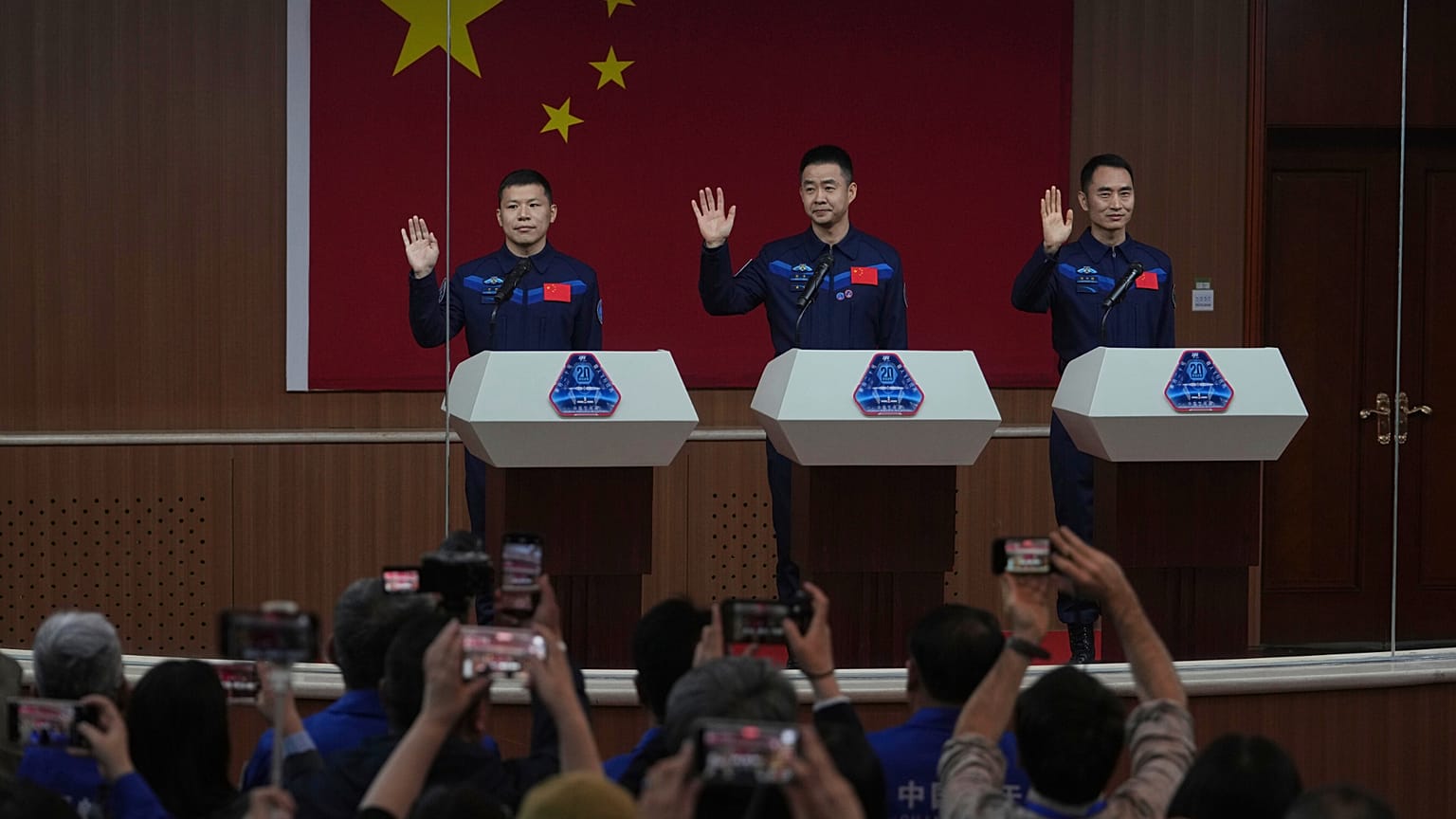
The astronauts' return was delayed for nine days.
Three Chinese astronauts returned from their nation's space station Friday after more than a week's delay because the return capsule they had planned to use was damaged, likely from being hit by space debris.
The team left their Shenzhou-20 spacecraft in orbit and came back using the recently arrived Shenzhou-21, which had ferried a three-person replacement crew to the station, China’s Manned Space Agency said.
The original return plan was scrapped because a window in the Shenzhou-20 capsule had tiny cracks, most likely caused by impact from space debris, the space agency said Friday.
They had been on a six-month rotation and were originally scheduled to return Nov. 5, four days after the new crew arrived. Their return was delayed for nine days, making their 204-day stay in space the longest for any astronaut at China’s space station.
It wasn’t clear if the change in spacecraft would affect the timing of future missions to the Tiangong space station, where new crews typically swap in every six months. The space agency said that Shenzhou-22 would be launched but did not specify when.
Chen Dong, the mission commander, said he felt at ease after their return, calling his latest space voyage both a training opportunity and a real test.
“The path of human space exploration is not smooth,” he said after emerging from the capsule.
“It’s filled with difficulties and challenges. But that is exactly why we choose to walk this path”.
The return capsule deployed a red and white striped parachute as it came down in the late afternoon to a remote site in northern China's Gobi Desert, about five and a half hours after leaving the space station. The impact sent up a large cloud of dust in the barren landscape.
The astronauts were carried out one by one about 30 minutes later and put into waiting chairs that were then loaded into individual orange trucks that took them away across the flat and scrubby desert.
Millions of pieces of space debris are circling the Earth at speeds faster than a bullet flies. The mostly tiny fragments can come from launches and collisions and pose a risk to satellites, space stations and the astronauts who operate outside them.
The temporarily stranded astronauts, who had traveled to the space station in April, conducted experiments with the new crew and were "in good condition, working and living normally,” the space agency said earlier this week.
Returning with the astronauts were four mice that also had a longer than planned stay after arriving on Shenzhou-21 about two weeks ago.
The mice were brought to study how weightlessness and confinement would affect them. The study will help in the development of technologies to breed and monitor small mammals in space, an engineer from the Chinese Academy of Sciences said.
China's space programme is a source of national pride. State broadcaster CCTV showed the astronauts' return live. A Chinese national flag flapped in a stiff wind after being planted in the ground near where the capsule landed.
Besides building its own space station, China has explored Mars with a robotic rover and aims to land a person on the moon by 2030.
China developed the Tiangong space station after the country was excluded from the International Space Station over US national security concerns. China’s space programme is controlled by its military.
The Tiangong, which means “Heavenly Palace,” hosted its first crew in 2021. It is smaller than the International Space Station, which has been operating for 25 years.
The International Space Station has also had delayed returns, notably that of two NASA astronautswhose one-week test flight of a new Boeing crew capsule in 2024 turned into nine months after problems cropped up with the capsule.
Jeff Bezos's Blue Origin launches NASA
Mars spacecraft on first New Glenn flight
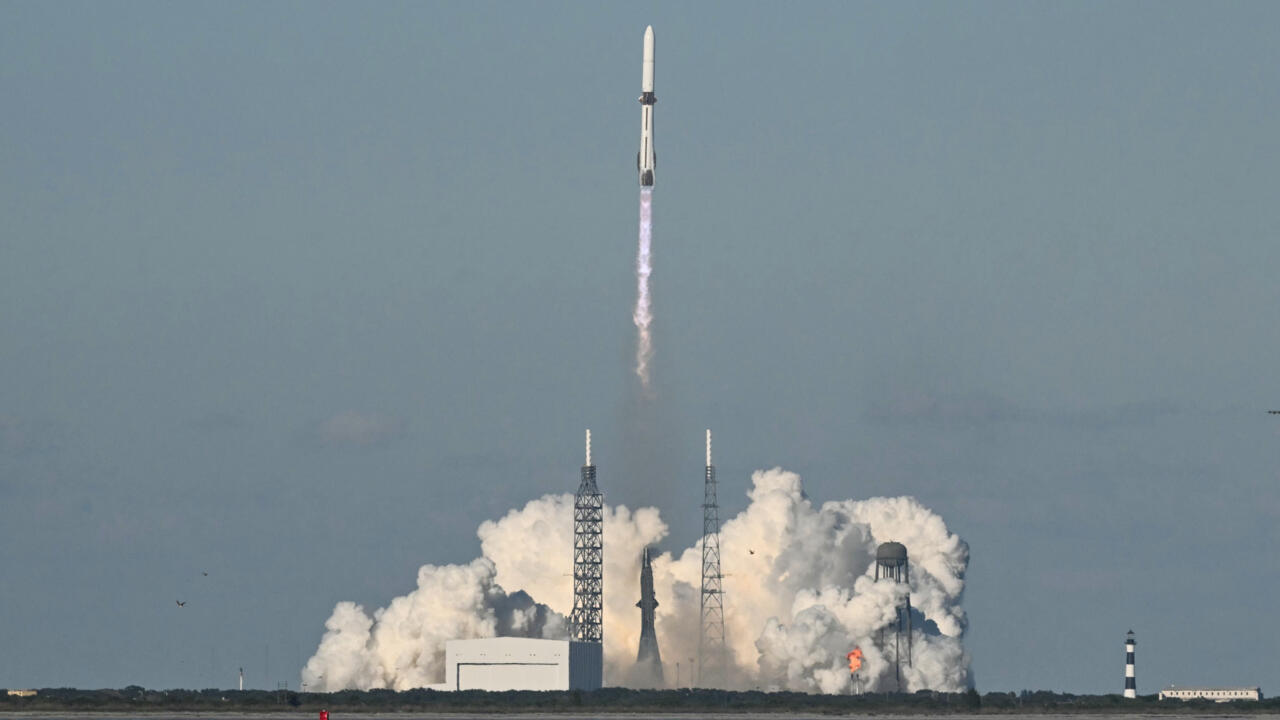
Jeff Bezos’s Blue Origin launched its New Glenn rocket on Thursday carrying NASA’s twin Mars-bound spacecraft, and in a major milestone successfully landed its booster for reuse. The launch, delayed for days by weather, marked only the second New Glenn flight and the first booster recovery by a company other than SpaceX.
Issued on: 14/11/2025
By: FRANCE 24
01:19
Jeff Bezos's Blue Origin successfully launched its New Glenn rocket on Thursday with NASA twin spacecraft destined for Mars aboard, and in a breakthrough stuck the landing of its booster.
The launch was stalled for days over weather both on Earth and in space, but it was worth the wait: in the rocket's second-ever flight, Blue Origin managed to recover the booster for reuse.
Ecstatic cheers rang out at the launch site in Florida's Cape Canaveral as the booster gracefully nailed its landing on a floating platform. Prior to Thursday, only Elon Musk's SpaceX had managed to accomplish such a maneuver with an orbital-class rocket.
Blue Origin's accomplishment comes amid intensified rivalry between the two billionaire-owned private space companies, as the US space agency NASA recently opened up bids for its planned Moon mission.
"Damn that was exciting!" said Jared Isaacman – a Musk ally who President Donald Trump recently nominated again to head NASA – on X, congratulating Blue Origin.
A handful of figures at SpaceX also had praise for their rivals, with their VP of Launch, Kiko Dontchev, saying the feat "moves the country and industry forward".
The launch was repeatedly delayed: on Sunday over weather on Earth, and on Wednesday over weather in space.
The second postponement was over "highly elevated solar activity" that NASA was worried could impact or damage its spacecraft.
And multiple glitches meant delays yet again on Thursday – hold-ups Blue Origin did not explain. But at 3:55 pm (2055 GMT), New Glenn finally blasted off.
The 322-foot (98-metre) rocket now has the task of sending NASA's ESCAPADE twin spacecraft to Mars, in a bid to study the Red Planet's climate history with the eventual hope of human exploration.
Applause resounded once more as the spacecraft successfully deployed.
Joseph Westlake, a NASA heliophysicist, explained during Thursday's webcast how the twin spacecraft named "Blue" and "Gold" will first finding a "benign, safe parking orbit" to make "measurements about the space weather here on Earth".
Then, once the planets have reached the ideal alignment in the fall of 2026, the spacecraft will get a boost from Earth's gravity and begin the journey to Mars, where they will arrive in 2027.
This type of launch could allow for more frequent missions in the future, because they could proceed outside the window of direct alignment of Earth and Mars that happens approximately once every two years.
01:35
'Launch, land, repeat'
New Glenn's inaugural flight in January also was marked a success, as its payload achieved orbit and successfully performed tests.
But its first-stage booster, which was meant to be reusable, was lost during descent.
Thursday's achievement signals that Blue Origin is on its way to reducing costs by reusing boosters rather than allowing them to plummet into the ocean.
"Launch, land, repeat – it starts today," said Eddie Seyffert, among Blue Origin's webcast commentators.
And it comes as US President Donald Trump's second term in the White House has seen the administration pile pressure on NASA to accelerate its progress to send a crewed mission to the Moon amid a race with China.
George Nield – a senior aerospace executive whose work promotes the commercial space industry, and who has flown with Blue Origin in the past – told AFP this launch would be an "indicator" of the company's progress.
It could show "whether they can play increased roles in near-term lunar exploration", he said.
(FRANCE 24 with AFP)
New evidence from GW230814 confirms the black-hole area law
China’s Purple Mountain Observatory independently verifies Stephen Hawking’s prediction that a black hole’s horizon area cannot shrink when two black holes merge
Science China Press
image:
Probability density distributions of the ratio between the measured and expected changes in the horizon area of the merged black hole. The results compare two post‑merger modelling approaches: the “pIMR” model, which uses the post‑merger portion of an inspiral‑merger‑ringdown waveform, and the “QNM” model, which represents the ringdown as a superposition of quasinormal modes of a perturbed Kerr black hole. The analysis also examines different ringdown start times t>, set at 4 or 6 times tMf (0.309 ms) after the reference strain peak. The grey‑shaded region indicates cases where the final horizon area is smaller than the sum of the initial two. The vertical dashed line at 1 corresponds to the prediction of general relativity.
view moreCredit: ©Science China Press
A research team at the Purple Mountain Observatory (PMO) announces a significant observational test of the black-hole “area law” using the gravitational-wave event GW230814. In 1971, physicist Stephen Hawking proposed that for classical black holes the total area of their event horizons cannot decrease over time. The merger of two black holes offers one of the few accessible ways to test this prediction — but accurately measuring the masses and spins (and hence the horizon areas) of the progenitor and resultant black holes has proved extremely challenging.
The PMO team turned to the high signal-to-noise ratio event GW230814, drawn from the fourth gravitational-wave transient catalog. Black-hole coalescence can be broadly divided into three phases: inspiral (two black holes spiraling inward), merger (the highly nonlinear coalescence), and ringdown (the newly formed black hole relaxing). The merger phase is the most dynamic and potentially most susceptible to deviations from general relativity; by contrast, the inspiral and ringdown phases lie in regimes where general relativity is typically a reliable approximation.
Recognising this, the authors performed independent parameter inference on the inspiral phase and the ringdown phase of GW230814, deriving constraints on the masses and spins of the two original black holes and the final merged black hole — and from those, the horizon areas. Across their analysis they carefully accounted for key uncertainties including sky-location error, waveform-template systematic effects, choice of ringdown modelling, and the time boundaries for inspiral end and ringdown start.
The analysis shows that, after considering these uncertainties, the posterior probability that the final black hole’s horizon area exceeds the sum of the progenitors’ horizon areas is extremely high. The one-sided statistical significance can reach about 4.1σ. This finding strongly supports the black-hole area law, and further corroborates the self-consistency and validity of general relativity in the strong-field, dynamical regime of black-hole mergers.
This independent verification of Hawking’s area law not only reinforces a foundational prediction of black-hole physics, but also strengthens confidence in our understanding of gravitational dynamics under the most extreme conditions. Moreover, the study provides a solid basis for future investigations into black-hole thermodynamics, quantum-gravity corrections and even more stringent tests of gravitational theory in the most extreme astrophysical environments.

No comments:
Post a Comment