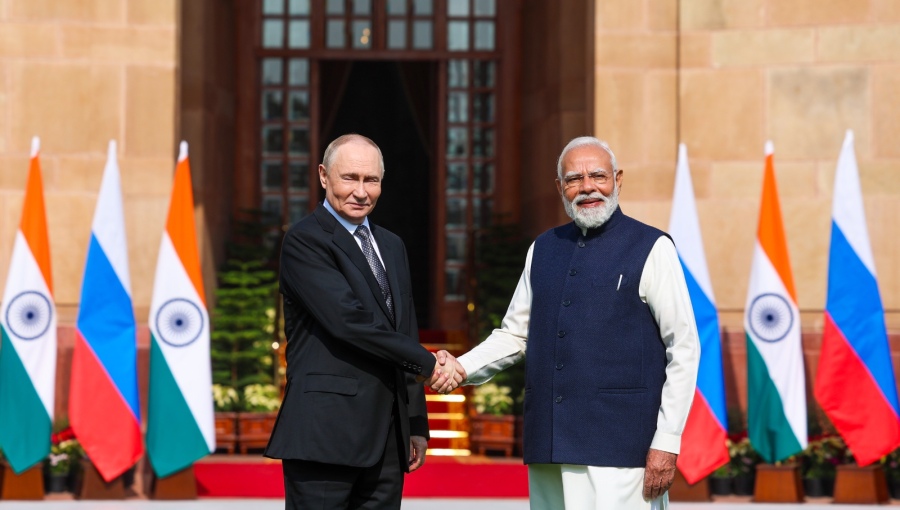
Russia's relationship with India has undergone a structural transformation bearing remarkable resemblance to the framework Moscow constructed with Beijing, explicitly branded the "no limits” strategic partnership.
During Russian President Vladimir Putin's December 4-5 2025 state visit to New Delhi, the two nations accelerated a recalibration that transcends traditional bilateral commerce to forge institutional integration across defense, technology, infrastructure, and financial systems.
The Russia-China "no limits" partnership, formalised in February 2022 but coined much earlier, explicitly states that cooperation has no boundaries, encompasses political, military, economic and technological dimensions, and is designed to withstand external pressures through mutual interdependence that makes strategic divergence increasingly costly.
Moscow-Beijing ties operate through nested institutional arrangements such as the Shanghai Cooperation Organisation(SCO) forums, BRICS mechanisms, and bilateral commissions that embed cooperation so deeply that disruption becomes practically infeasible.
India-Russia ties are now following a similar trajectory.
Bilateral trade between India and Russia exploded from $13bn in 2021 to approximately $68bn by FY2024-2025, propelled by energy commerce but increasingly diversified across sectors. More critically, Moscow and New Delhi have started constructing a similar financial architecture characterising the Russia-China model.
These include bilateral settlement systems using Indian Rupees and Russian Rubles, interoperability between payment mechanisms and central bank digital currency platforms designed to circumvent US dollar denominated constraints such as the Group of Seven(G7) sanctions imposed on Russia in the wake of its 2022 full scale invasion of Ukraine.
VEB.RF, Russia's de facto development bank, has reportedly begun the process of establishing Indian branches alongside Gazprombank(MOEX:GZPR) and Alfa Bank(MOEX:ALFB), creating finance infrastructure through which Moscow can channel massive Indian Rupee surpluses accumulated from hydrocarbon exports into joint venture manufacturing and long term investment commitments.
This financial architecture addresses the core vulnerability previously preventing India and Russia increasing ties as Russia had accumulated enormous Indian Rupee holdings from New Delhi’s energy purchases, generating a $59bn trade surplus, yet lacked mechanisms to repatriate those funds productively.
These new financial institutional mechanisms are locking both economies into mutual dependency analogous to existing, and in the pipeline Russia-China arrangements.
The India-Russia bilateral trade target of $100bn by 2030, joint manufacturing commitments, and BRICS institutional embedding collectively constitute an architecture wherein both powers increasingly depend on continuous cooperation across multiple dimensions. But interlinked dependence is a double edged sword, where disruption in one sector may become economically costly across many sectors.
However the transformation of a bilateral relationship into mutual structural integration that transcends traditional alliance frameworks becomes economically and strategically difficult to reverse.
The moniker "no limits” in a partnership sense has become as apt for India-Russia relations as it remains for Russia-China arrangements.

No comments:
Post a Comment