IS CUBA NEXT! RUBIO HOPES SO!

Trump says US carried out large-scale strike against Venezuela, captured President Maduro and his wife
Key Developments
- Trump says US forces have captured Venezuelan leader Nicolas Maduro after launching a “large-scale strike”; hails “brilliant” operation
- Venezuelan vice president says govt does not know whereabouts of Maduro or his wife; defence minister calls for united front of resistance in the face of “the worst aggression” ever
- US State Dept deputy chief declares ‘new dawn’ for Venezuela
- Venezuela calls for emergency UN Security Council meeting following strikes
US President Donald Trump said on Saturday that US forces had captured Venezuelan leader Nicolas Maduro after launching a “large-scale strike” on the South American country.
“The United States of America has successfully carried out a large-scale strike against Venezuela and its leader, President Nicolas Maduro, who has been, along with his wife, captured and flown out of the country,“ Trump said in a Truth Social post.

“This operation was done in conjunction with US law enforcement,” Trump added, saying he would give a news conference at 11:00am (1600 GMT; 9pm PKT) at his Mar-a-Lago residence in Florida.
In a brief phone interview with The New York Times, Trump hailed the “brilliant” operation.
“A lot of good planning and a lot of great, great troops and great people,” the paper quoted Trump as saying.
Venezuela has since demanded an emergency meeting of the UN Security Council to discuss the US attacks.
“Faced with the criminal aggression committed by the US government against our homeland, we have requested an urgent meeting of the United Nations Security Council, which is responsible for upholding international law,” Venezuelan Foreign Minister Yvan Gil wrote on the Telegram messaging platform.
“A new dawn for Venezuela! The tyrant is gone. He will now — finally — face justice for his crimes,” US Deputy Secretary of State Christopher Landau said on X.

 The tyrant is gone. He will now—finally—face justice for his crimes.

US Senator Mike Lee said the country had completed its military action, quoting Secretary of State Marco Rubio.
“He anticipates no further action in Venezuela now that Maduro is in US custody,” Lee, a Republican initially critical of the operation, wrote on X after what he said was a telephone call with Rubio.
Fuerte Tiuna, Venezuela’s largest military complex, situated in the south of Caracas, and Carlota airbase in the north were among the targets of the strikes. Blasts were also heard in La Guaira, north of the capital, where Caracas’s airport and port are located.
A US official said Maduro was captured by elite US special forces troops.
Venezuelan Vice President Delcy Rodriguez said the government does not know the whereabouts of President Maduro or his wife Cilia Flores, in an audio played on state TV.
“We demand immediate proof of life of President Nicolas Maduro and the first combatant Cilia Flores,” Rodriguez said.

Meanwhile, Venezuelan Defence Minister Vladimir Padrino López accused the United States of hitting residential areas.
The “invading” US forces “have desecrated our soil, going so far as to strike, using missiles and rockets fired from their combat helicopters, residential areas populated by civilians,” Lopez said in a video statement shared on social media.
He also said the South American country would launch a “massive deployment of all land, air, naval, riverine and missile capabilities … for comprehensive defence“. The defense minister called for a united front of resistance in the face of “the worst aggression” ever against Venezuela.

The Venezuelan opposition, headed by recent Nobel Peace Prize winner Maria Corina Machado, said in a statement that it had no official comment on the events.
Separately, Colombian President Gustavo Petro said he ordered the deployment of military forces to the Venezuelan border.
Petro described Washington’s actions as an “assault on the sovereignty” of Latin America and said they would result in a humanitarian crisis.
Petro made no mention of Maduro’s capture, despite the Venezuelan leader being one of his government’s closest allies in the region.
The US has not made such a direct intervention in Latin America since the invasion of Panama in 1989 to depose military leader Manuel Noriega.
Trump’s stunning announcement follows months of steadily mounting US military and economic pressure on leftist leader Maduro and his country’s oil-export-dependent economy.
The US president said in December “it would be smart for (Maduro)” to step down and has also said that the Venezuelan leader’s “days are numbered”.
Trump’s claim of Maduro’s capture comes two days after Maduro attempted to engage with Trump, offering cooperation on fighting drug trafficking and illegal migration.
The US has accused Maduro of running a “narco-state” and rigging an election. Trump had also repeatedly promised land operations in Venezuela.
The Venezuelan leader, who succeeded Hugo Chavez to take power in 2013, has said Washington wants to take control of its oil reserves, the largest in the world.


‘Flagrant violation of territorial integrity’: World reacts to US military action in Venezuela

The United States early on Saturday launched a “large-scale strike” on Venezuela, with President Donald Trump announcing that US forces had captured the South American country’s leader, Nicolas Maduro and his wife.
“The United States of America has successfully carried out a large-scale strike against Venezuela and its leader, President Nicolas Maduro, who has been, along with his wife, captured and flown out of the country,“ Trump said in a Truth Social post.
Multiple explosions rocked Venezuela’s capital, Caracas, earlier in the day, and columns of black smoke and aircraft could be seen.
Responding to the development in a video statement, Venezuela’s Defence Minister Vladimir Padrino said the country would resist the presence of foreign troops.
The strikes come after months of steadily mounting US military and economic pressure on Maduro and his country’s oil-export-dependent economy. Here is how the world is reacting to the development.
‘Violation of territorial integrity’
In a statement, the Iranian foreign ministry condemned the attack on Venezuela.
It strongly condemned the “American military attack on Venezuela”, declaring it a “flagrant violation of the national sovereignty and territorial integrity of the country“.
Colombia calls for de-escalation
In a post on X, Colombian President Gustavo Petro reaffirmed his country’s “unrestricted commitment to the principles enshrined in the charter of the United Nations, in particular the respect for the sovereignty and territorial integrity of states, the prohibition of the use or threat of use of force, and the peaceful settlement of international disputes”.
“In this regard, the Colombian government rejects any unilateral military action that could aggravate the situation or put the civilian population at risk,” he wrote on the social media platform.
Petro said that Colombia had adopted a position “oriented toward the preservation of regional peace” and called for de-escalation. He further called on all parties to refrain from actions that deepen the confrontation and to prioritise dialogue and diplomatic channels.
“As a preventive measure, the national government has arranged measures to protect the civilian population, preserve stability on the Colombian-Venezuelan border, and promptly address any eventual humanitarian or migratory needs, in coordination with local authorities and competent organisations,” he added.
‘Criminal attack’
In a sharp condemnation, Cuba’s President Miguel Diaz-Canel Bermudez denounced the “criminal attack by the US on Venezuela”.
In a post on X, he called on the international community to react against the US strikes.
“Our Zone De Paz (Zone of Peace) is being brutally assaulted,” he wrote, describing the US action as “state terrorism” against not only the Venezuelan people but also “our America”.
Spain offers to negotiate
The Spanish foreign ministry offered in a statement to negotiate and help find a peaceful solution in Venezuela.
It further called for de-escalation, moderation and respect for international law in the South American country.
‘Act of armed aggression’
Russia expressed deep concern over the development and condemned what it described as an “act of armed aggression” against Venezuela committed by the United States, the Russian Foreign Ministry said in a statement.
“In the current situation, it is important … to prevent further escalation and to focus on finding a way out of the situation through dialogue,” it said.
‘Great concern’
Germany’s foreign ministry said it was watching the situation in Venezuela with great concern.
A written communication obtained by Reuters said the ministry was in close contact with the embassy in Caracas, and a crisis team would meet later in the day.
Italy says monitoring situation in Venezuela
Italy’s Foreign Minister Antonio Tajani said Rome and its diplomatic representation in Caracas were monitoring any developments of the situation in Venezuela with particular attention to the Italian community in the country.
Tajani said in a post on X that Italy’s Prime Minister Giorgia Meloni was being kept constantly informed and that the foreign ministry’s crisis unit was operational.
Earlier, Italy’s Ambassador in Venezuela said that around 160,000 Italians currently live in the country, most of them with dual passports, as well as some who are there for reasons of work and tourism.
(EN/FR/NL) Given the situation in #Venezuela, the safety of our citizens is a top priority. Our embassy in Bogotá, which is responsible for Venezuela, and our services in Brussels are fully mobilized. The situation is being closely monitored, in coordination with our European partners.
—
Devant la situation au #Venezuela, la sécurité de nos ressortissants est une priorité absolue. Notre ambassade à Bogotá, compétente pour le Venezuela, et nos services à Bruxelles sont pleinement mobilisés. La situation fait l’objet d’un suivi étroit, en coordination avec nos partenaires européens.
—
Gezien de situatie in #Venezuela is de veiligheid van onze onderdanen een absolute prioriteit. Onze ambassade in Bogotá, die bevoegd is voor Venezuela, en onze diensten in Brussel zijn volledig gemobiliseerd. De situatie wordt nauwlettend gevolgd, in samenwerking met onze Europese partners.
‘Services fully mobilised’
Belgium said it was coordinating with European partners in order to closely monitor the situation in Venezuela.
“Our embassy in Bogot, which is responsible for Venezuela, and our services in Brussels are fully mobilised. The situation is being closely monitored, in coordination with our European partners,” Belgian Deputy Prime Minister and Foreign Affairs Minister Maxime Prevot said in a post on X.
Header image: Fire at Fuerte Tiuna, Venezuela’s largest military complex, is seen from a distance after a series of explosions in Caracas on January 3, 2026. — AFP
U.S. Strikes Two More Suspected Smuggling Boats, Killing Five
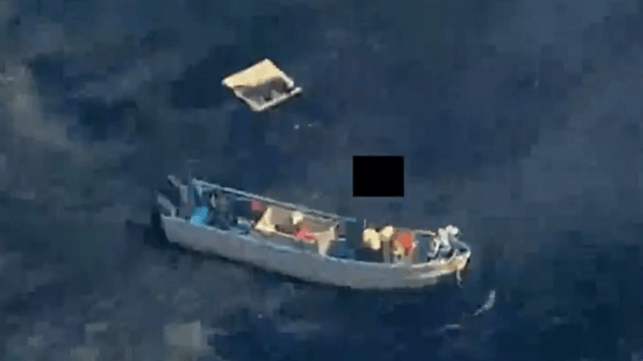
U.S. Southern Command has killed another five suspected smugglers in waters off South or Central America, the agency announced on New Year's Eve.
On Wednesday, aerial assets in the Southern Command area of operations carried out lethal strikes on two suspected smuggling vessels, at the direction of the Pentagon. The vessels were operating on known drug trafficking routes and the military believed that they were engaged in moving drugs.
Three personnel were killed in the first vessel strike and two more in the second vessel, Southern Command said in a statement. The region of the event (either Caribbean or Eastern Pacific) was not specified.
The command has hit 14 vessels over the past month, killing dozens of suspects. In total, it has attacked 35 boats since September 2, killing 115 people, rescuing two, and launching a search for four more survivors.
The Trump administration describes the targets of the strikes as "narco-terrorists" or "cartel terrorists," but reporting on the ground in South America suggests that most hired-on drug boat operators are fishermen, laborers, petty criminals and other low-income individuals. The Pentagon has not disclosed the identities of those eliminated in the strikes, if any are known. The majority of the deceased remain unidentified, according to MSNBC.
The strikes have attracted criticism in legal circles over questions of compliance with the international law of war. The Trump administration maintains that the attacks are legally justified.

No comments:
Post a Comment