Climate tech startup switches Mongolian yurt dwellers from dirty coal to clean solar
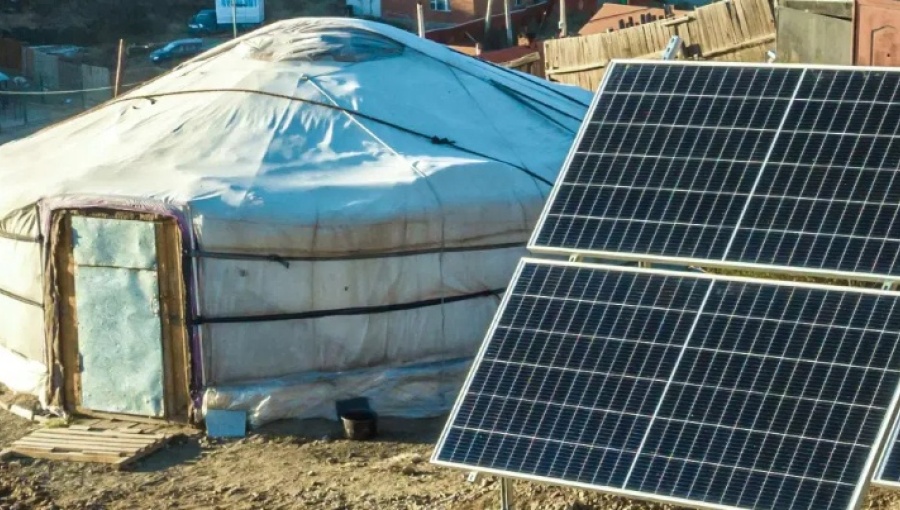
URECA, a Mongolian climate tech startup that switches city dwellers who live in gers (yurts) from air-polluting coal to solar, has won the backing of the European Bank for Reconstruction and Development’s (EBRD’s) Star Venture programme.
The fact that the ger districts of Ulaanbaatar rely on coal stoves to keep homes warm has made the city one of the most polluted capital cities in the world. Each household on average is responsible for 12 to 13 tonnes of carbon emissions, the EBRD said in a February 10 extended release on its support for URECA’s pilot Coal-to-Solar Initiative.
URECA has developed to the point where it is now better positioned to scale its climate solution, said the development bank.
“The question that we posed ourselves was: ‘If other large-scale renewables are able to generate carbon credits on the premise that they’re reducing emissions and then sell those credits and get additional revenue, how does someone living in a traditional Mongolian yurt and transitioning away from coal energy towards solar achieve the same thing?’” said URECA co-founder Orchlon.
The co-founder trio Orchlon, Amar and Unurbat see climate action as always having been a top-to-bottom approach, but believe that the clean energy transition should start with the people most affected by it, according to the EBRD.
By the end of 2025, URECA had almost 200 households using their technology. Its goal is to transition over 100,000 households by 2030. That would mean about 1.3mn tonnes of CO2 removed from the air per year, and Ulaanbaatar’s sometimes deadly air pollution reduced by more than 70%, said the bank.
Through two years of testing and piloting, URECA developed a plug-and-play system that means coal-dependent households can switch to renewable energy while financing the transition.
Cost is a major factor in climate tech adoption, explained Orchlon. With that in mind, the team, he said, concentrated on making the technology reliable and affordable by researching and developing both their hardware embedded systems and software internally.
Their infrastructure is described as combining an array of – as Orchlon put it – “low-cost, dumb, but very high-quality devices” like solar panels, inverters and electric heaters, all integrated with URECA’s verification, monitoring and reporting technologies. The latter include IoT sensors, AI, and other tools that track energy use in real time once families switch to renewable energy.
In practice, the systems enable URECA to insulate a yurt, install solar panels and batteries, then deploy smart sensors to track air quality, humidity and other indicators at five-minute intervals to verify whether any coal burning occurs throughout the day.
Emission reductions are automatically calculated, continuously verified and monetised through URECA’s platform. That opens the way to families funding their transition to renewable energy with carbon credits they generate entirely on their own, said the EBRD.
Since all devices are interconnected, URECA’s tech effectively makes each household a small virtual power plant that can be both monitored and controlled.
“Homes can operate in sync with the grid, ensuring no additional strain during peak demand, while remaining self-sustaining when the grid is under pressure,” it added.

No comments:
Post a Comment