Fortescue rolls out battery trains in Western Australia
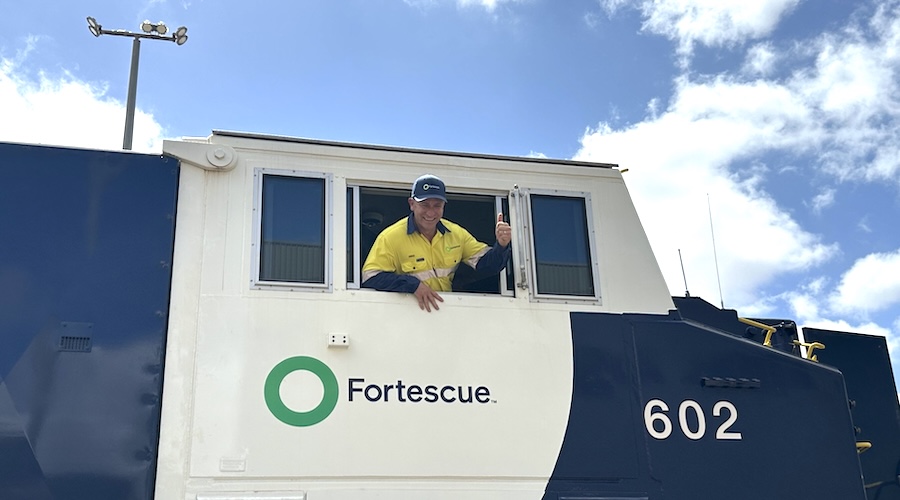
Australian iron ore producer Fortescue (ASX: FMG) has commissioned two battery electric locomotives in Western Australia’s Pilbara, marking a key step in its plan to achieve real zero emissions across its iron ore operations by 2030.

The locomotives, delivered by US-based Progress Rail, a subsidiary of Caterpillar (NYSE: CAT), are the first of their kind globally and form part of a $6.2 billion push by the Andrew Forrest-chaired company to fully decarbonize its Pilbara operations, which it says are the most comprehensive in the global mining sector.
Speaking in Port Hedland on Thursday, Fortescue Metals and Operations CEO Dino Otranto said rail remains one of the hardest sectors to decarbonize.
“We push 40,000 tonnes up 400 metres, 300 or 400 kilometres away, multiple times a day,” he said. “The forces and energy that’s behind that have been worked on for more than 200 years in the combustion two-stroke engine that has historically powered all of our fleet, but today, this is a turning point.”
Each locomotive houses a 14.5 megawatt-hour battery, the largest fitted to a land-mobile application, and can recover 40% to 60% of energy through regenerative braking. Together, they will eliminate about one million litres of diesel a year and operate on renewable electricity supplied through Fortescue’s Pilbara Energy Connect program.
Fortescue operates a fleet of 70 locomotives and will now test the first two units before transitioning the remainder over the next few years.
Full electrons ahead
The rail rollout sits within a broader electrification push across Fortescue’s 760-kilometre Pilbara network, which links five mines to its port and towage infrastructure in Port Hedland. The company expects to produce 195 million to 205 million tonnes of iron ore in the 12 months to June 30, 2026.
Otranto said 2026 would be a year of delivery for several major renewable energy projects. At North Star Junction, which supplies the Iron Bridge magnetite mine, Fortescue operates a 100 megawatt solar farm supported by a 250 megawatt-hour battery energy storage system capable of delivering up to 50 megawatts for five hours.
Construction of the 190 megawatt Cloudbreak solar farm is about two-thirds complete. The company has secured primary approvals for the proposed 644 megawatt Turner River solar farm, with construction expected to start later this year, and expects a decision on the 440 megawatt Solomon solar project within days.
Fortescue is installing about 3,600 solar panels a day and is deploying automation technology to increase that rate, Otranto said.
The company has begun building its first Pilbara wind project at Nullagine and recently acquired Nabrawind to support future wind developments. Across its operations, Fortescue now runs one electric drill and 12 electric excavators and has started taking deliveries of electric wheel dozers and trucks.
While the shift requires significant capital, Otranto said every investment must meet strict financial hurdles.
“We are not doing this out of charity. We need these machines to be economic. We want them to compete on the open market against the old technology,” he said, adding that the Pilbara’s climate offers strong renewable energy potential.
Beyond decarbonizing its mining operations, Fortescue aims to produce its first green iron by the end of June. The company is building a plant at Christmas Creek and expects first metal this financial year.
“For us, that’s the next chapter of growth in the Pilbara,” Otranto said.

No comments:
Post a Comment