Japan Arrests Chinese Trawler for Refusing a Fishery Inspection
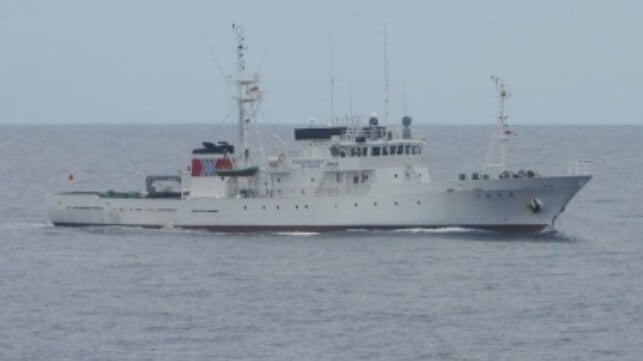
Japanese authorities have boarded and detained a Chinese fishing boat in the East China Sea, the first time that Japan has conducted an at-sea arrest of a Chinese fishing vessel in years.
On Thursday, Japanese fisheries control agents attempted to intercept and board a Chinese trawler at a position about 100 nautical miles south of Goto. The vessel attempted to flee, according to the Fisheries Adjustment Office for Kyushu. It was intercepted and boarded, and the master - identified as Qian Nianli, 47 - was arrested on allegations of violating Japan's Fisheries Sovereignty Act for refusing to allow an inspection within the Japanese EEZ.
Japanese forces have clashed with the Chinese fishing fleet before. In 2010, a Chinese trawler collided with Japan Coast Guard cutters during a hot pursuit in waters near the disputed Senkaku Islands, a frequent flash point off the coast of Taiwan. The fishing boat's captain was detained, angering Beijing and prompting the suspension of several high-level diplomatic events. In the end, the captain and crew were allowed to return to China without criminal charges filed.
The Chinese fishing fleet is a frequent source of friction with China's neighbors and nations overseas. EEZ incursions involving Chinese vessels are a regular occurrence in some parts of the world - notably waters off Argentina - and China's state-sponsored maritime militia is a constant presence within Philippine waters of the South China Sea. Methods of enforcement vary, depending upon the state of diplomatic relations between the affected nation and China; past deterrent methods have spanned the full range from administrative warnings to boardings to vessel arrests, and (rarely) kinetic engagements for noncooperative vessels.
Diplomatic ties between China and Japan are at an ebb. Beijing is displeased with Japanese Prime Minister Sanae Takaichi stance in favor of a more assertive, well-armed Japanese military and a clearer commitment to the defense of Taiwan; the fishing-vessel detention will likely elicit an unfavorable response from China in the days ahead.

Japan has seized a Chinese fishing vessel operating inside its exclusive economic zone off Nagasaki in the south west of the country, in the latest flashpoint in what is becoming an increasingly combustible maritime stand-off with Beijing.
According to Japan’s fisheries agency, the boat attempted to flee after being ordered to halt for inspection on February 12. It was intercepted and its 47-year-old Chinese captain arrested local Japanese sources report. Eleven crew members on board were also detained. Officials described the craft as a high-capacity tiger net fishing vessel, a method often criticised for its industrial scale and environmental impact.
More important that the actual fishing method, however, is the fact that the seizure marks the first time since 2022, that Tokyo has detained a Chinese fishing boat in its waters a BBC report adds - a sign that enforcement is hardening as patience with Beijing’s grey-zone tactics wears thin.
The incident itself unfolds against a backdrop of sharpening rivalry and increased tensions between Japan and China. Friction has intensified since Prime Minister Sanae Takaichi signalled in November that Tokyo would not stand idly by if China attempted to seize neighbouring Taiwan by force. The remark triggered an expected level of orchestrated fury in Beijing, which summoned Japan’s ambassador and warned Chinese citizens to reconsider travel and study in Japan the report adds.
At the heart of much of the recent tension lies Taiwan which is claimed by the Chinese Communist Party as sovereign territory despite being run as a self-governed country and fully functioning democracy with its own currency since 1949. Regardless, Beijing has refused to rule out the use of force to achieve what the CCP calls ‘reunification’ although Taiwan has never been a part of China. For Japan, whose southwestern islands including Yonaguni lie just a short distance from Taiwan, the prospect of conflict is seen as a threat.
Chinese maritime aggression in the region in recent years has increasingly tested the boundaries of international law across the East China Sea and down into the South China Sea. Fishing fleets accompanied by coastguard cutters and quasi-militia vessels have been deployed by Beijing in ways that blur the line between civilian and state-backed operations.
Japan, like Taiwan and several Southeast Asian states including the Philippines, Vietnam and Malaysia, argue that such activity amounts to incremental coercion as China probes responses, normalises its presence and erodes established norms without triggering open conflict.
To this end, Tokyo’s latest action signals that it is no longer prepared to treat Chinese incursions as routine irritants and officials in Tokyo have now indicated that enforcement against illegal fishing by foreign vessels will remain firm.
Beijing has yet to issue a formal response to the seizure sources say, but is expected to claim accidental intrusion into Japanese waters as is often the case. In previous disputes of a similar nature, China has combined diplomatic protest with economic signalling – the most recent example of this being after Takaichi’s Taiwan comments, when Chinese authorities escalated rhetorical pressure and issued travel warnings.
The result was a marked drop in Chinese tourism to Japan which hit retail and hospitality stocks.
already grappling with fragile post-pandemic recovery.
Japanese performers touring China have seen shows cancelled, while releases of Japanese films have reportedly been delayed.
For policymakers in Tokyo though, the pattern of baiting its neighbours and threatening economic penalties if they respond used by China is all too familiar.

No comments:
Post a Comment