WISHFUL THINKING

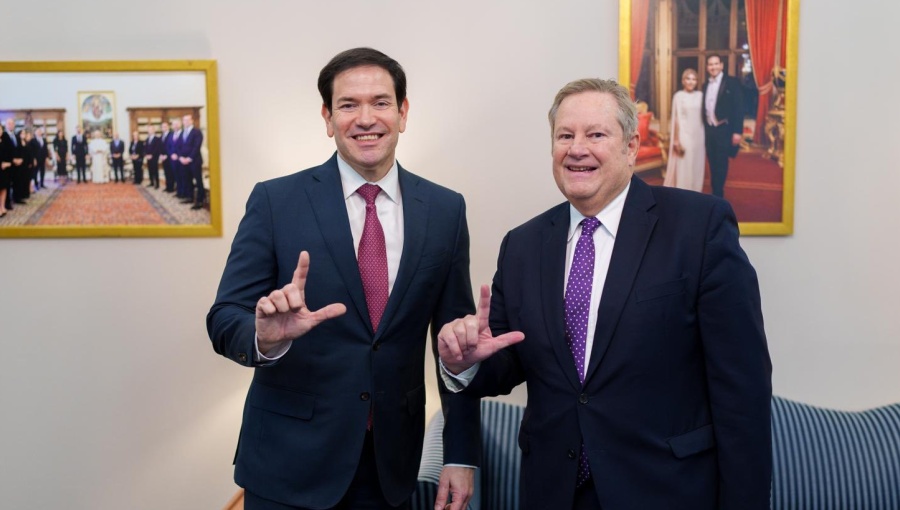
The head of the US diplomatic mission in Cuba has revealed Washington is holding discussions with high-ranking government figures on the island, hinting a political transition is imminent as the Trump administration tightens economic pressure on Havana.
Mike Hammer told Miami-based Telemundo on February 10 that contacts were taking place with senior regime officials, though he indicated some members of Cuba's ruling party remained unaware of the conversations. "Obviously, there are conversations with some very high-ranking people within the regime. Others won't be aware of them," he said.
The diplomat suggested Cuba had a figure equivalent to Venezuela's interim president Delcy Rodríguez, who assumed office as US-handpicked leader following Washington's military intervention in Caracas on January 3 that resulted in Nicolás Maduro's capture. However, Hammer declined to identify the individual despite repeated questioning. "Yes, there is a Delcy Rodríguez," he stated.
The claims echo statements by President Donald Trump, who said in January and again in recent days that dialogue with Havana was under way and that developments would soon follow. The Cuban government has flatly denied negotiations are taking place beyond routine exchanges on migration and drug trafficking.
Carlos Fernández de Cossío, Cuba's deputy foreign minister, recently insisted any talks must occur "with mutual respect" and dismissed reports of internal divisions as malicious. "If people think there is a split within the Cuban government and a willingness on the part of a small group to cede Cuba's sovereign rights, that is a misinterpretation," he told EFE.
Spanish newspaper ABC reported that the dialogue was being mediated by General Alejandro Castro Espín, son of former president Raúl Castro, a version Hammer declined to confirm.
The US envoy warned of a "plan B" if progress was not achieved within weeks, pointing to 2026 as the target year for political change in Cuba. He drew parallels with Venezuela, where Trump offered a negotiated exit to Maduro in November before ordering military action weeks later when talks yielded no results. "We have to imagine similar timelines," Hammer said.
“Washington seeks a peaceful solution,” he added. "No one wants to see bloodshed, but it's very important that change happens," he said, whilst urging other nations to "wake up and help move this process forward".
Hammer described a country in rapid deterioration following visits to several Cuban provinces. "The energy infrastructure is collapsing, everything is going wrong," he said, citing energy system failures, declining tourism and rising insecurity.
The diplomat rejected suggestions that Cuba's crisis stemmed from the Trump administration's latest measures, including the January 29 executive order threatening tariffs on countries that supply oil to the island. That order prompted Mexico to suspend oil deliveries, dealing the final blow to the island's energy production network.
"The embargo places no restrictions on food. The embargo places no restrictions on medicine. Cuba can trade with any country in the world," Hammer said. However, goods have begun accumulating at ports due to lack of fuel for distribution.
Cuba faces an acute energy crisis following the collapse of already dwindling oil deliveries from Venezuela, a close ally under former presidents Hugo Chavez and Maduro. Shipping data provider Kpler estimates Havana has just a few days of petroleum reserves remaining. The island, subjected to crippling US sanctions for over 60 years, has taken delivery of just one oil shipment so far in 2026.
Earlier this week, Cuban authorities informed international airlines that aviation fuel would be unavailable at all airports until March 11, threatening the island's vital tourism sector. The government has implemented emergency measures including a four-day working week for state employees, restrictions on fuel sales, and the closure of several hotels and resorts.
Power generation, which largely relies on ageing Soviet-era oil-fired plants, has been severely curtailed, with the state electricity operator reporting that 101 distributed generation plants sit idle due to fuel shortages, eliminating 927 megawatts of capacity. Prolonged daily blackouts have become routine whilst Cubans queue for hours at petrol stations and stock up on tinned food.
Hammer questioned why resources existed for "a repressive state machine", asking why police had fuel and vehicles whilst large sectors of the population lacked electricity and transportation.
He suggested that in a democratic scenario, reconstruction plans could be implemented with support from migrants and foreign investors. The electrical power system alone would require approximately $10bn investment, he said, noting Cuba lacks natural resources comparable to Venezuela's oil wealth.
Secretary of State Marco Rubio, the first US-born Cuban to hold the post, has made no secret of his desire to topple the communist regime. He told Congress last month: "We would love to see the regime change."
Breaking with years of defiance, President Miguel Díaz-Canel has indicated willingness to open dialogue with Washington, describing "economic strangulation by the world's leading power". But he has also launched military drills to prepare for potential instability, with Cuba's National Defence Council approving plans to shift the country into a "state of war" posture last month.
Hammer acknowledged facing hostile government-sponsored demonstrations in Cuba, but highlighted support from citizens who approach him with their problems. "Anyone within the inner circle knows that this is coming to an end," he concluded, insisting the United States seeks to support the Cuban people without legitimising the current regime's continued hold on power.

No comments:
Post a Comment