SPACE/COSMOS
France's Adenot and international crew take off for space station
NASA’s SpaceX Crew-12 mission launched to the International Space Station on Friday, sending four astronauts, including France’s Sophie Adenot, to replace a crew evacuated early because of a medical issue.
Issued on: 13/02/2026 - RFI
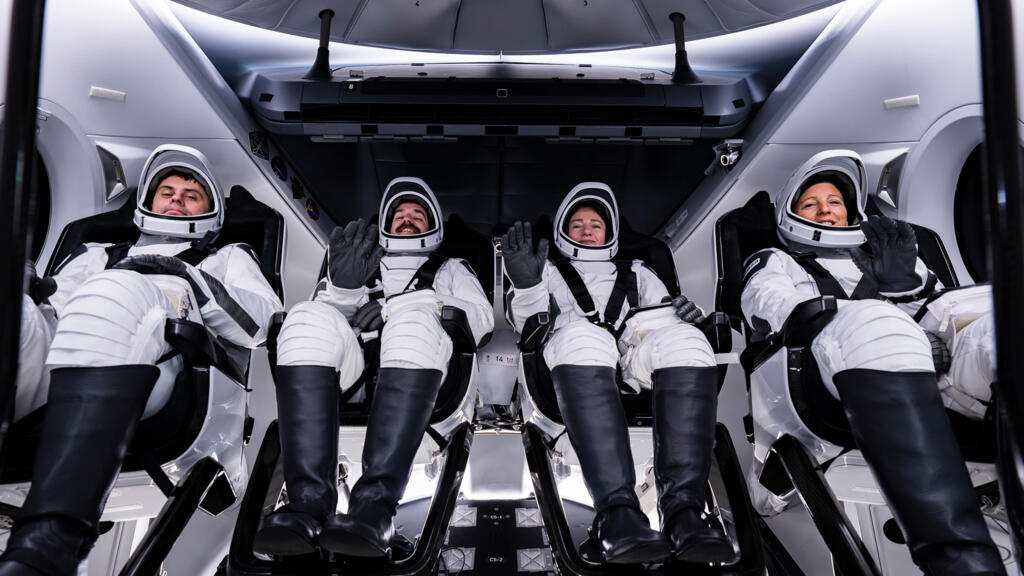
The US space agency NASA launched the Crew-12 mission aboard a SpaceX Falcon 9 rocket at 5:15am EST from Cape Canaveral Space Force Station in Florida.
The pre-dawn launch was delayed by two days because of adverse weather forecasts across the US East Coast, including high winds that could have complicated emergency manoeuvres.
The astronauts are expected to arrive at the orbiting ISS at about 3:15 pm on Saturday. They will spend nine months there.
They will replace Crew-11, which returned to Earth in January one month earlier than planned in the first medical evacuation in the space station’s history.
The ISS, a scientific laboratory orbiting 400 kilometres above Earth, has since been staffed by a skeleton crew of three.
NASA declined to disclose details about the health issue that cut the mission short.
All systems are go as France zeros in on space ambitions
'One day that will be me'
Once the astronauts arrive, they will be among the last crews to live aboard the football field-sized space station.
Continuously inhabited for the last quarter century, the ageing ISS is scheduled to be pushed into Earth’s orbit before crashing into an isolated area of the Pacific Ocean in 2030.
Adenot, an astronaut at the European Space Agency, will become the second French woman to fly to space, following in the footsteps of Claudie Haignere, who spent time on the Mir space station.
France's second woman in space prepares for launch after 30-year wait
When Adenot saw Haigneré’s mission launch, she was 14 years old.
“It was a revelation,” the helicopter pilot said during a recent briefing. “At that moment, I told myself: one day, that will be me.”
Adenot will carry out more than 200 scientific and medical experiments in microgravity while completing intensive training and maintenance work in space.
Among other research, she will test a system that uses artificial intelligence and augmented reality to allow astronauts to carry out their own medical ultrasounds.
(with newswires)
International astronauts launch to ISS after NASA's first medical evacuation
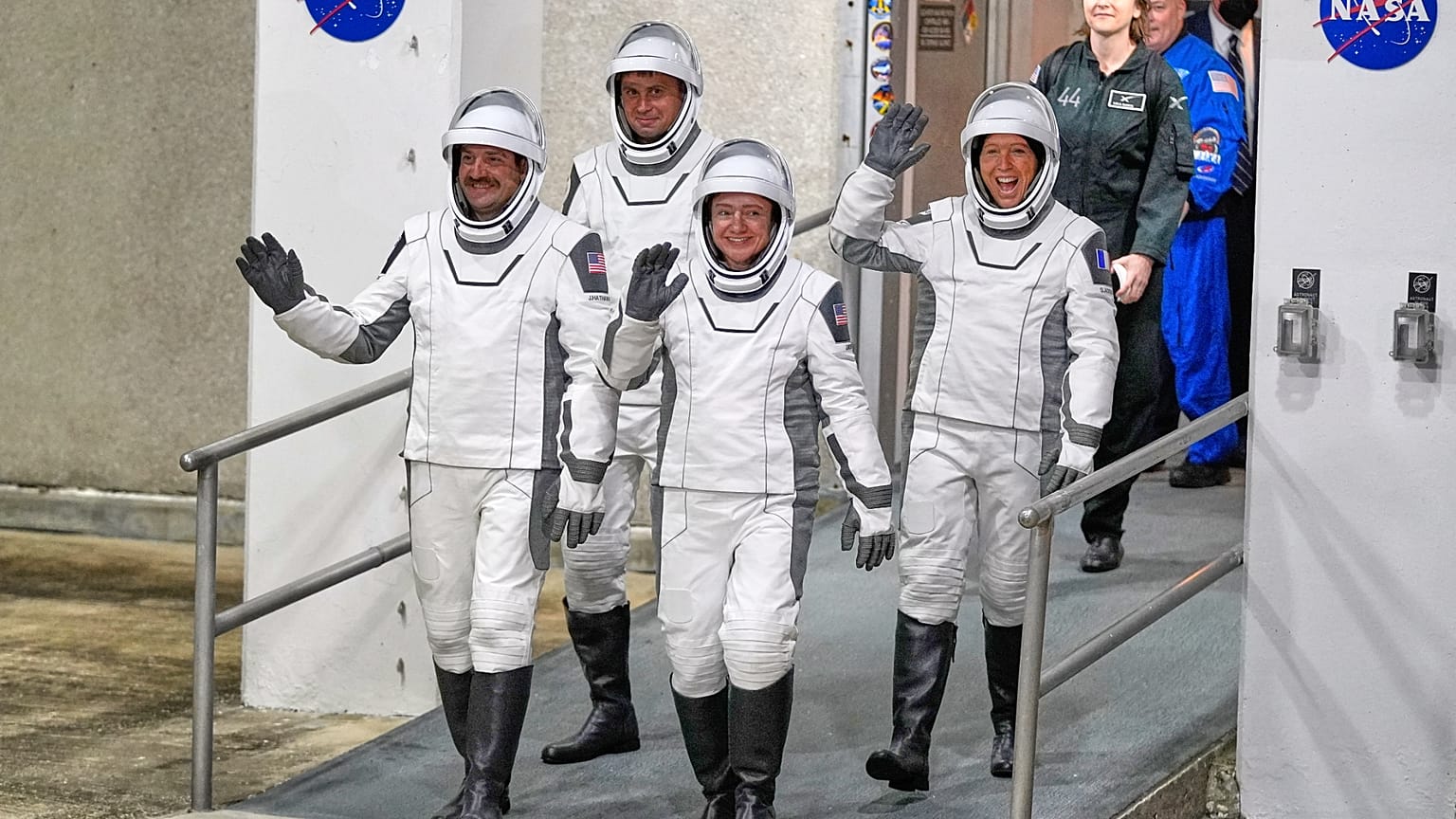
“It turns out Friday the 13th is a very lucky day,” SpaceX Launch Control radioed once the astronauts reached orbit.
A fresh team of astronauts launched toward the International Space Station on Friday aboard a SpaceX rocket, set to take over for crew members who had been brought back to Earth in what marked NASA's first medical evacuation from orbit.
NASA requested the expedited launch to quickly fill the positions left vacant by the evacuated astronauts.
The incoming crew—comprising astronauts from the United States, France, and Russia—is scheduled for an eight- to nine-month stay that will extend through until autumn. They arrive on Saturday and will restore the space station to its complete crew complement.
Once the spacecraft reached orbit, SpaceX Launch Control jokingly noted, "It turns out Friday the 13th is a very lucky day." Mission commander Jessica Meir responded with enthusiasm: "That was quite a ride."
During the month-long crew shortage, NASA suspended spacewalks and postponed various tasks while awaiting the replacements. Americans Meir and Jack Hathaway, alongside France's Sophie Adenot and Russia's Andrei Fedyaev, will now join the skeleton crew of three astronauts—one American and two Russians—who maintained station operations in the interim.
NASA said it saw no need for additional pre-launch medical screenings or specialised diagnostic equipment, expressing confidence in existing protocols aboard the station. However, an onboard ultrasound machine, typically used for research purposes, was pressed into urgent service on January 7 to examine the unwell crew member.
NASA has declined to identify the astronaut or disclose details about their condition. All four returning crew members were hospitalised immediately upon their Pacific Ocean splashdown near San Diego.
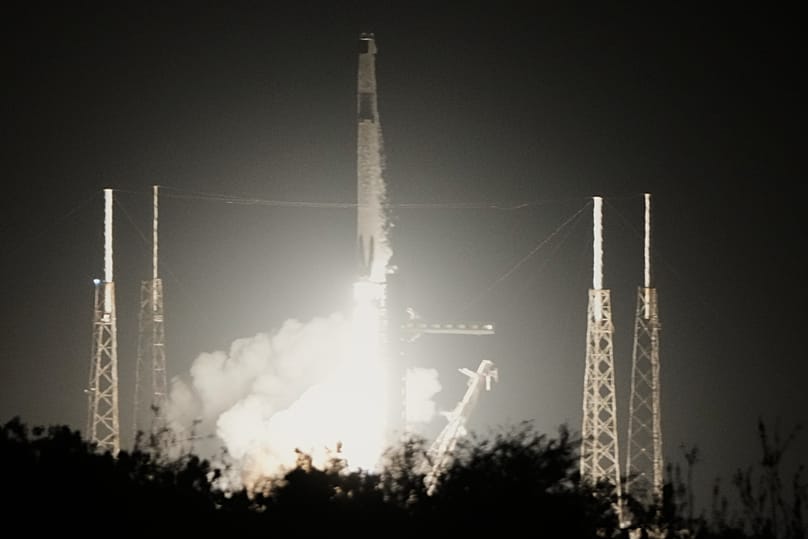
It marked the first instance in 65 years of human spaceflight that NASA terminated a mission early due to medical concerns.
Satisfied with medical procedures already in place, NASA ordered no extra checkups for the crew ahead of liftoff, and no new diagnostic equipment was packed.
An ultrasound machine already up there for research went into overdrive on Jan. 7 when used on the ailing crew member. NASA has not revealed the ill astronaut’s identity or health issue. All four returning astronauts went straight to the hospital after splashing down in the Pacific near San Diego.
With missions becoming longer, NASA is constantly looking at upgrades to the space station’s medical gear, said deputy programme manager Dina Contella.
“But there are a lot of things that are just not practical, and so that’s when you need to bring astronauts home from space,” she said earlier this week.
In preparation for moon and Mars trips, where health care will be even more challenging, the new arrivals will test a filter designed to turn drinking water into emergency IV fluid, try out an ultrasound system that relies on artificial intelligence and augmented reality instead of experts on the ground, and perform ultrasound scans on their jugular veins in a blood clot study.
They will also demonstrate their Moon-landing skills in a simulated test.
Adenot is only the second French woman to launch to space. She was 14 when Claudie Haignere flew to Russia’s space station Mir in 1996, inspiring her to become an astronaut. Haignere travelled to Cape Canaveral to cheer her on.
“I thought it would have been a quiet joy with pride for Sophie, but it was so hugely emotional to see her with a successful launch," Haignere said.
Hathaway, like Adenot, is new to space, while Meir and Fedyaev are making their second station trip. Just before liftoff, Fedyaev led the crew in a cry of “Poyekhali" — Russian for “Let's Go” — the word uttered at liftoff by the world's first person in space, the Soviet Union's Yuri Gagarin, in 1961.
On her first mission in 2019, Meir took part in the first all-female spacewalk. The other half of that spacewalk, Christina Koch, is among the four Artemis II astronauts waiting to fly around the moon as early as March. A ship-to-ship radio linkup is planned between the two crews.
ESA satellite finds 'inside-out' planetary system that challenges formation theories
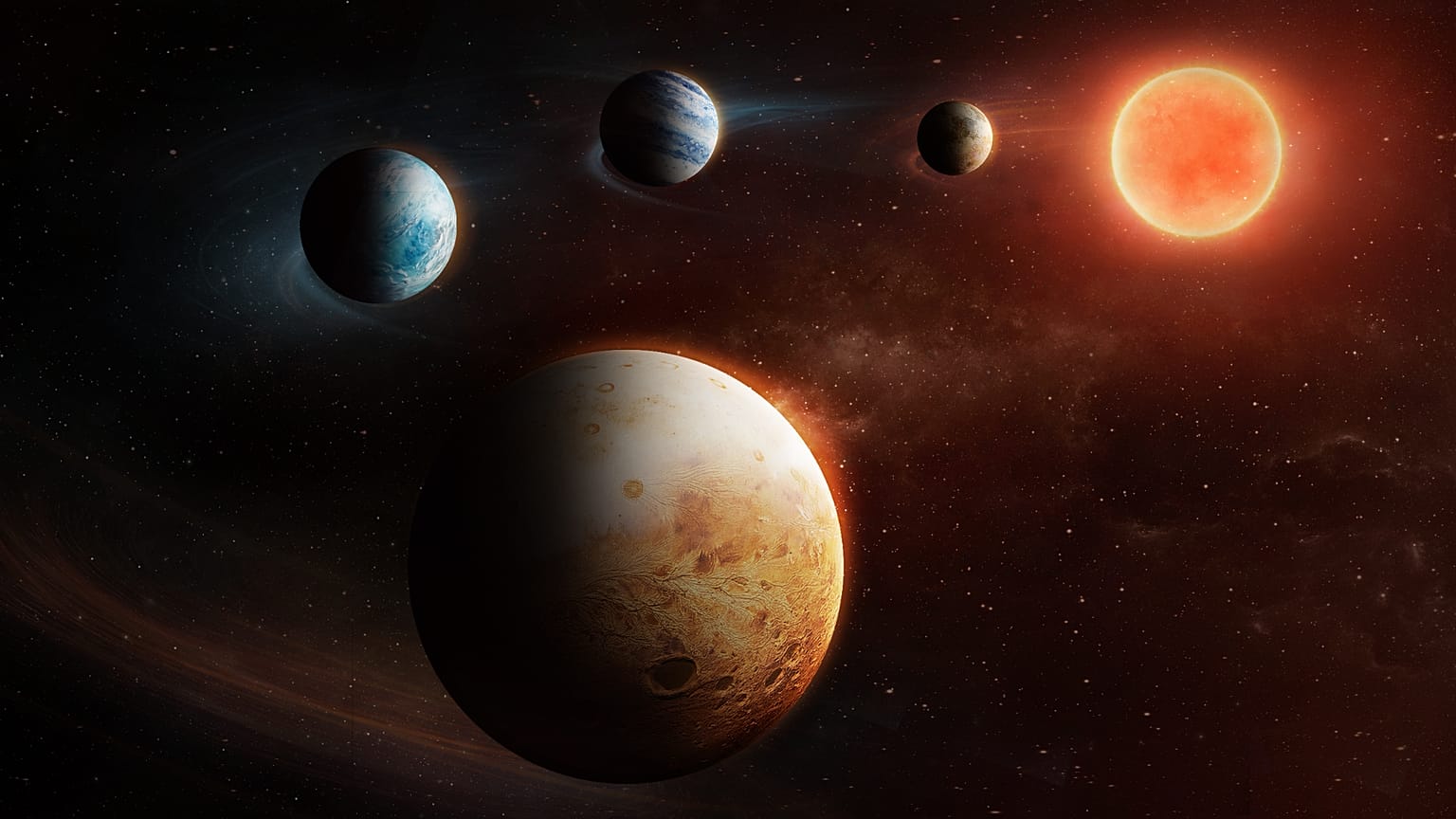
A newly discovered planet orbiting a distant star may change scientists’ understanding of how planetary systems form.
Astronomers say they have discovered a distant planetary system with planets arranged in a surprising order, challenging long-standing ideas about how planets form.
In our Solar System, the four planets closest to the Sun are small and rocky, while the four farther away are large gas giants. Scientists have long believed this pattern — rocky planets near the star and gaseous planets farther out — was common across the universe.
However, a star called LHS 1903 discovered in the Milky Way's thick disc suggests otherwise.
In a collaborative effort involving researchers across Europe, astronomers analysing data from several telescopes had already identified three planets orbiting the red dwarf star, which is cooler and dimmer than our Sun.
The closest planet to the star was rocky, followed by two gas giants. That is the order scientists expect.
But digging into observations made by the European Space Agency (ESA)'s exoplanet-probing Cheops space telescope revealed a fourth planet farther from the star. Surprisingly, this outermost planet also appears to be rocky.
"That makes this an inside-out system, with a planet order of rocky-gaseous-gaseous-and then rocky again," Thomas Wilson, the lead author of the study and a planetary astrophysicist from the University of Warwick in the United Kingdom, said in a statement with ESA.
"Rocky planets don't usually form so far away from their home star," Wilson added.
One planet after another
Inner planets are expected to be small and rocky because intense radiation from the nearby star blasts most of the gas away from their rocky core.
But farther out in the cold reaches of the system, a thick atmosphere can form around cores, creating gas giants.
Trying to explain the unusual LHS 1903 system, researchers tested several possibilities before proposing a new idea: the planets may have formed one after another rather than all at once.
According to the currently most widely accepted theory, planets form simultaneously in a massive ring of gas and dust called a protoplanetary disc.
This involves tiny dust grains clumping together, then snowballing into cores that eventually evolve into mighty planets.
But in this system, scientists believe LHS 1903 may have formed after most of the gas had already disappeared.
"Yet here is a small, rocky world, defying expectations," Wilson said.
"It seems that we have found the first evidence for a planet which formed in what we call a gas-depleted environment," he added.
Since the 1990s, astronomers have discovered more than 6,000 planets outside our Solar System, called exoplanets, mostly by spotting slight changes in brightness as they cross in front of their star.
"Historically, our planet formation theories are based on what we see and know about our Solar System," said Isabel Rebollido, a planetary disc researcher at ESA.
"As we are seeing more and more different exoplanet systems, we are starting to revisit these theories."
Cheops Discovers Late Bloomer From Another Era

Artist impression of the planetary system with four planets, around a small red star, called LHS1903 CREDIT: ESA
Many Vile Earthlings Munch Jam Sandwiches Under Newspapers and My Very Educated Mother Just Served Us Nachos. What sounds like gibberish half-sentences are memory aids taught to children to help remember the order of the planets in our Solar System: Mercury, Venus, Earth, Mars, Jupiter, Saturn, Uranus and Neptune.
The eight familiar planets can be sorted into two different types: rocky and gaseous. The inner planets that are closest to the Sun – Mercury to Mars – are rocky, and the outer planets – Jupiter to Neptune – are gaseous.
This general pattern, that planetary systems form with rocky planets closer to their star, followed by gaseous planets as the outer bodies, has been commonly observed across the Universe. It is what our current planet formation theories predict and what observations have widely confirmed to be true.
That was until scientists took a closer look at the planetary system around a star called LHS 1903 with ESA’s CHaracterising ExOPlanet Satellite (Cheops). What they have just discovered might flip our understanding of how planets form upside down.
The four planets of LHS 1903
LHS 1903 is a small red M-dwarf star that is cooler and shines less brightly than our Sun. Thomas Wilson from the University of Warwick in the UK and his international team combined the efforts of various telescopes in space and on Earth to classify three planets that they had spotted orbiting LHS 1903. They were able to conclude that the innermost planet seemed to be rocky, and the two that followed it gaseous.
So far, so normal. It wasn’t until Thomas and his colleagues were analysing observations made by ESA’s Cheops, that they discovered something strange: the data showed a small fourth planet, furthest from LHS 1903. And upon closer inspection, the scientists were surprised to discover that this planet seems to be rocky!
“That makes this an inside-out system, with a planet order of rocky-gaseous-gaseous-and then rocky again. Rocky planets don’t usually form so far away from their home star,” says Thomas.
Current planet formation theories predict that the inner planets in a system are small and rocky, because close to the star the radiation is so powerful that it sweeps away most of the gas around the planets’ rocky core. Further away from the star, in the outer part of a planetary system, the conditions are cool enough for a thick atmosphere to gather into a gaseous planet.
ESA’s Cheops project scientist Maximilian Günther is enthusiastic: “Much about how planets form and evolve is still a mystery. Finding clues like this one for solving this puzzle is precisely what Cheops set out to do.”
Born to be weird?
Scientists are not quick to say that an established theory needs to be reconsidered, based on a single contradictory observation. So, Thomas and his colleagues set out to explore various explanations for why this strange rocky planet breaks the familiar pattern.
Was the planet, for example, at some point in its past hit by a giant asteroid, comet, or another big object, that blew away its atmosphere? Or had the planets around LHS 1903 swapped places at some point during their evolution? After testing these scenarios through simulations and calculations of the planets’ orbital times, the team of scientists ruled them out.
Instead, their investigation led them to a more intriguing explanation: the planets may have formed one after the other, instead of at the same time. According to our current understanding, planets form from discs of gas and dust (protoplanetary discs) by clumping into planetary embryos at roughly the same time. These clumps then evolve into planets of different sizes and compositions over millions of years.
In contrast, here Thomas and his team discovered a planetary system where the star might have given birth to its four planets one after the other, instead of bearing quadruplets at once. This idea – known as inside-out planet formation – was proposed by scientists as a theory about a decade ago, but until now, never has the evidence been so strong.
A late bloomer defying expectations
This conclusion comes with an additional catch: Much like how our younger siblings are growing up in a world that is different from the one of our childhoods, this small rocky planet seems to have evolved and formed in a very different environment than its older sibling-planets.
“By the time this outer planet formed, the system may have already run out of gas, which is considered vital for planet formation. Yet here is a small, rocky world, defying expectations. It seems that we have found first evidence for a planet which formed in what we call a gas-depleted environment”, says Thomas.
The small rocky world is either an odd outlier, or the first evidence for a trend we hadn’t known about yet. Either way, its discovery begs for an explanation that lies beyond our usual planet formation theories.
Our Solar System as a one-size-fits-all
“Historically, our planet formation theories are based on what we see and know about our Solar System,” Isabel Rebollido who is currently a Research Fellow at ESA points out. “As we are seeing more and more different exoplanet systems, we are starting to revisit these theories.”
As our instruments improve, we continue to discover more and more ‘weird’ planetary systems in the vastness of space. They force us to question our understanding and make us reconsider established theories of planet formation. Ultimately, these discoveries are helping us learn about how our Solar System fits into the big family of diverse planetary systems. They make us wonder how special the order of the planets is that we teach our children, and if maybe it is our home Solar System that is the weird one after all.

No comments:
Post a Comment