It’s possible that I shall make an ass of myself. But in that case one can always get out of it with a little dialectic. I have, of course, so worded my proposition as to be right either way (K.Marx, Letter to F.Engels on the Indian Mutiny)
Friday, February 13, 2026
France's new energy law slashes targets renewables in favour of nuclear
After years of wrangling, France has set out a new energy law that slashes its wind and solar power targets and drops a mandate for state-run energy provider EDF to shut down nuclear plants.
Issued on: 13/02/2026 - RFI
French President Emmanuel Macron delivers a speech at the GE Steam Power System main production site for its nuclear turbine systems in Belfort, eastern France,
AP - Jean-Francois Badias
The 10-year energy planning law (PPE) will be pushed through by decree on Friday after almost three years of disagreement among lawmakers.
In addition to cutting wind and solar power targets, it reverses a previous legal mandate for state-run EDF to shut down 14 nuclear reactors.
President Emmanuel Macron promised to shutter the reactors in his 2017 presidential campaign but later changed course – supporting nuclear expansion with a plan for at least six new ones.
French Finance Minister Roland Lescure said on Friday that the PPE has set the target for decarbonised electricity production at between 650 and 693 terawatt-hours (TWh) by 2035, from a current level of 540 TWh.
The growth plan is ambitious but realistic, he told reporters.
"We need both nuclear and renewables," Lescure had said on Thursday.
The move to pare back renewables is designed to help shield EDF, which operates France's fleet of 57 reactors.
The company is struggling to remain competitive as abundant wind and solar in Europe have pushed down power prices and forced reactors to lower output.
"Nuclear is the backbone of our electricity system," said Lescure, adding that a first new reactor should be inaugurated by 2038.
EDF CEO Bernard Fontana welcomed the proposal, saying it would allow the company to advance toward its objectives.
The PPE lowers wind and solar targets to 105-135 gigawatts (GW) of installed capacity by 2035 from drafts that had called for 133-163 GW.
Environmental non-profit Greenpeace France said the change represented a step backwards.
"If this PPE is more than two years late on paper, it's at least a decade behind in its vision of an energy transition," it said in a statement.
The law had triggered fierce debate among lawmakers – pitting support for renewable subsidies against financing new nuclear at a time when France is struggling with high debt.
Marine Le Pen, leader of the far-right National Rally (RN) parliamentary group, sent a letter to French MPs saying the new power targets pursued and intensified "a policy that will impoverish the French people and ruin our economy, particularly our industry and agriculture".
She invited all MPs to file a "cross-party no-confidence motion" by next Thursday in reaction to the new energy law, adding that her party will, by default, file its own.
(with newswires)
U.S. Strategy in Armenia and Azerbaijan Includes Nuclear and AI
Vice President Vance's visit successfully broadened US economic and strategic engagement with Armenia and Azerbaijan, moving past the initial focus on the Middle Corridor trade route.
In Baku, the US and Azerbaijan signed a Strategic Partnership Charter, pledging to expand cooperation in energy, aerospace, digital infrastructure, AI, and defense, including the transfer of coastal defense vessels.
The main outcome in Yerevan was a nuclear energy agreement that positions the US as the leading contender to build a new nuclear power plant in Armenia, alongside a major sale of surveillance and drone technology.
Vice President JD Vance’s visit to Armenia and Azerbaijan succeeded in widening the scope of US economic engagement with the two South Caucasus nations. In the months immediately after Armenia and Azerbaijan signed a provisional peace deal in Washington last August, the Trump administration’s focus was on the development of the Middle Corridor trade and logistics network. But now other sectors, including civilian nuclear energy, arms sales and artificial intelligence, are part of the discussion.
Vance’s stop in Baku on February 10-11 included the signing of a US-Azerbaijani Charter on Strategic Partnership. While much of the document is devoted to maximizing the economic potential of TRIPP, or the Trump Route for International Peace and Prosperity, there are numerous provisions indicating that the partnership aims to have a much broader foundation.
The two sides pledge to “mobilize public and private sector investment” to expand not just TRIPP, but also Azerbaijan’s energy and aerospace sectors and the country’s digital infrastructure. The document additionally expresses an intention to “expand collaboration on developing AI partnerships.”
Defense and security cooperation are also in play. Vance noted at the signing ceremony that the US will send an undisclosed number of coastal defense vessels to Azerbaijan for use in the country’s sector of the Caspian Sea.
The US-Azerbaijani relationship “is one that will stick and is one that will continue to produce great fruits for both of our peoples,” Vance said.
Notably, the partnership document outlines an intent to deepen civilian nuclear cooperation, underscoring a US effort to muscle into a Eurasian energy market that has long been dominated by Russia. The countries of the Caucasus and Central Asia are embracing nuclear energy as a means of meeting rapidly growing power needs.
The main outcome of Vance’s stop in Armenia was a nuclear energy agreement that positions the United States as the front-runner to secure the contract to build a new nuclear plant in the country. A final decision on the tender likely will not come until after Armenia holds parliamentary elections on June 7.
Somewhat overshadowed by the nuclear agreement, Vance in Yerevan disclosed “a major sale of military technology” in the form of “surveillance and drone technology to the Armenians.”
Vance went on to say that Prime Minister Nikol Pashinyan will use the new arms “to secure his country and to make sure that the peace we are creating sticks.”
US campaign puts case for disposal, not reprocessing, of used fuel
The Nuclear Scaling Initiative’s Scale What Works campaign says that direct disposal of used nuclear fuel in the US is the "safest, most secure and least expensive pathway for the country" as nuclear energy capacity is expanded.
A rendering of the Onkalo underground used fuel repository in Finland, which is cited as an example of the benefits of 'clear, straightforward direct disposal policies' (Image: Posiva)
The initiative - which is a collaboration of the Clean Air Task Force, the EFI Foundation and the Nuclear Threat Initiative - aims to "build a new nuclear energy ecosystem that can quickly and economically scale to 50+ gigawatts of safe and secure nuclear energy globally per year by the 2030s".
The Nuclear Scaling Initiative (NSI) Executive Director Steve Comello said: "Making smart fuel management choices today, that acknowledge that reprocessing technologies today are not economically viable and pose security and waste management risks, can drive grid reliability, innovation, and economic and national security for the United States and beyond."
NSI, whose global advisory board is chaired by former US Secretary of State John Kerry, says that all forms of energy production produces waste, and says that in nuclear's case, directly storing and "eventually disposing of intact spent fuel" underground "is a safe, straightforward process that uses existing expertise and infrastructure".
Countries should learn from the reprocessing experience in the UK, Japan and France, NSI says, adding that its view is that reprocessing used fuel is "costly, complex and time-intensive, increasing energy prices for consumers and diverting resources from readily deployable technologies".
Former Deputy Secretary of Defense and Under Secretary of Energy John Deutch said: "Reprocessing is not a reasonable option: it threatens security, is not cost-effective and will slow our ability to scale nuclear energy."
Reprocessing of used fuel from commercial reactors has been prohibited in the USA since 1977, with all used fuel being treated as high-level waste. However, the nation has more than 250 plant-years of reprocessing operational experience, mostly from reprocessing oxide fuels at government-operated defence plants as part of its military programme. A civil reprocessing plant at West Valley, New York, operated successfully from 1966-1972: a second one at Morris, Illinois, failed to work successfully and was declared inoperable in 1974. A third civil reprocessing plant was built at Barnwell, South Carolina but was not commissioned due to the changed government policy.
Earlier this month the US Department of Energy's Office of Nuclear Energy awarded more than USD19 million to five US companies to research and develop recycling technologies for used nuclear fuel.
The Department of Energy noted that less than 5% of the potential energy in the USA's nuclear fuel is extracted after five years of operation in a commercial reactor. It says recycling used nuclear fuel could increase resource utilisation by 95%, reduce waste by 90%, and decrease the amount of uranium needed to operate nuclear reactors. Additional benefits to nuclear fuel recycling include the recovery and extraction of valuable radioisotopes for medical, industrial, and defence purposes.
In September last year Oklo Inc announced plans to design, build and operate a facility at Oak Ridge in Tennessee to recycle used nuclear fuel into fuel for fast reactors like the company’s own Aurora powerhouse. The Executive Orders signed by President Donald Trump last year included directions to the Department of Energy to bring forward national policies on the management of used fuel and high-level waste and evaluate private-sector reprocessing options, amongst other things.
Solstice plans expansion of US conversion facility
Solstice Advanced Materials announced that its Metropolis Works plant in Illinois - the USA's only domestic uranium conversion facility - is expected to produce more than 10,000 tonnes of uranium hexafluoride in 2026, which represents about a 20% increase from its planned output in 2024.
(Image: Converdyn)
Solstice - which was spun-off from Honeywell in October last year - said it has invested in de-bottlenecking projects at Metropolis Works following its 2023 restart in response to strong customer demand for uranium hexafluoride (UF6). The company's expansion efforts, it said, are underpinned by its backlog of more than USD2 billion driven by orders from long-term customers, many of which are domestic utility companies, as well as the USA's policy goal of quadrupling American nuclear energy capacity by 2050.
Backed in part by the US Department of Energy (DOE), Solstice said it is "actively exploring additional projects" to increase production at its Metropolis Works facility. The company has also retained a leading engineering, procurement and construction firm to conduct an initial engineering analysis for new capacity expansion investments and, at the same time, has initiated long-term supply discussions with customers.
"Solstice has stepped up production of UF6, a critical component in the nuclear fuel supply chain, with the support of disciplined capital investments and improved operational excellence at our Metropolis Works facility," said Solstice President and CEO David Sewell. "Leveraging our 60-plus years of operational excellence, industry leadership and proprietary expertise, we are exceedingly well-positioned to ensure our capacity to produce converted uranium is aligned with the industry and its rapid expansion."
Metropolis was built in the 1950s to meet military conversion requirements, and began providing UF6 for civilian use in the late 1960s. Original nameplate capacity was up to 15,000 tU per year, but this was reduced to 7000 tU per year in 2017 in light of global demand. Honeywell announced in November 2017 the temporary suspension of UF6 production at Metropolis pending an improvement in business conditions. The decision was a result of "significant challenges" faced by the nuclear industry at that time, including a worldwide oversupply of UF6. The plant was restarted in July 2023.
ConverDyn, a partnership between Solstice and General Atomics, serves as the exclusive marketing agent for all UF6 produced at the Metropolis Works facility, which holds a license from the US Nuclear Regulatory Commission that is valid until 2060.
Uranium must be converted from uranium oxide - the "yellowcake" that is shipped from uranium mines and mills - to gaseous UF6 before it can be enriched in fissile uranium-235 for use in nuclear fuel. In addition to Metropolis, commercial conversion plants are also in operation in Canada, China, France and Russia.
Study examines benefits of Pallas to future power plant construction
The knowledge and expertise gained in the Netherlands from the construction of the Pallas research reactor reduces the risk of delays in future nuclear power plant construction thanks to experience with permits, documentation, and supply chain qualification, according to a study by SEO Economic Research.
(Image: SEO)
The study - Building on Experience - examined the potential societal value of the Pallas programme for the construction of future Dutch nuclear power plants.
The Pallas research reactor is being built at Petten to replace the existing High Flux Reactor (HFR), which began operating in September 1960 and supplies about 60% of Europe's and 30% of the world's medical radioactive sources. Pallas will be of the "tank-in-pool" type, with a thermal power of around 55 MW, and able to deploy its neutron flux more efficiently and effectively than the HFR. Construction was officially launched in September last year.
"Pallas primarily delivers social added value through risk reduction: fewer surprises, fewer redesigns, and fewer iterations with suppliers or the supervisory authority," SEO said. "This predictability is important before construction begins, because many choices are made during this phase that later impact lead time and costs. At the same time, the learning effect is still developing and will only fully materialise if the acquired knowledge is actively retained and remains transferable.
"A scenario analysis shows that reducing construction delays by one to three years could yield significant financial benefits. For two nuclear power plants, the indicative total benefits range from EUR0.98 billion (USD1.16 billion) to EUR2.13 billion with a one-year reduction in delay to EUR2.96 billion to EUR6.41 billion with a three-year reduction in delay, primarily due to lower delay costs and an earlier start of the operational phase. In addition, smaller but positive savings are possible upfront (tens of millions of euros)."
NRG-Pallas said the construction of the new research reactor "presents an interesting case study because it is the first large-scale nuclear project in the Netherlands since the 1970s. With Pallas, the Netherlands has once again gained practical expertise in quality standards, safety, and supply chain qualification. The position of the supervisory authority, ANVS, has been strengthened with up-to-date expertise and experience".
The report shows that the acquired knowledge primarily reduces risks by reducing the likelihood of redesign and fewer issues with suppliers or regulators, thus lowering the risk of delays. These learnings enable faster and more predictable operations on these types of projects. Pallas also contributes to strengthening the ecosystem by enabling a new generation of professionals to gain experience, and by enabling suppliers to invest in knowledge to meet nuclear quality standards.
In December 2021, the Netherlands' new coalition government placed nuclear power at the heart of its climate and energy policy. In addition to keeping the Borssele plant in operation for longer, the government also called for the construction of new reactors. Based on preliminary plans, two new reactors will be completed around 2035 and each will have a capacity of 1000-1650 MWe. The two reactors would provide 9-13% of the country's electricity production in 2035. The cabinet announced in December 2022 that it currently sees Borssele as the most suitable location for the construction of the new reactors. Three other locations are also being considered for the reactors: the Tweede Maasvlakte near Rotterdam, Terneuzen in Zeeland and Eemshaven in Groningen. The government is also taking steps to prepare the Netherlands for the possible deployment of small modular reactors.
"With Pallas, the Netherlands has been able to gain unique knowledge about the practical aspects of implementing a large-scale nuclear project," said NRG-Pallas CEO Maurits Wolleswinkel. "Research agency SEO was asked whether it would be worthwhile to proactively retain this knowledge and manpower once the programme has completed all its various phases. The research confirms that the realisation of the Pallas reactor represents important pioneering work that could be of great value for the construction of new nuclear power plants. If the Netherlands retains and utilises this knowledge efficiently, its nuclear ambitions can be realised faster and at lower costs."
"Interviews and studies show that the Pallas programme can significantly reduce both time and costs in the construction of new nuclear power plants," said Erik Brouwer, head of the Competition, Aviation and Innovation group within SEO. "With NRG-Pallas, the Netherlands now has an organisation with recent experience in construction and permitting processes."
The report has been submitted to Jan Anthonie Bruijn, Minister of Health, Welfare and Sport, and Sophie Hermans of the Ministry of Climate and Green Growth.
"The report confirms that the investment made by the Ministry of Health, Welfare and Sport extends beyond the domain of public health and is of great value to the Ministry of Health, Welfare and Sport's major societal mission of achieving a sustainable and reliable energy supply," NRG-Pallas said. "Intensive collaboration between the ministries and the use of this report will ensure that the knowledge and experience are retained and utilised to the fullest extent possible for the Netherlands."
Assessment of proposed Norwegian SMR plant to begin
The Norwegian government has given Norsk Kjernekraft approval to begin work on an impact assessment for a nuclear power plant in Aure and Heim municipalities, the first step in the licensing process for nuclear power in Norway.
The proposed location for the plant (Image: Norsk Kjernekraft)
Nuclear project developer Norsk Kjernekraft submitted a proposal to Norway's Ministry of Energy in November 2023 for an assessment of the construction of the small modular reactor (SMR) plant. According to the preliminary plan, the plant will be located in a common industrial area - the Taftøy industrial park - in the border area between Aure and Heim in Trøndelag county. The plant is planned to consist of several SMRs, which together will produce around 12.5 TWh of electricity annually, if the plant is realised in its entirety.
In April last year, the Ministry of Energy, the Ministry of Health and Care Services, the Ministry of Justice and Public Security, and the Ministry of Climate and Environment requested the Norwegian Water Resources and Energy Directorate, the Norwegian Radiation and Nuclear Safety Authority, and the Norwegian Directorate for Civil Protection prepare an Environmental Impact Assessment programme for the proposed plant. A notification with a proposal for an assessment programme for the project was published for consultation in Norway by the Ministry of Energy in May 2024 with a deadline for submissions that same autumn.
At the request of the Ministry of Energy, the Norwegian Environment Agency submitted the proposed impact assessment programme for consultation by neighbouring countries, giving them the opportunity to assess the impacts this could have on them, so that this can be investigated further in a possible further process of planning the licence application and operation. The deadline for other countries to provide input to the assessment programme was 6 January 2026. The consultation responses have now been reviewed and taken into account.
The Ministry of Energy, the Ministry of Health and Care Services, and the Ministry of Climate and Environment have now established an impact assessment programme for the plans for the prosed plant.
"The impact assessment shall be prepared in accordance with the established assessment programme, and will constitute a central part of the decision-making basis for any applications for concessions under the Atomic Energy Act and the Energy Act, applications for permits under the Pollution Act and other relevant permits and approvals," the Ministry of Energy said.
"By establishing this assessment programme, we are setting minimum requirements for the scope and content of impact assessments for a possible nuclear power plant in Taftøy Business Park," said Minister of Energy Terje Aasland. The fact that we have now established this assessment programme does not mean that a position will be taken on nuclear power production as a power source in the Norwegian power system. Whether nuclear power will be relevant in Norway must be considered more closely in light of the Nuclear Power Committee's report. For the government, it is important to ensure a predictable and safe process."
"It is very pleasing that we have now received a formally binding impact assessment programme from the Ministry of Energy for nuclear power in Aure and Heim municipalities," said Norsk Kjernekraft CEO Jonny Hesthammer. "This is a big step forward for nuclear power in Norway. This confirms that Norway has the regulatory framework for nuclear power."
"Now we will first sit down and make a plan for the implementation of the impact assessment, where an important part is how the local population and other stakeholders will be able to contribute to the benefits and disadvantages of the nuclear power plant being highlighted. We have already started work on parts of the impact assessment, and we look forward to having a good dialogue with neighbours, municipalities and state authorities," he said.
The proposed nuclear power plant in Aure and Heim is the first of ten projects that Norsk Kjernekraft is implementing in Norwegian municipalities.
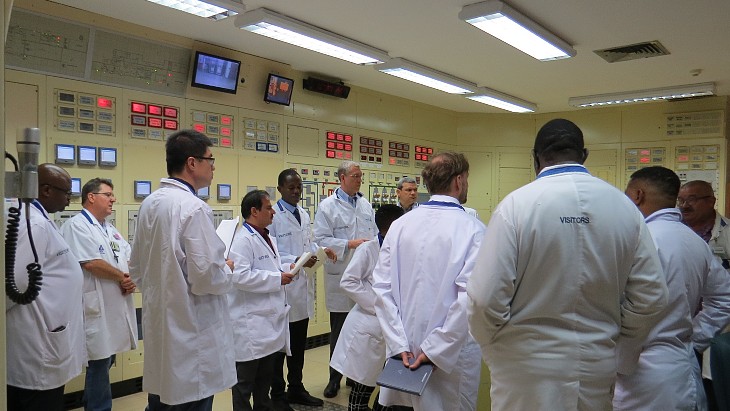
Safety review completed at South African research reactor
A team of International Atomic Energy Agency experts has outlined areas of good performance, and areas for strengthening South Africa's Safari-1 research reactor's ageing management programme.
(Image: NECSA)
The five-day six-person Safety Review Mission on Ageing Management and Continued Safe Operation was at the invitation of the facility's operator, the South African Nuclear Energy Corporation (Necsa) and was completed on 6 February.
Safari-1 is a tank-in-pool research reactor which reached first criticality in 1965 with a capacity of 6.67 MWt. Over its 60 years of operation it has undergone various power uprates and been converted to use low-enriched uranium fuel and low-enriched uranium targets for isotope production. Today, it has a licensed operating power of 20 MWt and is one of the world's major commercial producers of medical and industrial radioisotopes. It is also used for activation analyses, material modification (such as the neutron transmutation doping of silicon for the semi-conductor industry) and provides support services such as neutron radiography and neutron diffraction for both industry and research.
It is currently licensed to operate until 2030, but could be a sustainable operational irradiation facility beyond that date, pending an engineering assessment supported by an ageing management programme, Necsa has said.
Kaichao Sun, mission team leader and Nuclear Safety Officer at the IAEA, said: "We appreciated the high quality of the discussions during the mission, and the openness of the Safari-1 counterparts is well noted. Systematically implementing the ageing management activities can be challenging. Continuously improving the management system that integrates the existing operational programmes helps address this challenge."
The good performance identified included a "strong commitment and involvement of the reactor management and technical staff by conducting a self-assessment" against the review mission guidelines as part of preparation, and "effective engagement and communication between the operating organisation and the regulatory body at an early stage for the ongoing periodic safety review".
Recommendations to strengthen the ageing management programme included "management of financial and human resources to achieve the organisation's objectives of continued safe operation; development of a systematic screening process to identify the structures, systems and components in the scope of the ageing management programme; and establishment of formalised programmes to proactively address the obsolescence and qualification of equipment".
Sammy Malaka, Acting Group Executive for Nuclear Operations and Reactor Manager of Safari-1, said: "Our responsibility to manage the ageing process becomes increasingly critical. We view this … mission as a collaborative opportunity to strengthen our safety culture, enhance our ageing management programme, and ensure the long-term sustainability of our research reactor operation and capabilities."
A draft report from the mission team was provided and a follow-up mission is being scheduled for 2028.
The South African cabinet approved the construction of a Multipurpose Reactor to succeed the Safari-1 research reactor, in 2021. Last year South Africa's Minister of Electricity and Energy Kgosientso Ramokgopa announced a budget allocation of ZAR1.2 billion (USD66 million) towards the cost of such a new multipurpose reactor.
Cold testing of third Sanmen unit completed
Cold functional tests have been completed at unit 3 of the Sanmen nuclear power plant in China's Zhejiang province, China National Nuclear Corporation has announced.
(Image: CNNC)
Such tests are carried out to confirm whether components and systems important to safety are properly installed and ready to operate in a cold condition. The main purpose of cold functional tests is to verify the leak-tightness of the primary circuit and components - such as pressure vessels, pipelines and valves of both the nuclear and conventional islands - and to clean the main circulation pipes. The tests mark the first time the reactor systems are operated together with the auxiliary systems.
China National Nuclear Corporation (CNNC) said the completion of cold tests at Sanmen 3 on Tuesday "is a key turning point in the nuclear power plant commissioning process, laying a solid foundation for subsequent tasks such as hot testing and fuel loading startup".
Cold testing will now be followed by hot functional tests, which involve increasing the temperature of the reactor coolant system and carrying out comprehensive tests to ensure that coolant circuits and safety systems are operating as they should. Carried out before the loading of nuclear fuel, such testing simulates the thermal working conditions of the power plant and verifies that nuclear island and conventional equipment and systems meet design requirements.
The Sanmen site (Image: CNNC)
The construction of two new reactors at each of the Sanmen, Haiyang and Lufeng sites in China was approved by China's State Council in April 2021. The approvals were for Sanmen units 3 and 4, Haiyang 3 and 4 and units 5 and 6 of the Lufeng plant. The Sanmen and Haiyang plants are already home to two Westinghouse AP1000 units each, and two CAP1000 units - the Chinese version of the AP1000 - were approved for Phase II (units 3 and 4) of each plant.
"Once the second phase, units 3 and 4, are completed and put into operation, the Sanmen Nuclear Power Plant will generate more than 40 billion kilowatt-hours of electricity annually, equivalent to a reduction of 30 million tonnes of carbon dioxide emissions per year," CNNC noted. "This will be of great significance for optimising the regional energy structure and ensuring power supply."
Two Hualong One (HPR1000) reactors are planned for Phase III (units 5 and 6) of the Sanmen plant.
Eagles and Newcleo team up for LFR technology demonstrator
The Eagles Consortium has signed a collaboration agreement with France-based innovative reactor developer Newcleo to work together on the realisation of the LEANDREA lead-cooled small modular reactor technology demonstrator at Mol in Belgium.
The signing of the agreement in Brussels (Image: SCK-CEN)
Four European nuclear technology organisations launched the Eagles Consortium in June last year to develop and commercialise the EAGLES-300 small modular reactor (SMR) with the aim of delivering a first demonstration by 2035. The agreement was signed by Belgium's SCK-CEN nuclear research centre, Italy's national agency for new technologies, energy and sustainable economic development ENEA, Italian company Ansaldo Nucleare, and Romanian state-owned nuclear R&D coordination organisation RATEN.
EAGLES-300 is a lead-cooled Generation IV small modular reactor. The Eagles Consortium plans to leverage two test facilities on its route to commercialisation. The LEANDREA technology demonstrator, in Belgium will focus on fuel and materials testing; while the ALFRED (Advanced Lead Fast Reactor European Demonstrator) project, at Pitești, Romania, will be upgraded to serve as a stepping stone toward commercial deployment. With global commercialisation for EAGLES-300 targeted in 2039, the consortium said it is adopting a stepwise approach to development, ensuring technical feasibility and economic viability at each stage.
Paris-headquartered Newcleo's delivery roadmap sees the first non-nuclear precursor prototype of its lead-cooled fast reactor (LFR) being ready by 2026 in Italy and the first LFR-AS-200 reactor operational in France as early as 2032, while the final investment decision for the first commercial power plant is expected around 2029.
Under the new agreement, the Eagles consortium and Newcleo will generate synergies to streamline the development of the LFR technology in Europe by contributing to the design and construction of LEANDREA, which is expected to be completed in 2034. This reactor is being developed as both a technology demonstrator and a test facility for materials and fuels. Once operational, Eagles and Newcleo will benefit from significant irradiation capacity to test new materials and fuels for fast reactors. This supports both the Eagles and Newcleo roadmaps towards commercialisation.
For the development and deployment of LEANDREA, Eagles and Newcleo will share the engineering support and contributions, as well as promotion of LEANDREA as equivalent partners. Through this collaboration, the Eagles Consortium and Newcleo agree to jointly identify and coordinate R&D activities already foreseen in their respective roadmaps that can be shared, with the aim of minimising overlaps in technological development in LEANDREA.
"By signing this agreement, we are redefining the lead-cooled fast reactor as Europe's reference advanced reactor technology," said Stefano Buono, CEO and founder of Newcleo. "Alongside Eagles we are pooling together decades of world-class research on LFRs for the benefit of both organisations. This collaboration will consolidate the competitiveness of Europe's nuclear industry, allowing it to progress at pace and compete in the global race towards a new era of nuclear energy deployment."
"Bringing advanced nuclear technologies to maturity and market readiness in Europe requires synergies across national boundaries to make the best use of all the expertise available: this is at the focus and the nature of Eagles Consortium," added Roberto Adinolfi, chairman of the Eagles Steering Committee and of Ansaldo Nucleare. "Through the cooperation on LEANDREA with Newcleo we can reduce duplication, optimise resources, and shorten timelines to our goal."
"As a technology demonstrator and testing facility for materials and fuels, LEANDREA represents a crucial step in further validating lead-cooled fast reactor technology," said SCK-CEN General Manager Peter Baeten. "We are therefore very pleased that Newcleo is joining the Eagles Consortium in the design and construction of this infrastructure. By combining our complementary expertise, we are working together on a concrete project that can support Europe's energy security and innovation capacity."
Mariano Tarantino, head of the nuclear energy systems division of ENEA, said: "The collaboration with Eagles and Newcleo represents an important step forward consolidating European leadership on this technology, aiming at accelerating the development and deployment of LFRs as a low-carbon, reliable and sustainable energy supply for Europe."
The EAGLES-300 and Newcleo's LFR were among nine SMR designs selected in October 2024 by the European Industrial Alliance on Small Modular Reactors - a European Commission initiative to facilitate and accelerate the development, demonstration, and deployment of the first SMR projects in Europe in the early 2030s.
US Nuclear Regulatory Commission launches reorganisation
The US nuclear regulator is aiming to implement a reorganisation which it says will streamline decision-making, consolidate functions, and align with national goals for more efficient licensing and deployment of nuclear technology by the end of September.
Ho Nieh (on the left) was sworn in as the 20th chair of the NRC in December (Image: NRC)
The US Nuclear Regulatory Commission (NRC) was created in 1974 to ensure the safe use of radioactive materials for beneficial civilian purposes while protecting people and the environment, and regulates commercial nuclear power plants and other uses of nuclear materials in the USA. It is headed by five Commissioners appointed by the President and confirmed by the Senate for five-year terms.
The agency said it will reorganise around the core business lines of new reactors, operating reactors, and nuclear materials and waste. Licensing and inspection functions will be integrated within each business line to create a single point of accountability and improve coordination between licensing and inspection teams from the onset of projects. Functions carried out under the corporate support business line will be consolidated to improve efficiency.
"We are in one of the most consequential periods in the NRC's history, and this reorganisation enables us to meet the moment with more efficient and timely decision making," NRC Chairman Ho Nieh said. The reorganisation focuses the regulator's structure around national priorities aimed at accelerating the safe deployment of nuclear technologies, and also aims to achieve greater consistency in the implementation of agency safety programmes across the NRC's regional offices, he added.
The NRC is to develop a new organisational chart and change management plan "within the next 60 days". The appointment of key leaders for the reactor safety programme is also a near-term priority.
The changes will meet requirements under two executive orders signed by President Donald Trump last year: EO 14300, Ordering Reform of the Nuclear Regulatory Commission and EO 14210, Implementing the Department of Government Efficiency Workforce Optimization Initiative. Both these - and other orders signed by the president - have prompted actions by the US Department of Energy (DOE) and the NRC to streamline the route to deployment of advanced reactor technologies.
Since taking office in January 2025, President Trump has signed various Executive Orders aimed at increasing nuclear generating capacity and reinvigorating the USA's nuclear industry. The NRC's announcement of its reorganisation is the most recent in a number of efforts in line with these orders. Earlier this month, the DOE announced categorical exclusions for advanced nuclear reactors from various National Environmental Policy Act procedures. In January, the NRC issued internal guidance to its staff as it works towards setting up an expedited pathway for approval of reactor designs that have been tested under DOE or Department of War (formerly Department of Defense) programmes.
"Moving carefully but expeditiously to carry out this reorganisation is imperative to provide much-needed stability and certainty for our staff," NRC Executive Director for Operations Mike King said. "We will maintain a continued focus on the safety and security of operating facilities while creating a structure and regulatory culture that ensures accountability and service for Americans."
New lease of life for US legacy nuclear sites
The US Department of Energy's Office of Environmental Management announced it is restarting uranium recovery operations at the Savannah River Site H Canyon facility in South Carolina and is partnering with nuclear fuel company General Matter for the potential use of the Fuels and Materials Examination Facility at the Hanford site in Washington State.
The H-Canyon facility (Image: DOE EM)
The Savannah River Site (SRS) is a 310-square-mile (803-square-kilometre) site in Aiken, South Carolina, which was focused on the production of plutonium and tritium for use in the manufacture of nuclear weapons from the early 1950s until the end of the Cold War. H Canyon - so named because the processing areas inside the building resemble a gorge in a deep valley between steeply vertical cliffs - began operations in 1955. According to the Department of Energy's Office of Environmental Management (DOE EM), the facility historically recovered uranium and neptunium from fuel tubes used in nuclear reactors at SRS, to produce radioactive materials used in making nuclear weapons.
"H Canyon remains the only operating, production-scale, radiologically shielded chemical separations facility in the US, successfully operating and recovering uranium and other valuable materials from used nuclear fuel for more than 70 years," DOE EM noted.
DOE EM has now announced that it is restarting uranium recovery operations at the H Canyon facility.
The decision to restart uranium recovery will produce high-assay low-enriched uranium (HALEU) needed for advanced reactors, as well as recovering valuable isotopes currently available in limited domestic quantities, supporting critical needs in scientific research, medical applications and commercial uses. In addition, the facility will continue to safely process used nuclear fuel as part of SRS's cleanup mission.
HALEU - uranium enriched to contain between 5% and 20% uranium-235 - will be used to fuel many advanced reactors. The current inventory of used nuclear fuel at SRS contains enough highly enriched uranium to produce as many as 19 metric tons of HALEU, enough to fuel several proposed small modular reactors.
"Thanks to President Trump's leadership, we're maximising the value of existing assets, supporting national security objectives and advancing our cleanup mission - all while supplying America's next generation of advanced nuclear reactors," EM Assistant Secretary Tim Walsh said.
Vacant Hanford facility
Meanwhile, DOE EM has signed a lease with General Matter, unlocking the potential of the Fuels and Materials Examination Facility (FMEF) at the Hanford site to be used for advanced nuclear fuel cycle technologies and materials.
"This partnership holds great promise for rebuilding the domestic nuclear fuel supply chain and unlocking nuclear energy critical for meeting growing demand for affordable, reliable baseload power needed to fuel the artificial intelligence (AI) race," DOE EM said.
Hanford was the site of US military plutonium production activities from 1943 until 1987, with nine nuclear reactors and associated processing facilities. The DOE's Richland Operations Office now manages the site and is responsible for the clean-up of all its remaining waste streams.
The FMEF was constructed in the Cold War to support the Liquid Fast Breeder Reactor Program. Spanning 190,000 square feet, the FMEF was never used in any nuclear capacity. Although fully constructed and equipped, the facility never supported an operational nuclear mission and has remained dormant for three decades.
Alongside the DOE, General Matter will undertake the evaluations necessary to assess returning the facility to service, including site characterisation, potential facility upgrades and engagement with community leaders and stakeholders.
"Activating FMEF for a modern mission reflects responsible stewardship and forward momentum for the site," said Ray Geimer, manager for Hanford Field Office. "This lease puts an asset back to work for the American people and reinforces the Department's commitment to safe revitalisation across the Hanford footprint."
"Rebuilding America's nuclear fuel capabilities is critical to strengthening our nuclear industrial base, reducing our reliance on foreign providers and lowering energy costs for utilities and consumers," added General Matter CEO Scott Nolan. "We thank our partners in Hanford and the Department of Energy for supporting us in the development of a stronger, more secure nuclear fuel supply chain built here in the United States."
General Matter said the FMEF lease builds on its ongoing development of a new enrichment facility at the former Paducah Gaseous Diffusion Plant in Kentucky.
General Matter was one of four companies selected in October 2024 by the DOE to provide enrichment services to help establish a US supply of HALEU. The company did not emerge from stealth until April 2025, and in August signed a lease with the DOE for the reuse of federal land at the former Paducah Gaseous Diffusion Plant in Kentucky for a new commercial uranium enrichment facility.

_20086.jpg)
_44086.jpg)
_46050.jpg)
_75266.jpg)
_23466.jpg)
_a1530617.jpg)
_88081.jpg)
_23009.jpg)
_33392.jpg)

No comments:
Post a Comment