Israel is lost.
Every day for the last three years, the decent people of the world — in our untold millions — have been sunk in a pit of moral despair, weeping, having breakdowns or being permanently enraged by the most extraordinarily depraved example of full-spectrum, live-streamed barbarism in our lifetimes — the ongoing genocide of the Palestinians of the Gaza Strip by the State of Israel.
The trigger for Israel’s ongoing genocide was, of course, one particularly bloody day, October 7, 2023, when militants from the Gaza Strip, which had been maintained by Israel as an “open-air prison” for the previous 16 years, broke out through the perimeter fence and went on a killing spree in southern Israel in which 1,195 people were killed, and 251 others were taken hostage.
These are the bare facts, and, for anyone like myself who is an intuitive lifelong pacifist, they are, of course, deeply unpalatable. 1,124 Israelis and 71 foreign nationals, who all had hopes and dreams and loves and fears, were killed on October 7. 367 of them were members of the Israeli security forces, while the rest, including 36 children, were civilians.
We should mourn them all, but we cannot regard their deaths in isolation, because, in response, beginning on the evening of October 7, 2023 and continuing ever since, the Israelis have killed, at the barest minimum, 75 times as many Palestinians over the last three years, including over 21,500 children — at least 600 times as many children as were killed on October 7.
In total, according to statistics with which no one can seriously argue, 74,228 Palestinians have been killed and 175,188 injured (many very severely so) by Israeli forces over the last three years, although those figures are undoubtedly a serious undercount (see my notes at the end of this article). The remains of at least 8,000 Palestinians are still buried under the rubble, and untold numbers of others are unaccounted for, or are dying of secondary causes beyond the direct military attacks — of starvation and disease, and of everyday ailments, grievous wounds or chronic pre-existing health conditions, few of which can be adequately treated in a healthcare sector that has been deliberately destroyed by Israel, and from which it is still deliberately preventing the delivery of essential medical supplies and equipment.
According to an invisible assessment of the relative value of lives that Israel uses, and that has been shamefully adopted by most western leaders, we’re meant, today, to continue mourning those who died on October 7, 2023, while completely ignoring the genocidal carnage visited on the Palestinians ever since.
In the narrative of unique trauma and victimhood that Israel has maintained since October 7, the attacks on southern Israel were entirely unprovoked, and those killed or injured in response — even though they constitute over 10 percent of Gaza’s population — must all be regarded as legitimate targets or as acceptable “collateral damage”, as Israel continues to seek “total victory” in its “elimination” of Hamas.
That, of course, is untrue and unforgivable. The attacks by Hamas militants and other Palestinian factions on October 7, 2023 didn’t occur in a vacuum, and were not the actions of terrorists who, entirely unprovoked, sought to destroy the State of Israel.
They were, instead, a response — the bloodiest to date, but a response, nonetheless — to 75 years of oppression by the Israelis, dating back to 1948 when Jewish terrorist settler militias founded the State of Israel in an orgy of genocidal violence, killing 15,000 Palestinians, erasing 500 towns and villages and forcing 750,000 Palestinians from their homes, and into exile in neighboring countries, where their descendants still live in refugee camps, as well as in the Gaza Strip, administered by Egypt, and in the West Bank and East Jerusalem, administered by Jordan.
The militias were formed by Jewish settlers who arrived in Palestine, mostly from Eastern Europe and the Soviet Union, in their hundreds of thousands from the 1920s to the 1940s, after the British government, in the most ill-advised foreign policy decision in human history, offered Jewish people around the world a homeland in Palestine in 1917, which they proceeded to facilitate after they took over the running of Palestine in 1923 from the Ottoman Empire, defeated and dissolved after the Second World War.
After seizing control of 78 percent of Palestine at its blood-soaked founding in 1948, the State of Israel proceeded, in 1967, to seize the remaining 22 percent after the Six Days’ War, taking Gaza from Egypt, the West Bank and East Jerusalem from Jordan, and the Golan Heights from Syria.
Israel was condemned internationally for these occupations, but, shielded by its perpetual ally, the US, ignored all UN resolutions demanding its withdrawal, and established various punitive mechanisms to consolidate its control — amongst them, the widespread arbitrary imprisonment of Palestinians without charge or trial, killings with impunity, the colossal expansion of illegal settlements in the West Bank, policed through huge barrier walls and demeaning and dehumanizing checkpoints, and, in Gaza, the entrapment and isolation of the entire population after Hamas won elections in 2006, via a total land, sea and air blockade, in place since 2007, and with the entry and exit of all goods and people strictly controlled and largely and deliberately rationed or prevented.
In response to periodic rocket attacks by militant forces within Gaza, Israel also undertook, every few years, what was sickeningly and euphemistically described as “mowing the lawn” — military attacks, lasting for weeks or months, in which thousands of Palestinians were killed.
In total, between 1948 and October 7, 2023, an estimated 100,000 to 130,000 Palestinians were killed by Israeli forces, compared to an estimated 4,000 to 5,000 Israelis killed by Palestinians.
No one seeking to define the events of October 7 as pure, unprovoked evil should be allowed to forget the previous 75 years of Israel’s sustained oppression, dispossession and slaughter of the Palestinian people — and that is without even getting into the alarming subtexts of that particular day.
These include the fact that Benjamin Netanyahu was repeatedly warned of impending attacks, but chose not to inform the intelligence services, the fact that former defense minister Yoav Gallant has admitted that Israel used the Hannibal Directive on October 7, killing an untold number of its own people to prevent them being seized as hostages, and the fact that, despite irrefutable evidence to the contrary, the almost unthinkably cynical lies that were told about 40 beheaded babies and mass rapes on October 7 have never been properly refuted, and continue to feed the seemingly endless genocidal hysteria, in some quarters, that has transformed Israel into a state that now lives only to kill.

Burnt-out cars from October 7, 2023. No one has been able to explain how such destruction was undertaken by Hamas and other militants from the Gaza Strip, when they didn’t have the heavy weaponry required.
Western government’s complicity in endorsing Israel’s open-ended “right to defend itself” and in designating Hamas as a terrorist organization
Despite the long history of Israel’s oppression of the Palestinians, in which the events of October 7 were part of an ongoing conflict between oppressed people on the one hand, and their almost infinitely better-armed oppressor on the other, all of this was immediately forgotten, as western leaders, simultaneously, endorsed Israel’s open-ended and undefined “right to defend itself”, even though no such right exists in international law.
Even worse was the endorsement for open-ended barbarism that western countries had already given to Israel by helpfully proscribing Hamas — in its entirety, and not just its military wing — as a terrorist organization.
The US led the way, in 1997, while the EU, having designed Hamas’s military wing as terrorists in 2001, expanded that designation to include the entire organization in 2003. The UK, which also proscribed Hamas’s military wing as terrorists in 2001, only belatedly — under the ferocious Zionist Priti Patel — expanded that proscription to include the entire organization in December 2021. Other notable countries that have proscribed the whole of Hamas as terrorists include Australia, Canada, Japan and New Zealand.
The problem with these sweeping designations are two-fold. Firstly, they completely and deliberately erase the rights of an oppressed and occupied people to militarily resist their occupation, as enshrined in the UN Charter and recognized in the additional protocols to the Geneva Conventions in 1977, and secondly, by erasing any distinction between Hamas’s military wing and its administrative government, they have, in Gaza, paved the way for Israel to be able to claim that almost anyone it has targeted and killed was a terrorist.
It cannot be underestimated how cynical, devious and wrong these ever-expanding western terrorist proscriptions are.
Firstly, Hamas are not terrorists; they are a legitimate resistance movement, but secondly, and even more crucially, if an entire government — and not just its military wing — is proscribed as a terrorist organization, it becomes theoretically legitimate for Israel, as it has demonstrated so sickeningly for the last three years, to target and murder doctors and medical staff because they work for the Health Ministry, professors, academics and teachers because they work for the Ministry of Education, farmers because they work for the Ministry of Agriculture, judges and lawyers because they work for the Ministry of Justice, all emergency services workers, all of the police, all water engineers and sewage engineers, and many, many other people whose work was, in any way, even tangentially connected to Gaza’s administrative government.
Automated warfare: how the impact of Israel’s attacks on Gaza was multiplied through the sweeping use of AI-driven military targeting
Having directly facilitated the unbridled slaughter of Palestinian civilians, western governments also failed to show any alarm that, from the very beginning of Israel’s unprecedented attacks on Gaza, the destruction was so intense that it resembled nothing less than some of the most extraordinarily sickening campaigns of the last year of the Second World War — the firebombing of Tokyo and the destruction of Dresden, and, in their intensity, the atomic bombs dropped on Hiroshima and Nagasaki.
It looked like carpet-bombing, which, after the Vietnam War, was outlawed as a war crime in the 1977 additional protocols to the Geneva Conventions, but it was actually even worse, as was only revealed in November 2024, when Israel’s +972 Magazine published the first of two revelatory articles that disclosed how, although there were undoubtedly many elements of arbitrary and indiscriminate carpet-bombing in Israel’s devastating aerial assaults, the Israelis had manufactured a cutting-edge excuse — the use of military targeting driven by AI (artificial intelligence).
In the first of these articles, “‘A mass assassination factory’: Inside Israel’s calculated bombing of Gaza” (which I wrote about here), the journalist Yuval Abraham, after discussions with seven current and former members of Israel’s intelligence community, revealed how Israel had deliberately launched mass bombing campaigns against what were described as “power targets”, including “private residences as well as public buildings, infrastructure, and high-rise blocks”, to “create a shock” that would reverberate powerfully and “lead civilians to put pressure on Hamas.”
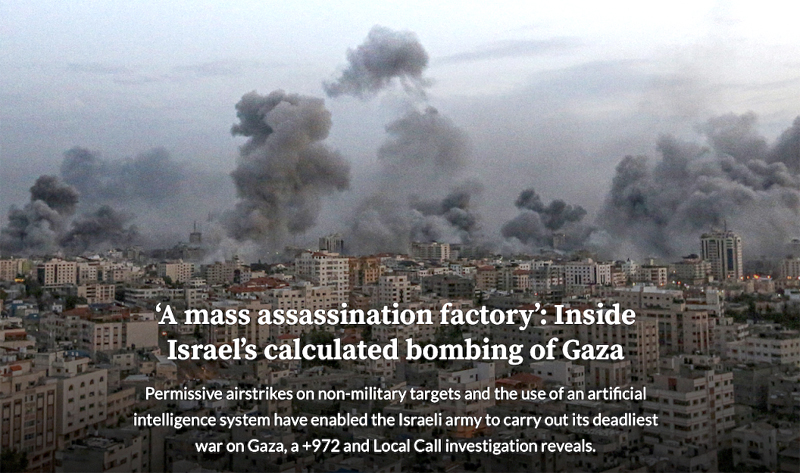
The header of +972 Magazine’s first revelatory article about Israel’s use of AI and its erasure of proportionality in military targeting, published on November 30, 2023.
Deliberately targeting civilian infrastructure to achieve a political aim is, of course, illegal under international humanitarian law, in which all parties to a military conflict “must at all times distinguish between civilian objects and military objectives.” It is also a central component of the additional protocols to the Geneva Conventions of 1977, and its status as a war crime was spelled out in the Rome Stature of 1998 establishing the International Criminal Court (ICC), which states that “intentionally directing attacks against civilian objects, that is, objects which are not military objectives”, constitutes a war crime in international armed conflicts.
It should also be noted that deliberately targeting civilian infrastructure to achieve a political aim is a hallmark of terrorism, but, through the connivance of the most powerful states in the world, as discussed above, only those resisting occupation and oppression are regarded as terrorists, while state parties are, it seems, always to be regarded as beyond reproach.
For those paying attention, Israel’s focus on “power targets” was not new, as it first emerged, in 2006, as the Dahiya Doctrine, named after a neighborhood in Beirut, during one of Israel’s many “wars” on Lebanon, deliberately “targeting economic interests and the centers of civilian power” that allegedly supported Hezbollah, to persuade the population to turn on them.
In the first weeks of the assault on Gaza, as the article explained, “Israel bombed the Islamic University of Gaza, the Palestinian Bar Association, a UN building for an educational program for outstanding students, a building belonging to the Palestine Telecommunications Company, the Ministry of National Economy, the Ministry of Culture, roads, and dozens of high-rise buildings and homes — especially in Gaza’s northern neighborhoods.” And this list is, of course, only a snapshot of the immense destruction that Israel rained down on the whole of Gaza’s infrastructure.
A “mass assassination factory”
More shocking than this revival of the Dahiya Doctrine, however, was +972 Magazine’s revelation of the existence of an AI system, “Habsora” (“The Gospel”), which is able to “‘generate’ targets almost automatically at a rate that far exceeds what was previously possible”, creating what a former intelligence officer described as a “mass assassination factory.”
When Israel first began using AI in its attacks on Gaza, in 2021, former IDF Chief of Staff Aviv Kochavi said of it that it “processes a lot of data better and faster than any human, and translates it into targets for attack”, adding that it “generated 100 new targets every day”, contrasting that with times in the past “when we would create 50 targets per year” in Gaza.
AI programs require targeting parameters, however, and it was clear that, to create so many targets, low-level Hamas members, who would never have been targeted before, were included along with senior commanders, and, in addition, all notions of proportionality and acceptable “collateral damage” were swept aside.
The article noted how, according to the intelligence sources, the “Habsora” program “generates, among other things, automatic recommendations for attacking private residences where people suspected of being Hamas or Islamic Jihad operatives live”, and Israel “then carries out large-scale assassination operations through the heavy shelling of these residential homes.” These “assassination operations”, inevitably, included all the members of the “suspected” militants’ families, but no one cared anymore.
One source explained that “a senior intelligence officer told his officers after October 7 that the goal was to ‘kill as many Hamas operatives as possible’, for which the criteria around harming Palestinian civilians were significantly relaxed.”
In one case, involving “a single top Hamas military commander”, the sources explained how the Israeli military command “knowingly approved the killing of hundreds of Palestinian civilians” during his attempted assassination. “The numbers increased from dozens of civilian deaths [permitted] as collateral damage as part of an attack on a senior official in previous operations, to hundreds of civilian deaths as collateral damage”, one source said.
In addition, the sources “confirmed that the Israeli army has files on the vast majority of potential targets in Gaza — including homes”, and that, as a result, they knew “the number of civilians who are likely to be killed in an attack on a particular target.”
“Nothing happens by accident,” one source said, adding, “When a 3-year-old girl is killed in a home in Gaza, it’s because someone in the army decided it wasn’t a big deal for her to be killed — that it was a price worth paying in order to hit [another] target. We are not Hamas. These are not random rockets. Everything is intentional. We know exactly how much collateral damage there is in every home.”
Another source, clearly appalled, said, “To my understanding, today they can mark all the houses of [any Hamas military operative regardless of rank]. That is a lot of houses. Hamas members who don’t really matter for anything live in homes across Gaza. So they mark the home and bomb the house and kill everyone there.”
Sweeping and ill-defined human targets
Even graver revelations emerged in a follow-up article in April 2024, “‘Lavender’: The AI machine directing Israel’s bombing spree in Gaza”, which I wrote about here, in which six Israeli intelligence officers spoke about an AI program specifically used to “mark all suspected operatives in the military wings of Hamas and Palestinian Islamic Jihad (PIJ), including low-ranking ones, as potential bombing targets.”
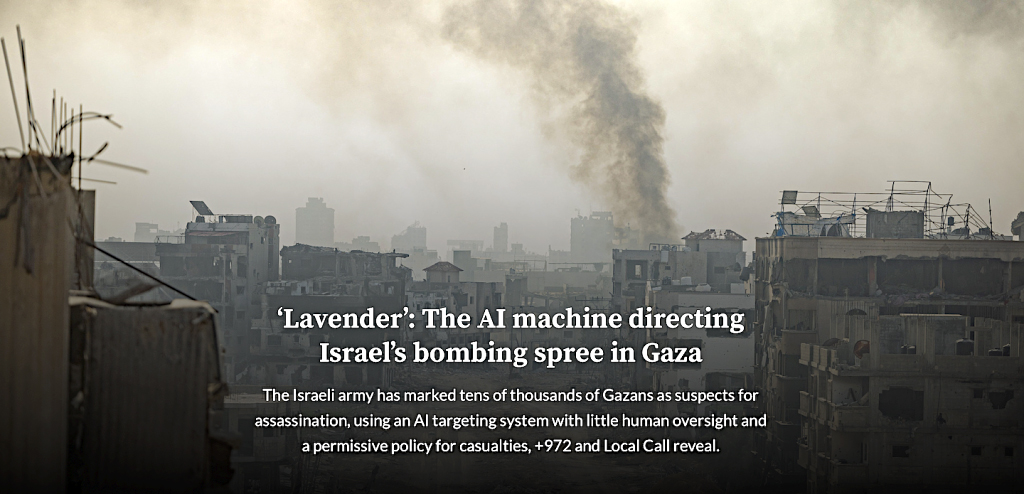
The header of +972 Magazine’s second revelatory article about Israel’s use of AI and its erasure of proportionality in military targeting, published on April 3, 2024.
The sources explained that, “during the first weeks of the war, the army almost completely relied on Lavender, which clocked as many as 37,000 Palestinians as suspected militants — and their homes — for possible air strikes”, exceeding the total number of militants — 30,000 — estimated to be in Gaza.
As the sources added, during this period, “the army gave sweeping approval for officers to adopt Lavender’s kill lists, with no requirement to thoroughly check why the machine made those choices or to examine the raw intelligence data on which they were based.” One source “stated that human personnel often served only as a ‘rubber stamp’ for the machine’s decisions, adding that, normally, they would personally devote only about ’20 seconds’ to each target before authorizing a bombing — just to make sure the Lavender-marked target is male.”
“This”, the article added, “was despite knowing that the system makes what are regarded as ‘errors’ in approximately 10 percent of cases, and is known to occasionally mark individuals who have merely a loose connection to militant groups, or no connection at all.”
The sources confirmed that those identified were generally targeted in their homes — “usually at night while their whole families were present — rather than during the course of military activity”, because it was “easier to locate” them there. The sources also revealed that one particular tracking program was, sickeningly, known as “Where’s Daddy?”
The sources also explained how, once the decision was made to target all low-level militants, there was no other option but to turn to AI to make the decisions, which were beyond the capacity of human operators to check. “They wanted to allow us to attack [the junior operatives] automatically”, one source said, “That’s the Holy Grail. Once you go automatic, target generation goes crazy.”
In an explanation of how sweeping the program was, the article stated that the “Lavender” software “analyzes information collected on most of the 2.3 million residents of the Gaza Strip through a system of mass surveillance, then assesses and ranks the likelihood that each particular person is active in the military wing of Hamas or PIJ”, giving everyone a rating from 1 to 100, based on “how likely it is that they are a militant.” The program was then instructed “to locate these same characteristics — also called ‘features’ — among the general population.”
Anyone “found to have several different incriminating features”, the sources explained, “will reach a high rating, and thus automatically becomes a potential target for assassination”, even though the “features” incriminating them might be nothing more than “being in a Whatsapp group with a known militant, changing cell phone every few months, and changing addresses frequently.”
One source explained how often mistakes were made, stating that a common error occurred “if the [Hamas] target gave [his phone] to his son, his older brother, or just a random man. That person will be bombed in his house with his family. This happened often.”
Expanding the program to include civilians
While everyone should be horrified that such an imprecise system was used automatically to generate targets for killing without any human oversight, the sources also revealed how easily the system strayed into defining civilian employees of the Hamas government as legitimate targets when its parameters were tweaked to make up for shortfalls in the numbers of targets required by death-hungry commanders.
One source talked about “times when a Hamas operative was defined more broadly, and then the machine started bringing us all kinds of civil defense personnel, police officers.” This particular source thought that “it would be a shame to waste bombs” on them, because, although “they help the Hamas government, they don’t really endanger soldiers.”
While this source appeared to be blithely unaware of the illegality of targeting civil defense personnel and police officers, another said he was “bothered by the fact that when Lavender was trained, they used the term ‘Hamas operative’ loosely, and included people who were civil defense workers in the training dataset.”
This source also explained the perils of expanding the program to include civilians working for the Hamas government, because doing so “made Lavender more likely to select civilians by mistake when its algorithms were applied to the general population.” In the source’s words, “Since it’s an automatic system that isn’t operated manually by humans, the meaning of this decision is dramatic: it means you’re including many people with a civilian communication profile as potential targets.”
I’ve previously written extensively about +972 Magazine’s revelatory articles about the horribly flawed AI-driven military targeting in Gaza, and the loosening of any definitions of proportionality and acceptable “collateral damage”, and I’m doing so again in this article because they are so crucial to understanding how horrific AI-driven military targeting is, and how it has been used to justify the extraordinary and unacceptable death toll in Gaza.
I’m glad to see that, with Rachel Szor, Yuval Abraham has expanded his coverage into a documentary film “NAZA” (“collateral damage”), which has caused hysteria in Israel because it so clearly conveys crucial truths about how sweeping genocidal intent can be disguised as clinical military accuracy.
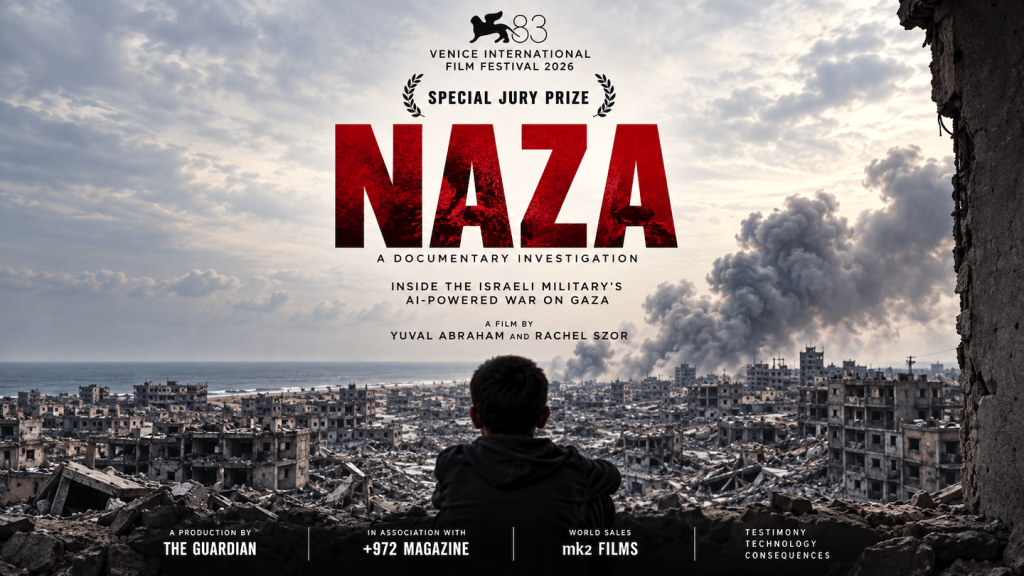
The poster for the newly-released documentary “NAZA.”
Genocidal intent and the persistent implementation of genocidal actions
Nevertheless, the main thrust of Israel’s actions remains what it has been since the beginning — genocidal intent, as openly expressed by senior government officials immediately after October 7, and as manifested not only through broadening the scope of acceptable “collateral damage” beyond anything previously imagined in its disguised carpet-bombing, but also through its destruction of almost the entirety of Gaza’s built environment, and its persistent, and almost incessant sieges on supplies of food, water, fuel and medical supplies.
The Genocide Convention specifically defines genocide as “acts committed with intent to destroy, in whole or in part, a national, ethnical, racial or religious group”, including, inter alia, not only “killing members of the group”, and “causing serious bodily or mental harm to members of the group”, but also “deliberately inflicting on the group conditions of life calculated to bring about its physical destruction in whole or in part.”
Everything Israel has been doing over the last three years has been designed not just to kill, but also to “deliberately inflict on the group conditions of life calculated to bring about its physical destruction in whole or in part”, as I have discussed in most of my nearly 100 articles over the last 36 months.
While the sieges have been almost relentless, punctuated only briefly for a six-week period during a ceasefire in January and February 2025, and have not even been adequately relieved since the supposed ceasefire over the last year — the terms of which Israel has deliberately and persistently flouted — the entire history of the last 36 months is one of relentless efforts to kill the Palestinians by all means imaginable.
A brief list of the almost bewildering number of grave crimes that have taken place includes Israel’s destruction of Gaza’s entire healthcare sector and the “war” on its hospitals and its doctors, through invented and illegal assertions of the hospitals’ use as Hamas “control and command centers”, its evacuation orders for almost the entire population to supposed safe zones that were subsequently bombed, its destruction of water and sewage systems, its withholding of fuel for generators, its snipers and armed quadcopter drones persistently targeting civilians, and especially children, the rounding up and abuse of countless civilians, many of whom subsequently disappeared into Israel’s brutal gulag of torture prisons for Palestinians, overseen by the monstrous Minister of National Security, Itamar Ben-Gvir, the license to kill anyone regarded as remotely suspicious at any time, the brazen murder of five-year old Hind Rajab and her family, the brazen killing of foreign aid workers, the brazen point-blank murder of 15 paramedics and aid workers and the botched attempts to hide the evidence, the “genocide within a genocide” in northern Gaza from October 2024 to January 2025, when everyone was ordered to evacuate, and those who remained, for whatever reason, were regarded as “enemy combatants” who could be summarily executed, the killing fields established by the joint US-Israeli Gaza Humanitarian Foundation (GHF) as a murderous alternative to the aid supplied by UNRWA and international NGOs, and the targeted killing of journalists in numbers never witnessed before in times of war, and subsequent slanderous allegations that they were all Hamas operatives.
This list barely scratches the surface of the enormity of Israel’s genocidal depravity, and, throughout, it has wheedled and lied about everything it has done, and has continued to deny any wrongdoing, even as its pundits, former politicians and members of the public have openly declared that everyone in Gaza should be killed, even children, because they will only grow up to become terrorists.
While Israel’s genocidal intent has been widely recognized, and the International Criminal Court issued arrest warrants for Benjamin Netanyahu and Yoav Gallant in November 2024, for war crimes and crimes against humanity, no significant opposition to its actions has been undertaken by any of its western supporters, even as it has expanded its horrors into the West Bank, where government-backed settler violence is ever-increasing, and southern Lebanon, where it has inflicted Gaza-style destruction and extermination on the Lebanese people, under the same genocidal context of conflating Hezbollah with Lebanese civilians, and indiscriminately slaughtering as many of them as possible.
Throughout, the US, whether under Joe Biden or Donald Trump, has continued to supply Israel with weapons, as has Germany, and, throughout the west, pliant governments have embarked on furious authoritarian clampdowns on their recalcitrant citizens.
The ever-growing backlash against Israel
Despite this, the people have refused to be cowed. Recent polling shows that the people are prevailing over the complicit politicians — and the largely compliant mainstream media. Israel’s carefully cultivated support for many decades — through bribery and bullying — has collapsed, with polls showing that it is hated by a majority of people in a majority of countries worldwide.
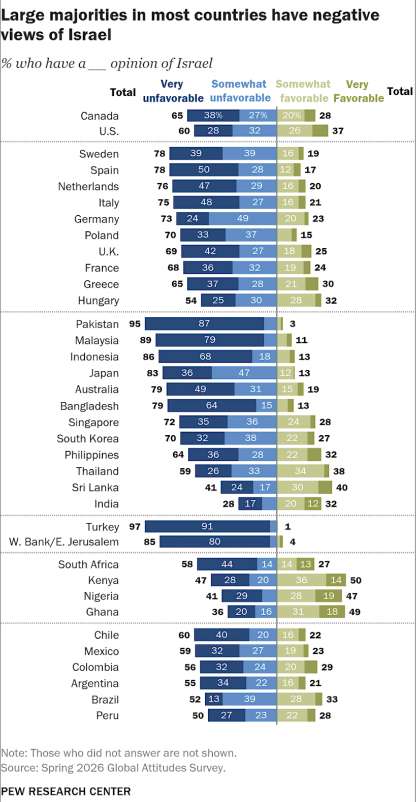
Pew’s polling, from earlier this year, showing how unfavorably Israel is regarded around the world.
Faced with moral disgust on an unprecedented scale, there are, finally, signs that at least some corrupt western governments are starting to recognize that three years of a genocide that Israel still doesn’t want to end, in which civilians are still being killed on a daily basis without any possible justification, and Israel’s leaders — Netanyahu, defense minster Israel Katz and the two far-right ministers, Itamar Ben-Gvir and Bezalel Smotrich — are only stepping up their genocidal rhetoric is increasingly difficult to defend, and that a genocidal “forever war” is not what they signed up for when those calls from Tel Aviv came though, three years ago, telling them all, in no uncertain terms, that they must openly declare in unison that Israel has “the right to defend itself.”
How can Israel be allowed to continue “defending itself” when all it is defending itself against is the lives of civilians, from Gaza to the West Bank and Lebanon, who continue to be regarded as legitimate targets because Israel has deliberately forgotten how to distinguish between civilians and combatants?
How can Israel be allowed to continue “defending itself” when it wants dead anyone who, even in their thoughts alone, poses a threat to its claims that it has a God-given right, 3,000 years old, to everything in the Levant that it eyes up as its own, and that, if the indigenous people won’t recognize that, they all deserve to be killed; or, in an even more extreme interpretation, that they all must be killed to ensure Israel’s safety, and to cement its divinely-ordained rights?
In recent weeks, as the leadership of the Labour government passed from the staunchly Zionist Keir Starmer — who was put in place to defend Israel at all costs, even though he was an empty shell lacking any leadership skills — to another Zionist appointment, the rather more palatable Andy Burnham, one appointment — of Ed Miliband, the only Jewish person amongst Labour’s Zionist elite, as foreign secretary — led, finally, to a recognition that Israel has been committing unacceptable crimes under international law, which has largely been buried over the last three years.
In a speech in Parliament, which was supposed to be a “comprehensive reset” of UK policy towards Israel, but which was, nevertheless, largely full of ongoing support for the genocidal entity, Miliband managed, at least, to support the hugely important findings of the International Court of Justice in July 2024, declaring that Israel’s entire post-1967 occupation of Gaza, the West Bank and East Jerusalem is illegal, and to demand its withdrawal and an end to complicity in its crimes by UN member states, and also recognized the findings, in September 2025, of the UN’s Independent International Commission of Inquiry on the occupied Palestinian territory, including East Jerusalem, and Israel, that Israel was engaged in war crimes in Gaza. (The UN Commission also found that Israel was engaged in a genocide, but Miliband wasn’t prepared to go that far).
He also condemned Israel for its proposed E1 settlement in the West Bank, which would completely cut off the West Bank from East Jerusalem, and prevent any notion of a future two-state solution to the Israel-Palestine question, to which most western nations, nominally at least, claim to be committed, and announced the imposition of sanctions. Eight Muslim-majority countries followed his lead, while, just two days ago, over 500 European former ministers and senior officials urged the EU to take action.
Of course, all of this means very little against a backdrop in which the government refuses to do anything meaningful to isolate and punish Israel, but I believe Ed Miliband to be a decent man, and, at the very least, a weather vane for a wider recognition, upheld with such endurance by campaigners over the last three years, that Israel’s behavior, its unwillingness to even contemplate bringing its depravity to an end, and the ever more unacceptable utterances of its leaders have reached a point that is no longer either tenable or tolerable for those in positions of power to continue to give it unconditional support.
“Zionism is racism”
On Sunday, the UK’s Green Party went even further, with party members passing a motion declaring that “Zionism is racism”, proposed by the British Palestinian artist Lubna Speitan on behalf of Greens4Palestine. The full text, and a detailed explanation of the reasons why the motion was proposed, are available here.
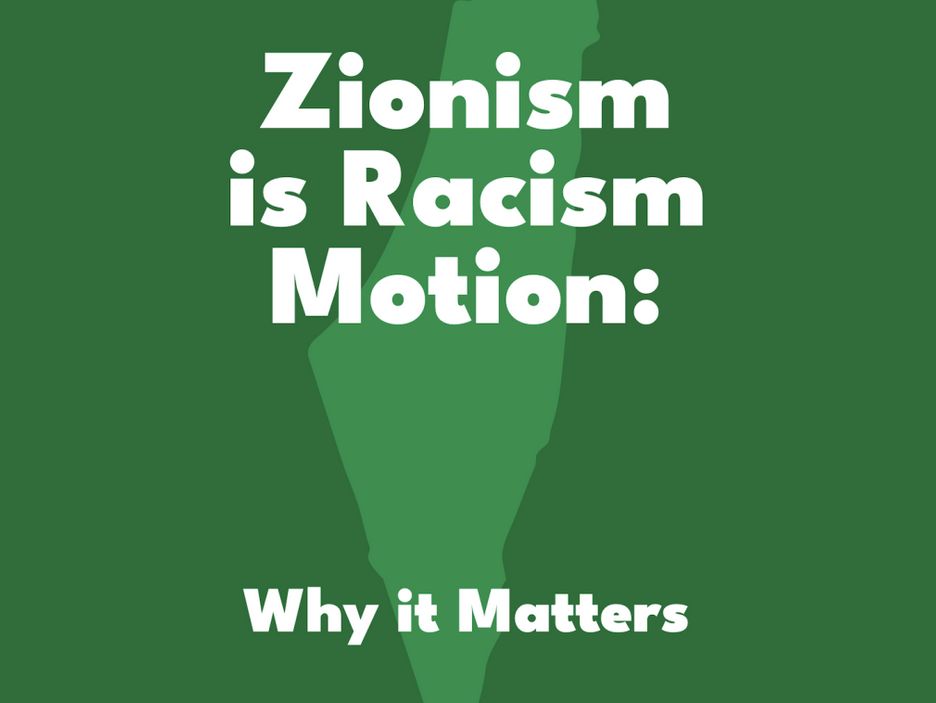
The cover of Greens4Palestine’s booklet providing the full text of the motion that was passed at the Green Party conference, and a detailed explanation of the reasons why it was proposed.
The motion stated, “The Green Party declares itself to be an anti-Zionist party”, adding that it “rejects attempts to normalize the racist subjugation and oppression of Palestinians; to equate anti-Zionism with antisemitism; to deny or minimize Palestinian human rights; to create hierarchies of racism; and to normalize or attempt to justify apartheid, ethnic cleansing or genocide.”
The motion also affirmed that “definitions of anti-Jewish discrimination should not equate Jewish identity with Zionist ideology or political practice. As with any ethnicity or faith group, no single political ideology should be ascribed to an entire people.”
In addition, the motion also affirmed “the Palestinian people’s inalienable right to self-determination, including the[ir] right … to resistance and liberation from Israeli occupation, domination and subjugation”, and acknowledged, correctly, that “the struggle to achieve that liberation by all available means under international law is legitimate.”
It also endorsed “the call from Palestinian civil society to impose broad boycotts and implement divestment initiatives against Israel similar to those applied to South Africa in the apartheid era”, and called for “the release of all Palestinian prisoners of conscience (including Marwan Barghouti), the end of the use of administrative detention of Palestinians by Israel, and the treatment of Palestinian combatants in accordance with international humanitarian law.”
Domestically, the motion also called for “the removal of Palestine Action from the list of proscribed organizations” under the Terrorism Act 2000 — the UK’s single most unacceptable act of punitive authoritarianism on behalf of Israel — and called for “the release of all prisoners detained for non-violent direct action in support of Palestinian rights and the end of the genocide, apartheid and the illegal occupation of Palestine.”
It also supported “the establishment of a single democratic Palestinian State in all of historic Palestine with Jerusalem as its capital, equal rights for all, and the right of return for Palestinians and their descendants.”
In explanatory notes, the motion made clear that “Zionism is a political ideology which called for the creation – and, now it exists, the continuity – of an ethno-nationalist Jewish State in historic Palestine to the exclusion and/or domination of the non-Jewish population”, adding, “The real, material manifestation of Zionism has been the historic and ongoing dehumanization, displacement, dispossession, disenfranchisement and destruction of Palestinians … based upon European settler-colonial systems of domination and oppression, which has also created racial hierarchies between Jews of different ethnicities in Palestine.”
Zionism as genocide, and its inevitable end
None of this ought to be even remotely contentious. Zionism, founded in Europe in the late 19th century, was, explicitly, a movement to create a national state for Jews in Palestine, where a mixed population of Muslims, Christians and Jews had been living for centuries, with a Muslim majority from the 12th century onwards, and with, at the start of the British Mandate in 1922, Muslims making up 78% of the population, Jews 11% and Christians 10%. Zionism, however, sought to establish a Jewish majority state, explicitly occupying as much of the land as possible, and with as few Arabs as possible.
It’s a sign of how deranged the discourse protecting Israel has become that the backlash against the Green Party motion has been immense. No one seems to want to recall that, 51 years ago, in 1975, the UN General Assembly passed a resolution condemning Zionism as a form of racism. That was withdrawn in 1991, under pressure from Israel and President George H. W. Bush, but it not only remains as true now as it was in 1975; Israel’s actions over the last 35 years — and, especially, over the last three years — have confirmed, more than ever, that it is a racist endeavor of such ferocious depravity that its leaders — and far too many of its people — now believe not only that the unending slaughter of Palestinian civilians is divinely ordained, but also that the Palestinian population should not just be minimized, but erased entirely.
Polling in Israel shows around 80 percent support for the forced expulsion of the Palestinians, which is not only unforgivable in and of itself; it also conveniently ignores the fact that there is nowhere for them to go. While the most fanatical settler enthusiasts, like Ben-Gvir and Smotrich and the monstrous settler matriarch Daniella Weiss fulminate endlessly about the need for other countries to step up and fulfill their dream of the “voluntary migration” of the Palestinians, the world’s nation states either recognize that this would be the greatest example of mass ethnic cleansing in modern times, and want nothing to do with it, or, in many cases, are so consumed with a rising tide of far-right anti-immigrant sentiment that they are seeking to close their borders entirely, and certainly won’t open them to welcome a displaced people who have been designated, collectively, as terrorists, not only by those seeking to get rid of them, but also by their own governments.
As I have repeatedly stated, the illusion of “voluntary migration” is nothing less than a deliberate and deeply cynical smokescreen for the continuing extermination of the Palestinian people.
No one, of course, has any idea how all this will end, whether Israel, as would be morally appropriate, will collapse under the weight of its own contradictions and the self-inflicted mental health costs of its own genocidal violence, or whether the world will, eventually, isolate it as a pariah state, as happened with South Africa. No route is clear to the realization of either a two-state or a one-state solution, but the people of the world are adamant, by a clear majority, that a no-state solution of steady and relentless extermination is a moral stain that can no longer be tolerated.
Israel is lost, and terminally so. Only the means of its collapse and its epitaph remain to be written.
Andy Worthington is a freelance investigative journalist, activist, author, photographer (of a photo-journalism project, ‘The State of London’, which ran from 2012 to 2023), film-maker and singer-songwriter (the lead singer and main songwriter for the London-based band The Four Fathers, whose music is available via Bandcamp). He is the co-founder of the Close Guantánamo campaign (see the ongoing photo campaign here) and the successful We Stand With Shaker campaign of 2014-15, and the author of The Guantánamo Files: The Stories of the 774 Detainees in America’s Illegal Prison and of two other books: Stonehenge: Celebration and Subversion and The Battle of the Beanfield. He is also the co-director (with Polly Nash) of the documentary film, “Outside the Law: Stories from Guantánamo”, which you can watch on YouTube here.
To receive new articles in your inbox, please subscribe to Andy’s new Substack account, set up in November 2024, where he’ll be sending out a weekly newsletter, or his RSS feed — and he can also be found on Facebook (and here), Twitter and YouTube. Also see the six-part definitive Guantánamo prisoner list, The Complete Guantánamo Files, the definitive Guantánamo habeas list, and the full military commissions list. Please also consider joining the Close Guantánamo campaign, and, if you appreciate Andy’s work, feel free to make a donation via PayPal or via Stripe.