As bombs fall, gold prices rise — and Poland is taking notice
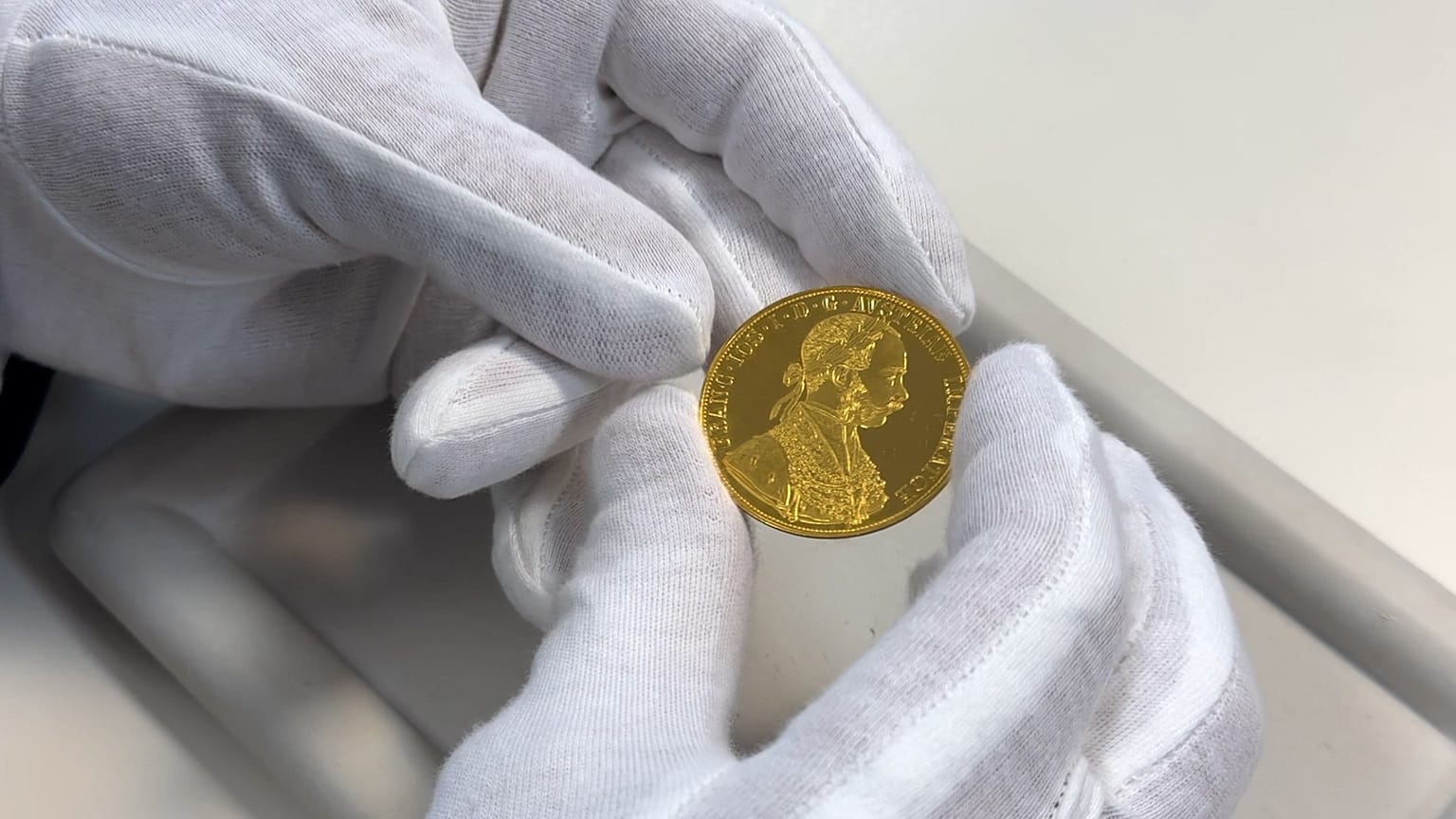
Geopolitical unrest is driving private investors away from virtual instruments and towards physical bars and coins — assets you can lock in a safe, carry in a suitcase or bury under the floorboards.
US and Israeli strikes on Iran have sent gold prices to a record $5,420 per ounce and triggered a rush into physical bullion, with buyers in Shanghai paying a $30 premium over London valuations, as markets recorded their sharpest flight to safe-haven assets in years.
Pawel Mazurek, president of Poland's Mazovia Mint, said demand for physical bullion had jumped sharply in the aftermath of the strikes.
"Some purchases are for hedging purposes, but some are unfortunately driven by emotions and fears of escalation," he explained.
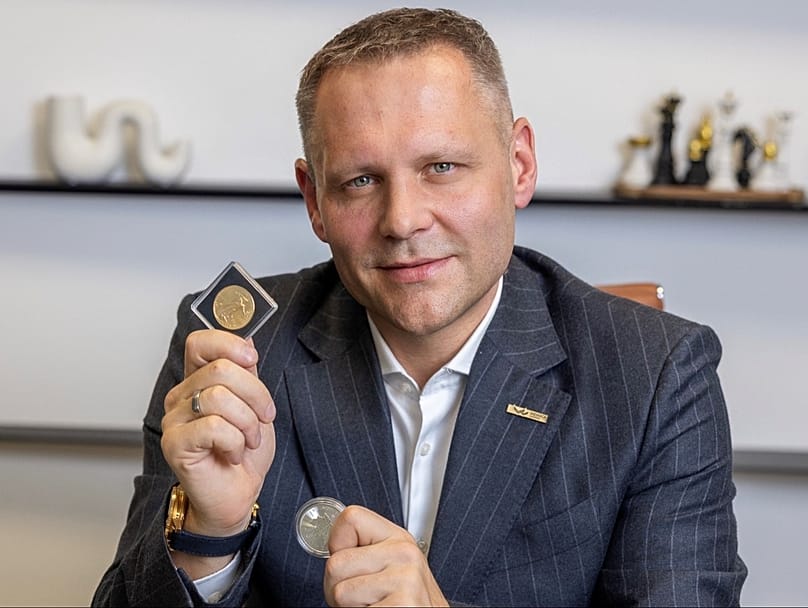
The pattern is not new. When Russia launched its full-scale invasion of Ukraine in February 2022, Mazurek said he learned of the attack not from the news but from his own order books.
"We saw it four years ago when the war in Ukraine broke out. Our company became aware that something bad had happened not [just] because of the headlines or the news, it was because we saw an exponential increase in interest in buying gold, queues in front of the company," Mazurek recalled.
"The war was a factor that influenced people to buy gold en masse [in] panic."
Gold at home vs in Central Banks
According to the Forex Club, 21% of Poles began investing in gold in 2025, with the largest percentage (12%) entering the market between April and November.
Mazurek said the trend was visible in his own sales figures.
"Interest in physical bullion is growing year-on-year by 30%-50%, mainly among individual buyers," he said, noting that the average transaction values had also risen, partly reflecting higher spot prices.
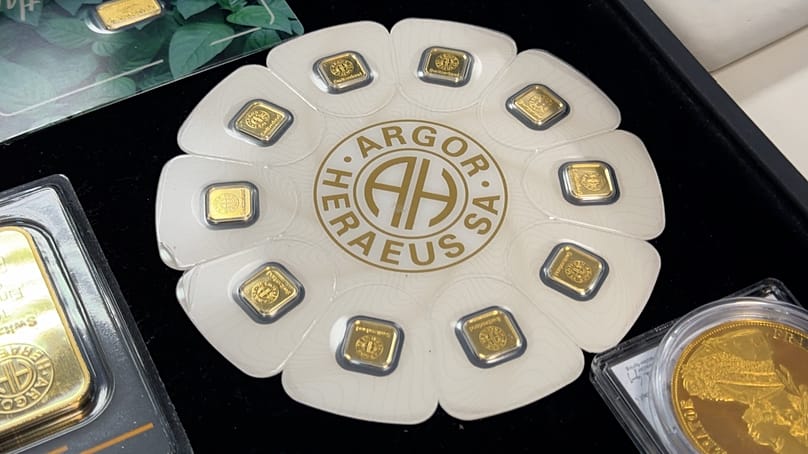
1-50 gram bars and bullion coins are the most popular entry points.
Despite the growth, Poland remains a laggard by regional standards.
Between 10% and 15% of Poles hold gold in their portfolios, against a markedly higher share among their Western neighbours.
In Germany, private households hold an estimated 9,000-9,300 tonnes — more than the Bundesbank's 3,350-3,378 tonnes.
In Poland the position is reversed: the National Bank holds around 550 tonnes, while private holdings are estimated at 200-500 tonnes.
At the start of 2023, the average Pole held roughly three grams of gold while the average German held around 103 grams.
Globally, private gold ownership is concentrated in South and East Asia.
India leads with an estimated 26,000-34,600 tonnes, largely in jewellery passed down through generations.
China holds 23,000-31,000 tonnes, the United States around 26,000 tonnes.
Turkey is a notable outlier in its region: the World Gold Council recorded 80 tonnes of purchases in 2022 alone, driven by inflation that reached 80% annually and deep mistrust in the lira.
Central banks have been accumulating gold at record levels for four consecutive years, with institutions from the ECB to those in China and India to diversify reserves and reduce dollar exposure amid deepening geopolitical fragmentation.
According to Pawel Mazurek, this should be a signal to private investors:
"Private investors are not so much copying, but... I think they are taking a good example from central banks, because the physical gold that is being bought by central banks is to hedge sovereign finances."
"So since central banks are making such large purchases and keeping large stockpiles of physical gold, it is a signal that individual investors should also consider securing their private wealth in physical bullion."
Changing investor awareness
Patrice Mesnier, founder of Oldenburg Capital Partners in Luxembourg, sees the current demand as more than a reaction to headlines.
"The immediate reaction is predictable: when there is a major geopolitical rupture, private buyers reach for coins and bars. What distinguishes the current moment is the persistence of this demand," he explained to Euronews.

Mesnier argues that retail demand had been building for months before the latest escalation, driven by something more than defensive instinct.
"Buying is no longer purely defensive. Investors increasingly understand that the scarcity of gold is fixed, while the supply of fiat money is volatile and reactive, and this shift in awareness does not disappear as soon as the headlines go quiet."
He locates the deeper shift in a slow erosion of confidence in dollar-denominated assets, compounded by the inflationary drag of prolonged geopolitical fragmentation.
"Gold retains a stable intrinsic value precisely because its production cannot increase significantly," he said, adding that above-ground reserves are vast while in-ground deposits remain limited — a fundamental reality the current crisis does nothing to alter.
The advantages of physical gold
Aneta Mazurek of the Mazovia Mint points first to mobility.
When Ukrainians fled in 2022, she notes, they could only take what fit in a pocket or suitcase and gold, unlike property, art or vehicles, can be carried out in an emergency.
The second advantage is fiscal. Under EU law, the supply, intra-Community acquisition and import of investment gold are exempt from VAT.

Thirdly, global liquidity:
"Gold can actually be sold all over the world for any currency. It's very liquid. So actually, when it comes to buying it is very simple, because you just have to have the money and pay for it. And when it comes to selling it is exactly the same. Gold is always in demand."
Mazurek adds that gold is easily divisible — available in formats such as combibars, which are scored like chocolate — and straightforward to store. "A kilogram, she notes, worth around £600,000, is roughly the size of a smartphone."
The price of gold ended 2025 at around $4,000 per ounce, rising as high as $5,500 in January 2026.
This spike was driven not only by geopolitics but also by the inflation crisis.
Forecasts for the end of 2026 from analysts at institutions such as JP Morgan, Wells Fargo, UBS, CIBC, Deutsche Bank and Société Générale even point to levels in excess of $6,000.
Ukraine's Oschadbank demands money back
and denies opposition links after Hungary
cash seizure
The bank is demanding the return of $40m, €35m and 9kg of gold seized by Hungarian authorities near Budapest, flatly rejecting Hungarian claims the funds were linked to organised crime or opposition party financing. The personnel on the cash-carrier have been banned from the EU for three years.
Ukraine's Oschadbank is demanding the immediate return of cash and gold confiscated by Hungarian authorities last week, lawyers representing the bank in Hungary told Euronews.
The incident triggered a diplomatic row after Hungarian police raided a convoy of cash carriers near Budapest and seized $40 million, €35 million and 9kg of gold.
Hungary expelled seven Ukrainian nationals accompanying the transport the following day and opened an investigation into suspected money laundering.
Horváth Lawyers, a law firm representing Oschadbank and its seven employees in Hungary, told Euronews that the Ukrainian vehicles were carrying out a routine transfer from Austria's Raiffeisen Bank to Oschadbank's headquarters in Kyiv.
'Conducted lawfully'
"The origin, purpose, and legal title of the funds can be clearly identified by documentary evidence, and there is no evidence to suggest that the money is derived from or related to criminal activity," the law firm said, adding that the seizure must be ended immediately.
The lawyers noted that Oschadbank had been conducting cash transfers through Hungary since Russia launched its full-scale invasion of Ukraine in 2022, with the knowledge of Hungarian authorities.
"The transfer was conducted lawfully, under the control of the relevant authorities," they said.
Ukrainian Foreign Minister Andrii Sybiha accused Hungary of kidnapping and state terrorism, while his Hungarian counterpart, Péter Szijjártó, said the funds could be linked to criminal activities.
"The question rightly arises whether this is not the money of the Ukrainian war mafia," Szijjártó said.
János Lázár, Hungary's minister for construction and transport, suggested the funds could be used to finance opposition parties ahead of Hungarian elections.
Horváth Lawyers rejected both claims.
"The data from the proceedings do not support those political statements. Based on our knowledge, the case has no Hungarian party financing implications and no Ukrainian criminal groups have been implicated," the firm said.
Seven Ukrainians banned from EU
Horváth Lawyers also disclosed that the seven Ukrainian nationals they represent have been banned from the Schengen area and the broader European Union for three years, with Hungary citing national security grounds.
"The case also contains several elements that are of legal concern, including the lack of substantive content of the national security justification, the limited transparency of the reasoning behind the decision, and the narrow scope of legal remedies," the firm said.
The lawyers indicated the concerns raised could form the basis of a case before the European Court of Human Rights.

No comments:
Post a Comment