Volkswagen slashes 50,000 jobs after profits collapse by nearly half
Volkswagen Group profits slumped by almost half in 2025. Trade conflicts, difficulties in China and the change in strategy at Porsche are putting Europe's largest car manufacturer under pressure.
The Volkswagen group had a bruising year in profits and plans to cut 50,000 jobs in Germany by 2030 — a dramatic escalation of its cost-cutting programme after net profit slumped 44% to €6.9bn in 2025, the carmaker's worst result since the diesel emissions scandal nearly a decade ago.
The announcement, made by chief executive Oliver Blume in Wolfsburg on Tuesday, goes well beyond the 35,000 job reduction the group had already agreed with trade unions at the end of 2024.
Revenue stagnated at around €322bn, while operating profit almost halved to around €8.9bn, according to Europe's largest carmaker.
Chief financial officer Arno Antlitz cited a "challenging environment" of geopolitical tensions, new trade barriers and intensifying competition, particularly from China.
Volkswagen shares rose nearly 3.7% in Frankfurt on Tuesday morning, lifted by the broader market rally that followed Donald Trump's comments on Iran sanctions and a potential end to the conflict.
In 2015, Volkswagen was found to have installed software in millions of diesel vehicles designed to cheat emissions tests, making cars appear far cleaner than they were during testing — a scandal that wiped billions from the company's market value, triggered criminal prosecutions and cost the group upwards of €30bn in fines, settlements and recalls worldwide.
The current predicament is considered to be more damaging than the 2015 scandal.
Problems in China and the US
Although Volkswagen grew in Europe, this was not enough to compensate for declines in China and North America. The Group delivered around 8.98 million vehicles worldwide in 2025 — a decrease of 0.5%.
Trump's tariffs hit the US market for Volkswagen cars particularly hard, while changes to environmental regulations and the withdrawal of government subsidies have cooled demand for electric vehicles — putting pressure on planned projects including a new plant for electric pick-up trucks under the group's Scout brand.
The squeeze is equally acute in China, long Volkswagen's most important growth market, where local manufacturers including BYD, Geely and Nio are closing the technological gap and gaining market share.
In response, Volkswagen is doubling down on an "in China for China" strategy with local development and local supply chains, which analysts consider crucial to the group's long-term prospects.
The pain has been felt most acutely at Porsche.
The sports car brand suffered a sharp drop in Chinese sales while absorbing the costs of a strategic reversal.
Having long prioritised electric vehicles, Porsche is now pivoting back toward combustion engine models.
Inflated pay bonuses?
Operating profit collapsed from around €5.3bn in 2024 to just €90m last year.
The earnings collapse has not, however, dented executive pay and that is causing anger.
Despite the group's worst results in nearly a decade, members of the Volkswagen executive board are again receiving bonuses totalling millions, driven largely by net cash flow — the cash remaining after investments and running costs — which hit €6.4bn, the highest target level in the remuneration system.
According to media reports, total bonus payments to the management board came to around €13.6m.
Chief executive Oliver Blume received total remuneration of around €7.4m — slightly less than the previous year, partly due to a voluntary pay waiver.
Employee representatives are now demanding that the workforce share in the strong cash flow, with talks over possible special payments under way.
Hope for recovery in 2026
Despite the weak annual results, the Group has recently been somewhat more stable.
In the final quarter, business developed better than before. Volkswagen had previously reported a loss of more than €1bn in the third quarter due to special charges at Porsche.
The Group now expects profitability to improve again in 2026. The operating margin is expected to rise to between 4.0 and 5.5%, after falling to 2.8% in 2025.
Volkswagen Group profits take big hit on
Porsche shift
Strategic readjustment at Porsche, as well as dwindling sales in both main export markets, the US and China took a big bite out of VW's 2025 profits — which almost halved.

Volkswagen's top executives on Tuesday said the vast automotive empire suffered a 44% reduction in net profits in 2025, with gains after tax dropping to €6.9 billion (roughly $8 billion) from 12.4 billion in 2024.
That's the company's worst annual overall performance since 2016, at the height of the financial fallout from the so-called "Dieselgate" scandal.
"2025 was punctuated by geopolitical tensions, tariffs and highly intense competition," Chief Financial Officer Arno Antlitz said in the company press release.
The VW Group is planning 50,000 job cuts across its various brands by 2030. It is struggling with falling demand and rapidly improving homemade competition in China, as well as new tariffs in the US, by far its two biggest export markets.
Like the rest of the German car industry, the VW Group is also struggling with managing and judging the pace of the shift towards electric motoring. Targets and incentives often vascillate and vary by region and public demand remains lower than many politicians and industry leaders had hoped.
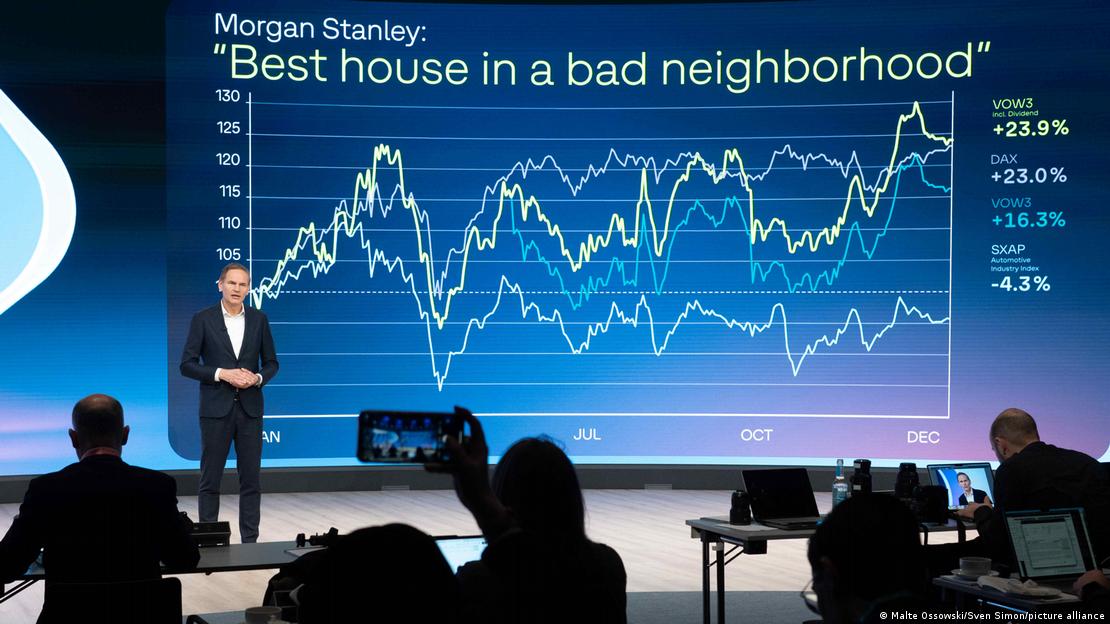
Nevertheless, VW CEO Oliver Blume tried to emphasize the positives, for instance pointing to comparatively strong recent performance of VW Group shares when compared to the industry as a whole in his presentation aimed in no small part at shareholders.
Porsche's electric slowdown takes big bite out of profits
A vast chunk of this dip was attributable to VW's performance brand and longest-standing partner Porsche, with the Stuttgart-based company's net profits all but wiped out. The company logged a net profit of just €90 million, compared to €5.3 billion in 2024.
"The reasons for the reduction are a fundamentally changed market environment in China, the US tariffs, the slower rise of electromobility and the one-off and special effects that are connected with it," VW wrote in the "Sport Luxury" segment of its annual report that pertains to Porsche's performance.
The works council said that Porsche's decision late last year to extend its production running times for combustion engine models accounted for a one-off financial hit in the region of €5 billion. It also said that US tariffs led to lost revenues in the region of €3 billion.
Once a major cash cow for the VW Group, Porsche has struggled in particular with the rapid advent of higher quality Chinese-made luxury and performance cars emerging as a serious rival to its top end sales in China faster than most in the industry anticipated.
Germany's Porsche pauses shift to EVs as profits tank 02:11
What did the company's other core figures look like?
As Porsche's balance sheet to a huge hit, other parts of the company performed better than some of 2025's doom-laden headlines seemed to suggest, perhaps helping to explain why VW share prices jumped on Tuesday morning amid the nominally bad news.
Some of the key figures across the group's main marques follow here: The Group as a whole delivered 8.98 million vehicles across all brands, a dip of just 0.5% from 2024
Total revenue was €322 billion, down roughly 0.8%
VW operating profit rose marginally, from €2.59 billion to €2.61 billion
Audi's operating profit dipped to €3.4 billion from €3.9 billion
The Group's operating profit margin dipped 3.1 percentage points to just 2.8%; VW predicts a sharp rebound again in 2026
Performance rebounded in the last quarter, following a €1 billion loss in the third quarter of 2025
Job cuts and cost cutting planned, bosses' pay packets also impacted
CEO Blume confirmed in his letter to shareholders that the company was sticking to its job cut plans hammered out with trade unions in recent months.
"In total, around 50,000 jobs are due to be cut by 2030 across the Volkswagen Group in Germany," he wrote.
A large chunk of these, roughly 35,000, will be cut at the parent company VW. Audi also plans to shed up to 7,500 jobs by 2029, while Porsche had announced plans to cut around 3,900 jobs. But the companies are aiming to achieve these plans primarily via job-sharing or part-time deals for older workers and voluntary severances, not redundancies.
CEO Blume also faced reduced rewards in 2025 as performance dipped and as he was replaced as the CEO of Porsche, from which he had graduated to head the VW Group as a whole. The company's annual report showed Blume was paid a total of €7.4 million, including his pension package and various performance-related payments, in 2025, a dip of around €3 million.
Blume's predecessor Herbert Diess was again the top-paid VW manager, earning a total of €9 million. Diess was replaced by Blume in 2022 but remained on the payroll and only went into retirement in October 2025.
As of midday on Tuesday, Porsche's shares were up around 2% and VW's shares had risen by just over 2.5%. But the losses had already been priced in by the market during a torrid 2025. A Porsche share was worth around €20 more this time last year, and the same can be said for VW's stock. Longer term, both companies' share prices have more than halved in the past five years.
Edited by: Rob Turner
In the Home State of Porsche & Mercedes – Greens & AfD Won

In the recent state election (8 March 2026), Germany’s environmentalist “the Greens” and the exact opposite – the neo-fascist AfD – won big time.
By an extremely narrow margin, the Greens are once again the strongest force in the 11.5-million-people-strong south-western state of Baden-Württemberg – the home of, for example, the electronics maker Robert Bosch GmbH with 414,000 workers, the discounter Lidl with 250,000 workers, Mercedes-Benz (166,000), nuts-and-bolts maker Würth (88,000), dm pharmacy (70,000), Heidelberger Cement (51,000), EDEKA supermarkets (44,000), Carl Zeiss (41,000), and Porsche (41,000).
Despite – or because of – being part of Germany’s manufacturing heartland, the Greens raked in 30.2%. This is slightly below the results of the last two state elections (2021: 32.6%, 2016: 30.3%). Germany’s conservatives – the CDU – achieved the second-highest vote with 29.7% (+5.6%). Even though the conservatives improved significantly, the CDU came in 0.5% behind the Greens.
Germany’s neo-fascist AfD came in third place with 18.8%, almost doubling its result while recording its highest gain (+9.1%). Germany’s once working-class party, the social-democratic SPD, narrowly passed the 5% barrier, entering parliament with just 5.5%.
Both Germany’s socialist party, the progressive Left, and Germany’s staunchly neoliberal FDP missed entry into the state parliament. Both received 4.4% – below the 5% hurdle needed to enter parliament. The Left gained 0.8%, while the neoliberal FDP lost 6.1%.
All in all, the CDU accounts for 56 seats (+14 seats); the Greens also receive 56 seats. The neo-Nazis of the AfD will receive 35 seats, and the SPD will have 10 seats. There are 53 women among the 157 members of the new state parliament – 33.8%. The Greens and the SPD have the highest proportion of women with 50.0%. The “old-man party” – the AfD – has 11.4%. The Führer must be male.
The average age of the new parliament is 48.5 years. The youngest MP is 23 years old and from the CDU. The oldest is 75 years old and from the “old-men” party, the AfD. Voter turnout has increased by 5.8%.
The highest participation was – with 76.2% – in one of Germany’s most environmental cities, Freiburg, as well as in the university town of Tübingen with 62%. The lowest turnout occurred in Mannheim with 54.3%, where the neo-fascist AfD was strong. In other words, the higher the education, the more likely people are to vote. The stupid do not vote and, if they do, they vote for the AfD. Postal votes accounted for 35.8%.
The AfD’s neo-Nazism has been normalized in the Baden-Württemberg state election despite widespread scandals about nepotism. Baden-Württemberg is the state that once – from 1958 to 1978 – had a real Nazi, Filbinger, as state premier. This was spiced up by yet another Nazi – Kurt Georg Kiesinger.
This is also the state where the predecessor of the AfD – the even more openly neo-Nazi NPD – gained 12 seats in Baden-Württemberg’s parliament in 1968, and another neo-Nazi party, called REP, got 14 seats in 1992 and 1996. In 1932, Hitler’s Nazis got 37.3% – twice that of today’s neo-Nazis. In short, Nazism and neo-Nazism have accompanied the state since the 1930s.
Still, given Hitler’s result, the AfD had expected more. At the obligatory cheering on election night, the AfD’s top apparatchik – the Romanian shorty Markus Frohnmaier – stood in front of TV cameras without the party’s “official” leaders, the Swiss lesbian Alice Weidel and Tino Chrupalla, and without the real leader of the AfD – Björn Höcke – internally greeted with “Heil Höcke”. The “Mein Führer” is only used in intimate privacy.
Overall, the AfD got just below 19%, which is pretty close to the 20% mark that is the norm for Germany’s hard-core Nazis. This is what the lawyer, journalist, and historian Sebastian Haffner found while being in the UK when examining Hitler’s Germany during the 1930s and 1940s.
Back in today’s Baden-Württemberg, the neo-Nazi AfD fell short of its own extremely high expectations. The Romanian stocky is not Adolf Hitler. During the election campaign, pocket-sized Fron(t)maier holidayed in the USA on tax money financed by the hated state. It was worth the trip. The idiots voted for his party regardless.
Worse for the AfD, local businesses like Mercedes no longer support the Nazis. Today, these corporations fear the AfD and its plan to leave the euro currency and even the EU – their most important market. Yet local polling for a very long time saw the neo-fascist AfD over 20%, even at 25%. Nevertheless, the neo-Nazis gained around 9%. In 2021, the AfD was at 10%. Now it is 19%.
After struggling for weeks with a scandal over nepotism and the looting of state coffers, voters rewarded those on the take with a 9% increase. In the nepotism affair, the leading candidate Markus Frohnmaier was also one of those who profited handsomely while looting the hated state. At the official closing of the election campaign, Putin-worshipper, warmonger, and miniature action-man Fro(t)maier – he likes the military front – was absent.
Internally he is defamed as a “paper German” – German by passport, not by birth. In the racist mythology of the AfD, being born in Romania means Frohnmaier is not a “biological” or “racial German.” Frohnmaier isn’t an Aryan.
While not even standing for the state parliament himself, Frohnmaier was absent. He had travelled to the USA at short notice for so-called “important economic contacts for Baden-Württemberg”. Being on the take means, in Frohnmaier’s case, that his own wife is “employed” by a party friend in Germany’s parliament, the Bundestag.
Even his father works for another AfD member – also of the Bundestag. His sister had worked for a member of the state parliament. Frohnmaier confirmed this. Virtually the entire family looted the much-hated state.
Behind the scenes, mini-man Frohnmaier was criticized for his sudden trip to the USA. The “under-built” Frohnmaier was missing in action. Despite everything, the result for the AfD was a record result. In other words, fools are easily fooled by good AfD propaganda – the Führer and his off-sider Goebbels showed the way. It worked then and it works now.
Historically, the neo-Nazis have had above-average success in Germany’s south-west since its foundation, because they can feast on long-standing and deeply engraved far-right ideological mentalities – especially in rural Christian-conservative regions. Yet the AfD’s 19% also means that 81% did not vote fascist.
And indeed, surveys show that 60% believe the AfD endangers democracy and the rule of law; 72% do not want to see the AfD in government. On the downside, 25% are in favor of government participation by the AfD.
Beyond all this, the neo-Nazis remain the most unpopular party and politically isolated – even if it would be mathematically sufficient to create a so-called hazelnut coalition government consisting of black (CDU) and brown (neo-Nazi).
However, the normalization of neo-Nazism is progressing. Worse, 47% of AfD voters said they voted for the extreme right out of conviction. The would-like-to-be strongman Markus Frohnmaier was mentioned by only 18% of AfD voters as important for their decision.
65% stated that the AfD’s party program – with its neo-liberal and deeply racist ideology – was important, while only 9% mentioned long-term party loyalty.
The age distribution for the AfD shows an inverted “U”. The AfD scored below average at both ends of the age spectrum – among the over-70s and the 16–24-year-olds. The AfD achieved its best results among the 35–44-year-olds and the 25–34-year-olds. The 60–69-year-olds are at 18%, making the neo-fascist AfD a party of middle-aged to older men.
Across occupational groups, workers vote for the party with above-average frequency (34%), the self-employed are represented at an average of 18%, and pensioners are represented at a below-average rate of 13%. In other words, the AfD is a party of middle-aged men not yet having reached pension age.
One of the most common constants is the gender-specific trend that the AfD is more often chosen by men and less by women. The neo-fascist AfD also performed more strongly in smaller municipalities under 100,000 inhabitants and worse in large cities with above 100,000 inhabitants.
In terms of ideological movements, one can say that when conservatives copy AfD positions – racism and ethnic cleansing (framed as “re-migration”) – the original (the AfD) benefits, not the copy (the conservative CDU).
In addition, the AfD benefited (26%) from non-voters. Meanwhile, 39% of AfD voters said that they had already voted for the neo-Nazis in the last state election. The election once again showed that neo-Nazi extremism is not exclusively an East-German problem.
Despite this record result in Baden-Württemberg, it is only the second-best result so far in a West-German state. In neighbouring Hessen, the AfD entered the state parliament with 18.4% in 2023 – close to Haffner’s standard 20% for Hitler’s Nazis during the 1930s.
Looking east, the AfD achieved its highest result in any state election in Thuringia – the Mustergau – in 2024 with 33%.
Yet there is also the environmental-progressive Baden-Württemberg. A visit to the city of Freiburg is instructive (Green: 42% and The Left: 18%). Party membership for Germany’s progressives – the Left – in Freiburg jumped from just 300 in 2023 to today’s 1,200. Meanwhile, Freiburg is also a Green stronghold. In Freiburg, the neo-fascist AfD is viewed as something for “people with half a brain.”

No comments:
Post a Comment