Death Toll of Paramedics Killed by Israel in Lebanon Climbs to 15
A medical charity leader said Israel is using its Gaza “playbook” during its assaults on Lebanon, including “collective punishment, forced displacement, and the deliberate terrorizing of civilian populations.”
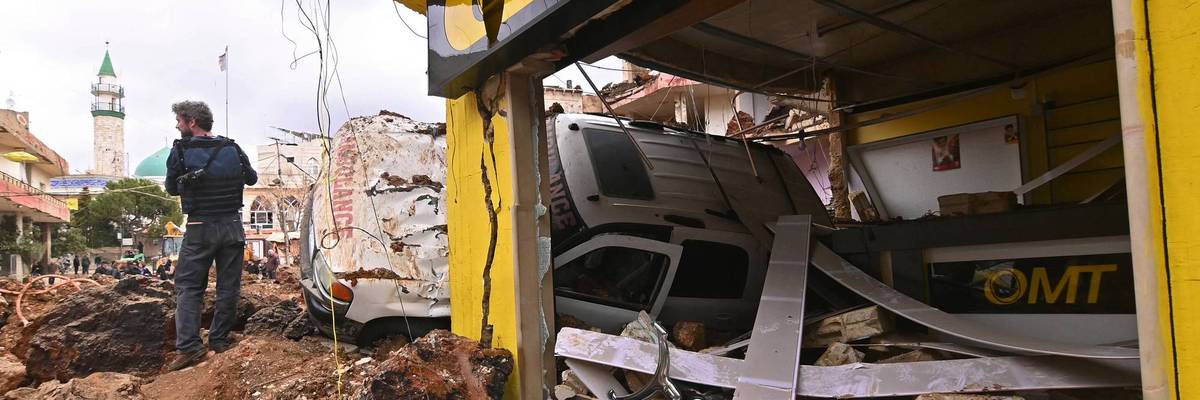
A photographer stands next to an overturned ambulance at Nabi Sheet town after an Israeli military operation in the Bekaa Valley of Lebanon, on March 7, 2026.
(Photo by Fadel Itani/AFP via Getty Images)
Stephen Prager
Mar 10, 2026
COMMON DREAMS
Israeli attacks in Lebanon have killed at least 15 paramedics and wounded another 30 in just over a week, according to a report from the Islamic Health Authority on Tuesday.
The report comes after a pair of strikes targeted emergency response teams in South Lebanon the previous day, killing two paramedics and wounding several others.
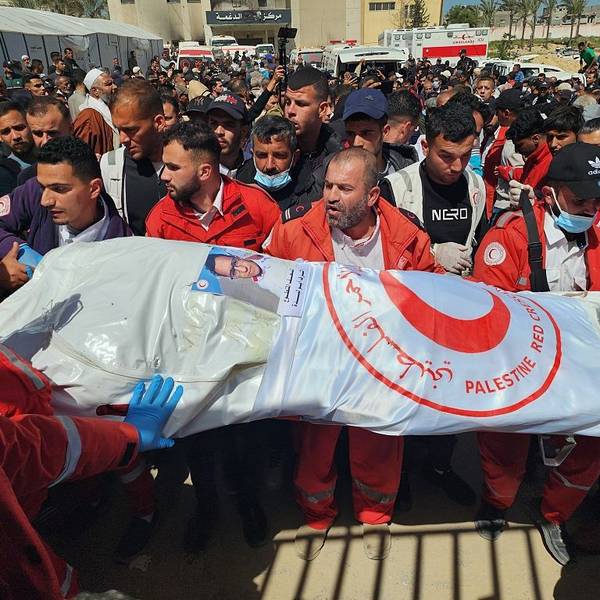
Investigation Details IDF’s ‘Execution-Style’ Massacre of Gaza Medics

‘10 Classrooms Full of Children’: US-Israeli War Kills Hundreds of Iranian, Lebanese Kids
It was the latest in what the Lebanese Public Health Ministry described as systemic attacks on ambulance and rescue teams that have been waged by Israel since it restarted its assault on Lebanon last week, which has prompted the World Health Organization (WHO) to urge their protection.
“The risk that more health workers will count among the casualties is high,” said WHO Director-General Tedros Adhanom Ghebreyesus, following an attack on the southern Tyre district where three paramedics were killed last week. “This must be avoided at all costs, so paramedics, doctors, and nurses can be allowed to carry out their lifesaving work, which is especially needed in times of crisis.”
A report on Sunday from Health Minister Rakan Nassereddine said that at least four hospitals in Lebanon had been damaged by Israeli strikes since March 2.
Lebanon’s Health Ministry reported that as of Tuesday, at least 570 people have been killed and 1,444 have been wounded from Israeli airstrikes since March 2.
Meanwhile, more than 750,000 people have been displaced from their homes following orders from the Israeli military last week, according to the UN Children’s Fund.
Nassereddine said that shelling has forced the ministry to quickly evacuate patients and those injured in the latest onslaught to other hospitals. At least 40 hospitals in Lebanon were damaged in Israel’s previous assault on the country in 2023-24, according to health ministry data.
The US and Israel have waged an even larger assault on hospitals in Iran since February 28. Health Ministry spokesperson Hossein Kermanpour said Sunday that 25 hospitals have been damaged, with nine totally out of service. He said 14 ambulances have also been destroyed.
Emphasizing that medical and humanitarian workers are protected under international law, the Lebanese Islamic Health Authority said that attacks on hospitals “constitute a blatant violation of all international conventions, foremost among them the Geneva Conventions.”
The group Medical Aid for Palestinians (MAP), a UK-based charity, has accused Israel of applying the same methods it used in Gaza as it has launched its latest military assault on Lebanon.
During Israel’s more than two-year-long genocide, it launched strikes that damaged every hospital in the strip. According to research from MAP, Israeli attacks killed about two to three medical workers per day on average.
“What we are witnessing in Lebanon is the unmistakable extension of the Israeli military playbook used in Gaza,” Steve Cutts, the CEO of MAP, said. He said this includes “collective punishment, forced displacement, and the deliberate terrorizing of civilian populations, including already traumatized Palestinian communities.”
A medical charity leader said Israel is using its Gaza “playbook” during its assaults on Lebanon, including “collective punishment, forced displacement, and the deliberate terrorizing of civilian populations.”
A photographer stands next to an overturned ambulance at Nabi Sheet town after an Israeli military operation in the Bekaa Valley of Lebanon, on March 7, 2026.
(Photo by Fadel Itani/AFP via Getty Images)
Stephen Prager
Mar 10, 2026
COMMON DREAMS
Israeli attacks in Lebanon have killed at least 15 paramedics and wounded another 30 in just over a week, according to a report from the Islamic Health Authority on Tuesday.
The report comes after a pair of strikes targeted emergency response teams in South Lebanon the previous day, killing two paramedics and wounding several others.
Investigation Details IDF’s ‘Execution-Style’ Massacre of Gaza Medics
‘10 Classrooms Full of Children’: US-Israeli War Kills Hundreds of Iranian, Lebanese Kids
It was the latest in what the Lebanese Public Health Ministry described as systemic attacks on ambulance and rescue teams that have been waged by Israel since it restarted its assault on Lebanon last week, which has prompted the World Health Organization (WHO) to urge their protection.
“The risk that more health workers will count among the casualties is high,” said WHO Director-General Tedros Adhanom Ghebreyesus, following an attack on the southern Tyre district where three paramedics were killed last week. “This must be avoided at all costs, so paramedics, doctors, and nurses can be allowed to carry out their lifesaving work, which is especially needed in times of crisis.”
A report on Sunday from Health Minister Rakan Nassereddine said that at least four hospitals in Lebanon had been damaged by Israeli strikes since March 2.
Lebanon’s Health Ministry reported that as of Tuesday, at least 570 people have been killed and 1,444 have been wounded from Israeli airstrikes since March 2.
Meanwhile, more than 750,000 people have been displaced from their homes following orders from the Israeli military last week, according to the UN Children’s Fund.
Nassereddine said that shelling has forced the ministry to quickly evacuate patients and those injured in the latest onslaught to other hospitals. At least 40 hospitals in Lebanon were damaged in Israel’s previous assault on the country in 2023-24, according to health ministry data.
The US and Israel have waged an even larger assault on hospitals in Iran since February 28. Health Ministry spokesperson Hossein Kermanpour said Sunday that 25 hospitals have been damaged, with nine totally out of service. He said 14 ambulances have also been destroyed.
Emphasizing that medical and humanitarian workers are protected under international law, the Lebanese Islamic Health Authority said that attacks on hospitals “constitute a blatant violation of all international conventions, foremost among them the Geneva Conventions.”
The group Medical Aid for Palestinians (MAP), a UK-based charity, has accused Israel of applying the same methods it used in Gaza as it has launched its latest military assault on Lebanon.
During Israel’s more than two-year-long genocide, it launched strikes that damaged every hospital in the strip. According to research from MAP, Israeli attacks killed about two to three medical workers per day on average.
“What we are witnessing in Lebanon is the unmistakable extension of the Israeli military playbook used in Gaza,” Steve Cutts, the CEO of MAP, said. He said this includes “collective punishment, forced displacement, and the deliberate terrorizing of civilian populations, including already traumatized Palestinian communities.”
HRW accuses Israel of using white phosphorus over Lebanese town
Human Rights Watch on Monday accused Israel of unlawfully using white phosphorus munitions over residential areas of the southern Lebanese town of Yohmor on March 3. The New York-based group said it verified and geolocated images showing airburst munitions over homes, with civil defence workers responding to fires in houses and a car.
Issued on: 10/03/2026 -
By: FRANCE 24


Human Rights Watch on Monday accused Israel of unlawfully using white phosphorus munitions over residential areas of the southern Lebanese town of Yohmor on March 3. The New York-based group said it verified and geolocated images showing airburst munitions over homes, with civil defence workers responding to fires in houses and a car.
Issued on: 10/03/2026 -
By: FRANCE 24
A smoke cloud erupts from the site of an Israeli airstrike on Beirut's southern suburbs on March 9, 2026. © Ibrahim Amro, AFP
Human Rights Watch on Monday accused Israel of "unlawfully" using white phosphorus over residential parts of a southern Lebanese town last week.
"The Israeli military unlawfully used artillery-fired white phosphorus munitions over homes on March 3, 2026, in the southern Lebanese town of Yohmor," the New York-based rights group said in a report.
HRW added that it "verified and geolocated seven images showing airburst white phosphorus munitions being deployed over a residential part of the town and civil defense workers responding to fires in at least two homes and one car in that area".
In response, the Israeli military said it "is currently unaware and cannot confirm use of shells that contain white phosphorus in Lebanon as claimed."
The army said its policy was not to use shells containing white phosphorus "in densely populated areas, with certain exceptions."
White phosphorus, a substance that ignites on contact with oxygen, can be used to create smokescreens and to illuminate battlefields.
But the munition can also be used as an incendiary weapon and can cause fires, horrific burns, respiratory damage, organ failure and death.
Human Rights Watch on Monday accused Israel of "unlawfully" using white phosphorus over residential parts of a southern Lebanese town last week.
"The Israeli military unlawfully used artillery-fired white phosphorus munitions over homes on March 3, 2026, in the southern Lebanese town of Yohmor," the New York-based rights group said in a report.
HRW added that it "verified and geolocated seven images showing airburst white phosphorus munitions being deployed over a residential part of the town and civil defense workers responding to fires in at least two homes and one car in that area".
In response, the Israeli military said it "is currently unaware and cannot confirm use of shells that contain white phosphorus in Lebanon as claimed."
The army said its policy was not to use shells containing white phosphorus "in densely populated areas, with certain exceptions."
White phosphorus, a substance that ignites on contact with oxygen, can be used to create smokescreens and to illuminate battlefields.
But the munition can also be used as an incendiary weapon and can cause fires, horrific burns, respiratory damage, organ failure and death.
© France 24
01:43
01:43
Israel -- which kept up strikes targeting Hezbollah despite a 2024 ceasefire -- launched multiple waves of strikes across Lebanon since last week and sent ground troops into border areas after the Iran-backed group attacked it.
The Israeli army has since repeatedly called on people living south of the Litani River, around 30 kilometres (20 miles) north of the Israeli border, to leave.
At least 394 people have been killed in Israeli attacks, Lebanese authorities said, registering more than half a million people as displaced.
"The Israeli military's unlawful use of white phosphorus over residential areas is extremely alarming and will have dire consequences for civilians," Ramzi Kaiss, Lebanon researcher at HRW, was quoted as saying in the report.
"Israel should immediately halt this practice and states providing Israel with weapons, including white phosphorus munitions, should immediately suspend military assistance and arms sales and push Israel to stop firing such munitions in residential areas," he added.
Lebanese authorities and HRW have over the past years accused Israel of using controversial white phosphorus rounds, in attacks authorities say have harmed civilians and the environment.
Lebanon's state-run National News Agency on Sunday said Israeli forces targeted the towns of Khiam and Tal Nahas, near the border with Israel, "with artillery and phosphorus shelling".
Last month, Lebanon accused Israel of spraying the herbicide glyphosate on the Lebanese side of their shared border, with President Joseph Aoun decrying it as a "crime against the environment".
(FRANCE 24 with AFP)
The Israeli army has since repeatedly called on people living south of the Litani River, around 30 kilometres (20 miles) north of the Israeli border, to leave.
At least 394 people have been killed in Israeli attacks, Lebanese authorities said, registering more than half a million people as displaced.
"The Israeli military's unlawful use of white phosphorus over residential areas is extremely alarming and will have dire consequences for civilians," Ramzi Kaiss, Lebanon researcher at HRW, was quoted as saying in the report.
"Israel should immediately halt this practice and states providing Israel with weapons, including white phosphorus munitions, should immediately suspend military assistance and arms sales and push Israel to stop firing such munitions in residential areas," he added.
Lebanese authorities and HRW have over the past years accused Israel of using controversial white phosphorus rounds, in attacks authorities say have harmed civilians and the environment.
Lebanon's state-run National News Agency on Sunday said Israeli forces targeted the towns of Khiam and Tal Nahas, near the border with Israel, "with artillery and phosphorus shelling".
Last month, Lebanon accused Israel of spraying the herbicide glyphosate on the Lebanese side of their shared border, with President Joseph Aoun decrying it as a "crime against the environment".
(FRANCE 24 with AFP)
.jpg)
Father Pierre El Raii was pastor of a Maronite parish in southern Lebanon.
| Credit: Photo courtesy of Aid to the Church in Need
March 10, 2026
EWTN News
By Diego López Marina
Pope Leo XIV has expressed his sorrow over the death of a priest in southern Lebanon, a victim of an Israeli bombing on Monday, March 9.
“Pope Leo XIV expresses his profound sorrow for all the victims of the bombings in the Middle East these past few days, for the many innocent people, including numerous children, and for those who were helping them, such as Father Pierre El-Rahi, a Maronite priest killed this afternoon in Qlayaa,” reads a statement released by the Holy See Press Office.
The pope, the Vatican message added, “is following the events with concern and prays for a swift end to all hostilities.”
El Raii, a Maronite parish priest in southern Lebanon, was killed in a bombing while going to the aid of a parishioner wounded in a earlier attack, according to Father Toufic Bou Merhi, a Franciscan of the Custody of the Holy Land, who spoke with Vatican media.
The pontifical foundation Aid to the Church in Need (ACN) confirmed the tragic news.
“Deeply disturbing reports indicate that a parish priest in southern Lebanon was killed in an Israeli attack. Father Pierre Al Rahi was ministering to his grieving parishioners in the village of Qlayaa when it was attacked,” the organization said in a statement.
The French Catholic organization L’Œuvre d’Orient (The Work of the Orient) strongly condemned the attack and warned of the growing risk to the civilian population.
“L’Œuvre d’Orient condemns in the strongest terms these acts of war, which aim to destabilize all of Lebanon and kill innocent civilians. The death of a priest who refused to abandon his parish is a further escalation of senseless violence,” it said.
The attack occurred around 2 p.m. local Beirut time, exactly one week after the start of the intensification of Israeli bombing in the south of the country.
“There was an initial attack that hit a house near his parish, wounding one of the parishioners. Father Pierre rushed to his aid with dozens of young people. It was then that another bombing occurred at the same house. The priest was wounded,” recounted Bou Merhi, parish priest of the Latin communities of Tiro and Deirmimas.
The priest was taken to a local hospital but died shortly afterward.
El Raii was 50 years old and considered a leading figure for the Christians in the area. According to the Lebanese National News Agency (NNA), armed militants had entered the Qlayaa-Marjayoun area, as well as the nearby villages of Rmeish, Debel, and Ain Ebel, endangering previously safe communities.
Grief and fear in Christian community
The priest’s death has deeply affected the local Catholic community, which was already living under increasing pressure from the conflict.
“They are weeping over the tragedy and, at the same time, are very afraid. Until now, people didn’t want to leave their homes in Christian villages, but in this situation, everything has changed,” Bou Merhi said.
The priest explained that for many, leaving their homes practically means “living on the street or trying to rent a house, but people can’t afford it.”
Humanitarian crisis: Thousands of displaced persons
The conflict has also caused a serious humanitarian crisis. Bou Merhi reported that the Franciscan convent in Tyre is currently sheltering some 200 displaced people, all of them Muslims.
“We are taking them in. Where else can those in need find refuge in this situation?” he asked.
He explained that in Beirut alone there are nearly 500,000 displaced people, while almost 300,000 have fled the south of the country and thousands more have left the Bekaa Valley.
“People know what they are leaving behind: their homes, their belongings, their history. But they don’t know where to go. Many are sleeping in their cars or on the streets. We were not prepared to take in almost a quarter of the population,” he said.
Despite the circumstances, the Franciscan friar affirmed that the Christian communities are striving to maintain hope. “We say, and we repeat, that the last thing that must not die within us is hope in the Lord, who always gives us the strength to continue,” he stated.
“As the pope has said, weapons do not bring peace; they bring massacres and hatred. All we ask is to live with a little dignity,” he concluded.
Walter Sánchez Silva and Victoria Cardiel contributed to this report.
This story was first published by ACI Prensa, the Spanish-language sister service of EWTN News. It has been translated and adapted by EWTN News English.
EWTN News
EWTN News is the rebranding of the Catholic News Agency (CNA), following the decision by EWTN — which was launched as a Catholic television network in 1981 by Mother Angelica, PCPA — that brings CNA and its affiliated ACI international outlets under a single, unified identity. Previous CNA articles may be found by clicking here.
EWTN News
By Diego López Marina
Pope Leo XIV has expressed his sorrow over the death of a priest in southern Lebanon, a victim of an Israeli bombing on Monday, March 9.
“Pope Leo XIV expresses his profound sorrow for all the victims of the bombings in the Middle East these past few days, for the many innocent people, including numerous children, and for those who were helping them, such as Father Pierre El-Rahi, a Maronite priest killed this afternoon in Qlayaa,” reads a statement released by the Holy See Press Office.
The pope, the Vatican message added, “is following the events with concern and prays for a swift end to all hostilities.”
El Raii, a Maronite parish priest in southern Lebanon, was killed in a bombing while going to the aid of a parishioner wounded in a earlier attack, according to Father Toufic Bou Merhi, a Franciscan of the Custody of the Holy Land, who spoke with Vatican media.
The pontifical foundation Aid to the Church in Need (ACN) confirmed the tragic news.
“Deeply disturbing reports indicate that a parish priest in southern Lebanon was killed in an Israeli attack. Father Pierre Al Rahi was ministering to his grieving parishioners in the village of Qlayaa when it was attacked,” the organization said in a statement.
The French Catholic organization L’Œuvre d’Orient (The Work of the Orient) strongly condemned the attack and warned of the growing risk to the civilian population.
“L’Œuvre d’Orient condemns in the strongest terms these acts of war, which aim to destabilize all of Lebanon and kill innocent civilians. The death of a priest who refused to abandon his parish is a further escalation of senseless violence,” it said.
The attack occurred around 2 p.m. local Beirut time, exactly one week after the start of the intensification of Israeli bombing in the south of the country.
“There was an initial attack that hit a house near his parish, wounding one of the parishioners. Father Pierre rushed to his aid with dozens of young people. It was then that another bombing occurred at the same house. The priest was wounded,” recounted Bou Merhi, parish priest of the Latin communities of Tiro and Deirmimas.
The priest was taken to a local hospital but died shortly afterward.
El Raii was 50 years old and considered a leading figure for the Christians in the area. According to the Lebanese National News Agency (NNA), armed militants had entered the Qlayaa-Marjayoun area, as well as the nearby villages of Rmeish, Debel, and Ain Ebel, endangering previously safe communities.
Grief and fear in Christian community
The priest’s death has deeply affected the local Catholic community, which was already living under increasing pressure from the conflict.
“They are weeping over the tragedy and, at the same time, are very afraid. Until now, people didn’t want to leave their homes in Christian villages, but in this situation, everything has changed,” Bou Merhi said.
The priest explained that for many, leaving their homes practically means “living on the street or trying to rent a house, but people can’t afford it.”
Humanitarian crisis: Thousands of displaced persons
The conflict has also caused a serious humanitarian crisis. Bou Merhi reported that the Franciscan convent in Tyre is currently sheltering some 200 displaced people, all of them Muslims.
“We are taking them in. Where else can those in need find refuge in this situation?” he asked.
He explained that in Beirut alone there are nearly 500,000 displaced people, while almost 300,000 have fled the south of the country and thousands more have left the Bekaa Valley.
“People know what they are leaving behind: their homes, their belongings, their history. But they don’t know where to go. Many are sleeping in their cars or on the streets. We were not prepared to take in almost a quarter of the population,” he said.
Despite the circumstances, the Franciscan friar affirmed that the Christian communities are striving to maintain hope. “We say, and we repeat, that the last thing that must not die within us is hope in the Lord, who always gives us the strength to continue,” he stated.
“As the pope has said, weapons do not bring peace; they bring massacres and hatred. All we ask is to live with a little dignity,” he concluded.
Walter Sánchez Silva and Victoria Cardiel contributed to this report.
This story was first published by ACI Prensa, the Spanish-language sister service of EWTN News. It has been translated and adapted by EWTN News English.
EWTN News
EWTN News is the rebranding of the Catholic News Agency (CNA), following the decision by EWTN — which was launched as a Catholic television network in 1981 by Mother Angelica, PCPA — that brings CNA and its affiliated ACI international outlets under a single, unified identity. Previous CNA articles may be found by clicking here.

No comments:
Post a Comment