It’s possible that I shall make an ass of myself. But in that case one can always get out of it with a little dialectic. I have, of course, so worded my proposition as to be right either way (K.Marx, Letter to F.Engels on the Indian Mutiny)
Poland strips Zelensky of country's highest honour, escalating World War II-era row
Poland's nationalist President Karol Nawrocki said Friday that he was revoking the country's highest award from Ukrainian President Volodymyr Zelensky after he infuriated Warsaw by naming a Ukrainian unit after a World War II insurgent militia that massacred Poles. Polish Prime Minister Donald Tusk had earlier appealed to both nations "not to waste" solidarity between allies amid the Russian invasion of Ukraine.
Zelensky infuriated Warsaw earlier this month by naming a military unit after an insurgent army that took part in massacres against Poles in World War II.
Poland has been one of Ukraine's main allies during the Russian invasion, taking in hundreds of thousands of refugees and turning into a logistics hub for Western support for Kyiv.
In Poland, Ukrainian refugees help drive economic growth
AFP - WOJTEK RADWANSKI 02:28
But spats over World War II memory have historically strained Kyiv-Warsaw relations.
Nawrocki stripped Zelensky of the Order of the White Eagle – Poland's highest honour.
He did so despite Kyiv and Poland's Prime Minister Donald Tusk asking him not to escalate the spat further – and less than a week before Poland is due to host the annual Ukraine Recovery Conference, with Zelensky's attendance unclear for days amid the row.
"Historical truth is not, and can never be, a bargaining chip. Remembering the victims is a moral obligation of the Polish state," Nawrocki, who became president last year, said in a statement.
He said that Poland had demanded Ukraine reverse its decision on the army unit but Kyiv had not done so.
"Therefore, in light of President Volodymyr Zelensky's consent to name one of the units of the Armed Forces of Ukraine 'Heroes of the UPA' ... I have decided to revoke the Order of the White Eagle from the president of Ukraine," Nawrocki said.
Ukraine slammed the decision as a "strategic mistake" from which "only Moscow stands to gain".
Ukrainian Foreign Minister Andriy Sybiga said he now planned to return an award he had received from Poland in 2022 after the "unjustified, impulsive and disrespectful" decision. Tusk calls for 'history not to ruin future'
Between 1943 and 1945, thousands of Polish civilians were killed by UPA Ukrainian nationalist units in the Volhynia region – a Ukrainian region that was part of Poland before World War II.
Tusk – whose government is at loggerheads with Nawrocki – has called Zelensky's army unit naming a "bad decision", while also calling for calm and saying the Ukrainian leader had told him "he did not have the slightest intention to offend Poles".
Tusk had appealed to both nations "not to waste" the kind of solidarity between the two countries seen during the Russian invasion.
Next week, Poland said it expects several thousand officials and business leaders in its Baltic port of Gdansk for the Ukraine Recovery Conference, an annual event to promote investment into Kyiv that Zelensky traditionally attends.
Tusk did not give a clear answer Friday on whether the Ukrainian leader will attend the conference, but said that "I hope nothing like that will undermine all the effort, mainly on Poland's part, to organise this huge undertaking."
Hours before the president's decision, Poland's foreign ministry spokesman Maciej Wiewor told AFP, when asked about the Gdansk conference, that "what unites us is the future and ensuring both Ukraine and Poland are safe. I think that is the priority today."
The Ukraine Recovery Conference is a two-day event due to kick off in Gdansk, Tusk's hometown, next Thursday.
Poland has presented the conference – previously hosted by Rome, Berlin, London and Switzerland's Lugano – as a major economic and political win, preparing it for weeks.
Zelensky has not yet commented on Poland's decision.
(FRANCE 24 with AFP)
THE IRONY IS THAT ZELENSKYI AS A JEW WOULD HAVE BEEN MURDERED BY THE FASCIST THUGS OF THE UKRAINIAN NATIONAL ARMY (OUN)
Makhno and the GAK quickly established a system of social organizations under their control: a peasant union (later a Soviet), trade unions, factory committees, ...
Nov 19, 2025 ... Ukrainian anarchist Nestor Makhno was among the factions who took advantage of the power vacuum left by the collapse of the Russian Empire ...
Aug 23, 2025 ... What do we think of Nestor Makhno? recently got into the Russian revolution and thus into the Ukrainian free territory so i wonder what do most ...
Makhno was the commander of the Revolutionary Insurrectionary Army of Ukraine, commonly referred to as the Makhnovshchina (loosely translated as "Makhno ...
Zelensky ignites fury by honouring Ukrainian WWII fighters who massacred Poles and Jews
EXPLAINER
Ukrainian President Volodymyr Zelensky’s decision to name a military unit after a World War II-era militia infamous for massacring Poles and Jews has led to a sharp spike in tensions between Kyiv and Warsaw.
Some things are better off staying buried. Ukrainian President Volodymyr Zelenskysigned a presidential decree on May 26 bestowing the honourary title of “Heroes of the Ukrainian Insurgent Army”, or UPA, on an elite unit of the nation’s special forces.
It remains infamous in Poland for its role in the massacres of ethnic Poles and Jews in Volhynia and eastern Galicia – massacres that Polish historians believe killed tens of thousands civilians, and that the Polish state considers part of a deliberate campaign of genocide.
Zelensky’s decree was all the more striking for having the uneasy makings of a pattern. The day before, the Jewish president had presided over the reburial of the repatriated remains of Andriy Melnyk in the national military ceremony near Kyiv.
Melnyk, who died in Germany in 1964 and had been buried in Luxembourg, was the leader of a branch of the OUN – and a staunch advocate for collaboration between the Ukrainian nationalist movement and Nazi Germany and its fascist allies.
Melnyk now lies buried with full state honours alongside Ukrainian soldiers killed during the four-year struggle against the Russian invasion, hailed as a national hero by the same Zelensky who once spoke proudly of his own grandfather’s fight against the genocidal Nazi regime in the ranks of the Red Army. Under strain
The president’s actions have been met with shock across the border in Poland.
Former Polish president Lech Walesa, who had led the Solidarity trade union movement that brought down the Soviet-backed Communist government in Poland at the close of the Cold War, said on social media that he had wrenched the Ukrainian flag badge from his chest upon hearing of the decree. While he said he would continue to support Ukraine’s fight against Moscow, he would not – could not – support its president.
Left-wing former prime minister Leszek Miller described the decree as akin to Germany renaming a military unit after the Nazis’ Einsatzgruppen death squads.
And conservative President Karol Nawrocki called for the Ukrainian president to be stripped of the Order of the White Eagle, the nation’s highest state honour that was bestowed on Zelensky by Nawrocki’s predecessor Andrzej Duda in the wake of the Russian onslaught.
"Glorifying the UPA has provided Russian propaganda with plenty of fuel for disinformation," he said. Russian President Vladimir Putin has long justified his assault on Ukraine in part as a campaign to "de-Nazify" the country. An open wound
The legacy of the fierce partisan fighting between Polish and Ukrainian forces remains an open wound between the two countries.
Anita Prazmowska, emeritus professor of international history at the London School of Economics and Political Science, said that the roots of the conflict could be traced back at least to Polish independence in the wake of World War I.
Following the collapse of the German, Russian and Habsburg Empires that had carved the country up between them, a newly independent Poland drove back an advance by the nascent Soviet Union and staked out territories that included a substantial Ukrainian minority in the eastern borderlands.
“During the inter-war period, the attitude of the new Polish state towards the Ukrainian minority was profoundly negative,” Prazmowska said. “Essentially, the attitude was that Ukrainians are not mature enough to form a state, that they are Slavs, yet not [Slavs] – essentially, that they should be incorporated in the Polish state.”
As Nazi and Soviet troops poured into Poland in 1939 under the terms of their non-aggression pact, many Ukrainian nationalists who had long fought a clandestine fight for independence became willing collaborators with the Nazis.
The twin wings of the OUN, led by Melnyk and his more radical rival Stepan Bandera, saw Hitler’s Third Reich as a force powerful enough to prise an independent Ukrainian state from Moscow and Warsaw – one swept clean of Jews, Poles and Russians.
“During the Second World War, Nazi Germany made use of the Ukrainian nationalists as foreign levies, and therefore exploited the very strong desire for independence in the Ukrainian community to draw them into policing – and policing the ghettos in particular,” Prazmowska said.
“Later, the levies who were brought into the Waffen-SS were brought in to [deal with] the [1944] Warsaw Uprising, where they distinguished themselves with their extreme brutality.”
'A defiant gesture'
Founded by the OUN after Hitler’s forces stormed into the Soviet Union, the UPA variously fought against Soviet, Nazi and Polish Resistance forces as it became clear that an independent Ukraine had no place in the Fuhrer’s plans to cleanse Eastern Europe for a new generation of German colonists.
As the Red Army drove the Nazi war machine back, the UPA launched a desperate campaign to cleanse the borderlands of their Polish communities – what Warsaw now describes as a genocide.
“Zelensky ... honoured certain people who had been involved in those activities – elevating them to positions of Ukrainian nationalists, Ukrainian heroes,” Prazmowska said. “And that's not how the Poles see them.”
This is not the history of the UPA as it is understood in much of Ukraine.
Lesia Bidochko, a senior lecturer at the Kyiv-Mohyla Academy, said that Zelensky’s actions fit into the country’s efforts to forge a common narrative of the country’s long march towards independence.
“From a historical standpoint, some of the figures being heroized in contemporary Ukraine are genuinely contested. Their significance is less historical than symbolic – most people simply do not engage deeply with the history itself,” she said. “What matters to many people is that these figures annoy Russia. They serve as a defiant gesture. This emotional and political significance often overshadows the more detailed aspects of historical record.”
Ukraine’s now four-year struggle against Russia’s advance has sharpened nationalist appetites for the public celebration of figures who fought for the country’s independence – though sometimes under the same blood-and-soil banner that unleashed some of the worst horrors of the twentieth century.
“There is a demand within parts of Ukrainian society for a rehabilitation of historical memory,” Bidochko said. “Ukrainian authorities have been responsive to that demand – unofficially framing it within a decolonisation discourse.” 'The first step'
With Ukraine still struggling to mobilise the troops it needs to the front despite widening conscription, the idea that Zelensky would extend further support to an intensely motivated – and ideologically hardline – minority within the country might make some sense.
Whatever the reasoning, Melnyk will likely not be the last of his nationalist compatriots to find his way back to his native soil.
The remains of OUN leader Yevgen Konovalets, who was killed by a Soviet agent in Rotterdam in 1938, will also be brought back to Ukraine for burial. Local media has also reported that Kyiv is campaigning for the return of Bandera, whose remains are currently buried in a Munich grave.
"Now is only the first step," Zelensky said during the ceremony.
"I am grateful to every person who worked so that return of great Ukrainian figures could happen and so that the Ukrainian people would receive their pantheon of heroes," he added.
Monday, May 04, 2026
First Commercial Bunkering of Ammonia Completed on Exmar Ship in Ulsan
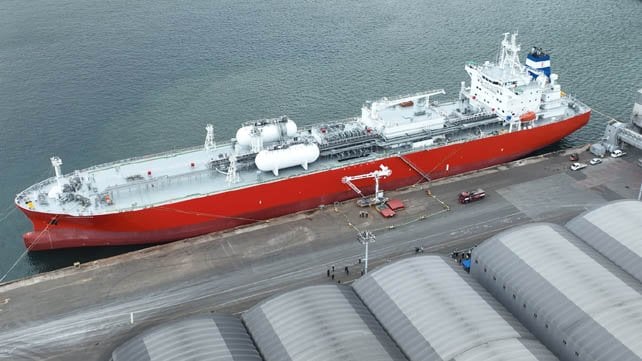
Exmarr's gas tanker Antwerpen completed the world's first ammonia bunkering for a commercial, ocean-going vessel docked at the Port of Ulsan, South Korea (Ulsan Port Authority)
The emerging market for ammonia-fueled commercial shipping achieved its next milestone with the first-ever port-to-ship bunkering on an ocean-going vessel. Previously, the only bunkering had been done as demonstrations, while extensive work has been underway by port authorities, classification societies, and others to develop the processes for safely handling highly toxic ammonia as a marine fuel.
The Ulsan Port Authority (UPA) in South Korea announced that the first ammonia bunkering operation had been carried out on April 23. The gas tanker Antwerpen, built by HD Hyundai as the first in a series of vessels for Exmar, achieved the milestone.
The bunkering operation took place at Pier 2 of Ulsan Main Port, where Lotte Fine Chemical, designated as the sustainable marine fuel supply demonstration operator, supplied approximately 600 tons of clean ammonia via the port-to-ship method.
“This world-first ammonia bunkering operation was made possible by Ulsan Port’s advanced energy infrastructure and accumulated bunkering expertise,” said Byun Jae-young, President of UPA. “It is a meaningful milestone that demonstrates the port’s readiness to support a range of major sustainable marine fuels.
To enable this milestone, the Ulsan Port Authority reports it signed a Memorandum of Understanding in January 2024 to promote the ammonia bunkering industry. Since then, it has worked closely with key stakeholders across the ammonia value chain, including Korean Register (KR), Lotte Fine Chemical, HD Hyundai Heavy Industries, and HMM, covering policy and regulation, port infrastructure, vessel readiness, and fuel supply.
The 46,000 cubic meter gas carrier continues to mark milestones in the development of this new segment. The ship was ordered in 2023 and named during a ceremony earlier in April at the HD Hyundai shipyard. It measures 190 meters (623 feet) in length and was specifically designed for the transport of liquefied gas cargoes, including ammonia and LPG. It can also use its cargo, including the ammonia, as its fuel.
The Antwerpen remains on the dock in Ulsan while her sister ship, Arlon,is completing sea trials. The second ship is scheduled to be delivered to Exmar in June.
To prepare for the bunkering, Lotte Fine Chemical announced in March that it had completed the world’s first commercial import of green ammonia. It was the first cross-border trade of green ammonia. The imported green ammonia was entirely produced using 100 percent renewable energy (wind and solar power) at the world’s largest green hydrogen and ammonia production complex developed by Envision and located in Inner Mongolia, China.
Lotte developed storage capabilities for the green ammonia at the Port of Ulsan. It said that it planned to use it to meet the growing demand for carbon-free energy applications, including ammonia marine bunkering, co-firing power generation, and as a hydrogen carrier.
The first ammonia bunkering for a vessel took place in Singapore in early 2024 and involved three tonnes of liquid ammonia loaded from Vopak’s Banyan Terminal on Jurong Island in Singapore. It was placed aboard Fortescue’s converted offshore supply vessel, which was rechristened Fortescue Green Pioneer and began ammonia demonstration in 2024. The only other vessels currently able to operate on ammonia are two tugboats, with Japan also reporting ammonia bunkering from tank trucks to NYK’s Sakigake, a tug that was converted from LNG to ammonia as part of an ongoing demonstration of the future marine fuel.
Thursday, March 05, 2026
RAGOZIN: The unholy alliance between Ukraine’s far right and the Western defence industry
Battle-hardened commander Mykola “Makar” Zynkevich appears at a large event organised on the sides of the Munich Security Conference. / Snake Island Institute via Facebook
A look at Ukrainian units dealing with cutting-edge unmanned technology reveals an unholy alliance between far-right extremism and the Western defence industry. It came into the limelight during the latest Munich Security Conference, the world’s most prestigious gathering of global security practitioners and military industry bosses.
Here is the backstory. At the end of May 2017, a group of far-right activists stormed Lviv region’s legislature and briefly detained its deputies inside the occupied building. They demanded amnesty for the veterans of the Russo-Ukrainian war who had been jailed for violent crimes inside and outside the war zone.
Only one of the attackers was charged at the end of the day — Mykola “Makar” Zynkevich of the National Corps, the political wing of the Azov Movement, as its members themselves call their vast network of large military units and paramilitary groups.
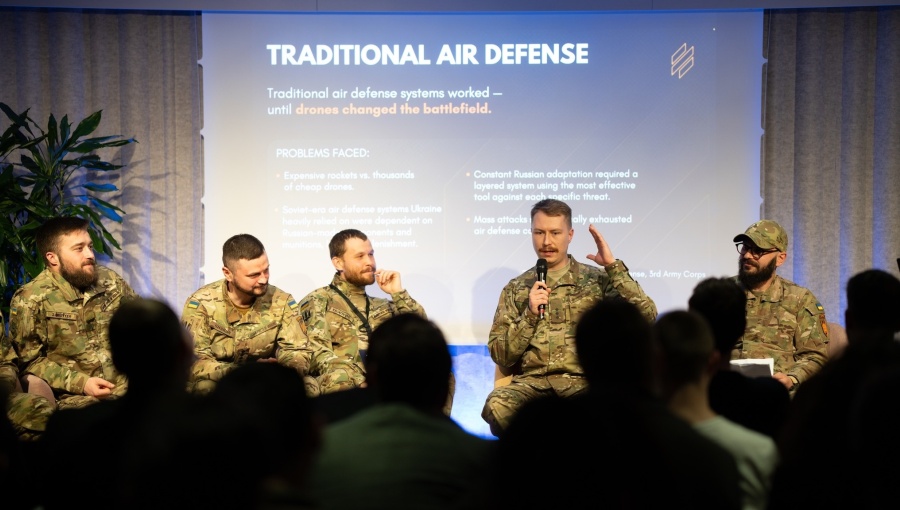
Fast-forward seven years and the battle-hardened commander Zynkevich appears at a large event organised on the sides of the Munich Security Conference. Zynkevich's unit deals with cutting edge war technology, namely terrestrial robotic systems which aid — and may one day replace — soldiers on the battlefield.
The unit is called NC13, in which NC likely stands for Zynkevich’s political alma mater, National Corps. Number 13 is defined by the Anti-Defamation League as a white supremacist symbol Aryan Circle (A being the first and C being the third letter in the alphabet).
NC13 is part of the 3rd Detached Assault Brigade which currently makes up the core of Ukrainian army’s 3rd Corps. The brigade was founded by the political leadership of Azov Movement, which grew out of Patriot of Ukraine, a white supremacist group at the core of Azov battalion formed in 2014. Its leader, Andriy Biletsky, is now 3rd Corps commander and gets regularly listed among presidential hopefuls in the polls.
The event on the sides of the Munich conference was organised by Snake Island Institute, a Ukrainian think-tank set up by Vladyslav Sobolevsky, formerly the chief of staff at Azov Regiment and deputy chief of staff at the National Corps, the political party.
War beneficiaries
Back in his days as National Corps official, Sobolevsky helped to organise various protests aimed at disrupting the Paris agreements between presidents Volodymyr Zelenskiy and Vladimir Putin that led to a near-full ceasefire throughout 2020 and 2021. These protests were a part of the “No to Capitulation” campaign, announced by Azov Movement leader Andriy Biletsky in October 2019 in response to Ukraine and Russia agreeing upon the Steinmeier formula — an algorithm for the implementation of Minsk agreements proposed by German President Frank-Walter Steinmeier.
On March 12, 2020 Sobolevsky led National Corps activists who violently attacked Zelenskiy’s ally and Security Council deputy head, Serhiy Syvokho, when he attempted to present a pro-peace political platform. Two days later, Sobolevsky led a march of Azov veterans to the Russian embassy. The participants tore up a Russian flag and shot at the embassy from flare pistols in a show which helped to convince the Kremlin that Zelenskiy is helpless against far-right thugs and hence of little value as a negotiator.
The campaign against “capitulation” has succeeded in swaying Zelenskiy who effectively rejected peace on conditions that look infinitely better than what Ukraine can hope for now, after four years of Russia’s brutal all-out invasion. Under the Minsk agreements, Ukraine would have retained full sovereignty over most of its Donbas region as well as formal sovereignty over the smaller part, then de-facto controlled by Russia.
Zelenskiy made a U-turn on relations with Putin at the beginning of 2021 (it coincided with Joe Biden moving into the White House). He embarked on crossing Putin’s key red lines, clamping down on his previously untouchable Ukrainian ally Viktor Medvedchuk and launching a loud campaign to join Nato. Putin responded by starting to deploy troops on the Ukrainian border in March that year.
Despite the president succumbing to the pressure, relations between the Azov Movement and Zelensky’s administration remained tense during the buildup to the all-out invasion in 2021. That year, Sobolevsky led protests against Ukraine’s Security Service arresting a large group of Azov Movement activists in Kharkiv on charges of racketeering and extortion — a pointed attack at the movement’s fledgling business empire. The arrested activists were released at the start of the all-out invasion and went on to form the Kraken special unit under the auspices of Ukraine’s military intelligence (the HUR).
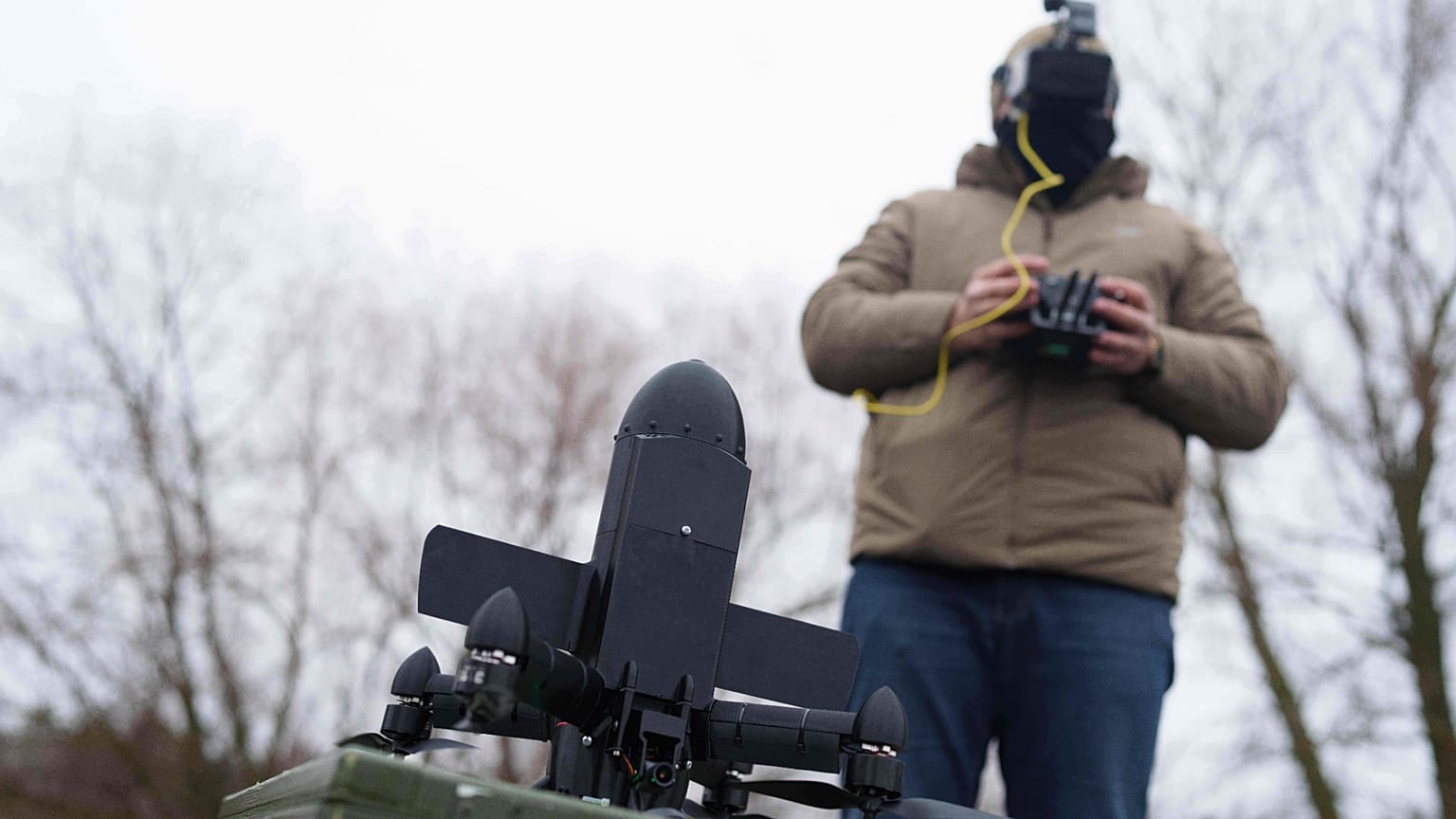
When the 3rd Detached Assault Brigade was reorganised into 3rd Corps in 2025, Kraken joined the corps. Its commanders — one of whom, Serhiy Velychko previously languished in prison in the SBU crackdown — were put in charge of the corps’ drone unit. Another Kraken commander set a drone pilot school called Killhouse Academy which ran a live FPV drone simulator show at the Munich conference event, with no one voicing objections to the propaganda of murder in its very name.
The war in Ukraine allowed people from the far-right fringe jump on a social lift they could have never dreamed about, which makes them key beneficiaries of this conflict — along with Putin’s regime in Russia — and explains their interest in this war running for as long as possible, at best forever.
With Gopniks on board
Times have changed in a big way since 2011, when the BBC Panorama exposed neo-nazi ultras from Metallist Kharkiv accused of violence against people of colour at football matches. At the end of the programme, famous British player Rio Ferdinand called for the boycott of Euro-2012 held in Ukraine. These days, people from this very milieu are warmly welcome at major international events platforms, like the Munich conference.
Coopting far-right extremists and football ultras as a potent street force that could either protect a political regime or help overthrow it is an old political technology. One may recall Arkan’s Tigers, a Serbian paramilitary group that threatened ethnic cleansing in Kosovo back in the 1990s. It was at least partly comprised of the Grobari (Gravediggers), the fans of Partisan Belgrade.
Putin’s regime has been eager to engage both football fans and neo-nazi thugs since the early 2000s — just look at his administration’s dealings with BORN, a neo-nazi group responsible for assassinations of migrants and antifa activists. However many of these former Kremlin allies and FSB volunteer helpers, including people related to BORN, ended up in Ukraine in the heady days of the Maidan revolution. They deemed Ukraine to be closer to their far-right political ideals, while Putin launched a purge of the far right in Russia exactly because of their role in the Maidan revolution.
In social terms, secret services and presidential office operatives engaging with the far right are tapping into the social strata typically described in post-Soviet space as “gopniki”, the nearest English-language equivalent being chavs — low-class young men prone to gang-like behaviour and criminal culture.
A predominantly Russian-speaking city, Kharkiv has its own word for gopniki — syavy. Two opposite paramilitary camps emerged in that city from this social strata — Patriot of Ukraine which grew into Azov movement and Oplot, a pro-Russian group that was instrumental in staging coup attempts in various Ukrainian regions in the spring of 2014. In a pattern characteristic of both Ukraine and Russia, both groups emerged at the conjunction of secret services, organised crime and far right activism.
People like Kraken founder Velychko (he coined the famous ‘Putin khuylo’ or ‘Putin is a dick’ chant when he was a leader of Metallist Kharkiv ultras), couldn’t possibly imagine that he would command a large, Nato-equipped military unit and the Western military-industrial complex would be keen to tap into his unit’s experience.
At the Munich conference, the Snake Island Institute event was opened by former CIA chief David Petraeus. Among the event’s partners, the institute listed Alta Ares which describes itself as “a leading Nato-backed project to reshape the defence of Europe’s eastern flank”, deals with AI-powered drones and takes part in Nato drills. Danish anti-drone equipment manufacturer MyDefence and Rasmussen Global, the PR agency run by former Nato secretary-general Andres Fogh Rasmussen, were on the same list.
The war in Ukraine saw many former far-right activists turn into operators of unmanned fighting systems, primarily drones. Some of these are absolutely open about their political leanings — a fact which the Ukrainian government and its Western funders seem to be entirely okay with. For example, the 422nd drone regiment of the Ukrainian armed forces is called Luftwaffe and displays the Prussian/Nazi Iron Cross symbol on its logo.
Snake Island Institute people are also not the only ones who get hosted by major Western expert platforms like Munich conference. Take Yevhen Karas, the founder of C14 group which has “Fourteen Words” (a neo-nazi slogan) in its name and whose members were accused of conducting political assassinations after the Maidan revolution, including that of the journalist Oles Buzyna. Now a drone regiment commander, Karas was hosted by Chatham House, a leading British think-tank, last November.
Members of the pro-Ukrainian commentariat tend to dismiss the very existence of a nazi problem in Ukraine, even as Kyiv landmark WWII Museum is currently hosting an exhibition dedicated to Russian Volunteer Corps, a far-right unit fighting on Ukraine’s side which draws inspiration from Hitler’s Russian allies of Gen. Vlasov’s Russian Liberation Army and uses the fascist Spayka symbol as its logo. The curator of the exhibition, Aleksey Lyovkin, is a frontman of M8L8TH (Hitler’s Hammer), in which 88 is a neo-nazi slogan which stands for Heil Hitler.
But none of that seems to bother the members of Western security establishment when people from this milieu appear at their prestigious event in Munich, a century after the Beer Hall Putch.
From €4 million in 2022, the year the war began, revenues have soared to €87.3 million in 2025. Portuguese exports to Ukraine, five to ten times lower before the conflict, now represent double the sales to Russia.
Portugal's drone exports to Ukraine have risen sharply since the start of the full-scale invasion of the country by Russia. Portugal is now selling more drones to Ukraine than it ever sold to Russia — and the gap is widening fast.
According to Jornal Económico, revenues from drone sales to Ukraine totalled €4 million in 2022, the year the conflict broke out, rising to €23 million in 2023 and €33 million in 2024.
Growth accelerated sharply in 2025, with revenues reaching €87.3 million. The largest Portuguese drone exporter to Ukraine is Tekever, a company based in Caldas da Rainha.
Relate
The surge has reshaped Portugal's broader trade relationships.
Ukraine climbed from 75th to 36th in the ranking of Portugal's export destinations between 2019 and 2025, while Russia fell from 34th to 50th over the same period — a decline surpassed among the top 100 destinations only by Cuba, which dropped 20 places, and Syria, which fell 19.
Before the war, Portuguese exports to Ukraine were five to ten times lower than sales to Russia.
By 2023 and 2024 that gap had narrowed to around 10%, and by 2025 Ukrainian purchases had pulled ahead to double those to Russia.
Overall, Ukrainian purchases from Portugal have jumped 110%, making Ukraine one of very few countries in the top 100 export destinations to record double- or triple-digit growth.
The trend may be further boosted by a deal signed in December between Portugal and Ukraine for the joint production of underwater drones.
A new book provides a bridge between global theory and Indian practices.
For any modern economy, there exist two crucial elements: firstly, money at the core and secondly, a monetary or financial system that lets money show its full potentialities. The issues of financial inclusion and financial stability are outcomes of the financial system that have been debated without any final outcome. India has been through an evolution of money and financial system since the Gupta Period (3rd to 6th century). After intermittent debacles, a uniform system during the Mughal era was taken over by the British empire to drain India's wealth. More organised monetary management started with the establishment of the Reserve Bank of India (RBI) on April 1, 1935.
Money and banking in India are complex phenomenon evolved over a long period and requires impeccable understanding of its foundations. It is in this context that the book "Foundation of Money and Banking in India" by Prof. Ankur Bhatnagar and Prof. C. Saratchand (Primus Book, Delhi; January 2026; 646 pages) serves the purpose of building a sound and organised understanding. It blends theoretical rigor with historical analysis, focusing on India's experience since independence in 1947. The authors describe it as a "synthetic outcome of a persistent academic dialogue", negotiating between mathematical models and non-mathematical expositions to make complex ideas accessible. The foreword, by eminent economist Prof. Prabhat Patnaik, sets a critical tone, arguing that in developing economies like India, fiscal policies have been ignored as effective pro-cyclical economic interventions and monetary policy intervention has been considered as a key lever for stability in the era of dominance of global finance. According to Prof. Patnaik, the book makes readers aware about the functioning of financial and monetary models which will be useful to understand the possible implications of financial and monetary policies practiced during this era.
The book is organised into five sections, each building on the last to provide a layered understanding. This reflects a logical progression from foundational concepts to applied Indian scenarios, enriched by numerous boxes, figures, and tables.
Money in Today’s World
Section I, Money: Concept, Theory and Measurement, lays the groundwork. This section clarifies how economic activities in an economy are determined by the presence of money and what are its basic characteristics that make money so significant for an individual and the country. We have witnessed emergence of crypto currencies as the recent development in the monetary and financial system across the world that are being used as digital medium of exchange for online and peer to peer transactions bypassing the role of national/fiat currency as also the role of central banking. According to the Cryptocurrency Market Report-2026, the projected growth rate of the size of cryptocurrency market was 17 percent during 2025-26 and is estimated to reach up to USD 3.35 billion in 2026. The book does have discussion on such latest development in the monetary world and its possible fallout. It also discusses Fintech in which India has been a leader as far as the extent of transactions is concerned triggered by demonetization in 2016. However, the share of cash circulation as percentage of GDP has gone up from 11.6 percent in 2015 to 13.7 percent in 2022 as per the book, defying one of the purposes of demonetization. This section stands out for its balance of economic theories and Indian specificity, incorporating discussions on fintech, crypto, and Central Bank Digital Currency (CBDC).
Financial Systems
The global economy that has been through one crisis after another triggered by the exponential growth of the financial instruments and their size in the name of financial innovation with an objective of risk reduction. The sub-prime crisis of 2008 has been the latest event that shook the global economic world and brought misery in India too, leading to stagnation and inflation in the later part of the UPA-II and finally causing its ouster from the central government. UPA-II also relied on monetary and financial tools mainly to overcome the stagnation in the economy leading to unsustainable build-up of Non-Performing Assets (NPAs) of the banking sector in India. But post-UPA-II, during the current political dispensation, NPAs might have come down but that has been possible only with slower GDP growth rate even though India is the fastest growing major economy in world as per the latest data.
The second section of the book is all about the prototypes of the financial system to the current structure of the financial system that world and India are characterised by, with evidence of financial crisis and bringing into the discussion one of the leading economists Hyman P. Minsky and his work on genesis of financial crisis. Such interweaving of theory and empirics is rare in textbooks from India's perspective.
Demystifying Interest Rates
Global domination of finance and its repercussions for developing economies is reflected in the interest policies of these countries. It has been continuously seen that developing countries adjust their interest rate as per the adjustment in federal rate of the USA to adjust the capital flight as per their needs. This trend raises the question on true sovereignty of a country and independence of its central banking. The recent rise of outflow of foreign capital to the magnitude of approximately USD 19 billion in 2025 is an indication of what happens when a developing country does not adjust its interest rate to the US federal bank rate as desired by global rentiers. Section III of the book deals with such issues with special reference to the whole notion of interest rate and its determination in the setting of Indian context. This Section excels in demystifying interest rates through graphics and Indian examples, though the mathematical models might intimidate non-economics majors.
Banking Sector and Monetary Policy
The final two sections of the book are about banking sector in India and monetary policy formulation by the central bank. It gives detailed functioning of role of banks and the central bank in an economy. The book goes beyond discussion of commercial and cooperative banking and brings into discussion new trends that have emerged on the financial horizon of India with greater possibility of instability, uncertainty and non-transparent financing of business expansion. Some of the important topics which any student of economics must understand such as functioning and objectives of Monetary Policy Committee in India makes this very useful.
Global Theory to Local Practice
Overall, the book's strengths are manifold. Its integration of theory with Indian empirics, supported by over 100 graphics, fosters critical thinking. The focus on financial development since 1947, including demonetization and fintech, fills a gap in India-centric textbooks. Another important aspect is introducing basic concepts of Islamic banking, present in 60 countries, which brings in an aspect of banking not guided by profit maximisation. The breadth of the book, covering cryptos to crises, could overwhelm beginners, and the mathematical elements assume prior knowledge. Data in places only include figures up to 2022, which might limit its utility amid fast-changing events. While it includes comparative discourse related to USA and China, it could have also discussed emerging markets like Brazil or South Africa. The index is a good addition, and each chapter ends with quizzes, review questions, and references.
In conclusion, "Foundations of Money and Banking in India" is a robust, insightful textbook that demystifies a complex field for not only Indian readers but anyone who holds interest in the world of money and finance in Indian context. It acts as a bridge between global theory and local practice, ideal for undergraduate and postgraduate students, policymakers, and economists.
The writer is Associate Professor at Shri Ram College of Commerce, University of Delhi. The views are personal.