Wednesday, July 02, 2025

PUTIN'S PUPPET

Pentagon halts some weapons shipments to Ukraine, Kyiv summons US diplomat


The United States is pausing some weapons shipments to Ukraine over concerns about declining US stockpiles, officials said Tuesday, marking a setback for Kyiv as it faces intensifying Russian attacks. Kyiv reacted to the military aid cuts by summoning the deputy chief of the US embassy in Kyiv to a meeting on Wednesday.


Issued on: 02/07/2025 - 
By: FRANCE 24
Video by: Emmanuelle CHAZE

02:12
Ukrainian President Volodymyr Zelensky stands in front of a US Patriot anti-missile missile battery on June 11, 2024, at a military training camp in the Mecklenburg-Western Pomerania region of Germany. 
© Jens Büttner, Pool, AFP Archives


The US is halting some shipments of weapons to Ukraine amid concerns that its own stockpiles have declined too much, officials said Tuesday, a setback for the country as it tries to fend off escalating attacks from Russia.

Kyiv reacted to the delay in military aid on Wednesday by summoning the deputy chief of the US embassy in Kyiv to a meeting Wednesday and warned him any delays in US military aid to Ukraine would "encourage" Russia, the foreign ministry said.

"John Ginkel was invited to the Ukrainian foreign ministry ... The Ukrainian side stressed that any delay or procrastination in supporting Ukraine's defence capabilities would only encourage the aggressor to continue the war," the ministry said in a statement.

Certain munitions were previously promised to Ukraine under the Biden administration to aid its defences during the more than three-year-old war. The pause reflects a new set of priorities under President Donald Trump and came after Defence Department officials scrutinised current US stockpiles and raised concerns.

“This decision was made to put America’s interests first following a review of our nation’s military support and assistance to other countries across the globe,” White House spokesperson Anna Kelly said in a statement. “The strength of the United States Armed Forces remains unquestioned – just ask Iran.”

That was a reference to Trump recently ordering US missile strikes against nuclear sites in Iran.

The Pentagon review determined that stocks were too low on some weapons previously pledged, so pending shipments of some items won’t be sent, according to a US official who spoke on condition of anonymity to provide information that has not yet been made public.

Read more Macron urges Putin to accept Ukraine ceasefire in first phone call since 2022

The Defence Department did not provide details on what specific weapons were being held back.

“America’s military has never been more ready and more capable,” spokesman Sean Parnell said, adding that the major tax cut and spending package moving through Congress “ensures that our weapons and defence systems are modernised to protect against 21st century threats for generations to come".

The halt of some weapons from the US is a blow to Ukraine as Russia has recently launched some of its biggest aerial attacks of the war, in an escalating bombing campaign that has further dashed hopes for a breakthrough in peace efforts championed by Trump. Talks between the sides have ground to a halt.

The US stoppage was first reported by Politico.

To date, the US has provided Ukraine more than $66 billion worth of weapons and military assistance since Russia invaded its neighbour in February 2022.

Over the course of the war, the US has routinely pressed for allies to provide air defence systems to Ukraine. But many are reluctant to give up the high-tech systems, particularly countries in Eastern Europe that also feel threatened by Russia.

Trump met with Ukrainian leader Volodymyr Zelensky on the sidelines of the NATO summit last week and had left open the possibility of sending Kyiv more US-made Patriot air defence missile systems, acknowledging they would help the Ukrainian cause.

Read more Russia ramps up attacks on Ukraine in biggest air offensive since war began

“They do want to have the antimissile missiles, OK, as they call them, the Patriots,” Trump said then. “And we’re going to see if we can make some available. We need them, too. We’re supplying them to Israel, and they’re very effective, 100% effective. Hard to believe how effective. They do want that more than any other thing.”

Those comments reflect a change of thinking about providing weapons to Ukraine across the administration in recent months.

In testimony before lawmakers in June, Defence Secretary Pete Hegseth said he has moved quickly to quash wasteful programmes and redirect funding to Trump’s top objectives.

Hegseth said a negotiated peace between Russia and Ukraine, which has been promoted for months by Trump, makes America look strong, even though Moscow is the aggressor in the conflict. He also said the defence budget includes hard choices and “reflects the reality that Europe needs to step up more for the defence of its own continent. And President Trump deserves the credit for that.”

The defence secretary told lawmakers last month that some US security spending for Ukraine was still in the pipeline, without providing details. But he said such assistance – which has been robust for the past two years – would be reduced.

05:25© France 24


“This administration takes a very different view of that conflict,” Hegseth said. “We believe that a negotiated peaceful settlement is in the best interest of both parties and our nation’s interests.”

The change comes after Hegseth skipped a meeting last month of an international group to coordinate military aid to Ukraine that the US created three years ago. Hegseth’s predecessor, Lloyd Austin, formed the group after Russia attacked Ukraine, and Hegseth's absence was the first time the US defence secretary wasn’t in attendance.

Under Austin’s leadership, the US served as chair of the group, and he and the chairman of the Joint Chiefs of Staff attended monthly meetings, which were both in person and by video.

Hegseth had previously stepped away from a leadership role of the Ukraine Defense Contact Group – turning that over to Germany and the United Kingdom – before abandoning the gathering altogether.

(FRANCE 24 with AP)

OUR WORD IS OUR BOND

US halting some shipments of military aid to Ukraine

Washington (AFP) – The White House said Tuesday it is halting some key weapons shipments to Ukraine that were promised under the Biden administration for Kyiv's battle against the Russian invasion.


Issued on: 02/07/2025 -

The US is halting some shipments of military aid to Ukraine 
© OLEG PETRASIUK / 24th Mechanized Brigade of Ukrainian Armed Forces/AFP/File

Stopping the delivery of munitions and other military aid including air defense systems likely would be a blow to Ukraine as it contends with some of Russia's largest missile and drone attacks of the three-year-old war.

"This decision was made to put America's interests first following a DOD (Department of Defense) review of our nation's military support and assistance to other countries across the globe," White House Deputy Press Secretary Anna Kelly told AFP in an email.

The curtailment of military aid signals a possible shift in the priorities of US President Donald Trump, who has pressed for Russia and Ukraine to speed up stalled peace talks.

The Republican has moved on to playing a greater role in orchestrating a possible ceasefire in Gaza and toning down Iran-Israel tensions after a deadly 12-day conflict between the arch foes.

The Pentagon review determined that stocks had become too low on some previously pledged munitions, and that some pending shipments now would not be sent, said a US official who spoke on condition of anonymity, according to Politico, which first reported the halt of military aid.

"The strength of the United States Armed Forces remains unquestioned -- just ask Iran," Kelly said, making a reference to the recent US bombings and missile strikes against the Islamic republic's nuclear facilities.

Politico and other US media reported that missiles for Patriot air defense systems, precision artillery and Hellfire missiles are among the items being held back.

Michael McFaul, who was the US ambassador to Russia from 2012 until just before the Crimea conflict began in 2014, said on X: "The Trump administration is even stopping delivery of Patriots? So disgusting and embarrassing as the 'leader of the free world.' I guess we are done with that."

Last week at a NATO summit in the Netherlands, Ukrainian President Volodymyr Zelensky met with Trump and appeared to get a vague response from the US leader on Patriot air defense systems.

"We're going to see if we can make some available," Trump said of the missiles that Kyiv desperately seeks to shoot down Russian attacks.

"They're very hard to get," Trump added.


Thousands of drones


A Russian drone attack on Ukraine's Kharkiv region killed one person and wounded another, its governor said early Wednesday.

The attack follows Ukrainian drone strikes which killed three people and wounded dozens in the Russian city of Izhevsk on Tuesday, striking more than 620 miles (1,000 kilometers) from the front line -- one of the deepest attacks inside Russia to date.

An AFP analysis published Tuesday found that Russia dramatically ramped up aerial attacks in June, firing thousands of drones as Ukraine's stretched air defense systems and exhausted civilian population felt the Kremlin's increased pressure.

An April report from the Stockholm International Peace Research Institute (SIPRI) found that Ukraine is being outgunned by Russia, despite spending more of its GDP on defense than any other country in the world.

Ukraine's military expenditure in 2024 was $64.7 billion, SIPRI said, and Kyiv has relied heavily on its allies in Europe and the United States for weapons and aid.

Russian leader Vladimir Putin blamed the West for fanning the flames of war with that support, telling French president Emmanuel Macron Tuesday that the West has "for many years ignored Russia's security interests."

The White House's tone has openly shifted on Ukraine with the Trump presidency.

Back in 2022, then president Joe Biden affectionately embraced Zelensky at the White House as his administration announced another $2 billion in weapons for Ukraine.

During Zelensky's Washington visit earlier this year, he was belittled on-camera by Trump and Vice President JD Vance during an Oval Office meeting, who ganged up to accuse the Ukrainian leader of ingratitude.

Asked by AFP for comment on the halt of shipments and why it was occurring, the Pentagon did not respond directly.

But its chief spokesman Sean Parnell said "America's military has never been more ready and more capable thanks to President Trump and Secretary (Pete) Hegseth's leadership."

© 2025 AFP


Demining Ukraine: from drones to risking it with a rake

Kamyanka (Ukraine) (AFP) – There were so many mines on Larisa Sysenko's small farm in Kamyanka in eastern Ukraine after the Russians were pushed out that she and her husband Viktor started demining it themselves -- with rakes.


Issued on: 02/07/2025 -  RFI

Pereverzev uses his tractor to clear mines in fields in Korobchyne village, Kharkiv region © Ivan SAMOILOV / AFP

SPECIAL FEATURE     

LONG READ


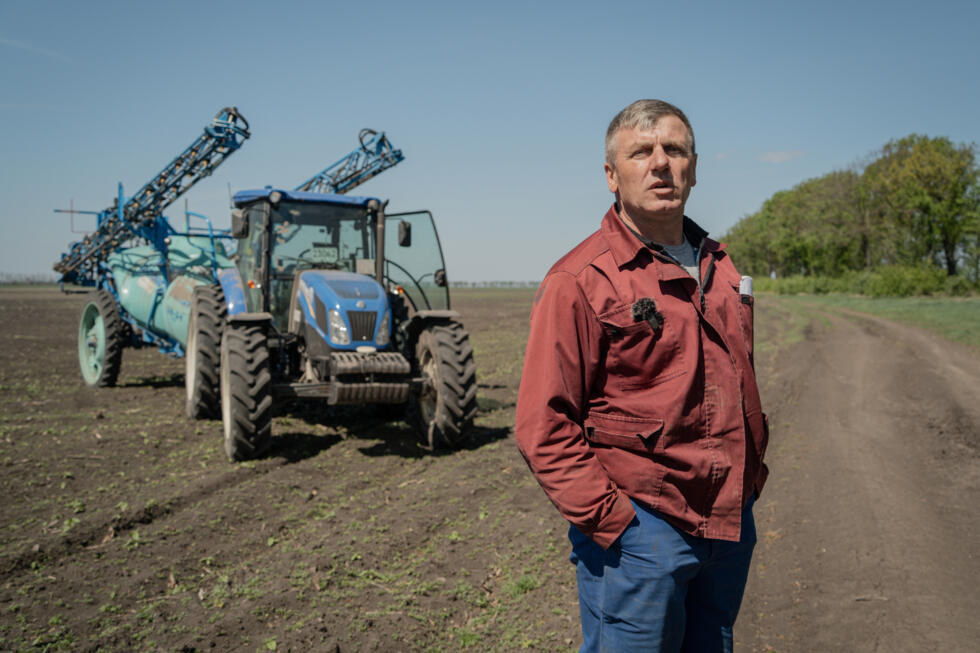
Further along the front line at Korobchyne near Kharkiv, Mykola Pereverzev began clearing the fields with his farm machinery.

"My tractor was blown up three times. We had to get a new one. It was completely unrepairable. But we ended up clearing 200 hectares of minefields in two months," he said.

"Absolutely everyone demines by themselves," declared Igor Kniazev on his farm half an hour from Larisa's.

Ukraine is one of the great bread baskets of the world, its black earth so rich and fertile you want to scoop it up in your hands and smell it.


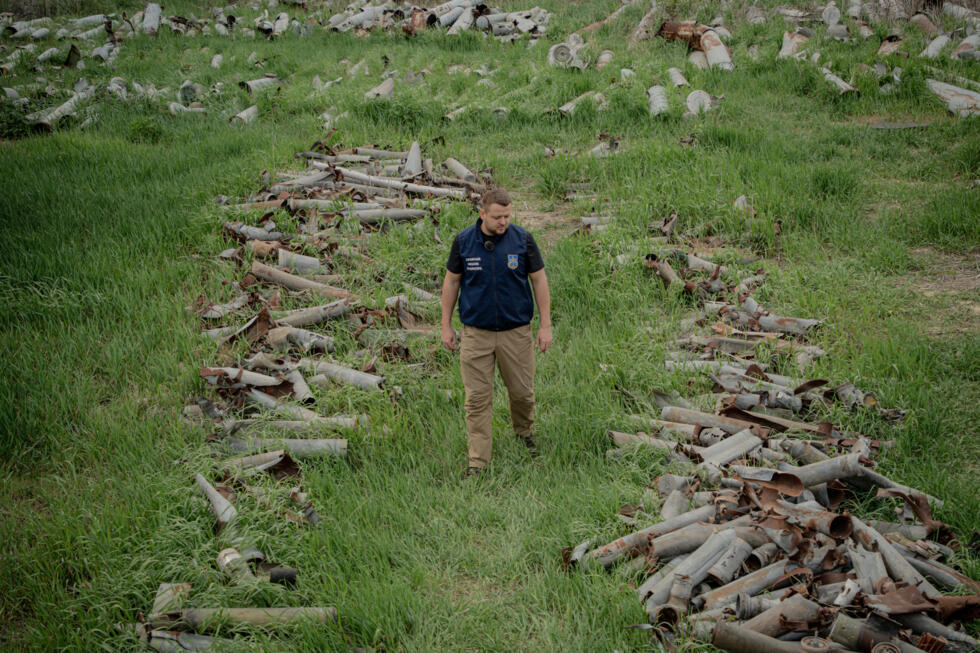
Ukrainian official Dmytro Chubenko with piles of Russian shells fired into the Kharkiv region © Ivan SAMOILOV / AFP

But that dark soil is now almost certainly the most mined in the world, experts told AFP.

More than three years of unrelenting artillery barrages -- the biggest since World War II -- have sown it with millions of tons of ordnance, much of it unexploded.

One in 10 shells fail to detonate, experts estimate, with as much as a third of North Korean ordnance fired by Russia failing to go off, the high explosives moulding where they fall.

Yet the drones which have revolutionised the way war is fought in Ukraine may also now become a game-changer in demining the country.

Ukraine itself and some of the more than 80 NGOs and commercial groups working there are already using them to speed the mammoth task of clearing the land, with the international community pledging a massive sum to the unprecedented effort.
Gallows in the garden

But on the ground it is often the farmers themselves -- despite the dangers and official warnings -- who are pushing ahead on their own.

Like the Sysenkos.
The Sysenkos began demining their battle-scarred fields with rakes 
© Ivan SAMOILOV / AFP

They were among the first to return to the devastated village of Kamyanka, which was occupied by the Russian army from March to September 2022.

Two weeks after its recapture by Ukrainian soldiers, Larisa and Viktor went back to check their house and found it uninhabitable, without water or electricity.

So they let the winter pass and returned in March 2023 to clean up, first taking down the gallows Russian soldiers had set up in their yard.

And they began demining. With their rakes.

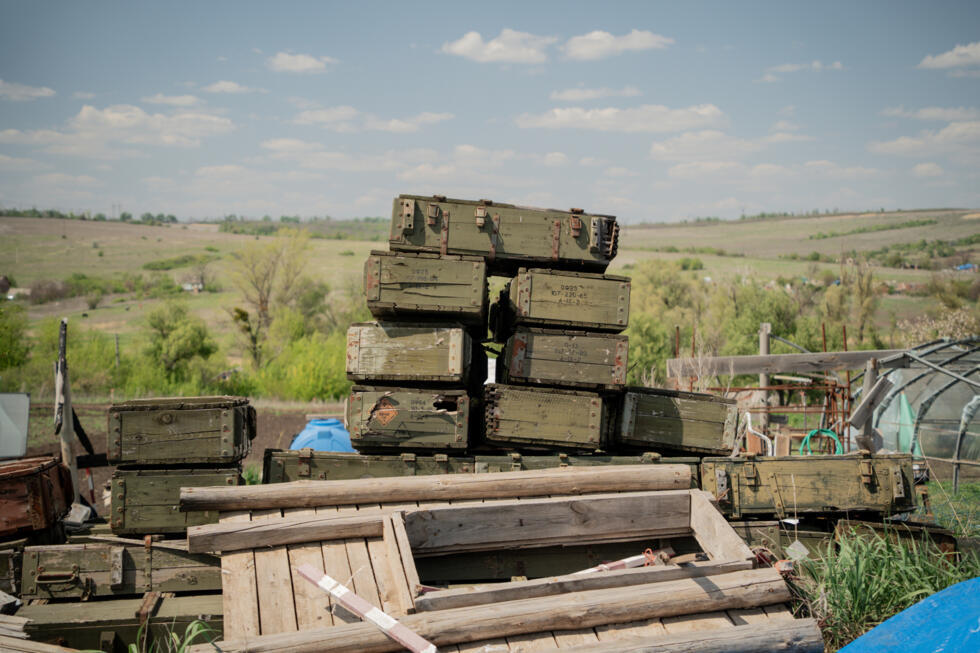
Russian shell boxes left in the Sysenkos's yard 
© Ivan SAMOILOV / AFP

"There were a lot of mines and our guys (in the Ukrainian army) didn't have time to take care of us. So slowly we demined ourselves with rakes," said Larisa cheerily.

Boxes of Russian artillery shells are still stacked up in front of their house -- 152mm howitzer shells to be precise, said Viktor with a mischievous smile.

"I served in the artillery during Soviet times, so I know a bit," the 56-year-old added.

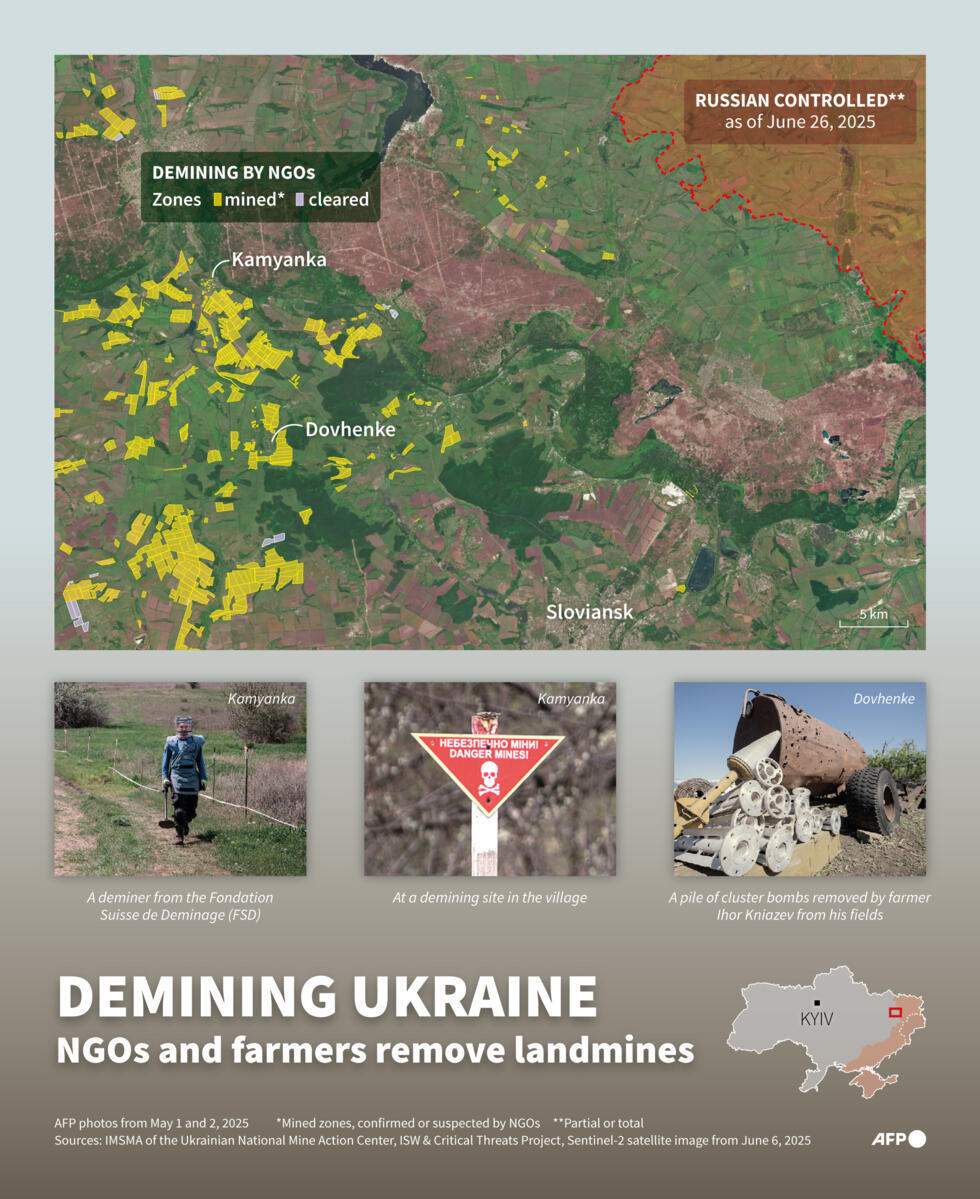
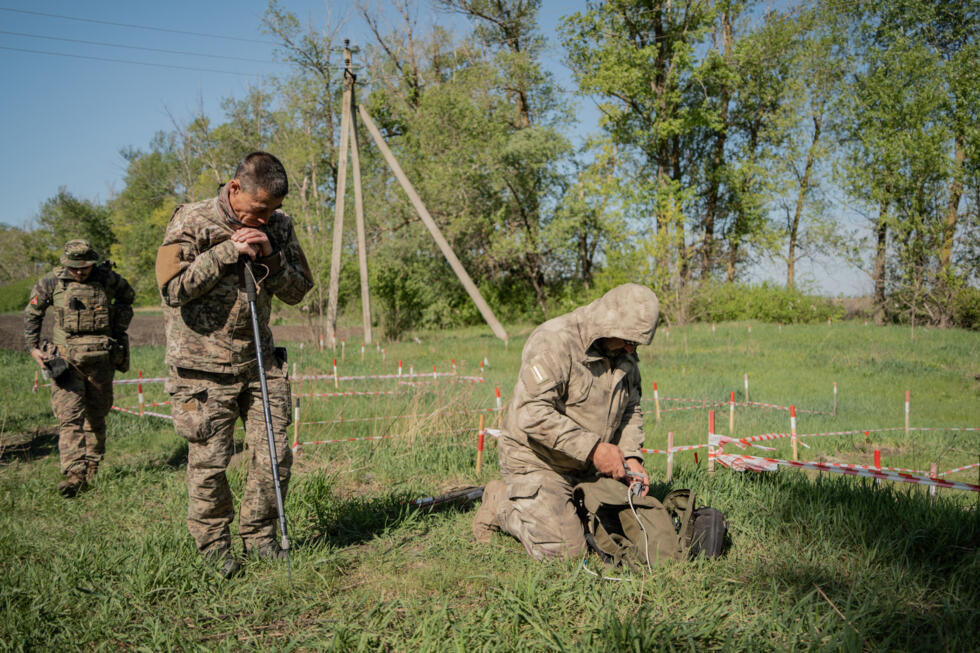
That summer a demining team from the Swiss FSD foundation arrived and unearthed 54 mines in the Sysenkos's field.

They were probably laid to protect a 2S3 Akatsiya self-propelled gun -- which looks like a big tank -- with which the Russians could hit targets up to 24 kilometres (15 miles) away.

Deadly 'flowers'


The PFM-1 anti-personnel mines they found are sensitive enough to detonate under the weight of a small child, exploding under only five kilograms of pressure.


Demining Ukraine: NGOs and farmers remove landmines 
© Nalini LEPETIT-CHELLA, Valentina BRESCHI / AFP

Known as the "flower petal" or "butterfly" mine, they blend horrifyingly well into fields and forests, with their petal shape and khaki colour.

They are banned under the 1997 Ottawa International Convention, to which Russia never signed up.

Ukraine said on Sunday it was withdrawing from the treaty.

The deminers told the Sysenkos "to evacuate the house".

"Under their rules, we couldn't stay there. So we obeyed. The demining machine went back and forth and there were tons of explosions und
er it."


Pereverzev's tractor was blown up three times when he demined fields himself near Kharkiv © Ivan SAMOILOV / AFP

With its gutted homes, Kamyanka still looks like a ghost village but about 40 people have moved back. (Its pre-war population was 1,200.)

Many fear the mines and several people have stepped on them -- "99 percent on the flower petal ones", said Viktor.

Yet farmers cannot afford to wait and are back at work in the vast fields famous for Ukraine's intensely black and fertile "chernozem" soil, which is rich in humus.

"If you look at the villages around here, farmers have adapted tractors themselves to clear their land and they are already planting wheat and sunflowers," Viktor added.

- Most mined land -

Ukraine's "cereal production fell from 84 million tons before the war to 56 million tons" last year, a drop of one-third, agriculture minister Vitaliy Koval told AFP.


A Ukrainian police unit prepare to demine a field at Korobochkino near Kharkiv 
© Ivan SAMOILOV / AFP

"Ukraine has 42 million hectares (103 million acres) of agricultural land. On paper, we can cultivate 32 million hectares. But usable, uncontaminated land not occupied by Russia -- (we have) only 24 million hectares," he added.

A fifth of Ukraine's total territory (123,000 square kilometres, 48,000 square miles) is "potentially contaminated" by mines or explosives, according to government data.

That's an area roughly the size of England.

So does that make Ukraine the most mined country in the world?


An FDS deminer working near the Sysenkos's home in Kamyanka 
© Ivan SAMOILOV / AFP

"I think that is probably true in terms of the most unexploded bombs and shells and the most mines in the ground," said Paul Heslop, the United Nations Mine Action Service adviser in Ukraine.

Like all experts AFP talked to, he said it was impossible to make an accurate count in a country at war with a front line stretching 1,000 kilometres (620 miles) and its Russian-controlled areas inaccessible.

"(But) if you have got maybe four to five million unexploded shells or munitions, and three to five million mines, you potentially have 10 million explosive devices in the ground."

Pete Smith, who leads the HALO Trust's 1,500 staff in Ukraine, is a veteran of demining Iraq and Afghanistan.

But "I can say with a large degree of certainty" that no other country has been strewn with so many explosives, he said.


Tractors blown up


Some semblance of normal life has returned for the Sysenkos.

Their two dogs frolic around a sign marked "Danger Mines".

Birds now nest in the bullet and shell holes in the peach-coloured walls of their farmhouse.


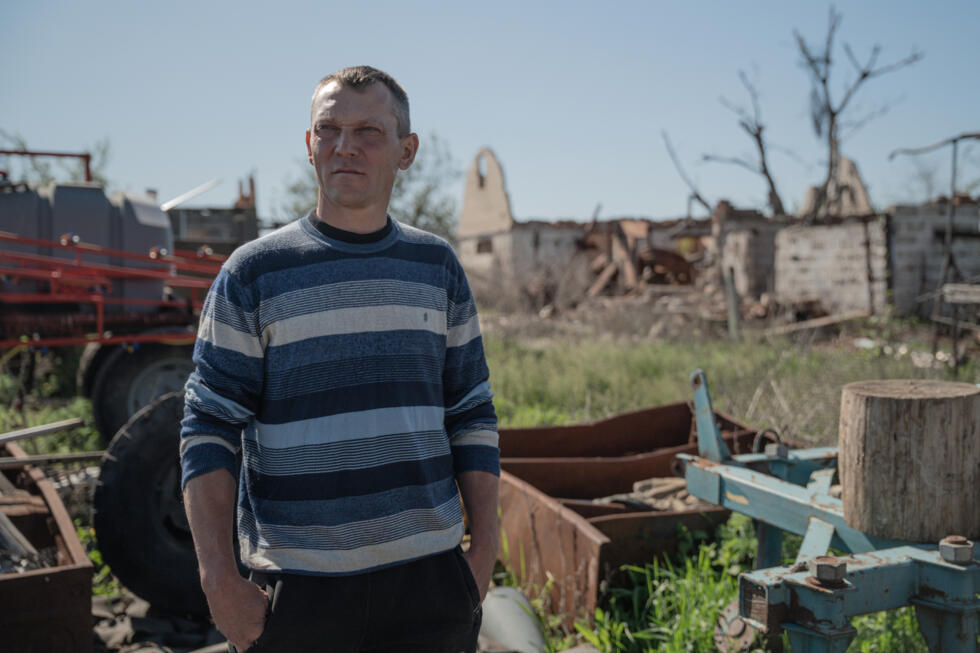
Kniazev is slowly getting back on his feet despite losing much of his farm machinery
 © Ivan SAMOILOV / AFP

But the demining will be going on for some time around them.

To get some idea of how thankless it can be, the Swiss FSD team found only the remnants of three explosives after two years of searching a nearby 2.6-hectare plot (about the size of three football fields).

"Metal contamination was so intense that our detectors became unusable. They were constantly going off," their site chief told AFP.

But after checking the thousands of metal fragments they had found, almost all turned out not to be dangerous.

The snail's pace of the meticulous process exasperates farmer Kniazev, who rattles off his gripes with the demining groups at machine gun pace.

"Every year they promise: 'Tomorrow, tomorrow, we'll clear all the fields.'" So in the end, he did it himself.

Like the Sysenkos, Kniazev went back to his land as soon as the Russians withdrew and has since demined 10 hectares by himself.

He hopes to finish the final 40 within a year.

How?

"I took a metal detector and cleared the mines," he shot back.

"I was on my tractor when the harrow (being dragged behind) hit a mine and it exploded."

Lost leg, went back to work


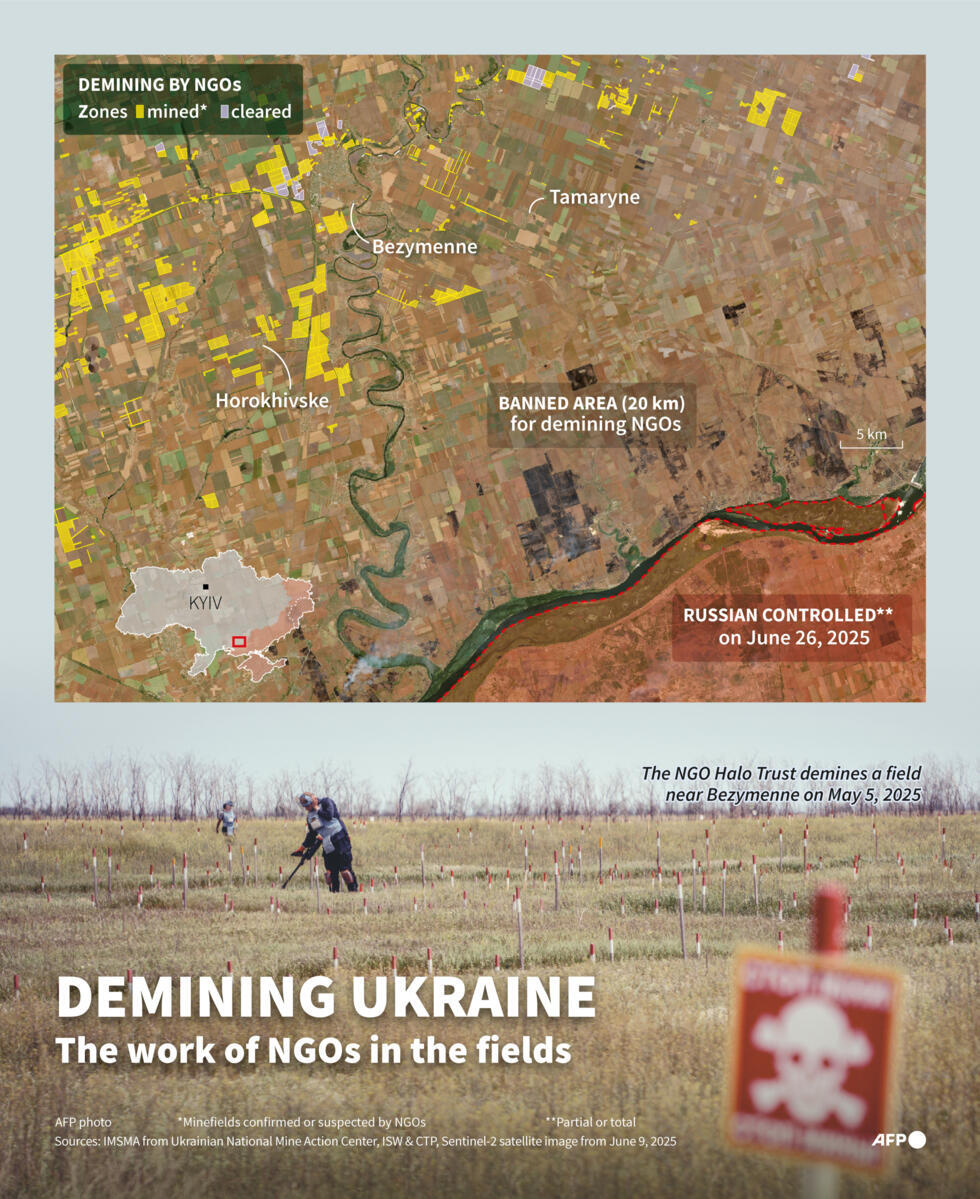
Demining Ukraine: the work of NGOs in the fields 
© Nalini LEPETIT-CHELLA, Valentina BRESCHI / AFP

Kniazev managed to repair the tractor but the harrow was a write-off.

"I was lucky," he said with a twinkle in his steel blue eyes.

Others not so much. "Demining will take a long, long time because people keep detonating mines," he said.

"Dozens (of farmers) around here have already hit TM anti-tank mines. Many of our folks also stepped on OZM mines."

These Soviet-era "jumping" anti-personnel mines are particularly dangerous, leaping up a metre (three feet) when triggered and spraying 2,400 bits of shrapnel at everything within 40 metres.

Kniazev has been turning the remnants of Russian shells into pipes.

"I'll make a lamp" with that empty cluster bomb on the floor, he said.

A prosperous farmer before the war, he is slowly getting back on his feet despite losing a large part of his agricultural machinery.


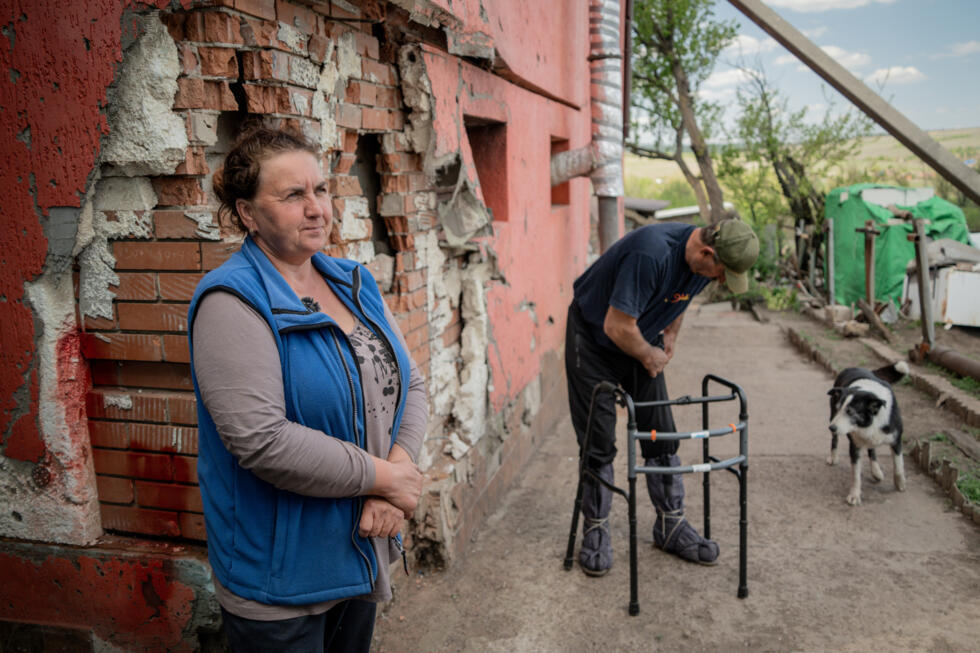
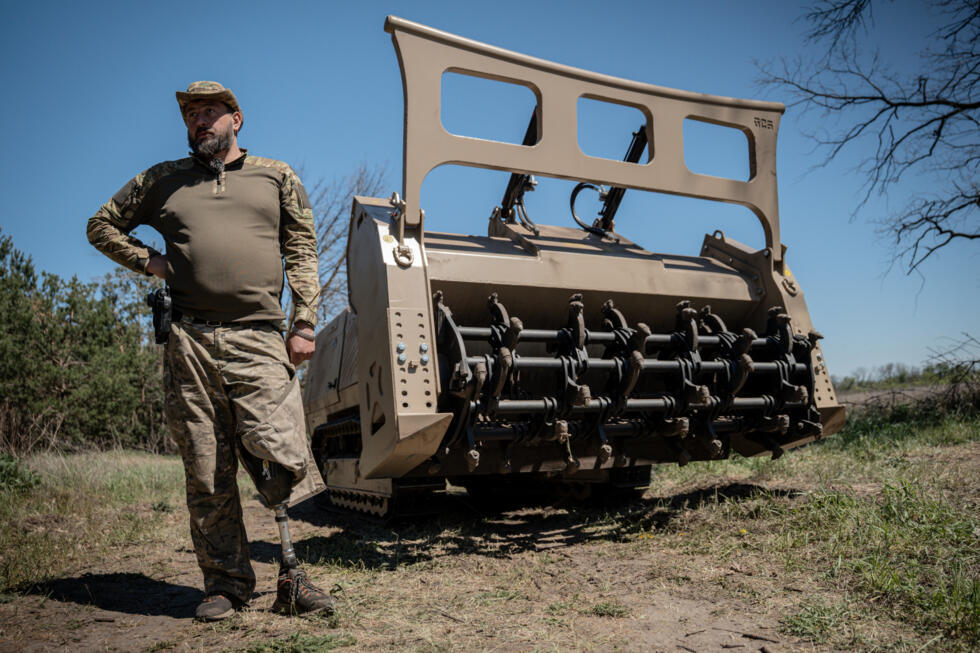
Ilkiv lost a leg below the knee when a mine exploded under his foot 
© Ivan SAMOILOV / AFP

He had just planted wheat after growing potatoes last year. He plans to diversify into mushrooms, which are highly profitable, he said.

Andriy Ilkiv lost his left leg below the knee when an anti-personnel mine exploded under his foot on September 13, 2022.

"I returned to work about four months later," said the head of a Ukrainian Interior Ministry demining team, even though the father-of-five was eligible for an office job because of his disability.

"I'm used to this work, I like it," he told AFP.

"Staying in an office isn't for me," he added, his colleagues gently ribbing him as they begin their day's work, the engine of their huge 12.5-ton German-made excavator already humming.


Hairdresser turned deminer


Kniazev said many Ukrainians work in demining for the good pay and to avoid conscription.

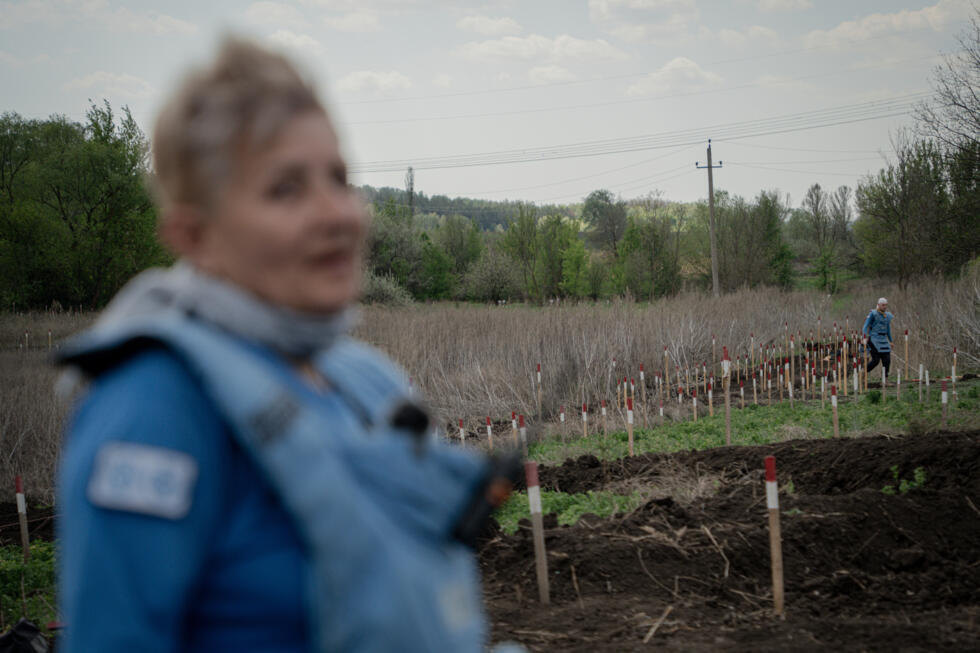
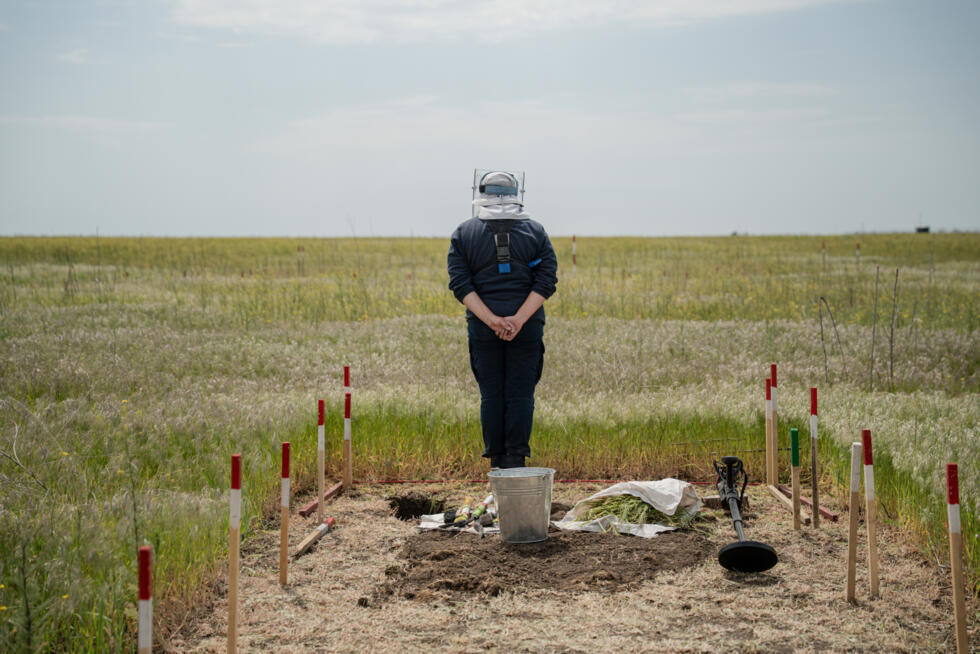
Former hairdresser Viktoria Shynkar has been working for HALO Trust, the world's biggest non-governmental demining group, for a year.

And she happily admitted the pay was one part of what drew her to this field in Tamaryne near Mykolaiv, not far from the Black Sea.

Viktoria Shynkar says demining is much less tiring than being a hairdresser 
© Ivan SAMOILOV / AFP

The 1,000 euros ($1,180) monthly wage she gets after the three weeks of training is as much as a young doctor is paid.

And despite the heavy body armour and helmet, it is much less tiring than being a hairdresser, where she hated making small talk with customers and was always on her feet.

"Before I used to cut hair. Now I cut grass (looking for mines). Before I cut to the millimetre. Now it's to the centimetre," the 36-year-old said.

You need to be precise. In a field nearby, Shynkar and her colleagues uncovered 243 TM-62 Russian landmines, each armed with enough high explosive to blast through the armour of a battle tank and kill its crew.

The Ukrainian government wants to clear 80 percent of its territory by 2033, despite some questioning how the work will be funded and coordinated, never mind problems with corruption.

"I've seen contracts worth millions that made no sense," a foreign expert, who asked to remain anonymous, told AFP.

"So there are clearly things going on under the table."

Drones armed with AI


But some "of the most significant innovations in mine clearance in 20 to 30 years" are also happening in Ukraine, said Smith of the HALO Trust.
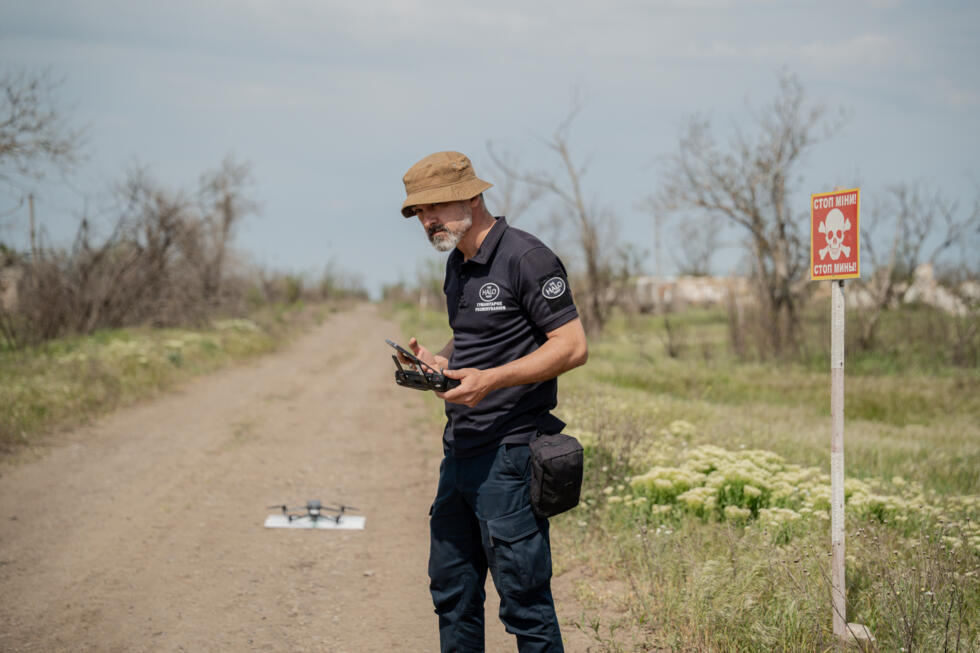
HALO Trust uses drones to detect mines in areas too dangerous for humans to walk 
© Ivan SAMOILOV / AFP

"Drones have been incredibly useful, particularly in areas we can't enter safely but they still allow us to survey the area," said Sam Rowlands, the trust's survey coordinator in Ukraine.

It uses 80 drones with various sensors depending on the ground conditions.

The images are sent to their headquarters near Kyiv to map out the minefield and are used to train AI in detecting different types of mines.

Volodymr Sydoruk, a data analyst there, works on the algorithms from partner company Amazon Web Services.

He enters multicoloured code for each type of mine that appears on his giant screen.

It is still early days for their machine learning but it is "already around 70 percent accurate, which is not bad", said Sydoruk.

A police unit demines a field near Korobochkino using a remote-controlled digger
 © Ivan SAMOILOV / AFP

And AI is likely to make drones a lot more effective in the future, experts say.

"One day we will see demining robots working 23 hours a day, with no risk to human lives," the UN's Heslop said.

"In five or 10 years, everything will be much more automated, thanks to what is happening today in Ukraine," he added.

Then Viktor and Larisa will finally be able to retire their rakes.

© 2025 AFP
Dalai Lama says he will have successor after his death

FU CHINA

McLeod Ganj (India) (AFP) – The Dalai Lama said Wednesday that the 600-year-old Tibetan spiritual institution would continue after his death, reassuring Buddhist followers around the globe and saying his office "exclusively" would name his successor, even as China insisted it would.

ANTI IMPERIALIST STRUGGLE


Issued on: 02/07/2025 - RFI

Tenzin Gyatso is the 14th reincarnation of the Dalai Lama, according to his followers 
© Biju BORO / AFP

Followers of the Dalai Lama laud his tireless campaign for greater autonomy for Tibet, a vast high-altitude plateau in China about the size of South Africa.

It is a landmark decision for Tibetans, many of whom had feared a future without a leader, as well as for global supporters who see the Dalai Lama as a symbol of non-violence, compassion and the enduring struggle for Tibetan cultural identity under Chinese rule.

According to Tibetans, Tenzin Gyatso is the 14th reincarnation of the Dalai Lama.

He and thousands of other Tibetans have lived in exile in India since Chinese troops crushed an uprising in the Tibetan capital Lhasa in 1959.

The charismatic Nobel Peace Prize-winning Buddhist had previously said the institution of Dalai Lama would continue only if there was popular demand.

He said Wednesday he had received multiple appeals over the past 14 years from the Tibetan diaspora, Buddhists from across the Himalayan region, Mongolia and parts of Russia and China, "earnestly requesting that the institution of the Dalai Lama continue".

The Dalai Lama is lauded by his followers for his tireless campaign for 
greater autonomy for Tibet, a vast high-altitude plateau in China about the size of South Africa
NO LONGER INDEPENDENCE
 © Sanjay BAID / AFP

"In particular, I have received messages through various channels from Tibetans in Tibet making the same appeal," he said in a video broadcast at the start of a meeting of religious leaders in the Indian Himalayan town where he has lived for decades.

"In accordance with all these requests, I am affirming that the institution of the Dalai Lama will continue," he added, according to an official translation.

The announcement was made ahead of his 90th birthday on July 6.
'Historic'

While China condemns him as a rebel and separatist, the internationally recognised Dalai Lama describes himself as a "simple Buddhist monk".

Many exiled Tibetans fear China will name its own successor to bolster control over a territory it poured troops into in 1950.

The Dalai Lama and thousands of other Tibetans have lived in exile in India since Chinese troops crushed an uprising in the Tibetan capital Lhasa in 1959 
© Sanjay BAID / AFP

But the Dalai Lama said Wednesday that responsibility for identifying the 15th Dalai Lama "will rest exclusively" with the India-based Gaden Phodrang Trust, the office of the Dalai Lama.

Samdhong Rinpoche, a senior Tibetan leader from the Gaden Phodrang Trust, told reporters that the Dalai Lama was "in excellent health" and that, at this time, there were "no further instructions for succession".

However, Rinpoche said the next Dalai Lama could be of "any nationality", and would come from a place where there is "access to freedom".

China said on Wednesday that the reincarnation of the Dalai Lama "must be approved by the central government" in Beijing, and that it would be carried out "by drawing lots from a golden urn", foreign ministry spokeswoman Mao Ning told reporters.

That urn is held by Beijing, and the Dalai Lama has already warned that, when used dishonestly, it lacks "any spiritual quality".

The Dalai Lama handed over political authority in 2011 to an exiled government chosen democratically by 130,000 Tibetans globally.


The Dali Lama says the institution of the role will continue © Sanjay BAID / AFP

At the same time, he warned that the future of his spiritual post faced an "obvious risk of vested political interests misusing the reincarnation system".

In 1995, Beijing selected a Panchen Lama, another influential Tibetan religious figure, and detained a Dalai Lama-recognised six-year-old, described by rights groups as the world's youngest political prisoner.

The Dalai Lama's announcement about the continuation of the role was welcomed with relief by Tibetans, including by Jigme Taydeh, a civil servant with the India-based Tibetan government.

"Whilst we rejoice at this confirmation of its continuation, we stringently object to China's interference and plans to install a puppet Dalai Lama", he said. "Neither the Tibetans nor the world would recognise such mischief."

burs-pjm/lb


China says Dalai Lama successor must be approved by Beijing

Tibetan spiritual leader the Dalai Lama on Wednesday affirmed that the centuries-old institution of the Dalai Lama will continue after his death. China, which considers the current Dalai Lama as a separatist, countered that Beijing has the final say on who the successor will be.


Issued on: 02/07/2025 - 
By: FRANCE 24

02:32
Tibetan spiritual leader the Dalai Lama (C) attends a Long Life Prayer offering ceremony at the Main Tibetan Temple in McLeod Ganj, near Dharamsala on June 30, 2025. 
© Sanjay Baid, AFP


Exiled Tibetan spiritual leader the Dalai Lama said Wednesday that the 600-year-old institution will continue after his death, a decision that will have profound impact on his Buddhist followers.

It is a landmark decision not only for Tibetans, but also for global supporters who see the Dalai Lama as a symbol of non-violence, compassion and the enduring struggle for Tibetan cultural identity under Chinese rule.

However, China said on Wednesday that the reincarnation of the Dalai Lama "must be approved by the central government".

"The reincarnation of the Dalai Lama, the Panchen Lama and other great Buddhist figures must be chosen by drawing lots from a golden urn, and approved by the central government," foreign ministry spokeswoman Mao Ning told a regular news briefing, referring to a method introduced by a Qing dynasty emperor in the 18th century.


"The Chinese government implements a policy of freedom of religious belief, but there are regulations on religious affairs and methods for managing the reincarnation of Tibetan living Buddhas," Mao said.

According to Tibetans, their current spiritual leader is the 14th reincarnation of the Dalai Lama, and his statement was released ahead of his 90th birthday on July 6.

He said he had received multiple appeals over the past 14 years from Tibetan diaspora in exile, Buddhists from across the Himalayan region, Mongolia and parts of Russia and China, "earnestly requesting that the institution of the Dalai Lama continue".

"In particular, I have received messages through various channels from Tibetans in Tibet making the same appeal," he said in a video broadcast at the start of a meeting of religious leaders in the Indian Himalayan town where he has lived for decades.

"In accordance with all these requests, I am affirming that the institution of the Dalai Lama will continue," he added, according to an official translation.

He and thousands of other Tibetans have lived in exile in India since Chinese troops crushed an uprising in the Tibetan capital Lhasa in 1959.

His advanced age has also sparked concern over the future of Tibetan leadership and the delicate question of his succession.

While China condemns him as a rebel and separatist, the internationally recognised Dalai Lama describes himself as a "simple Buddhist monk".

Many exiled Tibetans fear China will name a successor to bolster control over a territory it poured troops into in 1950.

But the Dalai Lama said Wednesday that responsibility for identifying the 15th Dalai Lama "will rest exclusively" with the India-based Gaden Phodrang Trust, the office of the Dalai Lama.

"I hereby reiterate that the Gaden Phodrang Trust has sole authority to recognise the future reincarnation; no one else has any such authority to interfere in this matter," he added.

(FRANCE 24 with AFP)
TORY AUSTERITY

Fire that closed Heathrow traced to unrepaired transformer

London (AFP) – A fire at an electrical substation that forced a shutdown at London's Heathrow Airport in March was likely caused by moisture entering electrical components, a problem first flagged in 2018, a report said Wednesday.


Issued on: 02/07/2025 - RFI

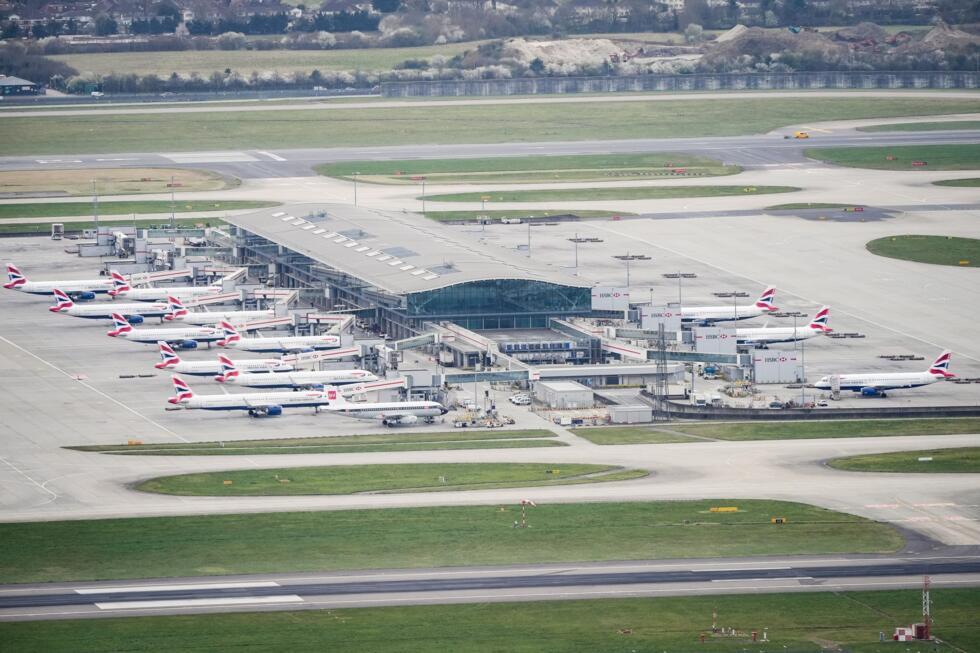
The fire broke out at the North Hyde substation in West London on March 20, 2025
 © STR / AFP

Water entering a transformer and causing a short circuit "most likely" started the fire, according to the National Energy System Operator (NESO) report, adding that elevated moisture readings were detected in July 2018 but "mitigating actions appropriate to its severity were not implemented".

The fire broke out at the North Hyde substation in West London, around two miles (3.2 km) north of Heathrow, at 11:21 pm on March 20, resulting in a complete loss of power supply to part of the airport's private internal electrical distribution network.

The airport was closed for most of March 21, affecting around 270,000 journeys and raising serious questions about the reliability of one of the UK's most critical pieces of infrastructure.

Using forensic analysis from the National Grid Electricity Transmission and London Fire Brigade, the government-commissioned report concluded that "a catastrophic failure" on high voltage "bushing" components caused a fire to ignite on the transformer.

"This was most likely caused by moisture entering the bushing causing a short circuit. The electricity likely then 'arced' (causing sparks) which combined with air and heat to ignite the oil, resulting in a fire," it added.

An elevated moisture reading in one of the bushings had been detected in oil samples taken in July 2018, indicating "an imminent fault and that the bushing should be replaced".


Flights were grounded and the airport shut after the substation fire © STR / AFP

However, "controls in place were not effective and failed to identify subsequently that action had not been taken in relation to the elevated moisture reading," it said.

"This includes an opportunity in 2022 when a decision was taken to defer basic maintenance. The issue therefore went unaddressed," added the report.
'Risks were not addressed'

Energy Minister Ed Miliband called the report "deeply concerning".

"Known risks were not addressed by the National Grid Electricity Transmission, and (energy regulator) Ofgem has now opened an official enforcement investigation to consider any possible licence breaches," he said in a statement.

The National Grid responded in a statement that "we fully support the recommendations in the report" and that "we will also cooperate closely with Ofgem's investigation".

Around 230,000 passengers use Heathrow every day -- 83 million a year -- making it one of the world's busiest airports. Planes from Heathrow serve around 80 countries.

The airport welcomed the report, which it said "sheds further light on the external power supply failure".

"A combination of outdated regulation, inadequate safety mechanisms, and National Grid's failure to maintain its infrastructure led to this catastrophic power outage," a spokesperson said.

"We expect National Grid to be carefully considering what steps they can take to ensure this isn't repeated."

© 2025 AFP
POLITICAL PRISONER

Algeria court upholds writer Boualem Sansal's five-year jail term


An Algerian court on Tuesday upheld a five-year prison sentence against writer Boualem Sansal for after he was found guilty of undermining Algeria's territorial integrity. The French Prime Minister said he hoped the Algerian president would "grant Sansal a pardon".


Issued on: 01/07/2025 
RFI

A banner in support of detained Franco-Algerian writer Boualem Sansal, is displayed on a bridge in Beziers, southern France. © AFP - Gabriel Bouys

Sansal, 80, was first sentenced to five years behind bars on 27 March on charges related to undermining Algeria's territorial integrity over comments made to a French media outlet.

The appeals court confirmed the sentence after prosecutors sought to double his jail term, a French news agency AFP journalist reported from the hearing.

Sansal was informed he has eight days to file a further appeal before Algeria's supreme court.

His newly appointed French lawyer, Pierre Cornut-Gentille, said he would consult with his client before deciding whether to pursue another legal challenge.

The case against him arose after he told the far-right outlet Frontières that France had unjustly transferred Moroccan territory to Algeria during the colonial period from 1830 to 1962 – a claim Algeria views as a challenge to its sovereignty and that aligns with longstanding Moroccan territorial assertions.

Sansal was detained in November 2024 upon arrival at Algiers airport. On 27 March, a court in Dar El Beida sentenced him to a five-year prison term and fined him 500,000 Algerian dinars ( 3,160 euros).


French-Algerian writer Boualem Sansal sentenced to five years in prison


'Unacceptable'

Following the verdict, French Prime Minister François Bayrou said he hoped Algerian President Abdelmadjid Tebboune would grant Sansal a pardon.

"Now that the sentence has been handed down, we can imagine pardon measures, particularly in view of our compatriot's health, will be taken," said Bayrou, calling the situation "unacceptable".

French President Emmanuel Macron has also urged Tebboune to show "mercy and humanity" to the author.

Some of Sansal's relatives have voiced hope he could be pardoned on Saturday, the 63rd anniversary of Algeria's independence.

Appearing in court without legal counsel on 24 June, Sansal said the case against him "makes no sense" as "the Algerian constitution guarantees freedom of expression and conscience".

He defended his remarks by citing the African Union's post-independence declaration that colonial borders should remain inviolable.

When questioned about his writings, Sansal asked: "Are we holding a trial over literature? Where are we headed?"
Diplomatic rift

Sansal's family has expressed fears prison could jeopardise his health, noting he is receiving treatment for prostate cancer.

Authorities in the North African country maintain that due process is being respected.

Commenting on his health on Tuesday, Cornut-Gentille said he saw Sansal a day earlier and that "he is fine".

The writer's conviction further strained already tense France-Algeria relations, which have been complicated by issues such as migration and Macron's recent recognition of Moroccan sovereignty over Western Sahara, a disputed territory claimed by the Algeria-backed Polisario Front.

Last month, the French National Assembly passed a resolution calling for Sansal's immediate release and linking future EU-Algeria cooperation to respect for human rights.

(with AFP)
THE LAST COLONY   VIVA INDEPENDENCE
Macron meets New Caledonian leaders to discuss future after riots

President Emmanuel Macron is bringing together political and economic leaders from New Caledonia for a summit starting Wednesday to talk about the French overseas territory’s future, one year after it was hit by deadly violence.


Issued on: 02/07/2025 - 08:17

1 minReading time
Unrest broke out in May 2024 in New Caledonia.
 © Delphine Mayeur/AFP

New Caledonian elected officials, along with economic and civil society representatives, have agreed to join the talks at the president’s invitation.

Macron said last week the discussions would last “as long as necessary” to deal with major issues.

“Beyond major institutional topics, I would like our discussions to touch on economic and societal matters,” Macron said.

New Caledonia has been ruled by France since the 1800s. Many indigenous Kanaks still resent Paris’s control and want more autonomy or independence.

Key dates in New Caledonia’s history

Unrest broke out in May 2024 after Paris planned to give voting rights to thousands of non-indigenous, long-term residents – something Kanaks fear would leave them in a permanent minority, crushing their chances of winning independence.

The riots – the most violent since the 1980s – led to the death of 14 people and caused billions of euros in damage.

The president's decision to host talks alongside the overseas minister Manuel Valls comes after a French court freed independence leader Christian Tein in June.

Tein, who is a Kanak, had been held in custody in eastern France since June 2024 over the rioting.

Investigating magistrates concluded there was no proof that Tein was preparing an armed uprising against the government, according to a source close to the case.

The last independence referendum in New Caledonia was held in 2021, and was boycotted by pro-independence groups over the impact of the Covid-19 pandemic on the Kanak population.

The referendum was the last of three since 2018, all of which rejected New Caledonian independence.

Anniversary of French occupation exposes rifts over New Caledonia's future
'Future of the territory'

Since the 2021 referendum – which pro-independence campaigners had wanted to be rescheduled – the political situation in the archipelago has been in deadlock.

Valls led negotiations in May between pro-independence and anti-independence groups, but they did not reach an agreement about the institutional future of the territory.

The president declared in early June that he wanted a "new project" for New Caledonia.

(with AFP)
Abuse ignored at French Catholic school while Bayrou was minister, inquiry finds

A French parliamentary inquiry has found that physical and sexual abuse went unchecked for years at a Catholic boarding school while Prime Minister François Bayrou was education minister in the 1990s.


Issued on: 02/07/2025 - RFI

A view of the Notre-Dame-de-Bétharram boarding school in Lestelle Bétharram, southwestern France. 
AFP - GAIZKA IROZ

The 330-page report, released on Wednesday, says children at the Notre-Dame de Bétharram school suffered violence “in the absence of action that the former education minister had the means to take”, Violette Spillebout and Paul Vannier, the two co-rapporteurs, wrote.

Bayrou, who served as education minister from 1993 to 1997, has denied any wrongdoing and called the accusations a campaign of “destruction” against him.

His office told BFMTV he ordered an inspection “the day after a complaint for a slap" appeared. They said the inspection “resulted in a positive report for the school” and claimed “all documents are online on Bayrou.fr”.


‘Absolute sadism’

Fatiha Keloua Hachi, who led the commission of inquiry, said lawmakers heard shocking testimony over three months from 135 people, including survivors of abuse at schools across France.

“This commission of inquiry was a thorough investigation into the unthinkable – children, all over France, subjected to monstrous acts,” Keloua Hachi said.

She said survivors described sexual violence and “physical violence too, sometimes of an unprecedented severity, of absolute sadism”.

Since February last year, around 200 legal complaints have been filed accusing priests and staff at Bétharram of abuse between 1957 and 2004. Some former boarders said priests visited boys at night.

Bayrou’s eldest daughter, Hélène Perlant, has said a priest beat her at a summer camp linked to Bétharram when she was 14. She said her father did not know about the incident.


Systemic failings


The report found the violence at Bétharram could not be reduced to isolated incidents and said it was – at least in part – kept in place by influential supporters, including some in government.

The co-rapporteurs said Bétharram was far from unique and that similar violence still happens in other schools, especially private Catholic ones, where a strong culture of silence remains.

Lawmakers described France’s system of checks as virtually non-existent and said efforts to prevent abuse remain inadequate.

The report said many victims were ignored for decades and left with lasting anger because so few adults took action while abusers went unpunished.


Proposals for reform


The commission recommended 50 measures to address the violence. These include creating a compensation fund for victims and recognising the state’s failings that allowed the abuse to continue.

It also proposed annual inspections of boarding schools, stricter checks in private schools at least every five years and a nationwide hotline for staff and parents to report abuse outside the usual school channels.

Other ideas include a clear ban on corporal punishment and humiliating treatment, criminal checks for all staff every three years and lifting the secrecy of confession when priests hear of abuse against children under 15.

The commission called for better training for teachers, nurses and school counsellors and regular reminders that staff must report suspected violence.

Bayrou survived a vote of no confidence on Tuesday. His position could come under more pressure as France’s minority government faces tough budget talks later this year.


Fact check: What we know about the link between climate change and heatwaves

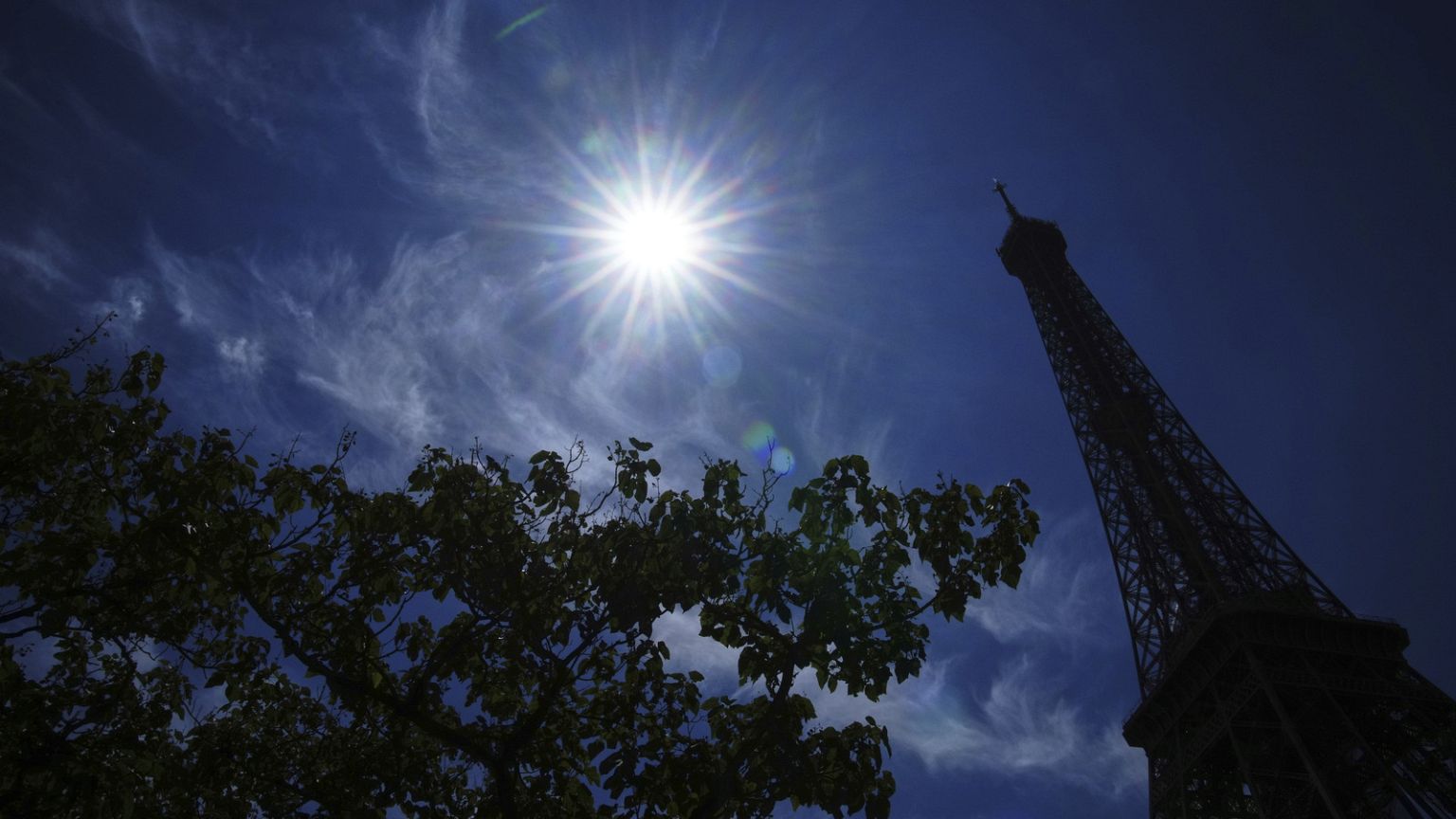
The sun shines over the the Eiffel Tower during a heat wave, Monday, June 30, 2025 in Paris
Copyright Christophe Ena/Copyright 2025 The AP. All rights reserved.

By Mared Gwyn Jones
Published on 

As extreme heat lingers across swathes of Europe, Euroverify looks at the evidence linking human-driven climate change with hotter and more persistent heatwaves.

Several European countries are set to see the mercury soar again on Wednesday as high-pressure zones persist across the continent. Experts are warning that sweltering temperatures are becoming the norm.

“Extreme heat is no longer a rare event - it has become the new normal,” UN Secretary General António Guterres said earlier this week. 

The abnormally high temperatures gripping Europe are caused by a heat dome, a phenomenon where high pressure lingers over a large area, trapping hot air.

But the extent to which human-induced global warming — driven by decades of fossil fuel pollution — is exacerbating such episodes of extreme heat has also come under scrutiny.

Scientists warn against directly attributing individual weather events to climate change: these episodes happen regardless. 

But there is a scientific consensus that global warming is making heatwaves more frequent, intense and longer-lasting, with potentially dire consequences for people's health.

Hotter heatwaves here to stay

Researchers at Carbon Brief recently mapped every published scientific study detailing how climate change has influenced extreme weather.

This analysis covered 116 heat-related events in Europe. Of this total, scientists deemed 110 (95%) were made more severe or more likely because of climate change.

June heatwaves are around ten times more likely to occur now compared to pre-industrial times because of the impact of climate change, scientists at World Weather Attribution estimate.

Others say atmospheric events driving heatwaves have almost tripled in strength and duration since the 1950s.

Heatwaves are defined as a prolonged period — usually lasting at least three days — of higher-than-usual temperatures. This means that the threshold temperatures for a heatwave vary between countries and even within borders.

For example, temperatures need to climb to 39°C over a prolonged period in Athens for a heatwave to occur. In Helsinki, just 25°C is required for the criteria to be met.


The thermometer of a drugstore shows the temperature of 39 degrees Celsius (102 degrees Fahrenheit) during a heat wave, in Rome, Tuesday, July 1, 2025. AP Photo

These events happen more frequently because the mean temperature is generally higher due to climate change, making it more likely for the conditions of a heatwave to occur.

Valerio Lucarini, a climate scientist at the University of Leicester, explains that deviations from the expected weather patterns are now also much more “persistent".

“As we have changing dynamics in the atmosphere, we have a higher probability of so-called blocked flows,” Professor Lucarini explains, referring to stationary high-pressure systems that lead to prolonged heat. “These patterns allow for the occurrence of large temperature anomalies, and persistent ones.”

European heatwaves are potentially up to 2.5°C hotter and drier than other similar events in recent years due to human-driven climate change, according to a study led by Professor Lucarini and a group of European academics for ClimaMeter.

“We're seeing a record-breaking continental heatwave at the moment, and it's warmer than it otherwise would have been due to climate change,” Samatha Burgess, Deputy Director of the EU's Copernicus Climate Change Service, told Euronews

"This heatwave is remarkable for three reasons: the intensity of the maximum temperatures forecast over large areas, the geographical extent of the warm anomaly and how early this is in the summer period," she explained.

Burgess added that periods of extreme heat exceptionally early and late in the summertime are becoming more common, prolonging the time of the year when there are risks of severe heat stress.

Europe is particularly vulnerable

Europe is the fastest-warming continent, seeing average temperatures rise at around 0.5°C per decade compared to 0.2°C globally. 

Its proximity to the Arctic, which is by far the fastest-warming part of the planet, contributes to this rapid warming, making it more vulnerable to heat waves.

Of the 30 most severe heatwaves to hit Europe between 1950 and 2023, 23 of them occurred since 2000, according to the World Meteorological Organisation’s (WMO) Europe Regional Climate Centre.

Scientists also believe southern Europe and the Mediterranean are particularly exposed due to their geographical location between the dry subtropics of North Africa and the wetter parts of northern Europe.

A 2020 study concludes that this brings unusually high surface pressure over the Mediterranean Sea, as well as hot and dry air from the Sahara towards Morocco and southwestern Europe. This results in more frequent dry springs and favours summer drought and heatwaves.

Scientists also say the changing behaviour of the jet stream — the rapid currents encircling the planet from west to east — could explain why Europe and North America are increasingly exposed to heatwaves, sometimes happening concurrently.

A phenomenon known as the ‘double jet stream’ — where the current of air splits, leaving hot air lingering over the continent — is largely responsible for the rise in Western Europe’s heatwaves, German researchers said in 2022.

What about ocean heat waves?


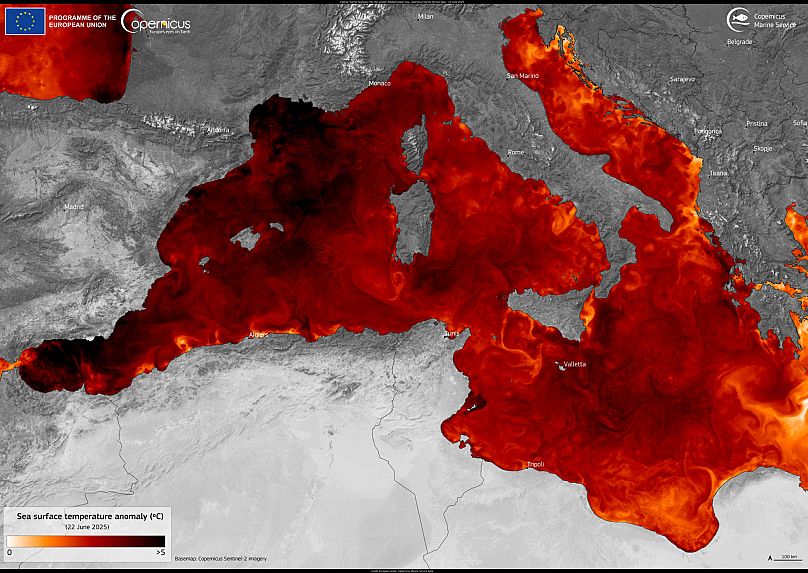
Intense marine heatwave hits the western Mediterranean Sea
Credit: European Union, Copernicus Sentinel-2 imagery

Land areas in Europe are warming up faster than the ocean, but the Mediterranean is currently seeing record-breaking sea surface temperatures, including for June.

“When seawater is warm, it evaporates more and heats the atmosphere above it. And with that evaporation, it generates more potential energy for storms. So there's this feedback between the atmosphere and the ocean,” Samantha Burgess explained.

Professor Lucarini pointed out that the current heatwave has coincided with a period of abnormally high temperatures — 4 to 5°C higher than average — in parts of the Mediterranean.

“We are seeing huge sea surface temperature anomalies all across the Western Mediterranean Sea and the East Atlantic,” he explained.

“Take France, it’s surrounded by ultra-hot waters, so obviously, it's much more prone to having long and persistent temperature anomalies on the land, as well as very strong thunderstorms.”

Far-reaching consequences

Cold weather is estimated to cause as many as ten times more deaths in Europe than the heat. But shifting climate conditions could drive up heat-related deaths.

A study by the European Commission estimates that, without climate mitigation and adaptation, the death toll from extreme heat in the European Union and the United Kingdom could multiply thirtyfold by the end of this century.

By the same time, heat-related deaths in southern Europe are expected to be 9.3 times more frequent than in northern Europe, compared to six times more frequent now.

Extreme heat can also trigger other extreme weather events, such as subtropical storms, drought and wildfires.

"The hotter the temperature is, the more evaporation we get from soil moisture. And the drier the soil is, the drier the vegetation is above it, which means we've got a much greater risk of fires," Burgess said, adding that this "doesn't necessarily mean we'll get a fire because we still need that ignition source".

This all means Europe needs to be increasingly prepared for hot episodes and their repercussions, both from a health and public safety point of view.

Short-term forecast for global offshore wind downgraded, says industry report

THANKS TO TRUMP

Short-term forecast for global offshore wind downgraded, says industry report
Fundamentals for the global offshore wind power sector look positive in the long term, but an industry report has downgraded its forecast by 24% in the short term. / US Department of Energy

By bne IntelliNews July 1, 2025

The Global Wind Energy Council (GWEC) has downgraded its short-term forecast by 24% for 2025-2029 compared with its prediction last year.

GWEC Market Intelligence expects more than 350 GW of new offshore wind capacity to be added over the next decade (2025-2034), bringing total offshore wind capacity to 441 GW by the end of 2034.

However, only one-third of this projected new volume will be added in 2025–2029, the first half of the forecast period, said the industry group in its annual offshore wind report.

The last few years have been marked significant economy-wide headwinds, said Feng Zhao, GWEC’s chief research officer. “The sector now faces a perfect storm of macroeconomic factors, geopolitical tensions and industry-specific challenges,” he said.

The series of setbacks includes failed tenders, persistent supply chain challenges, and increasing policy volatility, particularly in the United States where President Donald Trump – with the backing of his administration – appears to be on mission to halt all new wind development.

In addition, delays in expected commissioning dates in APAC are pushing capacity additions further into the forecast period.

Yet most governments and developers remain committed to offshore wind, said GWEC, and the global medium-term outlook remains resolutely optimistic. The sector will see a compound average annual growth rate of 28% until 2029 and 15% up to 2034.

Global offshore wind annual capacity additions are expected to sail past the milestones of 30 GW in 2030 and 50 GW by 2033, forecast the report.

The world’s offshore wind sector installed 8GW of new capacity in 2024, making it the fourth strongest year on record. This pushes the total global offshore capacity to 83 GW – enough to supply electricity to around 73mn homes.

In a year of significant industry activity, 56 GW of fresh capacity was awarded through global government auctions – the highest ever. Another record was set with 48 GW of offshore wind currently under construction worldwide.

While most immediate growth is concentrated in established hubs such as Europe and China, GWEC identifies growing momentum in Latin America and Asia-Pacific. Governments in Vietnam, Australia, Brazil and Colombia are now developing supportive policy frameworks in partnership with industry players, helping to prepare the ground for wider regional expansion.

The report also points to notable policy advances in emerging markets such as Japan, South Korea and the Philippines, indicating a shift there towards regulatory frameworks that support long-term deployment.

“China and Europe will continue to dominate offshore wind growth going forward but their global market share in cumulative installations is expected to drop to 89% in 2029 and 84% in 2034, because of growth in markets outside the two key markets in APAC, North America and Latin America,” said GWEC.  

The GWEC report cautions that the sector is approaching a pivotal juncture. While the case for offshore wind remains robust, the industry faces growing pressure to reform auction models and share risks more effectively between public and private stakeholders, it says.

 Such reforms, it argues, are essential if the sector is to meet its potential in delivering reliable and large-scale clean energy.

“Offshore wind is powering into a new era. The fundamentals of offshore wind remain rock solid, and countries around the world – from Brazil to Australia – are backing offshore wind to deliver clean, secure, home-grown energy at scale,” said Rebecca Williams, deputy CEO of GWEC. “In doing so, they are putting themselves at the leading edge of the next Industrial Revolution, one where growth and prosperity will be built through widespread electrification.”

Acknowledging recent challenges, Williams continued: “Of course, the sector has faced challenges, and in particularly policy instability in the US has had a significant impact, as well as failed auctions in mature markets. But the path forward is clear and achievable – smarter auctions, better policies, and faster delivery.”

She concluded: “With record levels of construction and auctions, 2025 is a pivotal year. This is the moment for industry and governments to come together, knuckle down and deliver the next stage of offshore wind’s growth.”