The Kennedy Center was Hijacked into Trump’s Animal Farm
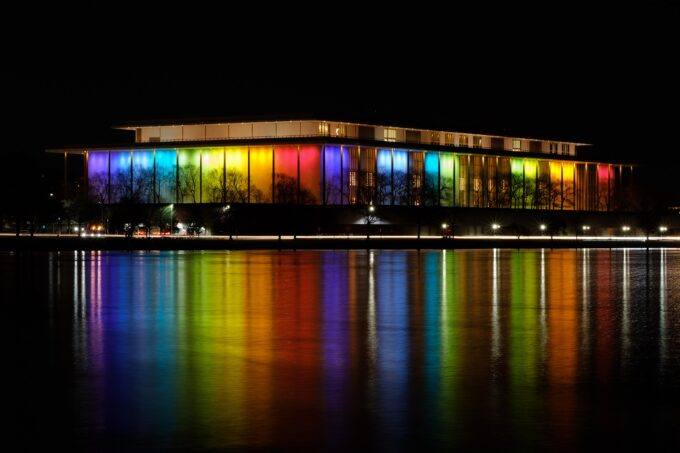
Photograph Source: Der Berzerker – CC BY 2.0
While Trump’s Iranian War may continue to capture our much-needed attention, it is essential that the public see this conflict as representative of our Trump era of rule, where rules are twisted far beyond their original intent.
Despite the Administration’s propaganda for starting a war with Iran, like many of his other actions, it is closely linked to Trump’s Narcissistic Personality Disorder (NPD). And this was also displayed in his hijacking of the John F. Kennedy Center for the Performing Arts.
Although this effort may seem minor compared to any war, it clearly shows how Trump tries to control any government institution that doesn’t fit with his agenda, including our nation’s top cultural and performance venue.
The Kennedy Center’s Creation and Mission Was a Bipartisan Effort
While sticking his name on the Center’s outside wall was largely seen as just another of his narcissistic outbursts, it goes much deeper. It symbolizes his hostility toward liberalism, which advocates for cooperation between rivals to achieve the greater good for everyone. This was the core principle behind President Dwight D. Eisenhower’s signing of bipartisan legislation in 1958 to create a National Cultural Center in the nation’s capital.
Four years later, in 1962, President John F. Kennedy and Mrs. Kennedy launched a $30 million fundraising campaign for the Center’s construction, which President Eisenhower and his wife Mamie contributed to.
After Kennedy’s assassination, Congress designated the new National Cultural Center as a living memorial to Kennedy for his support of the performing arts by renaming it the John F. Kennedy Center for the Performing Arts in Washington. It passed by voice vote (also known as unanimous consent) in both chambers, which is common when both Republicans and Democrats agree on a bipartisan resolution.
Authoritarianism, which consolidates all power under a single leader, demands obedience to simple beliefs. Art, in all its forms, has traditionally been a source of independent thought that often challenges those beliefs. As a result, authoritarian governments aim to control the arts to restrict their free expression.
This ongoing tension is recognized by both conservatives and liberals.
Elisabeth Braw, a former senior fellow at the conservative American Enterprise Institute (AEI), which focuses on free enterprise and limited government, compares Donald Trump’s control of the Kennedy Center to practices in authoritarian countries.
Braw notes that in Stalin’s Soviet Union, composers knew what they could and could not write. Similarly, in the Third Reich, the Nazis tried to organize and control the arts under a government department.
More recently, in Venezuela, the Chavista government under Hugo Chavez and then Nicolás Maduro, the leaders of their country’s successful El Sistema youth orchestra program, understood that it could not criticize the regime.
Braw concludes that when political leaders imprint their signature on cultural institutions, artistry finds a way to escape. And that’s what they did at the Kennedy Center when Trump took control.
The Artisans Walked Out of the Factory When the New Boss Arrived
A total of 13 groups canceled performances with the Center after Trump removed all Center Board Trustees and replaced them with his business friends in February 2025. Although few had notable involvement with the arts, the new board immediately elected Trump as their chairman.
At the end of the year, White House Spokesperson Karoline Leavitt announced on Dec 18, 2025, “the highly respected Board of the Kennedy Center has just voted to rename the Kennedy Center to the Trump-Kennedy Center.” Consequently, another 20 groups cancelled their performances as Trump’s name was immediately posted on the building the next day.
For instance, musician Chuck Redd withdrew from his holiday “Jazz Jams” performance, which has been held at the venue for the past twenty years, the day he saw Trump’s name added to the exterior of the building and on its website.
Historians argue that adding Trump’s name violates federal law and desecrates a living memorial for Kennedy by having Trump place his name in front of Kennedy’s on the building’s entrance and website. Trump’s handpicked new Center President Richard Grinell plans to seek $1 million in damages from Reed because he wouldn’t perform for Trump.
Less than two months after Leavitt’s announcement, Trump revealed plans to close the Kennedy Center for two years of renovations on February 1st, 2026. The next day, CNN reported that Trump’s new Center board was unable to sign enough acts to mount a 2026-27 season. Reed wasn’t alone in walking out of what had become a Trump factory.
Unlike JFK, Trump has No Record of Supporting the Arts
Trump isn’t a supporter of the arts! An AI search of available records and reports from the last ten years (2016–2026) reveals there is no evidence of significant, direct monetary contributions from Donald Trump to major art organizations. Additionally, an analysis of Trump’s charitable donations between 2015 and 2020 shows no major arts organizations among the recipients of his foundations’ gifts.
He appears to withhold financial support from cultural institutions that challenge his ethnocentric ideology, which discourages promoting or showcasing ethnic diversity positively.
Trump issued an order titled Restoring Truth in March 2025 that aimed to prevent displays he believed “degrade shared American values, divide Americans based on race, or promote programs or ideologies incompatible with Federal law and policy.” In effect, he was interpreting federal laws through this conservative, nationalistic worldview.
Therefore, Trump frequently attempted to cut or eliminate funding for the National Endowment for the Arts (NEA), the National Endowment for the Humanities (NEH), and the Institute of Museum and Library Services (IMLS). To prevent criticism of his actions, he quickly shut down the Committee on Arts and Humanities on his first day in office for his second term.
After taking control of the Kennedy Center, Trump vowed to usher in a new “golden age” for the institution while promising it “is not going to be woke.” Consequently, he removed performances that did not align with his ethnocentrism philosophy.
He canceled the upcoming tour of Finn, an acclaimed Kennedy Center-produced children’s musical, which the show’s creators described as having “at its heart a universal message of love and acceptance.” Why was it canceled? Is preaching love and acceptance “woke”?
When speaking at Charlie Kirk’s memorial, Trump said that unlike Kirk, he did “hate” his enemies. Despite his newly appointed Kennedy Center President, Richard Grenell, being openly gay, Trump canceled the Gay Men’s Chorus of Washington. Perhaps it was a favor to his conservative evangelist base, which condemns homosexuality.
How Trump Took Control of the Kennedy Center Board
In taking control of the Kennedy Center’s policies, Trump follows the same strategy that his SAVE Act would use on elections. That legislation would define who can vote as a way to try to influence election outcomes. In the case of the Kennedy Center, he removed all trustees appointed by Biden.
Although the law does not explicitly prohibit removing trustees, it had never been done before in the center’s nearly 70-year history. Legal experts said his action might violate the center’s charter.
All previous Kennedy Center boards have been bipartisan, spanning multiple administrations, with some members appointed to six-year terms. Trump broke the norms that society expects its leaders to follow just as much as they obey the laws they pass. Without norms, laws are simply inconveniences to work around.
And this is exactly what Trump did. He installed his current staff, like Chief of Staff Susie Wiles, Attorney General Pam Bondi, Dan Scavino, manager of Trump’s Truth Social account, and White House Personnel Office Director Sergio Gor. All others were allies, known for their loyalty to him; their lack of experience in artistic pursuits was not evident.
Once on the board, Trump’s supporters began to rewrite the Center’s rules, following the example set by the pigs in George Orwell’s Animal Farm, a fable about how Joseph Stalin’s concentration of power betrayed the ideals of creating a Soviet utopia.
The Orwellian pigs amended the rule that “All animals are equal” by adding the clause, “but some animals are more equal than others.”
Trump’s followers altered the rules so that board members appointed by Congress — known as ex officio members — could not vote or be included in a quorum. This allowed them to rename the Center as The Trump and Kennedy Center. Legal experts said the change might violate the center’s charter.
Nevertheless, in the Trump world, all rules, charters, and constitutions are just pesky minutiae. Reality is what Trump believes: on his Truth Social platform, he stated the name change was unanimous.
White House Press Secretary Karoline Leavitt also announced that the board unanimously renamed the Center the Trump and Kennedy Center. Leavitt said Trump received this honor “because of the unbelievable work President Trump has done over the last year in saving the building.” Although there is no public record of what he accomplished.
The vote was not unanimous because ex-official member Rep. Joyce Beatty attempted to object during the meeting when the name change was approved but was denied the ability to speak out. Federal law identifies ex officio members as some of the Center’s trustees, charged with maintaining it as a memorial to JFK, according to the Washington Post.
Consequently, Beatty filed a lawsuit, arguing that the name change violated federal law and the Constitution.
Is the Center Moving Away From Performing Arts to Appeal to Trump’s Interests
Senator Sheldon Whitehouse is an ex-officio member trustee and the Ranking Member of the Senate Environment and Public Works (EPW) Committee, which has jurisdiction over public buildings. He is condemning Trump’s loyalists of closing the Center for two years to cover up their failures since taking control.
Whitehouse, citing records his committee staff obtained about the center, accused them of rubber stamping “Trump’s power grab resulting in millions of lost revenue, luxury spending, and preferential treatment for Trump allies.”
Whitehouse had previously launched an investigation into the Center’s financial management and operations claiming that papers he obtained showed that there was “widespread cronyism, financial mismanagement and corruption.”
Because Republicans control the EPW Committee, Whitehouse has neither subpoena authority nor the votes to launch a formal committee investigation. As a result, Whitehouse cannot compel Grenell to provide evidence to support the validity of Grenell’s seemingly reasonable objections to Whitehouse’s charges.
Grenell responded as a fiscal conservative trying to manage the Center. For instance, Grenell wrote that “There were 94 people employed in the Development Department (today, there are 16). we were paying a bloated staff with our future debt reserves account.”
However, eliminating 83% of any department’s employees would need to be justified. Likewise, drawing down a debt reserve account to cover payroll is a serious situation if it is a regular practice. But Grenell provides no paper trail to validate his statements.
Whitehouse attributes two events that he believes turned the Kennedy center into serving Trump’s friends and political allies rather than the intended purpose of presenting art performances to the public.
The Senator said that Grenell gave the International Federation of Association Football (FIFA) free to host its 2026 World Cup draw. It had exclusive access of the Kennedy Center campus at an estimated $5 million loss that forced other events to cancel.
He didn’t mention how FIFA President Gianni Infantino invented a peace prize from the World Cup draw, four weeks after Trump was passed over by the Nobel Committee. Was that a typical Trump transaction victory?
Grenell, in response to Whitehall’s claims, said, “FIFA has given us several million dollars, in addition to paying all of the expenses for this event in lieu of a rental fee.” But no contract was provided showing that the exchange was genuine or legally binding, and it made no mention of Trump’s free “peace trophy.”
Whitehouse also objected to Grenell renting the Center’s national cultural stage for less than half its scheduled cost to allow American Conservative Union Foundation needed a venue for a summit on “ending Christian persecution.”
The senator did not ask whether this is the type of political gatherings that the Center should host or financially subsidize through discounting their fees to the Center.
Whitehouse’s questions raise the existential concern that the Center may be transitioning away from traditional performing arts to becoming a forum for political groups. If so, that is not why the Kennedy Center for the Performing Arts was established.
Bottom Line: Congress Must Protect the Kennedy Center to Serve the Public, Not Politicians
Trump’s probably illegal and certainly unorthodox actions weaken the Kennedy Center’s mission to support the arts. By directly controlling and guiding the Center’s board to turn it into a platform for events with a specific political message, Trump has fostered three harmful trends.
First, it encourages future presidents to continue using the Center to promote their political agendas.
Second, it allows unchecked spending that benefits those with political influence over the board.
Lastly, it undermines Presidents Kennedy and Eisenhower’s bipartisan legacy of supporting the arts to celebrate and showcase the culture of all our nation’s citizens.
The only way now to prevent these corrupt actions is for Congress to establish a bipartisan oversight committee to monitor and correct the Center’s expenditures and projects. Legislation, with Democratic and Republican sponsors, is needed to set guardrails so an authoritarian executive cannot repeat Trump’s practices.

No comments:
Post a Comment