Pesticides Forever?
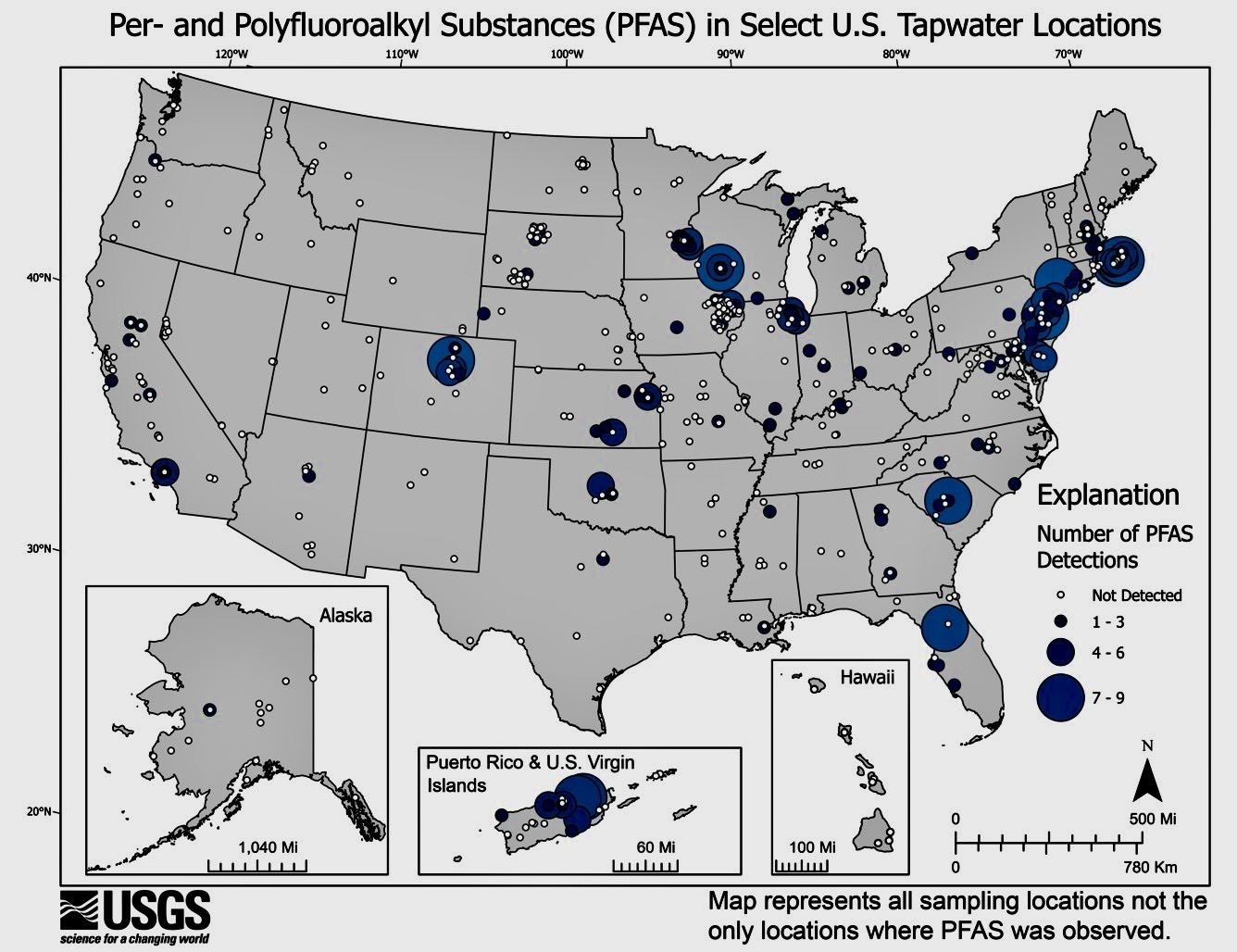
This US Geological Survey map shows the number of “forever chemicals” PFAS detected in tap water samples from select sites across the nation. The findings are based on a USGS study of samples taken between 2016 and 2021 from private and public supplies at 716 locations. The map does not represent the only locations in the U.S. with PFAS. Public Domain.
Prologue
I recently came across with an unpleasant memory from the past – chemicals that last so long in the environment that are now known as “forever” chemicals. The National Institute of Environmental Health Sciences defined the so-called forever chemicals as follows:
“Per- and polyfluoroalkyl substances (PFAS) are a large, complex group of synthetic chemicals that have been used in consumer products around the world since about the 1950s. They are ingredients in various everyday products. For example, PFAS are used to keep food from sticking to packaging or cookware, make clothes and carpets resistant to stains, and create firefighting foam that is more effective. PFAS molecules have a chain of linked carbon and fluorine atoms. Because the carbon-fluorine bond is one of the strongest, these chemicals do not degrade easily in the environment.”
Digging the past
I worked for the Pesticides Office of the US EPA for several years. I learned a lot about the farmers’ sprays. I had heard about the “PFAS forever chemicals,” but, frankly, I did not pay much attention to them. I was too involved with Pesticides: their chemistry, ecological effects, human health effects, disruption of ecosystems, disruption of traditional farming and, just as important, I kept asking myself why would a civilized society ever contemplate using such pernicious toxins in the growing of our crops? For about a century, they have posed a gigantic public and environmental risk in the US and around the world. I realized that the US Environmental Protection Agency was forced to prioritize the profits of farmers and agribusiness over the symbolic attention it sporadically gave to human and ecological health. This disturbed me profoundly. I did not know what to do. In fact, there was very little I could do to change the strategy of EPA. I talked to one or two Congressional staff and Congressmen, but without any result.
Toxic political influence
The Presidents, Congressmen, and Senators have been caught in a vicious, corrupt, money-driven electoral machine. Money has been coming from those who have been wealthy, especially agribusiness corporations that have imposed a medieval feudal order on the countryside. They own most of the land, which gives them tremendous power. And they grow crops like factory products: entirely based on gigantic petroleum-powered machines and plenty of petrochemical pesticides to kill insects, fungi and unwanted plants/vegetation / “weeds.”
Fear in the countryside
This factory model of cultivating the land and growing food emerged in the late 19th-century mania for industrializing everything, primarily in America and Western Europe. About 150 years later, traditional agriculture, in which animals pulled wooden or iron plows and small family farmers/peasants scarcely used any pesticides, is history in America. Instead, as I said, pesticides/biocides, which are for the most part carcinogens and neurotoxins, remain supreme.
But the costs and political dangers of a relatively small number of large farmers growing most of the country’s food are very high. They have emptied the countryside of people, relying on hundreds of thousands of imported farm workers. In addition, the costs for the chemicals and machines pale in comparison to the costs and harms to public and environmental health. Humans, including farmers, die quietly. One at a time, not really knowing why. And the medical establishment that enriches itself from more and more sick people, rarely, if ever, asks why farmers employ carcinogens and neurotoxins in growing food?
Meanwhile, food supermarkets and farmers’ markets in towns decorate themselves like brides. They are grand festivals selling beautiful, shiny products loaded with risks and poisons, all attractive and inviting. But nature tells the truth — and it is fighting back. Both insects and weeds are adapting to more and more pesticide chemicals. The result is that farmers are dumping higher amounts of toxic chemicals on the crops people eat. As for the EPA, at least during my years of service, 1979-2004, it pretended it “registered” the tested by private laboratories active and untested “inert” ingredients, assuring the inquisitive environmentalists that the chemicals were “safe.” This was an illusion, as some of the testing laboratories were faking data and test results.
Forever pesticides?
So, during those 25 years, I heard of PFAS—forever fluorinated chemicals — only parenthetically, never in connection with pesticides. Yet something terrible must have happened during the Obama administration that compelled the EPA to allow the mixing of pesticides with PFAS chemicals, producing far more toxic compounds now called PFAS pesticides. I suspect that the overuse of conventional pesticides made them nearly useless. Their toxic powers had to increase to kill the evolving yet unwanted insects, fungi, and weeds. And the hazardous synthetic forever chemicals fit the bill: giving even more bang for the buck. But the price, once again, was high, especially on human and ecosystem health– worldwide.
“Environmental contamination by fluorinated chemicals, in particular chemicals from the per- and polyfluoroalkyl substances (PFAS) class,” said a recent study, “has raised concerns around the globe because of documented adverse impacts on human health, wildlife, and ecosystem quality. Recent studies have indicated that pesticide products may contain a variety of chemicals that meet the PFAS definition, including the active pesticide ingredients themselves. Given that pesticides are some of the most widely distributed pollutants across the world, the legacy impacts of PFAS addition into pesticide products could be widespread and have wide-ranging implications on agriculture and food and water contamination, as well as the presence of PFAS in rural environments.”
These facts shocked me. They summarized a July 14, 2024, scientific study found in the National Library of Medicine. The scientists concluded:
“The long-term impacts of using mixtures of extremely persistent chemicals on potentially hundreds of millions of acres of US land every year is, to us, a cause for concern. Most, if not all, PFAS in pesticide products or their degradates are going to be chronic persistent pollutants for the foreseeable future of humanity, and their ultimate impact on human and environmental health is largely unknown.”
The scientists said that fluorinated pesticides should be eliminated or, at least, their use ought to be “reduced.”
As I said, I had never heard about “forever pesticides.” I knew that certain chemicals lasted in the environment for a very long time, hence their nickname “forever.” But forever pesticides? EPA approves / registers pesticides. The only pesticide that resembled the forever chemicals was DDT, which the EPA banned in 1972.
Yet a recent report concludes that plenty of “forever pesticides” are poisoning our food: About 37 percent of conventional food grown in California, for example, is contaminated by these insidious mixtures of pesticides and forever poisons PFAS. Scientists found 17 different PFAS in 40 produce: fruits like strawberries, peaches, plums, and grapes. Farmers in California spray something like 2.5 million pounds of active ingredients of “PFAS pesticides” throughout 58 counties every year. The result has been mass poisoning. A 2015 report by the Centers for Disease Control and Prevention found PFSA “in the blood of 97 percent of Americans.” Moreover, these “forever chemicals” are in our water.
Poisoned water
The United States Geological Survey discovered that the forever chemicals are poisoning drinking water: “At least 45% of the nation’s tap water,” says the July 5, 2023 study, “is estimated to have one or more types of the chemicals known as per- and polyfluorinated alkyl substances, or PFAS… There are more than 12,000 types of PFAS, not all of which can be detected with current tests; the USGS study tested for the presence of 32 types.”
Epilogue
The time has come to phase out pesticides and, immediately, ban any pesticide mixed with the deadly PFSA. Civilization and especially nature does not tolerate excess in any living being or human activity. The Greeks had a saying against that pathology: μηδέν άγαν: zero tolerance for overindulgence or doing anything in excess, like making a deadly chemical pesticide product even more deadly – forever! A guarantee of extinction.

No comments:
Post a Comment