Sunday, August 03, 2025

Russia's Nuclear Ambitions Face Funding Crisis

  • Russian energy entities, including Rosatom, are experiencing significant financing difficulties, raising doubts about their ability to fulfill international energy project commitments.

  • Kazakhstan has decided to independently build thermal power plants originally contracted to Russia's Inter RAO due to a lack of promised financing, and is increasingly turning to China for nuclear power plant construction.

  • Rosatom is seeking government financial support to maintain its global leadership in the nuclear energy market and carry out new projects, citing limited financing options due to international sanctions.

Russian energy entities are experiencing financing woes, raising questions about whether Rosatom, Russia’s nuclear energy agency, will be able to fulfill its obligations to build Kazakhstan’s first atomic power plant.

Already, financing troubles have caused another Russian state-controlled firm, Inter RAO, to lose out on constructing three thermal power plants in Kazakhstan. 

During a July 30 appearance before the Russian State Commission on Energy, Andrei Petrov, a top Rosatom official, openly acknowledged that Rosatom was seeking government support. The entity has the resources to complete ongoing work, but by 2027, it will need a financial injection to carry out new projects, Petrov indicated.

Rosatom officials have been somewhat cagey in specifying exactly what kind of support they are seeking and have shied away from specifying an amount. For example, Rosatom’s chief, Alexei Likhachev, recently stated the entity is seeking the “provision of special resources” from the government, according to a report published by the Interfax news agency.

In 2024, a Rosatom official, referring to a program to develop floating nuclear power plants, indicated that Rosatom had limited financing options due to international sanctions on Russia, and required state-subsidized low-interest loans in order for the company to maintain its industry lead in several areas. Rosatom presently enjoys a roughly 50 percent share of the global nuclear energy market, with operations even in several NATO member states, such as Turkey and Hungary.  

“The only way to maintain leadership with this product [floating nuclear power plants] is to subsidize exports even more than we already are,” Interfax quoted Vladimir Aptekarev, a top official at the Rosatom subsidiary Atomenergomash JSC, as saying in 2024, citing Chinese competition.

The Russian government, given the immense burden on the state budget imposed by its war effort in Ukraine, has so far resisted pleas from energy entities for increased support. Rosatom officials have acknowledged that the lack of assistance has hindered efforts to build new types of thermal and nuclear units, known as units Shelf-M and Elena-AM.

The Russian government’s cash crunch appears to be responsible for delays in construction of three planned Kazakh thermal power plants near Kokshetau, Semey and Ust-Kamenogorsk. Inter RAO signed a contract to build the three plants at an estimated cost of about $2.7 billion, with financing to be provided by Russian state-connected institutions. But the money never materialized.

On July 31, Deputy Kazakh Prime Minister Roman Sklyar confirmed that Kazakhstan was ditching the contract with Inter RAO, adding that it would build the plants on its own, according to media reports.

“When the company [Inter RAO] took on the obligation to build these facilities, it was supposed to receive export financing at a low rate. Unfortunately, they were unable to do this, so it was decided to build them independently,” he said.

The Kazakh government’s decision to move on from Inter RAO on the thermal plant projects instantly sparks questions about the fate of Rosatom’s deal to build Kazakhstan’s first nuclear power station. 

When Kazakhstan’s Atomic Energy Agency announced in June that Rosatom would lead the consortium to build the plant on the shores of Lake Balkhash, it indicated that the deal was contingent on the Russian entity’s ability to arrange financing. “Work on the issue of attracting state export financing at the expense of the Russian Federation has begun,” a KAEA statement announced at the time.

At the same time in June, Kazakh officials made the unexpected announcement that they were giving a contract to China’s National Nuclear Corporation (CNNC) to build a second nuclear power plant. At the time, observers saw the announcement as a shrewd move to keep Kazakhstan’s two powerful neighbors, Russia and China, happy. But in hindsight, the move can also be seen as a hedge.

On July 31, Kazakhstan appeared to give a vote of no-confidence in Rosatom’s ability to deliver on the nuclear plant. Sklyar, the deputy prime minister, announced that CNNC would lead construction of a third nuclear power plant in Kazakhstan. He declined to disclose a cost estimate for the projects, adding that the locations of both the second and third nuclear power stations had not been determined. 

Even so, it appears Kazakhstan has a backup plan already in place in case the Rosatom deal falls through.

By Eurasianet.org 


World Nuclear News


Tractebel, NRG-Pallas extend cooperation on research reactor


Friday, 1 August 2025
Belgian engineering firm Tractebel announced it has signed a new mutual agreement with NRG-Pallas to extend their long-standing collaboration on the construction of the Pallas research reactor in Petten, the Netherlands.

Tractebel, NRG-Pallas extend cooperation on research reactor
(Image: Tractebel)

Tractebel - part of France's Engie Group - has more than 60 years of experience in nuclear engineering and since 2015, alongside its subcontractor NucAdvisor, has acted as Owner's Engineer for the planned Pallas reactor. This has involved providing multidisciplinary expertise in engineering, safety, licensing and project management. 

The company said the extended agreement "reinforces Tractebel's commitment to supporting the reactor's successful completion".

Tractebel said its contribution "entails embedding long-term experts within the integrated project team with the support of Tractebel's global nuclear competence centres, acting as an independent third-party reviewer for civil engineering works, and holding a Safety Chair position within the Pallas Safety Committee".

The company also plays an active role in delivering training and facilitating knowledge transfer to strengthen the Intelligent Customer and Design Authority capabilities of the Pallas organisation. It said its experts have worked on all phases of the Pallas project, from initial feasibility studies and the tendering phase to the various design phases and now construction.

Tractebel has provided engineering services for: siting and licensing support (supporting detailed site characterisation and preparing licensing documentation, both nuclear and conventional); design and safety (ensuring compliance with nuclear safety and engineering standards - including technical Health, Safety, and Environment in design, reviewing technical specifications and safety analysis reports); project and risk management (supporting procurement strategies and risk mitigation); and construction oversight (advising on civil works, including the complex foundation and pit construction.

"This project demonstrates Tractebel's ability to support complex, multidisciplinary endeavours, while maintaining the highest standards of safety, technical integrity, and project delivery," said Deepak Narasimhamurthy, Country Manager, The Netherlands, Tractebel. "It also shows how international collaboration, technical expertise, and a shared mission can drive innovation in healthcare and energy. This new agreement demonstrates NRG-Pallas's trust and our shared objectives, positioning Tractebel as a long-term strategic partner in the Netherlands' nuclear future."

In March 2023, Tractebel signed a memorandum of understanding with NRG-Pallas to collaborate in providing engineering services for the construction of large nuclear power plants in the Netherlands.

The Pallas reactor project

NRG-Pallas applied in June 2022 to the Dutch regulator, the Authority for Nuclear Safety and Radiation Protection, for a permit to construct and operate the Pallas reactor. ANVS granted a construction licence in mid-February 2023. Preparatory work on the foundation began in May 2023. This work was carried out by Belgian construction firm Besix, which was awarded a contract in November 2022.

In May this year, NRG-Pallas announced that the building of the construction pit - a hole of about 50 metres by 50 metres and 17.5 metres deep - and the foundation for the Pallas reactor had been completed.

Last month, the Netherlands' outgoing Minister of Health, Welfare and Sport Daniëlle Jansen informed the House of Representatives that the project to construct the Pallas research reactor is ready to enter the next phase of construction.

Although funding had been allocated in the coming years for the construction of the Pallas reactor, the Dutch government has yet to make a final decision on its construction. The European Commission has already approved, under EU state aid rules, the Dutch government's plan to invest EUR2 billion (USD2.2 billion) in the construction of Pallas.

Former Minister of Health, Welfare and Sport Ernst Kuipers instructed NRG-Pallas not to take any irreversible steps, but to continue with the preparations for the project in the meantime to avoid unnecessary delays.

The Pallas research reactor is to be built at Petten to replace the existing High Flux Reactor (HFR), which began operating in September 1960 and supplies about 60% of Europe's and 30% of the world's medical radioactive sources. Pallas will be of the "tank-in-pool" type, with a thermal power of around 55 MW, and able to deploy its neutron flux more efficiently and effectively than the HFR.

Rolls-Royce SMR agreements with Škoda and Curtiss-Wright

Friday, 1 August 2025
UK-based Rolls-Royce SMR has signed a memorandum of understanding with the Czech firm Škoda JS to explore the production of key components for a global fleet of small modular reactors.

Rolls-Royce SMR agreements with Škoda and Curtiss-Wright
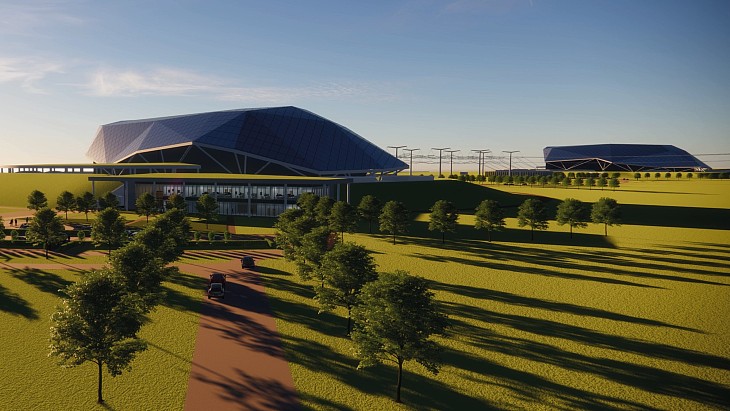
How a Rolls-Royce SMR might look (Image: Rolls-Royce SMR)

The agreement is described as the beginning of a strategic partnership, with Rolls-Royce SMR, now 20% owned by the Czech nuclear operator and Škoda JS parent company CEZ, saying that building long-term relationships with Czech suppliers was an important part of plans to deploy up to 3 GW of its units in the country.

Ruth Todd, Rolls-Royce SMR’s Operations & Supply Chain Director, said: "This agreement ... demonstrates our commitment to provide local opportunities to the Czech supply chain. Starting collaboration now will help Škoda JS supply its products to the required high standards and allow us to deliver this transformational opportunity together."

Silvana Jirotková, Director of the SMR Development Department at ČEZ, called it a "significant step in preparing the first Czech small modular reactor. From the beginning, we have emphasised that involving Czech industry in the development and construction of new nuclear sources is our priority, and the cooperation between the British SMR developer and this traditional Pilsen-based company is proof of that".

František Krček, Škoda JS CEO, said: "We are ready, and we have the significant support of our owner to invest further significant resources in the development of the SMR industry. We also want to involve our engineering capacities in this project in addition to our production capacities."

Rolls-Royce SMR has also signed a contract with another Czech company, ÚJV Řež, for the analysis, testing, and evaluation of critical SMR components.

Curtiss-Wright

In a separate announcement, Rolls-Royce SMR has also secured a multi-million-pound strategic partnership with Curtiss-Wright's UK-based nuclear business.

The Dorset business, formerly Ultra Energy, will provide design, qualification, testing and supply of the Non-programmable Diverse Reactor Protection Systems - "safety critical back-up instruments, designed to provide an independent means of shutting down a reactor. They are simple and robust, deploying proven-in-use electronic technology and techniques, while avoiding the use of microprocessors, software or programmable devices."

Ognjen Starovic, General Manager, Curtiss-Wright, said: "We have a strong UK-based team focused on supporting this partnership and we're all excited to be part of the Rolls-Royce SMR story. We take great pride in helping to deliver a British SMR, as well as provide our people with new career opportunities and create long-term job growth in the region."

Ruth Todd said "securing industry-leading expertise will further de-risk our programme by underpinning a critical element of the design".

Background

The Rolls-Royce SMR is a 470 MWe design based on a small pressurised water reactor. It will provide consistent baseload generation for at least 60 years. 90% of the SMR - measuring about 16 metres by 4 metres - will be built in factory conditions, limiting on-site activity primarily to assembly of pre-fabricated, pre-tested, modules which significantly reduces project risk and has the potential to drastically shorten build schedules.

In June this year it was selected as the UK government's preferred technology for the country's first SMR project. It is aiming to sign contracts with Rolls-Royce SMR later this year and will form a development company. It will also aim to allocate a site later this year and connect projects to the grid in the mid-2030s. A final investment decision is expected to be taken in 2029.

In October 2024, Rolls-Royce SMR was selected by CEZ to deploy up to 3 GW of electricity in the Czech Republic.

Hot testing of second Taipingling unit completed


Friday, 1 August 2025
Tests that simulate the temperatures and pressures which the reactor systems will be subjected to during normal operation have been completed at unit 2 of the Taipingling nuclear power plant. The unit is the second of six HPR1000 (Hualong One) units planned at the site in China's Guangdong province.
Hot testing of second Taipingling unit completed
(Image: CGN)

"On 30 July, with the drainage of the primary circuit of Unit 2 of the Taipingling nuclear power plant to the circuit water level and the successful completion of the last test of Phase II.3, it marked the successful completion of the hot performance test, and the unit took another step towards the goal of high-quality commissioning," China General Nuclear (CGN) said.

Hot functional tests involve increasing the temperature of the reactor coolant system and carrying out comprehensive tests to ensure that coolant circuits and safety systems are operating as they should. Carried out before the loading of nuclear fuel, such testing simulates the thermal working conditions of the power plant and verifies that nuclear island and conventional equipment and systems meet design requirements.

Cold functional tests - which are conducted to confirm whether components and systems important to safety are properly installed and ready to operate in a cold condition - were completed at Taipingling 2 earlier this year. The main purpose of those tests - which marked the first time the reactor systems were operated together with the auxiliary systems - was to verify the leak-tightness of the primary circuit.
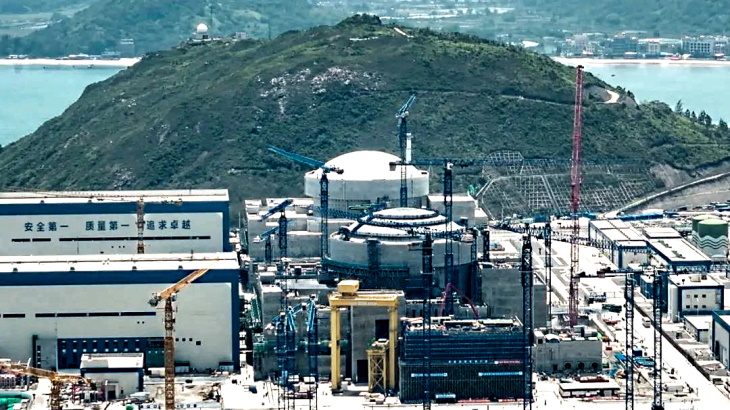

Taipingling units 1 and 2 (Image: CGN)

The Taipingling plant will eventually have six Hualong One reactors. The construction of the first and second units began in 2019 and 2020, respectively. Hot testing of unit 1 was completed in September 2024. Unit 1 is scheduled to start up in 2025, with unit 2 following in 2026.

Construction of the second phase of the plant - units 3 and 4 - was approved by China's State Council on 29 December 2023, with construction of unit 3 getting under way in June this year.

Hungary looking at deployment of BWRX-300s

Friday, 1 August 2025
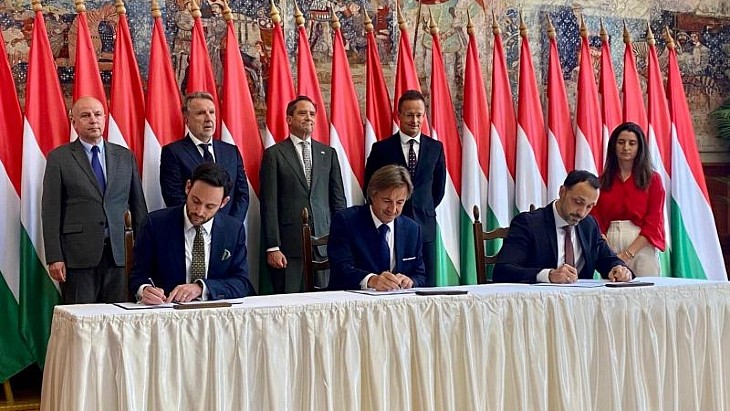
Hungarian nuclear energy development firm Hunatom has signed a letter of intent with Synthos Green Energy to establish a pre-framework for joint activities relating to project development for up to 10 GE Vernova Hitachi BWRX-300 small modular reactors.

Hungary looking at deployment of BWRX-300s
(Image: Synthos Green Energy)

Poland's Synthos Green Energy is project developer for BWRX-300 small modular reactors (SMRs) in the region. The signing of the agreement took place in the presence of Hungarian Foreign Affairs and Trade Minister Peter Szijjartó, US Chargé d’Affaires Robert Palladino, and Polish Chargé d’Affaires Jacek Śladewski.

Szijjártó said that with the increasing electricity demand there was a need to sustain energy security by increasing nuclear capacity and "SMRs are the ideal solution for us". He announced the launch of preliminary work in Hungary to prepare for the introduction of SMRs, which "encompasses technology, infrastructure, financial, and legislative measures" under the letter of intent.

Hunatom is part of the Paks II Group.

The US Embassy in Hungary said "the signing marks a major milestone for the US Foundational Infrastructure for Responsible Use of Small Modular Reactor Technology (FIRST) Program, which co-funded a two-part licensing and regulatory study for SGE in Poland. Under the FIRST Program, the US SMR Pan-European Regional Interest Nuclear Group or SPRING project is now poised to facilitate deliveries of more BWRX300s in the region, through a fleet deployment approach that will increase efficiency and reliability and lower costs".

Palladino said: "The United States and Hungary are deepening our relationship across the board: in defence, in commerce, in space, and in energy. This is no accident. We are doing so because we share interests, and more importantly, because we share values: sovereignty, freedom, and the right to chart our own course.

"Hungary has made a clear and sovereign choice to invest in its energy future with trusted partners. And the United States is proud to be one of them. We are not here to impose; we are here to invest."

Synthos Green Energy's Michał Sołowow said: "I am here as an entrepreneur, but also as a Polish patriot. As a patriot, I know that our agreement is a step towards increasing the energy independence of the entire region, including Poland and Hungary."

Hungary currently has four operable reactors generating about half its electricity. The Paks plant, 100 kilometres south of Budapest, comprises four Russian-supplied VVER-440 pressurised water reactors, which started up between 1982 and 1987. An inter-governmental agreement was signed in early 2014 for Russian enterprises and their international sub-contractors to supply two VVER-1200 reactors at Paks II. First concrete has been scheduled for the first unit for later this year, or in 2026.

The BWRX-300 is a 300 MWe water-cooled, natural circulation SMR with passive safety systems that leverages the design and licensing basis of GE Vernova Hitachi Nuclear Energy's 1500 MW ESBWR boiling water reactor.

Pilot uranium processing plant launched in Tanzania

Thursday, 31 July 2025

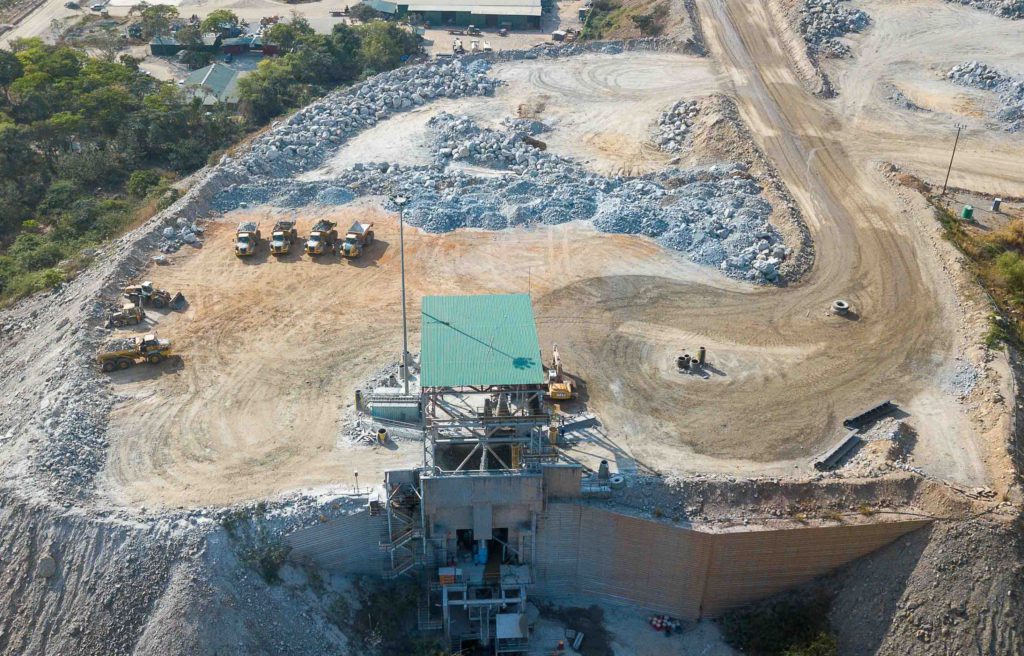
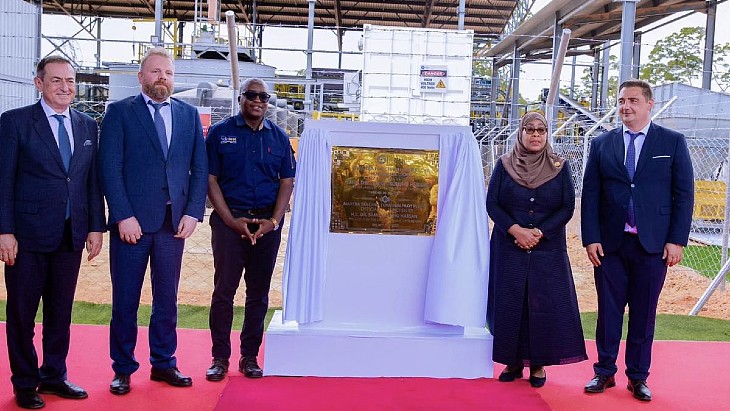
The pilot uranium processing plant has been commissioned by Rosatom subsidiary Mantra Tanzania Ltd at the Mkuju River project in southern Tanzania.
Pilot uranium processing plant launched in Tanzania
(Image: Rosatom)

The plant, located at the Nyota deposit, will be used to test uranium processing technologies and inform the design of the main processing complex with a production capacity of up to 3,000 tonnes of uranium per year. Its construction is scheduled to begin in the first quarter of 2026, with commissioning scheduled for 2029.

The official pilot plant commissioning ceremony was attended by government officials led by Samia Suluhu Hassan, Tanzania’s President, who said: "This is a landmark achievement for our country. For the first time, Tanzania is stepping onto the global uranium map with the capacity to supply a strategic mineral that is essential for safe and sustainable energy generation worldwide."

According to Tanzania's Ministry of Minerals the "strategic project is set to transform" the country’s "mining and energy landscape, opening new doors for foreign investment, clean energy solutions and high-value technological advancements". It said the government holds a 20% stake "projected to earn USD40 million annually in dividends, channelled into national development projects", and hundreds of direct and indirect jobs would be created.

It said that Tanzania will enter the list of the top 10 uranium-producing nations.

Alexey Likhachev, Rosatom director general, said the corporation was helping to develop Tanzania's "unique geological potential … as with all our partners, we intend to build cooperation with the Republic on the basis of equality and mutual understanding. At the same time, in its activities, Rosatom is always guided by the principles of sustainable development with unconditional compliance with high environmental and social standards. We will be happy to help Tanzania take an important step towards integration into the global nuclear energy industry".

The proposed environmental protection system for the project includes real-time ecosystem monitoring, closed-loop water supply systems with water recycling, and biodiversity conservation programmes, Rosatom said.

The Mkuju River project is owned by Mantra Tanzania Ltd. and is located in the Namtumbo district of the Ruvuma region. Mantra Tanzania is part of Rosatom subsidiary Uranium One Group which is an international mining group of companies which also has assets in Kazakhstan and Namibia.

Tomari 3 meets safety requirements, regulator concludes


Wednesday, 30 July 2025
Unit 3 of Hokkaido Electric Power Company's Tomari nuclear power plant - Japan's newest power reactor - has moved a step closer to restarting after the country's Nuclear Regulation Authority concluded the unit meets revised safety standards.
Tomari 3 meets safety requirements, regulator concludes
The Tomari plant (Image: Hokkaido EPC)

Under Japan's reactor restart process, plant operators are required to apply to the Nuclear Regulation Authority (NRA) for: permission to make changes to the reactor installation; approval of its construction plan to strengthen the plant; and final safety inspections to ensure the unit meets new safety requirements. Operators are required to add certain safety-enhancing equipment within five years of receiving the NRA's approval of a reactor engineering work programme.

The Tomari plant comprises two 550 MWe pressurised water reactors (PWRs) (units 1 and 2) and a 912 MWe PWR (unit 3). All three units have been offline since unit 3 stopped power generation for regular inspection in 2012. Hokkaido EPC is seeking regulatory approval to restart all three reactors.

The utility applied for a review in July 2013 to assess whether its plan for upgrades at Tomari 3, which started operation in 2009, satisfies updated safety standards introduced following the March 2011 accident at the Fukushima Daiichi plant.

After approving a draft report in April this year, following a period for public comments the NRA has now formally adopted its findings that unit 3 meets the new regulatory safety standards and has issued Hokkaido EPC a permit to make changes to the reactor installation. It becomes the 18th Japanese reactor to pass the regulator's safety screenings.

"We would like to express our sincere gratitude to the Nuclear Regulation Authority and everyone involved with Tomari Nuclear Power Plant who have been involved in the review for over 12 years since our application," said Hokkaido EPC President and CEO Susumu Saito. "The permit we received today recognises that the basic policy and basic design for safety measures for Tomari Nuclear Power Plant Unit 3 comply with the new regulatory standards, and we view it as a major milestone toward restarting operations."

The company built a new 16.5-metre-high seawall to protect the plant from tsunamis, but later agreed to build one 19 metres in height, based on the regulator's advice. Construction of the seawall is currently under way and expected to be completed in early 2027. Hokkaido EPC has also upgraded its quake-resistant design for the facilities to cope with more intense acceleration of seismic waves - from up to 550 gals to 693 gals. 

The company will still need to obtain the consent of local governments before it can restart Tomari 3.

In May 2022, the Sapporo District Court issued a ruling granting a request for an injunction against the operation of the three-unit Tomari plant. A lawsuit filed by about 1200 plaintiffs, including local residents, in November 2011 claimed the plant has insufficient countermeasures against earthquakes and tsunamis and called for it to be decommissioned. An appeal by Hokkaido EPC against that decision is currently being heard at the Sapporo High Court.

"We believe that the understanding of the local community and the people of Hokkaido is essential for restarting operations," Saito said. "We will seize every opportunity to provide explanations to as many people as possible so that we can gain their understanding.

"Our pursuit of improving the safety of Tomari Nuclear Power Plant is never-ending. We will continue to strive to achieve the world's highest standards of safety through continuous efforts, including further safety improvements and the enhancement of various training programmes."

The NRA is still reviewing the safety of Tomari units 1 and 2.


US Oil Rig Count Falls Again as Frac Crews Vanish

The total number of active drilling rigs for oil and gas in the United States fell this week, according to new data that Baker Hughes published on Friday as operators continue to scale back.

The total rig count in the US fell by 2 rigs for the second week in a row, landing at 540, according to Baker Hughes, down 46 from this same time last year.

The number of oil rigs fell by 5 to 410, down by 72 compared to this time last year. The number of gas rigs rose by 2 this week, coming in at 124 for a gain of 26 active gas rigs from this time last year. The miscellaneous rig count also gained a rig, for a total of 6.

The latest EIA data showed that weekly U.S. crude oil production rose in the week ending July 25, from 13.273 million bpd to 13.314 million bpd, breaking four consecutive weeks of falling production.

Primary Vision’s Frac Spread Count, an estimate of the number of crews completing wells, fell by 6 during the week of July 25, to 168. It is the fewest number of active frac crews since 2021. The count is now 47 below where it was on March 21.

Drilling activity in the Permian basin saw another loss this week, losing 1 rig. The Permian now has 259 rigs—a figure that is 44 fewer than this same time last year. The count in the Eagle Ford saw stayed the same at 39 rigs, which is 11 fewer than this time last year.

At 12:47 p.m., ET, the WTI benchmark was trading down $2.10 per barrel (-3.03%) on the day at $67.16—nearly $2 per barrel above last week’s levels. The Brent benchmark was trading down $2.21 (-3.08%) on the day at $69.49.

By Julianne Geiger for Oilprice.com

Inside the Lavish Lifestyles of Putin's Inner Circle


  • Sergei Chemezov, a close ally of President Vladimir Putin and head of the sanctioned Russian state defense conglomerate Rostec, and other Rostec subsidiary heads, spend time at luxury villas in the XXII Carat complex in Dubai.

  • While not always formal owners, these individuals use elaborate, multimillion-dollar villas, with some properties formally owned by associated firms or relatives, suggesting efforts to obscure ownership.

  • The article details the opulent lifestyle of these individuals, including private beachfronts, million-dollar bathtubs, and gatherings with Russian pop stars, highlighting how Dubai serves as a haven for wealthy Russians, including those under sanctions.

Private beachfronts, million-dollar bathtubs, evenings of wine, whiskey, cigars, and karaoke – or performances by Russian pop stars whose fame stretches back to the 1990s.

Those are some of the trappings of an “ultraluxe” villa complex in Dubai where Sergei Chemezov – the Western-sanctioned head of the massive Russian state defense conglomerate Rostec and a close ally of President Vladimir Putin since they were KGB officers in communist East Germany – spends time with family, friends, and associates.

While they are not the formal owners of the mansions, Chemezov and at least two heads of Rostec subsidiaries are neighbors at XXII Carat, a gated complex of elaborate, multimillion-dollar villas on the Palm Jumeirah, an artificial island on the Persian Gulf coast, Systema, RFE/RL’s Russian investigative unit, has found.

Chemezov, 72, became friends with Putin when they lived in the same apartment building in Dresden in the 1980s, when Chemezov was a KGB general and Putin a lieutenant colonel in the Soviet spy agency. In 1996, when Putin became President Boris Yeltsin’s deputy chief of staff, he made Chemezov head of the Kremlin’s foreign economic relations department.

Rostec and its sprawling web of units and subsidiaries manufacture many of the weapons and components Russia uses in its war against Ukraine, now in its fourth year since Putin launched the full-scale invasion in February 2022.

Chemezov has supported the invasion and echoed Putin’s narratives in public comments, accusing the United States and its Western allies of provoking the war and saying they risked triggering a global war. The Rostec CEO since 2007, Chemezov was hit with US, UK, and EU sanctions following the Russian seizure of Ukraine’s Crimean Peninsula in 2014.

Sapphire, Emerald, Ruby

Since 2015, he has been visiting the United Arab Emirates at least once a year, according to leaked border crossing data. A source who is familiar with Chemezov’s inner circle said that the villa Chemezov uses was purchased a few years before the complex was finished late in 2018, and that Chemezov and his wife “put a lot into it, like a second home,” personally choosing the interior and closely monitoring the construction.

The villa they built is the costliest of the three styles at the complex, Sapphire, each of which has beach access and some of which are fitted with a $1 million bathtub made crystal or quartz – rose or green. In 2020, Sapphire villas cost $25.8 million, and the current asking price is about $31 million.

The other styles are Emerald and Ruby; all of them have at least seven bedrooms, a hammam bath, a climate-controlled wine cellar, a landscaped garden, and a swimming pool.

Hidden Ownership?

Formally, the two-story, 2,170 square meter home Chemezov uses is owned by a firm called Neve Limited, according to data published by C4ADS, a US-based nonprofit data-analysis and global-research organization. Systema was unable to track down information about Neve Limited, but the C4ADS data shows an e-mail address and phone number that leaked documents suggest are those of Natalya Agapova, a lawyer who has longstanding financial ties to Chemezov and his family.

Agapova declined to comment on property at XXII Carat, and Rostec did not respond to a request for comment.

One and two doors down from the Chemezov villa are slightly smaller homes used by the heads of two Rostec subsidiaries: Nikolai Kolesov, the director of Russian Helicopters; and Aleksandr Mikheyev, the director of Rosoboronexport, the main Russian arms sales company.

The villa Mikheyev uses is registered to his son, Aleksei, according to C4ADS data and Dubai land records. The formal owner of the one Kolesov uses is a local UAE company, Veles Electronics, which the late Putin foe and anti-corruption crusader Aleksei Navalny’s associates linked to the Russian Helicopters chief in a recent report.

Aleksei Mikheyev declined to comment. Rosoboronexport and Russian Helicopters did not respond to requests for comment.

Chemezov often spends time with Mikheyev and Kolesov when he stays in Dubai, sources with knowledge of the Rostec leadership told Systema, speaking on condition of anonymity because they were not authorized to discuss the matter publicly.

Their gatherings typically involve drinking alcohol, smoking cigars, and singing karaoke, sources said – though sometimes it was patriotic Russian pop stars such as Oleg Gazmanov and Grigory Leps, both under EU sanctions since 2022 over their support for the war, doing the crooning.

Russian Roots

The sources of wealth that enable state-owned company chiefs like Chemezov, Mikheyev, and Kolesov to afford such property are murky, though the latter also controls a lucrative network of private military industry companies.

A haven for rich Russians, particularly for those hit by sanctions over the war in Ukraine, Dubai is on the Persian Gulf -- but the roots of XXII Carat are deep in Russia. The developer was a company called Forum Group, based in Yekaterinburg and founded by Oleg Cherepanov, a prominent businessman who was known in the Ural Mountains city as Cherep – “the Skull.”

Cherepanov has lived in Dubai since 2014 and heads Forum Group Dubai. He has distanced himself from the Russian-based Forum Group, which is now 80 percent owned by Tamara Cherepanova, 77.

In Yekaterinburg, Forum Group built an ice arena for UGMK, a metals giant whose co-owner, US and UK-sanctioned billionaire Andrei Bokarev, is reportedly a friend of Chemezov’s and purportedly owns real estate at XXII Carat.

The C4ADS database indicates that two Ruby-class villas belonged to Diana Madzhitova, 29, who has flown to the U.A.E. with Bokarev more than 20 times in the last five years, according to leaked border crossing data. One of those houses was apparently later acquired by relatives of a more prominent billionaire: Alisher Usmanov.

Usmanov, a metals-to-media tycoon with a fortune of more than $16 billion, according to Forbes, is under US, UK, EU, and other sanctions.

Usmanov’s niece Gulnoz Kocharova and her husband are beneficiary owners of two Ruby-class villas at XXII Carat, including the one that had been registered to Madzhitova, according to Dubai land records.

"We categorically reject the implications and assumptions embedded in your questions. There is no cause or obligation to address them further," a lawyer for Usmanov, Joachim Steinhoefel, wrote in a response to a query from Systema.

Kocharova hung up on a journalist who called for comment, and she and her husband did not respond to queries sent by messaging app. Bokarev and Madzhitova did not respond to attempts to contact them.

By RFE/RL 


EU Probe Puts ADNOC’s $14B Covestro Takeover at Risk

  • ADNOC’s $14 billion takeover of Germany’s Covestro faces an EU probe under the Foreign Subsidies Regulation over potential market distortion, with a decision due by December 2, 2025.

  • Covestro is struggling with weak Q2 sales (-8.4% YoY to €3.38B) amid U.S. tariffs and global oversupply, while management remains cautiously optimistic the deal will proceed.

  • A negative EU ruling could chill Gulf investment in Europe and affect ADNOC’s broader energy partnerships, including green hydrogen and ammonia projects.


The takeover of German chemicals giant Covestro by Abu Dhabi’s national oil company ADNOC is facing significant hurdles, as the EU is at present assessing the possible competition distortion in European markets. While the German chemical company reported today that it has missed its Q2 2025 sales expectation, primarily due to US trade policies, the management remains confident that the ADNOC takeover deadline is being met. Covestro indicated that it is satisfied that the EU probe is not going to materialize in a blockade of the deal.  Covestro is currently hit by a significant oversupply of its main products in global markets, including foam chemicals used in building, automotive, and mattresses. US tariffs have caused a substantial drop in prices, especially in Asian markets. In its financial report, Covestro stated that overall revenues decreased by 8.4% to 3.38 billion euros in Q2 (April-June), which is way below analyst expectations of around 3.55 billion.  Earlier in July, Covestro already put out a warning that its full-year earnings will be lower. At present, Covestro expects earnings before EBITDA between 700 and 1.1 billion euros, which is a dramatically lower figure than the last update, 1-1.4 billion euros.

The market, already under pressure, is now eagerly awaiting the progress and outcome of the EU probe in the coming months. Since the proposed takeover by ADNOC last year, which entails a total of $14 billion, political pressure is mounting inside the EU to assess the role of the Abu Dhabi National Oil Company and the Emirati government in the EU market. As ADNOC is a state-owned oil and gas company with opaque financial reporting, there are fears that the Covestro takeover could distort internal EU market competition. ADNOC has been refuting any claims about possible distortion tactics or threats to other competitors, but the market remains on edge.

The current EU approach demonstrates a proactive stance by Brussels and its member states on non-EU investments in critical sectors of the European Union. This proactive stance underscores the EU's commitment to protecting its market from potential distortions. The move, based on rules implemented in 2023, and the concerns it addresses, can push potential Gulf-based investors and operators to consider other investment regions. ADNOC could now be considering its European options, especially in light of US President Trump’s move to attract more foreign capital to the US via his America First Investment Policy.

Officially, the European Commission has opened the investigation based on the Foreign Subsidies Regulation (FSR), as the Commission stated it has concerns about potential foreign subsidies by the UAE. The latter accusation is based on concerns that not only will ADNOC increase its committed capital into Covestro, but it has also offered an unlimited guarantee from the UAE. Brussels, especially, is looking at the option that, based on the two above-mentioned points, ADNOC has acquired Covestro not on market confirm pricing. Indirectly, the question is whether ADNOC has used UAE backing and financial structures to outperform other competitors for Covestro. Emirati backing is expected to have allowed ADNOC to propose a much higher price than regular competitors would have offered during the takeover period.  The Commission, based on the fact that the transaction was notified to the Commission on May 15, 2025, has now until December 2, 2025, to make its own decision. Based on the FSR, companies should notify the Commission about a merger or acquisition entailing a company having an EU turnover of 500 million euros or more.

If the outcome of the EU probe is negative, the potential fallout could be massive, casting a shadow over other GCC investments in the EU. An adverse outcome could also have repercussions on ongoing deals between EU countries and ADNOC, especially in the areas of green hydrogen or ammonia, further complicating the situation.

By Cyril Widdershoven for Oilprice.com


New Tariffs Threaten American Battery Production

CUTTING NOSE TO SPITE FACE

  • Trump-era clean energy policies and a significant tariff on Chinese graphite are impeding the growth of the United States' domestic battery industry, despite prior gains under the Biden administration.

  • The domestic battery industry had committed to investing $100 billion by 2030 to build an independent grid battery sector, a goal now jeopardized by current policy shifts.

  • The impact of these policies is disproportionately affecting Republican districts within the "battery belt," leading to project pauses, cancellations, and funding declines.

Trump-era clean energy policies are slamming the breaks on the United States’ battery war with China. While lithium-ion batteries were invented in the United States, China has been outpacing the nation in terms of both battery manufacturing and technological innovations. But while U.S. companies have been scrambling to keep up, gutted clean energy incentives and tariffs on critical materials have made a U.S. victory all but impossible. 

The domestic battery industry had been gaining considerable ground under the Biden administration thanks to major incentives including the sweeping Inflation Reduction Act. Tax credits, in particular, “helped close the price gap between U.S.-made batteries and those made in China, the world’s main supplier of lithium-ion battery modules, cells, and materials,” according to Canary Media.

Realizing that the Trump administration would bring a less encouraging policy environment for clean energy technologies, makers of lithium-ion batteries promised the federal government that they would  collectively spend a cumulative $100 billion by 2030 to build up an independent and totally domestic grid battery industry. In exchange, they asked for continued political support.

So far, that plea seems to be falling flat. Just this month, the Trump administration accused Chinese suppliers of dumping graphite into U.S. markets – meaning that they are selling graphite more cheaply abroad than in their own markets. As a result, the United States has imposed a formidable 93.5 percent tariff on Chinese graphite. This could have immediate and serious consequences for United States batterymakers, as almost all refined graphite in the world comes from China. In fact, this tariff alone could “easily add $1,000 or more to the price of a battery” according to the New York Times. 

As a result, the nation’s once-thriving “battery belt” is faltering. “Projects are being paused, cancelled, and closed at a rate 6 times more than during the same period in 2024,” reports “The Big Green Machine,” a site affiliated with Wellesley College that tracks domestic clean energy investments. And this biggest projects are the ones suffering most.

Politico reports that “prospects dimmed for 34 projects that are worth more than $31 billion and were expected to create almost 28,000 jobs.” This includes projects that are either paused, canceled, delayed by at least six faced by a slash in funding, or scaled down. But the overall impact of recent political shifts are still unclear, and overall the domestic clean energy sector is still growing.

“The policies Republicans have passed are so recent that they may not have worked their way through the economy,” reports Politico. “In the last three months, Congress has passed and President Donald Trump has signed bills that removed key tax credits, taken the teeth out of fuel-economy rules and neutered California’s ability to force automakers to sell EVs.” 

Taken together, all of these compounding policy measures create an uncertain policy and investment environment at minimum. More likely, it will cause an extreme contraction of the domestic battery sector at a time when Beijing was already pulling away.

"Unquestionably, the Chinese are ahead in manufacturing technology," Bob Galyen, a retired executive who worked with both GM and the Chinese battery giant CATL, told NPR. He says that Chinese battery research and development is receiving major influxes of cash at a time when U.S. manufacturers are struggling for funding. "Clearly, the U.S. is lagging behind,” he finished.

Ironically, these measures are hitting Republican districts the hardest. The so-called “battery belt” is mostly comprised of red states. As a result, according to Politico, “GOP districts saw 60 percent of the funding decline, while Democratic districts saw 39 percent.”

By Haley Zaremba for Oilprice.com

BAN SEA BED MINING!

Trump’s Seabed Mining Plan Sparks Backlash

  • President Trump signed an executive order to expand U.S. seabed mining efforts for critical minerals, sparking widespread global criticism.

  • The International Seabed Authority and its member states condemned the move as a breach of international law and a threat to marine ecosystems.

  • Mining firm TMC faces scrutiny from international partners, while the ISA warned that rogue actions could result in revoked exploration rights.


United States President Donald Trump aims to develop the country’s seabed mining industry to access a supply of critical minerals, which are vitally needed across several industries, to reduce reliance on China. However, as seabed mining is an international issue, with strong regulations and norms on operations, Trump’s plan has attracted widespread criticism from international organisations and environmentalists worldwide. 

The International Seabed Authority (ISA) is an autonomous organisation that was established in 1982 under the United Nations Convention on the Law of the Sea (UNCLOS) and the 1994 Agreement relating to the Implementation of Part XI of the United Nations Convention on the Law of the Sea to protect the world’s marine environment from harmful effects that may arise from deep-seabed-related activities. By 2024, the ISA had 170 members, including 169 member states and the European Union – although not the United States – which had signed the Law of the Sea treaty.

In recent years, pressure has been mounting on the ISA to introduce regulations for the commercial extraction of minerals, with several global powers calling for a moratorium. Many expect the ISA to deliver such regulations this year, as several countries have begun to discuss plans for seabed mining for critical minerals due to the high global demand for these metals and minerals.

In 2024, Norway introduced a plan to assess the potential for deep-sea mining for minerals before the move was eventually blocked after the country’s Socialist Left Party said it would not support the government’s budget unless it scrapped the first licensing round, set for 2025, over environmental concerns. Meanwhile, several Pacific Islands, which rely heavily on the health of the ocean, continue to fight against deep-sea mining operations in a bid to ensure their survival.

However, this has not stopped President Trump from encouraging plans for seabed mining in U.S. waters. In April, Trump signed an executive order to “Unleash America’s Offshore Critical Minerals and Resources”. In the order, Trump states, “Our Nation must take immediate action to accelerate the responsible development of seabed mineral resources, quantify the Nation’s endowment of seabed minerals, reinvigorate American leadership in associated extraction and processing technologies, and ensure secure supply chains for our defence, infrastructure, and energy sectors.”

Days after Trump’s announcement, The Metals Company (TMC) USA submitted an application to the National Oceanic and Atmospheric Administration (NOAA) for two exploration licenses and one commercial recovery permit, in the Clarion Clipperton Zone, under the Deep Seabed Hard Mineral Resources Act (DSHMRA). However, the Clarion–Clipperton zone, an environmental management area of the Pacific Ocean, is managed by the ISA.

In response to Trump’s plans, Leticia Reis de Carvalho, Secretary-General of ISA, stated, the executive order regarding deep-seabed mineral resources “raises specific concerns because while the Order primarily addresses domestic political and policy matters, its reference to applicability in areas beyond national jurisdiction becomes a matter of the rule of law within the global ocean governance framework known as UNCLOS.” Reis de Carvalho added that the UNCLOS makes clear that “no state may claim, acquire, or exercise sovereignty or sovereign rights over any part of the area or its mineral resources.”

Since the signing of the order, several international organisations and environmental groups have pushed back against Trump’s mining plans. In addition, some of TMC’s international partners are questioning their relationship with the firm due to concerns over the legality of the company’s mining plans. Many believe that mining in areas outside a country’s territorial waters is not just a breach of international law, but also an affront to “the common heritage of mankind”, unless the international community can come to a common consensus on how to manage seabed mining. 

This week, ISA delegates gathered in its headquarters in Kingston, Jamaica, to address Trump’s mining ambitions. The council, which consists of 36 elected member states, passed a resolution that urges the group’s legal and technical committee to investigate “noncompliance” by its signatories. 

Matthew Gianni, a co-founder of the Deep-Sea Conservation Coalition, who attended the ISA talks, said, “TMC has been testing the limits of what it can get away with, a bit like a child seeing how far it can go with bad behaviour.” Gianni added, “The member countries of the ISA have basically sent a shot across the bow, a warning to TMC that going rogue may well result in the loss of its ISA exploration claims… It also sends a signal to other companies that if they go the same route as TMC has, they may also face the same consequences.” 

It remains uncertain whether President Trump will go ahead with plans for seabed mining, or if his administration will approve TMC’s mining license; however, the international community has made its stance clear. The ISA and its member states strongly oppose U.S. plans to commence deep-sea mining operations before international regulations are established, as it considers the move could cause irreparable damage to the marine environment. 

By Felicity Bradstock for Oilprice.com


Winning consortium vows responsible mining at Guinea’s Simandou


Simandou in Guinea. (Image: Google Earth.)

Winning Consortium Simandou, one of the companies developing the world’s biggest untapped iron ore deposit in Guinea, has said that it is working closely with authorities and communities to address environmental concerns linked with the project.

The commitment follows studies by Advocates for Community Alternatives, a non-governmental organization, which revealed that construction of the Simandou project was linked with water and soil pollution.

“Winning Consortium Simandou is committed to developing the project responsibly, in accordance with Guinean regulations and international standards,” it said Friday in response to questions. “We remain committed to ensuring that the project generates sustainable and inclusive benefits for the Guinean people.”


Earlier this week London-based Rio Tinto Plc, which together with Aluminum Corp. of China control the third and fourth blocks of the project said “we are fully committed to minimizing the impacts of our operations through preventive, mitigation, and compensation measures, in full compliance with national legislation and international standards.”

Coastal settlements around the sea port being constructed for ore shipment are experiencing pollution of fishing areas and cracks in buildings, the NGO said on July 29. Samples of water and soil collected around the iron ore deposits in the southeast tested positive for high levels of acidity and bacterial contamination, it said.

Winning Consortium Simandou, backed by Chinese companies including China Baowu Steel Group, own the first two blocks at Simandou.

(By Ougna Camara)


Vale says ERG Brazil mine investment still not adding up


Top iron ore producer Vale SA continues to weigh an investment in Eurasian Resources Group’s Brazilian mine project, but says it has not yet found a cost-effective way to develop it.

“The volume of ore available there alone does not justify the construction of the infrastructure that is needed in terms of railways,” chief financial officer Marcelo Bacci told reporters Friday. “We still haven’t been able to come up with an equation that makes this calculation work.”

The Bahia Mineração project, known as Bamin, needs an estimated 30 billion reais ($5.4 billion) investment to expand operations, build a port and finish a 527 kilometer (327 mile) stretch of railway.

The project has drawn interest from Brazil’s federal government, which has been trying to facilitate a deal that includes Vale, to help develop infrastructure in the region. Bamin is expected to produce as much as 26 million tons of iron ore once fully operational.

Making the project profitable partly would depend on finding a way to transport cargo other than just iron ore, Bacci said. Vale would only enter the asset along with other partners, he added.

(By Mariana Durao)