Republicans and Democrats Are United in Their War on the Unhoused
Theo Henderson, creator of the “We the Unhoused” podcast, discusses organizing against demonization of unhoused people.
By Leah Ida Harris ,
March 12, 2026
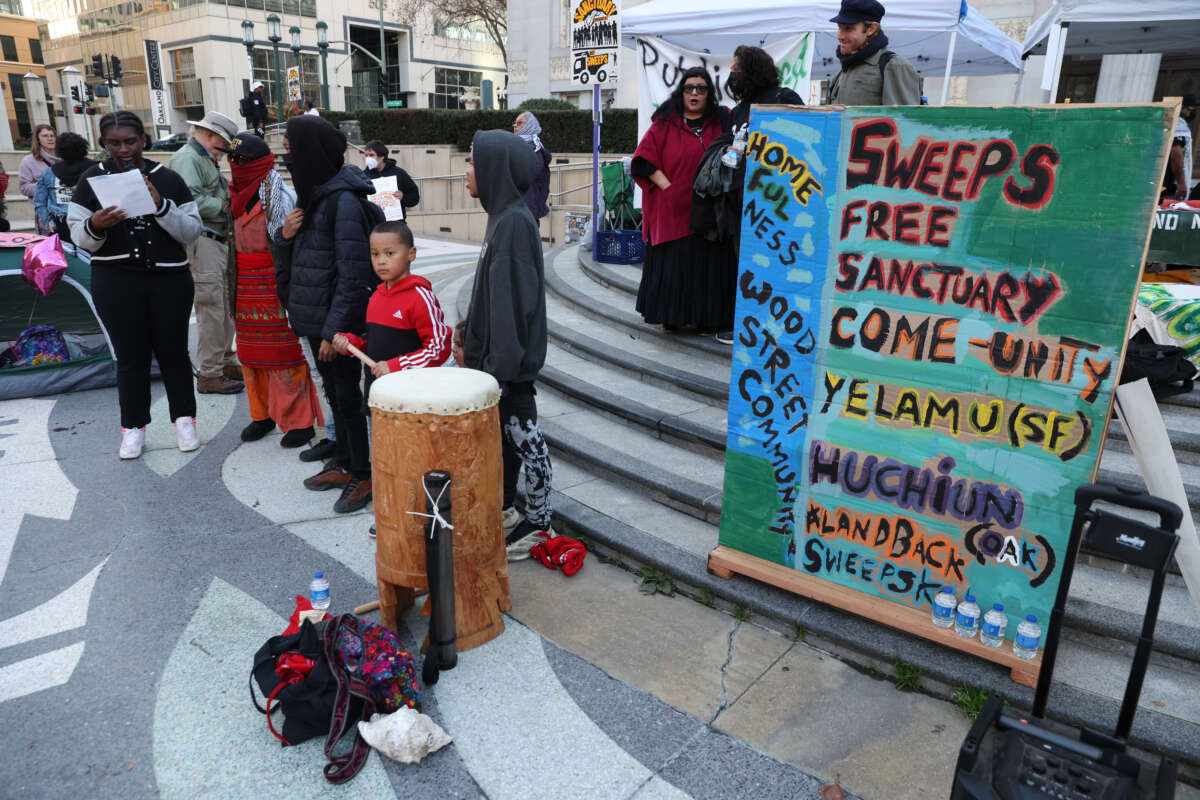
Homeless advocates attend a sweeps-free sanctuary protest outside of City Hall in Oakland, California, on December 17, 2024.Jane Tyska / Digital First Media / East Bay Times via Getty Images
Former schoolteacher Theo Henderson had been unhoused for six years when he launched the “We the Unhoused” podcast in 2019 from a park in Los Angeles’s Chinatown.
Henderson became unhoused in 2013 when he was evicted after losing his job and falling into medical debt due to spiraling costs related to his diabetes. When he began documenting his experiences and those of his unhoused neighbors back in 2019, three people were dying on the streets of Los Angeles County per day. Now, according to just-released public health data from 2024, that number has doubled to an average of six deaths per day, making questions of who gets to live and exist in public more urgent than ever.
Since Henderson started his podcast, his work has been featured in the BBC, Los Angeles Times, VICE, and CNN. In 2022 he was named activist-in-residence at the UCLA Luskin Institute on Inequality and Democracy.
In this exclusive interview with Truthout, Henderson unpacks the bipartisan machinery that perpetuates houselessness and renders unhoused people as disposable. He shares his analysis of how anti-camping ordinances like the one in Los Angeles function as “the new Jim Crow,” how Democrats and Republicans are united in their war on the poor, and how AI-powered medical diagnostics for unhoused populations echo the Tuskegee experiments. He points to J-Town Action and Solidarity as a mutual aid network that deserves our support.
Leah Harris: I’m thinking back to December 2019 when we connected on Twitter, after the first Trump regime held a mental health summit that previewed many of the policies they are trying to enact against unhoused people now. You had just started “We the Unhoused.” What led you in that moment to begin doing the podcast?
Former schoolteacher Theo Henderson had been unhoused for six years when he launched the “We the Unhoused” podcast in 2019 from a park in Los Angeles’s Chinatown.
Henderson became unhoused in 2013 when he was evicted after losing his job and falling into medical debt due to spiraling costs related to his diabetes. When he began documenting his experiences and those of his unhoused neighbors back in 2019, three people were dying on the streets of Los Angeles County per day. Now, according to just-released public health data from 2024, that number has doubled to an average of six deaths per day, making questions of who gets to live and exist in public more urgent than ever.
Since Henderson started his podcast, his work has been featured in the BBC, Los Angeles Times, VICE, and CNN. In 2022 he was named activist-in-residence at the UCLA Luskin Institute on Inequality and Democracy.
In this exclusive interview with Truthout, Henderson unpacks the bipartisan machinery that perpetuates houselessness and renders unhoused people as disposable. He shares his analysis of how anti-camping ordinances like the one in Los Angeles function as “the new Jim Crow,” how Democrats and Republicans are united in their war on the poor, and how AI-powered medical diagnostics for unhoused populations echo the Tuskegee experiments. He points to J-Town Action and Solidarity as a mutual aid network that deserves our support.
Leah Harris: I’m thinking back to December 2019 when we connected on Twitter, after the first Trump regime held a mental health summit that previewed many of the policies they are trying to enact against unhoused people now. You had just started “We the Unhoused.” What led you in that moment to begin doing the podcast?

San Jose Is Displacing Its Unhoused Residents to Prepare for Super Bowl Tourism
The city’s use of temporary shelters harms affordable housing efforts and merely delays displacement of unhoused people. By Ngakiya Camara , Truthout February 7, 2026
Theo Henderson: I was literally living on the streets creating this podcast because I saw an alarming type of conversation. It relegated unhoused people to “substance users” and “mentally ill.” It didn’t cover my story or the people I knew that were living on the streets. I created the show as a way for unhoused people to feel free and safe to tell their stories without being exploited. I also felt that it was important to tell my story because I was out here due to a medical mishap. Trying to get back on your feet is not as simple as people make it out to be.
The conversations started to open up different intersections of how unhoused people are affected in every environment — from mental health to substance use, to people having medical emergencies. Like the gentleman whose wife was terminally ill and passed away. They used their savings to try to save her, but they were unsuccessful. He ended up sleeping across the street from the building that he used to work in.
Surprisingly, people listened. They were impacted. That’s one of the things mainstream media misses: the dignity of people telling their stories without being judged.
We’ve been talking for a long time about how the media and politicians demonize unhoused people to justify all manner of repressive actions, sweeps, laws, kidnapping, disappearance, and neglect.
When I first started out, it was three unhoused people dying a day. It was a number that could easily be dismissed or ignored, with the atrocities that we’re seeing in real time overseas. Now, it’s seven unhoused people that are dying a day. We are walking past people who are dying, and we don’t have the same outrage. We are very quick to criminalize. But we don’t talk about the nuances that put people in such a perilous position.
“Once you’re able to demonize people, then it’s much easier to criminalize them.”
Look at what they’re doing with the undocumented community. They’re putting them in concentration camps and calling them “detention centers,” putting children in these places, making them feel it is their fault. That is the same narrative that they use with unhoused people: “The reason you’re out here is because you refuse help or you like being out there.”
Once you’re able to demonize people, then it’s much easier to criminalize them.
What is your response to federal initiatives like Donald Trump’s 2025 executive order and Robert F. Kennedy Jr.’s STREETS Initiative at the United States Department of Health and Human Services — initiatives that are all about disappearing unhoused people into involuntary mental health and drug treatment?
We keep talking among activist circles that they want to put unhoused people in warehouses and create the most carceral type of solution. One, erasing them from their humanity, but also cutting off their ability to speak out and let everybody know what’s happening.
Trump is trying to cut off money and services for unhoused people and housing-insecure people. If you take the money from people who want to be housed and want services to get off the street, where are they going to go? They’re going to go back on the street. Now they’ve got to deal with the hostility and hatred of the state and the city.
Over the past six years we’re seeing liberals and Democrats increasingly adopt the punitive approach to houselessness embraced by the Republican right. I’m thinking specifically about Gov. Gavin Newsom and his CARE Court.
California is a Democratic state that is basically aligned with Republican policies. They just hide it because they couch it in language of care. Democrats and Republicans are united in demonizing unhoused people.
Gov. Gavin Newsom is out there attacking Trump, but he’s not talking about how he’s also OK with targeting unhoused people. Before Trump’s executive order targeting unhoused people, Newsom had his own executive order along the same lines, that if unhoused people do not accept treatment, then they can be arrested on state property.
Newsom is no friend to unhoused people. He’s got this “encampment resolution fund”: If you criminalize unhoused people, then you’re able to get funding. If you don’t, then the funding gets taken away. So cities adopt these aggressive policies. This kind of extortion is commonplace
.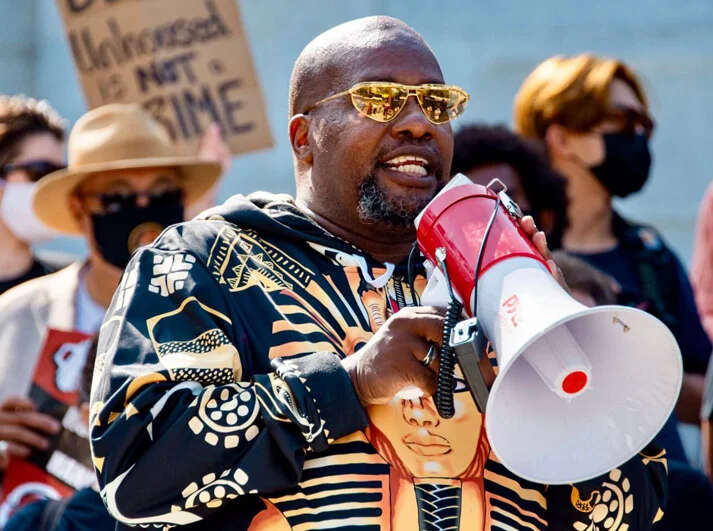
Theo Henderson, the founder of the “We the Unhoused” podcast, speaks into a megaphone at a protest in Los Angeles, California, in October 2021.WeTheUnhoused.com
You’ve long been speaking out about anti-camping ordinances, like the one created by Section 41.18 of the Los Angeles Municipal Code, and their impact on communities.
I keep saying that 41.18 is the new Jim Crow. It makes it against the law for anybody to sit, sleep, or lie in any place the Los Angeles City Council designates as a “special enforcement zone.” There is no accountability when they ticket you and put you in jail. The fine is over $2,500. An unhoused person is definitely not sitting around with $2,500. Now they’re even using this ordinance to ticket people who are protesting against ICE [Immigration and Customs Enforcement].
We also have a dichotomy between housed undocumented workers and undocumented workers who are unhoused. When we’ve seen video of housed undocumented persons being snatched up, there are people speaking out for them, fighting for them. How many cases have you heard on mainstream media about undocumented unhoused people that have been snatched? Look how easy it is to rip them away and have them disappear, because there is no formalized way to follow them.
Houselessness is this vortex that people want to avoid, but we can’t. If we’re talking about the injustices of Gaza, if we’re talking about the injustices of ICE, we have to understand that the unhoused community that you walk past in Los Angeles has skyrocketed from three unhoused people dying per day to seven [in 2023].
You just got back from an action where community members paid Los Angeles City Councilmember Hugo Soto-Martínez a visit. Can you tell us more about that?
It’s one thing when politicians are like Soto-Martínez’s predecessor, Mitch O’Farrell, who was openly anti-unhoused people. It’s another thing when you’re Soto-Martínez, campaigning against the sweeps and 41.18. You get elected by people that believe that you’re going to stop all of these harmful sweeps. And then you turn around and you just don’t say anything. For some reason, he feels it’s not effective to talk about police harassment, what they’re doing to unhoused people in his district, Echo Park. The issue is exposing the light on who we vote for, who we put our trust in, who is turning to the dark side.
I made a comment today: Dr. Martin Luther King Jr. makes it very clear that society is not going to remember the actions only of the bad people, but the appalling silence of the good people, or the “claimed” good people. So we have to ask ourselves: Which type of people are we?
Talk about how so many of these policy decisions derive from a eugenics mindset fueled by big business interests, like how the business improvement districts (BIDs) and the big city mayors are working together here to disappear folks?
Politicians and advocates keep saying that unhoused people are “service-resistant.” But we just don’t want this endless cycle of “services” that end up with us back on the street. They will offer temporary solutions where they’re going to throw people out in three months, and when they refuse, they say, “See. They don’t want help.” People actually believe that.
We don’t want to lose our belongings, only to end up back on the street. We want housing. If you are sincere, give us permanent supportive housing, so we don’t have to be in the neighborhood with these BIDs and NIMBYs [proponents of a “Not In My Backyard” mentality] running around targeting us. They go on sites like Nextdoor or Citizen. They find ways to aggressively target unhoused people to remove them from the neighborhood.
Republicans blame Democratic leaders for not doing anything. But the fact of the matter is, if they really wanted things done, they would permanently house people. They don’t want to, because they know this is a hot-button issue. They can count on people getting up in arms against the unhoused community.
Speaking of unholy alliances, how about this startup deploying AI to diagnose and provide treatment to unhoused folks in Los Angeles?
Look at the Tuskegee experiment, how they experimented on a vulnerable population that couldn’t raise a fuss. Unhoused people are a vulnerable population, so that means they can do what they want.
You have an AI machine that speaks to people, transcribes what they say, and diagnoses and prescribes medication. But just because someone may have a similar diagnosis, you have to consider other factors. I’m an African American male. I have diabetes, but my diabetes is different. The medication has to be more layered because I’ve had aggressive surgery after being stabbed. AI can’t know that. A doctor examines me and asks, “Did you have extensive surgery?” If you don’t do that and a person has a reaction or dies, who holds this agency accountable? Is there any inquiry to create justice for unhoused people?
There’s a high rate of unhoused African Americans with sickle cell anemia that AI won’t recognize. Or health issues that present as something else. Without background, it’s easy to make an error.
I wouldn’t feel OK having AI treat me. It’s already hard enough for Black people to get adequate care from living, breathing doctors.
In addition to your podcast that directly uplifts the voices of unhoused people and activists, what are other efforts that people can support?
J-Town Action and Solidarity. We’ve been working together close to six years creating direct mutual aid. There’s a huge food deficit in Los Angeles. Now, not only unhoused people come to our mutual aid meetups, there are food-insecure housed people coming. I would lean toward J-Town to get educated on the realities of what’s going on.
I think because of the ICE assassinations of Renee Nicole Good, Keith Porter Jr., and Alex Pretti, housed people are becoming more aware, more distrustful of the scripted narratives. But they don’t always know how to find help. So I would encourage them to start by listening to “We the Unhoused” — both the older episodes on YouTube and newer ones on iHeart.
Activists have told me that they don’t listen to the show because it is “long.” The reason it’s long is because you are getting people who finally have a platform to tell their story. If you can look at “Game of Thrones” or Netflix movies for two to three hours, you can take the time to listen to unhoused voices and the realities they face
This article is licensed under Creative Commons (CC BY-NC-ND 4.0), and you are free to share and republish under the terms of the license.
You’ve long been speaking out about anti-camping ordinances, like the one created by Section 41.18 of the Los Angeles Municipal Code, and their impact on communities.
I keep saying that 41.18 is the new Jim Crow. It makes it against the law for anybody to sit, sleep, or lie in any place the Los Angeles City Council designates as a “special enforcement zone.” There is no accountability when they ticket you and put you in jail. The fine is over $2,500. An unhoused person is definitely not sitting around with $2,500. Now they’re even using this ordinance to ticket people who are protesting against ICE [Immigration and Customs Enforcement].
We also have a dichotomy between housed undocumented workers and undocumented workers who are unhoused. When we’ve seen video of housed undocumented persons being snatched up, there are people speaking out for them, fighting for them. How many cases have you heard on mainstream media about undocumented unhoused people that have been snatched? Look how easy it is to rip them away and have them disappear, because there is no formalized way to follow them.
Houselessness is this vortex that people want to avoid, but we can’t. If we’re talking about the injustices of Gaza, if we’re talking about the injustices of ICE, we have to understand that the unhoused community that you walk past in Los Angeles has skyrocketed from three unhoused people dying per day to seven [in 2023].
You just got back from an action where community members paid Los Angeles City Councilmember Hugo Soto-Martínez a visit. Can you tell us more about that?
It’s one thing when politicians are like Soto-Martínez’s predecessor, Mitch O’Farrell, who was openly anti-unhoused people. It’s another thing when you’re Soto-Martínez, campaigning against the sweeps and 41.18. You get elected by people that believe that you’re going to stop all of these harmful sweeps. And then you turn around and you just don’t say anything. For some reason, he feels it’s not effective to talk about police harassment, what they’re doing to unhoused people in his district, Echo Park. The issue is exposing the light on who we vote for, who we put our trust in, who is turning to the dark side.
I made a comment today: Dr. Martin Luther King Jr. makes it very clear that society is not going to remember the actions only of the bad people, but the appalling silence of the good people, or the “claimed” good people. So we have to ask ourselves: Which type of people are we?
Talk about how so many of these policy decisions derive from a eugenics mindset fueled by big business interests, like how the business improvement districts (BIDs) and the big city mayors are working together here to disappear folks?
Politicians and advocates keep saying that unhoused people are “service-resistant.” But we just don’t want this endless cycle of “services” that end up with us back on the street. They will offer temporary solutions where they’re going to throw people out in three months, and when they refuse, they say, “See. They don’t want help.” People actually believe that.
We don’t want to lose our belongings, only to end up back on the street. We want housing. If you are sincere, give us permanent supportive housing, so we don’t have to be in the neighborhood with these BIDs and NIMBYs [proponents of a “Not In My Backyard” mentality] running around targeting us. They go on sites like Nextdoor or Citizen. They find ways to aggressively target unhoused people to remove them from the neighborhood.
Republicans blame Democratic leaders for not doing anything. But the fact of the matter is, if they really wanted things done, they would permanently house people. They don’t want to, because they know this is a hot-button issue. They can count on people getting up in arms against the unhoused community.
Speaking of unholy alliances, how about this startup deploying AI to diagnose and provide treatment to unhoused folks in Los Angeles?
Look at the Tuskegee experiment, how they experimented on a vulnerable population that couldn’t raise a fuss. Unhoused people are a vulnerable population, so that means they can do what they want.
You have an AI machine that speaks to people, transcribes what they say, and diagnoses and prescribes medication. But just because someone may have a similar diagnosis, you have to consider other factors. I’m an African American male. I have diabetes, but my diabetes is different. The medication has to be more layered because I’ve had aggressive surgery after being stabbed. AI can’t know that. A doctor examines me and asks, “Did you have extensive surgery?” If you don’t do that and a person has a reaction or dies, who holds this agency accountable? Is there any inquiry to create justice for unhoused people?
There’s a high rate of unhoused African Americans with sickle cell anemia that AI won’t recognize. Or health issues that present as something else. Without background, it’s easy to make an error.
I wouldn’t feel OK having AI treat me. It’s already hard enough for Black people to get adequate care from living, breathing doctors.
In addition to your podcast that directly uplifts the voices of unhoused people and activists, what are other efforts that people can support?
J-Town Action and Solidarity. We’ve been working together close to six years creating direct mutual aid. There’s a huge food deficit in Los Angeles. Now, not only unhoused people come to our mutual aid meetups, there are food-insecure housed people coming. I would lean toward J-Town to get educated on the realities of what’s going on.
I think because of the ICE assassinations of Renee Nicole Good, Keith Porter Jr., and Alex Pretti, housed people are becoming more aware, more distrustful of the scripted narratives. But they don’t always know how to find help. So I would encourage them to start by listening to “We the Unhoused” — both the older episodes on YouTube and newer ones on iHeart.
Activists have told me that they don’t listen to the show because it is “long.” The reason it’s long is because you are getting people who finally have a platform to tell their story. If you can look at “Game of Thrones” or Netflix movies for two to three hours, you can take the time to listen to unhoused voices and the realities they face
This article is licensed under Creative Commons (CC BY-NC-ND 4.0), and you are free to share and republish under the terms of the license.
Leah Ida Harris
Leah Ida Harris is an abolitionist writer whose work centers on resistance to carceral policies of force and coercion. Their forthcoming book, Noncompliant: A Family History of the Asylum (Haymarket Books) details the violent history — and grim resurgence — of the asylum in America through a multi-generational story of involuntary psychiatric treatment.

No comments:
Post a Comment