Sunday, August 10, 2025

Trump team pushes to oust No. 2 official at world energy body

The administration and its Republican allies in Congress say the Paris-based International Energy Agency discourages fossil fuel investments around the world.


Energy Secretary Chris Wright, left, has threatened to end U.S. support for the International Energy Agency, complaining about "nonsensical" projections that run afoul of President Donald Trump's championing of fossil fuels. | Saul Loeb/AFP via Getty Images

08/09/2025
POLITICO EU

President Donald Trump’s campaign to shake up international institutions has a new aim: upending the leadership of a Paris-based agency whose data and research help shape global energy policy.

The 32-country International Energy Agency has increasingly rankled Republicans in Washington by producing analyses that point to a waning future for fossil fuels and a need to embrace wind and solar power. Now the Trump administration is demanding that the agency replace its No. 2 leader with someone more aligned with the president’s policies, multiple energy industry insiders and former U.S. officials with knowledge of the situation told POLITICO’s E&E News.

The IEA’s second-ranking position has traditionally been filled by an American. Its current second-in-command, retired career State Department diplomat Mary Warlick, has served in the role since 2021.

The new pressure from Washington follows months of Trump’s efforts to bend global power centers to his will, including through his trade wars, his demands for higher defense spending by NATO members and his withdrawals from bodies such as UNESCO and the World Health Organization. It also follows months of public complaints about the IEA from top Trump administration officials, most notably Energy Secretary Chris Wright, who has vowed to make changes at the body or end U.S. support.

Some Republicans say the IEA has discouraged investment in fossil fuels by publishing analyses that show near-term peaks in global demand for oil and gas. “The product that the IEA produces is not generally accepted by everybody. It’s just not,” said Mark Menezes, who served as deputy Energy secretary during Trump’s first term. “And the political context has changed.”

‘Fight from the inside out’

The Trump administration is aiming to push changes internally, according to a Republican energy lobbyist with close ties to the Department of Energy.

“They want to get operatives in there, whether they’re career or political, who can actually move the needle,” said the lobbyist, who like the others familiar with the U.S. efforts was granted anonymity to speak freely. “They’re going to get someone they trust and that person is going to fight from the inside out.”

Regarding the U.S. effort to pressure the IEA, the lobbyist said: “The fact that Wright is out there now talking about it publicly shows that it’s elevated.”

House Republican appropriators are also lashing out against the IEA by pushing legislation to withdraw U.S. funding starting Oct. 1.

The White House did not respond to requests for comment, and an Energy Department spokesperson did not respond directly to questions posed by E&E News. The IEA said in a statement that it “does not disclose information about individual staff contracts due to reasons of privacy and confidentiality.”

A former U.S. official who worked closely with the IEA called Warlick a “hardworking, serious, diligent and capable professional” who does her work in a way that is consistent with guidance from the executive director and with guidance from the member countries.

The U.S. helped establish the IEA following the 1973 Arab oil embargo to focus on energy security. Today, the organization publishes influential energy market forecasts and data that guide major investments and government policies. Many of those studies have conflicted with the White House’s insistence that fossil fuels are more reliable and often cheaper than wind, solar and other clean energy sources.

Leaving the IEA would lessen U.S. influence or input on its work.

Historically, the United States has wielded a lot of influence at the agency and has been able to work with other member governments to advance its mission, said Jonathan Elkind, a former assistant secretary for international affairs at DOE during the Obama administration.

“There are going to be certain elements of policy that the current U.S. administration really disagrees with other member countries on, and the U.S. administration is entirely within its rights to advocate for adjustments in the agenda of the IEA,” Elkind said. “The U.S. does not have the right to simply insist that everybody will change as a consequence of what the U.S. has done.”

Threatening to pull out of the IEA is “misguided and myopic,” said Amanda Maxwell, managing director of global engagement at the environmental group Natural Resources Defense Council.

“Unfortunately, it’s par for the course for the Trump administration to try and ignore objective data,” Maxwell said. “Whether it’s climate science or energy trends, this administration is trying to make us less informed about the world we live in.”
Rosy scenarios

Wright has been especially critical of the IEA’s projection that oil demand will peak this decade, calling it “nonsensical” in a Breitbart interview in June. Republicans also bristled at the Biden administration’s use of IEA analysis in 2024 to justify a U.S. decision to pause consideration of new liquefied natural gas export permits.

In testimony at a Senate hearing last year, David Turk, then-deputy Energy secretary under Biden, cited IEA findings that showed global natural gas demand on the decline. The Trump administration is now betting heavily on the opposite occurring — pushing for a huge increase in U.S. natural gas exports and using trade pressure to cajole allies into buying massive amounts of the fuel, though some market analysts have expressed doubts about the realities of those hopes.

The IEA has also said that no new oil and gas projects are compatible with the goals of the 2015 Paris climate agreement, which aims to limit the rise in global temperatures to less-than-catastrophic levels. Trump announced the U.S. withdrawal from that pact on the first day of his second term.

Sen. John Barrasso (R-Wyo.) and then-Rep. Cathy McMorris Rodgers (R-Wash.), now retired from Congress, wrote in a letter to IEA Executive Director Fatih Birol in March 2024 that the IEA has strayed from its mission and become a “cheerleader” for the “energy transition.” Birol has defended the organization’s commitment to energy security while acknowledging that its mission has broadened.

Meanwhile, Trump ordered the State Department in February to do a six-month review of U.S. participation in international organizations and treaties and recommend leaving those that don’t serve his priorities.

One point of contention is the IEA’s World Energy Outlook, a lengthy annual report that dissects global trends and related impacts on energy security and greenhouse gas emissions. IEA calls it the “most authoritative global source of energy analysis and projections.”

In 2020, the IEA abandoned a portion of the outlook, known as the “Current Policies Scenario,” that analyzed the global energy picture based on existing national energy policies.

Trump officials have criticized the IEA for replacing the current policy analysis with a “Stated Policies Scenario,” which multiple Republicans and fossil fuel supporters say is based on policies that aren’t being implemented. The critics say the change paints a rosier-than-justified picture of global trends toward lower-carbon energy sources.

IEA officials are pledging to resurrect the Current Policies Scenario this year.

“As ever, the forthcoming World Energy Outlook 2025 will contain multiple scenarios reflecting the wide spectrum of possible outcomes that today’s market conditions and policies imply,” an IEA spokesperson told E&E News. “This year’s edition will include the Current Policies Scenario, which will illustrate the implications of a continuation of policies and measures currently in place.”

Warlick, the IEA’s deputy executive director, spent decades at the State Department, including as President Barack Obama’s ambassador to Serbia from 2010 to 2012 and as the National Security Council’s senior director for Russia under George W. Bush. From 2014 to 2017, Warlick was the State Department’s principal deputy assistant secretary at the Bureau of Energy Resources and represented the U.S. on the IEA governing board.

Trump administration officials in DOE’s Office of International Affairs, which is led by acting Assistant Secretary Tommy Joyce, tried to pressure the State Department into signing off on pushing Warlick out in March, according to a former State Department official.

At the time, State prevented that from happening, but since then a broad reorganization of the department has eliminated its Bureau of Energy Resources and most of the officials there who worked closely with the IEA.

That could mean DOE would face little resistance if it tries again.

In recent IEA meetings, POLITICO has reported, U.S. officials have pushed for the organization to stop publishing data that they argue promotes the shift to clean power over fossil fuels.

Just how the U.S. would force the agency to replace Warlick isn’t entirely clear. She is on a limited contract, and while the U.S. is an important member of the IEA, providing around 14 percent of the organization’s budget in recent years, it isn’t the only one.

Warlick rarely speaks publicly. At an Atlantic Council event in 2022, she said that the uneven pace of clean energy investments among countries has caused “geopolitical fragmentation” in the wake of the coronavirus pandemic and Russia’s full-scale invasion of Ukraine.

“Such investment is still well below the level needed to bring [greenhouse gas] emissions down if we are to keep net-zero and sustainable development goals in sight,” Warlick said. “Massive investment in clean energy is the best guarantee of energy security in the future, and it will also drive down harmful greenhouse gas emissions.”
Green Hydrogen for the Global South: What Remains After the Hype?

Analysis


Grand visions, bold announcements – yet implementation remains sluggish. Green hydrogen was hailed early on as a beacon of hope for the Global South. But without fundamental policy shifts, the project risks falling into familiar patterns of raw material export and asymmetric dependency. What’s needed are genuine industrial partnerships that relocate value creation to regions where renewable energy is especially cheap.

By Jörg Haas and Elena Gnant
5 August 2025


“Green hydrogen could be the oil of the future,” declared Colombia’s President Gustavo Petro in 2024 during a meeting with Olaf Scholz in Bogotá. He cited “the Germans” to back up his statement (Mejia 2024). This marked a clear stance against fossil fuel dependency – and a jab at Brazil’s President Lula, who is pursuing new oil sources at the mouth of the Amazon. Petro envisions a different model: industrial use of renewable energy, including green hydrogen. Symbolically, he proposed a partnership between Colombia’s Ecopetrol and Brazil’s Petrobras – a pivot from oil to hydrogen as a driver of development and prosperity (El nuevo signo 2024, Hydrogen Council 2017).

But can green hydrogen deliver on its promise – as a climate-friendly energy source, geopolitical tool, and engine of economic growth? Many Global South countries hope for new export opportunities (Cabaña 2024). Germany is actively promoting the rollout: with over 20 bilateral hydrogen partnerships, including with Namibia, South Africa, Brazil, and Morocco. Programs like H2Global, H2Uppp, and the H2-Diplo network aim to stimulate investment, promote technology exports, and enable fair supply chains – while also securing domestic supply (BMWK 2024).
How hydrogen became a beacon of hope

The idea of solving the climate crisis with hydrogen and forging new geopolitical alliances inspired politics, industry, and the public alike. Between 2020 and 2023, expectations skyrocketed: green hydrogen was to replace fossil fuels, decarbonize industry and transport, and create opportunities in the Global South. In 2020, BloombergNEF forecast that hydrogen could account for a quarter of global energy consumption by 2050 (BloombergNEF 2020). The IEA projected up to 700 million tons annually. At COP27 in Egypt in November 2022, Chancellor Scholz announced over 4 billion euros of investment in the hydrogen market. In the U.S., President Biden made “clean” hydrogen a pillar of the Inflation Reduction Act (IRA). China, too, invested heavily in electrolysis, aiming to dominate the market as it has with solar photovoltaics.

The number of announced projects grew rapidly (Hydrogen Council & McKinsey 2021). Companies like mining giant Fortescue announced gigawatt-scale projects, and many countries developed ambitious hydrogen strategies. Hydrogen became part of a "just transition" narrative: green industrialization and a new international division of labor. But criticism soon followed – regarding definitions, large-scale projects lacking local consent, and the inclusion of gas and nuclear infrastructure under the “clean” label.
Civil society actors intervene against new extractivism

Starting in 2021, civil society organizations began calling for binding guidelines for a responsible hydrogen economy (Tunn et al. 2024). Key questions emerged: Is hydrogen becoming a tool of a new extractivism? Will land and water be appropriated in the name of climate protection? (Barnard 2022, Corporate Europe Observatory 2023, Ammar & Ammar 2024)

Brot für die Welt and the Heinrich Böll Foundation published a synthesis report outlining ten minimum criteria – including environmental impact assessments, transparent land use, biodiversity protection, and Free, Prior and Informed Consent (FPIC) for Indigenous communities (Villagrasa 2022).

International actors also developed standards: the Hydrogen Council published ESG criteria; the H2Global Foundation released a sustainability concept; and the IPHE network created common principles in the “Joint Agreement on the Responsible Deployment of Renewables Based Hydrogen” (Hydrogen Council & McKinsey 2021, UN Climate Champions 2023). The goal: social and ecological compatibility, and the foundation for credible certification.

Germany’s hydrogen strategy (BMWK 2023) adopted many of these principles. However, efforts by civil society to make them binding in the 2024 import strategy failed due to resistance from the Chancellor’s Office (Klima-Allianz et al. 2024, Nationaler Wasserstoffrat 2021). While the development ministry (BMZ) supported sustainability obligations, the Chancellor’s Office blocked them – fearing competitive disadvantages and implementation hurdles. The result: many declarations of intent, but few binding rules.

The hydrogen revolution is facing delays

By 2024, it became clear: the global rollout of green hydrogen is slower and more selective than expected (Polly 2024, Tsvetana 2024). Investment decisions for major projects – such as in Namibia, South Africa, or Chile – are delayed or suspended (Ladera Sur 2023). Reasons include a lack of offtake agreements, high capital costs in the Global South, infrastructure uncertainty, and competition from direct electrification. Even Fortescue, once a pioneer, is increasingly turning to battery-electric solutions for its own mining operations (Liebherr 2024).

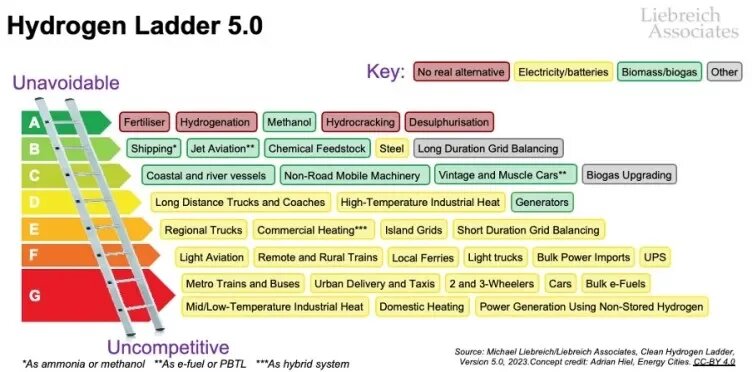
In Europe, plans are also being revised. According to BloombergNEF and Aurora Energy Research, anticipated demand falls far short of EU and member state targets (BloombergNEF 2024). Many applications – such as passenger cars, building heating, or electrifiable industrial processes – appear increasingly uneconomical. Michael Liebreich’s “Hydrogen Ladder” has shaped the debate on prioritization: steel, aviation, and shipping at the top; passenger cars, heating, and off-grid power at the bottom (Liebreich 2023, 2024).

Instead of a global hydrogen economy, 2025 is characterized by pilot projects, regional clusters, and state-backed initiatives – mainly in countries with sovereign wealth funds like Saudi Arabia, Oman, or the UAE, which have low capital costs. In poorer countries with unstable governance, investment remains scarce. This softens fears of green colonialism: investments depend not only on renewable potential, but also on political stability and favorable financing (Dejonghe & Van de Graaf 2025, Tunn et al. 2025).


licence infos

Green industrialization must replace raw material exports

What remains for developing countries? The dream of prosperity through green hydrogen remains risky. Some Global South countries do have world-class solar and wind resources that allow them to produce green hydrogen at very low costs. However, regions with favorable wind and solar potential are so widespread globally that significant scarcity rents, like those seen with oil, are unlikely. For example, the Fraunhofer Institute confirms that Colombia under Gustavo Petro has major potential in three regions (Hank et al. 2024). Yet regions like La Guajira, with a strong presence of paramilitary groups, are so insecure that billion-dollar investments seem implausible.

So, green hydrogen will not become the new oil. But it may become a building block for green industrialization in the Global South. For this to happen, the Global North must also change its policies. As a major importer and consumer of green hydrogen, Germany could enter into reliable partnerships with producer countries based on strict environmental and social standards and significantly increased local value creation. This would greatly enhance development impacts – particularly in terms of job creation.

Several studies show that relocating parts of the value chain for energy-intensive products to regions with cheap renewable energy leads to significant cost advantages (Verpoort et al. 2024, Steitz & Kölschbach Ortego 2023, Bähr et al. 2023). This points to the potential for long-term, reliable partnerships with countries not merely as resource suppliers, but as industrial partners on equal footing – which would also serve Germany’s own interests. However, this would require partially phasing out some basic industries in Germany. Is that politically sustainable?

In such a partnership, Germany and other energy-importing countries must systematically support exporting nations in their efforts to secure value creation locally. Green industrial partnerships instead of hydrogen partnerships – that should be the direction. But is there the political will to do so? So far, there seems to be a stronger readiness to use massive state subsidies to preserve the old industrial structure into the post-fossil age. The question is: how long can that be sustained?
ABOLISH PRISON

Overcrowded French prison swelters in 'unbearable' heat

Seysses (France) (AFP) – Inmates at a prison in southwestern France are struggling to cope as a heatwave grips the region, with high temperatures set to persist through the weekend.


Issued on: 09/08/2025 

Experts say heatwaves are likely to become more frequent across Europe © Lionel BONAVENTURE / AFP

Fans hummed in every corner, and sheets hung from windows at an overcrowded prison near the city of Toulouse, where inmates tried to cool down as temperatures pushed past 36 degrees Celsius, an AFP journalist observed on Thursday.

Southern France is in the grip of a heatwave, and for inmates at the Seysses detention centre, that heat is "unbearable", one detainee said.

But like many prisons in France, Seysses is overcrowded — in June, it held on average more than twice its capacity.

"Having two people per cell has become the exception," said one guard, whose name like all the detainees interviewed cannot be published.


With detention centres across the country at over capacity and facilities ill-suited to ever more frequent heatwaves, guards and inmates alike worry about the impact of the heat.

Heat can create security risks, with fights becoming "more frequent" as temperatures rise, the guard said.

"The slightest annoyance can spark a fight."

Temperatures this weekend are expected to hit 40C in some areas and Monday forecast to be the "hottest day nationwide," according to national weather service Meteo France.

At the prison, "you can really feel the 38 degrees. The walls absorb the heat. There's condensation," the detainee said, speaking from the 9-square-metre cell he shares with two other people.

"We're not going to ask for air conditioning, that's not going to happen, but we would like more ventilation or a larger cell," he said.

-'No choice'-

As the planet warms as a result of humanity's emissions of greenhouse gases, experts say heatwaves are likely to become more frequent across Europe.

For detainees at Seysses, a two-hour break in an asphalt courtyard with no trees offers little reprieve, with mist sprayers not due to be installed until next summer.

An inmate in the women's section of the prison said she and her fellow prisoners just stayed in their cells because it was too hot to go outside.

Guards say high temperatures can create security risks, with fights becoming more common © Lionel BONAVENTURE / AFP


For the inmates who did venture into the recreation yard, most stayed in the shade, though a few did some push-ups or pull-ups even in the blistering heat.

Prison staff distributed free water and provided fans and hats to the most vulnerable individuals, including those over 75 years old or those with health issues.

But the prison's facilities, including a poorly ventilated library and a gym, with tiny windows and a single fan, offer little escape from the heat.

"It's hot in there, but when there are a lot of them, it gets very, very hot very quickly," said a guard, describing the workout room.

Even sleep brings little relief, said one recent arrival in the women's section of the prison, which is built for 40 people but holding 80.

The inmate, who shares her cell with two other detainees, said she has no alternative but to sleep on a mattress on the floor.

Sleeping is "difficult, because it's concrete and during the summer, it's quite hot," she said.

"But we have no choice."
Zimbabwe: Pressure mounts on platinum sector


Issued on: 09/08/2025 - 

The platinum sector is facing mounting pressure as miners claim they are owed millions in unpaid export earnings. Under government policy, 30% of foreign currency from exports must be converted into local currency. However, delays in those payments are hitting producers hard. France 24's Sharon Mazingaizo reports.


WHY D.E.I.

Pawol becomes first woman to umpire in Major League Baseball

Washington (AFP) – Jen Pawol made history by becoming the first woman to umpire in a regular-season Major League Baseball game on Saturday -- and she says she is aware of the "magnitude" of the moment
.


10/08/2025 - FRANCE24

Jen Pawol makes an out call during her historic debut as the first female umpire in a Major League Baseball regular-season game as the Miami Marlins visited the Atlanta Braves © Brett Davis / GETTY IMAGES NORTH AMERICA/AFP

The 48-year-old, who worked in more than 1,200 minor league games before getting the call-up this week, achieved the milestone at Truist Park in Atlanta in the first game of a double-header between the Braves and the Miami Marlins.

"I'm aware of the gravity. I'm aware of the magnitude," said Pawol, who worked at first base.

Pawol, whose cap from the historic outing will be donated to the Baseball Hall of Fame, will be calling balls and strikes behind home plate in Sunday's contest between the clubs.

"Just incredible. The dream came true. The dream actually came true today," Pawol said following the game. "And I'm still living in it."

The historic moment for Pawol came when Atlanta starting pitcher Hurston Waldrep threw the opening pitch. She later inspected Waldrep's hands for foreign substances as part of her game duties.

"Once I started umpiring, I was like, 'This is for me,'" Pawol recalled before the game. "I can't explain it. It's just in my DNA.

"This is a viable career, to become a professional umpire, for men and women, girls and boys. I'm able to make a living doing it and I'm passionate about it. I just work harder every day and get better before tomorrow."

In the game, Drake Baldwin singled in two runs and Michael Harris smashed a three-run home run in the seventh inning to lead the Braves over Miami, 7-1.
'Long, hard journey'

Pawol began working as an umpire in the rookie-level Gulf Coast League in 2016 and last year became the first woman umpire in a pre-season spring training game since Ria Cortesio in 2007 before making her historic breakthrough in a regular-season game.

"It has been a long, hard journey to the top here," Pawol said. "I'm just extremely focused on getting my calls right and I'm so grateful to all those along the way who have helped me become a better umpire every day."

MLB's addition of a female umpire comes 28 years after Violet Palmer became the first woman to referee an NBA game in October 1997.

Shannon Eastin was the NFL's first female on-field official, hired as a replacement when regular officials were locked out in a contract dispute in September 2012.

Three years later, Sarah Thomas became the NFL's first full-time female on-field official and last year, two women worked on the officiating crew of the same game for the first time.

Stephanie Frappart of France was the first woman to referee a men's World Cup match when she worked a group stage match in 2022.

© 2025 AFP
French scientists map plankton, the ocean’s mysterious oxygen factories

French scientists are mapping plankton across the Indo-Pacific – using Navy ships to study the microscopic organisms that produce half of Earth’s oxygen, feed the ocean and help regulate the planet’s carbon. The eight-year mission is charting life in remote waters to understand how these drifting ecosystems evolve – and why they matter.


Issued on: 09/08/2025 - RFI

A large phytoplankton bloom, visible from space, shows how these drifting ecosystems can stretch across hundreds of kilometres. © European Space Agency

Since 2022, Mission Bougainville has been turning French Navy ships into floating science labs.

Recent graduates from the Sorbonne are stationed on board as biodiversity cadets. They work alongside the crew, collecting and studying plankton as the ships patrol thousands of kilometres of open sea.

One of those ships, the Champlain, sailed in June to the Scattered Islands near Madagascar – a remote string of French territories the Navy supplies and protects. The vessel usually patrols for illegal fishing and drug trafficking. Now, it also carries young scientists and plankton-sampling gear.

These minuscule organisms may be invisible to the naked eye, yet their role is immense. They absorb carbon dioxide, produce around 50 percent of the oxygen we breathe, and form the base of the marine food chain. Yet much remains unknown, especially how plankton responds to environmental change.

Mission Bougainville focuses on France’s vast Exclusive Economic Zones in the Indo-Pacific – a maritime area that spans from the Indian Ocean to the South Pacific and gives France one of the largest ocean territories in the world.

The project also has researchers aboard other Navy ships operating between French Polynesia and New Caledonia, territories that offer access to far-flung waters still largely unstudied.

Nations vow to cut shipping noise as sea life struggles to be heard

Charting life on the move

The mission builds on work by the Tara Ocean Foundation, which changed how scientists understand plankton. But Bougainville takes it further by using the Navy’s existing routes to access under-researched zones and collect data over time.

“The big difficulty with plankton is that you have to study it everywhere. It moves fast, adapts fast and you cannot understand it without worldwide study. It’s all interconnected,” said Colomban de Vargas, a marine biologist with France’s National Centre for Scientific Research (CNRS) and co-founder of the mission.

Scientists have studied plankton for more than a century. But Bougainville’s scale and regularity are what set it apart.

Multiple Navy ships are now involved, including the Champlain and vessels operating in the South Pacific. The mission aims to gather around 100 samples per ship each year through to 2030 – enough to build a global database covering millions of square kilometres.


Laurine, a French scientist, collects a plankton sample aboard the Navy vessel Champlain. © RFI / Titouan Allain


A major focus is what researchers call the “island effect”. The Indo-Pacific is dotted with islands and underwater mountains. In many parts of the ocean, nutrients are scarce. But land masses release material that acts like fertiliser – triggering blooms of phytoplankton.

These blooms can float for weeks and are large enough to be seen from space.

“Islands change the composition of plankton over tens, hundreds of kilometres. They create an ecosystem that moves through the ocean for weeks before disappearing, then being created again. They’re like moving forests,” said de Vargas.

These ecosystems move across the ocean, then vanish and reappear elsewhere. Scientists are now trying to understand how they form, whether they follow patterns, and how they change over time.

Plankton don’t choose where they go – they drift with the currents. That makes each island a kind of natural lab. “Each of these islands is a test tube, ideal terrain for science,” said de Vargas.

Niue, the tiny island selling the sea to save it from destruction

Climate and geopolitics

By taking repeated samples across different seasons and locations, researchers can learn how plankton adapt to changing conditions – from rising temperatures to shifts in ocean chemistry.

“Differences in plankton composition will affect the entire ecosystem, consequently affecting the economy of different territories and therefore global geopolitics,” said de Vargas.

But researchers stress that this work is still in its early stages. It will take years of sampling and analysis before the full picture becomes clear.

“You have to understand the basic functional aspects of plankton before talking about its evolution or adaptation,” de Vargas added.

Mission Bougainville is set to continue through to 2030.
Starvation spreads from camps to besieged Sudanese city of El-Fasher

Months after famine was declared in nearby displacement camps, the besieged Sudanese city of El-Fasher is now seeing starvation deaths of its own, with no food aid entering and the UN’s World Food Programme warning of worsening conditions for the 300,000 people still trapped inside.


Issued on: 09/08/2025 - RFI

Internally displaced women wait in a queue to collect aid from a group at a camp in Gadaref, after fleeing the Darfur town of El-Fasher. AFP - -

By: Melissa Chemam with RFI


After nearly 28 months of siege, the UN’s children agency Unicef and the World Food Programme (WFP) say famine could soon take hold in El-Fasher, the capital of North Darfur.

“The situation in El Fasher is completely catastrophic; the city's population is on the verge of starvation,” said Leni Kinzli, WFP’s spokesperson in Sudan, speaking to RFI this week

“It is besieged, cut off from the rest of the country, and humanitarian access is extremely difficult.”

WFP says it has not been able to deliver food to the city for over a year. In the meantime, it has carried out cash transfers, but the blockade has made those nearly useless.

“Since the city is under blockade, the prices of basic necessities have skyrocketed, and people cannot even buy enough to make one meal a day,” Kinzli said.

Some residents are reportedly now eating animal feed and rubbish to survive. “And this is despite the fact that we are ready to intervene with food trucks if we are allowed to pass,” Kinzli added.

WFP is again calling for aid convoys to be allowed through.


'Skin and bones'

The Sudanese army, at war with the paramilitary Rapid Support Forces (RSF) since April 2023, recaptured Khartoum state in May, but widespread hunger continues to grip the heart of Africa's third-largest country.

Many children in Sudan are now “skin and bones”, UN officials said this week, and thousands of families in El-Fasher, more than 1,000 kilometres west of Khartoum, are at risk of starving.

“Everyone in El-Fasher is facing a daily struggle to survive,” said Eric Perdison, WFP’s regional director for eastern and southern Africa, on Tuesday.

RSF forces have surrounded the city since May. It is the last major urban area in Darfur still under army control.

“People's coping mechanisms have been completely exhausted by over two years of war,” Perdison said in a statement. “Without immediate and sustained access, lives will be lost.”

WFP says food prices in El-Fasher are now 460 percent higher than in the rest of the country. Soup kitchens have shut down, and aid remains blocked.

Unicef’s Sheldon Yett, who recently visited Sudan, warned of growing malnutrition.

“Malnutrition is rife, and many of the children are reduced to just skin and bones,” he said. Around 25 million people across Sudan face severe food insecurity, according to the UN.


Acute hunger, limited access

Famine was first declared in the surrounding displacement camps last year, especially in Zamzam. The UN said the crisis would likely spread to the city itself by May.

Only a lack of reliable data has prevented a formal famine declaration for the wider region.

Aid agencies say insecurity is making it nearly impossible to act. In June, five humanitarian workers were killed when their UN convoy to El-Fasher was attacked.

“We have not had access to the horrible situation unfolding in El-Fasher, despite trying for months and months and months,” said Yett. “We have not been able to get supplies there.”

Nearly 40 percent of children under five in the area are acutely malnourished, UN data shows.

Residents often shelter in makeshift bunkers to avoid shelling as the RSF continues its push to take full control of Darfur.

This child got tested for malnutrition at World Food Programme (WFP) camp at El Fasher, in Darfur, Sudan, on 27 March 2025, here seen in a screengrab obtained from a video. via REUTERS - WFP

In April, an RSF attack on Zamzam camp killed hundreds and forced hundreds of thousands to flee to el-Fasher and the nearby town of Tawila. A deadly cholera outbreak is now spreading there.

“Every day the conflict continues in Sudan, innocent lives are lost, communities are torn apart, and trauma continues to haunt generations,” said Radhouane Nouicer, the UN's expert on human rights in Sudan. “The ongoing war has devastated civilian lives and turned daily survival into a constant struggle.”
Children in crisis

Relative calm has returned to Khartoum, but children there still have only "limited, but growing access to safe water, food, healthcare and learning", according to Unicef's Yett.

In the two hardest-hit areas of Khartoum state, Jebel Awliya and Khartoum proper, "children and families in the neighbourhood are sheltered often in small, damaged or unfinished buildings", he added.

"We are on the verge of irreversible damage to an entire generation of children."

The war, now in its third year, has killed tens of thousands across Sudan, displaced millions and left the country's healthcare system in ruins.

The UN describes the conflict as the world’s largest displacement and hunger crisis.

(with newswires)
Landmark EU media law enters into force, aims to provide protection for journalists


Copyright AP Photo


By Sandor Zsiros
08/08/2025 -

According to the EU, media freedom is a cornerstone of democracy and therefore needs protection in all member states.

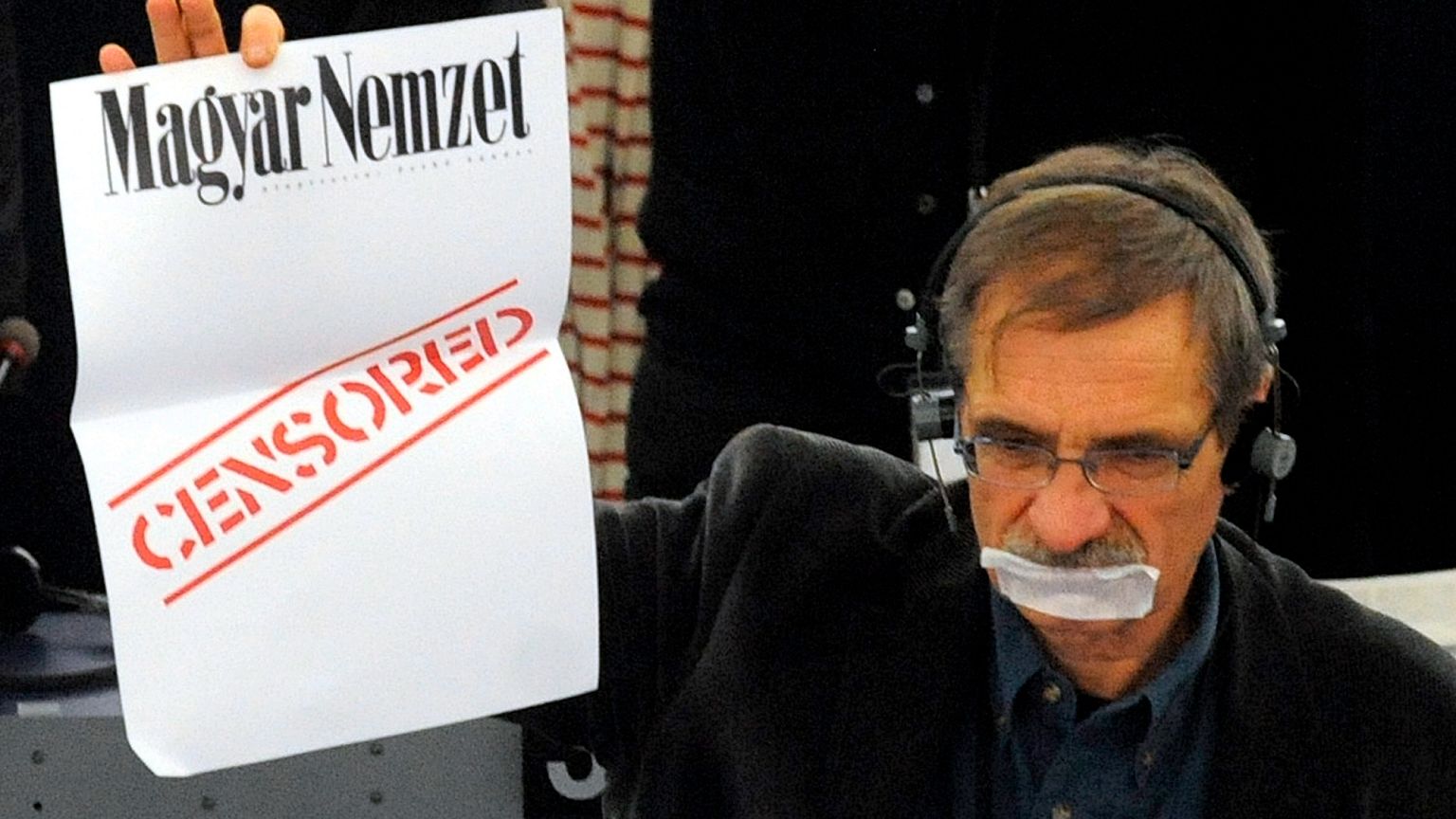
The EU's landmark Media Freedom Act (EMFA) entered into force Friday, with the aim of providing better protection for the press and making media ownership more transparent.

The law also aims to limit the use of spyware against journalists, enhance the transparency of state advertising, and strengthen the independence of public media.


The new rules also increase protection for journalists and for their sources. Social media platforms should also refrain from arbitrarily deleting or restricting content from independent media under the new regime.

The law was drafted by the European Commission and supported overwhelmingly by the European Parliament in a plenary vote in 2024.

“With the European Media Freedom Act entering into application, media and journalists across the EU gain unprecedented safeguards, and citizens can trust that the news they receive is driven by facts, not by business or political agenda,” European Commissioner for Democracy, Justice and the Rule of Law Michael McGrath said.

“The entry into application of the EMFA is a landmark for press freedom in the EU. But its true value will be measured in action, not words," said Sabine Veheyen, a German EPP MEP, who chairs Parliament’s working group scrutinising the law’s implementation.

"Now begins the real work: ensuring every member state implements the EMFA fully and faithfully. Media freedom is not negotiable - it is the backbone of our democracy,” Veheyen added.

Nela Riehl, a German MEP from the Greens/EFA group and the chair of the Parliament's Committee on Culture and Education, said member states should adhere to the rules.

“With the Media Freedom Act, Europe has set the benchmark for the protection of press freedom and journalistic work. This is a great achievement," Riehl said.

"But it is only meaningful if we adhere to it. I am looking with concern at the decline in press freedom in different parts of Europe and call on all member states to implement it dutifully.”

The European Commission proposed the new rules against a backdrop of declining media freedom in many member states.

Recent EU rule of law reports have highlighted ongoing concerns about media freedom and pluralism across the EU, noting a worrying decline in media freedom and safety of journalists in some member states, notably in Hungary, Poland and Greece.

Meanwhile, investigative journalist Daphne Caruana Galizia in Malta and Ján Kuciak in Slovakia were assassinated because of their work within the last eight years.

Under the new rules, governments may only use spyware on journalists as a last resort, if national security is in danger. Earlier, both Hungary and Poland allegedly used Pegasus spyware on journalists.

A new EU body, called the European Board for Media Services, will oversee the implementation of the laws. The Media Freedom Act is the first-ever EU regulation related to the press.
How the UK’s Green Man Festival has managed to stay independent


Copyright Atmos - Patrick Gunning

By Jonny Walfisz
Published on 09/08/2025 

Ahead of this year's festival, Green Man Festival owner and director Fiona Stewart explains the importance of independent festivals as corporations take over the industry.

Amid the tranquil verdant hills of the Brecon Beacons in south Wales, one of Europe’s most special music festivals finds its home.

While many festivals might turn their sites into cacophonous blurs of hedonism and noise, Green Man Festival is a little different.

Sure, there’s plenty of noise. After all, this year’s line-up includes Northern Irish rap group Kneecap, electro legends Underworld and indie rockers Wet Leg... But what sets apart Green Man is its community-led independent focus.

Ahead of the sold-out 2025 edition (14-17 August), Euronews Culture caught up with festival director Fiona Stewart.

Green Man - 2024 Nici Eberl

Started in 2003, the festival saw Stewart come on board in 2006. She has seen the festival’s profile grow to one of the most acclaimed in the UK. All 25,000 tickets sold out within 35 seconds when they went online in October last year.

About a 10th the size of Glastonbury, fans of Green Man come for its curated line-up of artists, its family and queer-friendly atmosphere, and its stunning placement in one of Wales’ most picturesque national parks.

“I love looking at people’s faces,” Stewart says of the Green Man audience. “We spend all year thinking about things which are going to entertain them and surprise them, so actually seeing them react to it and enjoy it. I get such a massive kick out of it.”


Green Man Festival - 2024 Patrick Gunning

What fans might not know is that Green Man is one of the biggest festivals that can still claim to be fully independent.

While other major music events have been bought out by large companies, Green Man is run entirely by its own team. Keeping Green Man independent has always been of great importance to Stewart, whose title isn’t just Director but also owner.

Prior to Green Man, Stewart worked for The Big Chill, and she learned from her experiences with the English festival.

“That was a lovely festival. A really, really beautiful festival,” she tells Euronews Culture. “And I saw that become very damaged over time.”

Indeed, The Big Chill went into voluntary liquidation in 2009 and was then sold to Festival Republic, who cancelled the festival outright after its 2011 edition.

Festival Republic owns multiple major UK festivals including Reading and Leeds, Latitude, Wireless and Download, as well as Longitude in Ireland and Germany’s Lollapalooza. Between 2002 and 2012, they also were the operators of Glastonbury.

Part of Live Nation Entertainment – the entertainment company that has been criticised for its widespread control of music venues and ticketings – Festival Republic runs efficient, enjoyable but, crucially, profit-driven events.

“They're about market share and shareholders and investment, and it's not their fault. Legally, they have to be generating money. And they do some amazing events. They do lots of things I couldn't do, and they employ a lot of people, so it's not all bad, but it's run in a very different way,” Stewart says.

Stewart still has to make sure Green Man is profitable enough to continue running, but without the same shareholder chain-of-command of a mega corporation like Live Nation, she’s more free to make decisions that benefit the atmosphere of the festival.

Green Man Festival - 2024 Kirsty McLachlan

Fundamentally, being independent allows Green Man to court the artists they please, choosing quality and experience over established star power. Discovery is at the heart of the experience, wandering between the charming walled garden stage into tents to find the next Self Esteem or Michael Kiwanuka.

For many acts across the weekend, Green Man is a potential launchpad.

That doesn't mean to say they don’t attract big names. This year’s line-up also includes heavy hitters like Beth Gibbons, Perfume Genius, Panda Bear and CMAT, as well as critically acclaimed emerging talents like Nilüfer Yanya, English Teacher and Been Stellar.

Stewart doesn’t handle the curation directly (“I'm too old, quite frankly”) but entrusts it to a team of curators, each covering music, spoken word, comedy, performing arts and more. They are all totally immersed in their areas with great relationships in the industry.

“I just say, as long as we can afford it and you and it's not gonna cause a problem, then you can book it.”

Kneecap performs in Finsbury Park - 5 July 2025, London AP Photo

Opening the weekend this year, Northern Irish rap group Kneecap have been the only source of a potential problem.

The group have been at the centre of multiple controversies after footage emerged of them allegedly calling for MPs to be killed. Band member Liam Óg Ó hAnnaidh was also charged by the Metropolitan Police with a terror offence after allegedly displaying the flag of proscribed organisation Hezbollah at a gig.

The Welsh government condemned their actions, but many artists – including those on this year’s line-up – have signed letters in favour of Kneecap’s freedom of expression. Ó hAnnaidh, known by his stage name Mo Chara, is set to next appear in court on 20 August, three days after Green Man Festival finishes for 2025.

Due to the ongoing legal proceedings, Green Man declined to comment on Kneecap’s inclusion on the line-up.

Green Man’s silence still puts the festival at odds with other festivals and venues. Kneecap were quickly dropped from line-ups at German festivals Hurricane and Southside, Hungary's Sziget festival, as well as multiple dates in the UK - including TRNSMT in Scotland.
The Bright Side: Spanish firefighters praised for saving historic Cordoba mosque-turned-cathedral

Firefighters were being praised on Saturday for rapidly containing a fire a day after it threatened to destroy a historic mosque-turned-cathedral in the southern Spanish town of Cordoba. The spectacular blaze, which broke out on Friday, was captured on video and widely shared on social media, evoking memories of the 2019 fire that almost razed France's famed Notre-Dame cathedral to the ground.

Issued on: 09/08/2025 -
By: FRANCE 24

Firefighters work to extinguish a fire which broke out in the historic mosque-turned-cathedral in the southern Spanish city of Cordoba on August 8, 2025
. © Madero Cubero, AFP

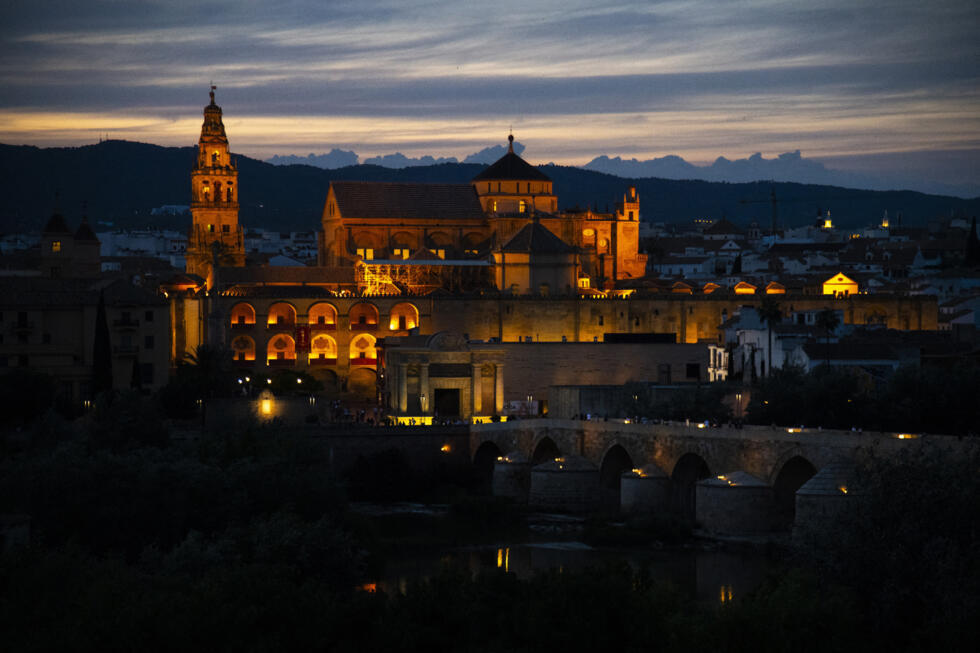
A historic mosque-turned-cathedral in Cordoba in southern Spain reopened on Saturday, a day after a blaze that was quickly contained by firefighters, a spokesman for the site said.

Considered a jewel of Islamic architecture, the site opened at 10am (0800 GMT) and will close at 7pm – its regular hours – with only the area where the fire broke out cordoned off to the public, he told AFP by telephone.

The spectacular blaze broke out on Friday at about 9pm, raising fears for the early medieval architectural gem and evoking memories of the 2019 fire that ravaged Notre Dame cathedral in Paris.

Widely shared videos had shown flames and smoke billowing from inside the major tourist attraction, visited by two million people per year.


Read moreThe Bright Side: Gabon's ancient caves shed light on 27,000 years of human history

Firefighters quickly contained the blaze and Cordoba's mayor, Jose Maria Bellido, told Spanish media said the monument was "saved".

Luckily, the rapid and magnificent intervention of the Cordoba firefighters averted a catastrophe. The fire is now out, and tonight firefighters and local police teams will remain on site to avoid any risk," he added on X late on Friday.

The Mosque-Cathedral of Cordoba is pictured next to the Roman bridge on June 11, 2023. © Cristina Quicler, AFP

Officials are expected to give an update on the extent of the damage later on Saturday.

ABC and other newspapers reported that a mechanical sweeping machine had caught fire in the site.

The site was built as a mosque – on the site of an earlier church – between the 8th and 10th centuries by the southern city's then Muslim ruler, Abd ar-Rahman, an emir of the Umayyad dynasty.

After Christians reconquered Spain in the 13th century under King Ferdinand III of Castile, it was converted into a cathedral and architectural alterations were made over following centuries.

(FRANCE 24 with AFP)

Wildfires rage across southern Europe amid record temperatures


Copyright AP Photo/Manu Fernandez

By Emma De Ruiter
Published on 09/08/2025 


France, Spain, Greece and Turkey are all battling wildfires as a new heatwave brings record temperatures surpassing 42 degrees Celsius.


Firefighters are battling wildfires across southern Europe as extreme heat grips the region with record-breaking temperatures.

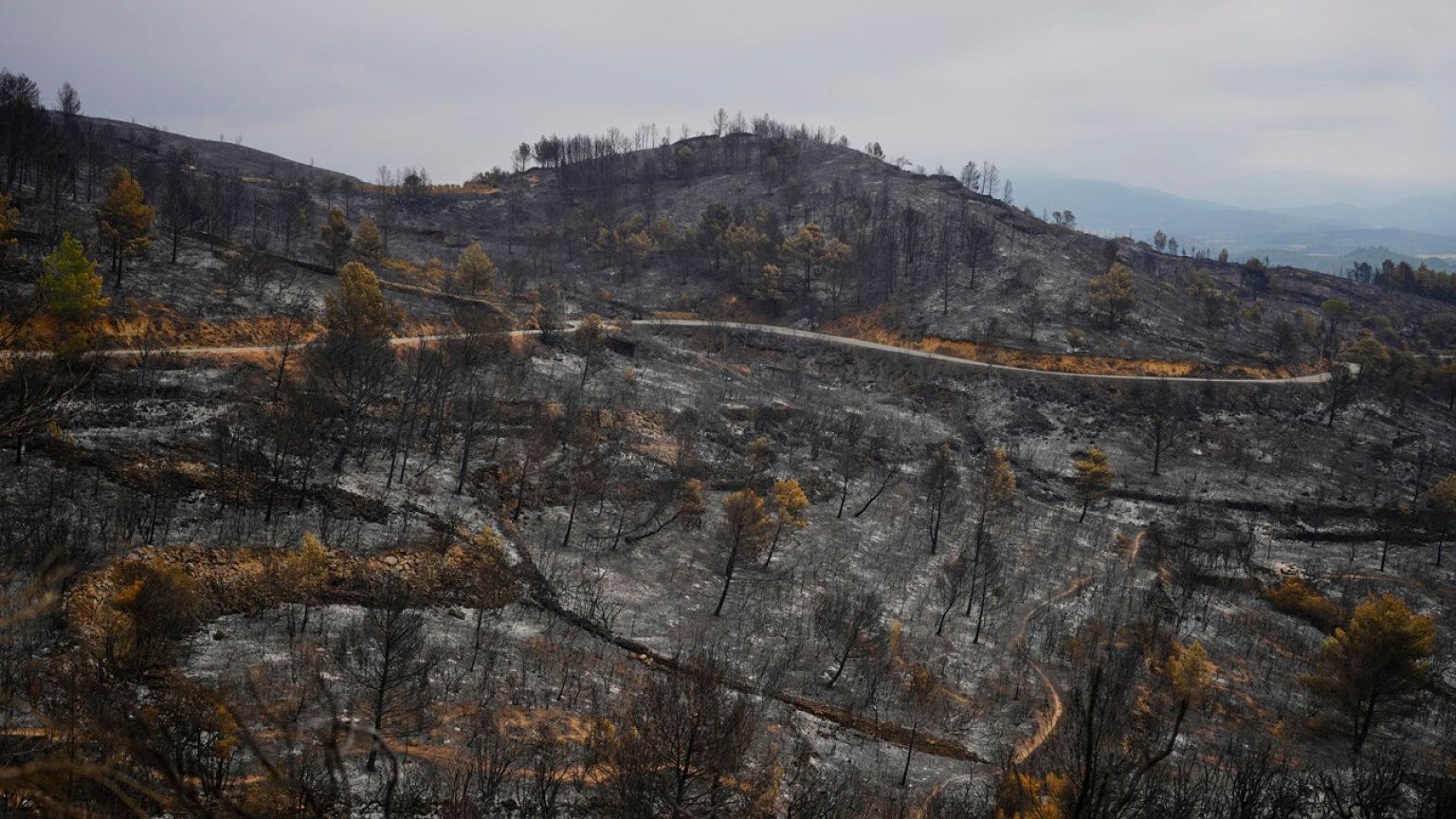
In France, About 1,400 firefighters were deployed on Saturday in France's southern Aude region to prevent the country's largest wildfire in decades from reigniting, as all residents were allowed to return to their homes.

Aude prefect Christian Pouget said the fire has been contained since Thursday after burning more than 160 square kilometres this week in the wooded region, known for its wineries.

All roads have been reopened but authorities issued a strict ban on accessing the forest, Pouget said at a news conference on Saturday.


“The fight is continuing, firefighters are still working on (fire) re-ignition,” he said.

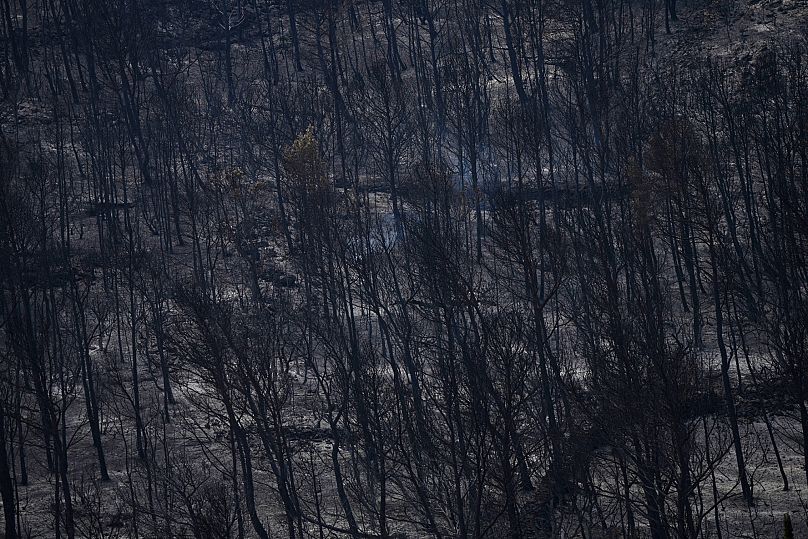
Burned trees are pictured during one of the largest wildfire in decades in Fontjoncouse, southern France, Friday, Aug.8, 2025. AP Photo/Manu Fernandez

The blaze left one person dead and 25 people have been injured, including 19 firefighters, Pouget said.

High temperatures in the coming days are expected to complicate firefighters' efforts.

“The fire won’t be extinguished for several weeks,” Col. Christophe Magny, director of Aude firefighters department, said, pointing to several “hot spots” that are being closely monitored.

France’s national weather agency Meteo France placed the southern half of France under “high vigilance” alert for heat wave, with temperatures expected in the Aude region of up to 39°C on Saturday.

Fires continue in Spain and Greece

Firefighters also continued to battle an active wildfire in Avila province, central-western Spain on Saturday.

The fire began on Friday afternoon, with the Spanish Military Emergencies Unit (UME) working through the night in an effort to bring it under control and prevent it from approaching roads and train lines.

With temperatures reaching close to 39°C in parts of Spain and Portugal, fire risk is extremely high.

The current period of extreme temperatures is expected to continue until at least next Wednesday, according to Spain's national weather service AEMET.


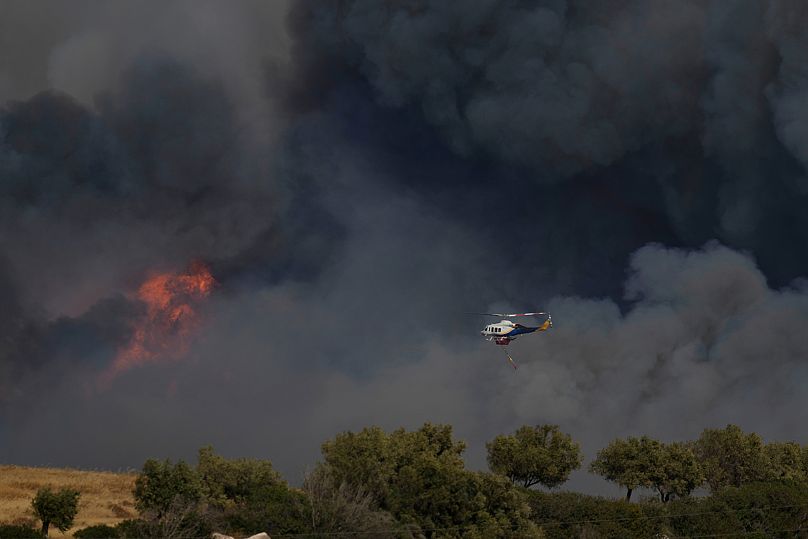
A helicopter flies through smoke from a fire at Keratea, outskirt of Athens, on Friday, Aug. 8, 2025. AP Photo/Thanassis Stavrakis

In Greece, a large wildfire that erupted on Friday afternoon in Keratea, some 40 kilometres southeast of Athens, continued to rage across eastern and southern Attica through the night, causing significant damage to homes and claiming one life.

Authorities issued evacuation orders as the blaze approached residential areas while firefighters battled strong winds.

At least 260 firefighters, supported by 77 vehicles, were working to contain the blaze, with numerous volunteers and civilians assisting in the affected areas.

Wildfire in Turkey under control


Wildfires in the central districts of Canakkale and the Bayramic area in western Turkey have been largely brought under control, according to Agriculture and Forestry Minister Ibrahim Yumakli.

Yumakli stated that firefighting teams worked throughout the night to halt the advance of the blazes. He confirmed that the spread of the fires had been stopped and that cooling efforts are ongoing.

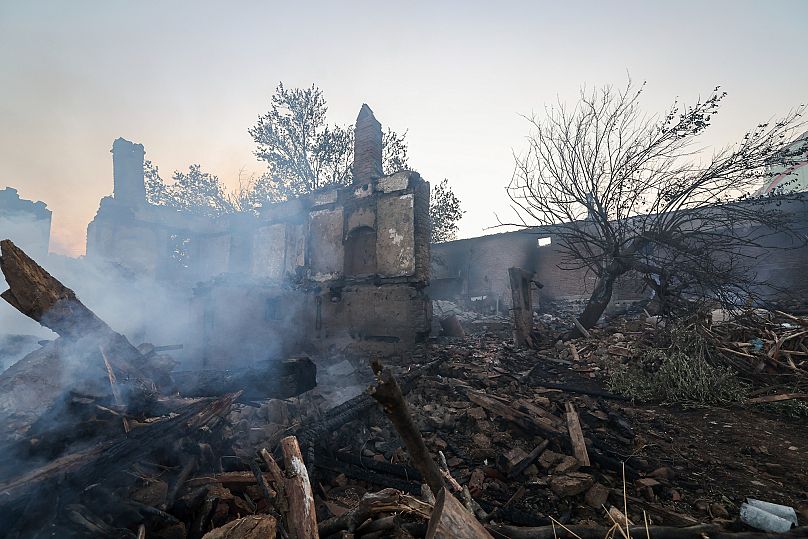
The fire, which broke out on Friday near Yigitler village and spread to a forested area under strong winds, had prompted precautionary evacuations in the villages of Sacakli, Ahmetceli, Doganca, Zeytinli, and Pitirelli.

A total of 654 residents were relocated to safe zones. Authorities reported that four suspects have been taken into custody as part of the ongoing investigations into the cause of the fires.

Smoke rises from the rubble following a fire in Sacakli, Canakkale province, northwest, Saturday, Aug. 9, 2025. Berkman Ulutin/Dia Photo via AP


A new normal

Southern Europe has seen multiple large fires this summer. Scientists warn that climate change is exacerbating the frequency and intensity of heat and dryness, making the region more vulnerable to wildfires.

This week, the UN World Meteorological Organisation (WMO) released a report detailing the impact of extreme heat worldwide.

The report indicated that extreme temperatures caused approximately 489,000 heat-related deaths annually between 2000 and 2019, with 36% occurring in Europe

In this record-breaking July, Turkey recorded an extreme new national high of 50.5°C, it said. Sweden and Finland also experienced unusually long spells of temperatures above 30°C.

The WMO warns that countries need to act faster to adapt to climate change and limit global warming, in line with the 2015 Paris Agreement.

“Extreme heat is sometimes called the silent killer, but with today’s science, data and technologies, silence is no longer an excuse. Every single death from extreme heat is preventable,” said WMO Deputy Secretary-General Ko Barrett.

The organisation estimates that scaling up heat-health warning systems in 57 countries alone could save nearly 100,000 lives annually.

“This is not just a climate issue, it’s a public health emergency,” said Joy Shumake-Guillemot, lead of the WHO-WMO Climate and Health Joint Programme and co-lead of the Global Heat-Health Information Network (GHHIN).


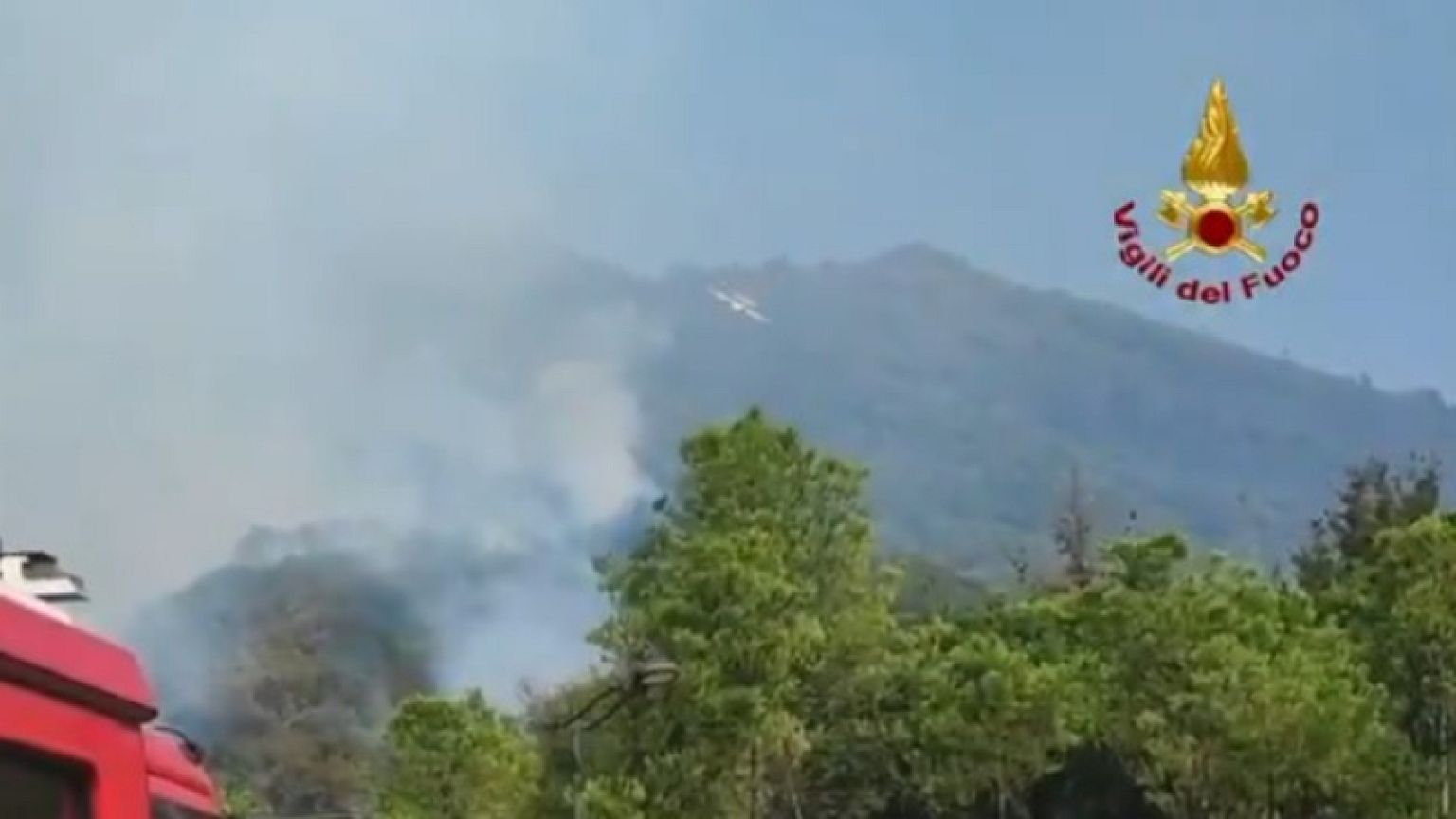
Huge wildfire breaks out on Mount Vesuvius with flames visible from Naples


Copyright Vigili del Fuoco

By Euronews
Published on 09/08/2025 


A huge fire has broken out in the Vesuvius National Park with smoke visible over the city of Naples. Whilst over 100 firefighters and volunteers work to put out the blaze.


A huge fire has erupted in Vesuvius National Park in Italy’s western Campania region. The Campania Civil Protection deemed the situation critical, and has called in the Army to help manage the situation and guard roads, open access routes, and supply water to the tankers.

The National Civil Protection Department is also sending a support team to the Terzigno coordination centre and providing air support.

"In order to fight the flames and ensure the greatest possible air coverage for the extinguishing activities, six Canadairs of the national fire-fighting air fleet, coming from different regions and at work from the first light of dawn, are operating on the vast fire. In addition to the state fleet, airborne resources from the regional fleet are also operating on the fire,' the Civil Protection Service wrote in a statement issued on Saturday.


Over one hundred firefighters and volunteers working to extinguish the flames

Around 100 firefighters and Civil Protection volunteers have been battling the blaze relentlessly, working through the night from Friday to Saturday. Rising temperatures and unfavourable weather have made the task even more difficult.

Now in its fourth day, the fire has ravaged the Terzigno pine forest and spread into the neighbouring municipalities of Ottaviano and San Giuseppe Vesuviano. The flames are so intense they can be seen from across Naples and much of the surrounding province.


The mayor of Terzigno, Francesco Ranieri, described the past night as “very critical,” though the efforts of rescuers prevented the flames from reaching homes. However, some of the area’s most beautiful vegetation, behind the municipal stadium, has been destroyed.

The cause of the fire is considered suspicious. Mayor Ranieri voiced concern that it may be arson, recalling the devastating blazes of 2017 and suggesting there may be a “criminal hand” behind this one as well. At present, the fire front is moving from the Terzigno pine forest towards the Tirone–Alto Vesuvio reserve — an area of particular concern for emergency crews. The Park Authority estimates that around 200 hectares have already been affected.

Over 50 fires in Campania over the weekend

The crisis extends far beyond Vesuvius. The regional Civil Protection also tackled two other major blazes — one in Mercato San Severino, in the province of Salerno, and another in Frasso Telesino, in the province of Benevento. On Friday alone, more than 50 fires were recorded across Campania, underlining the severity of the situation.

Los Angeles: Firefighters make progress against blaze that forced thousands to flee


Issued on: 09/08/2025 - FRANCE24

Firefighters in a mountainous area north of Los Angeles made good progress in their battle against a brush fire that has forced thousands of people to evacuate, officials said on August 8.

Video by: Catherine VIETTE