Wednesday, August 20, 2025

Our state has become a guarantor of corporate profits


18 August, 2025


Equitable distribution of income and wealth would go a long way towards stimulating domestic demand and investment...


The UK’s economic growth has slowed in the second quarter of the year to 0.3%. The economy grew by an average of 1.5% between 2009 and 2024. The UK remains trapped in low growth as the government’s chosen tools are deregulation and greater reliance on the finance sector. Right on cue, the Chancellor repeated the usual platitudes about the need for higher labour productivity, growth and investment.

Hardly any questions are asked about why the same policies have failed to fuel economic renaissance in the past. There is little questioning of the policies that destroy productivity. Austerity, wage cuts and neglect of public services have reduced productivity. Equitable distribution of income and wealth would go a long way towards stimulating domestic demand and investment, but that isn’t on the government’s agenda.

For a long time, neoliberals claimed that high rates of inflation, corporation tax and interest rate dissuaded the private sector from investing. In recent years, the UK has had low rates of interest, inflation and corporate taxes; and numerous tax reliefs have been handed to corporations but that didn’t translate into higher rates of investment in productive assets. In 2022, the UK invested around 19% of its GDP into productive assets, compared to 26% for France, 25% for Germany and OECD countries averaged 23%. By the first quarter of 2025, the UK investment declined to 18.2% of GDP. For 24 out of the last 30 years, the UK has languished at or near the bottom of the G7 countries’ investment league. It ranked 28thout of 31 countries despite the infrastructure investment made by the state via the expensive private finance initiative (PFI).

No government has shown a willingness to address structural problems. These relate to short-termism in the City of London, and the oppressive power of shareholders and stock markets. The average tenure of a FTSE 100 chief executive is around 5.2 years and 2.7 years for chief operating officers. As share prices form a key part of their bonus algorithm, they have economic incentives to maintain or increase it and appease shareholders by making excessive dividend payments. The Bank of England Chief Economist noted that in 1970 major companies typically paid £10 in dividends out of each £100 of profits, but by 2015 the amount rose to between £60 and £70, often accompanied by a squeeze on labour and investment.

Shareholders also have short-term horizons. Shares in listed companies are literally held only for seconds as portfolio managers scour markets for quick returns, and higher performance-related bonuses. In 2024, companies listed on the London Stock Exchange (not all are UK-based) raised £25.3bn in new shares; paid out £92.1bn in dividends and another £57.1bn in share buybacks. Instead of retained earnings and equity, companies are forced to use expensive debt to finance investment or just sweat assets, which leads to low rates of labour productivity. One study noted that labour productivity rose by only 5.9% between the first quarters of 2007 and 2024, compared to 38% between 1990 and 2007.

The City is a major extractor of cash rather than provider of investment, and aged assets don’t aid productivity. Successive governments have done nothing to reform corporate governance, short-termism in the City of London, obsession with share price and power of shareholders to squeeze more, or seek modifications to performance-related pay which rewards short-term gains at the expense of the long-term. Unlike most European countries, successive UK governments have opposed putting worker-elected directors on the boards of large companies to check rampant shareholder pressures.

Workers lacking good food, housing, education and healthcare are unlikely to be very productive. The median gross wage of a full-time employee is £30,624. Some 16m Britons, including 5.2m children, live in poverty. One in every 200 households in the UK is experiencing homelessness, and the homelessness rate is the highest in OECD countries. Due to insecurity and anxiety one-in-four young people in England have mental health conditions. Victorian illnesses like rickets and scurvy have returned. In 2023, 800,000 patients were admitted to hospital with malnutrition and nutritional deficiencies. Poverty has negative effects on educational attainment, health, employment potential, earnings and tax payments. It increases demand for social security benefits and public services. Due to child poverty, the UK is losing economic output of around £39bn a year. Equitable distribution of income and wealth would improve spending power of the masses, stimulate demand and investment, but it isn’t on the government’s agenda.

Successive governments have manufactured the crisis in labour markets, low productivity and skills shortages. Poor healthcare prevents people from working. The UK has an average of 2.4 hospital beds per 1,000 of population, compared to 7.6 in Germany and an average of 4.6 in OECD and EU countries. For hospital beds, the UK is ranked 24thout of 25 OECD countries. The number of beds in England is unevenly spread. For example, Homerton University Hospital NHS Foundation Trust has just 0.9 beds per 1,000 people, lower than the average for Mexico. Bedfordshire Hospitals NHS Foundation Trust has just 1.7 hospital beds per 1,000 people, about the same as average in Colombia.

The wilful neglect of the NHS in England has increased the waiting list for hospital appointments from 2.5m in 2010 to 7.7m in 2023, and is about 7.37m now. People struggle to access a dentist or a family doctor. There is 83% increase in people waiting for planned heart hospital treatment in England, from 232,082 at the start of the decade to 425,372 in March 2025. There is an 18% increase in cardiovascular deaths among working-age adults since 2019, translating to a jump from 18,693 deaths to 21,975 in 2023. Some 3.5m people live with cancer and around 167,000 a year die from it. Cancer deaths are almost 60% higher for people living in most deprived areas. Around 28,400 cancer deaths each year are linked to socioeconomic inequality. Some 300,000 people a year die whilst waiting for a hospital appointment. The deceased are typically those suffering from delays and cancellations to hospital appointments, the less well-off and people from ethnic minorities. People in the UK are less likely to survive treatable conditions, such as breast cancer and stroke than people in the 19 richest countries..

Poor healthcare and public services may meet some obscure fiscal rules and cut taxes for the rich but they result in loss of labour productivity and huge economic costs. Over 17m people are living with two or more chronic conditions. Around 2.8m people in the age 16-64 year are economically inactive due to long-term sickness. Around 16.1m people have disabilities. Some 148.9m working days were lost to sickness in 2024, compared to 163.8m day in 2023. The neglect of healthcare is a major cause of labour shortages and low labour productivity.

The UK infrastructure is crying out for direct public investment to boost productivity and create jobs. Healthcare and social care needs to be removed from the clutches of the private sector. Roads are full of potholes and need around £17bn to fix them. Universities are cutting courses; the number of home (UK domiciled) students is declining and about 40% of England’s universities are in financial difficulties. Legal-aid is scarce and justice is even scarcer even if you can pay. By March 2025, Crown Court backlog reached 76,957 – a 25-year high; backlog of magistrates’ courts reached 310,304. The UK can’t build enough homes as it doesn’t have brick building capacity. With annual imports of around 500m bricks, it is the world’s largest importer. Some 30%-40% of cement is imported.

For ideological reasons, the state is prevented from investing directly in new industries and infrastructure. As a result that investment in productive assets lags behind other major comparable countries. We need an entrepreneurial state with autonomy, not the one which has become a guarantor of corporate profits through privatisations, outsourcing and PFI. It needs to focus on quality of life instead of profits for the City. In the words of John Maynard Keynes:

“Where we are using up resources, do not let us submit to the vile doctrine of the nineteenth century that every enterprise must justify itself in pounds, shillings and pence of cash income, with no other denominator of values but this. Why should we not add in every substantial city the dignity of an ancient university or a European capital … an ample theatre, a concert hall, a dance hall, a gallery, cafes, and so forth. Assuredly we can afford this and so much more. Anything we can actually do, we can afford. …”.

Neoliberals are not constrained by such noble thoughts. They need to be reminded that a state with fiat currency can create money to achieve social objectives. It found money to bail out banks and subsidise corporations. It provided £895bn of quantitative easing to support speculators. It finds billions to fund foreign wars. The same state can find billions to invest in new industries and social infrastructure to improve the UK asset base and society.


Prem Sikka is an Emeritus Professor of Accounting at the University of Essex and the University of Sheffield, a Labour member of the House of Lords, and Contributing Editor at Left Foot Forward.


UK
Reform’s Andrea Jenkyns attacks workers’ rights and says she doesn’t like trade unions


Yesterday
Left Foot Forward


‘Oh, terrible. People having rights at work!’


Reform mayor for Greater Lincolnshire Andrea Jenkyns has said she doesn’t like trade unions and has criticised Labour for strengthening people’s rights at work.

Speaking on the Jeremy Vine show today, Jenkyns was asked for her view on introducing a wealth tax on the super-rich.

The Reform mayor expressed opposition to introducing a wealth tax, saying “I want wealth creators to come to Britain to create jobs” and that the 2% tax on wealth over £10 million would make the super rich leave the UK.

Jenkyns quickly went on to attack workers’ rights, stating that she does not agree with Labour’s Employment Rights’ Bill, which intends to give workers essential protections, such as curbing fire and rehire practices and sick pay from day one.

Mirror associate editor Kevin Maguire responded: “Oh, terrible. People having rights at work!”.

Jenkyns argued workers’ rights had gone too far: “But it’s ridiculous, it got very hard to set up a business.”

Maguire continued: “It’s an interesting insight into Reform here, you’re not seeing the workers here, you’re seeing the employers, the bosses, aren’t you?”.

He added: “Reform is a very right-wing party, with the most right-wing Tories. Farage was a Thatcherite, your deputy leader Richard Tice.”

Jenkyns’ mask slipped entirely as she said: “I’ll be honest with you, I don’t like trade unions.”

“You don’t want workers to have power?” Maguire asked.

“I want workers to have rights, but it’s got ridiculous now,” Jenkyns added.

In a post on X, Unison East Midlands wrote: “Reform UK’s Greater Lincolnshire Mayor Andrea Jenkyns says working people have too many rights and she doesn’t like unions. The feeling’s mutual – http://join.unison.org.uk.”


Robert Jenrick pictured with ex-BNP activist at far-right protest organised by the Homeland Party


‘Jenrick is fanning the flames of the far right by chasing Reform UK votes’


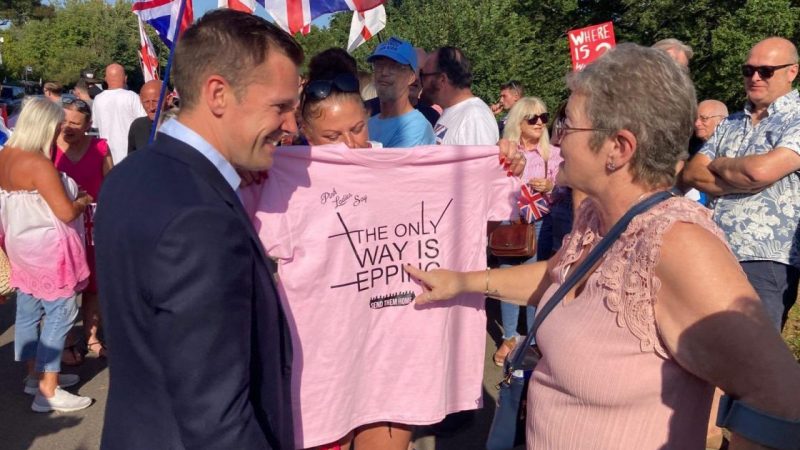
Shadow justice secretary Robert Jenrick has been condemned for going to a far-right protest organised by Homeland Party members in Epping.

At the anti-refugee rally on Sunday, Jenrick was pictured with Eddy Butler, an ex-British National Party (BNP) activist and former member of Nazi terror group Combat 18.

While an organiser for the BNP in East London, Butler spearheaded the party’s “Rights for Whites” campaign in 1993.

After the demonstration, Butler posted a photo on Facebook of him standing behind Jenrick. The caption read: “At the Bell Hotel riding shotgun for Robert Jenrick.”

A source close to Jenrick insisted the shadow justice secretary had “no idea” who Butler was. They also said he didn’t speak to Butler.

Liam Gillett, also known as Liam Tuffs, a far-right podcaster and friend of Tommy Robinson’s, also attended the Epping protest. Gillett runs a security firm and arranges security teams for Robinson’s events.

While Jenrick supposedly didn’t know about the BNP’s links to the protest, the link between the protests and the Homeland Party is well-established.

Homeland party activists, Barker, Adam Clegg and Andrew Piper, are the sole administrators of Epping Says No, the main Facebook group used to plan the Bell Hotel protests.

A local Tory councillor, Holly Whitbread, previously condemned Reform councillor Jaymey McIvor for joining one of the previous Sunday demonstrations and “standing next to a neo-Nazi”.

Whitbread said: “My grandad and my grandad’s generation fought in a war against these people.” She added: “These people do not talk for Britain. They’re not British values. I think, quite frankly, anyone who stands side by side with them should hang their heads in shame. It’s disgraceful.”

Protests outside the Bell Hotel started on 13 July, after a resident at the hotel, which houses asylum seekers, was charged with sexual assault.

A Labour party spokesperson described Jenrick as “a disgrace” for attending the far-right protest.

The spokesperson added: “Jenrick once proudly boasted about ramping up the procurement of asylum hotels when he was immigration minister. It shows, at best, a staggering lack of judgment.

“Kemi Badenoch must show some leadership, explain what action she’s going to take against her shadow justice secretary, and demonstrate that she is strong enough to stand up against this challenge to her authority and to basic decency.”

Jenrick isn’t the only one, Suella Braverman is also flirting with the far-right, having attended an anti-migrant protest in her constituency last week.

Lewis Nielsen, a spokesperson for Stand Up to Racism, said: “These aren’t ‘concerned parents’ or ‘local residents’. Jenrick is fanning the flames of the far right by chasing Reform UK votes – and he’s giving confidence to known fascists.”

Image credit: Robert Jenrick/X

Olivia Barber is a reporter at Left Foot Forward


Majority of voters still view Nigel Farage unfavourably, poll finds


Today
Left Foot Forward

It shows how deeply unpopular Farage remains among the public and how the next general election is far from a foregone conclusion.


A clear majority of voters still have an unfavourable view towards Reform UK leader Nigel Farage, a poll has found.

The polling, carried out by YouGov in mid August, found that Farage’s net rating has consistently been between -27 and -31 since the local elections in May.

The latest figures show a third of Britons (32%) have a favourable opinion of the Reform UK leader, while six in ten (61%) see him unfavourably, giving a net rating in August of -29.

It shows how deeply unpopular Farage remains among the public and how the next general election is far from a foregone conclusion.

Progressives should continue to expose Farage for what he really stands for, from favouring tax cuts for the rich to wanting to privatise the NHS, to voting against workers’ rights.


Labour slams Nigel Farage for supporting Andrew Tate in new attack ad


Basit Mahmood 
18 August, 2025 
Left Foot Forward

The attack ad, which was launched yesterday, refers to comments Farage made on the ‘Strike It Big’ podcast last year.


Labour has launched a new attack ad against Nigel Farage, accusing the Reform UK leader of supporting the misogynist influencer Andrew Tate.

The attack ad, which was launched yesterday, refers to comments Farage made on the ‘Strike It Big’ podcast last year.

He told the hosts, who are three male influencers in their 20s, that Tate was “an important voice” for many young men.

Farage said: “You three guys, you are all 25, you are all kind of being told you can’t be blokes, you can’t do laddish, fun, bloke things … that masculinity is something we should look down upon, something we should frown upon. It’s like the men are becoming feminine and the women are becoming masculine and it’s a bit difficult to tell these days who’s what.

“And Tate fed into that by saying, ‘Hang on, what’s wrong with being a bloke? What’s wrong in male culture? What’s wrong in male humour?’ He fed into those things. His was a campaign of raising awareness. His was a campaign of giving people, perhaps, a bit of confidence at school or whatever it was to speak up.”

The attack ad features a picture of Farage with Tate, with the words: “Nigel Farage says Andrew Tate is ‘an important voice’ for men.

“Andrew Tate said women should ‘bear responsibility’ for being sexually assaulted.”

Appearing on LBC, Labour MP Rosie Wrighting said it was right that Farage was asked the ‘difficult questions like ‘how are you going to keep women and girls safe online if you repeal the Online Safety Act but you don’t come forward with any policies that keep women and girls safe from things like explicit pictures being shared and young boys and women safe from misogynist like Andrew Tate.”

Basit Mahmood is editor of Left Foot Forward

Telegraph inaccurately calculated ‘one in 12 in London is illegal migrant’ stat, IPSO rules

Yesterday
Left Foot Forward

IPSO found that the Telegraph had reported on the Thames Water findings in a way that was “inaccurate, misleading, or distorted”.


Another right-wing paper has been found to have made a misleading claim when it comes to migrants.

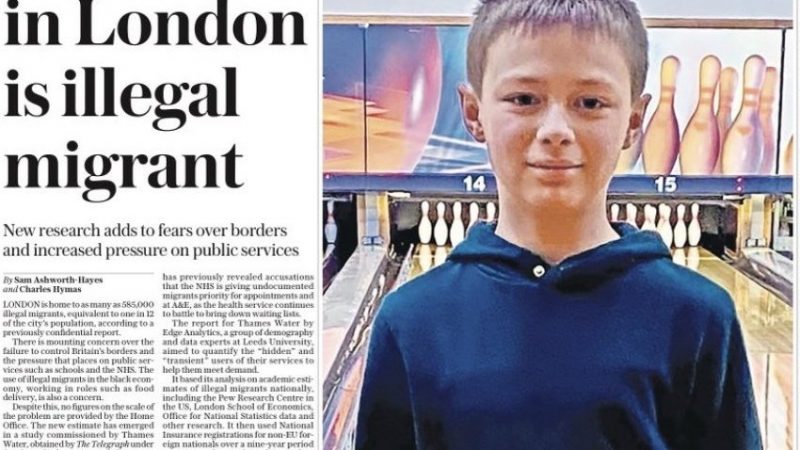
IPSO, the newspaper regulator, has found that The Telegraph’s sums to conclude that “one in 12 in London” is an illegal migrant were inaccurate. The misleading claim was also picked up by the Daily Mail which tried to say that it was fine for it to use the claim without checking because it was “reasonable for it to assume the central premise was accurate”.

The paper’s front-page article in January relied upon a study commissioned by Thames Water and obtained under freedom of information laws.

Press Gazette reports: “The analysis found that there were between 390,355 and 585,533 illegal migrants in the Thames Water London Water Resource Zone.

“The Telegraph used these figures and a population estimate of 7,044,667 to say “that would mean one in 12 of the capital’s population is an illegal migrant”.

“However IPSO noted that by The Telegraph’s own admission, this calculation was done inaccurately.”

IPSO ruled: “It had failed to add the estimated migrant population to the overall population it had based the article upon.

“In addition, it had not taken account of the fact, in its reporting, that the report was based on the population of the Thames Water London Water Resource Zone – rather than of London itself.”

IPSO found that the Telegraph had reported on the Thames Water findings in a way that was “inaccurate, misleading, or distorted”.

It’s important for media organisations to recognise that printing false and misleading claims in newspapers has real life consequences for communities.

Basit Mahmood is editor of Left Foot Forward
Thousands object to Elon Musk’s bid to supply energy to homes in the UK


Today
Left Foot Forward


Members of the public cited billionaire owner Elon Musk's "clear political agenda" as the reason for the objection.


Thousands of people have complained to the energy regulator Ofgem, in a bid to block Elon Musk’s Tesla from supplying energy to British households.

Campaign group Best for Britain is urging the public to write to Ofgem, stating that Musk is not a “fit and proper” person to have “a foothold in our essential services”, with around 8,000 people contacting the energy regulator lodging their objections.

Members of the public cited billionaire owner Elon Musk’s “clear political agenda” as the reason for the objection.

In July, Tesla had applied for a licence from Ofgem to provide electricity to homes and businesses across England, Scotland and Wales as early as next year.

Musk’s association with the Trump presidency, and support for the likes of far-right thug Tommy Robinson as well as turning X, formerly Twitter, into an incubator for right-wing hate, promoting baseless conspiracy theories, has seen progressives protest against his malign influence.

A slump in Tesla sales has also been blamed on his political agenda, with sales taking a particular hit in Europe.

According to latest industry data, just 987 new Teslas were registered in the UK in July, almost 60% less than the 2,462 registered in July 2024. This means Tesla’s UK market share shrank to 0.7% in July, from 1.67% a year ago.

Musk’s close association with Trump has been blamed by many for the brand taking a hit.

Now thousands of people in the UK are using Best for Britain’s tool to complain to Ofgem about Musk’s attempt to supply energy to UK homes.

The public have until Friday, August 22 to write to Ofgem regarding Tesla’s application, when the regulator will decide whether to grant Tesla a licence to supply electricity.

You can find a link to the petition here.


Basit Mahmood is editor of Left Foot Forward


UK

Right-wing claims of mass exodus of wealthy ‘non-doms’ due to tax rises overblown, latest data shows


Yesterday
Left Foot Forward


There was no mass exodus


While those on the right tried to whip up a moral panic over tax rises on ‘non-doms’, claiming that there would be a mass exodus of wealthy individuals leaving the UK, official data shows that their claims were once more overly exaggerated.

In April the chancellor, Rachel Reeves, scrapped the non-domiciled tax status, which allowed wealthy individuals with connections abroad to avoid paying full UK tax on their overseas earnings.

That led to a panic among right-wingers who tried to claim that it would lead to a mass exodus of wealthy elites which in turn would be bad for the economy.

However, according to a report in the Financial Times, official HMRC payroll data has found no evidence to suggest more non-doms left Britain in response to Rachel Reeves’ 2024 Budget than official predictions.

The paper reports: “Reeves was told by the Office for Budget Responsibility to expect 25 per cent of non-doms with trusts to quit the country in response to the crackdown on their tax status, which began under the Conservatives and intensified when Reeves became chancellor last year.

“HMRC data now suggests this prediction is broadly correct, the people said, removing pressure on Reeves to reverse a Labour policy that is forecast to raise more than £4bn in 2026-27 and almost £6bn the following year.”

Basit Mahmmod is editor of Left Foot Forward

UK

Majority of Labour members think government was wrong to proscribe Palestine Action

18 August, 2025 
Left Foot Forward

Seven in ten members say the move was wrong


TweetShareWhatsAppMail


The large majority of Labour members believe that the government was wrong to proscribe Palestine Action as a terrorist group.

According to polling carried out by Survation for Labour List, one in seven or 71% of members said the move was wrong, while a small minority, 21%, said it was the right decision.

Opposition to proscribing the group was strongest among 18-24 year olds, members aged over 65 and 96% of those who voted for Rebecca Long-Bailey to be leader, according to Labour List.

Palestine Action was proscribed last month, after the group broke into RAF Brize Norton in Oxfordshire and sprayed two military planes with red paint.

Proscription of the group made membership or showing support for the group a criminal offence. More than 700 people have been arrested for showing support for Palestine Action since its proscription on 5 July.

Members were also polled on the government’s plan to recognise a Palestinian state in September if Israel does not agree to a ceasefire.

Almost half of respondents (48%) said the government should recognise a Palestinian state immediately.

A further 26% said recognition should go ahead in September, regardless of whether Starmer’s conditions are met.

Damian Lyons Lowe, chief executive of Survation, said that the polling “shows a clear disconnect between Labour’s grassroots and the government on this issue”.

He added: “With more than seven in ten Labour members opposing the proscription, it’s evident that many feel this decision was either disproportionate or politically misjudged against the backdrop of the humanitarian crisis in Gaza.”

Olivia Barber is a reporter at Left Foot Forward


UK

Consider free public transport for all, not just buses for under-22s, say campaigners

Campaign groups, including Fare Free London, have welcomed the House of Commons Transport Committee’s proposal for free bus travel for under-22s – and called on the committee, and the government, to consider making all public transport free for all.

The call to extend zero-fares transport further is supported by Fare Free London, Fare Free Yorkshire and Get Glasgow Moving, as well as the Greener Jobs Alliance, Tipping Point UK campaign, and  the Leeds, Wakefield and York branch of Unite Community.

It came in response to a report from the House of Commons Transport Committee that acknowledged the damage done by high bus fares, and poor services, to the lives of millions of young people.

The statement said:

“The undersigned organisations welcome the House of Commons Transport Committee’s call for a pilot scheme providing free all-day bus travel to under-22s – and we call for a more wide-ranging study on the potential for universal free travel on all types of public transport.

“The committee states that access to free travel would help to remove ‘barriers to education, training and employment for the next generation’, but it is not only the young who experience these barriers. The burden borne by millions of households due to high fares as well as to the deterioration of bus services over the past decade is well documented.

“High fares and poor public transport services exacerbate social inequality, and obstruct progress away from car-centred transport systems – and not only on buses. Trains, including the underground, add to the problem.

“With regard to buses, the Transport Committee is calling for a change in the way that funding is provided. We believe that that change should be applied to public transport as a whole. 

“We call for the Committee and the government to consider the potential of universal free public transport, which has been successfully introduced in a range of European cities, including the capitals of Luxembourg, Estonia and Serbia, and more than 130 cities in Brazil.”

Fare Free London and allied organisations will discuss the next steps of the campaign for free public transport at its annual meeting on Saturday 27th September, 10am, at the Waterloo Action Centre, Baylis Road, London SE1 7AA. Details here.

 More information at farefreelondon.org.

Image: Fare Free London


UK
New Left party, new vision, new culture?

Mike Phipps considers some strategic questions facing the Corbyn-Sultana project.

The announcement of a new party of the left headed by Jeremy Corbyn and Zarah Sultana is, as former top Corbyn advisor Andrew Fisher said recently, “potentially very significant for British politics.” Despite predictable sneering from the mainstream media, over 700,000 people have signed up to the idea and pollsters estimate it could win between 10 and 15% at a general election.

Teething troubles

Of course, there will always be any number of teething troubles with the launch of any new formation. How far should it be a standard vote-winning party as opposed to a social movement? To what extent should it rely on traditional organisational methods rather than embodying a new way of doing politics? Should it adopt a delegate structure for policy decision-making or something more innovative, for example grassroots assemblies? These vital issues were raised by David Osland in a recent article on this site and they will all need to be resolved – but they don’t detract for one moment from the enormous appetite that exists for a new political formation to the left of the Labour Party.

To maximise this potential, it’s important that the new party gets things right, not just in terms of policy, but its culture. There is already tension between some of the ‘leading’ individuals at the centre of the project and those out in the country who have more of a local base and mandate. Then there were the unfortunate leaks to the Murdoch press of messages in a private Whatsapp group at the time of Zarah Sultana’s perhaps premature declaration that she was leaving Labour to lead a new party with Jeremy Corbyn  – leaks which did not augur well for ongoing mutually trusting relationships among those involved.

One major strategic question facing a new organisation of the left will be what relationship it will have with other existing parties. Compass, among others, have talked for years about the need for a progressive alliance – but the problem is how progressive should that be and who should be included or excluded?

 Should a new party of the left enter into some kind of electoral alliance with the Greens, for example? A lot may depend on who wins the Green Party leadership. If it’s Zack Polanski, generally touted as the most progressive of the current contenders, the party is likely to move in a more left wing direction. It will also continue to attract young radical activists and may find itself in competition with the new Corbyn-Sultana party in doing so.

Is Labour dead?

A more pressing question might concern the new outfit’s relationship with the Labour Party out of which the new leadership emerged. Notwithstanding the understandable anger that many feel over the treatment of Corbyn, Sultana and others who have lost the Labour whip for opposing unpopular austerity policies for which the government has no mandate, it’s important to be objective in appraising the current state of affairs.

In a recent interview, Zarah Sultana said: “The Labour Party is dead. It has destroyed its principles and its popularity. Some Labour MPs who consider themselves on the left are still clinging to its corpse. They say that by staying in they’ll be able to retain their political influence. My response is simple: you haven’t been able to stop disability cuts, you haven’t been able to stop the flow of arms to a genocidal apartheid state, so where is this influence you’re talking about?”

This is true, but it’s not the whole picture. One might also complain that the newly elected Independents have not proved particularly effective – some voted against removing tax breaks for private schools, for example.

But the Labour Party cannot be so easily written off, in my view. It still has more socialist MPs than any other party. Furthermore, if Keir Starmer is still as deeply unpopular in two years’ time as he is now, he is unlikely to remain unchallenged as leader. Out of self-preservation alone, Labour MPs will demand first a change of course – that is already happening – and failing that, a change of leader. True, it is unlikely that a Jeremy Corbyn-type figure will get another opportunity, but that does not exclude the possibility of a softer left candidate, backed by the affiliated unions, having s strong chance. And while someone like Andy Burnham may not be to the taste of many on the socialist left, that’s not a reason for minimising the very real differences between that wing of the Labour Party and the current Starmer leadership.

Talking of the unions, any discussion of their role seems curiously absent in the calculations around the new party’s prospects of success. Another leading figure who worked for Jeremy Corbyn, Andrew Murray, recently said in an interview: “In the short term I don’t see the trade unions, as collective bodies, having a formal relationship to the new party.”

This seems odd. If Labour has really ceased to speak for the working class and progressive opinion, then surely a campaign to win over the key affiliated unions that fund with its members’ subscriptions an apparently bankrupt, “dead” party should be a central priority. Or are the unions also “dead”?

This could be what Labour needs…

In his recent article in the paper, Andrew Fisher welcomed the new party, arguing it could have a positive effect on Labour.  He believes it could bring about a leftward shift on Labour policy, which “might prove more popular with the public as polling shows support for wider public ownership, redistributive taxation, and policies like rent controls, which have been backed by Scottish Labour and English mayors, including Sadiq Khan and Andy Burnham.

“This new party could therefore force Labour towards a more populist left stance and stop alienating its own supporters on issues like welfare and immigration. If Corbyn and Sultana start mobilising support, it puts pressure on Labour to stem the loss of voters on its left flank.”

He adds: “External pressure mobilised by this new party, alongside campaigning from unions, members, MPs, and mayors within the party, could force the Starmer government into more radical stances. This internal coalition, combined with public pressure, has already forced significant partial U-turns of two of the Starmer government’s least popular policies: scrapping winter fuel payments and cutting disability benefits.”

I agree with this analysis: there is still a lot to play for in Labour. While those who have had the Labour whip withdrawn may be tempted to join the new formation, other socialist Labour MPs will agree with Clive Lewis MP who argues that the recent “U-turn on cuts to personal independence payments and the role progressive MPs in the PLP played in making that happen, showed exactly why that presence matters.”

It may be too early to say whether the new party can be more than a pressure group forcing Labour to the left, or whether there is a realistic chance of it wielding real power. Current UK politics is in an unprecedentedly volatile phase, as the Reform surge underlines. One thing is clear: many of those signing up to the new project will be disappointed if it takes the route of being an anti-imperialist pressure group while leaving the big domestic cost of living issues to an undisturbed Labour-trade union partnership.

Think big

To succeed on its own terms, the new party will also need to liberate itself from any sense of hurt – worse, ‘betrayal’ – in relation to the Corbyn leadership of the Labour Party. When Zarah Sultana itemised some of the failings of that epoch, the mainstream media pounced on her suggestion that Corbynism “capitulated to the IHRA definition of antisemitism”. The last thing the new project needs is a resurrection of that discussion.

It will need to think big, too. Zarah’s idea that the new party should be called The Left falls short in this respect. Responding to this, Ash Sarkar was right to say that many people don’t have a strong sense of political or ideological identity, so left versus right may not have much meaning for them. There’s a lot more to be won, she argues – and she’s correct. Calling the new party The Left implies it is only for the already ideologically left wing, as opposed to the mass of the working class, the 99%, the overwhelming majority of people. Reform UK would never be so self-confining as to call itself the ‘Right’ party: it claims – spuriously – to be the party of all Brits. Socialists need a similarly ambitious vision.

For the sake of all those looking for a clear political alternative, it is important that the new party overcomes its early difficulties – particularly the aforementioned factional antics at the moment of its birth – gets off to a strong start and embodies a democratic, outward-looking and community-oriented spirit. Like Andrew Fisher, I shall look forward to it exerting a positive influence on the Labour Party where I shall be staying along with a good number of other principled socialists.

Mike Phipps’ book Don’t Stop Thinking About Tomorrow: The Labour Party after Jeremy Corbyn (OR Books, 2022) can be ordered here.

Image: https://commons.wikimedia.org/wiki/File:Jeremy_Corbyn_-_reflections_(51982235668).jpg Source: Jeremy Corbyn – reflections. Author: Alisdare Hickson from Woolwich, United Kingdom, licensed under the Creative Commons Attribution-Share Alike 2.0 Generic license.

Interview


“Defeatism Has No Place” in Liberation Struggles, Frantz Fanon’s Daughter Says


For Black August, Mireille Fanon Mendès-France sets the record straight on her father’s revolutionary legacy.
August 19, 2025

Mireille Fanon Mendès-France, president of the Frantz Fanon Foundation, speaks during an anti-racist rally on September 5, 2020, in Paris, France.Thierry Nectoux / Gamma-Rapho via Getty Images


Public gatherings this week in Jackson, Mississippi and New Orleans, Louisiana — featuring an especially distinctive guest — will honor the legacy of revolutionary psychiatrist Frantz Fanon (1925-1961). The Black Alliance for Peace, an African internationalist organization committed to peace and opposition to war and imperialism, and Cooperation Jackson, which is building a solidarity economy anchored by worker-owned co-ops in West Jackson, are co-hosting several Black August events with Fanon’s eldest daughter. Mireille Fanon Mendès-France is a jurist, an educator, and an anti-racism expert who passionately shares her father’s commitment to rebellion against colonialism in its many forms. She founded the Frantz Fanon Foundation in 2007 to connect his theoretical work to ongoing anti-colonialist struggles like those Black communities throughout the Deep South are facing, especially the kind of ongoing mass displacement that occurred in the aftermath of Hurricane Katrina 20 years ago. Kali Akuno of Cooperation Jackson told Truthout that Fanon Mendès-France has a great deal to share about her father’s contributions in raising consciousness about what it takes to fight against fascism, “because that is what we are staring down.”

Fanon fought the Nazis in World War II with the Free French Forces. Later, he fought for independence against the reactionary colonial regime in Algeria, which, Akuno said, used Nazi tactics against the national liberation movement. “We are doing this consciousness raising in a period where they are deliberately erasing all oppositional history and knowledge, and they’re doing it very intentionally under the color of law. If we don’t recall the lessons of our earlier generations who fought against colonial erasure, who fought against white supremacy, then we’re gonna lose this battle before it even begins.” Akuno explained that a backdrop to all this is the ongoing genocide in Palestine; Fanon Mendès-France is directly tied into the struggle of Arab and North African/Southwest Asian people. “There’s many intersections that we’re trying to get at this year, and she’s one of the best people who encapsulates it all.”

Shortly before her travels to the U.S., Mireille Fanon Mendès-France spoke to Truthout by phone about combating disinformation about her father’s work, her eagerness to be in community in the U.S. with anti-colonial activists, and why defeatism is not an option. The interview that follows has been lightly edited for clarity and length.

Frances Madeson: The centenary of Frantz Fanon has inspired commemorative events all over the world — in Martinique, the Caribbean island where he was born on July 20, 1925, into French colonial dominance in the region; across Europe, where he studied psychiatry and began to write explicitly about the anti-Black racism he encountered there; in Africa, where he lived and was engaged during the bloody struggle for Algerian independence from colonial France; and in the United States, where he died prematurely from leukemia on December 6, 1961, at only 36 years old.

His main books — The Wretched of the Earth (1961) and Black Skin, White Masks (1952) — are still in print and have been translated into more than 25 languages. His singular contributions to anti-colonial psychiatry and humanism are widely studied and deeply embedded in the practices of a growing cadre of Fanonian psychoanalysts who deploy his insights in the service of fostering anti-colonial consciousness in the Palestine solidarity movement and beyond. One would think Frantz Fanon’s legacy would be a settled matter. But is it?

Related Story

How Can Philosophy Speak to a World in Crisis? The Answer May Lie in Our Bodies.
Pain and vulnerability can isolate us — or be the source of our deepest bonds, says philosopher Drew Leder. By George Yancy , Truthout January 7, 2024


Mireille Fanon Mendès-France: Unfortunately, no. The work of decolonial emancipation remains to be done. But before getting to these points, I would like to emphasize that this centenary has given rise to numerous events, particularly in Martinique. One was presented on March 15, 2025, by an organization founded by the Békés — who are descendants of former colonizers and enslavers who continue to control the island’s economy. This association, Tous Créoles, hosted an exceptional conference on Frantz Fanon entitled “Fanon the Humanist.”

Their aim was to demonstrate that the philosophy of Tous Créoles is in line with Frantz Fanon’s by extracting certain quotes and taking them out of context, thereby reinforcing their positions: “I am not a slave to the slavery that dehumanized my fathers. … I, a man of color, want only one thing: that the instrument never dominate man.” The use of these quotes supports their argument. Likewise, “There is no Negro mission; there is no white burden. There is a struggle for the triumph of human dignity, for the disappearance of human humiliation, whatever the origin of that humiliation.” These quotes can be interpreted in any way one wishes if one remains on the surface, but above all, they can be used to demonstrate that Frantz Fanon was not in contradiction with the dominant colonial thinking, particularly that of the Békés, who for several years have been trying to reverse the burden of proof by demonstrating, through this kind of instrumentalization of Frantz Fanon’s thinking, among other things, that they stand alongside the descendants of enslaved people.

These Békés are trying to do what successive Israeli governments have tried to do with the Palestinian people, victims of an illegal occupation that constitutes a war crime and genocide. The Békés try to impose their own agenda by showing their credentials to those they despise, because their colonizer’s unconscious has never abandoned the coloniality of power that led them to consider Black bodies as unimportant because they are commodifiable. Above all, they are trying to promote the myth propagated by the anti-Black (and anti-Arab and anti-Islamic) right wing of “living together,” which means that the dominated must accept the yoke of the dominant without ever questioning this ancestral domination rooted in the racist capitalist system. In twisting Fanon’s thinking to a message that descendants of enslavers and the enslaved should live together in harmony without any reckoning, this is an instrumentalization of Fanonian thinking, and part of a disturbing tendency toward normalization of institutional racism, négrophobia, and colonialism which we see constantly since October 7, 2023.

Why is there so much will to transform the thinking of Frantz Fanon to say things he did not say and to defend positions which are absolutely contradictory to his own? Why does Fanon become compatible with the most racist white thinking, which continues to enrich itself on the backs of Black people?

Let us not forget that Frantz Fanon was a man of rupture, no compromise with the enemy: as presented by the Békés, he becomes consensual, stripping him of his radicalism to make him acceptable to those who rejected him for decades, criticizing him for resigning from his position as chief physician at the Blida hospital and for committing himself intellectually, physically, politically, and in solidarity to the struggle for liberation of a people who had suffered under colonial rule for over a century.

In another event, organized by the Cercle Frantz Fanon, one of their speakers said that Fanon’s ideas are no longer accurate or relevant because in Martinique, or in Guadeloupe, which are overseas French colonies, there is no more colonialism. As proof, he said, “Have you ever seen a colonizer giving monthly social services to the colonized people? Have you seen in a colonized country, one family having two or even three cars!?” What is the benefit for participants at a conference organized as part of the centenary celebrations to listen to such statements? It is a non-starter, and, above all, it closes the debate. Does Fanon get him down? What does this thinker say to him about his difficulty in understanding the current world, which is part of a colonization that has never been abandoned but is truly violent? Is the return to the future here?

Fortunately, there was another event, a conference sponsored by the Caribbean Philosophical Association (CPA), and the Frantz Fanon Foundation organized one plenary. The foundation has close ties and works with grassroots organizations fighting for their rights while questioning their practices in the light of leaders who have reflected on the nature of anti-colonialist engagement from a decolonial approach. The goal was for the panelists to share their thoughts so that CPA participants could step outside their intellectual positions and confront the difficult economic situation. The economic sector is under a stranglehold by the Békés, as it was under the period of enslavement and after abolition.

In Martinique just last fall there was an economic riot: the Vie Chère protests against the high cost of living, during which 140 protesters were arrested and four were killed. Activists have filed a complaint against the high cost of living, aiming to put an end to decades of anti-competitive and abusive practices organized by the Békés with the full support of the government. This is a prime example of colonial power through economic capture, enriching a handful of actors at the expense of the “Non-Beings.” For the Frantz Fanon Foundation, it was also a question of reflecting, based on these struggles, on the role that a philosophical approach should play in the quest for radical change in the economic model of colonized territories.

I’m reluctant to share this with you, but since you’re coming to the U.S., I think you should know: A KKK flyer was distributed in Cincinnati, Ohio, widely enough that a city councilman felt compelled to issue a dignified rebuttal in a Facebook post. In it, he entreats state politicians to stop fanning damaging flames of racism about his city.

In the spirit of internationalism, you’re set to meet with two Black-led organizations unapologetically resisting the rise of a neo-Confederate order in the U.S. — the Black Alliance for Peace and Cooperation Jackson. What are you hoping to build with them?

We have no choice but to build alliances between dominated victims of négrophobia; alliances based on ethical principles considering that the fight against institutional racism and for land and human dignity are essential if we want to change the world. But this is not enough; everyone agrees, including the IMF [International Monetary Fund] and the World Bank. The essential principle on which we must agree is that no change will be possible within the racist, capitalist, and liberal system. This system has killed our ancestors and continues to spoil, kill, exclude, and commit genocide.

The poster you sent me, “Arm yourselves, white citizens of Cincinnati,” speaks loudly about this return to the future. We really need to be concerned and prepare ourselves. In the United States, will Black people have to endure the return of the KKK? Will those who claim to be in solidarity remain as silent as they were during the first six months of the genocide organized by the Israeli state with the complicit support of many members of the international community?

That is why meeting, exchanging ideas, sharing thoughts, and perhaps setting up an alert platform is part of the resistance struggle. If we do not resist and if we do not equip ourselves with the means to resist, we are, in a sense, dead. One might wonder if it is not too late, but in this fight, defeatism has no place.

Kali Akuno told Truthout that one of his aims for your joint events is to link the legacy of resistance and sacrifice in Africa with the history of struggle and resistance that came out of Hurricane Katrina, which he says is downplayed.

He was part of the New Day Collective’s sustained resistance to the ideology permeating the Green Dot Plan, an actual development plan floated in 2006 with a nefarious map to indicate where the priorities for the city’s recovery should be. Areas in the green dots would be left as open space in a bold land grab to create a “New” New Orleans — smaller, whiter and more affluent. From the heart of one of those green dots, their Fight Back Center was the epicenter of the struggle to save public housing throughout New Orleans for years. Yet, the center’s sustained role has been erased in dominant media narratives and the city’s militant history has not been widely celebrated in Katrina commemorations.

Akuno also says that in order to keep New Orleans from being further gentrified, a new struggle is going to have to be raised.

I agree with Kali; I’m also interested in discussing Fanon’s thinking, his thinking in action, with people touched by the Katrina disaster.

The trip is not just to make a declaration, or to pay tribute to Frantz Fanon, even if he helps us to continue the fight.

Are the outcomes of willful climate inaction — the terrifying wildfires, smoke-filled summer air, droughts, and floods and storms like Katrina — related to coloniality?

It is another way to kill the people, to maintain the permanent war against the people, to make their environment uninhabitable.

Looking to international institutions like the United Nations is not the solution. In fact, it’s part of our problem. The UN is the perfect example of paradoxical thinking — something for the people, but they act against the people.

The best example is Haiti: the cholera the UN spread, the mass death it caused, and everything they’ve done with The Core Group [a political entity formed by a UN Security Council Resolution in 2004; its creation was originally proposed as a six-month interim transition support measure, yet it endures to this day].

Even as we’re talking, there’s a palpable dread of imminent mass death in Gaza because the U.S. and Israel are actively starving the people. How is the emancipation of Black people in the U.S. related to the liberation, then emancipation, of Palestinians?

What we have to understand is what was done against African people from the mid-15th century until now, is the same paradigm in Gaza — a continuation of the permanent war against people, authorized by the early papal bulls of the Doctrine of Discovery. You want something, first you kill the people: like it was done in the transatlantic slave trade. The powerful fight against the people, because for this system, the problem is the people.

If we want to get our emancipation, we have to try to invert the relation of power, because until now, the capitalist system has been stronger than the social movement. But maybe we have to think about how to be in solidarity with people under attack, how to be engaged a little bit differently — what does it mean to be engaged and in solidarity with people who are fighting?


This article is licensed under Creative Commons (CC BY-NC-ND 4.0), and you are free to share and republish under the terms of the license.

Frances Madeson has written about liberation struggles in the U.S. and abroad for Ms. Magazine, VICE, YES! Magazine, The Progressive Magazine, Tablet Magazine, American Theatre Magazine and Indian Country Today. She is also the author of the comic novel Cooperative Village.