Saturday, September 06, 2025

‘Pessimist patriots’: hard-right Reform UK widens appeal

By AFP
September 6, 2025


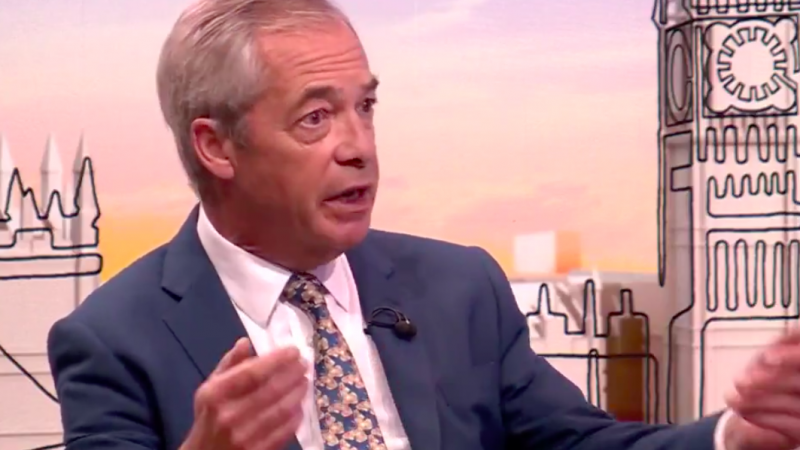
Farage believes he can be Britain's next prime minister
 - Copyright AFP Oli SCARFF

Joe JACKSON

Joanne Woodhouse and Henry Godwin live at opposite ends of England and used to sit on opposite sides of the political fence — until both decamped to Nigel Farage’s Reform UK party.

Woodhouse, a one-time Labour voter in northwest England, and Godwin, a former Tory (Conservative) based near London, were among those at the hard-right party’s annual conference Saturday, as it celebrated its surging popularity.

The middle-aged pair appeared typical examples of anti-immigration Reform’s ability to draw disaffected voters from both its right-wing Conservative rival and centre-left Labour, as it builds on an unprecedented performance in local elections in May.

“I want to see a big change,” Woodhouse, an independent local elected official in Merseyside who joined Reform two months ago, told AFP at the two-day event in Birmingham, central England.

The 57-year-old voted for Brexit in 2016 because she “wanted our borders to be closed” and backs Reform “to protect our community, our traditions”.

“I’m totally disappointed by Labour — disappointed by everything they are doing. People are struggling.”

Godwin, 52, a free speech advocate most concerned by perceived curbs on freedom of expression, signed up for Reform after Labour won power 14 months ago, following 14 years of Conservative rule.

“The Tories in my mind have completely lost their way… they’ve lost their conservativeness,” he said.

“So, as far as I’m concerned, there’s only one party to vote for, and that’s Reform.”


– ‘Vast disillusionment’ –


Reform’s growing appeal mirrors advances by far-right parties across Europe and US President Donald Trump’s “Make America Great Again” movement in the United States, but at breakneck speed.

Reform won 14 percent of the vote in the 2024 general election, netting it five MPs under Britain’s first-past-the-post election system, which has long suited the two established parties.

It has since trebled its membership to over 240,000, seized control of 12 local authorities across England in May and led in all national polls over recent months.

Late-August fieldwork by conservative pollster James Johnson unveiled at Reform’s conference showed it on 32 percent support, 10 points ahead of Prime Minister Keir Starmer’s Labour.

The surveys indicated immigration and patriotism were key to its appeal, with almost half of supporters classed as “pessimist patriots” — typically older, non-graduates who backed Brexit and oppose climate change mitigation policies.

They were uniformly downbeat about the country’s trajectory.

Crucially, according to Johnson, there are plenty more such voters still unclaimed by Reform ahead of the next election, not due until 2029.

“It’s very rare in politics to have… voters that you need to win looking a bit like your existing base — that’s a great place to be,” he told AFP.

“They’re flocking to Reform because they basically feel they have no other option,” he added, citing “vast disillusionment” and “vast lack of trust” in the long-established parties.

While acknowledging “four years of being a frontrunner is tough,” Johnson could see Reform attaining a 35 percent share of the vote at the next election.

“If they’re in a two-party system, that wouldn’t be enough. But they’re in a fractured system, and that will get them a stonking majority.”


– ‘Hope’ –


For many Reform converts, the appeal of ever-present Eurosceptic Farage, a longtime ally of Trump, appeared as important as key policy issues like immigration.

Amelia Randall, a Reform councillor in Kent, southeast England, where the party won control four months ago, believed Farage had “a very good chance to be the next prime minister”.

“The spirit is rising a lot inside the party,” she told AFP as its leader addressed the conference Friday.

Like Johnson’s research, new polling by More in Common found the party’s base was becoming increasingly mainstream, with the number of female Reform supporters fast catching up with men.

“He’s giving us hope,” retiree Karen Dixon told AFP of Farage.

She became a party member nine months ago after growing up in a Labour-voting family and later siding with the Conservatives.

“I didn’t want to vote anymore,” she said.

Some younger voters also appeared attracted by Reform, though not yet in the numbers Labour typically draws, according to pollsters.

“He definitely shows leadership, that’s what I’m getting,” student Marcus Ware said after becoming a “young member” and turning up to hear Farage speak.

“I don’t see why young people can’t be interested in this.”

He said he liked Reform’s low-tax message, though noted concerns that its tax-and-spend numbers at the last election did not “add up”.

He dismissed criticism that the party’s hard-right agenda was divisive.

“The label of being divisive and too extreme is very subjective,” he said.


Nigel Farage branded a ‘Trump sycophant’ and ‘fringe party leader’ during US congress visit

4 September, 2025 
Left Foot Forward 


Farage was grilled on his support for MAGA and why ReformUK bans journalists from its events
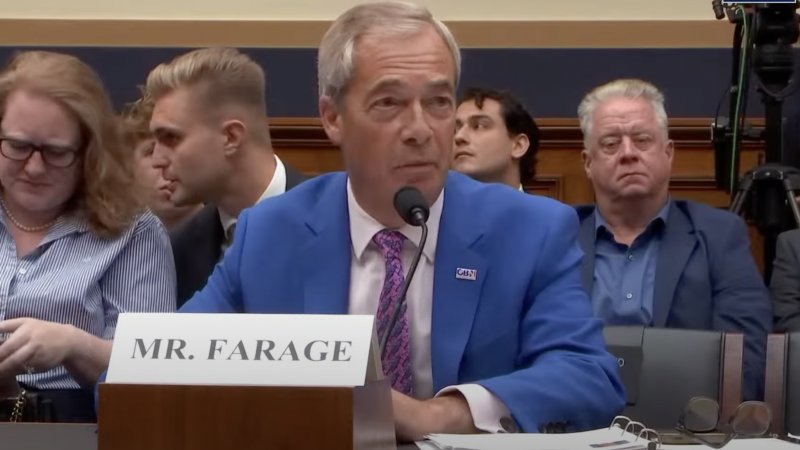


Nigel Farage was grilled by Democrat politicians over his support for Donald Trump and Reform’s banning of journalists during a visit to the US Congress yesterday.

Farage skipped PMQs to give evidence on freedom of speech at the US House Judiciary Committee.

Democratic representative Hank Johnson questioned Farage on his regular appearances at Make America Great Again (MAGA) rallies, accusing him of trying to “ingratiate himself” with tech billionaires so he can become prime minister.

The congressman asked Farage to confirm his party has four MPs. Johnson then said: “So you are indeed the leader of a fringe party. As a fringe party leader seeking to run for prime minister of Great Britain, you need a lot of money in order to blow up like the Maga (Make America Great Again) movement has blown up.”

“You need money from Elon Musk in order to get elected prime minister of Great Britain, that’s the bottom line,” he added.

He also said to Farage: “You’re trying to ingratiate yourself with the tech bros by coming over here.”

Johnson also accused Farage of advocating for the UK to pay tariffs if tech companies are not allowed to violate British laws.

Farage called the Online Safety Act “a danger” to trade between the US and the UK and said he hoped American companies and politicians have honest conversations with the British government about the legislation. He said he has not suggested sanctions.

Congressman Jamie Raskin asked Farage why Reform bans journalists who oppose his party’s views. Farage claimed “I am the most open person to any journalist”.

“Undoubtedly, you’re the most handsome person in the world, but that’s not my question. My question is why do you ban journalists you disagree with from your political events, like from your convention?,” Raskin added.

Farage denied any recollection of having banned media organisations from Reform conference or other events. “If I go back the last 25 years, I can’t think of banning anybody. But I mean, maybe somebody else did,” he said.

Last September, Byline Times and investigative climate outlet were banned from attending Reform conference, as well as ex-Guardian journalist Carole Cadwalladr.

In a statement to the British public, Raskin said: “To the people of the UK who think this Putin-loving free speech impostor and Trump sycophant will protect freedom in this country: come on over to America and see what Trump and Maga are doing to destroy our freedom […] and turn the government into a money-making machine for Trump and his family. You might … think twice before you let Mr Farage make Britain great again.”

Olivia Barber is a reporter at Left Foot Forward

US congressman shows UK media how to expose Nigel Farage for his hypocrisy and love of autocrats


4 September, 2025 

One can only dream of sections of the right-wing press in the UK holding Farage to account in the same way.
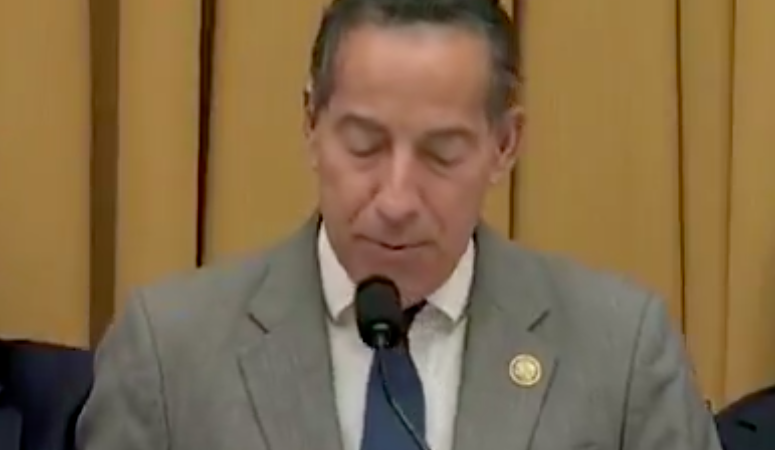


A US congressman is being praised for taking apart Nigel Farage is a blistering speech, in which he highlighted the Reform UK leader’s hypocrisy over free speech and his cosying up to dictators and autocrats.

Rather than return to Parliament after the summer recess, Farage decided to once more jet off to the U.S. where he not only rubbed shoulders with Trump loyalists but also to attend a Congressional inquiry into freedom of speech, where he falsely claimed that freedom of speech is under attack in the UK.

As part of evidence given to the House of Representatives Judiciary Committee, Farage said: “On the question of civil liberties, Britain has, unfortunately, now lost her way.

“I will do my part, as a participant in UK democracy, to help our country find its way back to the traditional freedoms which have long bound together our two countries in friendship.”

However, one Congressman was having none of it. Jamie Raskin, the U.S. representative for Maryland’s 8th congressional district since 2017, slammed Farage as a “Putin-loving free speech imposter”.

In a blistering speech, Mr Raskin said: “To the people of the UK who think this Putin-loving free speech imposter and Trump sycophant will protect freedom in your country, come on over to America and see what Trump and Maga are doing to destroy our freedom … You might think twice before you let Mr Farage ‘make Britain great again’.”

He also told Farage there is ‘no free speech crisis in Britain’, and added: “UK Prime Minister Keir Starmer has not shutdown GB News where Mr Farage has his own show, just because Mr Farage has used his airtime to call for banning peaceful protests that he disagrees with, no one has stopped him from going on Russian TV, 17 times and saying that the one world political leader he most admired is Vladimir Putin, even though Putin is a war criminal and dictator.”

One can only dream of sections of the right-wing press in the UK holding Farage to account in the same way. Indeed, in just over two minutes, a US congressman has done more to expose Nigel Farage’s hypocrisy on free speech and his love of autocrats and dictators like Putin, than sections of the press in the UK have for decades.

British-American journalist and commentator Mehdi Hasan posted on X: “I have spent years saying I wished the US were more like the UK when it comes to tough interviews, but here’s a turning of the tables: @jamie_raskin grilling @Nigel_Farage in a way the UK media rarely does.”

Basit Mahmood is editor of Left Foot Forward

Nigel Farage skips Parliament to go to hard-right US conference but misses speaking slot


Olivia Barber 
3 September, 2025 
Left Foot Forward 

Farage arrived in Washington DC too late to speak


Nigel Farage skipped the start of the first week back in Parliament to attend a hard-right conference in the US, only to miss his speaking slot due to “transport issues”.

Farage was supposed to give a speech at the National Conservatism conference yesterday, but was a no show due to arriving in Washington DC too late.

According to The Mirror, Farage was scheduled to speak about “getting mass deportations done”, alongside Donald Trump’s Director of National Intelligence Tusli Gabbard and his former advisor Steve Bannon.

The ex-MP for Clacton and co-founder of Vote Leave, Douglas Carswell, who now lives in the US, was present at the hard-right event.

Hedge fund manager and Republican donor Tom Klingenstein filled in for Farage, giving a speech about “white guilt”, which he argued was “the problem of our time”.

Today, Farage will miss PMQs to give evidence at the US Congress’ Judiciary Committee, as part of its investigation into “Europe’s threat to American Speech and Innovation”.

The Reform leader is expected to speak to the committee about the case of Lucy Connolly, who was jailed after pleading guilty to inciting racial hatred against asylum seekers, as evidence of supposed threats to freedom of expression in the UK.

Connolly called for hotels housing asylum seekers to be set on fire.

Farage also said he will speak about Graham Linehan, who was arrested yesterday on suspicion of inciting violence on social media, after sharing his views on trans rights.

While Farage speaks about the importance of free speech in the US, back in the UK a Reform-led council has banned journalists from reporting on its activities.

Deputy leader of Reform Richard Tice and Lee Anderson have spoken in support of Nottinghamshire County Council’s decision.

Olivia Barber is a reporter at Left Foot Forward


Nigel Farage goes to America to complain about a lack of free speech in UK, while Reform bans journalists at home
3 September, 2025 


So much for Reform’s tolerance of free speech.


TweetShareWhatsAppMail


You couldn’t make it up! Nigel Farage is once more being accused of breathtaking hypocrisy, after he jetted off to the U.S. once again, missing the opening of Parliament, to complain about a ‘lack of free speech’ in the UK, while his own party bans journalists at home.

As well as speaking alongside Trump loyalists, Farage will also attend a Congress inquiry into freedom of speech, where he will falsely claim that freedom of speech is under attack in the UK. He is expected to raise the case of Lucy Connolly, the Tory councillor jailed for a tweet calling for asylum hotels to be set on fire, as an example of how free speech is being hampered in the UK.


Of course, it doesn’t matter to Farage that Connolly was jailed after pleading guilty to inciting racial hatred.

As part of evidence given to the House of Representatives Judiciary Committee, Farage said: “On the question of civil liberties, Britain has, unfortunately, now lost her way.

“I will do my part, as a participant in UK democracy, to help our country find its way back to the traditional freedoms which have long bound together our two countries in friendship.”

However, Farage’s hypocrisy really is quite something, especially since Reform’s own politicians in the UK are banning journalists from speaking to them.

Last week, a Reform UK council leader’s decision to ban his councillors from engaging with a prominent local newspaper just because he didn’t like what was reported was slammed as a “massive attack on local democracy”.

Nottinghamshire county council, which is run by Reform, said it would no longer deal with the Nottingham Post, its online edition and a team of BBC-funded local democracy journalists that it manages, after they didn’t like a story about plans for a local government restructure.


So much for Reform’s tolerance of free speech.

Basit Mahmood is editor of Left Foot Forward


Australian state halts logging for koala haven


By AFP
September 6, 2025


The koala population in Australia's eastern state of New South Wales is threatened with extinction, environmentalists say - Copyright AFP DAVID GRAY

Australia’s eastern state of New South Wales halted logging in a large stretch of woodland Sunday to create a retreat for koalas and save the local population from extinction.

The state government imposed a ban effective from Monday on logging across 176,000 hectares (435,000 acres) of forest on the north coast for a Great Koala National Park, hitting six timber mills and about 300 workers.

Without action, it warned that koalas in Australia’s most populous state could die off by 2050.

Environmentalists say koala numbers in New South Wales have suffered a dramatic decline in recent decades due to deforestation, drought and bushfires.

“Koalas are at risk of extinction in the wild in NSW — that’s unthinkable. The Great Koala National Park is about turning that around,” said New South Wales Premier Chris Minns.

“We’ve listened carefully and we’re making sure workers, businesses and communities are supported every step of the way.”

State officials contacted each affected mill, the government said in a statement, vowing to provide payments to cover workers’ salaries and business costs while offering free access to training, financial, health and legal services.

The state government first announced the planned koala haven in 2023 but it only stopped logging in 8,400 hectares of forest. The plan was also criticised for not protecting trees immediately.

– Gliding marsupials –

The Great Koala National Park will provide a refuge to more than 12,000 koalas, 36,000 greater gliders — nocturnal marsupials with a membrane that lets them glide — and more than 100 other threatened species, officials said.

The government said it would invest Aus$6 million (US$4 million) to support new tourism and small business opportunities in the area.

It also boosted funding to create the park by Aus$60 million — in addition to Aus$80 million announced in 2023.

“This park will ensure future generations will be able to see koalas, greater gliders and other threatened species in the wild for many years to come,” said Gary Dunnett, chief executive of the state’s National Parks Association.

“The permanent protection of this magnificent area will also safeguard critical water catchments for the people of the Coffs Coast, protect sacred Indigenous sites and open up huge economic opportunities for regional green tourism. It is truly a win-win for the people of NSW and nature.”

When connected with existing national parks, the koala haven would create a 476,000-hectare reserve, the state government said.

Final creation of the koala park will depend on it being registered by the federal government as a carbon project for improved management of native forest, the state said. That assessment was underway.
‘Build, baby, build’: Canada PM’s plan to counter Trump


By AFP
September 6, 2025


Copyright Trans Mountain Corporation/AFP Handout


Geneviève NORMAND

On the night he won Canada’s election, Prime Minister Mark Carney summarized his plan to jumpstart the country’s economy in response to President Donald Trump’s threats.

“Build, baby, build!” Carney told a jubilant crowd of Liberal party supporters in April.

In the early weeks of his first term, Carney’s plans to build have taken shape, headlined by the new “Major Projects Office”, launched last month to spearhead the construction of ports, highways, mines and perhaps a new oil pipeline — a contentious subject for groups concerned about the environment.

The office, which is expected to announce its priorities in the coming days, was formed after Carney’s Liberals secured cross-party support to pass legislation empowering his government to fast-track “nation-building projects.”

“We are moving at a speed not seen in generations,” Carney said, a level of urgency he argues is required as Trump reshapes the global economy.

Trump’s threats to annex Canada have eased, but his trade war is hurting the Canadian economy.

US tariffs on autos, steel and aluminum have squeezed the three crucial sectors and led to job losses.

The unemployment rate hit 7.1 percent in August, the highest level since 2016 outside of the pandemic.

That “adds to evidence that the trade war is taking its toll on Canadian labor markets,” RBC senior economist Claire Fan said this week.


– ‘Economy in peril’ –


Since entering politics earlier this year, Carney has insisted Canada needs to break its decades-long reliance on US trade by revitalizing internal commerce while pursuing new markets in Europe and Asia.

During a visit to Germany last month, Carney said his government was “unleashing half a trillion dollars of investment” in infrastructure for energy, ports and other sectors.

Jay Khosla, an energy expert at the Public Policy Forum, said the momentum to build would not have been possible without Trump.

“We know our economy is in peril,” he said, noting Canada was effectively “captured economically,” because of its closeness to the United States.


– ‘Energy superpower’? –


Canada is the world’s fourth largest oil exporter and its crude reserves are the world’s third largest.

Most of its resources are in the western province of Alberta, which exports almost exclusively to the United States, as Canada lacks the infrastructure to efficiently get energy products to other foreign markets.

Former prime minister Justin Trudeau, Carney’s predecessor, put climate change at the center of his political brand and faced criticism from some over his perceived lack of support for the energy sector.

In a shift from the Trudeau era, Carney’s Liberals now support exporting liquefied natural gas (LNG) to Europe.

“What we heard loud and clear from German LNG buyers and LNG users is they believe there is demand and they want to buy our products” Energy Minister Tim Hodgson said in Berlin las

But not everyone is enthusiastic about that plan.


Greenpeace has accused the prime minister of backing “climate-wrecking infrastructure” while ignoring clean energy.

Carney could likely press ahead despite concerns from pro-climate NGOs, but support from Indigenous leaders — for whom safeguarding the environment is top priority — is seen as essential.

Despite Carney’s efforts to secure Indigenous backing for his major projects push, their concern persists.

“We know how it feels to have Trump at our border. Let’s not do that and have Trump-like policies,” said Cindy Woodhouse, the national chief of the Assembly of First Nations, in a swipe at Carney’s backing for energy infrastructure.

“Let’s take the time and do things properly.”
Salmon are being harmed by pharmaceutical pollution


Pharmaceutical pollutants are an emerging global issue


By Dr. Tim Sandle
EDITOR AT LARGE SCIENCE
DIGITAL JOURNAL
September 6, 2025


Salmon like these are dying prematurely at fish farms in Norway - Copyright AFP BAY ISMOYO

With pharmaceutical waste, the goal is maintaining safety, environmental responsibility, and legal compliance.

Despite some technological advances and greater adherence to regulations, pharmaceutical waste remains an environmental concern. In many parts of the world, water entering the streams from wastewater treatment plants that are designed to break down pharmaceutical manufacturing waste contains concentrations of pharmaceuticals between multiple times higher than water released into the environment from standard utility plants.

Pharmaceutical waste includes antimicrobials (fuelling antimicrobial resistance among pathogenic species of bacteria), muscle relaxants, and opioids.

As well as environmental pollution, there are concerns about pharmaceuticals that are not processed but instead enter into illegal markets. Many nations have regulations designed to prevent this, such as the US Drug Enforcement Administration (DEA), which requires all controlled substances to be destroyed in a way that renders them “non-retrievable”; however, this does not entirely prevent theft and illegal trading.

Clobazam pollution


In terms of environmental impact, a recent study conducted in Sweden demonstrates the risks. Research reveals commonly detected environmental levels of clobazam — a medication often prescribed for sleep disorders — increased the river-to-sea migration success of juvenile salmon in the wild.

Salmon pens belonging to the Tassal company located off Charlotte Cove, in the d’Entrecasteaux Channel in Tasmania. – Copyright AFP Gregory PLESSE

In addition, traces of the drug shortened the time it took for juvenile salmon to navigate through two hydropower dams along their migration route — obstacles that typically hinder successful migration.

Clobazam is used for its anxiolytic effect and as an adjunctive therapy in epilepsy. The drug is a type of benzodiazepine, a class of central nervous system depressant medications. Clobazam has two major metabolites: N-desmethylclobazam and 4′-hydroxyclobazam, the former of which is active.

The scientists from the Swedish University of Agricultural Sciences employed slow-release pharmaceutical implants and animal-tracking transmitters to monitor how exposure to clobazam and the opioid painkiller tramadol — another common pharmaceutical pollutant — affected the behaviour and migration of juvenile Atlantic salmon (Salmo salar) in Sweden’s River Dal as they migrated to the Baltic Sea.

Atlantic salmon are the largest species in the genus Salmo. After two years at sea, the fish average 71 to 76 cm (28 to 30 in) in length and 3.6 to 5.4 kg (7.9 to 11.9 lb) in weight.

This is significant because any change to the natural behaviour and ecology of a species is expected to have broader negative consequences both for that species and the surrounding wildlife community.

While the recent decline of Atlantic salmon is primarily attributed to overfishing, habitat loss, and fragmentation — leading to their endangered status — the study highlights how pharmaceutical pollution could also influence key life-history events in migratory fish.

Pharmaceutical pollutants are an emerging global issue


Commenting on the research, Dr Marcus Michelangeli from Griffith University’s Australian Rivers Institute states: “Pharmaceutical pollutants are an emerging global issue, with over 900 different substances having now been detected in waterways around the world. Of particular concern are psychoactive substances like antidepressants and pain medications, which can significantly interfere with wildlife brain function and behaviour.”

By designing drugs that break down more rapidly or become less harmful after use, pharmaceutical companies can improve and significantly mitigate the environmental impact of pharmaceutical pollution.

The research appears in the journal Science, titled “Pharmaceutical pollution influences river-to-sea migration in Atlantic salmon (Salmo salar)”.
REST IN POWER
Rosa Roisinblit, activist for Argentina’s ‘stolen’ children, dies at 106

By AFP
September 6, 2025


Rosa Tarlovsky de Roisinblit photographed at her home in Buenos Aires on July 20, 2016 - Copyright AFP/File JUAN MABROMATA

Rosa Tarlovsky de Roisinblit, a prominent activist for victims of Argentina’s 1976-1983 dictatorship, died Saturday, her organization said. She was 106.

“We only have words of gratitude for her dedication, her solidarity and the love with which she searched for the grandsons and granddaughters until the very end,” the Grandmothers of the Plaza de Mayo campaign group said in a statement.

Roisinblit was born in 1919 in Moises Ville, a town of Jewish immigrants in central Argentina, and was an obstetrician by trade.

Alongside other mothers whose family members disappeared during Argentina’s dictatorship, Roisinblit demanded to know the whereabouts of her missing relatives.

Her pregnant daughter Patricia Roisinblit and son-in-law — both militants of the armed Peronist group Montoneros — were kidnapped in 1978.

Patricia is believed to have given birth in a basement before the baby was taken from her. She and her husband’s bodies were never found.

More than 20 years later, in 2000, Roisinblit was reunited with her grandson Guillermo through her activist organization.

He was among 140 people that the Grandmothers group has reunited with their families.

Roisinblit also fought for decades to see the military personnel involved in her daughter’s kidnapping brought to justice.

In 2016, she was in the courtroom when two former air force commanders and an ex-intelligence officer were sentenced to prison on charges of kidnapping and torture.

“The pain is still there, this wound never heals… But to say I’m stopping? No, I’ll never stop,” she told AFP at the time, at the age of 97.

Campaigners say 30,000 people were victims of forced “disappearances” under Argentina’s military dictatorship.

Roisinblit’s group says there are 300 “stolen grandchildren” — born in captivity or kidnapped with their parents — yet to be found.

“We fight but the heroes are our children who rose up against a fierce dictatorship and gave their lives for a better country,” she told AFP in 2016.

How a Century of Anti-Communism Cleared the Way for Trump’s Authoritarianism

This trope has long been used to justify repression of anarchists, communists, liberals, immigrants, and unions.


September 3, 2025

Listening to the incendiary rhetoric emanating from Trump and MAGA world, one would think the United States of today, decades after the collapse of the communist bloc, was enmeshed in an existential struggle against communism. Even before his election win in 2024, Trump claimed his opponents’ economic policies were at the extremes of leftism. Kamala Harris, he said, had gone “full communist.” With Trump setting the tone — and now ensconced in the White House — his minions have amplified that rhetoric as a way of justifying their repressive onslaught. For example, Homeland Security Director, and anti-immigrant stormtrooper, Kristi Noem told the press in July that liberals “are actually turning out to be a bunch of communists and Marxists.” In like fashion, Trump’s Deputy Chief of Staff Steven Miller — speaking in Washington’s Union Station after the military was dispatched to that city, proclaimed, “We’re not going to let the communists destroy a great American city.” The tenor and tone of all this show no signs of abating, as the fascistic moves and raw assertion of power continues.

That the trope of anti-communism is being invoked and retains such power, is in no small measure a testament to the legacy of the anti-communist initiatives of the 20th century. This writer’s forthcoming book, Menace of Our Time: The Long War Against American Communism, takes a deeper dive into that history. Given the moment we find ourselves in, it is worth exploring some.
Beginnings

In 1901, President William McKinley was assassinated at the Pan-American Exposition in Buffalo, New York. What followed was a wave of repression in which his assassin, an erstwhile anarchist named Leon Czolgosz, was tried and executed, all within two months of the shooting. In the aftermath, New York State passed a law proscribing what it called “criminal anarchy,” making it a felony to advocate — not plan for, let alone move to carry out — revolution. The law would serve as a major weapon against organized leftists, specifically communists, who emerged in the early years of the 20th century.

Fast-forward 18 years, and an anarchist bombing at the home of U.S. Attorney General A. Mitchell Palmer triggered the Palmer Raids, a key chapter of what would come to be called the First Red Scare — a government roundup of thousands of anarchists and communists, hundreds of whom would be deported. Arrested in this period and prosecuted under the criminal anarchy law was the then-communist Benjamin Gitlow, convicted and imprisoned for publishing a document called The Left-Wing Manifesto. The conviction, appealed all the way to the Supreme Court, was upheld. As the court wrote in its opinion, “It cannot be said that the State is acting arbitrarily or unreasonably when, in the exercise of its judgment as to the measures necessary to protect the public peace and safety, it seeks to extinguish the spark without waiting until it has enkindled the flame or blazed into the conflagration.” This principle of anti-advocacy — a fundamental negation of the First Amendment — would remain the law of the land for decades. It would also be a major instrument leveled against domestic communists.

This period also saw the rise of a young up-and-comer in the U.S. Justice Department: J. Edgar Hoover. Hoover, who was modernizing the Bureau of Investigation (later the Federal Bureau of Investigation), created a filing system of anarchists and communists that would be a cornerstone of the FBI’s work going forward. The bureau also deployed government informants who gathered intelligence, facilitated raids, and spread insidious rumors about the loyalty of dedicated comrades. It was a methodological template that would come to serve the FBI well.

Related Story

The Red Scare Overlapped With Another State-Sanctioned Panic: The Black Scare
Rooted in white people’s fear of Black Nationalism, the Black Scare was conjoined with the anti-communist Red Scare. By Charisse Burden-Stelly 
UniversityofChicagoPress/TruthoutFebruary 2, 2024

While the fallout from the Palmer Raids subsided by the mid-1920s, the communists, who would cohere into the Communist Party USA (CPUSA or CP), would become the preeminent target of the FBI and other anti-communist forces. In doing so, it confronted the repressive bite of not only the bureau, but also the anti-syndicalism and criminal anarchy laws that had been passed in nearly every state in the U.S. — to say nothing of the routine harassment by right-wing forces and local police.
Depression and World War

Such was the situation as the country entered the Great Depression. It was during this time that rank-and-file communists and their supporters fought for unions, the unemployed, and opposed lynchings and the larger Jim Crow system. In doing so, they confronted unceasing pushback — firings, violent attacks on their meetings, arrests on the picket lines, beatings by police, and even killings. All of this was facilitated by a media sounding a hyperbolic alarm against a communist menace.

That alarm would grow shriller as the country approached World War II. The communists, whose initial anti-war position was at cross purposes with the administration of Franklin Delano Roosevelt, were targeted by early predecessors of the House Committee on Un-American Activities. They also saw their leader, Earl Browder, imprisoned for traveling under a false passport. At the same time, new anti-communist laws were enacted: the Voorhis Act, requiring the registration of agents of a foreign power (i.e., the CP); the Hatch Act, proscribing communists in government; and the Smith Act against teaching the principles of revolution. It was also during this time that Roosevelt bestowed extraordinary powers on the FBI to target domestic communism. That led to measures such as the creation of a custodial detention list — essentially a concentration camp scheme to round up communists if an emergency order was given. When the communists abandoned their anti-war position with the Nazi invasion of the Soviet Union, the repression abated — though hardly ended. It was a circumstance that would not last.
Dangerous Public Opinion

With the onset of the Cold War, the government undertook its most aggressive wave of anti-communist repression ever, imprisoning or holding under indictment dozens of the party’s top leaders by way of the Smith Act. This formal repression also fostered a social climate where communists became pariahs of the first order.

An indication of how deeply anti-communist sentiment penetrated the public consciousness could be seen in a 1954 poll by the Opinion Research Corporation. When asked if congressional committees hurt innocent people, 49 percent of the respondents said yes. Then, when asked if innocent people could be hurt in the process, 58 percent said, hurt or not, it was more important to uncover communists. The vast majority of Americans also said that communists should be stripped of citizenship, that the government should be allowed to tap their phones, and that it was a good idea “for people to report to the FBI any neighbors or acquaintances whom they suspected of being communists.” That this repression garnered such support — despite the modest actual influence of U.S. communists — was an example of how a negative consensus could be built through unrelenting demagoguery. In the fifties and to a lesser degree in the sixties, it was communism; in the eighties and nineties, it was terrorism, in the wake of 9/11 it was Islam, first Al Qaeda, then ISIS, and now again it is “the communists” and “the woke left.” The names may have changed, but the methodology has not.

A Vicious COINTELPRO

While the fever pitch of the Second Red Scare would lessen as the fifties gave way to the sixties, the pursuit of the CP did not. This era witnessed the initiation of the FBI’s Counterintelligence Program (COINTELPRO) aimed at the CPUSA, the first and most extensive in this notorious disruption effort.

One example can offer insight into the program’s myriad operations: the case of Aaron Libson, a closeted gay man and communist activist living in Philadelphia. In 1966, Libson was arrested by undercover police in a “tearoom” — a restroom in a public park used for gay encounters — on a sodomy charge. When the FBI, who knew Libson was a communist, learned of the arrest, they snapped into action with a COINTELPRO operation. As an FBI memorialized, the point was to “neutralize Libson with the party and embarrass the party generally.” To achieve this, they anonymously called James Dolsen, the head of the Philadelphia CP, as well as one of their press contacts “who has been used quite successfully in the Counterintelligence Program and has always protected the Bureau’s interests.”

Libson describes what followed:

“When I had the arrest, I pleaded nolo contendere — I do not wish to contend — on a Friday. The next day, Saturday, I woke up and got ready for work, and as I looked at the paper that morning, there was a small article saying, ‘Local Red arrested.’ I had a suicide plan ready just in case it came out, so I thought, OK, this is it and I carried out the plan. … I wasn’t going to do anything at my house where my family would find me, so I rented a room at the Arch Street YMCA. I’d packed some of the crystal stuff you clean toilets in some tin foil, and I swallowed that and laid down and waited for something to happen. Nothing happened. In the interim, I’d called a friend of mine. While I was waiting for something to happen with the poison, I got up and sat on the window ledge — the room was on the fifth floor. As I realized the poison wasn’t working.”

Fortunately, the friend stopped things from going further. For its part, the Bureau counted this as a victory. As the noted in a memo detailing various COINTELPRO operations, “After Libson entered a guilty plea in February 1967, the fact was published in a newspaper, Daniel Rubin, National Organizational Secretary, stated Libson was dropped from the CP.”

While COINTELPRO officially came to an end after being exposed in the early 1970s, the surveillance and attention to the CP did not. In 1978 Congress established the Foreign Intelligence Surveillance Court which allowed for the legal wiretapping of those the US considered foreign agents, which included the pro-Soviet, CPUSA. The Bureau also kept in place its informant Morris Childs, who was acting as CP General Secretary Gus Hall’s liaison with the Soviets — a paradoxical circumstance of the Bureau both facilitating the funding of the CP, something Child’s was responsible for, while also garnering precious intelligence — and then there was the FBI’s investigation of the Committee in Support of the People of El Salvador (CISPES) because of perceived communist infiltration. With the collapse of the USSR in 1991, the extraordinary attention to the CPUSA ended, if not the legal and extralegal measures against other perceived enemies.

Were all this a matter of the past, it would be bad enough, but this history has thrust itself into the present. The Alien Enemies Act of 1798, used against communists and anarchists during the Palmer Raids of 1920, was leveled in 2025 against Kilmar Abrego Garcia and Mahmoud Khalil. Trump has talked about stripping immigrant citizens of naturalization; meanwhile, the MAGA shock troops have set their sights on the political opposition. Elise Stefanik, the MAGA congresswoman from New York, has called New York City’s mayoral candidate Zohran Mamdani a “raging antisemite communist.” The methodology behind this is hardly concealed. Trump, while running for president in the summer of 2024, made this clear: “All we have to do is define our opponent as being a communist or a socialist or somebody who is going to destroy our country.”

While this effort has not been wholly successful, it is a significant problem that no small number of people are swayed by this. In that sense, knowing a little history can serve as a weapon.


This article is licensed under Creative Commons (CC BY-NC-ND 4.0), and you are free to share and republish under the terms of the license.

Aaron J. Leonardis an author and historian. His current book is Menace of Our Time: The Long War Against American Communism (Rutgers University Press).
Interview

Authoritarian Wave in US Shows Democracy’s Fragility, South African Scholar Says


The racist upswell in the US looks “clearer from the outside,” says South African philosopher Nuraan Davids.

September 6, 2025
Protesters face off with police outside of a federal building in downtown Los Angeles for an anti-Trump "No Kings Day" demonstration in a city that has been the focus of protests against Trump's immigration raids on June 14, 2025, in Los Angeles, California.
Spencer Platt / Getty Images

Donald Trump’s war on diversity, equity, and inclusion (DEI) is not only an attack on the importance of education as a space for cultivating critical thought — it is also a direct attack on Black people.

Trump’s attacks are buttressed by his commitment to an authoritarian playbook that wallows in weaponizing differences against the backdrop of creating historical myths — in this case about the supremacy of whiteness.

However, we mustn’t forget that DEI can also function insidiously as a form of appeasement and deception. In other words, hegemonic whiteness, well before Trump, has never ceased to exist within this country. As such, whiteness accommodates differences but maintains its normative power. Within the context of education, this means that the appearance of difference (think here of university and college brochures that are spattered with faces of color) can exist alongside the power of whiteness and its control over what counts as knowledge or over whose history matters. Hence, as philosopher Nuraan Davids argues, “diversity is seen as an appendage to a pre-existing ethos, which remains undisturbed by how things ‘ought to be.’”

Davids is professor of philosophy of education and the chair of the Department of Education Policy Studies in the Faculty of Education at Stellenbosch University. Her most recent publications include Academic Citizenship, Identity, Knowledge, and Vulnerability (2023); and Out of Place: An Autoethnography of Postcolonial Citizenship (2022). ​​In this exclusive interview, Davids radically critiques authoritarian control over what should be a democratically functioning U.S. educational system and lays bare the perfunctory dimensions of DEI that preserve whiteness as normative, bringing in unique insights from abroad. The interview that follows has been lightly edited for clarity and length.

George Yancy: Your work has been important in terms of critiquing the ways in which concepts like “diversity” and “inclusion” actually function to conceal the continuing existence of structures of power (say, white supremacy). My point here is not to exempt Trump and the right wing from critique as they eliminate DEI and replace it with the myth of a “post-racial” and “meritocratic” U.S. I am concerned that DEI was never radical enough to begin with. Talk about how you understand the ways in which DEI can parade as a political and academic good while systems of hegemonic power continue to operate in universities.

Related Story

Op-Ed |
Pete Hegseth Has Banned 3 of My Books From the US Naval Academy
Censorship is an act of cowardice and a direct refusal of the mirror I hold up to the US’s racist past and present. By George Yancy , Truthout May 18, 2025


Nuraan Davids: As much as DEI programs are needed in some instances, there are complexities and problems with DEI as a concept and program. Diversity is deployed as a collectivist and homogenous concept, inclusive of all differences, with scant regard for the differences within differences. In turn, inclusion exists in a dyadic relationship with exclusion; inclusion cannot be understood in the absence of exclusion. Both the concept and the idea of DEI programs are taken for granted, because most universities seem to think that the mere presence of these programs means that they are doing something. What the “something” is hardly matters, because the mere presence of policies and programs is deemed as a sufficient indicator of transformation (at least by those who design the policies and programs). Yet, in deliberately setting out to let some diversity in, others are inadvertently also kept out. This is because diversity is constructed as an anomaly, in need of management and regulation — incapable of naturally finding its place in the university. Instead, it can only be ushered in to a very low saturation point, because “too much” diversity will not only negate the need for DEI programs, but more importantly, also disturb the status quo.

The point is that DEI programs are not interested in diversifying university spaces; they are interested in letting in just enough diversity to create the impression of “doing something,” as a ready response to racism. I don’t believe that DEI programs have shifted beyond the strategic placement of certain bodies. I don’t think that most of these programs are accompanied by any conscious desire to unlearn certain patterns of behavior that have kept diversity at bay, or how to relearn how to be with others. Instead, diversity is seen as an appendage to a pre-existing ethos, which remains undisturbed by how things “ought to be.” So even when diverse bodies are let in, this is not a fully encompassing entry or participation. It’s a negotiation, underscored by an unarticulated code: “We’ve let you in, so be grateful.” The code reflects the agency of the “we,” so that the subjectivity of those “let in” are reminded of their “rightful” place.

Once in, diverse bodies know that to remain “let in,” they need to contain themselves: Don’t be too Black, too gay, or too Muslim; keep your way of life and living knowledge traditions to yourself. The moment diverse bodies renege on the unspoken code, by being too visible in their diversity — whether it’s in how they dress, speak, or by having a point of view — they and the knowledge they bring are viewed as a threat. So, there are a few questions worth asking: Have DEI programs made any difference in the thinking and functioning of higher education in the U.S.? Are DEI appointments or promotions privy to the same set of academic goods and freedom as those not burdened by a diverse marker? Is the knowledge carried by diverse identities conferred the same value as the golden standard embodied by white, male academics? The treatment of Nikole Hannah Jones, as just one example, suggests not.

Much can be said about Trump’s deeply troubling onslaught on education in the U.S., but it’s a mistake to think of Trump as a singular problem. The right-wing social imaginary is hardly as imaginary as we think. It’s thriving — whether in the U.S., in Modi’s India, or in the ruins of Gaza. If anything, it’s the liberal imaginary that’s buckling under the weight of its own pretense, which begins to explain why it has been so easy for Trump to upend the DEI programs and trample on the academic freedom of universities. The U.S. has been a democracy for a much longer period than my home, South Africa. It prides itself as the world’s greatest democracy, and every single one of its universities rides on that democracy and claims to be an inclusive space. Why does the need for DEI programs persist? Why has the very idea of DEI programs not jarred university leaders, managers, administrators, and academics into introspective reflections on their institutional cultures? If the U.S. and its universities are as liberal as they would like the rest of the world to think, then why, after two-and-a-half centuries, are they struggling to include diversity without the assistance of a program?

Like you, I certainly would not want to exempt Trump, but it just seems too easy to lump what is happening in the U.S. right now at the door of one individual. That door was opened for him — twice over — by most of the American people. And what he has done, as an elected president, is to stop the parade by being quite honest about the depth and strength of white normativity. And Trump has succeeded not only because of his own authoritarianism, but also because the majority of educational institutions in the U.S. still propagate white normativity. And until this normativity is confronted, unapologetically, diversity will continue to be relegated to the margins of programs, waiting to be let in.

As a critical scholar and teacher in South Africa, as someone who sees what is happening from a distance, what are some of the horrors that you see taking place within the U.S. in terms of the Trump/right-wing attack on education? As you know, higher education demonstrates patterns of discursive closure, where the space for what is unpopular (dare I say freedom of thought itself) is placed under erasure. How do you see this erasure (which I take to be one of these horrors) taking place in the U.S.?

Let me start by saying that things always look clearer from the outside, and it’s always easier to make certain judgments when the full horror of what is happening in the U.S. does not bear down on one’s daily life and work. So, I say the following with sensitivity: I am incredibly surprised that there has not been a harder pushback from universities — students, academics — to Trump’s authoritarianism. I think of the protests that have been sparked in response to the clampdown on immigrants or the reverberating voices of Black Lives Matter, a movement which encouraged young people in South Africa to call out racism in their schools on social media, leading to an outpouring of rage against the systemic racism within the some of the country’s most elite schools. So, I cannot understand why similar kinds of protests have not erupted to preserve the integrity of what it means to be a university.

What Trump and his administration are doing far exceeds curricula, or a systematic repeal of discourses on critical race theory, gender, or systemic inequality. As someone who has endured apartheid’s systemic dehumanization and violence, and who understands the weaponization of knowledge and language, I see the crisis in higher education as an epistemological one. The U.S. is witnessing and living the flaring of the colonialist project. For those who might dismiss this claim, it is important to understand that colonialism does not only occur through a foreign occupation or the prohibition of a state formation; rather, colonialism also lives in the othering and denigration of others, their way of life and thought. Trump is seeking to (re)-invoke the hegemonic narratives of America’s past by simultaneously erasing the lived experiences of racialized America. By prohibiting books deemed as “divisive,” he is not only shutting down epistemological pluralism, critical thinking, or academic freedom. He is also not only delegitimizing certain kinds of knowledge. He is also proscribing the rights of all Americans to access and engage with certain kinds of knowledge. Importantly, the crisis being created here is neither limited to educational sites, nor is it only an educational crisis. The spillover onto American society is direct and inevitable, with Trump being unequivocally clear about the kind of society he wishes not to create, but to restore.

When citizens/students are not open to the diversity of knowledge that informs the living traditions of a pluralist and multicultural society, then it means that they will neither know about epistemological pluralism, nor how to engage with it. It also means that whatever they know would have been gained from echo chambers, which might perpetuate stereotypes, biases and blatant mistruths, all of which contribute to a society of mistrust, fear, and antagonism. What Trump is effectively doing is halting the cultivation of a pluralist and multicultural society. He is saying that in the U.S., it is sufficient to only have knowledge of white normativity. Any knowledge that detracts from this must be stopped, so that young people do not learn about that which is disagreeable to white ideological norms.

In the U.S., we are witnessing an attack on the democratic life of universities, colleges, and schools. As someone who passionately writes about, teaches about, and fights for the democratizing of universities in South Africa, what critical interventions do you suggest to teachers and students here in the U.S. as we struggle with the attack on education?

I think it’s important to recognize that universities can never be sites of complacency of consensus. The very idea of a university is to recognize and cultivate spaces for competing truths, ideas, being, and acting. The university is fundamentally a place of struggle — open to different political and social imaginaries and interests, and cognizant of its role in society. Teaching and learning, therefore, are certainly not meant to bring about comfort. Teaching ought to be provocative, and geared toward inviting curiosity about this world, others, and what we bring to this world. What I am proposing is not a critical intervention; it’s a reasonable realization and expectation that with knowledge comes responsibility.

So, my suggestions are critical, yet modest, if one considers that what I am proposing should be a natural part of what it means to be a teacher, academic, or researcher in higher education. Academics and students alike need to reclaim their (academic) freedom. They should not wait for it to be given or returned; they should simply lay claim to it, demand it! I see the presumption of academic freedom as akin to Jacques Rancière’s contention: Equality is a presupposition, an initial axiom — or it is nothing. Without academic freedom, the university is nothing.

I am sure that there are individuals or groups that are and have always been pushing back against attempts of censorship and prohibition in the U.S. But these voices need to be amplified in carefully planned movements and protests. Students played an immensely powerful role in the struggle against South Africa’s apartheid. I would go as far as saying that without their contribution, South Africa’s liberation might have been further delayed. They were unwavering in their commitment to liberation, even at the expense of education, because they understood that even if educated, they would still be without freedom. Freedom to think, question, and to pursue different kinds of knowledge evokes a critical consciousness, which equips us to call out injustices, whether in our immediate midst or elsewhere. Freedom turns us toward others, so that we understand our interconnection. Without freedom, regardless of how educated we are, we can neither defend ourselves nor others. Notably, students’ voices have not subsided in South Africa’s democracy; they have learned that democracy must be held accountable to its own ideals, and hence movements such as “fees must fall” and “Rhodes must fall,” which evolved into a transnational call for the decolonization of universities.

Crucially, the repression and authoritarianism being imposed in America right now is not an American problem. Right-wing authoritarianism is a global scourge; Trump is one player, and America is one country. It is time for American academics and students to look outward beyond their national borders to contexts that have endured much worse than what Americans are experiencing. There are no shortages of oppressive and repressive battlegrounds. More importantly, there are no shortages of epistemic resistance and values. It is important, therefore, for universities to actively forge and to learn from transnational collaborations and alliances, but this would require a shift in the mindset of how knowledge from others is viewed.

Within the South African context, you have written about trust and mistrust within pedagogical spaces. Without conflating what happens within South African pedagogical spaces and U.S. pedagogical spaces, please discuss the important dynamics of trust and mistrust. I ask for this reason: In the U.S., students and teachers who might normally feel “safe” naming the reality of systemic racism and white privilege are faced with the possibilities of serious draconian backlash. Under conditions of a Trumpian neo-fascist regime, how should students and teachers think about trust and mistrust?

Issues of trust and mistrust cut across contexts and educational systems. As much as our world has changed, advanced, and deteriorated, human nature remains the same. Most of us attach a common value to what it means to be good; we share a common bond in what it means to act with civility and trust. As human beings, we are inherently social; we co-exist with others; we foster relationships based on mutual regard, inclusion, belonging, and safety from harm. To trust someone is not only to believe in who they are, what they say and do; it also includes a belief that those who are worthy of our trust will not harm us, or act in ways that compromise our well-being. When we trust someone, we make ourselves vulnerable. Just as we trust parents to have the best interests of their children at heart, we trust teachers to act in ways that will nurture the development and progress of the child.

So, what happens when the political climate prohibits the acknowledgement of racism and white privilege — effectively forcing teachers into propagating a false narrative? How do teachers conscientize students about the normative ways of the world and its systemic racism? I think in this climate, issues of trust and mistrust become heightened. The role of the teacher, therefore, is not only to guide students in what they can trust, but also in what they should mistrust. The prohibition of a language that calls out racism and white normativity demands a reimagined language in which trust is foregrounded as an ethical encounter, based on mutual regard, compassion, and care. Concomitantly, students should be conscientized to their subjectivity as citizens — that is, they need to be made aware that they are neither neutral observers of their own citizenship and society, nor passive recipients of knowledge. Instead, they have agency and, hence, have the capacity to actively participate in the kind of society they wish to live in. While it might no longer be permissible to speak about critical race theory, for example, it becomes more important to think critically and questioningly about the world. And this includes shifting students into understanding the importance of mistrust.

This is not a call for cynicism. Rather, on the one hand, this is an argument for making young people aware of the fragility of democracy. On the other hand, it is to teach them that in authoritarian contexts, the state does not trust its own citizens to think for themselves. Independent and critical thinking are viewed as threats, and hence must be suppressed, or worse, punished. In this context, mistrust becomes a necessary socio-political response.

The ethical role of the teacher is crucial in this regard — it is up to her to cultivate safe spaces in which students can learn from one another. As one pedagogical example, sharing stories offers a powerful medium through which to subvert white normativity as the only valid ways of knowing, as well as working against the colonial epistemic frame to subvert and recreate possibilities and spaces for resistance. Sharing stories also implies a shift in how teachers come into the presence of their teaching — specifically, by recognizing that students are not only recipients of knowledge; they are also carriers of knowledge. The pedagogical conscientization of young people, therefore, does not only have to come from the teacher. By proving herself as trustworthy, it is possible for the teacher to cultivate classrooms where students feel safe to share their stories, and hence, offer insights and experiences beyond the formal (regulated) curriculum.

This article is licensed under Creative Commons (CC BY-NC-ND 4.0), and you are free to share and republish under the terms of the license.


George Yancy
George Yancy is the Samuel Candler Dobbs professor of philosophy at Emory University and a Montgomery fellow at Dartmouth College. He is also the University of Pennsylvania’s inaugural fellow in the Provost’s Distinguished Faculty Fellowship Program (2019-2020 academic year). He is the author, editor and co-editor of over 25 books, including Black Bodies, White Gazes; Look, A White; Backlash: What Happens When We Talk Honestly about Racism in America; and Across Black Spaces: Essays and Interviews from an American Philosopher published by Rowman & Littlefield in 2020. His most recent books include a collection of critical interviews entitled, Until Our Lungs Give Out: Conversations on Race, Justice, and the Future (Rowman & Littlefield, 2023), and a coedited book (with philosopher Bill Bywater) entitled, In Sheep’s Clothing: The Idolatry of White Christian Nationalism (Roman & Littlefield, 2024).
Faculty Want Answers on University Supplying Equipment for “Alligator Alcatraz”


The disclosure intensified existing anger over the university’s police partnership with ICE and ongoing labor disputes.
September 3, 2025

A woman sits by a sign reading "No Human Is Illegal" during a protest as part of the Good Trouble Lives On national day of action against the Trump administration at Florida International University Green Library in Miami, Florida, on July 17, 2025.

This story was originally published at Prism.

Florida International University (FIU) is under fire from one of its own faculty members after news reports detailed that the school provided equipment to the Everglades immigration detention facility known as “Alligator Alcatraz.” The disclosure intensified existing anger over FIU’s police partnership with Immigration and Customs Enforcement (ICE) and ongoing labor disputes, fueling demands for transparency, higher pay, and accountability from administrators.

After Prism and NBC6 reported that FIU supplied an emergency operations trailer to the construction site at “Alligator Alcatraz,” university President Jeanette Nuñez confirmed in a recent NBC6 interview that the university did so at the state’s request, clarifying that the equipment is owned by the state’s Department of Emergency Management, the lead agency overseeing construction and operations of the facility.

“It is a state asset, let’s be clear,” Nuñez told anchor Jackie Nespral. “When the Department of Emergency Management requests a state asset, we have to provide it. We don’t opine, we don’t object. People want to make more out of it than what it was.”

The president was not asked about the implications for the workers who had to carry out the task. Those workers expressed concern when given the order, according to an FIU staff member who previously spoke to Prism on the condition of anonymity out of fear of retaliation. FIU has not responded to Prism’s request for comment.

Faculty leaders say Nuñez’s explanation does little to ease concerns that the university — long touted as a haven for immigrant students — is complicit in immigration enforcement.

Related Story

Organizers Call for Shutdown of Immigrant Jails as Trump Expands Incarceration
Despite public outrage, Trump is doubling down on deportation policies designed to incarcerate 100,000 immigrants. By Mike Ludwig , Truthout July 18, 2025


“FIUPD is ICE,” said Tania Cepero López, the president of the United Faculty of Florida (UFF-FIU) union, referring to the FIU Police Department. “The faculty are amazing, the students are wonderful, smart, and dedicated, and they deserve the best education in the world.”
FIU and ICE Relationship Deepens Fears on Campus

The equipment controversy comes on top of outrage over FIU’s finalized 287(g) agreement, which deputizes campus police as ICE agents. Nuñez defended the decision in the NBC6 interview, arguing that the agreement gives FIU more control.

“If ICE wants to come on campus, regardless of the agreement, they will come,” she said. “So they do have access to come into our campus. The police chief took the position, and I supported him, that he wanted to be in control [of] the situation from the get-go.”

Faculty remain unconvinced. Internal emails obtained by Prism show that the faculty union began pressing the administration in June for guidance on how faculty should respond if ICE enters classrooms in the coming school year. Only on Aug. 22 did the university provide a formal response: ICE can access public areas and enter classrooms with a warrant, consent, or exigent circumstances, and faculty should not obstruct ICE and notify FIUPD. The memo confirmed that FIUPD officers will inform faculty when acting as ICE agents, but stated that the university has “no plans to provide notifications” of ICE operations.

“The main priority right now is compliance, so that there’s no retaliation, so that we don’t lose funding, so that we don’t lose any more grants, so that we don’t lose courses in the curriculum,” Cepero López said of her impression of FIU administration’s motives. “There’s a lot of interference and a lot of oversight happening that, to me, is unprecedented.”

Cepero López added that the partnership with ICE is chilling both teaching and learning on campus. Faculty members, she said, are increasingly worried that under the new agreement, their syllabi, reading lists, and classroom discussions could become targets of political or police scrutiny.

The sense of fear is especially acute among international and undocumented students, according to Cepero López, many of whom have asked whether their classroom attendance could put them at risk if ICE officers entered a lecture hall or classroom. She said professors have reported receiving anxious questions from students regarding protocol around ICE and FIU police. Teachers themselves have been asking what they should do if an agent arrives during class and whether to continue teaching, ask for a warrant, or protect their students. Some students even fear returning to campus due to their immigration status, Cepero López said? .

The climate of uncertainty, Cepero López noted, is compounded by Florida’s broader restrictions on curriculum and diversity initiatives.

“Faculty are wondering, what’s the next thing that we’re going to be forced to do? What’s the next compliance item that we’re going to be forced to spend two hours working on instead of working on our research, instead of working on our lesson plans, instead of working on replying to student emails?” she said. “The morale is as low as I’ve ever seen it.”

Faculty say FIU’s collaboration with ICE undermines the very values that have defined the institution since its founding: diversity, inclusion, and international engagement. As Miami’s public research university, FIU has long recruited students and faculty from across Latin America and the Caribbean. Now, professors warn that that reputation is at risk.
Town Hall Invitation Denied

In an attempt to provide a space for administration to answer the community’s concerns, on Aug. 18, UFF-FIU formally invited FIU’s top leadership, including Núñez, Police Chief Alexander Casas, Provost Elizabeth Béjar, Board of Trustees Chair Carlos Duart, and General Counsel Ryan Kelley, to attend a community town hall. The union asked them to choose from three dates in September to discuss the ICE agreement, Duart’s business contracts tied to the detention camp, and FIU’s provision of state-owned assets.

“Our faculty, students, and community deserve a clear explanation of these institutional actions that affect our learning spaces and safety,” the union wrote in a letter.

Four days later, the administration declined. In a letter sent by Associate Vice President of Academic Affairs Barbara Manzano, the chief negotiator in ongoing contract negotiations between the university and the union, FIU leaders said attendance was “unnecessary.” Instead, they pointed to prior appearances at a Faculty Senate meeting in April, a town hall in May, and Núñez’s TV interviews.

“Please feel free to use this response at the forum, in lieu of our attendance,” Manzano wrote.

Faculty say the event, scheduled for Sept. 9, will proceed without FIU leadership.

“I told them we’re going to do the town hall with or without you,” Cepero López said.
Bargaining Battle Adds to Tensions

The disputes over ICE and FIU’s relationship are unfolding alongside contentious contract negotiations. Some faculty members say that FIU has refused to honor raises previously negotiated in a three-year contract, citing legislative funding shortfalls. Instead, administrators have offered one-time bonuses tied to performance evaluations, a substitute that faculty call both inadequate and demoralizing.

“We’re at that point where we are tired of being asked to do more with less, and we’re just not going to continue to do that anymore,” Cepero López said. “Good working conditions for faculty equal good working conditions for students equal good learning conditions for students.”

The rejected raises would have provided a 2 percent increase across the board and an additional 1.5 percent merit raise. The raises wouldn’t have kept pace with inflation and Miami’s skyrocketing housing market, Cepero López said, but they were still seen as a baseline commitment.

“FIU has a strong tradition of faculty and administration collaborating, and that’s what made FIU rise so quickly,” Cepero López said. “And for so long, we’ve done a lot with a lot less than other universities.”

Instead, FIU proposed bonuses as low as $1,500 for faculty whose performance reviews were “satisfactory” and $3,000 for those rated “outstanding.” Unlike raises, bonuses do not contribute to base pay, meaning that salaries remain stagnant year to year.

During the most recent bargaining session on Aug. 29, the administration presented a new counteroffer: a recurring raise of 1 percent to base salary or $1,000 (whichever is greater) for nine-month faculty, with the equivalent applied to 12-month faculty, alongside a tiered one-time merit bonus of $1,000 to $2,000 based on performance evaluations. To fund the recurring increase, FIU said it shifted $2.2 million in expenses for postdoctoral hires from recurring to nonrecurring dollars.

Faculty union leaders acknowledged the adjustment but noted that FIU remains the only preeminent public university in Florida that initially offered no recurring salary increase this year. Other universities, including the University of West Florida, which offered 4 percent merit-based raises for the second year in a row, have made more competitive offers. The union will reconvene with administrators in the coming week ahead of a ratification vote on Sept. 16 and 17.

The issue cuts to the heart of recruitment and retention. Faculty warn that without competitive salaries, FIU risks losing talent to other universities including those outside the state. Several faculty members noted that the administration has simultaneously expanded spending on compliance measures and visiting instructors? to cover ballooning freshman classes, while telling full-time faculty that there isn’t enough recurring money to honor their contracts.
Litigation Looms Over “Alligator Alcatraz”

While FIU faces growing unrest on campus, the detention center itself is under legal fire. On Aug. 21, U.S. District Judge Kathleen Williams issued a preliminary injunction halting construction, barring the admission of new detainees, and requiring operations to wind down within 60 days.

The lawsuit, brought by Friends of the Everglades, the Center for Biological Diversity, and the Miccosukee Tribe, argues that the facility violated the National Environmental Policy Act by proceeding without an environmental impact study. Litigation will continue even as the camp closes.

“This is a landmark victory for the Everglades and countless Americans who believe this imperiled wilderness should be protected, not exploited,” Eve Samples, executive director of Friends of the Everglades, said in a press release. “It sends a clear message that environmental laws must be respected by leaders at the highest levels of our government — and there are consequences for ignoring them.”

For the Miccosukee, whose homes and sacred grounds sit nearby, it was also a violation of sovereignty.

“Justice for us is people’s sovereign rights being respected on all levels,” said William “Popeye” Osceola, the secretary of the Miccosukee Tribe. “It reminds us that as much as the system is geared against us, there are still mechanisms we can engage with to fight for what we know is right, including our rights to this land. But it’s also a sovereignty issue.”

Osceola said the state and federal governments circumvented processes that the tribe has worked decades, if not centuries, to help establish. Those processes, he said, don’t just protect and benefit the tribe, but also other fellow citizens, including all Floridians, South Floridians, and any Americans visiting Big Cypress or the Everglades.

“Those who want this to happen are betting on people getting complaisant,” he said. “It’s no time to be complaisant.”

The university’s handling of these controversies mirrors a broader pattern critics say has defined the detention camp itself: decisions imposed from above without meaningful input from those most affected. For Miccosukee tribal members, who were excluded from consultation as construction encroached on their ancestral lands, that exclusion was a violation of sovereignty. For FIU faculty, it’s a breach of the university’s own stated mission of openness and inclusion, and highlights the stakes of the university’s entanglement in immigration enforcement.

“I don’t understand why they can’t communicate to us why this is happening and we have to hear from Jackie Nespral interviewing our president,” Cepero López said. “That’s not what accountability looks like.”

Prism is an independent and nonprofit newsroom led by journalists of color. We report from the ground up and at the intersections of injustice.

Alexandra Martinez is the senior news reporter at Prism. She is a Cuban-American writer based in Miami, Florida, with an interest in immigration, the economy, gender justice and the environment.


Facing Defunding, Indigenous Cultural Workers Say They Cannot Be Suppressed

The proposed elimination of the National Endowment for the Humanities threatens Indigenous libraries and arts programs.

By Marianne Dhenin ,
September 6, 2025

Jonathan Baca of Northern Colorado, center, dancing with other Native Americans during the 43rd Paumanauke Pow Wow at Tanner Park in Copiague, New York, on August 9, 2025.
J. Conrad Williams, Jr. / Newsday RM via Getty Images

The Trump administration’s efforts to reshape federal cultural institutions as part of a broader attack on what the president characterizes as “woke” or diversity, equity, and inclusion policies have left many Indigenous arts and culture institutions in a challenging position, according to leaders at those institutions as well as culture workers and advocates who spoke to Truthout.

Institutions offering Indigenous arts and culture programming, as well as those centering the histories and culture of other communities of color, are at disproportionate risk of being defunded and further marginalized under the administration’s policies. Faced with sweeping cuts to federal agencies that have historically supported cultural programming nationwide, these institutions are dipping into reserves, building new partnerships, turning to their communities for donations, and receiving added support from philanthropic organizations.

“At one level or another, we’re all impacted by this,” Estevan Rael-Galvez, executive director of Native Bound Unbound, told Truthout of his organization’s work and others in the field. Native Bound Unbound is a digital humanities project archiving histories of Indigenous slavery in the Western Hemisphere. Still, Rael-Galvez told Truthout, the Trump administration’s attack on cultural heritage programs “puts all the more fire in my belly to work towards recovering these histories.”

The Association of Tribal Archives, Libraries and Museums (ATALM) called the proposed elimination of the National Endowment for the Humanities (NEH) and the Institute of Museum and Library Services (IMLS) a threat to the future of Indigenous archives, libraries, museums, cultural centers, historic preservation offices, and language programs in the U.S. in April 2025.

Donald Trump ordered the elimination of IMLS’s non-statutory functions and the reduction of its statutory functions and personnel to the furthest extent possible under the law in a March 2025 executive order on “The Reduction of the Federal Bureaucracy.” The following month, the so-called “Department of Government Efficiency” terminated tens of millions in grant funding from NEH, which provides funding to thousands of groups nationwide, including museums, historic sites, archives, and libraries.

At the time, NEH said it was “repurposing its funding allocations in a new direction in furtherance of the President’s agenda.” Shortly after, the agency clarified that it would not support projects promoting what it called “extreme ideologies based upon race or gender.” When NEH announced a new funding round in August 2025, ATALM noted that seemingly none of the grantees’ projects “incorporates a Native perspective or benefits Native communities.” Instead, the new grant awards mostly fund projects dedicated to former presidents and statesmen, as well as the nation’s founding documents.

The National Endowment for the Arts (NEA) also terminated grants en masse in May 2025, and the Corporation for Public Broadcasting (CPB) announced in August 2025 that it would cease operations after House Republicans voted to strip $1.1 billion in funding from the 57-year-old corporation over two years. Lawsuits have since resulted in the return of some terminated grant funding.

Rebekah Crisanta de Ybarra, a Minnesota-based Indigenous artist and cultural extension officer for the Maya Lenca Nation, has seen the effects of lost funding up close. Layoffs at the Science Museum of Minnesota in St. Paul, due to state and federal budget cuts, have left the future of Indigenous programming at the institution uncertain, including an intertribal roundtable that Crisanta de Ybarra co-chairs.

An event in California at which Crisanta de Ybarra was scheduled to present earlier this year was postponed indefinitely after federal funding was withdrawn. “That would have been a really important opportunity for especially Latin American Indigenous refugee communities to get together and talk about the nuances of rematriation,” she told Truthout. Rematriation refers to the restoration of relationships between Indigenous peoples and their lands and cultural artifacts, including the return of objects and collections.

“Without being able to transmit our traditional knowledge and oral histories … it feels like we’re at the end of a long genocide.”

“Without being able to transmit our traditional knowledge and oral histories, unfortunately, it feels like we’re at the end of a long genocide, where we still have such a valuable treasure of rich cultural heritage, but we’re not able to get together and share it with the next generation,” Crisanta de Ybarra told Truthout.

Elsewhere, funding cuts have disrupted Indigenous language preservation programs, the nation’s only Hopi-language radio channel, Native American boarding school research projects, and a nationwide network that sought to advance cultural equity by strengthening folklife infrastructure nationwide.

That network, called the National Folklife Network, was launched with a renewable two-year NEA grant of $1 million in 2021 by the Southwest Folklife Alliance, in collaboration with the Alliance for California Traditional Arts and the First Peoples Fund. The alliance is a non-profit organization affiliated with the University of Arizona that researches folklore and offers cultural programming in the Greater Southwest and the U.S.-Mexico Border Corridor.

Maribel Alvarez, the network’s director and a professor at the University of Arizona, told Truthout that her organization anticipated the grant would be renewed again this October. Instead, without explanation, NEA chose not to renew the program.

Alvarez told Truthout that losses like these are about much more than funding. “The money is important because the money makes things happen in communities, but I think the intention is the emptying out and weakening of the space of civil society,” she said. “People are not going to stop singing traditional songs because they don’t get a grant. However, the possibility of me encountering that tradition bearer in a public square where they’re presenting their work and that becoming a bridge for me to know my Indigenous neighbor, that’s a thing you can curtail … The target is not the art form itself. The target is the people who produce it.”

Funding cuts are one of the most obvious ways that the Trump administration’s policies are disrupting Indigenous cultural production and heritage preservation. But there are others, too: Crackdowns on freedom of expression and immigration, as well as the Trump administration’s dehumanizing rhetoric about the nation’s communities of color, also contribute to the issue.

“I have been frozen in my work because I am afraid to bring people together. I don’t want to put anyone in harm’s way,” Crisanta de Ybarra, whose performances often gather communities of Indigenous peoples of Latin America who live in diaspora in the U.S. and could be vulnerable to the Trump administration’s increased anti-immigrant actions, told Truthout. “I’m afraid to do a performance with an audience … because I don’t want the event itself to be flagged.”

“I’m afraid to do a performance with an audience … because I don’t want the event itself to be flagged.”

The suppression of Indigenous cultural institutions and practices also threatens to worsen community health, according to organizers who spoke to Truthout. “A lot of the reason why these services and programs are so valuable for our community is because, during colonization, our people were not allowed to speak their language. They were not allowed to do their prayers or dances. They were not allowed to worship in the ways that they wanted,” Almalía Berríos-Payton, marketing and public relations officer at Native Americans for Community Action (NACA), told Truthout. “Cultural well-being is just as important as mental, spiritual and emotional well-being.”

Allie Redhorse Young, founder of Protect the Sacred, echoed Berríos-Payton. Protect the Sacred’s Connecting the Rainbow program pairs young people living in the Navajo Nation with local elders to learn storytelling and arts traditions in an effort to address disproportionately high suicide rates among Indigenous youth. “Cultural revitalization and reconnection to culture is a solution to that [and] a protective factor,” Young told Truthout. “It reconnects youth to their culture, helps them through this cultural or identity crisis that they’re facing, and helps them feel that they’re connected to a community.”

Indigenous cultural institutions nationwide are committed to resisting this escalating suppression. ATALM launched a survey earlier this year, aiming to quantify the impacts of the loss or reduction of federal funding on tribal cultural institutions and develop solutions. Now, the association is working with the progressive legal organization Democracy Forward to protect IMLS grants for tribal libraries and museums. It is currently soliciting declarations from individuals who depend on services made possible by those grants as part of that effort.

Additionally, ATALM recently appointed the first-ever director of the Tribal Library Council as part of its commitment to supporting and advancing the work of tribal libraries nationwide. That hiring was made possible by a grant from the Ford Foundation, one example of philanthropic organizations bolstering cultural institutions that the Trump administration’s rollbacks have threatened.

Berríos-Payton told Truthout that NACA accepts in-kind donations and has pursued new partnerships to grow its reach as threats to federal funding for non-profit organizations have increased. Similarly, for Rael-Galvez of Native Bound Unbound, ​​“It’s always about building partnerships, ensuring people know about the project [and] that we have continuous engagement from various partners.”

He told Truthout that “grounding [the work] in the community and in people who continue to care about telling these stories, whether it’s family members or an institution,” has given him hope that Indigenous cultural programming and heritage preservation efforts will weather the current administration’s attacks.

Alvarez echoes that cautious optimism. “I think we’ll be surprised, and the nonprofit sector will demonstrate a resiliency that comes from models of cooperation, solidarity, and innovation that are not limited to the 501(c)(3) model.”

“The services have not gone away,” Berríos-Payton emphasized to Truthout. “Everyone who works in services that are at risk is doing everything they can to be creative and find ways to continue.”


This article is licensed under Creative Commons (CC BY-NC-ND 4.0), and you are free to share and republish under the terms of the license.


Marianne Dhenin
Marianne Dhenin is an award-winning journalist and historian. Find their portfolio or contact them at mariannedhenin.com.