Saturday, September 06, 2025


The True, the Brave, the Few


Be not intimidated… nor suffer yourselves to be wheedled out of your liberties by any pretense of politeness, delicacy, or decency. These, as they are often used, are but three different names for hypocrisy, chicanery and cowardice.

— John Adams, “A Dissertation on the Canon and the Feudal Law,” No. 3, National Archives.


Victims of great crimes deserve to be memorialized. So, too, those who bravely protected them. Hitler’s genocide indeed is solemnly recognized in prominent votive memorials – in Berlin, in Russia-Babi Yar, in Washington. The heroes and heroines who put themselves at risk to save innocent souls are honored at Yad Vashem in Israel.

A decent respect for humanity and the opinion of mankind obliges us to similarly honor those who have fought against mass murder of the Palestinians – and sought to balm their suffering, who have called out the atrocities inflicted on them by the Israelis. In this case, incidents of direct physical action by outsiders are nonexistent because the victims are inaccessible. Still, they present outstanding examples of integrity and empathy that transcend parochial boundaries of ethnicity or nationality. To do so, they resisted the intemperate pressures from all sides to conform or to stay silent. Some paid a price for that temerity. Instead, they felt the imperative to fix a revealing light on the Gazan horrors, and to testify to the shameless conduct of their tormentors.

[I am not aware of a single occasion where Israeli Jews succored Arabs. Admittedly, the Gazans and Jewish Israelis were not mingled since the former already were segregated in a virtual concentration camp. On the West Bank, though, the ongoing violent ethnic cleansing has allowed for acts of decency – none appear to have occurred.]

This is not the place to identify those virtuous individually. For any attempt to compose a list runs the risk of overlooking some worthy parties. Besides, they are well known – especially so because their numbers are relatively few. The cadre include former American ambassadors whose singular accomplishments are historic landmarks of the past century, courageous commentators and independent journalists who have seized the opening created by alternative electronic media to speak truth to abusive power and specious argument, and those who amplified the damning report of Francesca Albanese, United Nations Special Rapporteur on the Occupied Palestinian Territories.

Pride of place should be given those thousands of students who exhibited in protest demonstrations their conviction that American ideals and universal humanistic principles demanded a stop to the wholesale killing – only to be betrayed cruelly by high university officials, moral eunuchs, who chose instead to pay massive indemnities to a deranged, sordid extortionist who proclaims himself the Prince of Righteousness; why? for tolerating (briefly) public condemnation of despicable crimes against humanity. Among the “not in my name” protestors were hundreds of Jewish students whose character and conscience were formed by a blend of American civic virtue and the ideals of their religious heritage.

Equally noteworthy are the many accomplices – active or passive – in the Gazan genocide. 99 Senators, 400+ Representatives, the publishers/owners/editors of every mainstream media organization, the Presidents or Chancellors of nearly all the nation’s universities and colleges, foundation directors, think tanks, the mute churchmen, the inert professional associations of America’s vaunted civil society. All bear a measure of culpability for our country’s genocidal behavior. They forever will bear the mark of their infamy.

Where should these votive memorials be placed? Most appropriate are the South Lawn of the White House, the Capitol rotunda, the State Department courtyard, 251 ‘H’ St D.C., the foyer of The New York Times building, Harvard Square, Columbia University.

Michael Brenner is Professor Emeritus of International Affairs at the University of Pittsburgh and a Fellow of the Center for Transatlantic Relations at SAIS/Johns Hopkins. He was the Director of the International Relations & Global Studies Program at the University of Texas. Brenner is the author of numerous books, and over 80 articles and published papers. His most recent works are: Democracy Promotion and IslamFear and Dread in the Middle EastToward a More Independent EuropeNarcissistic Public Personalities & Our TimesRead other articles by Michael.

Trump Redecorates the Oval Office

Donald John Trump, born June 14, 1946, the 47th president of the United States, has decided to leave his imprint in history by redecorating historical landmarks in the nations capital. After reciting plans for a grand ballroom in the Whitehouse, which will feature Klezmer bands on Wednesday nights and Hora dancing on Sunday evening, also duplicated periodically at the Kennedy Center for the Performing Arts, the master decorator has prepared simple renovations for the Oval Office.

The renovation does not attempt to obtain a more pleasing and aesthetic environment. The thrust of the renovation is to clarify power, reveal who controls, manages, and enchants the Oval office. The writer has been able to obtain the plans. Here is an image.


RedditEmail

Dan Lieberman publishes commentaries on foreign policy, economics, and politics at substack.com.  He is author of the non-fiction books A Third Party Can Succeed in AmericaNot until They Were GoneThink Tanks of DCThe Artistry of a Dog, and a novel: The Victory (under a pen name, David L. McWellan). Read other articles by Dan.

AU CONTRAIRE

Russia’s Special Military Operation in Ukraine


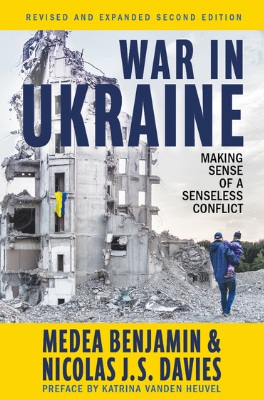
Medea Benjamin and Nicolas Davies have come out with the expanded and revised second edition of their book War in Ukraine (OR Books). Defying logic, the subtitle is Making Sense of a Senseless Conflict.

A blurb from professor Noam Chomsky calls it: “An invaluable guide.” I agree.

Media analyst Norman Solomon calls the book a “concise primer … historical context with balance and compassion.” Benjamin and Davies are compassionate advocates for peace; this is laudable and undeniable. However, too often information that criticizes all sides in a conflict, more or less equally, is passed off as balanced. Yet, when the preponderance of blame lies with one side in a dispute, to criticize equally would be unbalanced. War in Ukraine often comes across as unbalanced, and that starts with the title.

The authors give short shrift to the “Russian media narrative” notion of a “special military operation” (SMO, p 149) whereby Russia states that it is not conducting a war. The authors deal marginally with the distinction between SMO and war, (p 149) and it is left to the reader to just accept the authors’ assertion that it is a war and not a SMO. But what is a SMO? Basically, a SMO is a political-military concept used to downplay the severity and scope of a military action, while “war” is a broader, more objective term for a large-scale armed conflict. Thus, calling it a SMO versus war points to a semantic distinction aligning with a certain narrative.

Putin says Russia’s hands were forced by the US-NATO to launch the SMO:

They [US-NATO and Ukraine] did not leave us any other option for defending Russia and our people, other than the one we are forced to use today. In these circumstances, we have to take bold and immediate action. The people’s republics of Donbas have asked Russia for help.

For the most part, War in Ukraine provides most of the requisite background leading to Russian invasion, inter alia:

  • NATO breaking its agreement to not move one inch eastward toward Russia.
  • The Budapest Memorandum of 1994 affirmed a commitment “to respect the independence and sovereignty and the existing borders of Ukraine,” and “obligation to refrain from the threat or use of force against the territorial integrity or political independence of Ukraine…”
  • The US was instrumental in fomenting the Maidan Coup/Revolution to overthrow the elected government of Viktor Yanukovych to install a US-preferred president.
  • The machinations of the US-NATO in the politics of Ukraine and the involvement of US-NATO in a proxy war.
  • Western Ukraine launched war on the eastern oblasts of Ukraine.
  • Kyiv failed to implement the Minsk Agreements to end the west versus east fighting in Ukraine.
  • Nazi ideologues constituted a major fighting force for Kyiv.
  • Western media played a biased role in its coverage.

Questioning Balance

The authors write, “… when Russia jumped on the might-makes-right bandwagon by tearing up the UN Charter and invading Ukraine.” (p 6) Thereby, “The people of Ukraine were unwittingly caught in a perfect storm, whipped up not only by brutal Russian aggression but also by astonishing Western hubris and stupidity.” (p 6) This dismisses or ignores that Putin launched the SMO “in accordance with Article 51 (Chapter VII) of the UN Charter, with permission of Russia’s Federation Council, and in execution of the treaties of friendship and mutual assistance with the Donetsk People’s Republic and the Lugansk People’s Republic…” War on Ukraine is somewhat taciturn about the killing and aggression preceding Russia sending its military into Ukraine on 24 February 2022.

In mid-February 2014, the Maidan Coup (“coup” because an elected government was violently overthrown) resulted in the deaths of 107 civilians and 13 police officers. In the subsequent fighting, 14,000 people were killed, according to the estimates of the Office of the United Nations High Commissioner for Human Rights from 14 April 2014 to 31 January 2022 in eastern Ukraine. In essence, if one posits a Russian aggression, then it seems it can also be posited that it was in response to Ukrainian aggression against Donbass with its sizeable proportion of ethnic Russians. In other words, the Russian aggression is to protect ethnic Russians from the initial aggression of Ukraine.

Yet, Benjamin and Davies frame one question as: “And why did Russia decide to invade Ukraine?” (p 8) There was no question posed: “And why did western Ukraine decide to invade eastern Ukraine?” Why decide to invade Ukraine? (Balanced another way: Why did Russia feel forced to launch the SMO?) Putin stated,

The purpose of this operation is to protect people who, for eight years now, have been facing humiliation and genocide perpetrated by the Kyiv regime. To this end, we will seek to demilitarize and denazify Ukraine, as well as bring to trial those who perpetrated numerous bloody crimes against civilians, including against citizens of the Russian Federation.

Benjamin and Davies do speak to why the West backed the coup and post-coup governments in Ukraine thorough financing from the IMF: “The thrust of the IMF-mandated reforms was not to give Ukraine back to its people, but to open it up to Western capital and to partnerships between local oligarchs and Western ones with even deeper pockets.” (p 42)

The authors quoted Putin from a presidential address in April 2021 warning:

Those behind provocations that threaten the core interests of our security will regret what they have done in a way that they have not regretted anything for a long time. (p 65)

Yet War on Ukraine is decidedly lacking in presenting and analyzing the speeches Putin made in an attempt to end the warring in Ukraine and preclude Russia’s entry into the fighting.

It is a fact that the US-NATO rejected the security agreement proffered by the government of Russia to end the fighting in Ukraine and provide for the security of all parties. Neither did the US-NATO come back with a counter proposal. Clearly, Russia was seeking to avoid military action. From the decision of the US-NATO that “summarily dismissed Russia’s proposals” (p 68) one might well surmise that the West was hoping to force Russia to take up arms, which Russia obliged.

Benjamin and Davies focus on the illegality of Russia’s SMO. (p 72) There certainly are laws that one can cite to criticize Russia on the legality of its SMO. Even if legal arguments might find against Russia’s militarism, should extant law always be the final arbiter on right and wrong? Is the launching of military action to save lives and staunch further killing not morally warranted? Many have clamoured for military action to stop the genocide being wreaked against Palestinians. Should the courageous state of Yemen be legally condemned as a scofflaw state for coming to the aid of Palestine?

Benjamin and Davies bring up “the allegations of serious Russian war crimes in Bucha and Mariupol.” (p 76) The authors do not consider that this might have been a false flag carried out by Ukraine. The Bucha allegation is forcefully refuted by former US Marine Scott Ritter who says “hundreds of Ukrainian civilians in Bucha … were slaughtered by Ukrainian security forces.” Ritter provides a narrative of what happened and avers, “The evidence of this crime was overwhelming.” That may be so, but what Ritter provided was a narrative and not evidence.

The authors write that in the first phase of the Russian penetration into Ukraine that Russia failed to take Kyiv. (p 79) The authors are attributing Russian intentionality to take the Ukrainian capital. In stating that, Benjamin and Davies call into question the veracity of Putin who has stated: “It is not our plan to occupy the Ukrainian territory. We do not intend to impose anything on anyone by force.”

Early in the Russian SMO, the authors cite Amnesty International reports of Russia’s “deliberate killings of civilians, rapes, torture, and inhumane treatment of prisoners of war.” (p 80) Is Amnesty International a credible source? Paul de Rooij has written a few articles highly critical of Amnesty International (“Amnesty International: Trumpeting for war… again,” “Amnesty International: The Case of a Rape Foretold,” “Where was Amnesty International during the Genocide in Gaza?” as have others; e.g., Khaled Amayreh, “Amnesty’s Scandalous Obliquity” and Binoy Kampmark “Finding the Unmentionable: Amnesty International, Israel and Genocide.”) One wonders what exactly is a report? Testimony given by people? That has validity if the testimony is verifiable or at least has genuine verisimilitude.

Patrick Lancaster, an on-the-ground independent American journalist in Ukraine, for some reason not sourced by Benjamin and Davies, has spoken of several war crimes by Ukraine.

The authors write that Russia violated the Budapest Memorandum. (p 101) This is true, but it shouldn’t be stated without context. The memorandum was to provide security guarantees for Ukraine. But security for one state was not meant to diminish the security of the Russian signatory and be to the detriment of ethnic Russians in Ukraine. Certainly when Russia signed the memorandum it did not foresee that other signatories to the memorandum, the US and UK, would undermine democracy in Ukraine, weaponize and militarize Ukraine, and seek to draw it into NATO despite it being a Russian redline.

Benjamin and Davies claim that Russia violated the UN Charter when it launched its SMO against Ukraine. (p 118-120, 128) What the authors do not discuss is the Responsibility to Protect, a global political commitment, endorsed by all member states of the United Nations at the 2005 World Summit. At R2P’s core is that sovereignty is not just a right but a responsibility. When Kyiv attacked eastern Ukraine it violated its responsibility for the security and welfare of all its citizens and opened the door for R2P to be invoked.

Consider whether the authors are tendentious in the following depictions:

As reporters got swept up in Zelenskyy’s calls for more Western military involvement, they often became purveyors of fake news. There were surely accurate stories of real Ukrainian heroism, but some turned out to be exaggerated, embellished, or even simply invented. (160)

If there “surely are accurate stories of real Ukrainian heroism,” — and there must be — then why the need for the fake news? There are several admonitions about accepting the truth of statements when previous statements have been exposed as disinformation, from Aesop’s boy who cried wolf to “Fool me once, shame on you; fool me twice shame on me” and the Latin dictum: Falsus in uno, falsus in omnibus.

There is credible evidence of summary executions, rapes, and torture carried out by Russian forces in Ukraine, and evidence of Ukrainian war crimes too. (p 162)

There is evidence of Ukrainian war crimes, not credible evidence and the crimes are not spelled out as summary executions, rapes, and torture.

And the question for this reader is: what is the evidence? Is it sufficient for a writer to merely state that there is evidence and that the evidence is credible? Would critical thinkers accept such an assurance?

The authors write of “Russia’s annexation of Crimea.” (p 181)

According to DeepSeek: “In international law, annexation is the forcible acquisition of territory by one state at the expense of another state. It involves the formal act of claiming sovereignty over territory that was previously under the control of another sovereign entity.” Much more context is required to just call it an annexation. This was a process whereby the people of Crimea, predominantly ethnic Russians, exercised their right under Article 1 of the UN Charter to self-determination, which they overwhelmingly voted for in a referendum. Also the historical context is relevant. Soviet president Nikita Khrushchev had formally transferred Crimea from the jurisdiction of Russia to Ukraine in 1954.

*****

Benjamin and Davies conclude:

As with this war and the crisis that led up to it, Russia is accountable and responsible for its own actions, which have violated the most fundamental principles of international law. But our leaders in the West are also equally responsible for their actions and they too have acted irresponsibly and dangerously. (p 209)

It is unassailable logic: that we are all responsible and accountable for our actions. Notable is that no violations of fundamental principles of international law are ascribed to the Western leaders. What about the casus belli; which entity provoked the war? Did Putin provoke the war? That would be a risible contention because Putin made overtures to US-NATO seeking security guarantees, but he was thoroughly rebuffed by the West. US-NATO was going to militarize and arm Ukraine and likeliest place missiles within Ukraine.

Speaking of responsibility, is it not the responsibility of any country’s leadership to provide security for the country and its people? Putin has identified this as an existential threat to Russia.

The intentions of the US in its proxy war against Russia have been made clear by several politicians, both Democrats and Republicans. For example, US senator Lindsay Graham, after meeting with President Zelenskyy Kyiv in August 2023, stated:

“The Ukrainians are fighting to the last person, and we’re funding it. It’s a good deal for us.”

“It’s the best money we’ve ever spent. Without a single American soldier dying, we can weaken the Russian military.”

Several other US politicians have made the same argument. For example, Mitch McConnell, Senate Minority Leader said,

“The Ukrainians are destroying the army of one of our biggest rivals without having to put American soldiers at risk. We’re rebuilding our industrial base. The rest of the world is watching. This is a direct investment in cold, hard American interests.”

Also, the West has a history of attacking Russia. Would Putin have been faithful to addressing the security situation of Russia if he had allowed NATO to deploy troops and missiles in Ukraine? It is often said that Putin does not bluff. What would his reputation have been if he did not stick to his redlines of no NATO in Georgia and Ukraine?

Shouldn’t people devoted to peace be focused on arguing for the dismantling of NATO; adherence to the Treaty on the Non-Proliferation of Nuclear Weapons, thereby denuclearizing; and engaging in worldwide disarmament? This is what Benjamin and Davies do best.

Benjamin and Davies acknowledge the insight offered by several persons for their book. (p 235-236) The absence of certain persons who speak more understandingly of Russia taking on US-NATO-Ukraine, for instance,  former Marine Scott Ritter, retired colonel Douglas Macgregor, and professor Jeffrey Sachs is suggestive of the authors’ leaning. Jeffrey Sachs wrote a recent essay that stands in contrast to certain conclusions reached by Benjamin and Davies.

War in Ukraine is very readable, and it is informative. It is a great primer. But as for any information proffered, by whatever source, demand the evidence, question the evidence, and scrutinize the analysis.

Kim Petersen is an independent writer. He can be emailed at: kimohp at gmail.com. Read other articles by Kim.


Trump and the International Criminal Court

Blunting Justice


The International Criminal Court bash fest is getting ever more frenetic in Washington and among the law shredding members of the Netanyahu cabinet in Israel. Last month, the Trump administration smacked sanctions on judicial members Kimberly Prost of Canada and Nicolas Guillou of France via Executive Order 14203. Prosecutors also received a chastening, sanctioning experience, including Nazhat Shameem Khan of Fiji and Mame Mandiaye Niang of Senegal.

The US Secretary State Marco Rubio, who occupies more administrative posts than he can identify, confirmed the line of his boss, President Donald J. Trump.  The ICC was “a national security threat that had been an instrument for lawfare against the United States and our close ally Israel.”  In an August 20 press statement, Rubio insisted that the individuals in question had sought to investigate, arrest, detain, or prosecute US and Israeli nationals “without the consent of either nation”.  While Rubio has an undergraduate’s acquaintance with the principle of consent regarding the jurisdiction of the court, he should also be aware the involvement of the ICC can still take place regarding a non-signatory to the Rome Statute in certain cases.

In the case of the murder, mayhem and orgiastic slaughter being visited upon Palestinians by the Israeli forces, the ICC has assumed jurisdiction given Palestinian ratification of the treaty.  As the alleged breaches of humanitarian law have taken place on Palestinian soil, Israel has fallen within the court’s investigative and judicial scope.  In November 2024, Israeli Prime Minister Benjamin Netanyahu and former Defence Minister Yoav Gallant were issued with arrest warrants.  Rubio, nonetheless, repeats the usual charge sheet and insists that actions are necessary “to protect our troops, our sovereignty, and our allies from the ICC’s illegitimate and baseless actions.”  With depths of sheer cravenness, he insists that signatories to the Rome Statute appreciate that the freedom of many of the ratifiers “was purchased at the price of great American sacrifices”.

The response from the ICC to such head spinning conspiracy could do no more than summarise the important point: that the sanctions were “a flagrant attack against the independence of an impartial judicial institution.”  The move was “also an affront against the Court’s States Parties, the rules-based international order and, above all, millions of innocent victims across the world.”  With admirable pluck, the body went on to declare that it would persist in “fulfilling its mandate, undeterred, in strict accordance with its legal framework as adopted by the State Parties and without regard to any restriction, pressure or threat.”

UN spokesperson Stephane Dujarric also told the press that the decision by Washington imposed “severe impediments on the functioning of the office of the prosecutor and respect for all the situations that are currently before the court.”

Such impositions, and the broader attempt to place the US outside the gravitational pull of the ICC, has become routine.  American exceptionalism is always cited as the mainstay principle in doing so, despite the fact that drafting the original Rome Statute involved considerable interest from the American legal fraternity.  The first Trump administration saw the issuing of Executive Order 13928 in June 2020, which imposed travel and financial sanctions on ICC personnel and their family members.  President Joe Biden revoked the measure in April, 2021, with his Secretary of State Antony Blinken reasoning that the order had been “inappropriate and ineffective”.

Last year, the House of Representatives passed the Illegitimate Court Counteraction Act which blustered against international law while shielding US citizens and entities, along with non-US citizens lawfully resident in the country.  Were the ICC to investigate, arrest, detain or prosecute such “protected” persons, the President would “impose visa- and property-blocking sanctions against the foreign persons that engaged in or materially insisted in such actions”.  Sanctions blocking the visas of immediate family members of those targeted would also be implemented.

In January this year, the same bill failed by 54-45 votes to pass, though Democrat and Senate Minority Leader Chuck Schumer could still offer considerable support for the instrument.  “However, as much as I oppose the ICC bias against Israel, as much as I want to see that institution drastically reformed and reshaped, the bill before us is poorly drafted and deeply problematic.”

In February, Trump reprised his role as assaulter-in-chief of the ICC by issuing Executive Order 14203, reviving the provisions of the moribund Illegitimate Court Counteraction Act.  He warned that the Court’s “recent actions against Israel and the United States set a dangerous precedent, directly endangering current and former United States personnel, including active service members of the Armed Forces, by exposing them to harassment, abuse, and possible arrest.”  Accordingly, any non-American person or organisation can be sanctioned if they directly engage in any actions on the part of the ICC to investigate, arrest, detain, or prosecute a “protected person” without consent of that individual’s country or nationality.  (Such persons are defined as US nationals and US military personnel, including persons who are citizens or lawful residents of a US NATO ally or “major non-NATO ally”.)

Anyone supplying material assistance, including sponsorship, financial, material or technological assistance to the Court’s activities, can also be sanctioned.  As before, these can take the form of blocking assets within the US and bans on entry into the US for any sanctioned persons including their families.  Most prominently on the list is ICC Prosecutor Karim Khan.

While criticism of these battering responses from Trump has been forthcoming from various Rome Statute member states, they constitute a mere smattering.  Trump’s hostility to the regime of international justice and accountability is one shared, overtly or otherwise, by various allies and adversaries.  Netanyahu knows, for instance, that the ICC arrest warrant will carry no truck in certain countries, however sentimental they claim to be about international humanitarian law.  France’s Foreign Ministry is notably adamant that he is immune from arrest, as Israel is not a party to the ICC.  Hungarian Prime Minister Viktor Orbán stoutly flouted the warrant by inviting the Israeli PM to Budapest and also announcing his country’s withdrawal from the Rome Statute.  Czech Prime Minister Petr Fiala, preferring a certain obliqueness, called the ICC decision “unfortunate”, undermining “its authority in other cases when it equates the elected representatives of a democratic state with the leaders of an Islamist terrorist organization.”  With supporters like these, the blunting and sundering of international judicial processes is always assured.

Binoy Kampmark was a Commonwealth Scholar at Selwyn College, Cambridge. He lectures at RMIT University, Melbourne. Email: bkampmark@gmail.comRead other articles by Binoy.
Cold War 2.0 Is Against China

Trump’s military spending for the coming fiscal year is $1 trillion 
ENTITLEMENTS
and this is all about targeting China in an attempt to stave off U.S. hegemonic decline.

by Gary Olson / September 5th, 2025

“Globally, all available resources are to be focused on a zero-sum increase in U.S. power and on the defeat of China as the newly arising rival.” — John Bellamy Foster, “The Trump Doctrine and the New MAGA Imperialism

On September 3, China staged a grand gathering of over 20 foreign leaders to commemorate the 80th anniversary of the victory in the Chinese People’s War of Resistance Against Japanese Aggression and the World Anti-Fascist War. China’s loss of some 20 million people was second only to the USSR in terms of deaths in WWII. We also need to acknowledge the 30,000 killed in the Nanjing Massacre of 1937 and the fact that 10 million Chinese were enslaved.

Before the parade in Beijing, the Summit Meeting of the Shanghai Cooperation Organization (SCO) took place in Tianjin from August 31 to September 1. The meeting was the largest in the group’s decade-old history. In his Keynote Address, President Xi called on SCO member states to continue to resist “hegemonism and power politics,” and instead advocate for “an equal and orderly multipolar world and a universally beneficial and inclusive globalization.”

Each of these meetings takes the multipolar world a step further, as they transition from a “talk shop” to substantive and cooperative projects that “bypass the US-led system toward one that protects these countries from the West.” This formidable coalition is saying, “You can bully your European vassals into obedience, but not us.” All available evidence suggests that we are witnessing the emergence of a new coalition, the end of Western domination of the global system, and the advent of a new era — provided the world remains intact.

Photos of Chinese President Xi Jinping embracing Russian President Vladimir Putin and India’s Narendra Modi brings to mind Zbigniew Brzezinski’s famous warning in his book, The Grand Chessboard: American Primacy and its Geostrategic Imperatives (1997), when he wrote “the most dangerous scenario would be a grand coalition of China, Russia and perhaps India, an ‘anti-hegemonic’ coalition united not by ideology but by complementary grievances.” Little did Brzezinski know how rapidly the US would push India into a closer relationship with China and Russia, which gives multipolarity a tremendous boost. Nor did Brzezinski foresee the accelerating pace of common grievances and how quickly the multipolar world he feared would emerge.

I should note that the final declaration made no mention of Ukraine. My sense is that although the war will drag on, Russia has won and Ukraine is already in the rearview mirror. Not coincidentally, the developments in Beijing happened just as the neocons lamentably realized the long-term US military strategy of a major proxy war with Russia in Ukraine has, in all essentials, failed. Here, it’s important to note that for some within the national security establishment, Ukraine was seen as a mistaken use of limited US military resources, but now there is an overwhelming consensus that China must be taken on.

It is China’s economic growth and alternative development model that strikes fear into the capitalist ruling class. As Asia expert, Danny Haiphong, has asserted, “Without China’s economic development, there would be none in the Global South. These countries want to replicate China’s success.” In short, China is threatening a US-controlled world order that only benefits U.S. capitalists.

This apprehension accounts for the fact that on November 17, 2011, former President Barack Obama announced his administration’s “Pivot” or “rebalance” to China, which heralded a decade of increased levels of US imperialism toward Beijing. Arguably, today’s most influential iteration of this bellicose approach toward China is the work of Elbridge Colby, the current Under Secretary of Defense, who is known to “prioritize” China and has been called “The China Hawks’ China Hawk.”

Colby, grandson of former CIA Director William Colby, was a co-author of the 2018 National Defense Strategy, which argued that the U.S. should refocus its military might on the Pacific and that Europe and the Middle East were of secondary importance. (Incidentally, Bernie Sanders criticized Colby for halting arms shipments to Ukraine). Colby believed that two-front wars against Russia and China were dangerously stretching US military resources.

In his 2021 book, Strategy of Denial: American Defense in an Age of Great Power Conflict (Yale University Press, 2021), Colby advocates, as one reviewer states, “magnifying threats and increasing fears in order to build support among attentive publics and capitalist ruling class leaders for a possible war, this time, with China.” He urges the massive forward deployment of US military power in the Pacific to augment the existing 400 US military bases surrounding China. Furthermore, he counsels constructing an anti-China coalition that would include: Japan, Taiwan, South Korea, Australia, Vietnam, India, and Myanmar. It’s not lost on the Chinese that many of these former Japanese colonies are now US colonies.

Further, Colby seeks to build support within the higher circles of the monopoly capitalist class — and by extension, ordinary Americans — for a possible “limited” war to prevent China from “dominating a key region of the world.” Under certain circumstances, Colby endorses a “limited nuclear war which would achieve victory for the United States.” As journalist and geopolitical analyst KJ Ngo warns, Colby posits a seamless continuum between nuclear weapons and conventional war. At other points, Colby suggests that “selective friendly nuclear proliferation may be the least best option, though this would not be a panacea and would be dangerous.” His fear-mongering reaches a fever pitch when he warns that, “If China succeeds, we can forget about housing, food, savings, affordable college for our kids, and other domestic needs.” In sum, Colby recognizes China’s new position of strength, wants to deny it “regional hegemony,” and in doing so, he’s willing to risk a nuclear catastrophe.

Foremost in curbing China’s rise is the effort to portray it as a full-spectrum, moral enemy and threat to so-called “Western democracy.” This manufacture of consent to prepare for war requires a massive propaganda campaign, and in 2024, Congress approved 25 anti-China bills in just one week. It was hailed as “China Week” by the House Select Committee on the Chinese Communist Party. One of the bills passed during the week allocated $1.6 billion, or $ 325 million per fiscal year 2023-2027, to subsidize media worldwide to demonize China. The legislation passed 351-36, revealing conclusive bipartisan agreement to counter China.

The new law specifically targeted China’s highly successful Belt and Road Initiative (BRI), under which China has built infrastructure and cemented ties with Latin America, Asia, and Africa. The U.S. Council on Foreign Relations, the semi-official voice of U.S. imperialism, has warned that the BRI “poses significant risks to U.S. economic and political interests and to longer-term security implications,” and the bill characterized the BRI as China exercising its “malign influence.” What’s so striking about this and other claims is that there’s never any evidence to support them. The “Chinese Threat” is simply assumed to be true and therefore perfectly legitimate, and even “morally right” to oppose China.

Finally, of the 100 countries surveyed by the Democracy Perception Index, more than three-quarters have a more favorable view of China than of the United States. Conversely, the Pew Research Center’s polling in 2025 indicates that Americans’ negative opinions of China are slightly less unfavorable than in 2024 — 81% in 2024 to 77% this year. Still, 42% see China as the country posing the “greatest threat” to the U.S.

We know that Americans are the most heavily propagandized people in the world. If the public is to be de-brainwashed about China, social media must take on an uphill but critically important role.


Recommending Reading on China:

Ken Hammond, CHINA’S REVOLUTION AND THE QUEST FOR A SOCIALIST FUTURE (NY: 1804 Books), 2023.

Carlos Martinez, THE EAST IS STILL RED (Glasgow, Scotland: Praxis Books, 2023).

Jeff Brown, CHINA RISING: Capitalist Roads, Socialist Destinations – The True Face of Asia’s Enigmatic Colossus (Brewster, NY: Punto Press Publishers, 2016).

Deborah Brautigan, THE DRAGON’S GIFT (New York: Oxford University Press, 2009)
.

Gary Olson is Professor Emeritus at Moravian College, Bethlehem, PA. Contact: glolson416@gmail.com. Per usual, thanks to Kathleen Kelly, my in-house ed. Read other articles by Gary.

 Veterans For Peace Condemns the Deployment of National Guard in Washington, DC, and the Misuse of U.S. Troops and ICE to Create Terror in Our Cities


Veterans For Peace unequivocally condemns President Trump’s unlawful deployment of the National Guard to Washington, DC. This follows the outrageous deployment of National Guard and U.S. Marines to the streets and parks of Los Angeles in support of ICE terror tactics in a city where as many as one in ten residents are undocumented workers. Even U.S. military veterans have been targeted and deported.

The crime rate in Washington, DC, is at a 30-year low. The claim that an emergency exists requiring military policing is a blatant lie. The use of the U.S. military for domestic policing violates the Posse Comitatus Act, which reserves law enforcement for civilian authorities, not federal troops.

Is it a coincidence that the cities targeted for occupation by federal forces are Democratic-led and often with Black mayors? Furthermore, the deployment of National Guard units without the consent of state governors, as in California, is highly questionable and likely illegal.

Equally disturbing is the role of Immigration and Customs Enforcement (ICE) in terrorizing entire communities. Wearing masks, without identification, often in plain clothes and unmarked vans, ICE personnel are becoming shock troops more reminiscent of fascist, totalitarian regimes. In recent days, at least one man was killed when he ran into traffic to avoid being detained by masked men. There are now reports of women being abducted and assaulted by violent criminals posing as ICE. How can anyone tell the difference?

The ICE budget in Trump’s “Big Beautiful Bill” is larger than that of any branch of the armed services and larger than the entire federal prison system. New prisons—such as “Alligator Alcatraz” in Florida, effectively concentration camps—are being built to imprison nonviolent immigrants with no criminal records whatsoever. Meanwhile, Trump brands undocumented workers as violent criminals and drug-dealing gang members—another blatant lie.

The deployment of tens of thousands of U.S. soldiers to the border with Mexico threatens border communities and Mexico itself, with Trump even claiming the right to invade with drones and the U.S. military in pursuit of “cartels.” U.S. leaders have leveled unsubstantiated claims, such as accusing Venezuelan president Nicolás Maduro of running a drug cartel, while dangling multimillion-dollar bounties. These are the hallmarks of regime-change propaganda.

Veterans For Peace stands opposed to racist violence in our communities. Behind the masks and lies of the Trump administration, we see the face of White Supremacy—and a growing trend of domestic repression. As the old warning goes: First they came for the immigrants and communities of color…

The U.S. Supports Genocide in Gaza and Escalates Toward Global War

At the very same time, the U.S. government continues to provide bipartisan support for the genocide and starvation of Palestinian men, women, and children in Gaza. The U.S. supplies the bombs that fall on Palestinian neighborhoods and the political cover for the systematic destruction of an entire people.

The U.S. has bombed Yemen and Iran, both countries that sought to aid Palestinians. The Pentagon is openly planning war against China, simply because the Chinese economy challenges U.S. dominance. Military planners even discuss using tactical—or first-strike strategic—nuclear weapons. The U.S. is also fueling a devastating proxy war in Ukraine, where the priority should be to cease hostilities and pursue genuine negotiations. Meanwhile, escalating threats toward Iran risk plunging the region into another catastrophic war.

When Veterans For Peace and antiwar activists protest, will we find ourselves in ICE’s concentration camps?

Military Members: “This Is Not What We Signed Up For!”

As veterans of the U.S. military—and too many questionable wars—we stand with our brothers and sisters, sons and daughters in today’s armed forces. They did not enlist to chase immigrants around parking lots or into traffic. They did not sign up to invade Mexico or Venezuela. They do not want to stand on the front lines of a nuclear war. Increasingly, we are hearing from GIs questioning their deployments and seeking advice on their legal rights and alternatives.

Veterans For Peace will continue to support members of the military who are questioning whether their orders are morally or legally justified. We encourage military personnel and their families to call the GI Rights Hotline at 877-447-4487 to learn more about their rights and how to seek a discharge.

Peace at Home, Peace Abroad!

Veterans For Peace joins the majority of people in the U.S. who reject the deployment of National Guard, U.S. troops, and ICE to terrorize our communities and prepare the ground for fascist repression. We will work with civil society organizations resisting these illegal, authoritarian measures.

We call for peace at home and abroad: an end to U.S. support for genocide in Gaza, an end to provocative military actions against China, Iran, Venezuela, and Mexico, and a permanent peace agreement in Ukraine.

We invite like-minded people—especially fellow veterans—to join us in defending our communities and building a future of Peace at home and peace abroad.

Veterans For Peace is a national organization founded in 1985 by military veterans opposed to the Reagan administration's war against the people of Central America. It includes men and women veterans of all eras and duty stations spanning the Spanish Civil War, World War II, Korea, Vietnam, Panama, Persian Gulf, Bosnia, Afghanistan, Iraq, other conflicts and periods in between. Read other articles by Veterans for Peace, or visit Veterans for Peace's website.