Sunday, October 26, 2025

The ‘No Kings’ Protests: An Affirmation of Democracy in the Face of Authoritarianism

The protests served as both a warning and a beacon, sending the message to all Americans that the arc of justice, even if it bends too far toward Trump’s dystopia, can be straightened by collective will.
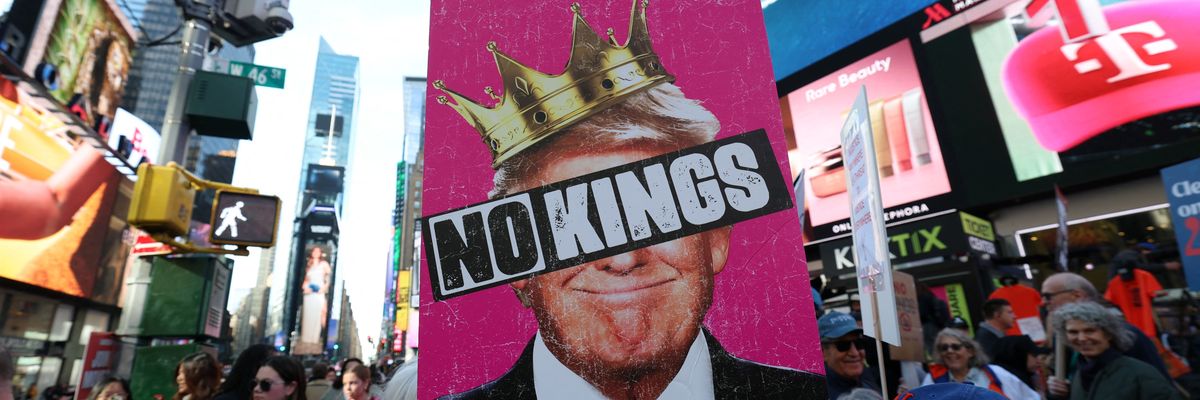

People participate in a “No Kings” national day of protest in New York on October 18, 2025.
(Photo by Timothy A. Clary / AFP via Getty Images)

Chloe Atkinson
Oct 25, 2025
Common Dreams


Millions of Americans poured into the streets across the country on October 18 to protest President Donald Trump’s second-term agenda which threatens the democratic ideals that have long defined progressive visions of America.

With defiance and hope, protesters echoed calls of “democracy, not monarchy,” embodying the liberal ethos that power must answer to the people, not the whims of a self-anointed ruler. Today, executive overreach threatens to erode the checks and balances our Founders so painstakingly designed, and the protests served as both a warning and a beacon, sending the message to all Americans that the arc of justice, even if it bends too far toward Trump’s dystopia, can be straightened by collective will.
RECOMMENDED...



Pro-Democracy Americans Gear Up for ‘No Kings’ Day Nationwide



‘No Kings’ Rallies Against Trump Authoritarianism Could Be ‘Largest Protest in US History’

The sheer breadth of the protests was indeed impressive and shattered expectations as massive crowds of urban progressives, rural independents, and suburban families gathered to express their deep-seated anxieties over the Trump administration’s destructive political agenda, including immigration crackdowns and education cuts.

This was no ordinary protest, and the goal was not to cry out against one policy or another. When democracy is under siege, Americans must rise as a collective, amplifying marginalized voices on important issues such as immigration, reproductive rights, and environmental justice. “No Kings” is a clarion call for those who care about the monarchical pretensions of Trump’s governance. Liberals are furious over the president’s actions like executive orders expanding his presidential powers beyond reason, the deployment of federal forces against state governors, and daily threats to prosecute political adversaries. The protesters decried not abstract, theoretical tyranny, but Trump’s tangible harms. He has sent Immigration and Customs Enforcement (ICE) agents on violent raids in numerous cities across America, slashed funding for public education and clean energy, and cooked up schemes to undermine fair representation. Trump’s “America First” rhetoric masks a zero-sum nationalism that erodes the inclusive and pluralistic fabric that liberals value.

The “No Kings” protests were not an endpoint. Instead, they served as a pivot point, energizing a resistance that may just reshape the 2026 midterms and perhaps beyond.

The “No Kings” framing resonates deeply with progressive history. The anti-monarchy fervor of 1776 against King George III and the civil rights marches of the 1960s both recast national resistance as patriotic duty. Americans are no longer able to count on the Supreme Court for justice and instead must fight on their own to prevent Trump’s monarchic fantasy and effect change. True security lies in empowered communities, not with iron-fisted leaders. The protests demanded an end to authoritarian overreach, safeguarding immigrant families, and ensuring that healthcare, wages, and climate action aren’t bargaining chips in Trump’s game of thrones.

We must not despair. The protests served a great public good in sustaining morale and offering hope for a better future and democratic governance. The voice of the people has always been a central element in American democracy, and it will remain as such as long as the people do not fear emerging from their homes and engaging in public protest without the threat of arrest or persecution.

The Trump administration’s response was as predictable as it was revealing. House Speaker Mike Johnson (R-La.) branded the DC march a “hate America rally.” Press Secretary Karoline Leavitt floated RICO charges and Antifa smears, as well as pulling out old, debunked George Soros conspiracies. Trump’s infantilism has been put on display once again when he added to the administration’s messy response by publishing an AI-generated video of him as a crowned bomber dropping excrement on crowds.

Of course, from a liberal vantage this is not just mere rhetoric. Trump is once again displaying his adherence to the authoritarian playbook as he sows division to justify oppression. Why was the National Guard mobilized? It certainly wasn’t for protection. If anything, it was meant as intimidation, the very tool used by dictators and authoritarians around the world for centuries.

The “No Kings” protests were not an endpoint. Instead, they served as a pivot point, energizing a resistance that may just reshape the 2026 midterms and perhaps beyond. We know this from historical precedent. The suffrage parades of 1913 and the Vietnam War protests of the 60s were not flashpoints but foundations for progress. Americans can aid ballot initiatives by amplifying calls for accountability, impeaching anti-democracy enablers, and electing pro-democracy champions. The key is to channel outrage into structural change, county by county, state by state.

America thrives not on crowns, as Trump would like, but on the collective courage of its citizens. Let’s hope that the “No Kings” protests act as the spark that reignites the republic.

Trump's weakness wasn't the only thing exposed at Saturday's protests


U.S. President Donald Trump attends the commencement ceremony at West Point Military Academy in West Point, New York, U.S., May 24, 2025. REUTERS/Nathan Howard

October 24, 2025
 | ALTERNET

Yesterday, I talked about how the No Kings rally exposed the regime’s weakness. Donald Trump wants the common folk of America to surrender in advance, just like their betters did. But when more than 7 million said hell no, what did he do? Well, let’s just say it was profane.

In today’s edition, I want to talk about another kind of weakness that it revealed. Instead of the president and the Republicans, however, the No Kings rally exposed the weakness of certain centrist Democrats.

How so? First remember what centrism is. These days, it’s the capacity for a Democrat in a competitive district to accept as true the premise of the lies told about Democratic Party by Trump and the Republicans.

For instance, when it became conventional wisdom, as a result of all this lying, that Vice President Kamala Harris was defeated because she pushed too hard for trans rights, centrist Democrats accepted that as true, though it was false, in order to seem moderate by comparison.

This is what Congressman Seth Moulton of Massachusetts aimed for when he invoked transgender girls in sports. Harris lost, he said, because his party spent “too much time trying not to offend anyone rather than being brutally honest … I have two little girls. I don’t want them getting run over on a playing field by a male or formerly male athlete, but as a Democrat I’m supposed to be afraid to say that.”

Centrists do this in order to portray themselves to independent voters as honest brokers whose primary concerns are above partisan politics. In reality, however, it’s conflict-avoidance. They don’t want to take the risk of fighting Republicans. So they fight their own side instead. They make the demands of advocates and reformers – known cynically as “the groups” – seem radical or impractical or beyond “what’s really important to the American people.” The result? Nothing changes.

What I’m describing is the normal for Democrats like Seth Moulton. They believe that it earns them credibility and public trust. But norms can’t endure in the face of an ongoing constitutional crisis. The Trump regime isn’t just violating the rights of one or two marginal groups. It is violating the rights of all Americans, triggering a national reckoning that fueled the biggest one-day demonstration in American history.

More than anything else, No Kings was a necessary reaffirmation of bedrock democratic principles, because so few elites, including centrist Democrats, have been willing to affirm them. And if centrists choose to smear more than 7 million people the way they have smeared “the groups,” they risk discrediting themselves completely.


It may not be clear yet that centrism is fictional, but it will be.

In the case of Seth Moulton, perhaps sooner than he thinks.

Moulton is set to primary US Senator Ed Markey of Massachusetts. While he’s acting like trans rights are negotiable, Markey isn’t playing. At the No Kings rally in Boston, which drew 100,000 demonstrators, he declared trans rights to be human rights and the people there roared.

When Moulton got up to speak, they booed.

That was a bright line, according to Evan Urquhart. After writing extensively for The Atlantic, Vanity Fair and others, he set up Assigned Media in 2022 to report on transgender news. Evan was in Boston.

“The Democratic rank-and-file is disgusted by Trumpism,” he told me in the interview below. “They don't want to see Democrats who compromise and meet Trumpism halfway. They want to see fighters.”

In a thread prior to the No Kings rally, you shared some wisdom about how to balance the evils facing the trans community with the joys found within it. You seemed to be addressing the old problem with hope: too much makes you naive, too little makes you nihilist.

I've noticed that informed Americans in general, and especially trans people, are crying out for ways to push through the despair at seeing our country's rule of law collapse. Ideals that we may have thought were universal and unassailable, such as human rights or the worth and dignity of every person, are suddenly very much up for grabs.

It is, as you say, naive to imagine that good is simply going to triumph here. We've blown past most of the guard rails that were supposed to protect us, and no one is more keenly aware of that than trans people. The federal government officially defines us as not even existing, and they've hinted that they want to go further to define us as terrorists.

My thread is about finding ways to live with the reality that we are losing our rights and there's no clear floor, no knowing how much we will lose before this insanity ends, while also contributing to efforts to find that floor and begin pushing that floor back up again.

Ed Markey was at the No Kings rally in Boston. He said: "Here in Massachusetts we stand for what is right. We stand with trans people because trans rights are human rights.” That's in contrast to Seth Moulton, his primary challenger, who seems to think trans rights are negotiable. You were there. How are you feeling today?

Ever since November, when we learned Trump would be president, I've known that the trans community would be in a uniquely vulnerable position, because Trump's closing argument against Kamala Harris was that she was too trans-supportive.

Never mind that Harris didn't say one word in support of trans rights during her campaign. The conventional wisdom was always going to be that Democrats were punished for being too trans supportive.

So the struggle for my community has been participating in a movement for democracy led by Democrats who aren’t sure they want our community with them – or want to blame us for all their troubles.

Senator Markey is a longstanding supporter of trans rights, and his primary challenger is Representative Moulton, who was one of the early Democrats distancing himself from the trans community.

And what I think we're seeing, and saw so decisively with Markey being cheered in Boston for standing up for trans rights and Moulton being booed by that same crowd, is that the Democratic rank-and-file is disgusted by Trumpism. They don't want to see Democrats who compromise and meet Trumpism halfway. They want to see fighters.

Trans people are great fighters. Our activists are out there, unbowed, defiant in the face of all of this scapegoating and oppression, and I think that fighting spirit is resonating with many Americans.

In your thread, you hint at the importance of federalism – the decentralization of federal power and the sovereignty of the states – in protecting trans and human rights. You suggest that there could be a "soft secession with blue state protections growing more meaningful as federal power fades." Talk about that more please.

I think that the No Kings rallies showed that Americans are not willing to go quietly into dictatorship. Unfortunately, there are a lot of deep structural problems in the American system that Republicans are determined to exploit. The Supreme Court has become a partisan rubberstamp on the most lawless actions by the president. The government is currently shut down and House Speaker Mike Johnson doesn't even seem like he's trying to find a solution, to the point where you almost start to suspect Republicans would rather us not even have a legislative branch and just vest all power in the executive.

These are headwinds that national Democrats might be able to overcome with a strong enough midterms and a strong enough Democratic president in 2028, but even if a lot of things broke that way, it does not feel assured. So, what's the alternative?

If Trump is too weak and unpopular to turn all of America into a dictatorship, but Democrats are unable to restore constitutional governance, we could see a much stronger federalism, with blue states increasingly ignoring the federal government. It's a sad picture in a lot of ways, but trans people have got to be practical, and practically speaking, I'd rather live in a strong Massachusetts that can protect me, perhaps even a Massachusetts that has strong regional alliances with other New England states, than be forced out of the country.

You remind me of something I came back to often: that the crisis probably can't be overcome through elections alone, but through political change that starts with individual hearts and minds.

I think we do have deeply moral people and movements, but those movements are increasingly detached from any institutional power.

When I think about the concern people have about the fate of the Palestinian people, people halfway around the world that we've been indoctrinated to hate and look down on, I see a deep belief in the principle that where a child is born shouldn't determine whether they're able to grow up safely.

When this deep care and concern for others is treated as radical, idealistic, naive and impractical, what happens at first is that no action is taken to protect the children in harm’s way, but in the end the leaders and institutions who worked so hard to distance themselves from these movements wind up delegitimizing themselves.

In journalism, we're seeing this with the deepest values of our profession. Journalists are expected to hold powerful people accountable without fear or favor, and bring audiences the truth even when it might be risky or unpopular. That’s being treated in the same way, as naive, childish and something no one believes any more, in a time when news organizations have been defanged by billionaires.

And what happens at first is that you see a loss of hard-hitting, honest reporting, but what I think happens next is that those institutions lose their legitimacy, and independent reporters who are willing to carry the mantle of those deep values rush into the vacuum.

Musk's Grok misleads internet users about anti-Trump 'No Kings' protests


Issued on: 21/10/2025 
05:13 min
From the show


Over the weekend, huge crowds gathered in cities across the US for demonstrations against President Donald Trump's policies. Some online have been alleging that the American news channel MSNBC used old footage to exaggerate the scale of the protests. On X, Elon Musk's AI chatbot Grok claimed that the footage shown was from 2017. But Grok's claims were false: analysis shows the footage shared by MSNBC was indeed taken at a "No Kings" protest in Boston on October 18, 2025, as FRANCE 24's Charlotte Hughes explains.


Opinion

Trump’s megalomaniac White House project fits a global trend among far-right populists

The president’s move is less an example of American exceptionalism than part of a familiar pattern


Jan-Werner Müller
Sun 26 Oct 2025 
THE GUARDIAN

Amid all the horrors of the second Trump administration, the demolition of the East Wing is hardly in the top 10. But it provides a powerful symbol of wanton destruction – and, as Trump himself knows full well, images matter greatly in politics. It also curiously combines so many elements of a distinctly Trumpian approach to government: shameless falsehoods about the proposed ballroom (“It won’t interfere with the current building. It’ll be near it but not touching it”); complete disregard for legislation (in this case rules about preservation), and unprecedented levels of cronyism (with CEOs trying to curry favor with the president through donations to a grotesque project of self-aggrandizement). There is also something very poignant about the destruction of an edifice which had provided an office of one’s own for first ladies. For all these peculiarities, Trump’s disfiguring the White House fits into a larger global trend: far-right populist leaders in many countries have used spectacular architecture to advance their political agenda and, more particularly, to set their vision of a “real people” – as in “real Americans”, “real Hungarians” et cetera – in stone.


Just before Christmas 2020, in the dying days of his first administration, Trump had already taken time off from his busy schedule promoting the big lie about having won the election in order to issue an executive order entitled “Promoting Beautiful Federal Civic Architecture”. The order made “classicism” the preferred style for new federal buildings, stopping just short of banning modernism entirely. Biden rescinded the order; Trump brought a version of it back right on inauguration day this year. What is almost entirely forgotten is that the 2020 order had belonged together with Trump’s “1776 commission”, the ill-fated attempt to whitewash US history; both the architecture orders and the instructions for history teaching were meant to promote an image of the US as pure and “beautiful”.


In his use of the built environment, Trump is less an example of American exceptionalism than is suggested by credulous accounts of “Trump, ever the developer.” Turkey’s president, Recep Tayyip Erdoğan, has had massive structures erected, from a gigantic mosque in Istanbul to a new presidential palace in Ankara; he has also promoted the Ottoman-Seljuk style as reflecting his neo-Ottoman understanding of Turkey. Viktor Orbán’s reconstructions of historical edifices on Budapest’s Castle Hill are supposed to present a correct understanding of Hungarian history; India’s prime minister, Narendra Modi, has been reconstructing Hindu temples – most controversially on the ruins of the destroyed mosque in Ayodhya.


The pattern is usually this: one layer of history – be it the Mughal period or, in Hungary, state socialism with its modernist buildings – is removed and a reconstruction is celebrated as a return to a people’s authenticity and greatness. But beyond this symbolic message about “the real people”, large construction projects demonstrate dominance; the implicit claim is: “We won and now the country is ours!” And that claim is inevitably in citizens’ faces: one might avoid all kinds of propaganda online and on TV, but one cannot avoid buildings in everyday life. Even if such autocratic figures were removed from office – and of course they do everything to avoid that outcome – their edifices and monuments will remain.

True, in one sense Trump’s case is unique: he already had a portfolio of buildings before assuming office – though most of his own buildings had never been particularly classical; instead, they are modern on the outside, while on the inside one finds a nouveau riche fever fantasy of Versailles – which has now also spawned an engoldened Oval Office, displaying what an astute critic, Kate Wagner, has called “regional car dealership rococo”. And while size matters for all far-right leaders on one level (just think of Erdoğan’s enormous palace in Ankara), hardly anybody else would have fixated on a ballroom. Perhaps the reason is as banal as the fact that banquets and catering were one of the few business ventures in which Trump ever had genuine success; more likely, it is a space for unlimited adulation of the president and for plenty of occasions for “deal-making”.

Architects promoting traditional styles have been happy to go along with Trump’s ideas. To be sure, style is never just reducible to a particular politics; modernism is not automatically progressive (some fascist edifices in Italy are modernist marvels). But the way some promoters of classicism have talked about “beauty” and insisted that “classical public buildings make us feel proud of our country” is not only backward-looking; it easily legitimizes a Magalomaniac architecture of little aesthetic value.

The architect in charge of the ballroom, James C McCrery II, trained with, and worked for, Eisenman, one of the great proponents of the “deconstructivism” in architecture that one of Trump’s executive orders explicitly derided for its “disorder”. McCrery came to regard non-traditional architecture as “ungodly” and started to specialize in church architecture. Eisenman in turn has called the ballroom plans “bonkers” and observed that “putting a portico at the end of a long facade and not in the center is what one might say is untutored”.

This monstrosity might well be empty most of the time (unless it can be re-purposed to store classified documents). It is not too early to think about how it could either be modified or perhaps removed altogether. Of course, the Maga activists who opposed every removal of a Confederate statue in the name of “preserving history” would not be happy. But then again, they had nothing to say about the destruction of the East Wing – a building of which citizens who have visited the White House are likely to have fond memories.

Jan-Werner Müller is a Guardian US columnist and a professor of politics at Princeton University
Trump isn't alone in seeking retribution — 'air is thick with talk of revenge': professor


Alternet
October 26, 2025 


U.S. President Donald Trump speaks on the day he is expected to sign a sweeping spending and tax legislation, known as the "One Big Beautiful Bill Act," during a picnic with military families to mark Independence Day, at the White House in Washington, D.C., U.S., July 4, 2025. REUTERS/Ken Cedeno

President Donald Trump's critics are accusing him of transforming government power into an instrument of retaliation, arguing that his administration’s pursuit of “retribution” against perceived enemies signals a departure from legal norms and erodes institutional independence.

In an article for The New Republic published Sunday, Paul Starr, a professor of Sociology at Princeton University, argued that Trump’s focus on revenge is not just a personal obsession but a political strategy rooted in a broader cultural reaction against decades of social change.

"The air is thick with talk of revenge, and it’s not limited to Donald Trump’s personal vendetta against individual enemies like James Comey, Letitia James, and John Bolton," the article read.

Starr wrote that Trump’s call for “retribution” against his enemies and the institutions he claims have “betrayed” his followers reflects a deep current of resentment within American politics.

Trump’s threats and acts of retaliation, Starr said, have helped him consolidate control over the Republican Party and intimidate other institutions.

Starr added that Trump’s appeal to revenge resonates with supporters who feel disempowered by the liberal and progressive movements that reshaped American life since the mid-twentieth century. The social revolutions that advanced racial equality, women’s rights, LGBTQ rights, and secular values, he argued, disrupted long-standing hierarchies and provoked backlash among those who saw their traditional privileges eroded.

"For years he had been telling his followers that they had been betrayed by the nation’s leaders on diversity policies, trade, immigration, foreign wars, and much else. He would be their instrument for a historic settling of scores," Starr said of Trump.

Trump’s promise of payback, Starr wrote, channels those grievances into a demand for the restoration of lost status and dominance.

Tracing the roots of this backlash, Starr noted that earlier Republican leaders like Richard Nixon and Ronald Reagan courted conservative resentment but did not seek to overturn liberal reforms entirely.

Nixon’s policies, he observed, often extended the liberal project, while Reagan’s conservatism, though economically transformative, stopped short of a full social counterrevolution.

Starr argued that the decisive shift toward Trump-style politics emerged in the 1990s, when the conservative movement and Republican Party increasingly turned to fear and aggression as organizing principles. In that evolution, he argued, the politics of revenge became central to the identity of the American right.

"There have been other dark times in America’s past and other dangers we have faced and overcome. We need the courage and determination that others before us have shown in leading the country through darkness to the other side," he concluded.
'Before it's too late!' Trump says he will ban early voting for midterms in panicked rant

Alexander Willis
October 26, 2025 
RAW STORY


U.S. President Donald Trump speaks to the media aboard Air Force One ahead of his arrival in Malaysia, October 25, 2025. REUTERS/Evelyn Hockstein

President Donald Trump announced Sunday that mail-in ballots and early voting would be prohibited for the upcoming midterm elections, citing false claims that the 2020 election had been “rigged,” despite having no authority to outlaw such voting practices.

“Look what happened to our Country when a Crooked Moron became our ‘President!’ We now know everything,” Trump wrote on his social media platform Truth Social. “I hope the DOJ pursues this with as much ‘gusto’ as befitting the biggest SCANDAL in American history! If not, it will happen again, including the upcoming Midterms. No mail-in or ‘Early’ Voting, Yes to Voter ID!”

Trump had previously vowed to eradicate mail-in ballots back in August, and again without having the authority to do so. In his social media post Sunday, however, he also vowed to eradicate early voting, and singled out California for its upcoming ballot measure to redraw its congressional districts, a measure passed in response to Texas’ redistricting that was designed to bolster the GOP’s numbers in Congress.

“Watch how totally dishonest the California Prop Vote is! Millions of Ballots being ‘shipped,’” Trump wrote, with it being unclear what “millions of ballots” he was referring to. “GET SMART REPUBLICANS, BEFORE IT IS TOO LATE!!!”

The Trump administration has deployed Justice Department officials to monitor California’s upcoming election in a move that critics have decried as a form of “voter intimidation.”
“What’s worse, the NBA Players cheating at cards
, and probably much else, or the Democrats cheating on Elections. The 2020 Presidential Election, being Rigged and 
Stolen, is a far bigger SCANDAL,” Trump wrote.


Thanks to one man, Trump has successfully mounted a coup

Thom Hartmann
October 26, 2025
COMMON DREAMS


Donald Trump holds an image of a rendering of the new White House ballroom. REUTERS/Kevin Lamarque

“No political truth is of greater intrinsic value, or is stamped with the authority of more enlightened patrons of liberty: The accumulation of all powers, legislative, executive, and judiciary, in the same hands … may justly be pronounced the very definition of tyranny.”
—James Madison, Federalist 47


“All the powers of government, legislative, executive, and judiciary, result to the legislative body. The concentrating of these in the same hands, is precisely the definition of despotic government. An ELECTIVE DESPOTISM was not the government we fought for; but one ... in which the powers of government should be so divided and balanced among several bodies of magistracy, as that no one could transcend their legal limits, without being effectually checked and restrained by the others.” (emphasis Jefferson’s)
— Thomas Jefferson, commentary on Federalist 48

Speaker Mike Johnson, presumably on the orders of Donald Trump, has unconstitutionally shut down the House of Representatives for over a month. The result is that Trump can now do pretty much whatever he wants without restraint.

He’s effectively King of America, at least for the moment. No limits, no constraints, no oversight. It’s the coup that finally worked.

If there is any one principle the Founders of this nation agreed on, it was that the first and primary function of Congress is to prevent a president from seizing king-like powers. It’s repeated over and over throughout their writings and carved into the Constitution itself.

That historical reality notwithstanding, “King” Donald has decided, all by himself, to demolish a large chunk of The People’s White House and replace it with a replica of Vladimir Putin’s Winter Palace’s Grand Throne Room so he can entertain billionaires with large, high-dollar fundraisers at the taxpayers’ expense without having to travel all the way to Mar-a-Largo.

He didn’t bother to get permission from the National Trust for Historic Preservation, nor did he submit plans for what people are now calling the “Epstein Ballroom” to the National Capital Planning Commission as any other historic building in D.C. would do. Loopholes in the law apparently allowed him to do this, however, because previous generations of lawmakers never imagined a president would be so insane as to one day demolish parts of the White House without consulting Congress or the people, so they saw no need to forbid it.

Which leaves only Congress as the single agency that could have thwarted Trump’s imperial plans. As any Constitutional scholar will tell you — as would Declaration of Independence author Thomas Jefferson or Father of the Constitution James Madison — that’s at the foundation of their job.

Congress is supposed to have oversight over the president, to constrain him with laws, budgets, and hearings, and keep his behavior within the law. Like they did when Richard Nixon was bugging the Democratic National Committee, or when Bill Clinton tried covering up his affair, or George W. Bush engaged in illegal torture after lying us into two wars.

They should be demanding answers about Trump’s lawless “murders” (quoting Colombia’s president) of people in the Caribbean, his imposing tariffs in violation of Article I of the Constitution, or his ICE agency’s brutality and illegal warantless arrests.

But to do that — even to have prevented his unilateral tearing down part of the White House — the House of Representatives would have to convene oversight hearings and create such a public uproar that Trump would back down, and there’s a real possibility that could have happened, particularly as Republicans like Rep. Marjorie Taylor Greene (R-GA) and Rep. Thomas Massey (R-KY) are starting to stand up to Trump.

The only problem is that Congress is on vacation. Apparently because Trump ordered it: we all know that if he wanted the House open, it would be open today.

Johnson has shut down the House by sending everybody home and then dragging out the recess. The growing concern is that he’s doing this at Trump’s demand in order to eliminate congressional oversight and thus enhance his now-near-dictatorial power.

Johnson has kept the chamber in indefinite recess during a government shutdown — the first Speaker in history to do so — while refusing to hold even pro forma sessions, seat a duly elected member (Adelita Grijalva, of Arizona), or allow continuing resolutions to reach the floor.

This is against the law — the supreme law — of the land. There is no joint resolution with the Senate allowing for a recess longer than three days, nor has the Senate passed such a standalone resolution. Article I, §5, cl.4 of the Constitution reads:

“Neither House, during the Session of Congress, shall, without the Consent of the other, adjourn for more than three days, nor to any other Place than that in which the two Houses shall be sitting.”

Congress didn’t even suspend its functioning for weeks like this during the Civil War or WWII; it’s literally never happened before.

So why would Johnson take this unprecedented step? What’s the emergency that’s greater than the War of 1812, WWI, 9/11, or any other crisis?

One possible answer is that it’s all about increasing Trump’s power as potentate, so he can do whatever he wants — like demolishing part of the White House — with no criticism or examination, no hearings or testimony, no experts or historians, from the House of Representatives.

By halting committee work, freezing discharge petitions through this naked (and unconstitutional) calendar manipulation, and withholding any date for Congress to reconvene, Johnson — obviously fulfilling Trump’s demand — has placed the entire legislative branch into a political form of suspended animation.

Why does Trump want this? Why does he care about the House of Representatives enough to put Mike Johnson in this difficult, illegal situation? This threat to Johnson’s legacy as Speaker?

The House, which only “exists” as a functional body when formally in session (normal or pro forma), has been rendered incapable of introducing bills, issuing subpoenas, or performing any oversight whatsoever of the executive branch, from Trump to Stephen Miller to Russell Vought, Kristi Noem, Pam Bondi, Kash Patel, or anybody else.

And even if the Senate were to step in and “legalize” Johnson’s recess, his dragging it out this long or longer would still have the same impact on weakening what’s left of our democracy and handing more and more uncountable power to Trump.

What Johnson has pulled off is a “procedural” coup: he (with Trump) now controls whether Congress exists at all. His keeping the House in recess concentrates extraordinary power in the Speaker’s office and, by extension, in Trump, whose directives Johnson slavishly follows.

With the calendar erased and committees paralyzed, transparency and accountability over the executive and judicial branches has disappeared; the public can’t track missed votes, can’t demand action, and federal agencies like Vought’s CBO and Noem’s ICE can operate entirely unchecked.

Border Czar Tom Homan suddenly has no oversight. Whatsoever. Ditto for Bondi, Noem, FCC Chair Brendan Carr, Patel, Miller, etc.

They can do whatever they damn well please, particularly since they appear to believe they’ll get pardoned if they get caught breaking the law.

Furthermore, the longer this paralysis continues, the more it normalizes an unbalanced government in which the president acts without legislative restraint.

If this continues, or Johnson falls into a pattern of repeatedly recessing Congress whenever Trump requires him to, Trump might as well declare himself king.

Without the House, even the Senate can’t act in a meaningful way; the Constitution requires that all legislation involving money — including any laws or resolutions that may tie Trump’s hands (since virtually all actions must be paid for) — must originate in the House. (Article 7, Clause 1: “All Bills for raising Revenue shall originate in the House of Representatives…”)

Without ever proclaiming it out loud, Mike Johnson has accomplished what open insurrection never could: the methodical, bureaucratic nullification of Congress itself, eliminating its ability to perform oversight over Trump.

All without even a peep or notice from the mainstream press, who are instead fixated on the government shutdown, seemingly thinking it’s the same thing as, or part of, the House recess.

If Johnson doesn’t back down, or if he does temporarily but this becomes a regular thing, our republic will have been really and truly turned into a kingdom — complete with a massive new throne room — before our very eyes.
Anti-Union, Pro-Israel Billionaires Are Behind Tim Walberg and His Show Trials

Rep. Tim Walberg’s weaponization of antisemitism neatly fulfills his donors’ agenda against unions and public education.
October 22, 2025

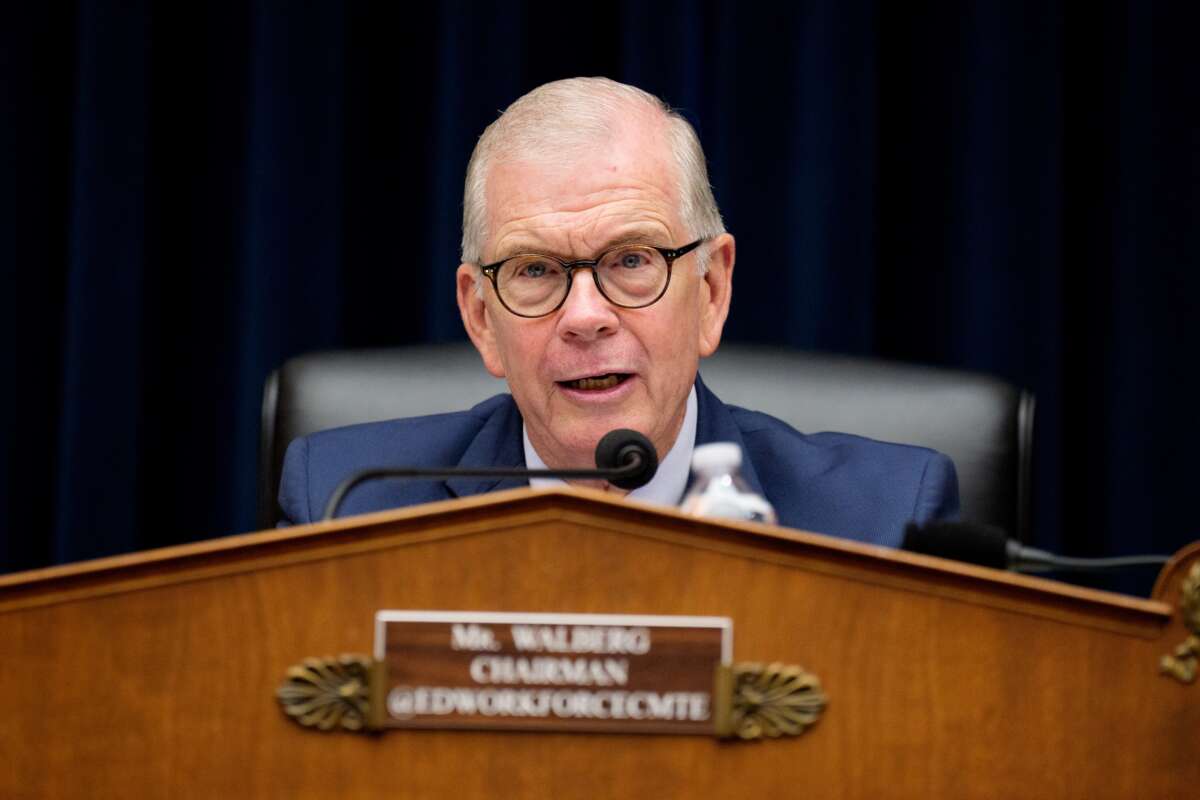
Chairman Rep. Tim Walberg speaks as Labor Secretary Lori Chavez-DeRemer appears for a House Committee on Education and Workforce hearing on Capitol Hill on June 5, 2025, in Washington, D.C.Andrew Harnik / Getty Images


In late 2023, Rep. Virginia Foxx of North Carolina made headlines when she used her position as chair of the U.S. House Committee on Education and Workforce to stage something akin to a show trial. Committee members berated the presidents of Harvard, the Massachusetts Institute of Technology, and the University of Pennsylvania about their failures to confront alleged antisemitism on their campuses. In the fallout from the hearings, both Penn’s and Harvard’s presidents resigned.

No longer the committee chair, Foxx now has a successor in Rep. Tim Walberg, a hard right Michigan Republican who has wasted little time carrying on Foxx’s work. Under Walberg’s leadership, the House Committee on Education and Workforce has continued weaponizing charges of antisemitism to attack labor unions and universities.

And just like Foxx, whom Truthout profiled in early 2024, Walberg is backed by a slew of wealthy donors who have long worked to undermine the labor movement, remake higher education, privatize public schools, attack teachers unions, and bolster support for Israel. These donors range from former Trump education secretary Betsy DeVos, to a former president and current board member of AIPAC who is one of Michigan’s top political donors, to Marc Rowan, the private equity billionaire who has played a critical role in the ongoing assault on higher education and Palestine solidarity.

Mapping out key figures in the donor network behind Tim Walberg makes one thing clear: Supporters of the labor movement, defenders of universities and public education, and people who care about freedom and justice for Palestinians have common opponents in Walberg and the nexus of conservative and corporate power backing him.
Committee Hearings

Under Walberg, who is serving his ninth term in Congress and represents Michigan’s 5th district, the House Committee on Education and Workforce has launched investigations and hearings into alleged antisemitism at universities and public schools and within labor unions. Its investigations often draw on the International Holocaust Remembrance Alliance definition of antisemitism, which can be wielded to equate any criticism of Israel and Zionism with hatred toward Jewish people. This distorted definition has been weaponized to repress expressions of solidarity with Palestine against the backdrop of Israel’s genocide in Gaza and Israel’s decades-long occupation of Palestinian land.

Related Story

Pro-Israel Billionaires Line Up Behind NC Republican Leading Campus Witch Hunt
Virginia Foxx uses her position of influence to amplify the GOP’s war on universities through congressional hearings. By Derek Seidman , Truthout March 9, 2024


For example, the committee held hearings in September titled “Unmasking Union Antisemitism” that focused on the United Electrical Workers and United Auto Workers, which were among the earliest unions to back a ceasefire in Gaza and an arms embargo on Israel. One of the testifiers at the hearings was a longtime staff attorney with the Koch-aligned National Right to Work Legal Defense Foundation, which is dedicated to crushing the labor movement and helped argue the 2018 Janus v. AFSCME case in which the Supreme Court ruled that government workers aren’t required to pay dues to unions that represent them in bargaining.

In September 2025, Walberg sent a letter to the National Education Association stating that the House Committee on Education and Workforce was investigating the union for alleged “antisemitism,” and announcing it as an investigation into the NEA’s “Jew-hatred” on his website. Walberg’s letter noted “serious concerns that antisemitism has infected the nation’s largest teachers’ union,” citing, for example, the vote by the NEA members to break with the Anti-Defamation League, which has been criticized for inflating its tally of antisemitic incidents by including criticism of Israel and Zionism, and for targeting the anti-Zionist left and equating criticism of Israel with far right, white supremacist extremism.

The committee is also targeting universities and medical schools. Their investigations and hearings also cherry-pick extreme and outlying examples as means for broadly attacking universities, labor unions, and Palestine solidarity.

Walberg’s investigations and hearings exist within a wider constellation of efforts to instrumentalize charges of antisemitism toward a converged assault on labor unions, higher education, public education, the Palestine solidarity movement, and the U.S. left, ranging from the Heritage Foundation’s Project Esther to attacks by billionaire-backed groups and Zionist organizations on unions like the Massachusetts Teachers Association and United Teachers Los Angeles.

Far Right Politics and Israel Support

Walberg has taken a host of far right positions. He backed the December 2020 effort to overturn Joe Biden’s victory in Michigan and voted to overturn the 2020 election results immediately after the January 6, 2021 capital insurrection.

Walberg is a staunch proponent of school “choice” and weakening of federal oversight of education, and was “delighted” by Trump’s executive order closing the Department of Education. Walberg’s own constituents haveprotested his education policies. He also backs federal and state right-to-work laws and has supported efforts to incapacitate the National Labor Relations Board.

Speaking about climate change in 2017, Walberg said that “if there’s a real problem, [God] can take care of it.” Walberg’s top corporate donors have included utility and fossil fuel giants like DTE Energy, CMS Energy, and Koch Industries.

Walberg faced major backlash when he spoke at Uganda’s National Prayer Breakfast in early 2024 and appeared to endorse the country’s draconian anti-homosexuality law, though Walberg subsequently tried to distance himself from the comments.

Walberg is also a staunch backer of Israel. Speaking at the University of Michigan in 2019, he praised the “moral clarity” of Israeli Prime Minister Benjamin Netanyahu, who is currently indicted for war crimes by the International Criminal Court. “In his presence, I understand very clearly he knows good from evil, right from wrong, success from failure,” said Walberg.

The Michigan Daily reported that “a large reason” Walberg “is adamant about the United States supporting Israel is because he believes God supports Israel.” Before joining Congress, Walberg was a division leader of the Moody Bible Institute, a conservative evangelical private college.

Walberg made headlines in March 2024 when he told constituents that “[w]e shouldn’t be spending a dime on humanitarian aid” in Gaza and that “[i]t should be like Nagasaki and Hiroshima.”

One of Walberg’s top backers is the American Israel Public Affairs Committee (AIPAC), whose PAC channeled $60,656 to Walberg between April 2022 and August 2025. AIPAC was the top donor to Walberg’s campaign committee during the 2021-2022 and 2023-2024 election cycles.


Pro-Israel and Anti-Palestine Solidarity Donors


Walberg’s donor network is dominated by wealthy elites dedicated to attacking unions, privatizing education, and advancing corporate interests. Key donors are also influential with the pro-Israel lobby.

One major Walberg backer is Edward C. Levy Jr., a construction company magnate who once called Henry Kissinger a “close friend” and is one of Michigan’s most prolific political donors. Levy Jr. and his wife Linda Dresner Levy have given at least $77,600 to Walberg since 2006, including $47,200 since 2020.

A 2010 profile of Levy Jr. noted that “a love for Israel drives him.” Levy Jr. recalled visiting Israel in 1951, where his father, Ed Levy Sr., had built a rock quarry and crushing plant, to train Israelis to operate the equipment. “They’re great at killing Arab enemies, but they’re also great at killing machinery,” Levy Sr. told his son.

Levy Jr. joined AIPAC in the 1960s and rose to become AIPAC’s president in 1988. Today, he remains on AIPAC’s board of directors. He and his wife are enormous donors to AIPAC, giving over $1.1 million to three AIPAC-tied PACs since 2020 alone.

Walberg celebrated the centennial of Levy Jr.’s company, Edw. C. Levy Co., in the Congressional record in 2017.

One of Walberg’s most noteworthy infusions of new donations has come from Marc Rowan, the billionaire head of Apollo Global Management, a top private equity firm.

Rowan has helped spearhead attacks on the campus Palestine solidarity movement over the past two years. He is a big donor to the University of Pennsylvania and chairs the board of Penn’s Wharton Business School. In late 2023, he led a donor revolt over a Palestinian literary festival held at Penn and drove the successful effort to oust Penn President Liz Magill.

Just over a month after Magill’s resignation, which came days after Virginia Foxx staged the “antisemitism” hearings with Magill and other university presidents on December 5, 2023, Rowan and his wife donated $13,300 to Foxx and soon hosted a fundraiser for her.

Now, Rowan is showering donations on Foxx’s successor as House Committee on Education and Workforce chair. After never donating to Tim Walberg, Rowan and his wife Carolyn gave him $21,000 on March 19, 2025, a few months after Walberg was elected the committee’s chair. The PAC for Apollo Education Group, which Apollo owns, gave another $5,000 to Walberg in June 2025 and $2,500 in September 2024.

Rowan has been revealed as a key architect behind Donald Trump’s effort to strongarm “compacts” with universities tied to federal funding. A recent investigation into the Anti-Defamation League also suggested that Rowan has helped drive the group’s attacks on the pro-Palestine “radical left.”


Union Opponents and School Privatizers


Billionaire Betsy DeVos and her family are also longtime backers of Walberg, having donated at least $76,700 to Walberg since 2007.

The DeVoses, whose family fortune is derived primarily from their privately-owned corporation, Amway, are power players in Michigan, consistently ranking among the state’s top donors to right-wing candidates and causes.

DeVos has long attacked public education, and as Trump’s education secretary from 2017 to 2021 — a stint applauded by Walberg — she scaled back civil rights protections, reversed support for student borrowers, and pushed “school choice.”

The DeVoses are part of the Koch-aligned donor network that pushes an anti-regulatory, pro-privatization agenda. They’ve poured millions into trying to make Michigan a right-to-work state and repealing the state’s prevailing wage laws.

In 2019, DeVos called campus BDS efforts a “pernicious threat,” adding that “we all know that BDS stands for anti-Semitism.”

Real estate baron Ron Weiser has worked in close alliance with the DeVoses in pushing anti-labor legislation in Michigan.

Weiser has served three stints as the chair of the Michigan GOP and has given big to Trump. He’s a board director of the Republican Jewish Coalition, which has celebrated the crackdown against pro-Palestine student protesters and the arrests of Mahmoud Khalil and Badar Khan Suri.

Like Levy Jr. and the DeVoses, Weiser is a powerful figure in Michigan’s ruling class. He’s showered tens of millions of dollars on the University of Michigan and served on the Board of Regents from 2016 to 2024.

As Regents’ chair, Weiser referred to graduate workers engaged in collective bargaining as “hired student hacks” and faced a range of other controversies, including calling Michigan’s top women political leaders the “three witches.”

Weiser and his spouse have given $147,035 to Walberg since 2006, including almost $75,000 since 2021. Weiser also gave $50,000 to AIPAC-aligned PACs in 2024.


Shared Opponents, Common Cause


Richard (Dick) and Ethie Haworth have used their furniture business fortune to support conservative efforts in Michigan, giving huge sums to DeVos-aligned, pro-school privatization, and anti-union PACs and groups like Michigan Families United, Let MI Kids Learn, and Michigan Freedom Network.

The Haworths are also trustees of the Eagle Feather Foundation of the National Christian Charitable Foundation, a donor-advised fund that has channeled donations to Christion Zionist groups like Christians United for Israel, Christian Friends of Israel, and Israel Allies Foundation, as well as nearly two dozen organizations labeled by the Southern Poverty Law Center as hate groups.

The Haworths have given Walberg at least $87,700 since 2024 and $132,500 since 2007.

The donor money and political efforts of the DeVoses, Haworths, and other rightwing backers of Walberg converge on the Mackinac Center, a rightwing think tank that is Michigan’s only affiliate of the Koch-backed State Policy Network.

The Mackinac Center runs a legal foundation that takes anti-union cases. Dick Haworth and Levy Jr., recently honored by the Mackinaw Center, both serve on its board.

The billionaires and multimillionaires atop Walberg’s donor list have long supported attacks on labor, public education, universities, and Palestine solidarity. Now, Walberg is continuing Virginia Foxx’s strategy of staging hearings and investigations that weaponize antisemitism to advance those attacks. But for movements defending these causes, there’s also a strategic takeaway in mapping out Walberg’s donor base: They have common cause in their shared ultra-wealthy, far right opponents.


This article is licensed under Creative Commons (CC BY-NC-ND 4.0), and you are free to share and republish under the terms of the license.


Derek Seidman
Derek Seidman is a writer, researcher and historian living in Buffalo, New York. He is a regular contributor for Truthout and a contributing writer for LittleSis.
'Scared of crossing' Trump: Anger follows new report on America's privileged


(REUTERS)

October 25, 2025
COMMON DREAMS

Even as they acknowledged that only the public opposition of people in power would rein in President Donald Trump’s attacks on democracy and the rule of law, a number of political, military, business, and academic elites made clear Friday that they “are scared of crossing” the president.

In a column published on Friday in the Financial Times, Edmundv Luce revealed that he has been talking with “dozens of figures, including lawmakers, private sector executives, retired senior military figures and intelligence chiefs, current and former Trump officials, Washington lawyers, and foreign government officials,” and he found that the vast majority asked to remain anonymous for fear of attacks from the president and his administration.

“Such is the fear of jail, bankruptcy, or professional reprisal, that most of these people insisted on anonymity,” Luce explained. “This was in spite of the fact that many of the same people also wanted to emphasize that Trump would only be restrained by powerful voices opposing him publicly.”

Trump’s revenge campaign against his foes has taken many forms, Luce found. The most high-profile examples have been instances in which the president has personally pushed for officials at the US Department of Justice to criminally indict many longtime adversaries, including New York Attorney General Letitia James, former FBI Director James Comey, and John Bolton, Trump’s own former national security adviser.

Luce also learned that the administration has been waging pressure campaigns on private employers to blacklist former Biden administration officials and other opponents from being offered jobs.

“Every employer says something along the lines of ‘We’d love to hire you but it’s not worth the risk,’” one former Biden White House staffer told Luce. “All they offer me is apologies.”

Former Biden national security adviser Jake Sullivan, who is now a professor at Harvard University, told Luce that he spends much of his time “trying to help former colleagues find jobs” because so few employers are willing to chance angering the president.

Military officials who spoke with Luce expressed fears that the US armed forces will not resist Trump, as they did in his first term, were he to give them illegal orders. One retired four-star general said he worried that Dan Caine, the current chairman of the Joint Chiefs of Staff, would not refuse to carry out requests to have the military interfere with elections, as many officials did in 2020 when Trump tried to get the US Army to seize voting machines in swing states that he had lost to former President Joe Biden.

“Caine has the thinnest background to run the military at its most difficult stress test in modern history,” the general said.

Many Trump critics who read Luce’s reporting found it appalling that so many wealthy and powerful Americans were afraid to publicly criticize the president.

“When all this is over, we need to have a pretty serious conversation about the utter moral failure of the elite of this country,” remarked Leah Greenberg, co-founder and co-executive director of Indivisible, on Bluesky.

Brendan Nyhan, a political scientist at Dartmouth, said that Luce’s reporting shows “how much opposition we never see or hear because people fear reprisal” from the president.

Bradley Moss, a national security attorney who was one of Luce’s few sources willing to speak on the record, wrote on Bluesky that more elites needed to start speaking out against the president and his authoritarian ambitions.

“I am disappointed in those who think keeping quiet will save them,” he said. “It will not.”

Ryan Enos, a political scientist at Harvard University, acknowledged the dangers outlined in Luce’s column but also pointed out reasons for hope.

“This wannabe dictator is also extremely unpopular and those of us with the courage to stand up have the American people on our side,” he argued. “It’ll take courage and focus, but democracy can win.”

The elites interviewed by Luce expressed their reticence to publicly speak out against Trump days after more than 7 million people gathered at thousands of “No Kings” protests condemning the president’s authoritarian agenda—despite the administration’s threats against protest movements. Residents in cities including Portland, Oregon and Chicago have also resisted federal agents carrying out Trump’s mass detention and deportation campaign.
Only the 'crazies' and 'lizard people' left after Trump purges the press corps: analysis


A LindellTV reporter smiles for the camera after getting blasted by US Rep. Nancy Pelosi (D-Calif.) for lying to audiences.(YouTube screengrab)
October 25, 2025 |
 ALTERNET


When Secretary of Defense Pete Hegseth demanded journalists agree not to report anything without formal authorization from the Defense Department, he sent a mass evacuation of legitimate media from the press corps.

What’s left, writes Slate reporter Molly Olmstead, is … really something.

“The Pentagon has remade its press corps, and we’re starting to get an understanding of which people now are allowed access to the halls of power,” said Olmstead, who included a list of the “top hits” that Hegseth’s considers “valid journalism of interest to the public.”

MyPillow CEO Mike Lindell “peddled his 2020 election conspiracy theories through a number of avenues, including his video streaming site,” wrote Olmstead. “As a result, LindellTV has been subject to the same defamation lawsuits that Lindell himself courted, but it carries on with a host of right-wing shows, including the signature Mike Lindell Show.”

LindellTV’s reporters frequently pester Democrats with MAGA lies dressed up as legitimate questions, prompting Nancy Pelosi to publicly snap at them for churning nonsense and MSNBC hosts to blast them for spreading lies to a LindellTV audience that is “too stupid to know the truth.”

And when their reporters are not spouting lies, Olmstead says they’re fawning over President Donald Trump’s “fitness plan” and asking press secretary Karoline Leavitt when Trump plans to go public with it.

Another sycophantic organization still hanging around is The One America News network, which Olmstead describes as “about as extreme as it gets without tipping fully into Alex Jones lizard-people territory.”

“It has promoted hydroxychloroquine as a ‘miracle cure’ for COVID; spread ominous conspiracy theories about George Soros; speculated that Michael Cohen, not Donald Trump, had an affair with Stormy Daniels; and declared that Roy Moore was innocent and actually won his election,” said Olmstead. “It has also hired Matt Gaetz as a host.”

“Human Events” is another example of the lingering press corps flotsam, said Olmstead.

“This is the latest home for Jack Posobiec, a content creator so inflammatory that being seen as cozy with him — as Hegseth was, in inviting Posobiec on an overseas trip — can lead to major scandal,” said Olmstead. “Posobiec, who has connections to various hate groups, is known primarily as the man behind Pizzagate. … He remains extreme: “Welcome to the end of democracy. We are here to overthrow it completely,” he said at last year’s Conservative Political Action Conference.

The Navy revoked Posobiec’s security clearance as a U.S. naval intelligence officer on reserve, after his involvements with the Unite the Right white supremacist rally.

The list continues with spurious far-right networks like the National Pulse, whose leader was so inflammatory that Australia’s Labor Party asked to ban him from the country, Olmstead reports. Another is The Epoch Times, which Olmstead points out has been charged with money laundering and is “a dedicated promoter of right-wing conspiracy theories, going so far as to create a network of YouTube channels amplifying hoaxes and election misinformation.

The list goes on, and Olmstead said all will “inevitably benefit from a veneer of legitimacy from the credentialing and from the ‘scoops’ they’re given.”

Read the Slate report at this link.


People who believe lies often care more about seeming tough than being factual: scientists


A protester holds a sign saying "Trump wins" at a rally in support of U.S. President Donald Trump at the Oregon State Capitol in Salem, Oregon, U.S. January 6, 2021. 
REUTERS/Terray Sylvester


October 16, 2025


Why do some people endorse claims that can easily be disproved? It’s one thing to believe false information, but another to actively stick with something that’s obviously wrong.


Our new research, published in the Journal of Social Psychology, suggests that some people consider it a “win” to lean in to known falsehoods.

We are social psychologists who study political psychology and how people reason about reality. During the pandemic, we surveyed 5,535 people across eight countries to investigate why people believed COVID-19 misinformation, like false claims that 5G networks cause the virus.

The strongest predictor of whether someone believed in COVID-19-related misinformation and risks related to the vaccine was whether they viewed COVID-19 prevention efforts in terms of symbolic strength and weakness. In other words, this group focused on whether an action would make them appear to fend off or “give in” to untoward influence.

This factor outweighed how people felt about COVID-19 in general, their thinking style and even their political beliefs.

Our survey measured it on a scale of how much people agreed with sentences including “Following coronavirus prevention guidelines means you have backed down” and “Continuous coronavirus coverage in the media is a sign we are losing.” Our interpretation is that people who responded positively to these statements would feel they “win” by endorsing misinformation – doing so can show “the enemy” that it will not gain any ground over people’s views.

When meaning is symbolic, not factual

Rather than consider issues in light of actual facts, we suggest people with this mindset prioritize being independent from outside influence. It means you can justify espousing pretty much anything – the easier a statement is to disprove, the more of a power move it is to say it, as it symbolizes how far you’re willing to go.

When people think symbolically this way, the literal issue – here, fighting COVID-19 – is secondary to a psychological war over people’s minds. In the minds of those who think they’re engaged in them, psychological wars are waged over opinions and attitudes, and are won via control of belief and messaging. The U.S. government at various times has used the concept of psychological war to try to limit the influence of foreign powers, pushing people to think that literal battles are less important than psychological independence.

By that same token, vaccination, masking or other COVID-19 prevention efforts could be seen as a symbolic risk that could “weaken” one psychologically even if they provide literal physical benefits. If this seems like an extreme stance, it is – the majority of participants in our studies did not hold this mindset. But those who did were especially likely to also believe in misinformation.

In an additional study we ran that focused on attitudes around cryptocurrency, we measured whether people saw crypto investment in terms of signaling independence from traditional finance. These participants, who, like those in our COVID-19 study, prioritized a symbolic show of strength, were more likely to believe in other kinds of misinformation and conspiracies, too, such as that the government is concealing evidence of alien contact.

In all of our studies, this mindset was also strongly associated with authoritarian attitudes, including beliefs that some groups should dominate others and support for autocratic government. These links help explain why strongman leaders often use misinformation symbolically to impress and control a population.

Why people endorse misinformation

Our findings highlight the limits of countering misinformation directly, because for some people, literal truth is not the point.

For example, President Donald Trump incorrectly claimed in August 2025 that crime in Washington D.C. was at an all-time high, generating countless fact-checks of his premise and think pieces about his dissociation from reality.

But we believe that to someone with a symbolic mindset, debunkers merely demonstrate that they’re the ones reacting, and are therefore weak. The correct information is easily available, but is irrelevant to someone who prioritizes a symbolic show of strength. What matters is signaling one isn’t listening and won’t be swayed.

In fact, for symbolic thinkers, nearly any statement should be justifiable. The more outlandish or easily disproved something is, the more powerful one might seem when standing by it. Being an edgelord – a contrarian online provocateur – or outright lying can, in their own odd way, appear “authentic.”

Some people may also view their favorite dissembler’s claims as provocative trolling, but, given the link between this mindset and authoritarianism, they want those far-fetched claims acted on anyway. The deployment of National Guard troops to Washington, for example, can be the desired end goal, even if the offered justification is a transparent farce.

Is this really 5-D chess?

It is possible that symbolic, but not exactly true, beliefs have some downstream benefit, such as serving as negotiation tactics, loyalty tests, or a fake-it-till-you-make-it long game that somehow, eventually, becomes a reality. Political theorist Murray Edelman, known for his work on political symbolism, noted that politicians often prefer scoring symbolic points over delivering results – it’s easier. Leaders can offer symbolism when they have little tangible to provide.

Randy Stein, Associate Professor of Marketing, California State Polytechnic University, Pomona and Abraham Rutchick, Professor of Psychology, California State University, Northridge

This article is republished from The Conversation under a Creative Commons license. Read the original article.