Thursday, October 30, 2025

Nigeria's NNPCL weighs technical equity partnerships to revive idle state-owned refineries

Nigeria's NNPCL weighs technical equity partnerships to revive idle state-owned refineries
/ NNPCL
By bne IntelliNews October 30, 2025

The Nigerian National Petroleum Company Limited (NNPCL) says it has begun a fresh review of the country’s three state-owned refineries, signalling yet another attempt to revive facilities that have remained largely idle despite repeated rehabilitation efforts.

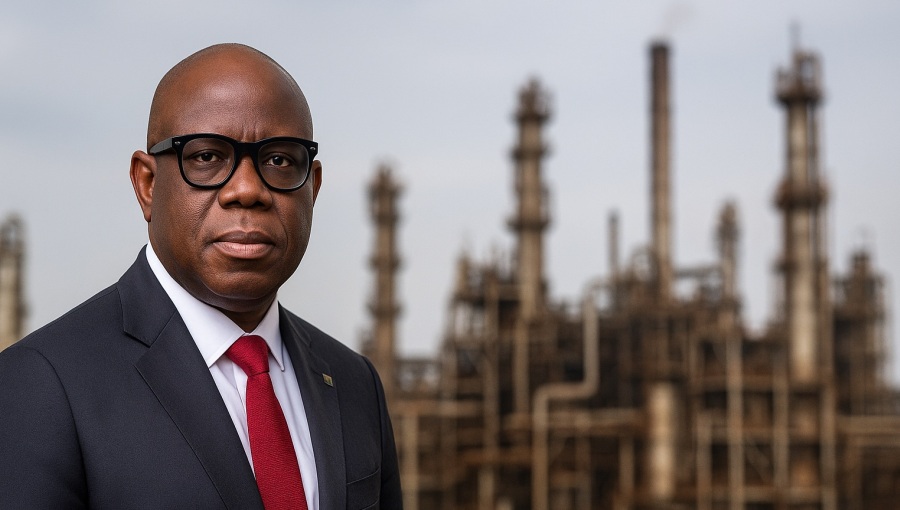
Group CEO Bayo Ojulari disclosed the development on his X account, noting that the company is assessing several options to restore reliable refining capacity. NNPCL could seek technical equity partners to “high-grade or repurpose” the plants, he said, in what would represent a shift from previous government-led overhaul programmes.

The approach would involve external operators taking equity positions in the Port Harcourt, Warri and Kaduna refineries, which operated at minimal capacity for more than a decade,  alongside responsibility for operational performance, maintenance and technology upgrades.

“We are filled with determination! We are looking ahead with optimism to ensure our refineries operate effectively. We are dedicating significant time to a detailed review and are eager to implement our insights,” Ojulari wrote on X.

“What fuels our drive is the understanding that the prosperity of the Nigerian states and the future success of Nigeria will always take precedence over any individual interests. This very commitment inspires us as we anticipate creating sustainable solutions for our refineries in the near future. #Nigerianrefineries #willwork”.

Despite spending an estimated $3bn on rehabilitation and turnaround maintenance in recent years, only a 60,000-bpd segment of the Port Harcourt complex briefly came online before operations were suspended after short test runs. For long stretches, domestic fuel supply has relied almost entirely on imports.

Securing qualified downstream partners would require clarity on plant ownership structures, feedstock supply arrangements, product pricing frameworks and long-term investment protection. Previous talks with international oil companies and trading firms stalled over concerns about regulated pricing and foreign exchange liquidity.

NNPCL says it remains committed to restoring local refining capacity to reduce import dependency and save foreign exchange. The company is also counting on the gradual ramp-up of production at the privately owned 650,000-bpd Dangote refinery, which began supplying fuel to the domestic market this year, although distribution volumes remain limited during its phased start-up.

That refinery’s owner, billionaire Aliko Dangote, estimated in July that the federal government may have spent over $18bn over the years to revamp the Port Harcourt, Warri and Kaduna refineries without results, ThisDay reported.

The Port Harcourt refinery rehabilitation project has been led by Maire’s (BIT: MAIRE) Tecnimont, under a contract awarded in 2021. Warri and Kaduna refineries have undergone separate repair programmes, though progress updates have been sporadic and timelines have slipped.

Ojulari indicated that the latest review is still at an early stage, and no decisions have been made on which facilities would be prioritised or whether repurposing could include conversion to petrochemical or modular refining configurations. He said NNPCL remains “optimistic” that the plants can be restored to efficient operation.


Erdogan says Turkey “couldn’t even produce a sewing needle” before he came to power, sparks storm of criticism

Erdogan says Turkey “couldn’t even produce a sewing needle” before he came to power, sparks storm of criticism
Delusions of grandeur? Erdogan has been accused of belittling Turkish eras of industrial development that came long before his rise to prominence. / DonkeyHotey, cc-by-2.0
By bne IntelliNews October 30, 2025

President Recep Tayyip Erdogan on October 28 sparked a storm of criticism after claiming that Turkey “could not even produce a sewing needle” 25 years ago.

Opposition politicians and critics said the statement amounted to a dismissal of decades of pre-Erdogan industrial development.

Erdogan and his Justice and Development Party (AKP) have ruled Turkey for nearly 23 years.

Turkey’s leader made the remarks during an inauguration ceremony held for Turkish contractor BMC’s new battle tank, the Altay, and next-generation armoured vehicle production facility in Ankara. The event took place a day before the 102nd anniversary of the founding of the Republic of Turkey.

“Let me take you back 20 to 25 years. Could we produce a sewing needle in our country back then? I’m not even talking about weapons. But now, thank God, Turkey is producing its own weapons. We couldn’t produce even 20 percent of our defence needs then, but now we’ve reached 80 percent,” Erdogan was quoted as saying by Turkish Minute.

Some critics pointed out that Turkey has been manufacturing sewing needles since the 1950s. Istanbul-based Atli Needle and Machinery Company, founded in 1951, produced the country’s first domestically made sewing needles, they said.

Main opposition Republican People’s Party (CHP) deputy chairman Yanki Bagcioglu, a former rear admiral, observed that Turkey had been building naval vessels decades before the AKP came to power.

“The country’s current technological capability is built on decades of effort. … While trying to glorify one era for political purposes, one should not belittle the earlier periods that laid the foundations for today,” he added.

Leader of the small opposition IYI Party, Musavat Dervisoglu, tweeted that aircraft factories, sugar factories, textile mills, iron and steel plants, shipyards, paper and cement factories, tobacco factories, power plants, dams, weapons factories and chlorine plants were all established within the first 15 years of the Turkish Republic.

Dervisoglu added that “we weren’t living in caves before the AKP came to power”.


Viktor Orban facing delicate balancing act to persuade Donald Trump to ease pressure on Hungary over Russian sanctions

Viktor Orban facing delicate balancing act to persuade Donald Trump to ease pressure on Hungary over Russian sanctions
Viktor Orban last met Donald Trump in Washington earlier this year. / Facebook/Viktor Orban
By bne IntelliNews October 30, 2025

US President Donald Trump is scheduled to meet Hungarian Prime Minister Viktor Orban on November 8, though the location of the talks has yet to be confirmed, Bloomberg reported on October 29. According to local analysts, Orban will try to persuade Trump to ease the pressure on Hungary from decoupling from Russian fossil fuel at least until the April election.

Foreign Minister Péter Szijjarto said earlier this week that the Hungarian premier would hold talks with Trump next week to discuss ways to shield Hungary from the effects of the latest US sanctions targeting Russia’s two largest oil groups. The measures had so far had no impact on Hungary’s Russian energy imports, he added.

Speaking in Rome, Orban said he was "particularly interested in finding a workable system for the Hungarian economy," noting that Hungary was heavily dependent on Russian oil and gas, without which prices would skyrocket and there would be severe supply shortages.

Hungary continues to rely on Moscow for most of its oil and gas imports, in contrast with many EU member states that have sought to reduce their dependence since Russia’s full-scale invasion of Ukraine.

The Hungarian government has argued that its geographic position leaves it little alternative but to rely on Russian energy, though it could also import oil via the Adriatic pipeline.

US Ambassador to NATO Matthew Whitaker rejected Hungary’s arguments in a Fox News interview on October 26 saying the country had still "not made any active steps" to end its dependence on Russian oil. He added that Washington would continue to work with Hungary and its neighbours, including Croatia, to help diversify energy sources.

Hungary’s MOL and Croatian state-owned Janaf had been in dispute over the viability of supplies. Local analysts note that the lack of political will from Budapest is hindering an agreement with Zagreb. Government officials also warned that relying on a single channel of supply poses security risks for Hungary.

Preparations for the upcoming Trump-Orban meeting are under way. Hungary is also seeking to restore the double taxation avoidance agreement between Hungary and the United States, Index.hu writes after the Secretary of the Economy Ministry held discussions in Washington with senior officials of the US Department of the Treasury.

In a separate article, independent Hvg.hu highlighted a BBC report by the broadcaster’s Budapest-based correspondent, published under the telling headline “Orban’s dilemma: Russian oil or Trump’s favour”.

The Hungarian prime minister, whom Trump has publicly praised as a "great leader", and who has long enjoyed admiration from MAGA circles, finds himself at odds with the US president for the first time over a matter of strategic and economic significance, Nick Thorpe writes.

According to the report, Orban hopes the Washington meeting will ease US pressure ahead of next year’s Hungarian election, where energy security and the cost of living will be a major campaign issue. Europe’s longest-serving prime minister and his nationalist Fidesz party is trailing in most polls behind an opposition challenge led by former Fidesz cadre Peter Magyar.

While Trump is likely to push for stronger action from Budapest, Orban faces a difficult balancing act: maintaining his stance on cheap Russian energy while preserving his close ties with his ally in the White House.

The BBC story noted that the Czech Republic, which faced similar geographic and technical challenges, has already eliminated Russian oil imports after upgrading its Transalpine pipeline link to Trieste and adapting refineries to process non-Russian crude.

The Hungarian government warned that weaning itself off Russian crude and gas would lead to skyrocketing prices, but that argument is undermined by the Czech example as there is no data that Czech consumers have to pay more, the BBC concludes.

Tanzania: Hundreds defy lockdown in second day of protests

DW with Reuters, AFP
Issued on: 30/10/2025 

Government workers and students had been ordered to stay home after violence marred voting in the East African country.
Tanzanians voted on Wednesday in elections in which the main challengers were either jailed or barred from running

Image: Marco Longari/AFP

Streets in Tanzaniasaw another round of demonstrations on Thursday, a day after a general election marred by violence. Protesters gathered in at least three neighborhoods in the commercial hub of Dar es Salaam, where police fired tear gas and gunshots to disperse the crowds, witnesses told Reuters.

The unrest in Dar es Salaam and other cities began on Wednesday over the exclusion of opposition candidates. While results are still to come, President Samia Suluhu Hassan is expected to cement her position for a second term in office.

Her party, Chama Cha Mapinduzi (CCM), has governed since Tanzania's independence in 1961.

The AFP news agency cited a diplomatic source saying that protests continued into the night despite a curfew imposed on Wednesday.

What the government has said

"All public servants in the country should work from home except those whose job duties require them to be present at their workplaces as directed by their employers," said a post on the Instagram account of government spokesperson Gerson Msigwa late on Wednesday.

Tanzania's state broadcaster also announced that students should remain at home on Thursday.

The French AFP news agency also reported that the internet blackout was still in place on Thursday, a day after the election, citing a diplomatic source.

The same source said that military and police checkpoints were in place in and around Dar es Salaam.

Covering Wednesday's polls has proven difficult as many journalists, both local and international, were denied accreditation.

Those who attempted to enter polling stations were not allowed to take photos.

In Ubungo, Dar es Salaam, witnesses on Wednesday told DW there had been opposition protests and that some polling stations had been vandalized.
Presidential poll without main opposition parties

Tanzania's largest opposition party, Chadema, boycotted the presidential election after its leader Tundu Lissu was imprisoned and faces treason charges after calling for electoral reforms.

Luhaga Mpina, the presidential candidate for the second-largest opposing party, the Alliance for Change and Transparency (ACT-Wazalendo), was disqualified by the Independent National Electoral Commission.

Sixteen opposition candidates representing smaller parties were on the ballot but were not expected to be a challenge for President Samia Suluhu Hassan, who is widely expected to win a second term.

Edited by: Darko Janjevic

Curfew declared in Tanzania's main city after election-day protests


Authorities in Tanzania have imposed a curfew in Dar es Salaam, the country's biggest city, following violent unrest between the police and protesters that erupted during Wednesday’s general election which is expected to offer President Samia Suluhu Hassan a second term.


Issued on: 30/10/2025 - RFI

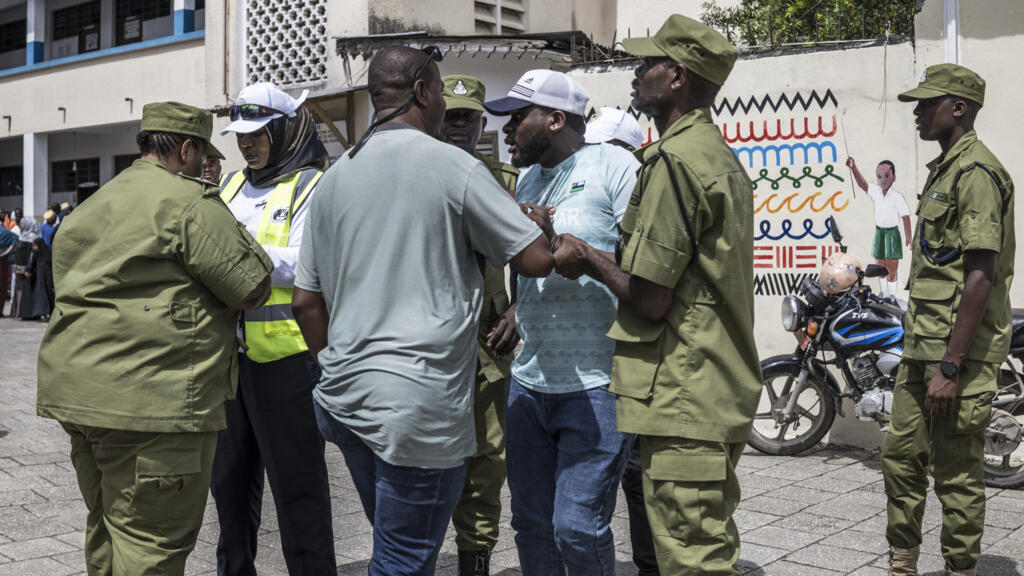
Tanzanian police officers detain a man (C) accused by electoral officials of attempting to taint the voting process at a polling station in Stone Town on 29 October, 2025. © AFP - MARCO LONGARI


Police in Tanzania's main city of Dar es Salaam fired gunshots and teargas on Thursday to disperse dozens of protesters who returned to the streets a day after elections were marred by violent demonstrations, Reuters reported.

Protests broke out in Dar es Salaam and several other cities during the presidential and parliamentary vote on Wednesday with demonstrators setting fire to vehicles and a local government office.

They are angered over the exclusion of Hassan's two biggest challengers from the presidential race, as well as what they say is increasing repression of government critics.

Police ordered an overnight curfew in Dar es Salaam, a city of more than seven million people, and internet access remains disrupted across the country. Global internet monitor NetBlocks described the interruption a "nationwide digital blackout".

The US embassy said that some major roads, including the main one leading to Dar es Salaam's international airport, were closed.

On the Zello app, some protesters discussed plans for further demonstrations, including marches on government buildings.

The government has remained silent and the heavily controlled local media made no mention of the unrest, nor provide any update on the election.

There are reports that upwards of 30 people may been killed in Wednesday's violence, a diplomatic source told AFP, but this could not be verified.

Tanzania blackout after election chaos, deaths feared


Civil servants and students told to stay home

In a post on his Instagram account, government spokesperson Gerson Msigwa said all civil servants should work from home on Thursday except for those whose duties require them to be present at their workplaces.

The state television channel also announced that students should study from home on Thursday.

Tanzania's main opposition party Chadema had called for protests during the election, which it said amounted to a "coronation" of Hassan.

Chadema was disqualified in April from the election, which also included votes for members of parliament and officials for the semi-autonomous Zanzibar archipelago, after it refused to sign a code of conduct. Its leader Tundu Lissu was charged with treason.

The commission also disqualified Luhaga Mpina – the candidate for the ACT-Wazalendo opposition party, leaving only minor parties to take on Hassan.

Reports say voter turnout in Dar es Salaam was low, with many people reluctant to show up amid safety concerns.

The electoral body is expected to announce results over the weekend.

Tanzanian opposition leader to represent himself in court over treason charges


Increasing censorship

Hassan is expected to win the election. Her ruling party, Chama Cha Mapinduzi – Swahili for “Party of the Revolution” (CCM), has dominated Tanzania politics and won all the elections since the country gained independence from Britain in 1961.

But the unrest presents a major test for Hassan.

She was initially praised after taking office in 2021 for easing repression of political opponents and censorship that had increased under her predecessor John Magufuli.

In recent years, however, rights campaigners and opposition candidates have accused the government of unexplained abductions of its critics.

Hassan said last year she had ordered an investigation into reports of abductions, but no official findings have been made public.

(with newswires)


Tanzania election protests trigger curfew; military deployed, internet cut

Tanzania election protests trigger curfew; military deployed, internet cut
/ SABC News
By bne IntelliNews October 29, 2025

Protests erupted across Tanzania on October 29, voting day in a general election widely seen as non-competitive, with President Samia Suluhu Hassan facing no major challenger after opposition figures were barred, detained, or withdrew in protest over electoral conditions.

Demonstrators clashed with security forces in Dar es Salaam, setting a bus and a gas station ablaze, prompting authorities to impose a curfew from 6 p.m., the Associated Press reports. The military was deployed in Dodoma, Zanzibar, and the commercial capital, while internet service was disrupted nationwide.

Hundreds demonstrated in the Kimara and Ubungo districts, with unrest also reported in Magomeni, Kinondoni and Tandale. Polling stations were vandalised in Arusha and Mbeya outside the capital.

Dar es Salaam Regional Commissioner Albert Chalamila said security agencies were prepared to deal with any “disruptors of peace.” The U.S. Embassy issued a security alert, warning of “country-wide” protests in Tanzania.

In the lead-up to the general election, opposition figures, activists, and government critics reported surveillance, intimidation and arbitrary detentions, while local civil society organisations said political rallies and dissent were increasingly restricted.

Tanzania’s main opposition party, Chadema, said it would boycott the presidential and parliamentary elections unless the government implemented what it calls "fundamental electoral reforms".

Preliminary results are expected on October 30, with the National Electoral Commission due to announce the final outcome within seven days.

Turnout was low, observers reported, particularly among young voters. University student James Matonya told the AP he did not vote because the election was a “one-horse race.”

Hassan assumed the presidency in 2021 following the death of John Magufuli. She is facing 16 candidates from smaller opposition parties. Tanzania has more than 37mn registered voters, a 26% increase from 2020.

Chadema’s disqualification in the contest came amid broader political tensions, including a treason charge brought in April against party leader Tundu Lissu, who was blocked from contesting. Another prominent opposition figure, Luhaga Mpina of ACT-Wazalendo, was also barred from seeking the presidency.

Early voting in Zanzibar by electoral and security officials was criticised by the ACT-Wazalendo party for alleged irregularities, including impersonation and the barring of party representatives. 

While Tanzania is a multiparty democracy, a version of Hassan's CCM – whose name translates as the Party of the Revolution – has been in power since the East African country won independence from Britain in 1961.

Rights and pro-democracy groups, such as Amnesty International and Freedom House, say that under Hassan, there has been a narrowing of political space, although her government maintains that legal processes are being followed.

David Omojomolo, Africa Economist at Capital Economics, wrote in a note to clients ahead of the vote Tanzania’s presidential election is likely to result in a win for incumbent Samia Suluhu Hassan and ongoing investments into infrastructure and the extractives sector will support strong GDP growth in the coming years.

“The key risk is post-election unrest – and a government backlash – which could call into question the concessional financing that Tanzania is reliant upon,” he said, adding that a key economic risk is how international donors like the IMF and World Bank perceive the government’s response to any unrest.

“The World Bank, for example, has in the past suspended disbursements – just last year an infrastructure project was halted due to complaints of excessive government force directed towards communities affected by a funded project.”

“The multilaterals are critical given how reliant Tanzania is on concessional financing. The IMF estimates that concessional financing is needed to cover around half of Tanzania’s gross financing needs (total fiscal financing needs), which are equal to around 6% of GDP per annum, over the coming years.

“A scenario where the IMF or World Bank were to be more reluctant to lend further to Tanzania would be particularly damaging given open questions as to whether Tanzania could successfully access international capital markets in its place – it has struggled to issue a Eurobond for some years, for example.”


South Korean parties clash over tariff deal with the United States

South Korean parties clash over tariff deal with the United States
/ Daniel Bernard - Unsplash
By bno - Busan Office October 30, 2025

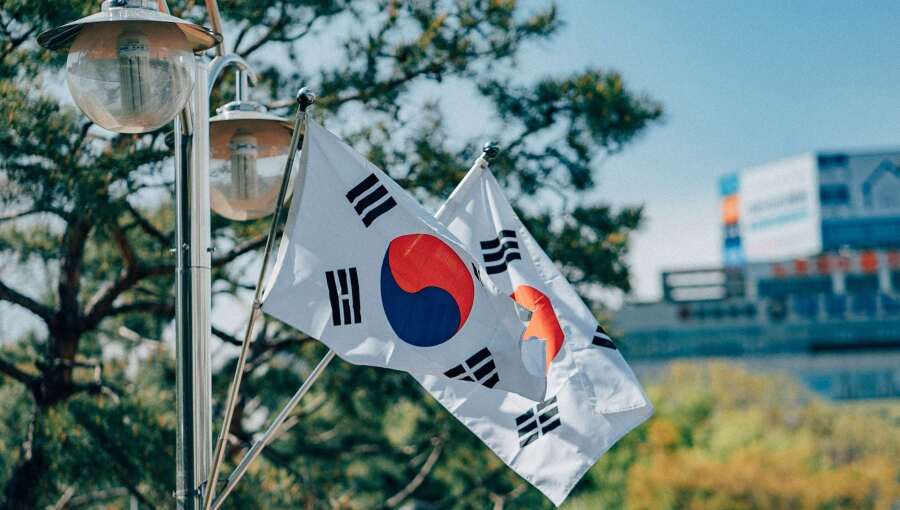
South Korea’s newly sealed tariff agreement with the United States has triggered sharply divided political reactions, Chosun Daily reports. The Democratic Party has celebrated the deal as a diplomatic success that protects national interests, while the conservative People Power Party argues that the government misled the public about the scale of South Korea’s cash investment in the United States.

Members of the Democratic Party praised the agreement, highlighting that tariff reductions on vehicles, auto parts, and adjustments to semiconductor-related duties are expected to remove uncertainty weighing on the country’s economy. They also stressed that key agricultural protections remained intact, preventing further market opening that could harm farmers and rural communities. According to leading Democratic figures, the outcome demonstrates effective and steady leadership from President Lee Jae-myung, with some lawmakers crediting his persistence for securing terms they believe support long-term economic stability. Party representatives even predicted that the agreement could fuel stock market optimism, with some pointing to new highs in the KOSPI index and forecasting continued growth.

According to Chosun Daily, Democratic Party officials expressed appreciation to the negotiation team, noting that 23 ministerial and working-level talks were required to reach the final result. They emphasised that the negotiators worked with a clear priority of advancing the country’s national interest, and several lawmakers characterised the result as a catalyst for a stronger manufacturing sector and enhanced export competitiveness.

In contrast, the People Power Party voiced strong concerns. The party acknowledged that the end of uncertainty is positive, but argued that the final terms are less favourable than Japan’s agreement with the United States. They criticised the government for previously stating that less than five per cent of the planned $350bn investment would be in cash. According to the opposition, committing $200bn in cash—about KRW284 trillion —contradicts earlier explanations and misled the public. They also criticised the absence of a currency swap agreement with the United States, which the government had previously presented as crucial for foreign exchange stability.

The opposition added that the investment plan could increase national debt and limit South Korea’s foreign exchange flexibility. They called for full transparency and insisted that the agreement must be reviewed and approved by parliament, in line with constitutional requirements.


Project Matador marks new South Korea-US nuclear collaboration

Project Matador marks new South Korea-US nuclear collaboration
/ Mick Truyts - Unsplash
By bno - Busan Office October 30, 2025

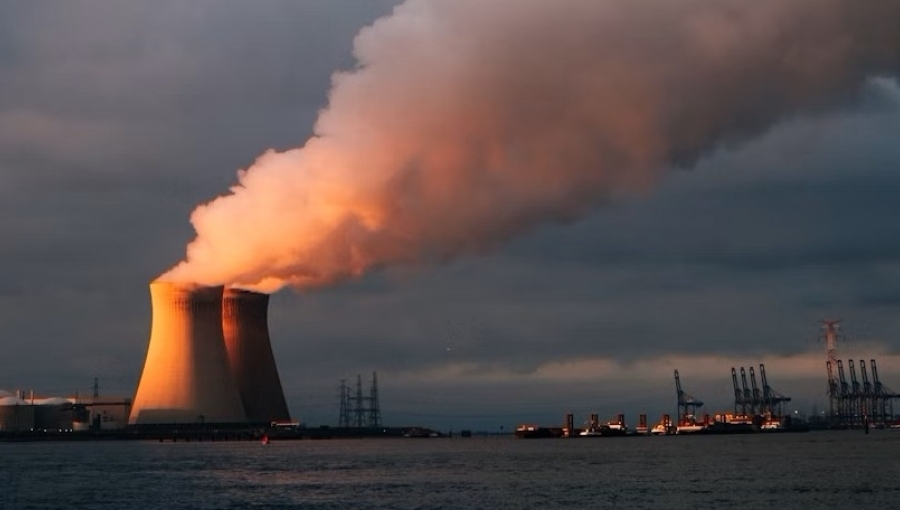
Fermi America, a private energy developer in the United States, is moving ahead with what could become one of the most significant privately financed clean energy projects globally. The developer has signed binding agreements with two South Korean power and engineering giants Doosan Enerbility and Hyundai Engineering & Construction to assist in constructing four AP1000 nuclear reactors in Texas. These reactors will serve as the main power source for a large-scale computing and energy campus designed to support advanced artificial intelligence systems. According to World Nuclear News, the project represents a shift in how data and computing centres could be powered in the future, as it aims to rely on reliable, clean and high-capacity power rather than public electricity grids.

Private energy ecosystem for AI

The development, named Project Matador, was announced in June and will be located in Amarillo, Texas, in partnership with the Texas Tech University System. World Nuclear News reports that the project is designed to function as a behind-the-meter HyperGrid campus, meaning it will generate and manage its own power on site and distribute it directly to energy-intensive computing rather than relying on public utilities.

Project Matador is intended to become the world’s largest energy-driven artificial intelligence complex. Once completed, the site will integrate nuclear power from the four Westinghouse AP1000 reactors with a vast combined-cycle natural gas facility, solar installations, battery energy storage and selective access to power from conventional utility grids. Fermi America expects the campus to deliver one gigawatt of energy by the end of 2026 from non-nuclear sources, giving the computing campus operating capacity while nuclear reactors undergo licensing and construction.

The developer views Project Matador not simply as an energy plant but as a new model for powering digital infrastructure. The concept is centred on maintaining energy independence and providing a stable power supply to artificial intelligence systems, reducing exposure to grid instability or power shortages.

Regulatory progress and construction timeline

On June 17, Fermi America submitted its Combined Operating Licence Application to the United States Nuclear Regulatory Commission. According to World Nuclear News, this application covers both the construction and operation of the four AP1000 reactors, and it was accepted for review in September. Reaching this stage places Fermi America ahead of many competing private nuclear proposals in the country.

The developer has already begun ground analysis and geotechnical work at the site. Fermi America plans to begin construction of the nuclear power complex next year, with the first reactor expected to become operational by 2032. World Nuclear News states that the remaining reactors will follow in subsequent phases. This timeline highlights the developer’s aim to bring nuclear energy to market more rapidly than past American nuclear projects, supported by proven technology and experienced partners.

Doosan Enerbility: component provider

To avoid delays that often occur due to equipment procurement, Fermi America has signed an agreement with Doosan Enerbility. World Nuclear News reports that under this agreement, Doosan will begin forging the large and complex reactor pressure vessels and steam generators, which are essential components for AP1000 reactors. These pieces require long lead times and specialised manufacturing capacity. By reserving production slots now, Fermi America positions itself ahead of other developers who may depend on the same supply chain.

Fermi America said that this early commitment ensures priority placement in the supply chain and demonstrates that Project Matador is transitioning from planning into execution. The agreement is described as a strategic step that keeps the project on schedule and reduces risk during later construction phases.

Hyundai Engineering & Construction: turning plans into designs

In parallel with the Doosan agreement, Fermi America has signed a Front-End Engineering Design contract with Hyundai Engineering & Construction. According to World Nuclear News, Hyundai will produce the engineering foundation for the reactors, including the overall site layout, evaluation of cooling solutions suitable for the climate in Texas, and a detailed budget and construction timeline for the first phase.

This contract builds on a memorandum of understanding signed in July between the two companies. Under that MoU, both parties committed to collaborate on planning and executing the hybrid energy model, preparing construction work packages and advancing toward a full Engineering, Procurement and Construction contract, expected in early 2026. World Nuclear News highlights that this agreement signals early contractor involvement on a scale not commonly seen in American nuclear developments.

Why Korean nuclear expertise matters

Doosan Enerbility and Hyundai Engineering & Construction are both known for their strong global track records in nuclear power. South Korean builders are recognised for completing nuclear projects on time and within budget, something that has historically challenged nuclear development in the United States. Hyundai emphasised that this contract marks the first time a South Korean company has secured a large nuclear construction project in the United States. World Nuclear News notes that Hyundai also claims to be the only firm in nuclear power construction history that consistently delivers on schedule and on budget.

Fermi America stressed the importance of working with partners that have real-world experience constructing large nuclear facilities. Company co-founder Toby Neugebauer said that Doosan and Hyundai represent the hands-on experience necessary for delivering nuclear energy at the pace expected by the US government and energy markets. Mesut Uzman, CEO of Fermi Nuclear, added that securing the FEED contract with Hyundai and forging commitments with Doosan represent the moment the project shifts from vision to implementation. Doosan’s president Jongdoo Kim said the company was eager to support Project Matador because Fermi America has consistently followed through on commitments.

Project Matador is more than a single development. If it succeeds, it could serve as a blueprint for future energy-intensive industries. Instead of relying on the strained national power grid, large computing centres could generate and control their own dedicated energy sources powered by nuclear energy and supported by complementary generation technologies.