Monday, December 01, 2025

Donald Trump, Union Buster


 December 1, 2025

Image by Bao Menglong.

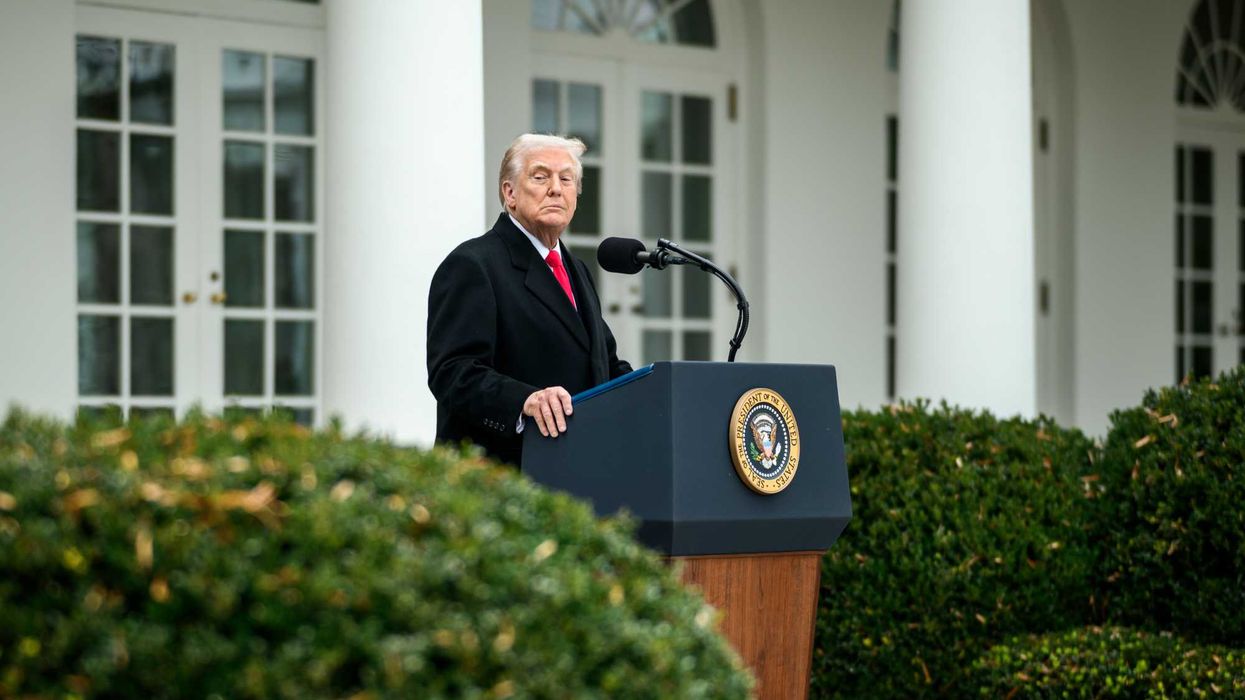
Although President Donald Trump has claimed that “every policy” of his administration was “designed to lift up the American worker,” he has acted consistently, since returning to office in January 2025, to undermine workers’ chosen representatives, America’s labor unions.

The most flagrant Trump action along these lines occurred in March 2025, when he issued an executive order that terminated collective bargaining rights for more than one million federal government employees. This measure, the largest single union-busting action in American history, ended union representation and protections for 1 out of 14 unionized workers in the United States.

Trump’s anti-union campaign dovetailed with his efforts to terminate the employment of hundreds of thousands of federal workers, many of them union members. Federal workers, Trump claimed, are “destroying this country,” and are “crooked” and “dishonest.” “Many of them,” he said, “don’t work at all.”

To supervise his massive purge of public employees, Trump chose Elon Musk―the world’s wealthiest individual and largest donor to his presidential campaign―to direct a mysterious Department of Government Efficiency (DOGE). Delighted with the job, Musk declared, without any evidence, that there were “people on the government payroll who are dead” and others “who are not real people.” Addressing a conference of conservatives, the flamboyant multibillionaire charged that “waste is pretty much everywhere” and brandished a chain saw against what he called “bureaucracy.”

As Musk’s minions rampaged through federal agencies, planning large-scale firings, DOGE informed workers that, if they voluntarily resigned, they would be paid without working during the remainder of the fiscal year. Confronted with the difficult choice of possible termination or resignation with some financial compensation, 154,000 employees signed up in the first six months for the new voluntary resignation program. “Nobody really knew if your job was safe,” recalled a former Social Security Administration employee. “I thought, better just to take it voluntarily, rather than being forced out.”

Labor unions, of course, were appalled by the situation, and turned to the federal courts for redress. But, although some lower court decisions bolstered their efforts to maintain union rights and job security for federal workers, courts at a higher level, including the Republican-dominated U.S. Supreme Court, granted Trump most of the expanded powers that he claimed.

Thus far, the mass termination of federal workers has wreaked havoc on their lives―ending careers, undermining financial security, and creating severe mental distress. And it has also produced a weaker labor movement.

Estimates are that 300,000 federal workers will have lost or left their jobs by the end of 2025.

Meanwhile, the embattled labor movement turned to Congress. Here it worked to secure passage of the Protect America’s Workforce Act, which would repeal Trump’s executive order abolishing union rights. In the House of Representatives, Speaker Mike Johnson (R-LA) refused to allow a vote on the legislation, promoted by the AFL-CIO and by Democrats. On November 17, however, the sponsor of the legislation, Representative Jared Golden (D-ME), finally secured the necessary 218 signatures (from 213 Democrats and 5 renegade Republicans) on a discharge petition to force House action, which presumably will occur soon.

Golden predicted that “Congress will not stand idly by while President Trump nullifies federal workers’ collective bargaining agreements and rolls back generations of labor law.” Even so, as the repeal legislation has only one declared Republican backer in the GOP-controlled U.S. Senate, its passage by that body seems unlikely.

Another major target of Trump’s anti-union campaign is the venerable National Labor Relations Board (NLRB). A product of landmark New Deal legislation in 1935, the NLRB is the sole recourse for private-sector workers seeking to assert their rights under labor law. This includes the right to join with coworkers to improve their working conditions, as well as the right to choose union representation. By supervising workplace elections to determine if workers want such representation, the NLRB plays a vital role in facilitating the establishment of unions.

It’s no accident, then, that Trump moved rapidly to cripple the NLRB. On January 27, 2025, he fired Gwynne Wilcox, the acting NLRB board chair―action unprecedented in the 90-year history of the agency. As half of her term remained, it was also illegal. Furthermore, the firing left the agency without the quorum necessary to function, thus shutting it down. In addition, on that same day, Trump fired the NLRB’s general counsel, Jennifer Abruzzo, replacing her with a Republican loyalist. During Abruzzo’s tenure, she had issued memos prohibiting common anti-labor practices by corporations. Her Republican successor quickly reversed the memos.

By August 2025, the NLRB was in sorry shape. Elon Musk, who scorned “the idea of unions,” had been angered by the NLRB’s investigation of the anti-labor practices of his SpaceX corporation. Consequently, he brought suit against the federal agency, charging that―despite a Supreme Court ruling in 1937 that declared the NLRB constitutional―the federal agency was actually unconstitutional. In August 2025, the rightwing Fifth Circuit Court ruled in Musk’s favor. Since then, the NLRB has been on life support―a status reinforced by the fact that, as of late November, only one of its five board positions has been filled, leaving it without a quorum and, therefore, unable to function.

Trump has also limited the activities of another agency that could assist unions: the Federal Mediation and Conciliation Service. Established in 1947, the agency has helped to resolve difficult labor disputes, such as those leading to strikes. As unions have been on the defensive for decades against increasingly aggressive corporate tactics, it is often to their advantage to settle their grievances through mediation rather than strike action. Therefore, it’s revealing that, in March 2025, Trump directed the agency to eliminate “non-statutory components” and to reduce its statutory functions and associated personnel to the minimum required by law.

Against this backdrop, Liz Shuler, president of the AFL-CIO, concluded: “This has been the most hostile administration to workers in our lifetimes.”

Dr. Lawrence Wittner is Professor of History emeritus at SUNY/Albany and the author of Confronting the Bomb (Stanford University Press.)

Experts blame Trump as blue collar jobs collapse


President Donald Trump and First Lady Melania Trump participate in the annual ceremony to pardon the national Thanksgiving turkeys, Tuesday, November 25, 2025, in the White House Rose Garden. (Official White House Photo by Daniel Torok)

December 01, 2025
ALTERNET

Newsweek reports that blue collar jobs are collapsing under President Donald Trump as the labor market in 2025 "takes a decidedly white-collar tone" driven by artificial intelligence.

"AI has already been cited in many of the mass reductions announced by Amazon and other corporations in recent weeks," writes Hugh Cameron.

"But for all the hand-wringing over the potentially ill-fated employees of Silicon Valley and Wall Street, a quieter crisis appears to be unfolding for the U.S.'s blue-collar employees, despite the pledges and efforts of the current administration to foster a renaissance in marquee industries such as construction and manufacturing," he adds.

The delayed September jobs report corroborates this, showing "an encouraging uptick in overall hiring but no pause in blue-collar employment's long-term decline," Cameron writes.

Of the five areas of employment considered blue collar — manufacturing, mining and logging, transportation and warehousing, utilities, and construction — only construction saw an increase in employment, he notes.

That said, construction's 19,000-job gain was also "insufficient to offset the monthly loss of 25,300 jobs in transportation or manufacturing shedding a further 6,000," he writes.

"Year-over-year changes show that annual payroll declines have accelerated since January — albeit continuing a long-term trend—and have pushed blue-collar job growth into negative territory for the first time since the pandemic," Cameron explains.

Heidi Shierholz, chief economist for the Department of Labor during President Barack Obama's tenure, tells Newsweek there is "undeniably a deterioration in employment conditions for the U.S.'s blue-collar workers."

"Between April and September, goods-producing industries (manufacturing, construction, logging, mining), lost 72,000 jobs, with most of those losses (58,000) in manufacturing," she says.

Shierholz also says that "the services sector — which falls partially under the blue-collar umbrella — is 'limping along' thanks solely to gains in health care."

David Dorn, a labor market expert at the University of Zurich, says construction is particularly vulnerable to negative growth despite that slight uptick in employment.

"This sector is highly sensitive to broader economic deceleration, and increasingly restrictive immigration policies under the current U.S. administration are likely constraining labor supply," he says.

And while Dorn says it's hard to "isolate" the direct effects of Trump's tariffs on employment, he says he doubts "whether these had 'generated any sustained gains' in jobs."

Dean Baker, a co-founder of the Center for Economic and Policy Research, goes further and says "tariffs have been largely to blame for the uncertainty and 'overall weakness in demand' that has driven cautious hiring across blue-collar sectors," Newsweek reports.

"Companies are reluctant to invest in a context where they have no idea what tariffs will be in place six months from now, much less three to five years from now," he says.

Baker also says that while manufacturing's gradual decline as a share of total employment has "been the case for more than 50 years," as labor demand shifted toward health care, education and other roles within the more service-focused economy, the president isn't trying to fix it either.

"Trump is doing nothing to address these issues," Baker says.

The Trumpian Nightmare Has a Long Way to Go Before It’s Over

Trump’s second term is indeed so much worse than the first, and I fear that we haven’t seen anything yet.


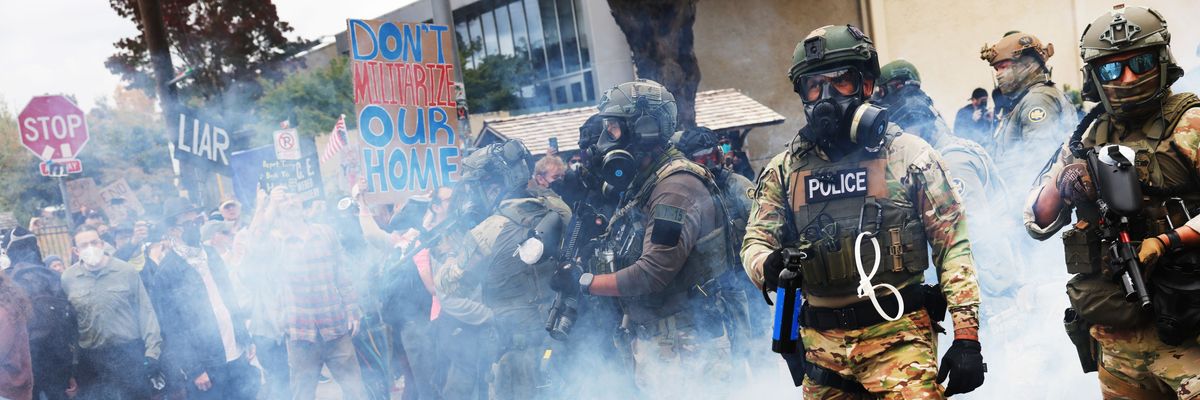
Federal agents, including members of the Department of Homeland Security, the Border Patrol, and police, clash with protesters outside a downtown U.S. Immigration and Customs Enforcement (ICE) facility on October 04, 2025 in Portland, Oregon.
(Photo by Spencer Platt/Getty Images)
Alexandra Boutri
Dec 01, 2025
COMMON DREAMS

Does it feel like the Trumpian nightmare has been around forever? How and when will it end? Does Trump’s second term signify the end of the neoliberal order? Is his cronyism unique in the history of US capitalism? And why is the wannabe emperor of the world preparing to strike Venezuela?

Political scientist, political economist, author, and journalist C. J. Polychroniou takes a crack at these questions posed in the interview below by the French-Greek independent journalist and writer Alexandra Boutri.

Alexandra Boutri: Donald Trump’s second term in the White House began on January 20, 2025. Yet, although he has been in office for a little over 10 months, it already feels like he’s been there forever. Do you have that same odd feeling? If so, why is that?

C. J. Polychroniou: Yes, sometimes it does feel like he’s been in power forever because his actions as President during the relatively short time since his return to power have been appalling, marked by depraved cruelty, moral blindness, and unprecedented corruption. He has unleashed something utterly terrifying, chaos by distraction around the world and terror on the USA. The first tactic is part of his wish to reassert US dominance in global capitalism. The second tactic is part of his plan to spread fear and oppress all those who stand on his path of constructing a neofascist, white Christian America run by oligarchs. He is not just a pathological liar and the biggest con artist in US history, traits which the liberal media frequently applies to him, but also a malignant narcissist, a sadistic and tyrannical buffoon who believes he can do whatever he pleases, that is, operate outside his legal and constitutional authority, by virtue of the fact that he is in charge of the world’s most powerful nation. Trump hates democracy and the idea of an open society and detests the rule of law. Trump’s second term is indeed so much worse than the first, and I fear that we haven’t seen anything yet. The Trumpian nightmare is really just underway, and it will take a lot more resistance than what has already taken place to stop the dictator’s attacks against civil society, his destruction of the environment, and the acceleration of the climate crisis.

Alexandra Boutri: Trump’s approval ratings are sinking. Is this important? Can we subsequently hope to see a shift in some of his policies on account of the fact that his approval rating is dropping even among core Republican voters?

C. J. Polychroniou: I have looked closely at the latest data on Trump’s job approval rating and popularity. According to the most recent Gallop poll, Trump’s approval rating was at 36%. However, RealClear Polling shows that 42% of Americans approve of Trump’s job performance, which is utterly shocking considering the horrifying consequences of his actions. It is something that makes one wonder whether the real problem is Trump himself or a rather huge chuck of the US electorate. While I don’t know how important these job approval ratings really are, it is probably more important to look at Trump’s approval rating by state. There, we find that Trump’s popularity remains positive in Republican-dominated states, although the Gallop poll mentioned earlier also shows that Republicans’ approval has slipped by eight points. Equally worth noting is that Trump’s disapproval rating (55.3%) is not far off from what it was during his first term (54.9%), according to statistician and political analyst Nate Silver. In sum, Trump’s base is still very much with him and the main issue dividing his MAGA movement appears to be over the Epstein files! I do not have hopes for a shift in any of his odious and outright evil policies.

Alexandra Boutri: It has been said that Trump’s turn to protectionism is a death blow to neoliberalism and that what best describes his regime is cronyist state capitalism. What are your own thoughts on these matters? Has Trump abandoned neoliberalism?

C. J. Polychroniou: Politics and economics aren’t black and white. Politics is more of an art than science, and economics is definitely not a hard science. As academic disciplines, both politics and economics are regarded as social sciences. But while hard science is based on concrete laws, social science, though it can follow the scientific method, lacks universal laws and subjectivity all too often enters rather freely into analyses. As Richard Feynman once quipped, “Social science is an example of a science which is not a science….They follow the forms…but they don’t get any laws.”

To be more specific, there is no such thing as a “free market” and no such thing as a “pure” capitalist system. Neoliberalism, which relies heavily on free-markets and advocates privatization and marketization, has always depended on the state to carry out its anti-social agenda. The state not only shapes and enforces rules for markets but most of the major technological developments and innovations have been fueled by the federal government. Global neoliberalism itself has been a state-driven enterprise. It was initiated by the United States sometime around the mid-1970s and revolved around a regime of an unimpeded movement of capital, good and services. The global economy itself was regulated by global governance institutions such as the International Monetary Fund (IMF), the World Bank, and the World Trade Organization (WTO) although the United States itself played a significant role in enforcing the rules of global neoliberalism. The new political order in global economic affairs served quite well the United States on account of its financial hegemony, but China’s full integration into the global capitalist economy saw the rise of a new imperial power and its emergence as something of a model for the developing world. China’s growth over the past four decades was many times over that of the US. Eventually, China would displace the US and become the “manufacturing workshop of the world” and overtake the US to become the top trading partner to more than 140 countries.

Enter Trump. Since coming to power, Trump has been obsessed with the idea of bringing manufacturing back to the US and reducing the trade deficit. To do so, he inaugurated a new protectionist age, which is in full swing during his second term in office. Trump’s protectionist economic policies, which we should file under the label “economics nationalism,” represent a strategy for restoring US supremacy (and thus profitability) in global economics affairs and reindustrializing the United States. In practical terms, this means not only enforcing “reciprocal tariffs” on all countries exporting goods to the United States but using military force to regain hegemonic control over Latin America and the Pacific and threatening China into submission. I believe all these policies are destined to fail, rather miserably, while causing in the process a lot of pain and suffering to a lot of people.

Does Trump’s approach to global economic affairs represent the end of the neoliberal order? I don’t think so. What he is trying to do is “Make American Corporations Great Again.” He is trying to change the relation between state, corporations, and the world economy, not the nature of the global capitalist system. The main dynamic and contradiction will remain between capital and labor, exploitation and oppression. Other states will be even more inclined than before to resort to even more extreme forms of neoliberal capitalist exploitation for the benefit of their own capital bosses. Indeed, workers’ rights are collapsing across the world, according to the 2025 Global Rights Index published by the International Trade Union Confederation. On the domestic front, Trump’s policies are unmistakably neoliberal. In fact, he has gone beyond deregulation and liberalization by embarking on the grand project of making workers even more vulnerable to abuse by eliminating key workplace protections and making it even more difficult for them to form a union. And his whole approach to the environment is as neoliberal as it can get.

I have a rather similar line of analysis regarding the debate between crony capitalism (describing an economy of close relationship between businesspeople and government officials) and neoliberalism. First, capitalism coexists and connects with greed and corruption. In fact, cronyism is inherent to capitalism. Capitalism tends to oligopoly, which strengthens the relationship between key government officials and business people. The US has had a crony oligarchy all along. People speak today of Trump’s cronyism as if it is a new phenomenon in American capitalism when the reality is that it has been around for a very long time. The George W. Bush administration was accused in fact of taking cronyism to a new level. Now of course we can say with certainty that Trump has not only taken cronyism to a new level but is actually using the presidency for self-enrichment. But let’s not fool ourselves by thinking that cronyism has somehow surfaced in the US because of Donald Trump. As far as neoliberalism specifically is concerned, research has shown that the neoliberal policies promoted by the IMF in the developing world foster crony capitalism. In sum, I do not accept the distinction between cronyism and (neo)liberal capitalism.

Alexandra Boutri: Why is Trump preparing to strike Venezuela?

C. J. Polychroniou: I can think of a number of reasons. One is because of his need to manufacture crises in order to draw attention away from his domestic crimes and shenanigans. He also wants to bring down the Maduro regime because of its close ties to China and Russia. I think geopolitical calculations figure large in Trump’s plan to strike Venezuela and it’s part of a new strategy in Latin America with the intent being to reassert US dominance over a region that Washington used to control not long ago. The US military build-up in the Caribbean is not to fight drugs. Of course, don’t expect Trump to seek the authorization of Congress to wage war against Venezuela. And he won’t be the first president not to do so. Many presidents have acted without Congress declaring war. The imperial presidency was established long before Trump, although the orange man is bent on being both “imperial president at home and emperor abroad.


C.J. Polychroniou
C.J. Polychroniou is a political economist/political scientist who has taught and worked in numerous universities and research centers in Europe and the United States. His latest books are The Precipice: Neoliberalism, the Pandemic and the Urgent Need for Social Change (A collection of interviews with Noam Chomsky; Haymarket Books, 2021), and Economics and the Left: Interviews with Progressive Economists (Verso, 2021).
Full Bio >
A Dangerous Step Back: The Renewed Threat of Landmines and Cluster Munitions

Ninety percent of the more than 6,000 killed by landmines last year were civilians, and half of them were children. There can be no justification for weapons such as these.


This photo taken on February 11, 2025 shows a deminer from the Cambodian Mine Action Centre (CMAC) examining an unexploded ordnance (UXO) that was unearthed by a worker during irrigation work in Svay Rieng province. Parts of Cambodia are still littered with unexploded ordnance from decades of conflict, and US President Donald Trump’s decision to freeze virtually all American aid has seen many long-running projects to clear the deadly debris grind to a halt.

(Photo by Tang Chhin Sothy/AFP via Getty Images)


Hannah Guedenet
Dec 01, 2025


Landmine deminer working in CambodiaThis photo taken on February 11, 2025 shows a deminer from the Cambodian Mine Action Centre (CMAC) examining an unexploded ordnance (UXO) that was unearthed by a worker during irrigation work in Svay Rieng province. Parts of Cambodia are still littered with unexploded ordnance from decades of conflict, and US President Donald Trump’s decision to freeze virtually all American aid has seen many long-running projects to clear the deadly debris grind to a halt. (Photo by Tang Chhin Sothy/AFP via Getty Images)A Dangerous Step Back: The Renewed Threat of Landmines and Cluster MunitionsNinety percent of the more than 6,000 killed by landmines last year were civilians, and half of them were children. There can be no justification for weapons such as these.Hannah GuedenetDec 01, 2025Common Dreams

One step can be the difference between life and death in many communities around the world. Srey Neang, a young girl living in rural Cambodia, ran outside to play in her uncle’s backyard, and her life was upended in a moment when she stepped on a landmine. She was rushed to the hospital, where her leg was amputated at only four years of age. Her story—like so many others—shows that even decades after conflict ends, the threat of these weapons never does.

Every year, thousands of civilians, particularly children, are injured or killed by landmines and cluster munitions. The use of landmines and cluster munitions had been on the decline since the signing of the Mine Ban Treaty in 1997 and the Convention on Cluster Munitions in 2010.
RECOMMENDED...President Trump Addresses U.S. Troops On Thanksgiving From Mar-A-LagoTrump Delivers Darkest Thanksgiving in US HistorySigns say: "Quality Care Over Profits"As America Faces a Caregiving Catastrophe, We Need to Name the Real VillainsBut despite progress, we are seeing more countries return to the use of landmines and cluster munitions as security concerns rise globally. 

Some will argue that these weapons make countries safer, but that’s faulty thinking. Security can’t come at the expense of innocent lives. Nor do these weapons actually provide meaningful military advantage; they leave behind contamination that destabilizes communities, limits economic recovery, and threatens peacekeeping forces long after conflicts end. You can’t be safe from a weapon that can’t distinguish between a soldier and a child.

The 2025 Landmine Monitor, out today, reports that more than 6,000 people were killed or injured by landmines and explosive remnants of war in 2024—the highest annual figure since 2020, and a 9% increase from the previous year. Ninety percent of those victims were civilians, and half of them were children. The 2025 Cluster Munition Monitor, published on September 15, also revealed that all reported casualties from this weapon in 2024 were civilians. New uses by countries like Russia, Myanmar, and Syria challenge the treaty. Lithuania’s withdrawal from the Convention, effective March 2025, sends a dangerous message to other countries in the region.

As these findings are released, there is a growing need for clear analysis and public understanding. On December 3, I’ll be joining fellow experts for a virtual briefing hosted by the US Campaign to Ban Landmines—Cluster Munition Coalition to discuss the latest Monitor reports, the human cost of these weapons, and the role US leadership must play at this pivotal moment. Bringing these insights directly to policymakers and advocates is essential to strengthening global norms and advancing effective solutions.

Stand With Independent Media This Giving TuesdayAs corporate influence grows, independent journalism is more important than ever. If you value reporting that puts people and the planet first, please support Common Dreams this Giving Tuesday.

Despite never joining either treaty, the United States has long been one of the world’s largest supporters of mine clearance and victim assistance, helping make former battlefields safe for farming, economic investment, and community life. These investments are among the most cost-effective and high-impact uses of US international assistance, directly saving lives and restoring livelihoods.

The case for action is both moral and pragmatic. Every mine removed or cluster bomb destroyed reopens land for cultivation, enables displaced families to return home, and prevents future casualties. These are tangible, measurable outcomes that support U.S. foreign policy priorities: stability, economic recovery, and the protection of civilians in conflict.
Humanity & Inclusion, which has worked in mine action for more than 40 years, witnesses the human toll daily, as seen in the case of Srey and her family in Cambodia. The organization where I work, Humanity & Inclusion, supported Srey, now 13, in receiving a new prosthetic leg, which allows her to ride her bike to school, help take care of her family, and play soccer, one of her favorite hobbies.

Srey’s story and those of many others are reminders that behind every statistic is a person whose future depends on the choices policymakers make today. US leadership has always mattered. When the United States aligns its policies, funding, and diplomacy toward a humanitarian goal, the world follows. The US has made progress in recent years. In 2022, the Biden administration restricted US landmine use to the Korean Peninsula and reaffirmed the goal of ultimately joining the Mine Ban Treaty. But the transfer of US cluster munitions to Ukraine in 2023 and landmines in 2024, undercut those commitments and send mixed signals to the world.

US leadership in aligning policy with the Mine Ban Treaty and the Convention on Cluster Munitions, and in sustaining robust funding for mine action, comes at a critical time. Washington can once again set the global standard for protecting civilians and strengthening international law.

In a time of never-ending partisan fights, this is a place where both sides can come together and agree on the right steps forward. This is not an abstract debate. It’s about whether children can walk to school safely. Whether farmers can plant crops without fear. Whether communities emerging from war can build futures on land that no longer hides deadly remnants of the past. Eliminating landmines and cluster munitions aligns with American values, advances security, and reflects our nation’s enduring commitment to human dignity.

The world doesn’t need new reasons to fear these weapons. Instead, we must take the kind of step that brings hope rather than harm. If we lead with courage now, our next steps can help ensure that every step, everywhere, is safe.


Our work is licensed under Creative Commons (CC BY-NC-ND 3.0). Feel free to republish and share widely.Hannah GuedenetHannah Guedenet is the Executive Director of Humanity & Inclusion U.S., part of the global Humanity & Inclusion Federation, which works in more than 60 countries to support people with disabilities and communities affected by conflict, disaster, and poverty. HI is a member of the U.S. Campaign to Ban Landmines – Cluster Munition Coalition (USCBL–CMC).Full Bio >


One step can be the difference between life and death in many communities around the world. Srey Neang, a young girl living in rural Cambodia, ran outside to play in her uncle’s backyard, and her life was upended in a moment when she stepped on a landmine. She was rushed to the hospital, where her leg was amputated at only four years of age. Her story—like so many others—shows that even decades after conflict ends, the threat of these weapons never does.

Every year, thousands of civilians, particularly children, are injured or killed by landmines and cluster munitions. The use of landmines and cluster munitions had been on the decline since the signing of the Mine Ban Treaty in 1997 and the Convention on Cluster Munitions in 2010.

But despite progress, we are seeing more countries return to the use of landmines and cluster munitions as security concerns rise globally. Some will argue that these weapons make countries safer, but that’s faulty thinking. Security can’t come at the expense of innocent lives. Nor do these weapons actually provide meaningful military advantage; they leave behind contamination that destabilizes communities, limits economic recovery, and threatens peacekeeping forces long after conflicts end. You can’t be safe from a weapon that can’t distinguish between a soldier and a child.

The 2025 Landmine Monitor, out today, reports that more than 6,000 people were killed or injured by landmines and explosive remnants of war in 2024—the highest annual figure since 2020, and a 9% increase from the previous year. Ninety percent of those victims were civilians, and half of them were children. The 2025 Cluster Munition Monitor, published on September 15, also revealed that all reported casualties from this weapon in 2024 were civilians. New uses by countries like Russia, Myanmar, and Syria challenge the treaty. Lithuania’s withdrawal from the Convention, effective March 2025, sends a dangerous message to other countries in the region.

As these findings are released, there is a growing need for clear analysis and public understanding. On December 3, I’ll be joining fellow experts for a virtual briefing hosted by the US Campaign to Ban Landmines—Cluster Munition Coalition to discuss the latest Monitor reports, the human cost of these weapons, and the role US leadership must play at this pivotal moment. Bringing these insights directly to policymakers and advocates is essential to strengthening global norms and advancing effective solutions.

Despite never joining either treaty, the United States has long been one of the world’s largest supporters of mine clearance and victim assistance, helping make former battlefields safe for farming, economic investment, and community life. These investments are among the most cost-effective and high-impact uses of US international assistance, directly saving lives and restoring livelihoods.

The case for action is both moral and pragmatic. Every mine removed or cluster bomb destroyed reopens land for cultivation, enables displaced families to return home, and prevents future casualties. These are tangible, measurable outcomes that support U.S. foreign policy priorities: stability, economic recovery, and the protection of civilians in conflict.

Humanity & Inclusion, which has worked in mine action for more than 40 years, witnesses the human toll daily, as seen in the case of Srey and her family in Cambodia. The organization where I work, Humanity & Inclusion, supported Srey, now 13, in receiving a new prosthetic leg, which allows her to ride her bike to school, help take care of her family, and play soccer, one of her favorite hobbies.

Srey’s story and those of many others are reminders that behind every statistic is a person whose future depends on the choices policymakers make today. US leadership has always mattered. When the United States aligns its policies, funding, and diplomacy toward a humanitarian goal, the world follows. The US has made progress in recent years. In 2022, the Biden administration restricted US landmine use to the Korean Peninsula and reaffirmed the goal of ultimately joining the Mine Ban Treaty. But the transfer of US cluster munitions to Ukraine in 2023 and landmines in 2024, undercut those commitments and send mixed signals to the world.

US leadership in aligning policy with the Mine Ban Treaty and the Convention on Cluster Munitions, and in sustaining robust funding for mine action, comes at a critical time. Washington can once again set the global standard for protecting civilians and strengthening international law.

In a time of never-ending partisan fights, this is a place where both sides can come together and agree on the right steps forward. This is not an abstract debate. It’s about whether children can walk to school safely. Whether farmers can plant crops without fear. Whether communities emerging from war can build futures on land that no longer hides deadly remnants of the past. Eliminating landmines and cluster munitions aligns with American values, advances security, and reflects our nation’s enduring commitment to human dignity.

The world doesn’t need new reasons to fear these weapons. Instead, we must take the kind of step that brings hope rather than harm. If we lead with courage now, our next steps can help ensure that every step, everywhere, is safe.


Our work is licensed under Creative Commons (CC BY-NC-ND 3.0). Feel free to republish and share widely.

Hannah Guedenet
Hannah Guedenet is the Executive Director of Humanity & Inclusion U.S., part of the global Humanity & Inclusion Federation, which works in more than 60 countries to support people with disabilities and communities affected by conflict, disaster, and poverty. HI is a member of the U.S. Campaign to Ban Landmines – Cluster Munition Coalition (USCBL–CMC).
Full Bio >
Comparing the Ukraine and Gaza Peace Deals

Both what is similar and what is different about the agreements orchestrated by the Trump administration have lessons to teach us about these conflicts.


Students and supporters of the Jamaat-e-Islami political party gather to express their solidarity with the Palestinians during an anti-Israel protest in Islamabad on October 9, 2025.
Photo by Aamir Qureshi / AFP via Getty Images)

James Zogby
Dec 01, 2025
Common Dreams

In the span of a week, the Trump administration succeeded in passing a United Nations Security Council resolution on Gaza (based on its earlier 20-point plan to end the conflict) and also released a 28-point peace plan for Ukraine. Commentators and critics have noted some similarities between the two initiatives. There are also profound differences that are important to note.

In the first place, the intention of both plans appears to be driven by the simple and commendable goal of ending the ongoing violence in Gaza and Ukraine. While trying to do this, however, critics note that aggressors have been given undo deference. In the case of Ukraine, it was deemed that the way forward was in awarding Russia’s land grab in eastern and southern Ukraine. In the case of Gaza, no attention was paid to Israel’s genocidal crimes against Palestinians with the assumption that the victims should make do with aid and some form of recovery—even though it appears from the plan that their future remains indeterminate and subject to the will of others.

The problems with both plans owe to the fact that they were initially drafted without the input of either the Palestinians or Ukrainians. The exact origins of the Gaza plan remain somewhat murky, but what’s clear is the absence of Palestinian participation. The UN resolution’s only mention of the Palestinian Authority is a reference to their possible future involvement should they meet unspecified reforms, at which point the PA “may” be allowed to assume a role in Gaza on terms approved by Israel and the international bodies the resolution has established to govern Gaza controlling the funds and making the plans to help Gaza recover.

The Ukraine plan’s origins have been a subject of some controversy. At first the US claimed it had been developed with the Russians, based on a Russian draft. Then they denied any US involvement, only later to “clarify” that it had been a joint US-Russian effort. After push back from Europeans and some Republican senators, the US engaged with the Ukrainians, making some changes which may or may not be acceptable to the Russian side.

Herein lies one of the differences between the two plans. Ukraine is recognized as a sovereign entity, despite the draft plan’s allowing for violations of Ukraine’s sovereignty. The plan for Gaza, on the other hand, not only doesn’t acknowledge Palestinian sovereignty, but also goes to great lengths to erase it. It subjects Palestinians to the whims of Israel and the international bodies—led by the US—which will be positioned to serve as sovereigns over decisions that will shape the future of the Palestinian people.

There are, to be sure, what appear to be feints toward Palestinian sovereignty—a “tip of the hat” to the Saudi-French Proposal, references to a Palestinian police force, and the idea that a reformed PA “may” be involved in the future. But these are conditioned on terms established by others, rather than as rights. All of this seems to pour cold water on the giddiness accompanying the Special Session on Palestine that preceded the opening of this year’s General Assembly when a number of states recognized Palestinian statehood.

Especially concerning in this slighting of the PA is the lack of acknowledgement or understanding by the Gaza plan’s architects that Israel has, for three decades, done its best to ensure the PA’s failure. From the first years after Oslo, Israel denied Palestinians the freedom to develop an independent economy, guaranteeing the Palestinians would remain dependent on Israel. Israel circumscribed the areas in which the PA could govern, frequently violating even that by invading areas nominally under PA control. Israel also continued to build Jewish-only settlements and infrastructure, and played games with Hamas in Gaza, often elevating their stature at the expense of the PA. Today, the PA, while still conceptually representing the promise of Palestinian statehood, is increasingly seen in the West Bank more as a subordinate acting on behalf of Israel than as an independent self-governing entity representing Palestinian aspirations.

While it’s clear that Hamas has fallen into great disfavor among Palestinians in Gaza, the PA polls well behind Hamas in the West Bank. So when the Gaza plan insists that the PA reform, the questions that must be asked are: “What exactly are these reforms?” “Can the PA implement reforms under continuing Israeli domination of the West Bank?” and “With Israel as one of the parties designated to establish the metrics of reform, after meeting Israel’s criteria, will the PA have the credibility it needs to govern or will it be seen as the agent of the true sovereign, Israel?”

Finally, while the initial version of the Ukraine plan does include some constraints on Russia—even before recent reports of still unseen Ukrainian modifications—there are no such constraints imposed on Israel in the UN Gaza plan. Even the agreed-upon “ceasefire” remains elusive, with Israel acting with impunity as the ceasefire’s sole enforcer. Since Israel still controls access and egress to the less than half of Gaza from which they have withdrawn, Palestinians remain largely without adequate shelter, food, and medical services as winter approaches.

Months remain before the UN plan for Gaza can begin to be fully implemented. Most likely it will not be, as Israel and the US are obsessive about the unrealistic precondition that Hamas be fully disarmed and dismantled before any forward movement can occur. What appears to be in the offing is a US-Israel plan to develop housing projects for Palestinians in the Gaza areas under Israeli control. This effort to lure some desperate Palestinians to move into the Israeli region would mean abandoning those who remain under Hamas control to an uncertain future. This actually meets the definition of genocidal intent.

One decisive difference in the development of the two plans has been the roles played by external forces. Ukraine has the backing of a near-unified European bloc, coupled with support from Republicans driven by anti-Russian animus. This tempered even the initial US 28-point plan. While the Gaza plan had its origins in an Arab draft, and while Arab states and others were able to insert some language in the UN resolution on Gaza, by the time the US and Israel had finished stripping it down and President Trump had put his imprimatur on it bullying it through the UN process, Palestinian rights were gone.

It’s not too late for Arabs to demand better terms, for Palestinians to put their house in order creating a unified national plan of governance for the West Bank and Gaza, and for Arabs and Palestinians to insist that those nations who have recognized Palestinian statehood call for reopening the debate on Palestine’s future. If changes aren’t made, in short order, we will tragically be right back where we started.


James Zogby
Dr. James J. Zogby is the author of Arab Voices (2010) and the founder and president of the Arab American Institute (AAI), a Washington, D.C.-based organization which serves as the political and policy research arm of the Arab American community. Since 1985, Dr. Zogby and AAI have led Arab American efforts to secure political empowerment in the U.S. Through voter registration, education and mobilization, AAI has moved Arab Americans into the political mainstream. Dr. Zogby has also been personally active in U.S. politics for many years; in 1984 and 1988 he served as Deputy Campaign manager and Senior Advisor to the Jesse Jackson Presidential campaign. In 1988, he led the first ever debate on Palestinian statehood at that year's Democratic convention in Atlanta, GA. In 2000, 2008, and 2016 he served as an advisor to the Gore, Obama, and Sanders presidential campaigns.
Full Bio >
Warren Demands Resignation of Trump Education Secretary Over Lawless Assault on Public Schools

Billionaire Linda McMahon “has no business leading the Department of Education,” said US Sen. Elizabeth Warren.


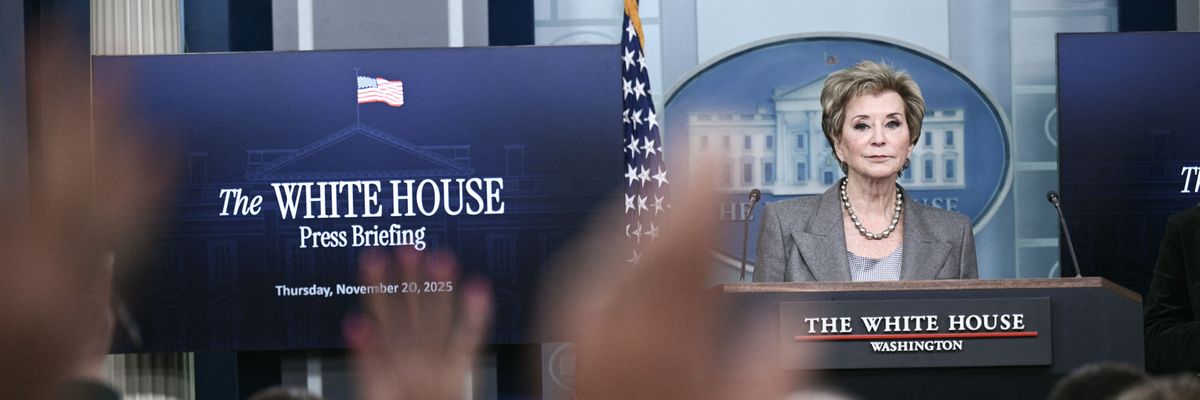
US Secretary of Education Linda McMahon takes questions from reporters in Washington, DC, on November 20, 2025.
(Photo by Brendan Smialowski/AFP via Getty Images)

Jake Johnson
Dec 01, 2025
COMMON DREAMS

Democratic US Sen. Elizabeth Warren on Monday called on President Donald Trump’s billionaire education secretary, Linda McMahon, to step down over her sweeping attempt to dismantle the Department of Education from within.

In an op-ed for USA Today, Warren (D-Mass.) warned that “both families and schools will suffer” from McMahon’s mass layoffs and transfer of key Education Department functions and programs to other federal agencies—an effort to circumvent the fact that only Congress can legally shutter the department.

McMahon is carrying out what she’s described as her department’s “final mission” at the direction—and with the enthusiastic support—of the president, who reportedly told McMahon earlier this year that “when we actually close down the department, you and I are going to stand on the steps, and we’re going to have a padlock that we’re going to put on it and invite the press.”

Warren wrote Monday that under McMahon and Trump’s plan, “the Department of Labor will be in charge of supporting K-12 literacy, American history and civics, and Title I funding.”

“Drink that in: Labor Department employees will decide which reading readiness programs to support for kindergartners,” she wrote. “”No part of public education will remain untouched by this move. Title I provides the biggest federal fund for K-12 schools and is used to help pay for good teachers and new textbooks all across America. School administrators are concerned that these changes may result in bigger class sizes, fewer afterschool and tutoring programs, and not enough workbooks for our kids because federal funding isn’t coming through.“

Warren argued that McMahon, a longtime supporter of school privatization, “has no business leading the Department of Education” and “should resign.”

“When a secretary of Education is actively dismantling our public education system, it’s time to reconsider her role in government,” she wrote. “When the secretary is working to make class sizes bigger, take away aides for kids with special needs, leave college students at the mercy of financial predators, and make the whole department nonfunctional, it’s time for new leadership.”

The senator’s op-ed came after a coalition of labor unions, educators, and school districts took legal action against the Trump administration’s over its ongoing destruction of the Education Department.

The lawsuit argues the administration’s actions “violate the Constitution, authorizing statutes, appropriations statutes, and the Administrative Procedure Act.”

“More importantly, defendants’ actions will harm millions of students and their families, school districts, and educators across the nation,” the complaint reads. “Scattering Department of Education programs among agencies with no expertise in education or lacking key agency infrastructure will reduce the efficiency and effectiveness of these programs and will prevent the type of synergy that Congress intended to achieve by consolidating federal education activities in one cabinet level agency.”
Karl Marx explained our current conundrum nearly 150 years ago: economist
December 01, 2025 


When OpenAI’s Sam Altman told reporters in San Francisco earlier this year that the AI sector is in a bubble, the American tech market reacted almost instantly.

Combined with the fact that 95 per cent of AI pilot projects fail, traders treated his remark as a broader warning. Although Altman was referring specifically to private startups rather than publicly traded giants, some appear to have interpreted it as an industry-wide assessment.

Tech billionaire Peter Thiel sold his Nvidia holdings, for instance, while American investor Michael Burry (of The Big Short fame) has made million-dollar bets that companies like Palantir and Nvidia will drop in value.

What Altman’s comment really exposes is not only the fragility of specific firms but the deeper tendency Prussian philosopher Karl Marx predicted: the problem of surplus capital that can no longer find profitable outlets in production.

Marx’s theory of crisis

The future of AI is not in question. Like the internet after the dot-com crash, the technology will endure. What is in question is where capital will flow once AI equities stop delivering the speculative returns they have promised over the past few years.

That question takes us directly back to Marx’s analysis of crises driven by over-accumulation. Marx argued that an economy becomes unstable when the mass of accumulated capital can no longer be profitably reinvested.

An overproduction of capital, he explained, occurs whenever additional investment fails to generate new surplus value. When surplus capital cannot profitably be absorbed through the production of goods, it is displaced into speculative outlets.

Tech investments mask economic weakness

Years of low interest rates and pandemic-era liquidity have swollen corporate balance sheets. Much of that liquidity has entered the technology sector, concentrating in the so-called “Magnificent Seven” — Amazon, Alphabet, Meta, Apple, Microsoft, Nvidia and Tesla. Without these firms, market performance would be negative.

This does not signal technological dynamism; it reflects capital concentrated in a narrow cluster of overvalued assets, functioning as “money thrown into circulation without a material basis in production” that circulates without any grounding in real economic activity.

The consequence of this is that less investment reaches the “real economy”, which fuels economic stagnation and the cost-of-living crisis, both of which remain obscured by the formal metric of GDP.

How AI became the latest fix


Economic geographer David Harvey extends Marx’s insight through the idea of the “spatio-temporal fix,” which refers to the way capital temporarily resolves stagnation by either pushing investment into the future or expanding into new territories.

Over-accumulation generates surpluses of labour, productive capacity and money capital, which cannot be absorbed without loss. These surpluses are then redirected into long-term projects that defer crises into new spaces that open fresh possibilities for extraction.

The AI boom functions as both a temporal and a spatial fix. As a temporal fix, it offers investors claims on future profitability that may never arrive — what Marx called “fictitious capital.” This is wealth that shows up on balance sheets despite having little basis in the real economy rooted in the production of goods.

Spatially, the expansion of data centres, chip manufacturing sites and mineral extraction zones requires enormous physical investment. These projects absorb capital while depending on new territories, new labour markets and new resource frontiers.

Yet as Altman’s admission suggests, and as U.S. President Donald Trump’s protectionist measures complicate global trade, these outlets are reaching their limits.

The costs of speculative capital

The consequences of over-accumulation extend far beyond firms and investors. They are experienced socially, not abstractly. Marx explained that an overproduction of capital corresponds to an overproduction of the means of production and necessities of life that cannot be used at existing rates of exploitation.

In other words, stagnant purchasing power prevents capital from being valorized at the pace it is being produced. As profitability declines, the economy resolves the imbalance by destroying the livelihoods of workers and households whose pensions are tied to equities.

History offers stark examples. The dot-com crash wiped out small investors and concentrated power in surviving firms. The 2008 financial crisis displaced millions from their homes while financial institutions were rescued.

Today, large asset managers are already hedging against potential turbulence. Vanguard, for instance, has shifted significantly toward fixed income.

Speculation drives growth

The AI bubble is primarily a symptom of structural pressures rather than purely a technological event. In the early 20th century, Marxist economist Rosa Luxemburg questioned where the continually increasing demand required for expanded reproduction would come from.

Her answer echoes Marx and Harvey: when productive outlets shrink, capital moves either outward or into speculation. The U.S. increasingly chooses the latter.

Corporate spending on AI infrastructure now contributes more to GDP growth than household consumption, an unprecedented inversion that shows how much growth is being driven by speculative investment rather than productive expansion.

This dynamic pulls down the rate of profit, and when the speculative flow reverses, contraction will follow.

Tariffs tighten the squeeze on capital

Financial inflation has intensified as the traditional pressure valves that once allowed capital to move into new physical or geographic markets have narrowed.

Tariffs, export controls on semiconductors and retaliatory trade measures have narrowed the global space available for relocation. Since capital cannot readily escape the structural pressures of the domestic economy, it increasingly turns to financial tools that postpone losses by rolling debt forward or inflating asset prices; mechanisms that ultimately heighten fragility when the reckoning comes.

U.S. Federal Reserve Chair Jerome Powell’s openness to interest rate cuts signals a renewed turn toward cheap credit. Lower borrowing costs let capital paper over losses and pump up fresh speculative cycles.

Marx captured this logic in his analysis of interest-bearing capital, where finance generates claims on future production “above and beyond what can be realized in the form of commodities.”

The result is that households are pushed to take on more debt than they can manage, effectively swapping a crisis of stagnation for a crisis of consumer credit.

Bubbles and social risk

If the AI bubble bursts when governments have limited room to shift investment internationally and the economy is propped up by increasingly fragile credit, the consequences could be serious.

Capital will not disappear, but will instead concentrate in bond markets and credit instruments inflated by a U.S. central bank eager to cut interest rates. This does not avert crisis; it merely transfers the costs downward.

Bubbles are not accidents, but recurring mechanisms for absorbing surplus capital. If Trump’s protectionism ensures that spatial outlets continue to close and temporal fixes rely on ever riskier leverage, the system moves toward a cycle of asset inflation, collapse and renewed state intervention.

AI will survive, but the speculative bubble surrounding it is a sign of a deeper structural problem — the cost of which, when finally realized, will fall most heavily on the working class.

Elliot Goodell Ugalde, PhD Candidate, Political Economy, Queen's University, Ontario

This article is republished from The Conversation under a Creative Commons license. Read the original article.


Karl Marx. 1858. Page 2. Page 3. Once adopted into the production process of capital, the means of labour passes through different metamorphoses, whose ...


Kristi Noem dumbstruck after being told Trump admin approved DC shooter's asylum request

Alexander Willis
November 30, 2025 
RAW ST0RY


U.S. Homeland Security Secretary Kristi Noem participates in a town hall event at the Citadel, in Charleston, U.S., November 7, 2025. Alex Brandon/Pool via REUTERS

Homeland Security Secretary Kristi Noem was left dumbstruck Sunday when, after blaming the shooting last week of two National Guard members on the Biden administration, she was confronted with the fact that the suspect shooter actually had their asylum request approved under the Trump administration.

Last Wednesday, an Afghan migrant allegedly shot two National Guard members in Washington, D.C., killing one and leaving the other in critical condition. The suspected shooter, 29-year-old Rahmanullah Lakanwal, migrated to the United States after the 2021 U.S. withdrawal from Afghanistan, and had also worked for the CIA for so-called counter-terrorism operations.

Speaking on NBC’s Meet the Press with Kristen Welker, Noem laid the blame for the shooting squarely on the Biden administration, arguing that the previous administration had put the United States in a “dangerous situation.”

“The vetting process happens when the person comes into the country, and Joe Biden completely did not vet any of those individuals, did not vet this individual!” Noem said.

However, the facts told a different story, as brought up by Welker, who pushed back on Noem’s remarks.

“His asylum was approved in April of this year on the Trump administration's watch, so just to be very clear, was there a vetting process in place to approve that asylum request?” Welker asked.

“Yeah, the vetting process all happened under Joe Biden's administration,” Noem responded.

Welker pushed back further, noting that whether or not Lakanwal was vetted upon entering the United States, his asylum request was still approved under the second Trump administration.

“But was he vetted when he was granted asylum, are you saying he wasn't vetted when he was granted asylum?” Welker pushed back.

Stammering, Noem essentially repeated her previous deflection, and again laid blame for the shooting on the Biden administration.

“Vetting is – vetting is – vetting is happening when they come into the country, and that was completely abandoned under Joe Biden's administration,” Noem said.


Trump admin selling off historic public art to the highest bidder

John P. Murphy
November 30, 2025 
RAW STORY


Detail from Seymour Fogel’s “Security of the People” (1942). (Image: Carol M. Highsmith/USGSA Fine Arts Collection)

Painted figures haunt an empty building. A boy leaning on a pair of crutches. A father and son wandering a barren railroad track. A nuclear family at a picnic table. These poignant scenes were painted by two of the foremost American artists of the twentieth century, Ben Shahn and Philip Guston. No one is around to see them. They are on the walls of the Wilbur J. Cohen Building in Washington, DC, one of forty-five federal properties currently earmarked for sale. The staff who worked in the building have been mostly fired, furloughed, or relocated. Only the murals remain—and perhaps not for long.

The Cohen Building has been called the “Sistine Chapel of the New Deal” for its ambitious mural cycles. Shahn and Guston, as well as Seymour Fogel and Ethel and Jenne Magafan, gave indelible form to New Deal tenets: the dignity of labor, the benefit of public works, and the need for a social safety net. A detail of Fogel’s Wealth of the Nation, painted for the lobby, is on the cover of my survey of New Deal art: it crystallizes the period belief in the mutual power of mind and muscle to secure a prosperous future. If the Cohen building is sold, these masterpieces of public art will be in peril. As Timothy Noah has reported, a private developer is unlikely to bear the cost of renovating and maintaining the building, much less the murals. It would be cheaper to tear the whole thing down.

Is it frivolous to worry about art when the world is on fire? The Franklin D. Roosevelt administration didn’t think so. In the midst of the Great Depression, the worst economic calamity in the country’s history, FDR’s New Deal invested in culture as essential to a more “abundant life” for US citizens.

The government paid struggling artists like Shahn, Guston, Jacob Lawrence, Alice Neel, and Jackson Pollock to create artworks for post offices, schools, hospitals, and airports across the country, in big cities and rural hamlets. New Deal art extolled American livelihoods and landscapes in an accessible style, reassuring anxious viewers about the state of the nation and the economy. “In encouraging the creation and enjoyment of beautiful things,” FDR said in a 1939 address, “we are furthering democracy itself.”
The Cohen murals, like all New Deal art, were made by and belong to the people. They tell us about who we’ve been, who we are, and who we aspire to be.

The Cohen murals were among the New Deal’s highest-profile works. Commissioned by the Treasury Department’s Section of Fine Arts, the agency that oversaw art for federal buildings (such as your local post office, which may house a New Deal mural), the murals celebrate the Social Security Act of 1935. The landmark law established retirement benefits and unemployment insurance at a time when most Americans worked until they dropped and risked starvation if fired or injured. When Ben Shahn learned he’d won the commission, he wrote to the head of the Section: “To me, it is the most important job that I could want. The building itself is a symbol of perhaps the most advanced piece of legislation enacted by the New Deal, and I am proud to be given the job of interpreting it, or putting a face on it.”

Shahn and Guston knew social insecurity firsthand. Both came from immigrant Jewish families in flight from persecution. Sympathy for the poor and downtrodden is a leitmotif of Shahn’s career, made vivid by the recent retrospective at the Jewish Museum in New York. Guston, also the subject of a major traveling retrospective, was ten years old when he found his father’s dead body hanging from a noose in the backyard shed: a suicide of despair after a protracted struggle to find work. Guston might have met a similar fate if the federal art projects hadn’t “kept me alive and working,” as he recalled, “It was my education.” Their murals combine humanist conviction with visual invention (“the best work I’ve done,” in Shahn’s estimation), testaments to the idea that art, like social security, should be a shared resource to benefit the public.

It is a tragic irony that murals meant to represent the contract between the government and its citizens—the Social Security that over 70 million Americans rely on today—would be sold to the highest bidder rather than preserved for posterity. The Cohen building is listed on the National Register of Historic Places, which should require a review and consultation before it’s sold or torn down—but wasn’t that also true of the White House’s historic East Wing? While the nonprofit Living New Deal has taken steps to intervene and issued a petition to save the murals, the administration’s “move fast and break things” ethos may run roughshod over due process.

So it must be said: The Cohen murals, like all New Deal art, were made by and belong to the people. They tell us about who we’ve been, who we are, and who we aspire to be. Preserving them would not only steward a significant chapter of American cultural history—itself a civic responsibility—but also keep alive the New Deal dream of social security for all, especially for society’s most vulnerable. This was Roosevelt’s definition of liberty: something that required “a living which gives man not only enough to live by, but something to live for.” While Social Security has helped hundreds of millions of Americans earn “enough to live by,” the Cohen murals help us see what Americans “live for”: peace, prosperity, and mutual aid for our fellow citizens.