Wednesday, December 31, 2025

Israel blends ethnic cleansing and human trafficking


Jared Sacks 
The Electronic Intifada 
12 December 2025


The designs of Benjamin Netanyahu and Donald Trump for Gaza must be rejected.
 Shawn ThewUPI

On 14 November, South Africa was abuzz with news that about 150 Palestinian refugees from Gaza were being held on the tarmac at OR Tambo International Airport in Johannesburg. Even though Palestinians did not require a visa at that time, they were unable to enter the country because they could not tick a few bureaucratic boxes such as having proof of accommodation while in the country.

There was significant pressure from protesters who showed up at the arrivals area in the airport for the Palestinians to be permitted entry. Some civil society organizations also intervened.

When campaigners convinced Cyril Ramaphosa, South Africa’s president, to overrule the callous decision to deny entry taken by the Border Management Authority, most of the Palestinians were allowed to come into the country. Nearly two dozen others were able to board flights for other countries, where they have family or friends.

The buzz involved widespread misinformation shared on social media, as well as in some mainstream news outlets.

One claim made by pro-Israel sources was that the Gift of the Givers Foundation – a humanitarian aid group – had brought the refugees to South Africa and dumped them at the airport. The intent behind this claim was to rile up xenophobic sentiment – which is exactly what happened.

Many social media accounts started claiming that Gift of the Givers’ founder Dr. Imtiaz Sooliman had paid for the flights himself.

One account on X (formerly Twitter) bearing the name Simon Rossouw called Gift of the Givers a terrorist organization and argued that its support for refugees was “a middle finger to all people who died” fighting for freedom from apartheid. Rossouw also warned – without evidence – that “Hamas is now fully entrenched in South Africa.”

Others claimed – again without evidence – that the arrival of the Palestinians in Johannesburg constituted a security risk and blamed the African National Congress (ANC). Even The Kiffness – a racist comedian famous in South Africa – jumped into the fray in his typical Islamophobic manner and had a go at Imtiaz Sooliman.

The danger here was real. The spread of xenophobic rhetoric and violence in South Africa, usually limited to Africans from other parts of the continent, is now also being directed at Palestinians.

The situation worked in favor of xenophobic groups like the Operation Dudula and the Patriotic Alliance, which supports Israeli apartheid and has denied the genocide taking place in Gaza.

Of course, these xenophobic groups opportunistically elide the fact that Palestinian refugees entering South Africa are compelled to do so precisely because of the atrocities Israel is committing against the Palestinians.

Why do the xenophobes support Israel which is the root cause of this crisis? Critical thinking has never really been their strong suit.
Trafficking

After further investigation, it was discovered that while the refugees were indeed fleeing the Gaza genocide, the trafficking operation which brought them to South Africa was facilitated not by Gift of the Givers or any other pro-Palestinian organization, but by Israel itself.

What was behind the sudden arrival of Palestinian refugees from Gaza?

After the misinformation spread blaming Gift of the Givers for bringing refugees to South Africa, civil society activists began doing their own research.

They found out that an unregistered nongovernmental organization called Al-Majd Europe had chartered the Romanian carrier, Flyyo Airlines, to take the Palestinian refugees to Nairobi. There, the refugees were put on another flight operated by South Africa’s Lift Airlines to take them to Johannesburg.

Investigations into Al-Majd Europe led to the conclusion that it is not a well-meaning humanitarian initiative. Rather, it appears to be a front group for human traffickers.

Its website is, to put it mildly, suspect. Much of the content appears to be generated by artificial intelligence (AI).

The group claims to be headquartered in Sheikh Jarrah, a neighborhood of occupied East Jerusalem. Yet that information appears to be fake.

Al-Majd claims on its website that its coordinators are two men named Adnan and Muayad. No surnames are given for the men.

I checked the photos of the two men on the Al-Majd website using an AI detector app. According to the app, the photos were almost certainly AI-generated.

While Al-Majd says that the organization was founded in Germany in 2010, there is no evidence of the group’s existence before its website was launched in February this year.

Donations through the well-known online processor Stripe are currently not functioning, so the only way to send Al-Majd money is through untraceable cryptocurrency transfers.

Reports indicate that Al-Majd was charging between $1,500 and $2,700 per person to take Palestinians out of Gaza. Those that arrived in Johannesburg on 14 November, as well as another group that arrived in South Africa the previous week, had filled out an online form and transferred the money to personal accounts, after which they were transported through Kerem Shalom, an Israeli-controlled boundary crossing in Gaza.

At the crossing, the Israeli army stole virtually all their belongings, leaving them with nothing but their passports and a little bit of money.

Once allowed into Israel, they were driven to Ramon Airport and put on the chartered plane. They were promised to be taken to countries such as India and Malaysia, but were surprised when they arrived in South Africa instead.

It gets worse.

Investigations by the Israeli newspaper Haaretz and the Qatar-based broadcaster Al Jazeera, not only link Al-Majd to the Israeli government, but also demonstrate that it operates as a tool of Israeli military policy in Gaza.

Al-Majd, Haaretz discovered, was being run by an Israeli-Estonian national named Tomer Janar Lind who, according to a follow-up report by France24, has ties to a billionaire supporter of Israeli Prime Minister Benjamin Netanyahu.
Removing Palestinians from Palestine

Al-Majd has been operating in close cooperation with Israel’s so-called Voluntary Emigration Bureau. This is a division of the defense ministry created earlier this year for the sole purpose of using the apocalyptic conditions that Israel has created as a pretext to remove as many Palestinians as possible from Palestine.

As no country in the world is willing to directly accept Palestinians ethnically cleansed from Gaza, Israel cannot reach formal agreements with third states on accepting people pushed out of Gaza.

The situation is one which Israel can exploit. Israel is able to claim it is allowing “humanitarian” exits from Gaza, while also maintaining plausible deniability of the fact that it is actually facilitating human trafficking.

Israel is able to claim it is not involved and, in effect, shift the blame for how Palestinians are being treated onto Al-Majd and the countries of destination.

It is not a coincidence that Palestinian refugees are ending up in South Africa. Rather, it seems calculated for at least two reasons.

Firstly, Benjamin Netanyahu’s government wishes to punish South Africa for taking Israel to the International Court of Justice under the Genocide Convention. And secondly, Israel and its supporters have fomented a xenophobic media storm that undermines the South African government’s humanitarian actions.

South Africa – not Israel – would be blamed if it was to reject entry to Palestinian refugees on the grounds that accepting them would be enabling Israel’s illegal removal of the Palestinian population from Gaza.

South Africa did the right thing by accepting these Palestinian refugees, who showed up unannounced on our doorstep. We cannot reject people fleeing a genocide.

But the world cannot allow Israel to continue to depopulate Gaza – first by making the enclave uninhabitable, and then trafficking survivors to other countries so that US President Donald Trump and his real estate buddies can take over the land and build their “Riviera of the Middle East.”

Unfortunately, instead of holding Al-Majd and similar fronts for Israeli policy to account, the South African government has instead chosen to withdraw its 90-day visa exemption policy for Palestinians. This will collectively punish all Palestinians traveling to South Africa, making it extremely difficult for Palestinians to seek asylum in the country, rather than ensuring a ban specifically on these Israeli-backed human trafficking operations.

More broadly, the recent US resolution at the United Nations Security Council authorizing a “stabilization force” in Gaza will only entrench the occupation, giving Israel’s ethnic cleansing campaign an aura of legitimacy. This attack on the Palestinian right to self-determination will not end the genocide, but instead keep it going for years to come.

We must oppose Trump’s designs for Gaza, designs which will allow Israel to continue to facilitate the human trafficking of Palestinians to South Africa and elsewhere.

South Africa and all the other nations of the world must unite in opposing this strategy.

The only solutions are the end of the genocide and the end of the blockade of Gaza – both of which have continued despite Trump’s so-called “ceasefire.” The Israeli forces of occupation must be expelled immediately from Gaza, unlimited amounts of humanitarian aid must be allowed in, and the reconstruction of Gaza by Palestinians and for Palestinians must be foregrounded as the way forward.

Jared Sacks is an activist, writer and member of South African Jews for a Free Palestine.
UN urges Israel against expelling charities from Gaza


The New Arab Staff
31 December, 2025


The UN has urged Israel against barring 37 international NGOs from operating in Gaza, saying that their work with UN agencies in the enclave is essential for humanitarian services.

"The UN and its partners are urging the Israeli authorities to reconsider today's announcement on international NGOs, which are an essential part of the life-saving humanitarian operation in the Occupied Palestinian Territory," the Humanitarian Country Team of the Occupied Palestinian Territory said in a statment issues yesterday.

The Palestinian Foreign Ministry condemned the move, saying in a statement that "Israel has no sovereignty over the occupied Palestinian territory, including Jerusalem."

"Israel does not want any witnesses to its crimes, nor does it want institutions that support the Palestinian people and prevent Israel from implementing its colonial project aimed at destroying the lives of the Palestinian people," the statement added.

NGOs that are set to stop work in the Gaza from 1 January include Doctors Without Borders, the International Rescue Committee and the Norwegian Refugee Council.

NRC says Israel did not meet in good faith with aid groups

The Norwegian Refugee Council has said that Israel did not meet in good faith with aid organisations following its announcement that it will bar 37 organisations from carrying out humanitarian work in Gaza.

Shaina Low, the group's communications advisor, told NPR that the NRC worked with diplomats and donors "to try and engage the Israeli authorities to productively find an alternative solution" to Israel's demands, which include vetting staffers, a key demand that was denied by agencies over concerns for staffer safety and complying with EU data protection laws.

"But we were not met with good faith from the Israeli authorities. We were not given any alternatives, and so this is where we are now," Low said.

"It falls in line with what we've seen over the last two-plus years of Israeli authorities continually obstructing the operations of humanitarian aid organisations - impartial, independent, neutral, principled humanitarian agencies," Low added.

EU warns Israel over suspending Gaza NGOs

The New Arab Staff & Agencies

The EU warned Wednesday that Israel's threat to suspend several aid groups in Gaza under new registration rules would block "life-saving" assistance from reaching the population.

"The EU has been clear: the NGO registration law can not be implemented in its current form," EU humanitarian chief Hadja Lahbib posted on X, after Israel said several groups would be barred from 1 January for failing to comply with rules concerning the listing of their Palestinian employees.

"IHL (international humanitarian law) leaves no room for doubt: aid must reach those in need," Lahbib wrote.

10 countries warn of 'catastrophic' Gaza situation


The New Arab Staff & Agencies

The foreign ministers of 10 nations on Tuesday expressed "serious concerns" about a "renewed deterioration of the humanitarian situation" in Gaza, saying the situation was "catastrophic".

"As winter draws in, civilians in Gaza are facing appalling conditions with heavy rainfall and temperatures dropping," the ministers of Britain, Canada, Denmark, Finland, France, Iceland, Japan, Norway, Sweden and Switzerland said in a joint statement released by the UK's Foreign Office.

"1.3 million people still require urgent shelter support. More than half of health facilities are only partially functional and face shortages of essential medical equipment and supplies. The total collapse of sanitation infrastructure has left 740,000 people vulnerable to toxic flooding," the statement added.

The foreign ministers in their statement said they welcomed the progress that had been made to end the bloodshed in Gaza and secure the release of Israeli hostages.

"However we will not lose focus on the plight of civilians in Gaza," they said, calling on the government of Israel to take a string of "urgent and essential" steps.

UNRWA says Israel still blocking aid entry

The New Arab Staff & Agencies

The UN's agency for Palestine Refugees has accused Israel of continuing to "block UNRWA from directly bringing aid into the Gaza Strip," despite the harsh winter conditions of the enclave, adding "tents and tarpaulins are desperately needed."


ANARCHY IS SELF ORGANIZATION

Gazans are taking matters into their own hands by launching community reconstruction efforts


With limited resources, Palestinians in Gaza and in exile are funding community reconstruction efforts amid the absence of international aid. “We have to keep trying to help Gaza rise again,” an organizer with the Sameer Project tells Mondoweiss.

By Noor Alyacoubi 
 December 24, 2025 
MONDOWEISS

LONG READ

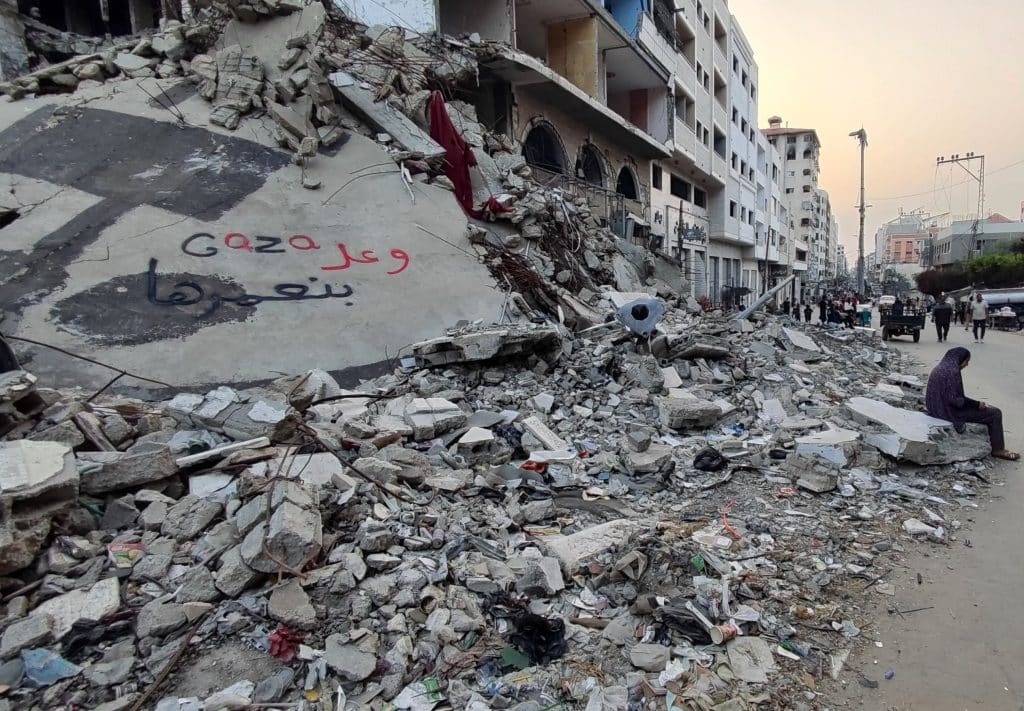
Palestinians walk in front of graffiti written in Arabic: “We will rebuild Gaza” on the wall of a building destroyed during Israeli attacks, as Israeli attacks continue since 7th October in Gaza City, Gaza Strip, on May 29, 2024. Photo by Khaled Daoud apaimages

Abu Ahmad, a displaced resident of northern Gaza, thought he would be living with some sort of roof over his head by now. Instead, he and his family remain exposed to the cold and the rain with only a threadbare tent for shelter.

“When the ceasefire was announced, I believed I would finally be able to rebuild my home, or at least get a caravan to survive the winter,” Abu Ahmad told Mondoweiss. “Instead, we only hear about plans and conferences. Nothing has actually changed.”

Abu Ahmad’s home now lies beyond the so-called Yellow Line, which cuts Gaza in half and has been progressively expanded by the Israeli army to cover larger swathes of land to fall under its control.

Almost two months into the ceasefire, international conferences on Gaza’s reconstruction and frequent promises to rebuild have so far amounted to little. According to UN estimates, 25 hospitals are out of service, nearly 70% of housing units have been partially or completely destroyed, 85% of water and sewage facilities have been damaged, and 95% of schools are reduced to rubble.

Amid these conditions, humanitarian aid and reconstruction materials have entered at rates far below the agreed-upon amounts as part of the ceasefire deal. Gazans have characterized the present humanitarian situation as a “new form of genocide.”

U.S. President Donald Trump has envisioned turning Gaza into a Middle East “Riviera,” while his 20-point “peace” plan would see Gaza run by a foreign “Board of Peace” that amounts to a Mandate-like form of colonial rule over the Strip.

Meanwhile, Egypt plans to host an international conference on Gaza’s reconstruction, estimating that $70 billion would be required to rebuild it. Qatar and other countries have also pledged support. On the ground, however, no tangible reconstruction efforts have begun, widening the gap between political statements and lived reality.

As the first phase of the ceasefire comes to an end and the second phase is supposedly looming, reconstruction remains a vague promise rather than a defined process. The agreement offers no clear mechanisms or timelines for how reconstruction would be implemented, leaving residents with little choice but to take matters into their own hands.

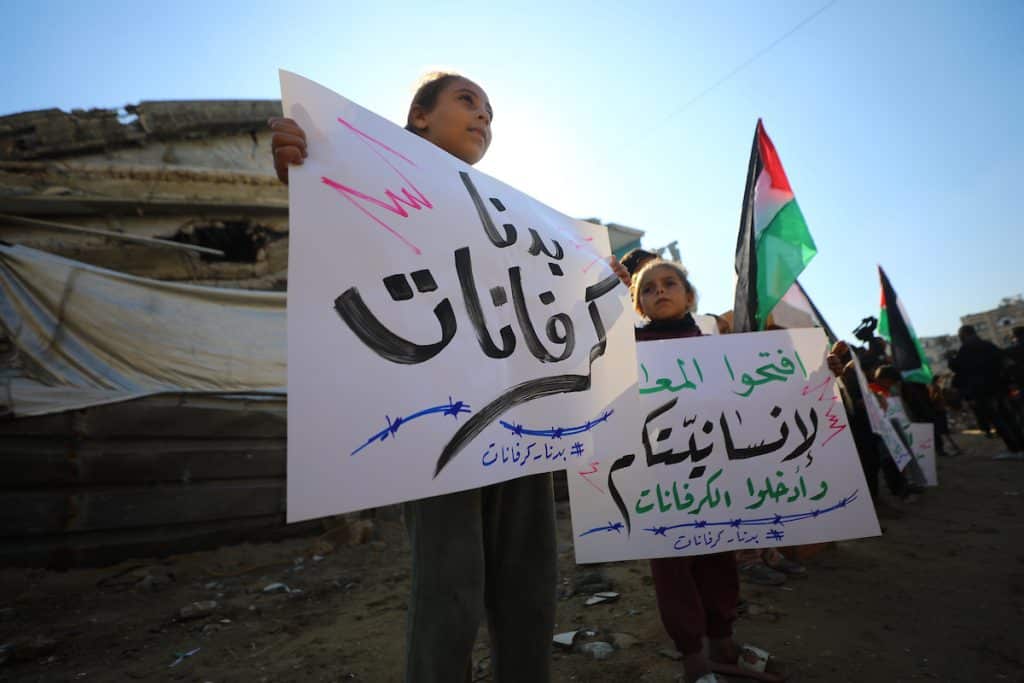
Displaced Palestinians hold a protest in front of a collapsed home in Gaza City, demanding reconstruction efforts be expedited and that mobile homes be provided instead of tents, which are unsuitable for habitation in the face of the severe cold, on December 24, 2025. (Photo: Omar Ashtawy/APA Images)


Helping Gaza rise again

In the absence of meaningful reconstruction efforts, the Municipality of Gaza launched the “We’ll Rebuild It Again” campaign on November 15—marking Palestinian Independence Day—in collaboration with the Civil Organizations Network, the Gaza Chamber of Commerce, and several voluntary youth groups.

“This campaign is part of a broader plan to rebuild Gaza through sanitation, planting, painting, reopening roads, and repairing homes,” said Ahmed Al-Dremly, Head of Public Relations and Media at the Municipality of Gaza. “We support every effort and every initiative that aims to help Gaza rise again from the rubble.”

He added that the campaign also seeks to bring youth initiatives together under one umbrella. “We aim to unite youth programs to harness their skills and energy, replant hope in people’s hearts, and prove that Gaza is still alive,” he said.

The campaign began on Omar al-Mokhtar Street, one of Gaza City’s central streets, where groups of young volunteers cleaned the area using only basic tools—brooms, dustpans, and shovels. The goal was to remove rubble, clean the street, and restore a sense of order and normalcy to the city’s public space despite the limited means available.

Al-Dremly noted that around 85 percent of the municipality’s heavy and medium machinery was damaged during the war. Still, he stressed that the lack of equipment would not halt the initiative. “Gaza will rise again through its people’s spirit and love of life and land,” he said.

In the short term, the Municipality of Gaza plans to continue the campaign on a weekly basis, moving each time to a new location across the city.
We’ll rebuild it

One of the partners in the Gaza Municipality’s “Let’s Rebuild” campaign is the Sameer Project, founded by six Gazans living in the diaspora.

“Living abroad does not mean sitting aside and waiting for the world to decide when to act and help our people in Gaza,” said Hala Sabbah, an official with the project. “We’ve waited for too long. We felt the necessity to act.”

“Gaza needs immediate support,” she added. “As civil society organizations, even simple efforts matter. No one understands Gaza’s pain better than its people. That’s why we initiated this project — because we are Gazans, and we know how Gazans suffer.”


Launched in April 2024, the Sameer Project has continuously adapted its work to meet changing needs. During the famine, the focus was on food aid. During mass displacement, it provided tents and temporary shelters. Following the ceasefire, priorities shifted toward reopening blocked roads and salvaging damaged homes.

Two weeks after the ceasefire began, Sabbah and her team launched the “Hand in Hand, Let’s Rebuild It” campaign, responding to residents’ inability to return to their homes in northern Gaza, where streets and entrances remain buried under the rubble.

“We knew this work required heavy machinery and proper equipment,” Sabbah said. “But that doesn’t mean we do nothing. Any step that relieves people’s pain matters.”


“It’s a drop in the ocean. The level of destruction is beyond anything normal.”Hala Sabbah, the Sameer Project

Using every available resource — shovels, wheelbarrows, a limited number of bulldozers, brooms, and above all, youthful determination — the project mobilized at least 100 volunteers, including engineers, journalists, and students. So far, three main streets in Gaza City, Khan Younis, and the Abu Eskandar area have been cleared and reopened, easing the movement of people and vehicles.

Priority was given to roads that allow access for water trucks and basic services. “Water is a basic need for everyone in Gaza,” Sabbah said. “When we open a road, we make sure water trucks can pass. This alone can ease people’s daily suffering.”

Despite these efforts, Sabbah stressed that what they are doing addresses only a fraction of Gaza’s needs. “It’s a drop in the ocean,” she said. “The level of destruction is beyond anything normal.”

According to the UN Development Programme, rebuilding Gaza would cost around $40 billion, generate 40 million tons of rubble, and take up to 80 years if current Israeli restrictions remain in place.

A major obstacle is the severe lack of equipment. “We can’t operate across the entire Strip,” Sabbah explained. “Most heavy machinery was destroyed during the war.”

Local estimates indicate that Israeli bombardment deliberately targeted bulldozers and other heavy equipment, leaving only a very limited number of functioning machines in Gaza, mostly owned by private companies. In 2025, Israel permitted a limited number of machines to enter the Strip under specific sponsorship arrangements. The Government Media Office estimates that at least 500 heavy and medium machines are needed to support reconstruction efforts.

Fuel shortages further complicate the work. Since the ceasefire, Israel has allowed only 5–6 fuel trucks per day, covering roughly 10% of Gaza’s actual needs, despite pledges to allow 50–60 trucks daily. As a result, fuel prices have soared, with gasoline reaching 120 ILS ($37) per liter and diesel nearly 60 ILS (almost $14).

Alongside road clearance, the Sameer Project works to salvage partially damaged homes and turn them into temporary shelters when possible. “The first step is always checking the foundations,” Sabbah said. “We work with field engineers to make sure homes are safe.”

“So far, at least 62 homes have been cleared of rubble and partially repaired using wooden poles and plastic sheets,” she added. “They’re not ideal, but they’re safer than tents.”

In cases where foundations are unsafe, repairs are refused. Families are instead provided with tents erected beside their homes and warned not to return inside. According to Gaza’s Interior Ministry, at least 12 previously damaged homes collapsed during recent storms, killing eight people, including children.

One volunteer with the Sameer Project lost five family members when their home collapsed during the storm.

Beyond physical reconstruction, the initiative also considers the psychological toll of displacement. “People feel safer when they are close to their homes, even if those homes are destroyed,” Sabbah said. “We want to help them stay connected to their land, neighbours, and communities.”

As winter intensifies, the project has expanded its response to flooded camps. In addition to reopening roads and repairing homes, volunteers have delivered sand trucks to raise tents above ground level and prevent water from flooding shelters.

“So far, at least 35 sand trucks have been provided to stabilize makeshift camps and prevent water accumulation,” Sabbah told Mondoweiss.

Grassroots efforts extend beyond rubble removal. The youth-led “Ele Elna Elak” campaign recently established a desalination plant serving camps in northern Gaza. Commenting on the initiative, content creator Bissan Ouda said, “This achievement, accomplished with almost no resources, is like digging through rock.”
More funds, wider impact

With international funding largely stalled, these initiatives rely almost entirely on online fundraising, informal networks, and community trust. For the Sameer Project, social media platforms — primarily Instagram, X, and TikTok — have become the main channels for raising donations and reaching supporters outside Gaza.

Despite the scale of their work and its direct impact on people’s lives, fundraising has become increasingly difficult. Hala Sabbah told Mondoweiss that donations dropped sharply after the ceasefire, as many outside Gaza assumed the war had ended.

“Donations were reduced by nearly half,” Sabbah said. “That’s why we started posting more urgent content—scenes of daily struggle, flooded tents, and people trying to survive.”

She explained that limited media coverage of Gaza’s post-ceasefire reality has made these efforts even harder. “We were told many times that what we share is not widely shown on social media,” she said, referring to the lack of visibility of continued displacement and worsening living conditions.

This invisibility, she added, sometimes turns into doubt. “Some people even question our transparency,” Sabbah said. “That directly affected donations and slowed our work, especially before the recent storm.”

According to Sabbah, this skepticism stems from a widespread belief outside Gaza that the war is over. “People don’t always believe the scenes we share—families living in torn tents or children chasing food in the streets,” she said.

However, after images of flooded camps circulated during the recent storm, donations increased slightly. “People began to trust what we were showing again,” she added.

Still, Sabbah stressed that the war has not ended, but continues in different forms. “The suffering didn’t stop,” she said. “It only changed shape.”

She renewed her appeal for urgent support. “Despite closed crossings, Israeli restrictions, and the lack of equipment, we can’t stand aside and do nothing,” she said. “We have to keep trying to help Gaza rise again.”

“It won’t return to what it was anytime soon,” she added, “but we can help people regain some dignity and stability.”

Alongside the Sameer Project, other youth-led initiatives face similar challenges. One example is the Samir Foundation, led by Izzeddin Lulu, a medical student from Gaza who lost 20 members of his family, including his father–after whom he named his foundation, and older brother alongside his family.

The foundation depends on online campaigns, partnerships with sponsors, and collaboration with charitable organizations. Lulu maintains a strong presence on social media, sharing his personal experience and the foundation’s humanitarian mission. In addition, a network of ambassadors in several countries organizes awareness and fundraising campaigns in universities and international forums.

Through these efforts, the foundation has built partnerships with regional and international donors to support programs ranging from scholarships and financial aid for medical students to investments in educational and health infrastructure.

In June 2025, the Samir Foundation inaugurated Gaza’s first-of-its-kind medical hub in partnership with Human Smile, a Belgium-based humanitarian organization. The hub provides uninterrupted electricity, high-speed internet, and a stable learning environment—offering students an alternative to studying by candlelight in overcrowded shelters.

Despite global delays and the ongoing stagnation of Gaza’s reconstruction, youth-led and grassroots initiatives continue to turn resilience into action. With limited tools and shrinking resources, people rebuild not because conditions allow it, but because survival leaves them no other choice.
Palestine’s internal political crisis is allowing foreign powers to decide its fate

Palestinians are in a political crisis. With Palestinian society divided, and no unified national leadership to represent it, regional and global powers are drawing up plans for the future of Gaza and Palestine - without any say from Palestinians.
 December 29, 2025 
MONDOWEISS

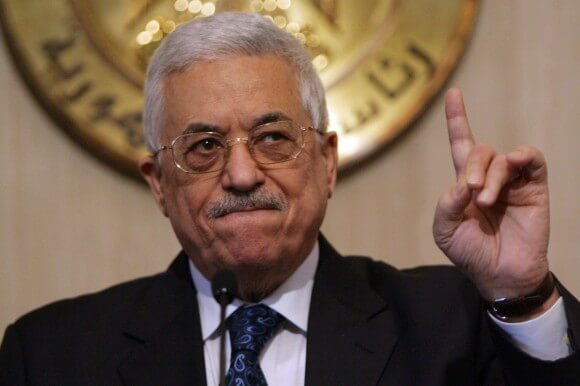
Palestinian Authority President Mahmoud Abbas. (Photo: Khaled Desouki/AFP)


Before the signing of the Gaza ceasefire in Egypt last October, U.S. President Trump began to draw up his 20-point “peace” plan by meeting leaders from Arab and Islamic countries before amending the plan with Israeli Prime Minister Benjamin Netanyahu. European countries also had their say as expected funders of the reconstruction effort, along with Arab countries. But amid all these interlocking interests, one side has continued to be absent: the Palestinian people.

While Palestinians have routinely throughout history been sidelined when negotiations and decisions are made around their own future, one reason for this glaring absence in the current moment is that the Palestinian people are undergoing an internal political crisis. The nature of the crisis has often been characterized as one of political representation and factional disunity — a question of political differences between Hamas and Fatah, or even more trivially, a difference over which faction runs the ministries or who signs the paychecks of public employees.

But there’s another reason for the political marginalization of Palestinians, and it doesn’t boil down to political differences over tactics, strategy, and how national aspirations are articulated: it is because Palestinian society is itself divided.

The result of this fragmentation is that while regional and global powers draw plans for the future of Gaza and Palestine, Palestinians still struggle to have a national leadership and representation that rises to the occasion and addresses this pivotal moment in Palestinian history.

A crisis of society, institutions, and elites

The real crisis is not one of representation, but of society, says Khaled Odetallah, a Palestinian intellectual and founder of the Suleiman Halabi Center for Colonial and Liberation Studies. The essence of the Palestinian political crisis is nothing more than a “symptom” of a deeper social crisis, Odetallah argues, stressing that “political elites are, in the end, the reflection of social forces, which in the Palestinian case have been exposed to relentless targeting by colonial policies seeking to destroy the social fabric,” he told Mondoweiss.

“The crisis is one of a society which is currently incapable of drawing a single definition of its aim of liberation, after its social bodies were destroyed by the Israeli occupation,” he explained. “The occupation’s violence has decimated social bodies like unions, student movements, and associations, killing many and putting thousands in prison. It has also segregated Palestinians into different geographical realities,” he went on.

“The separation between Gaza and the West Bank, for instance, has been years in the making, and there have been different realities created between the north and the south of the West Bank, let alone Jerusalem and Palestinians holding Israeli citizenship, and there are many social groups with different interests in each of these parts,” Odetallah noted.

“Political representation is usually born out of interaction and struggle among social groups, which builds the representation of a society from the bottom up. This process has been systematically aborted by Israeli segregation and crackdown, and that is reflected in the lack of a united leadership,” he said.

For Odetallah, Palestinian political institutions have lost their representative capacity because they have lost their capacity to lead a liberation project. “The PLO has become a tool for political survival,” he pointed out. “It has given up much of its liberation movement role for the sake of survival and recognition, which is why it has lost much of its significance.”

“Palestinians are at a moment where they have to rebuild their political movement from scratch, based on their social reality from the most local level up, just like in the post-Nakba years in the early 1950s,” he added.

The origins of the crisis

Since the establishment of the Palestine Liberation Organization (PLO) in 1964, as the post-Nakba embodiment of the Palestinian national movement, the entire Palestinian struggle has mainly centered around reclaiming Palestinian agency. In the 1970s, the UN and the Arab League’s recognition of the PLO was in fact a revolutionary breakthrough, because it meant the admission that the leadership and representation of the Palestinian people at the time, with its political program, was a legitimate party to any political discussion on the future of Palestine.

Today, however, the recognition of a Palestinian state is considered by many as merely symbolic — because there is no unified Palestinian representative that can present a vision of self-determination.

This representation crisis has, in fact, been deepening for at least 15 years, predating the Israeli war on Gaza following October 7, 2023.

The last time Palestinians voted to elect a leadership was in 2005 and 2006. The head of Fatah, Mahmoud Abbas, was elected president in the first, and Hamas won a simple majority of seats in the Palestinian Legislative Council in the second. The duality of radically different political programs, and the stance of Western sponsors of the Palestinian Authority against having such a duality, created a political crisis, which exploded in 2007, when Hamas took over by force the administrative institutions in Gaza. As a consequence, two Palestinian entities emerged, with two leaderships. Palestinian politics have ever since been largely dominated by this split, marginalizing the other components of the Palestinian political scene and obstructing the formation of unified political representation for Palestinians.

Since 2007, Fatah and Hamas, sometimes with other factions, have met for talks and concluded agreements more than 10 times, under Egyptian, Saudi, or Qatari auspices. In at least two of these agreements, general elections were foreseen but never took place.

The only notable exception came in 2014, as a result of an agreement between both sides following talks at the Shati’ refugee camp in western Gaza City, without any third-party auspices. The agreement included the formation of a “national consensus government” reuniting the Palestinian ministries, although maintaining their actual administration under the separate control of Hamas in Gaza and Fatah in the West Bank (this is why the Palestinian health ministry, for example, is the same in both places, and their figures of Palestinians killed in Israeli bombings are not “Hamas figures”).

This situation was supposed to be temporary, but it has lasted until today. Although the government was officially one between the West Bank and Gaza, actual control and administration remained separated, and Palestinian political division has continued to this day.

The elections that never happened in 2021

In 2020, Palestinian factions agreed on holding general elections that would include the PA’s Legislative Council (in the West Bank and Gaza) and the PLO’s National Council (in Palestine and the diaspora). Such a move would have meant a fresh representative body for all Palestinians, which would have led to electing a new Palestinian leadership and drafting a unified national political program.

In comparison to the 11 candidates’ lists in the 2006 elections, no fewer than 36 lists signed up for the 2021 legislative elections in the West Bank and Gaza. Among these were nine non-partisan lists made up of independents, including lists formed by public functionaries who had previously taken part in union strikes, young professionals, and youth groups.

“It was an opportunity to make the new voices of the Palestinian people heard,” Inès Abdel Razek, director of the Palestinian Institute for Public Diplomacy (PIPD), told Mondoweiss. “There is an urgent need for political renewal in Palestinian politics, and one of the obstacles to it is that, out of 14 million Palestinians in the world, only those in the West Bank and Gaza are directly included in PA politics. Only they are able to vote in any PA elections.”

Abdel Razek was part of a youth group that presented a list for the elections under the name of the Generation of Democratic Renewal. “I myself am the daughter of a Palestinian refugee who isn’t a resident of Palestine,” she said. “Although I am a Palestinian, I can’t participate in Palestinian politics in Palestine.”

Another example was the “Freedom and Dignity” electoral list, headed by noted Palestinian political dissident Nizar Banat, who would later be assassinated by members of the PA security forces in June 2021. His extrajudicial lynching sparked widespread protests against PA repression and its crackdown on dissent, solidifying widespread perceptions of PA corruption and complicity in security coordination.

According to Abdel Razek, “the political fabric has been decimated by the Israeli occupation, and it has become unable to give birth to an inclusive and united political representation.”

Despite the knowledge that little can be achieved through Palestinian political institutions, Abdel Razek says that “many of us thought in 2021 that we should use the opportunity of announced elections to get some representation, before the elections were called off.”

But the elections were called off by PA President Mahmoud Abbas in April 2021, under the pretext that holding elections without the participation of Palestinian residents of Jerusalem — who hold Israeli residency permits and are prevented by Israel from participating in PA institutions or elections — constituted an unacceptable erosion of the Palestinian claim to Jerusalem.

At the time, Nizar Banat derisively remarked that such pretexts concealed the PA’s abandonment of Jerusalem through its signing of the Oslo Accords in 1993, sarcastically mocking the statement of one Fatah official as akin to the more radical and politically uncompromising discourse of the Palestinian Islamic Jihad.

But the fact that Palestinian political life has atrophied is no coincidence. It is the product of direct Israeli interference and the cultivation of a social and political class whose interests lie in maintaining the status quo. For Abdel Razek, Israeli policy has “engineered” Palestinian society and politics through a variety of instruments, from “keeping leaders in prison or assassinating them,” to segregating Palestinians geographically, to banning political meetings, and most recently, to supporting collaborators like the now-deceased gang leader Yasser Abu Shabab in Gaza.

“Preventing dissent is a way to prevent a healthy political life,” Abdel Razek noted. “Then we, Palestinians, are blamed for not being capable of governing ourselves, but the crisis is not one of the Palestinian people, because Palestinians agree on the essentials and on our priorities, despite our differences.”

That’s why the crisis of representation is a crisis of institutions and political classes, Abdel Razek maintains, adding that “it is maintained by the occupation’s interruption of our political life.”

Over the course of Israel’s genocide in Gaza, Palestinian factions attempted to unify their representation in order to take part in Gaza’s postwar arrangements. In July 2024, Palestinian factions agreed in Beijing to form a technocratic, non-political committee to run Gaza after the war and prepare it for general elections. Then in March 2024, they agreed on the same thing in Cairo. Last October, they reaffirmed the same commitments yet again following the signing of the ongoing tenuous ceasefire in Gaza.

Yet because Palestinians are politically divided, they are unable to act in unison and exercise collective leverage in the postwar political process. This has guaranteed that Palestinians are unable to have a say in their own fate, and it is what made the consecration of Trump’s colonial postwar plan at the UN Security Council possible.


Trump reaffirms his support for another strike on Iran after meeting with Netanyahu

On Monday, Donald Trump reaffirmed his support for another strike on Iran after meeting with Israeli Prime Minister Benjamin Netanyahu. But analysts say Netanyahu's designs go far beyond Iran.


By Michael Arria 
 December 30, 2025 
MONDOWEISS

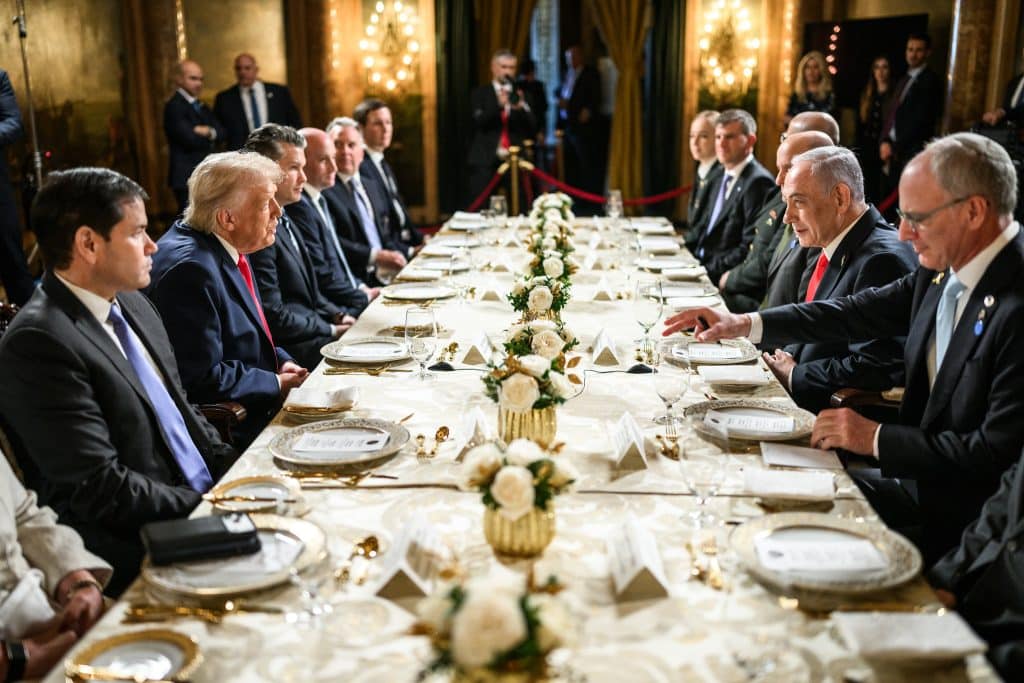
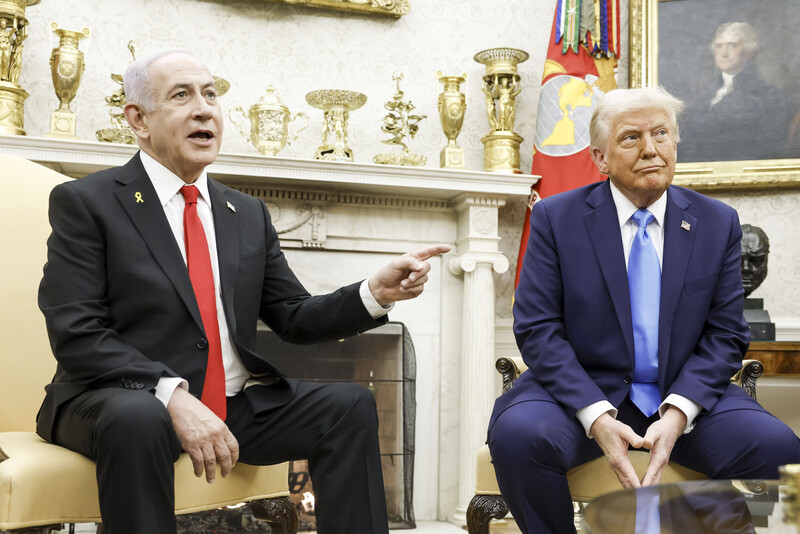
President Donald Trump hosts a bilateral meeting with Israeli Prime Minister Benjamin Netanyahu, Monday, December 29, 2025, at the Mar-a-Lago Club in Palm Beach, Florida. (Official White House Photo by Daniel Torok)


In comments to reporters after his meeting with Israeli Prime Minister Benjamin Netanyahu, President Donald Trump reiterated his support for another strike on Iran.

“I hope they’re not trying to build up again, because if they are, we’re going to have no choice but very quickly, to eradicate that build up,” said Trump, referring to the alleged expansion of Iran’s ballistic missile program.

“We’ll knock them down,” he added. “We’ll knock the hell out of them.”

Netanyahu has consistently pushed for a wider war on Iran, and was expected to make the case for further attacks during his Mar-a-Lago visit.

Trump’s comments prompted an immediate response from Iranian officials.

In an article in The Guardian, Iranian foreign minister Seyed Araghchi called on the Trump administration to defy Israel on the issue.

“The US administration now faces a dilemma: it can continue writing blank cheques for Israel with American taxpayer dollars and credibility, or be part of a tectonic change for the better,” he wrote. “For decades, Western policy towards our region has been mostly shaped by myths originating from Israel.”

“The response of the Islamic Republic of Iran to any oppressive aggression will be harsh and regrettable,” tweeted Iranian President Masoud Pezeshkian.

In a post on the meeting, Quincy Institute for Responsible Statecraft Vice President Trita Parsi wrote that an attack on Iran could easily lead to retaliatory strikes.

“Tehran has gone to great lengths to avoid a military confrontation with Washington, but just because it has shown restraint in the past does not mean that it can afford to do so in this scenario,” wrote Parsi. “Indeed, given that Iran will be totally exposed without its missiles, it will likely reckon that it has no choice but to strike directly at U.S. targets.”

“Even if Trump opts to ‘only’ support Israel defensively in yet another Israeli choice of war — which is the position Biden took — it nevertheless incentivizes Israel to restart war, as the U.S. is lessening the cost for Israel to do so,” he continued.

Sina Toossi, a senior non-resident fellow at the Center for International Policy, says that Netanyahu’s designs go far beyond Iran.

“Netanyahu’s visit unfolds against a backdrop of unresolved fronts, with widening disputes with Washington over the second phase of the Gaza ceasefire, including postwar governance, reconstruction, and Turkish involvement,” he said in a statement to Mondoweiss. “At the same time, Israel is seeking greater latitude to escalate again against Hezbollah in Lebanon, an end to U.S. accommodation of Syria’s new leadership, and firm assurances on expanded military aid. What remains unclear is Netanyahu’s actual order of priorities, even as a transactional give and take appears inevitable.”

Israel’s repeated violations of the recent ceasefire have seemingly postponed the Trump administration’s postwar plan for Gaza, but the President expressed no frustration over the timeline and embraced Netanyahu’s call for Hamas to disarm.

“They’re going to be given a very short period of time to disarm and we’ll see how that works out,” he told reporters. “[Trump advisors] Steve Witkoff and Jared Kushner will be in charge of that, from our side. But if they don’t disarm, as they agreed to do — they agreed to it — then there will be hell to pay for them. And we don’t want that. We’re not looking for that. But they have to disarm within a fairly short period of time.”

“We have 59 countries that signed on, big countries, countries that are outside of the Middle East as you know the Middle East,” Trump continued. “They want to go in and wipe out Hamas. They don’t want Israel, they don’t need Israel; they want to do it because it’s the right thing to do. Because they were for the deal, based on the fact that Hamas pledged, they swore, that they were going to disarm. Now, if they’re not going to disarm, those same countries will wipe out Hamas.”

U.S. officials with knowledge of the meeting told Axios that Trump aides called on Netanyahu to change his policy in the occupied West Bank, where violent escalations run the risk of derailing Trump’s vision for the region.


Tony Blair pressured officials to keep UK soldiers accused of abusing Iraqis out of civil courts, files reveal

Documents released to National Archives reveal former UK leader Blair’s insistence that soldiers accused of abusing Iraqi detainees be kept out of civilian courts and the ICC


December 30, 2025 

Tony Blair, former Prime Minister of the UK addresses the World Travel & Tourism Council Asia Summit on 10 September 2013 [World Travel & Tourism Council/Flickr]

Newly released government files suggest former UK Prime Minister Tony Blair put pressure on officials to prevent British soldiers accused of abusing Iraqi detainees from being tried in civil courts, according to reports by British media on Tuesday, Anadolu reports.

The documents, released to the National Archives at Kew, west London, reveal that in July 2005, a senior aide wrote to Blair reporting that the attorney general had met army prosecutors to discuss the case against British soldiers alleged to have beaten Baha Mousa to death.

Mousa was an Iraqi hotel receptionist who died in British military custody in Basra, Iraq, in Sept. 2003.

He was one of several civilians detained at a British army interrogation facility and subjected to severe mistreatment, including beatings, hooding, and stress positions.

Antony Phillipson, the then prime minister’s private secretary for foreign affairs, wrote: “Although if the Attorney General felt that the case was better dealt with in a civil court, he could direct accordingly.”

Blair underlined the paragraph and added, “It must not!”

Two years later, Corporal Donald Payne, who brutally mistreated Mousa and other civilians at a detention center in Basra in Sept. 2003, was court-martialed and became the first British soldier to be convicted of a war crime.

READ: No room for toxic Blair on Gaza peace council

Payne, who was jailed for a year and dismissed from the army, admitted punching and kicking hooded and handcuffed civilians, conducting what he called “the choir,” and striking prisoners in sequence, their groans or shrieks making up the “music.”

He admitted to inhumanely treating Iraqi civilians—a war crime under the International Criminal Court (ICC) Act 2001.

The newly released files appear to show Blair’s eagerness to ensure British soldiers facing allegations of wrongdoing in Iraq would not be tried in civilian courts or by the ICC.

Phillipson recommended that Blair request the Defence Ministry and the attorney general provide notes on proposed changes to legislation and an assessment of how they would be presented so the government could avoid being accused of making it impossible for troops to operate in a war zone.

Blair wrote in response: “We have, in effect, to be in a position where ICC is not involved and neither is CPS. That is essential. This has been woefully handled by the MoD.”

Earlier, Phillipson had told Blair that the Foreign Office expected the ICC prosecutor to decide whether to pursue a formal investigation into UK military operations in Iraq. Blair wrote in the margins, “This is vital.”

In 2020, the ICC formally abandoned a long-running inquiry into claims that British troops committed war crimes in Iraq between 2003 and 2008.
UN says war in Sudan has displaced nearly 13 million people


December 30, 2025 


Displaced Sudanese families shelter at the newly established Al-Afadh camp in Al Dabbah after fleeing Al-Fashir and other conflict zones in North Darfur following the Rapid Support Forces’ (RSF) takeover of the city, on November 6, 2025. [Stringer – Anadolu Agency]

The war in Sudan, which began on 15 April 2023, has displaced almost 13 million people, including more than four million who have fled to neighbouring countries, according to the United Nations.

The UN has described the situation in Sudan as the world’s worst humanitarian crisis, citing severe deterioration in conditions across displacement camps in Tawila in North Darfur and Al-Afad camp in northern Sudan, as well as in the cities of El Obeid in North Kordofan, Kosti in White Nile State and Damazin in Blue Nile State.

UN estimates indicate that more than eight million Sudanese have been forced from their homes by the fighting. Separately, Sudan’s National Council for Child Welfare said the conflict has disrupted the education of nearly 12 million children across the country.

Meanwhile, the Sudanese Doctors Network accused the Rapid Support Forces on Saturday of killing more than 200 people on an ethnic basis in the areas of Amro, Sirba and Abu Qumra, days after the group announced it had taken control of those locations. The RSF has not commented on the allegations.

The Joint Force of Armed Movements in Darfur said last Thursday that it had repelled an RSF attack on several northern areas of North Darfur State.

Beyond Darfur, intense fighting has also continued for weeks across the three Kordofan states — North, West and South — between the Sudanese army and the RSF, triggering the recent displacement of tens of thousands more civilians.

Of Sudan’s 18 states, the RSF currently controls the five states of Darfur in the west, with the exception of parts of North Darfur that remain under army control. The Sudanese army retains influence over most of the remaining 13 states, including the capital, Khartoum.
THE ONLY FREE PRESS IN ISRAEL

Israeli government announces boycott of Haaretz newspaper over claims it supports ‘enemies’


December 30, 2025 
Middle East Monitor 


Israeli Knesset in Jerusalem  [Noam Moskowitz – Knesset – Handout/Anadolu Agency via Getty Images

For the first time since the establishment of the State of Israel, the government has announced a boycott of the newspaper Haaretz, accusing it of supporting “enemies” during wartime.

According to Galei Tzahal, the government has decided to sever ties with Haaretz in both advertising and editorial matters. Ministries, advertising agencies and state-funded companies have been instructed to halt all forms of contact with the newspaper.

An Israeli radio report said the boycott was implemented under a government decision issued in November 2024, which also called for isolating the newspaper from communication with official accounts of senior media offices within the Israeli army.

In a statement, the Israeli government said Haaretz had published editorials during the war on Gaza that “damaged the legitimacy of the State of Israel in the world and its right to self-defence”.

The statement said the government “will not accept a situation in which the publisher of an official newspaper in Israel calls for sanctions against it and supports the enemies of the state in the midst of war”. On this basis, it said all ties with the newspaper would be cut and no official statements would be issued through it.

The move comes about a month after the Knesset approved, in a first reading, a bill imposing new restrictions on freedom of opinion and expression, according to Yediot Aharonot.

The Hebrew-language daily reported that the bill, titled “Reforming the Media System”, was submitted by Communications Minister Shlomo Karhi and passed its initial vote in the Knesset plenum.

The legislation expands the powers of rabbinical courts at the expense of the authority of Israel’s attorney general, Gali Baharav-Miara, who opposed the bill. She warned that it “includes arrangements that exacerbate the risks to the image of a free press in Israel”.

“There is genuine concern about significant commercial and political influence and interference in the work of media institutions,” she said.
Lazzarini calls Knesset vote against UNRWA ‘outrageous’ and a challenge to ICJ rulings

December 31, 2025 


The United Nations Relief and Works Agency for Palestine Refugees (UNRWA) Commissioner General Philippe Lazzarini holds a press conference at the UN headquarters on September 25, 2025, in New York City, USA.[Selçuk Acar – Anadolu Agency]


The Commissioner-General of the United Nations Relief and Works Agency for Palestine Refugees, Philippe Lazzarini, has condemned an Israeli Knesset (Parliament) vote targeting the agency, describing it as “outrageous”.

In a statement published on the X platform on Tuesday, Lazzarini said the legislation constitutes a blatant violation of the mandate granted to United Nations Relief and Works Agency by the UN General Assembly and represents a direct challenge to rulings issued by the International Court of Justice.

He said the legislation grants the Israeli government authority to confiscate UN property in occupied East Jerusalem, including UNRWA’s headquarters and its vocational training centre.

Lazzarini added that the bill explicitly excludes the agency from the immunities and privileges normally afforded to UN bodies, a move he said is intended to end UNRWA’s presence in occupied Jerusalem and sever all contact with its officials.

The UNRWA chief described the legislation as a serious blow to the multilateral system and part of a systematic campaign to discredit the agency and obstruct its role in delivering essential humanitarian assistance and development services to Palestinian refugees.

He stressed that Israel is obligated to act within the framework of the United Nations and its Charter, adding that any objections raised by Israel should be addressed through the appropriate UN deliberative bodies, rather than through unilateral legislative measures.
Spain orders removal of ads for rentals in occupied Palestinian territories

KUSHNER REALTY INC.

December 31, 2025 
Middle East Monitor 


A general view of Efrat Jewish Settlement in Bethlehem, West Bank on March 30, 2024. [Wisam Hashlamoun – Anadolu Agency]

Spain’s Ministry of Consumer Affairs has ordered advertising platforms to remove listings promoting tourist accommodation in the Israeli-occupied Palestinian territories, in a move framed as support for the Palestinian people.

In a statement issued on Tuesday, the ministry said it had identified 138 advertisements for tourist accommodation on seven platforms operating in Spain.

It said the multinational companies involved were issued with an initial warning, informing them that illegal content had been found on their platforms in the form of advertisements for accommodation located in the occupied Palestinian territories. The companies were instructed to remove or block the ads immediately.

The ministry warned that failure to comply would result in “further measures” being taken.

READ: Israel settler violence forces closure of only primary school in occupied West Bank village

The decision comes within the framework of a decree issued by the government of Pedro Sánchez, approved by parliament in October, which aims to “end the genocide in Gaza and support the Palestinian people”.

Related measures under the decree include a ban on the purchase and sale of weapons to Israel, as well as a ban on advertising products manufactured in Israeli settlements or in occupied territories.

Commenting on the latest decision, the ministry said that such tourist accommodation “contributes to the normalisation and perpetuation of a colonial regime that is considered illegal under international law”.

Similar steps have been taken elsewhere. In October, the Human Rights League in France announced action against online booking platforms that advertise tourist accommodation in Israeli settlements in the occupied Palestinian territories.