Saturday, March 21, 2026


Why the Iran War May Have Just Killed the AI Boom

  • The $1.5 trillion in committed AI infrastructure spending by major tech companies is built on an assumption of a functional global supply chain, which the Iran conflict has fundamentally broken.

  • The war's effects, including the collapse of shipping insurance in the Strait of Hormuz, attacks on data centers, and a spike in oil prices, are structural problems that will increase component costs and slow the AI buildout.

  • Compounding issues—higher costs for fuel and fertilizer, coupled with elevated electricity bills from data center demand—will shorten the political window for the AI transition and fuel consumer backlash.

The stock market spent the first week of the Iran war doing something strange: mostly shrugging. Oil spiked. Insurance markets effectively collapsed. Amazon had two data centers blown up. And the Nasdaq dipped, steadied, and the conversation shifted within days to whether the Fed might still cut in June. 

The prevailing read was: disruption, yes. Catastrophe, no. This thing will be over soon. I think that read is wrong. 

And wrong in a specific, structural way, not because the war will necessarily escalate further, but because the damage being done right now is the kind that compounds quietly. 


It hits a system that had no room left to absorb it. And it is aimed, with surprising precision, at the single largest economic bet America has ever made.

The $1.5 Trillion Bet

Add it up. Meta has pledged over $600 billion in US AI infrastructure by 2028. Apple committed $500 billion over four years. Amazon is projecting $200 billion in data center spending in 2026 alone, up from $131 billion last year. Google sits at $175 to 185 billion. Microsoft is tracking toward $105 billion for the year. 

That is roughly $1.5 trillion in committed AI capital, most of it tied to data centers, chips, and the supply chains that feed them.

These numbers have a numbing quality. They are so large they start to feel theoretical. 

But they’re not theoretical. They’re the load-bearing wall of the current bull market. 

Goldman Sachs noted in December that consensus capex estimates have been too low for two years running, with actual spending growth exceeding 50% in both 2024 and 2025 against forecasts of 20%. 

The market has priced in the spending, the compounding returns that spending is supposed to generate, the AI productivity boom, the new revenue streams, the structural advantage that justifies Nvidia trading at the multiples it does.

The whole thing is a bet. A very large, very confident, very specific bet. And that bet has one core assumption embedded in it: that the global supply chain stays roughly functional.

Tiffany Wade, a senior portfolio manager at Columbia Threadneedle, was already nervous before the war started. "This feels like a return to Meta's old days of overspending," she told Bloomberg. "Investors are losing patience." That was November. Before the Strait of Hormuz closed.
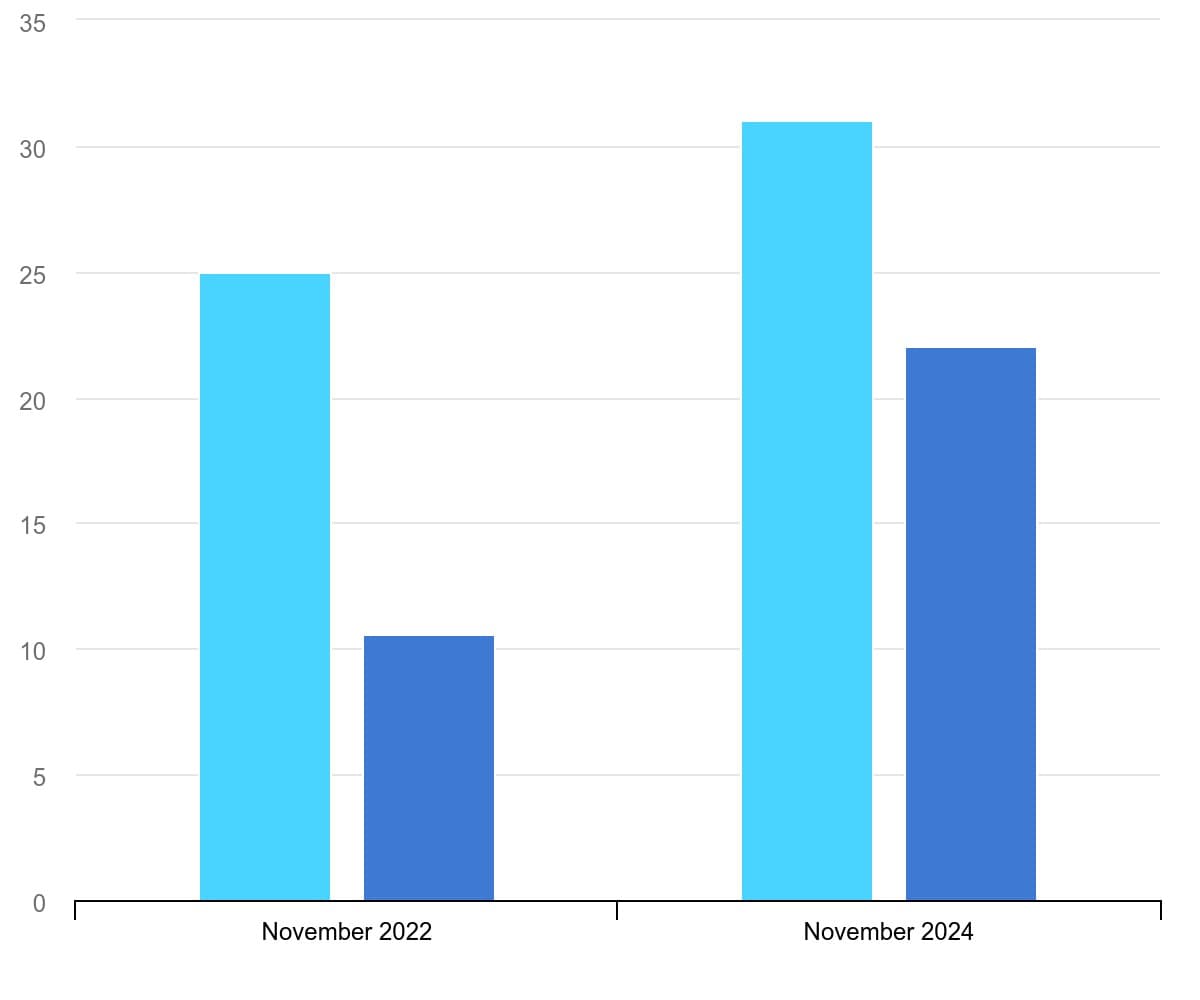
Annual average market capitalisation of S&P 500 companies, November 2022 and November 2024

Annual average market capitalisation of S&P 500 companies, November 2022 and November 2024

Source: IEA, Energy and AI (2025)

The Supply Chain Nobody Draws

Here is something most people don't know: a single semiconductor chip crosses more than 70 international borders before it reaches an end customer. 

The journey takes up to 100 days and involves more than 1,000 discrete manufacturing steps. This is not a quirk. It is the architecture.

Silicon wafers start in Japan or Germany. Chip design happens in the US or the UK. The actual fabrication, for the most advanced chips that power AI workloads, is done almost entirely in Taiwan (92%) and South Korea (8%). Assembly and testing happen in Malaysia, Vietnam, the Philippines. The finished chip ships to a US data center. 

There are more than 50 points across this chain where a single country controls more than 65% of global market share. Each one of them just got more expensive and more uncertain.

Every step in that chain costs energy. Every border crossing costs money. Every logistics node, the freight forwarders, the marine insurers, the fuel for the container ships, is now running hotter than it was on February 27th.

The friction is structural and it compounds with time. It does not resolve when the headlines move on.

Oh, and the Gulf also produces a significant share of the world's helium, a critical input for semiconductor manufacturing. These things connect in ways that don't make the front page.

Halving the Dream

Here's the part that doesn't get enough attention.

Those $1.5 trillion in AI pledges weren’t just announcements; they are the reason the stock prices are where they are. 

When Meta says it's committing $600 billion in AI infrastructure, the market hears something more: $600 billion in projected returns, plus whatever multiplier you want to apply for future AI dominance. The capex is the proof of conviction.

Now imagine what happens when that budget doesn't go as far as it was supposed to. Component costs up. Shipping up. Energy up. Insurance on every supply chain touchpoint up. 

Related: No Missiles, No Drones: What Happens When Rare Earths Stop Flowing?

The dollar amount of the pledge stays the same. The buildout it actually buys does not. You're not getting less ambition, you're getting the same ambition running into a world that charges more for everything it needs.

The pledges don't disappear. The compounding future returns that were priced in do. And the correction, when it comes, is not proportional to the shortfall. It's proportional to the distance between what was promised and what gets built. 

Markets priced in the full vision. They didn't price in the friction.

The Pin

On February 28th, the US and Israel launched Operation Epic Fury. Within days, the Strait of Hormuz, through which roughly 20 million barrels of oil flow every day, about one-fifth of global oil consumption, was effectively closed. 

The IEA called it the biggest oil supply disruption in history.

Brent crude went from $70 a barrel to touching $120. It's sitting around $110 as I write this, which sounds like a retreat until you remember where it started three weeks ago.

But the oil price is almost the least interesting part of what happened to shipping. What happened to shipping was a collapse of the insurance architecture that makes global trade work.

Before the war, insuring a tanker through the Strait of Hormuz cost between 0.02% and 0.05% of the vessel's value. For a $120 million tanker, call it $40,000 a trip. 

Bloomberg reported last week that coverage has leaped to roughly 5% of hull value. The same tanker now costs $5 million to insure for a single voyage. That cost does not stay with the shipowner. It travels through the price of everything on that ship.

All 12 of the Protection and Indemnity Clubs, mutual insurers that cover 90% of the world's ocean-going tonnage, gave 72 hours' notice of war cover cancellation in the Gulf. Hapag-Lloyd added a War Risk Surcharge of $3,500 per container. Daily charter rates for supertankers quadrupled to nearly $800,000 a day. Iran has made 21 confirmed attacks on merchant ships as of March 12th. That is not a threat. That is a policy.

And then there's the data centers.

Iran's IRGC-linked Tasnim News Agency published a target list: Amazon, Microsoft, Palantir, Oracle, captioned "Enemy's technological infrastructure: Iran's new goals in the region." 

Within days, AWS confirmed drone strikes had damaged two UAE facilities and one in Bahrain, causing structural damage, power disruptions, and water damage from fire suppression. 

AWS told customers to consider migrating workloads out of the Middle East entirely.

On pro-Iranian Telegram channels, researchers at SITE Intelligence Group documented hackers posting: "The datacenters need to be taken out. They host the brains of USA's military communication and targeting systems."

Both the Red Sea and the Strait of Hormuz are now active conflict zones simultaneously, severing the undersea cables connecting Gulf data centers to Africa, South Asia, and Southeast Asia. 

First time both chokepoints have been closed at once. The $1.5 trillion bet on AI infrastructure assumed those cables would stay intact.

Why It'll Last Longer Than You Think

Markets are pricing this as a short-term disruption, a bad few weeks, a ceasefire, a slow normalization of shipping routes. 

That's wrong, and wrong for a specific reason: Iran's incentive structure.

Iran cannot win this war militarily. That was decided on day one. But Iran doesn't need to win. Iran needs to make the war expensive enough for everyone else that the pressure to de-escalate lands somewhere other than Tehran. 

Every week the Strait is effectively uninsurable costs the global economy more than the week before. Every data center attack is essentially free, drones are cheap, reputational damage to cloud infrastructure is not. 

Every shipping delay, every fertilizer shortfall, every spike in electricity prices is a cost Iran isn't paying.

The incentive to cause economic chaos outlasts the incentive to sue for peace. The math on oil is already severe.

Oxford Economics estimates that every $10 sustained increase in oil prices knocks 0.1% off global GDP. 

Federal Reserve models suggest the same $10 increase pushes US inflation up by roughly 0.35%. 

Oil is up about $30 from pre-war levels right now. If prices reach $140 and hold for two months, the US approaches a temporary economic standstill. Europe, the UK, and Japan face mild contractions.

There is a historical pattern here that economists keep raising: 1973, 1978, 2008. Every significant oil shock has been followed, in some form, by global recession. 

The Gulf War of 1990 to 1991 is the most instructive parallel, prolonged disruption, sustained high prices, meaningful economic slowdown even though the military phase was fairly brief. 

Gregory Daco, chief economist at EY-Parthenon, put it plainly: "The longer this lasts, the more significant the shock would be."

Why would this time be different? Especially when there's less cushion than there's ever been.

The Federal Reserve entered this conflict with inflation already above its 2% target, the easing cycle already paused, and American consumers already financially stretched. 

The WEF's 2026 Global Risks Report described the economy as "already navigating tariffs, post-pandemic debt overhangs and inflationary pressures." Cut rates to stimulate growth and inflation comes back. Raise rates and a stretched consumer breaks. There is no clean move.

The Part That Connects Back to the Bet

Here is where the story loops back to the $1.5 trillion.

People think of oil shocks as a gas pump problem. They are also a food problem, a chip problem, and a financing problem. 

It’s the three F's: fuel, fertilizer, and financial markets. All three are now in motion, and all three eventually hit the AI buildout.

Start with fertilizer, because it's the one nobody is watching. The Persian Gulf is a fertilizer corridor, not just an energy corridor.

According to Al Jazeera's reporting on the crisis, 46% of global urea supply comes from the Gulf. Qatar's QAFCO alone supplies 14% of the world's urea. Since LNG output from Qatar collapsed, here is what has happened in the span of weeks:

  • India cut output from three of its own urea plants
  • Bangladesh shut four of its five fertilizer factories
  • The US is already close to 25% short of fertilizer supply for this time of year
  • Urea export prices surged roughly 40%, from ~$500 to ~$700 per metric tonne
  • Nitrogen fertilizer prices could roughly double; phosphate up ~50%, per Morningstar analysts

This lands in the middle of spring planting season. Farmers who can't get fertilizer don't just have higher costs, they have lower yields. Lower yields mean food supply pressure in three to six months, well after the news cycle has moved on. The cause and effect will look disconnected. They won't be.

Zippy Duvall, president of the American Farm Bureau Federation, wrote directly to Trump warning that the US "risks a shortfall in crops" that "could contribute to inflationary pressures across the US economy." 

Jet fuel is up 58% since the war began. United Airlines has already warned fares will rise.

Here is how this connects back to AI. Higher food prices, higher energy bills, higher airline tickets... these all hit the same consumer who was supposed to start seeing AI productivity gains show up in their lives in the next two to three years. 

The patience required to get through the transition costs just got shorter. 

The political window for the buildout just got narrower. 

And the financing conditions that made $1.5 trillion in capex possible, low rates, stable inflation, patient investors, are all moving in the wrong direction at once.

Everything that makes the AI bet work is getting more expensive. Everything that makes it politically survivable is getting harder.

The Backlash Engine

AI already had a political problem before any of this. The job displacement anxiety is real and growing. The IP lawsuits are piling up. The environmental footprint was drawing scrutiny. But the resentment was abstract, it didn't have a number attached to it.

Energy costs give it a number.

US data centers already consume roughly 4.4% of national electricity, about 176 terawatt hours a year, according to Lawrence Berkeley National Lab

The IEA projects that roughly half of all US electricity demand growth over the next five years will come from data centers. Goldman Sachs estimates that data center electricity demand will add 0.1% to core US inflation in both 2026 and 2027. Retail electricity prices are already up 42% since 2019, significantly outpacing CPI.

The PJM Interconnection, managing the grid serving 65 million people from New Jersey to Illinois, saw data center capacity costs add $9.3 billion to the 2025 to 2026 cycle. That works out to $16 to $18 more per month on the average residential electricity bill. People are noticing.

An AI server rack requires 40 to 100 kilowatts of power. A traditional server rack needs 5 to 15. A single AI workload consumes roughly 1,000 times more electricity than a traditional web search. These are not marginal differences. They show up on bills.
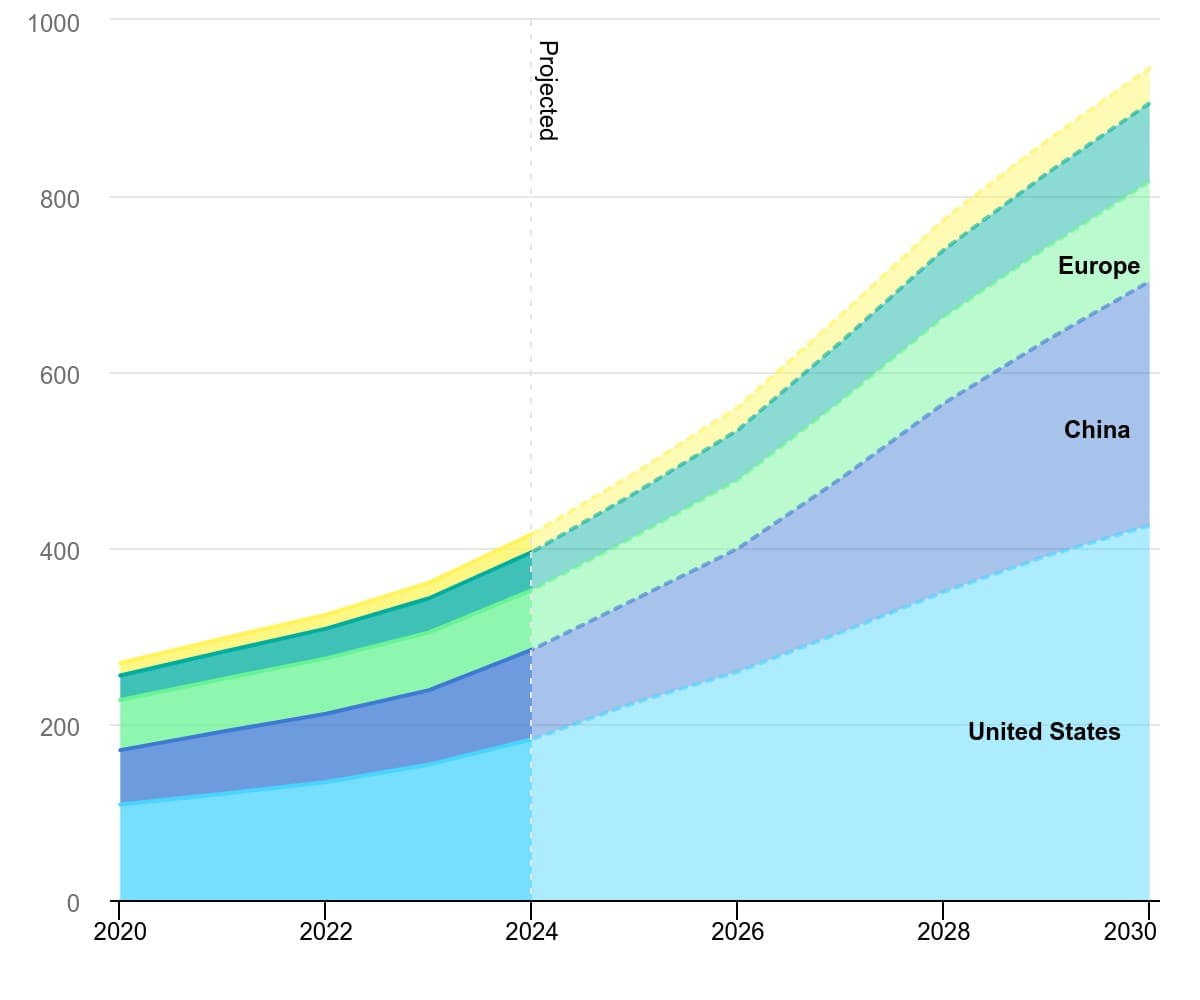
Data centre electricity consumption by region, Base Case, 2020-2030

Data centre electricity consumption by region, Base Case, 2020-2030

Source: IEA, Energy and AI (2025)

When the energy price shock from the Iran war lands on top of bills already elevated by data center demand, the politics shift. 

And when you consider the environmental impact…
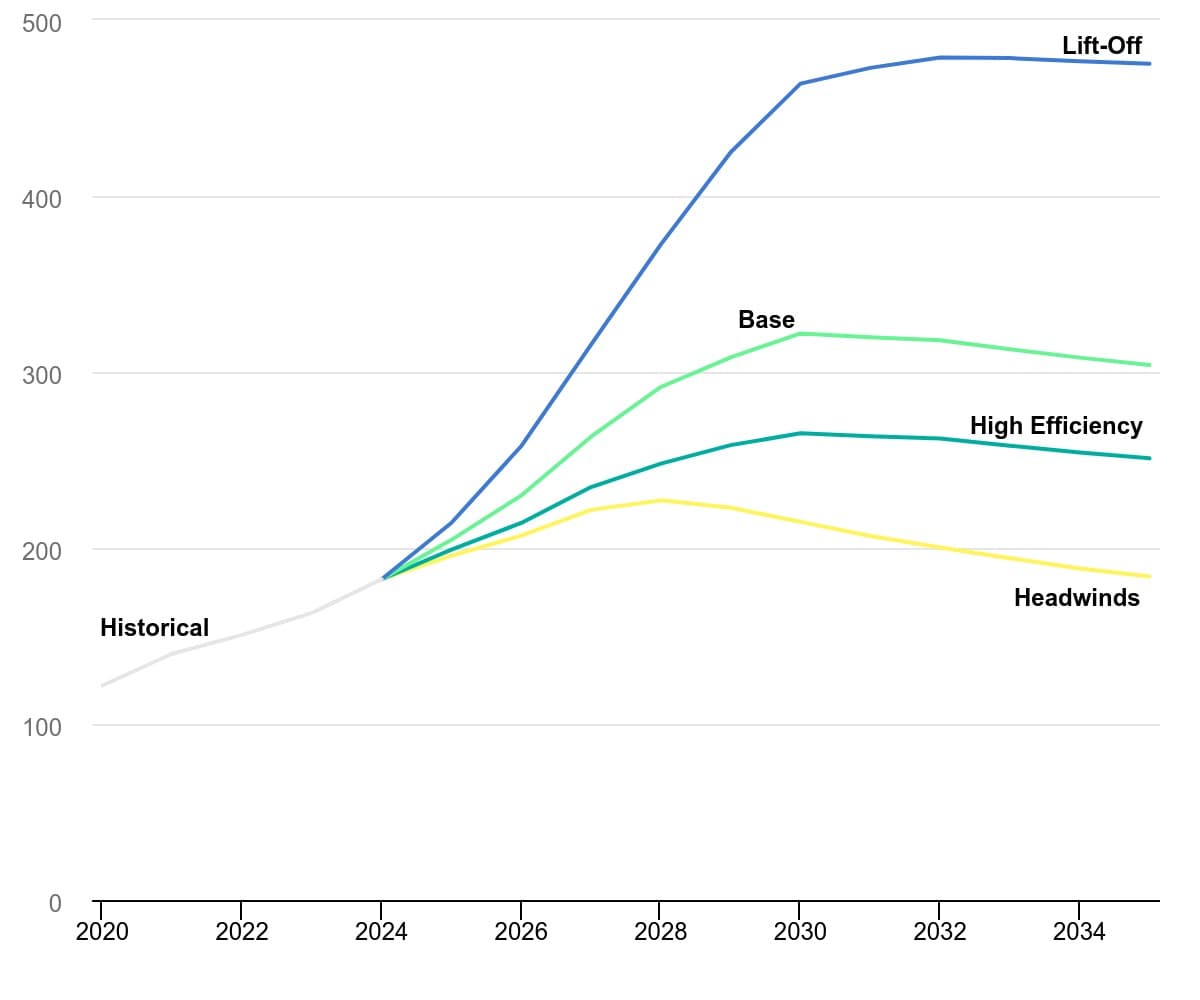
CO2 emissions associated with electricity generation for data centres by case, 2020-2035

CO2 emissions associated with electricity generation for data centres by case, 2020-2035

Source: IEA, Energy and AI (2025)

...permitting battles get even harder. Grid priority legislation becomes real. State-level pushback on data center tax exemptions accelerates. 

The buildout was already being slowed by cost. Now it gets slowed by politics. And those two forces amplify each other.

China Watches

There is one more actor in this story that has not fired a single shot. Yet. 

China controls roughly 90% of rare earth processing globally and about 70% of rare earth mining. 

Since July 2023, Beijing has been running a methodical escalation of export controls on the materials that underpin semiconductor manufacturing:

  • July 2023: gallium and germanium controls
  • October 2023: graphite controls
  • August 2024: antimony and superhard materials
  • February 2025: tungsten and tellurium
  • April 2025: seven medium and heavy rare earth elements
  • October 2025: comprehensive controls, for the first time asserting jurisdiction over foreign-made products containing Chinese-origin rare earths and over rare earth technology know-how globally

The October controls were suspended through November 2026 after US-China talks. 

Clark Hill, analyzing the announcement, described it as "a pause in escalation, not a strategic reversal." 

The underlying architecture is fully intact. The US Geological Survey has estimated that a total gallium and germanium ban alone could cost the US between $3.4 and $9 billion in GDP. The weapon is built. Beijing is deciding when to use it.

China doesn't need to do anything dramatic right now. 

The US is bogged down in a Middle East war. AI capex timelines are slipping. Supply chains are taking friction from every direction. 

Beijing can wait, let the situation compound, tighten rare earth flows through "administrative review" if the moment calls for it, and emerge in 18 months having closed the AI development gap while everyone else was watching Hormuz.

The Question Markets Haven't Asked Yet

The AI bet was not irrational. It was made by serious people with real conviction, backed by genuine technological progress. The case for AI productivity gains is not fabricated.

But it was a bet made under specific conditions: stable energy prices, accessible components, functional shipping lanes, cooperative geopolitics, and a consumer with enough slack to absorb a few years of transition costs before the gains showed up on their side of the ledger.

None of those conditions exist right now.

The insurance market has already repriced the Strait of Hormuz as a war zone. The fertilizer market is already pricing a supply shock. The shipping market is already pricing in a new risk premium that will not disappear when the shooting stops, because once underwriters reprice a region, they don't unwind it quickly. Reputational risk is sticky. Supply chain reroutes are sticky. Political backlash, once it finds a number to attach to, is very sticky.

The question is not whether the AI buildout survives this. Some version of it will. The question is whether the market has actually updated its model, or whether it is still running on the assumption that this resolves in a few weeks and everything returns to February 27th.

I don't think it resolves in a few weeks...

The bet was made. The conditions changed. The math is what it is.

By Michael Kern for Oilprice.com 


Op-Ed: Why mining companies are rewriting their technology roadmaps


Stock image.

As volatility reshapes global markets and stakeholder expectations continue to rise, mining companies are entering a period of strategic reset. Commodity prices fluctuate, costs remain elevated. Environmental, social, and governance (ESG) scrutiny is intensifying across jurisdictions.

Operations now span continents and regulatory regimes, adding complexity to already demanding supply chains. In this environment, leaders need visibility.

For years, many mining organizations relied on a mix of legacy systems, spreadsheets, and manual processes to connect finance, maintenance, procurement, and site operations. That approach was manageable in steadier cycles, when slower reporting cycles and fragmented data posed fewer risks. Today, those same gaps create exposure. Investors expect transparency, and regulators require traceability.

In addition, boards want clear insight into cost drivers, capital allocation, and operational performance in real time. Technology modernization, once viewed as a future milestone, has quickly become a present-day strategic imperative.

At the center of this modernization is the enterprise resource planning (ERP) system. Modern ERP environments are becoming the operational backbone for mining organizations, providing a single system of record that connects finance, supply chain, maintenance, and site operations.

Here are the essential elements of the 2026 tech roadmap:

A fundamental shift in scale

The meaning of scale in mining technology is changing. Digital transformation once implied a sweeping, multi-year overhaul that only large enterprise, global producers could fund. Today, cloud delivery models and standardized architectures allow junior and mid-sized mining companies to modernize in phases faster and at lower overall cost.

Miners can establish a stable enterprise core across finance, capital management and procurement, then expand into supply chain and maintenance as complexity increases. Systems grow alongside the business instead of lagging behind it.

For many organizations, that core is anchored by a modern ERP platform, such as SAP, that provides the financial and operational structure needed to scale. By establishing a standardized ERP foundation early, miners gain the ability to extend capabilities across sites and jurisdictions without rebuilding core processes each time the business grows.

This flexibility lowers barriers for emerging and mid-market operators and helps them adopt stronger governance earlier in their lifecycle.

Making the invisible visible

Mining is inherently capital intensive. Heavy equipment fleets, spare parts inventories, contractor services, and fuel expenditures represent major cost categories. Yet, in many organizations, operational data and financial data still operate in separate systems. Maintenance activity may not align seamlessly with procurement records, while inventory balances may not reflect real-time usage. Financial reconciliation often happens after the reporting period closes.

When information moves slowly or inconsistently, leaders lack a clear picture of cost behavior. Excess stock accumulates, downtime trends remain hidden, and small inefficiencies compound across sites.

Modern enterprise platforms address this disconnect by unifying operational and financial data into a shared environment. Managers gain consolidated visibility into asset performance, reliability, working capital, and costs. With reliable data across departments, teams can identify anomalies earlier, adjust procurement strategies, and deploy capital with greater precision.

Finance as a strategic driver

Traditional reporting cycles often limit leadership to retrospective insight. By the time results are consolidated, market conditions have already shifted. Integrated financial architectures are compressing those timelines. Automated consolidations and standardized data models enable faster closes and near real-time visibility into cash position, capital spending, and operating performance.

This shift transforms the role of finance. Leadership can rebalance investment, pace development projects, or manage liquidity based on current data.

For junior and mid-tier miners, this agility is critical as exploration and development projects require disciplined capital management.

Designing for resilience

As modernization efforts advance, system design philosophy is evolving. Increasingly, mining companies are embracing a clean core approach, keeping essential processes standardized within the central enterprise platform while developing custom requirements through extensibility and integrating business solutions through open interfaces.

Applications supporting geology asset management, environmental monitoring, or safety are difficult to integrate without deeply customizing the core system. Using Extensibility and standard smart interfaces improves upgrade flexibility, reduces technical debt, and strengthens governance and reporting.

Preparing for advanced analytics

Artificial intelligence (AI) and predictive analytics are gaining momentum across mining, from forecasting equipment failure to optimizing supply chains and enhancing workforce safety. Yet advanced capabilities depend on disciplined data foundations. Companies realizing measurable returns, focus first on harmonizing master data, improving business process, and defining governance over information flows.

Modern ERP environments help provide the structured data foundation required for these AI applications. By standardizing financial, operational, and asset data across the enterprise, ERP systems support AI and predictive analytics initiatives across mining operations.

A strategic imperative

Mining has always operated on long investment horizons, with assets designed to produce value over decades. Yet the systems that support those investments can no longer move at the historical slow pace. Market volatility is no longer cyclical but often have large sporadic swings due to technology innovations, political climate and global markets.

In 2026, rewriting the technology roadmap is about reinforcing the digital backbone of the business. Integrated platforms enhance visibility across operations. Clean architectures enable adaptability as organizations grow. Trusted data supports faster, well informed decision making.

Cloud ERP platforms today are offering opportunities for mining organizations of all sizes to deploy what they need, when they need it, without massive IT teams and infrastructure. The new cloud-based approach provides standardization to keep a clean core while offering extensibility, faster implementation cycles, lower project costs, and have a higher return on investment with less impact to the business.

Forward-looking mining companies recognize that enterprise systems are no longer back-office infrastructure. They are central to performance, governance, and sustainable growth. By modernizing with intention, miners position themselves to manage uncertainty, attract investment, allocate capital, and compete with confidence in a demanding global market.


* Nick Cecil is Industry Principal for Mining & Natural Resources at Syntax.


AU

Teck’s undisclosed royalty worth billions on Barrick’s Fourmile could stymie IPO plans

A view of the Fourmile project in Nevada. Photo credit: Barrick Mining.

Teck Resources (TSX: TECK.A/TECK.B; NYSE: TECK) holds a royalty on Barrick Mining’s (TSX: ABX; NYSE: B) Fourmile gold project in Nevada that could generate billions of dollars and impact the valuation of Barrick’s planned North American mine spinoff, reports say.

Teck owns a 10% net legacy profits interest over an area that covers 260 sq. km and includes a “meaningful” overlap with the Fourmile discovery, Scotia Capital mining analyst Orest Wowkodaw wrote Thursday in a note, citing information provided by Teck and Barrick. The royalty climbs to 15% after 6 million oz. of gold are delivered, Wowkodaw said.

The Globe and Mail first reported the story on Wednesday. Barrick and Teck didn’t immediately respond Thursday to e-mails from The Northern Miner seeking comment on the royalty.

“Overall, we view this development as positive for Teck and negative for Barrick,” Wowkodaw said. He values Fourmile at about $15 billion, or 19% of Barrick’s net asset value – assuming that the mine can start operating in 2030 and reach full production in 2034.

Significant discovery

Barrick sees Fourmile as one of the most significant discoveries of the past 25 years, highlighting its potential to produce as much as 750,000 oz. of gold annually. Fourmile combines exceptionally high grades with long mine life and access to existing infrastructure through the Nevada Gold Mines joint venture with Newmont (TSX: NGT; NYSE: NEM), Barrick said in September.

Shares of both miners dropped Thursday amid a stock market selloff. Teck fell 4.6% to C$64.34 in Toronto for a market capitalization of about C$31 billion ($22.6 billion) while Barrick declined 6.5% to C$51.82 for a market value of about C$87 billion ($63.4 billion).

On a “very preliminary basis”, the royalty could generate $100 million to $200 million annually for Teck at production rates of about 750,000 oz. a year if gold averages $3,400 per oz., Wowkodaw said in his note.

The calculation assumes 100% area of interest overlap, though the exact overlap will become clearer once Barrick releases a technical study, Wowkodaw said.

Key asset

Fourmile is one of the key North American gold assets to be included in a new publicly listed company that Barrick plans to spin off by the end of the year.

Carving out the North American assets – which also include stakes in the Nevada Gold Mines joint venture and the Pueblo Viejo property– in an initial public offering is the best way to maximize shareholder value, Barrick said last month. Barrick plans to keep a “significant” majority stake in the properties, which account for more than half of the company’s gold production.

Fourmile holds 4.6 million indicated tonnes grading 17.59 grams gold per tonne for 2.6 million oz. of contained metal, Barrick said last year as it doubled the deposit’s estimated resource for a second straight year. It also contains 25 million inferred tonnes grading 16.9 grams gold for contained metal of 13 million ounces.

Growth potential

Ongoing prefeasibility studies at Fourmile point to the potential for significant additional resource growth, Barrick said last month.

Fourmile could have a mine life of more than 25 years, Barrick said in September, citing the conclusions of a preliminary economic assessment.

Project capital is estimated at $1.5 billion to $1.7 billion, while the overall capital expenditure budget is pegged at $3.2 billion. Key milestones include decline construction start in late 2026, the completion of a prefeasibility study in late 2028 and an independent feasibility study in 2029.

Newmont spat

The existence of a royalty also has implications for Denver-based Newmont, which is at loggerheads with its partner in Nevada Gold Mines. Barrick owns 61.5% of the venture, while Newmont holds 38.5%.

Newmont last month issued a notice of default, saying that Barrick diverted resources from Nevada Gold Mines to advance Fourmile. Newmont holds a contractual right of first refusal over moves affecting the venture and argues that the alleged actions breach the companies’ 2019 JV agreement.


Glencore could walk away from South Africa smelter rescue talks over conditions


Credit: Glencore

Glencore’s South African ferrochrome unit could walk away from talks with the government over a discounted electricity package due to what it sees as unfavourable conditions, an executive said on Thursday.

Glencore has said it requires reduced tariffs to keep its loss-making smelters open and avert job cuts. The government is keen to save the smelters, which employ thousands and are major customers of the state-owned electricity supplier Eskom.

Eskom on February 27 offered the country’s two biggest ferrochrome firms, including the Glencore unit, heavily discounted electricity in a bid to rescue their troubled operations.

The offer, to reduce electricity tariffs from 1.36 rand ($0.0808) to 0.62 rand per kilowatt hour, is subject to approval by South Africa’s energy regulator under conditions that are yet to be made public.

But Glencore Ferroalloys CEO Japie Fullard warned the company could walk away from the talks, saying some conditions of the package deal were not acceptable to the company.

“The terms and conditions, the way that it is now, I unfortunately will not be in a position to sign,” Fullard said at a mining conference in Johannesburg.

“So that means, if they do not come to the party, we are going to walk away from the 62 cents (deal),” he added.

Smelters battling high costs

Fullard said representatives of the ferrochrome firms were meeting government representatives late on Thursday.

Glencore on March 2 deferred lay-off procedures at its ferrochrome until March 31 to allow ongoing negotiations. As many as 1,500 jobs would be cut if no agreement is reached on the electricity tariff package, Fullard added.

Samancor Chrome, the other ferrochrome producer which was offered discounted electricity, has said it is going ahead with plans to lay off workers.

The firm said while the reduced tariff addressed electricity cost pressures, the terms and conditions attached to the offer posed “a threat to the long-term viability of the ferrochrome industry”.

Neither Glencore nor Samancor have disclosed the conditions as negotiations are ongoing.

South African smelters are battling high electricity costs, which have risen tenfold since 2008, amid growing competition from Chinese producers. Only 11 out of a possible 66 smelters are still operational in the country.

($1 = 16.8380 rand)

(By Olivia Kumwenda-Mtambo, Nqobile Dludla and Nelson Banya)

Peru proposal to limit idle concessions sparks mining pushback

La Rinconada, Puno, Peru. Stock image.

Peru’s mining industry is warning that a bill moving through Congress to halve the time to hold unused concessions would end up discouraging investment and favoring informal operators.

“It’s a blow to formal mining that could wipe out $60 billion in investments,” Gonzalo Quijandría, vice-president of mining and energy society SNMPE, told Canal N.

The proposal, which passed committee this week and is headed for a floor debate, would cut to 15 years from 30 the period companies have to explore before a concession expires.

Industry groups say it can take decades to discover and develop a deposit, while small-scale miners argue that large companies hoard scarce mineral rights instead of developing them. In Peru, that tension is heightened as global firms increasingly compete with informal operators for control of mineral-rich areas.

Peru — the world’s third-largest copper producer and a major supplier of gold, silver and zinc — grants concessions that allow companies to explore vast areas for extended periods. But the rise of illegal mining and years of project delays have led some lawmakers to push for shorter concessions that could be developed more quickly by smaller operators.

If enacted, the bill could spur an “invasion of concessions,” SNMPE executive director Ángela Grossheim told RPP.

The issue is emerging in the run-up to Peru’s general election on April 12. Conservative front-runner Rafael López Aliaga has pledged to revoke exploration permits for idle projects and redistribute them.

(By Carla Samon Ros)

FE

UK to cut steel import quotas, raise tariffs to protect domestic industry

Stock image.

Britain will lower its tariff-free quota on imported steel and double the tariff on imports exceeding that quota, the government said on Thursday, launching a plan to protect its small but strategically and politically sensitive steel sector.

Steelmakers have struggled to survive in the birthplace of the Industrial Revolution after decades of decline driven by long-term de-industrialization and, more recently, by high energy costs and a global glut of cheap steel.

The government will cut the amount of steel that can be imported without incurring tariffs by 60%. Imports above that new level will face a 50% tariff – twice the previous rate of 25%. The changes will come into force on July 1.

The move brings Britain’s tariff rates into line with recent increases in the United States and proposals by the European Union, against a backdrop of heightened global trade tensions as US President Donald Trump uses trade measures to further his “America First” agenda.

The British government also said that its National Wealth Fund would make up to 2.5 billion pounds ($3.33 billion) available to help finance investment in the sector and that it wanted 50% of steel used in Britain to be produced domestically, up from the current target of 30%.

“Making steel in the UK is vital for national security, critical infrastructure and the wider economy,” Business Secretary Peter Kyle said in a statement.

“With this strategy we are closing the decades-long chapter of destructive de-industrialization and committing instead to strengthening and sustaining Britain as a steel-making nation.”

Unions and industry bodies welcomed the measures.

The sector only accounted for 0.1% of UK economic output in 2024 but supported 37,000 jobs, many in heartlands of the governing Labour Party which grew from a trade union movement deeply rooted in Britain’s industrial heritage.

Two of the country’s biggest steelmakers have faced financial troubles in recent years.

Tata Steel has closed its blast furnaces at Port Talbot, while the government had to seize control of British Steel to prevent the shutdown of its Scunthorpe plant under Chinese owner Jingye, taking on huge costs in the process.

($1 = 0.7502 pounds)

(By William James; Editing by Edmund Klamann)


U.K. Bets on Tariffs to Rebuild Its Steel Industry


  • The U.K. will cut tariff-free steel import quotas by 60% and impose 50% tariffs beyond limits to boost domestic output.

  • The policy aims to meet 50% of national steel demand locally, backed by £2.5 billion in state support.

  • Critics warn that higher costs and flawed carbon pricing rules could hurt competitiveness and investment.

The UK government has reduced steel import quotas and raised tariffs to 50 per cent outside unit limits as part of a strategy to save the industry, an “bold” move that is likely to draw criticism from economists and opposition groups. 

Quotas for imports free from the higher tariffs will be reduced by 60 per cent from July. The government has set a target for domestic production to support half of steel demand in the UK.

“Making steel in the UK is vital for national security, critical infrastructure and the wider economy,” Business Secretary Peter Kyle said. 


“With this strategy we are closing the decades-long chapter of destructive de-industrialisation and committing instead to strengthening and sustaining Britain as a steel-making nation.” 

The move to introduce tariffs has already led to backlash from the Conservatives, with shadow business secretary Andrew Griffith hitting out at the government’s decision to introduce a new tax on businesses. 

“Raising the cost of imported steel means more cost for the construction industry, less infrastructure investment, and is a further blow to the diminishing number of firms making things in the UK,” Griffith said. 

“Astonishingly, almost a year on, the government seems no closer to making the Chinese owner of British Steel Scunthorpe step up to their liabilities.”

“Labour don’t understand business and these tariffs now join the list of taxes and employment red tape which are choking growth and making us all poorer.”

Steel industry’s mixed response

UK Steel, the main industry body for the sector, said the government’s reforms were “incredibly bold” but warned that a net zero pricing scheme for trade and higher energy prices could undermine businesses’ competitiveness. 

Gareth Stace, the director general of UK Steel, said: “The government’s bravery in taking the required measures represents a real shift in the culture of Westminster from protecting the ideology of free trade at any cost, to defending critical industries and national security.

But an energy policy chief at the body said the government strategy’s approach to the Carbon Border Adjustment Mechanism (CBAM), which attempts to equalise net zero costs between domestic products and imports, risked “achieving precisely the opposite” of the scheme’s aim. 

“As it stands, the UK CBAM could favour imported Chinese steel over steel made in the UK,” Frank Aaskov, the energy policy director at UK Steel, said. 

The government is also set to finance steel production through the national Wealth Fund, with £2.5bn set to be injected into manufacturers by 2030. 

Some of the cash would go towards investments in building electric arc furnaces, which the government said would “support net zero”. 

It will also go towards supporting operations at Scunthorpe after the government took control of manufacturing under Chinese company Jingye Group’s ownership, with British Steel on the brink of collapse until Labour stepped in to keep blast furnaces on in April 2025. 

National Audit Office report said this week that operations were costing the Department of Business and Trade about £1.3m a day, with the government already spending £377m in nine months.

By City AM


Column: China’s robust iron ore imports are going into storage, not steel


Port Zhuhai, China. Stock image.

China increased imports of iron ore at the start of this year, but the extra volumes are being used to build inventories to record highs rather than lift steel production.

The increase in imports appears largely driven by softer prices for the key steel ​raw material, but it is also fortuitous given the potential for the fallout from the US and Israeli attacks on Iran to spread ‌beyond energy markets.

China, which buys about three-quarters of global seaborne iron ore, saw arrivals of 210.02 million metric tons in the first two months of 2026, up 10% from the same period a year earlier, according to customs data released on March 10.

The robust start to the year came after imports hit a record monthly high of 119.65 million tons in December, which took ​arrivals for 2025 to an all-time annual high of 1.26 billion tons.

The strength in iron ore imports isn’t because of higher steel production, with output ​in the first two months dropping 3.6% from the same period in 2025 to 160.34 million tons, according to official data released ⁠on March 16.

The weaker steel production continued the trend from 2025, when annual output dropped to a seven-year low of 960.81 million tons.

Rather than being consumed by steel ​mills, China has been building stockpiles, with port inventories monitored by consultants SteelHome rising to 166.91 million tons in the week to March 13.

This is up 28% from ​the recent low of 130.1 million tons in early August and is the highest in SteelHome data going back to 2012, eclipsing the previous record of 161.98 million in June 2018.

There are several factors driving China’s strong imports of iron ore, but the primary one is likely price.

Singapore Exchange contracts had been on a declining trend since reaching a 14-month high of $108.89 a ton ​on January 12.

The decline in prices ended at $98.20 a ton on February 20, but it lasted long enough to boost arrivals at the start of the year ​and likely into March as well, with commodity analysts Kpler estimating seaborne imports of around 109 million tons.

Strong supply from top exporters Australia and Brazil in the absence of usual seasonal ‌weather disruptions ⁠also boosted the availability of cargoes and China acts as a clearing house for any surplus iron ore.

Since the low in late February prices have shifted higher, partly in response to the conflict in the Middle East, reaching $107.10 a ton on March 17, before easing slightly to end at $106.30 on Wednesday.

Iran risks

So far the impact on iron ore flows to China from the US and Israeli war on Iran is limited to higher freight charges as the price of fuel oil soars along with ​prices for other oil products such as ​diesel and jet fuel.

But there is ⁠the potential for wider disruptions, especially if top exporter Australia and number four South Africa start to run short of diesel.

Both countries are major importers of refined products and in Australia mining accounts for about 40% of total diesel demand.

In a situation ​where refined fuel cargoes become hard to source at any price, Australia will have to ration fuel and prioritize food ​production and distribution, and ⁠emergency services.

While shutting down the mining industry would be a radical step, it would be the only option left if fuel-exporting countries limit or halt shipments, as China has already done.

For now, China is likely to continue iron ore imports at robust levels as prices aren’t yet high enough to act as a disincentive.

A further incentive to continue imports is ⁠the potential ​for disruption to supplies from diesel shortages, even though that is still a fairly small possibility.

(The views expressed here are those of the author, Clyde Russell, a columnist for Reuters.)

(Editing by Jacqueline Wong)


Li

SQM-Codelco tie-up to submit environmental study for Salar Futuro lithium project in June


Credit: SQM

Novandino Litio, the joint venture between Chile’s Codelco and SQM, will submit the environmental impact study for its Salar Futuro lithium project in June, local media reported on Thursday.

The project is estimated to cost between $2 billion and $3.5 billion.

Salar Futuro aims to produce 280,000 to 300,000 metric tons of lithium carbonate equivalent (LCE) annually.

Codelco chairman Maximo Pacheco told journalists that Salar Futuro represents the most important challenge for the partnership.

Codelco’s 2026 copper production will exceed 2025 levels, Pacheco said.

He acknowledged it was “perhaps an error” to tackle four megaprojects simultaneously at Codelco, calling it a “titanic task.”

Pacheco is set to leave his role on May 25. He ruled out leaving the position early.

(By Kylie Madry and Fabian Cambero; Editing by Brendan O’Boyle)


US, Japan to focus rare earths cooperation on select group of minerals at first

Japanese Prime Minister Sanae Takaichi visited the White House on Thursday. Credit: Sanae Takaichi’s official X page

The US and Japan on Thursday released an action plan for their efforts to develop alternatives to China for critical minerals and rare earths supply chains, focusing initially on price floors for a select group of minerals.

A joint US-Japan statement released by the US Trade Representative’s Office during Japanese Prime Minister Sanae Takaichi’s visit to the White House said the two countries aimed to deliver “concrete, near-term results towards securing mutual supply chain resilience.”

The statement said the two countries will discuss coordinated trade policies such as a border-adjusted price floor mechanism, “focusing in the first instance on a select group of critical minerals.” They did not identify which minerals would be considered first for price floors.

Takaichi and US President Donald Trump signed a framework agreement on rare earths in October 2025 in Tokyo as both countries were struggling with Chinese export controls.

The action plan announced on Thursday does not mention China by name, but refers to a need to correct “distortions resulting from pervasive non-market policies and practices (that) have left critical minerals supply chains of market-oriented economies vulnerable to a myriad of disruptions, including economic coercion.”

The two sides will consult on how price floors and other trade provisions can fit into a plurilateral critical minerals supply agreement involving other countries, the statement said.

They also will work to identify specific projects in each country and elsewhere for critical minerals mining, processing and manufacturing that meet internationally recognized responsible business practices and that should get priority financing and policy support, the statement added.

US-based Albemarle, the world’s largest lithium producer, is “exploring opportunities” for potential Japanese investment or supply deals with the company’s under-construction North Carolina lithium project, according to the statement.

An Albemarle spokesperson said the company had nothing to add.

Japan’s Mitsubishi Materials is in talks with Indiana-based ReElement Technologies for a potential equity stake or joint venture, according to the statement. A representative for ReElement was not immediately available to comment.

Tokyo and Washington also agreed to share information on mining standards, technical cooperation, and geological mapping of potential critical mineral deposits. They also agreed to coordinate stockpiling of critical minerals, rapid responses to prevent supply disruptions and joint actions to address economic coercion, the statement said.

(By David Lawder and Ernest Scheyder; Editing by Paul Simao and Daniel Wallis)


U.S. Approaches Chile for Critical Mineral Supply


  • The U.S. is negotiating a supply deal with Chile for rhenium, a rare and critical mineral essential for defense and aerospace, with Chile controlling about 50% of global supply.

  • Rhenium is indispensable due to its extreme heat resistance and lack of substitutes, making it vital for jet engines, turbines, and military systems.

  • The move is part of a broader U.S. strategy to secure critical minerals and reduce dependence on China through global partnerships and strategic reserves.

Oil and gas prices are hogging headlines, but while the world watches the Middle East, U.S. officials have been busy elsewhere. Chile, the world’s biggest supplier of one particular critical mineral, is in talks with the U.S. on a supply agreement for rhenium—an element seen as vital for national security.

Rhenium is a genuinely rare element that has an extremely high melting point of around 3,180 degrees Celsius, which makes it extra resistant to both heat and wear, according to the USGS. This, in turn, makes rhenium highly prized in the defense industry. Since most rhenium is extracted as a by-product from copper mining, it is little surprise that Chile is the largest producer, seeing as the South American state is also the world’s top copper producer. It accounts for 50% of global rhenium supply, per UPI, which reported the news about the talks.

“Chile controls nearly half of a mineral that the United States and China cannot produce in sufficient quantities. Washington reinstated rhenium to its critical minerals list in 2025 and explicitly included it in the bilateral mining agreement with Chile. That makes it a genuine geopolitical asset, not just a mining one,” UPI quoted an engineering professor from Chile’s Adolfo Ibanez University as saying.

Indeed, the Trump administration has prioritized critical minerals from day one. The overwhelming reliance of most of the world on China for both supply and, more importantly, processing of rare earths and other critical elements had started to become a cause for concern in both the United States and the European Union, but the U.S. under Trump has been a lot quicker in taking action.

Last year, Washington closed a deal with Australia’s government to cooperate in the development of a local critical mineral supply. The deal, worth more than $3 billion, according to the White House, could open up access to resources worth $53 billion or more—theoretically. Australia is one of the most mineral-rich countries in the world. It is home to some of the largest reserves of lithium as well as rare earths, tungsten, vanadium, manganese, cobalt, copper, and other metals and minerals used in key industries. The deal with the Trump administration would help boost the production of these metals and minerals and diversify the U.S. supply chain.

Then this year, President Trump announced he would set up a strategic national reserve for critical metals and minerals worth $12 billion to make sure the United States does not get vulnerable to supply shifts from China. The reserve would include rare earths and some of the most in-demand metals and minerals, such as lithium, cobalt, nickel, and graphite, which are used in weapons systems, satellites, batteries, data centers, and industrial motors.

Yet when it comes to weapons systems, rhenium is a lot more valuable than the rest of these metals and minerals. It has no substitutes and its role in defense and aerospace applications is critical as part of specialized alloys—rhenium, in short, is literally indispensable. “It is the metal that allows aircraft engines and military turbines to withstand extreme temperatures without deforming,” according to Professor Victor Perez from Adolfo Ibanez University.

The global race for critical minerals is still on, even if it is not all over the news. And the United States just made an important move in Chile, which is part of a broader move to gain greater exposure to South America’s mineral resources. Every such move counts. The U.S. has a lot of catching up to do with China in the field of critical minerals and speed counts, especially in the current geopolitical situation.

By Charles Kennedy for Oilprice.com