It’s possible that I shall make an ass of myself. But in that case one can always get out of it with a little dialectic. I have, of course, so worded my proposition as to be right either way (K.Marx, Letter to F.Engels on the Indian Mutiny)
Saturday, March 21, 2026
AU
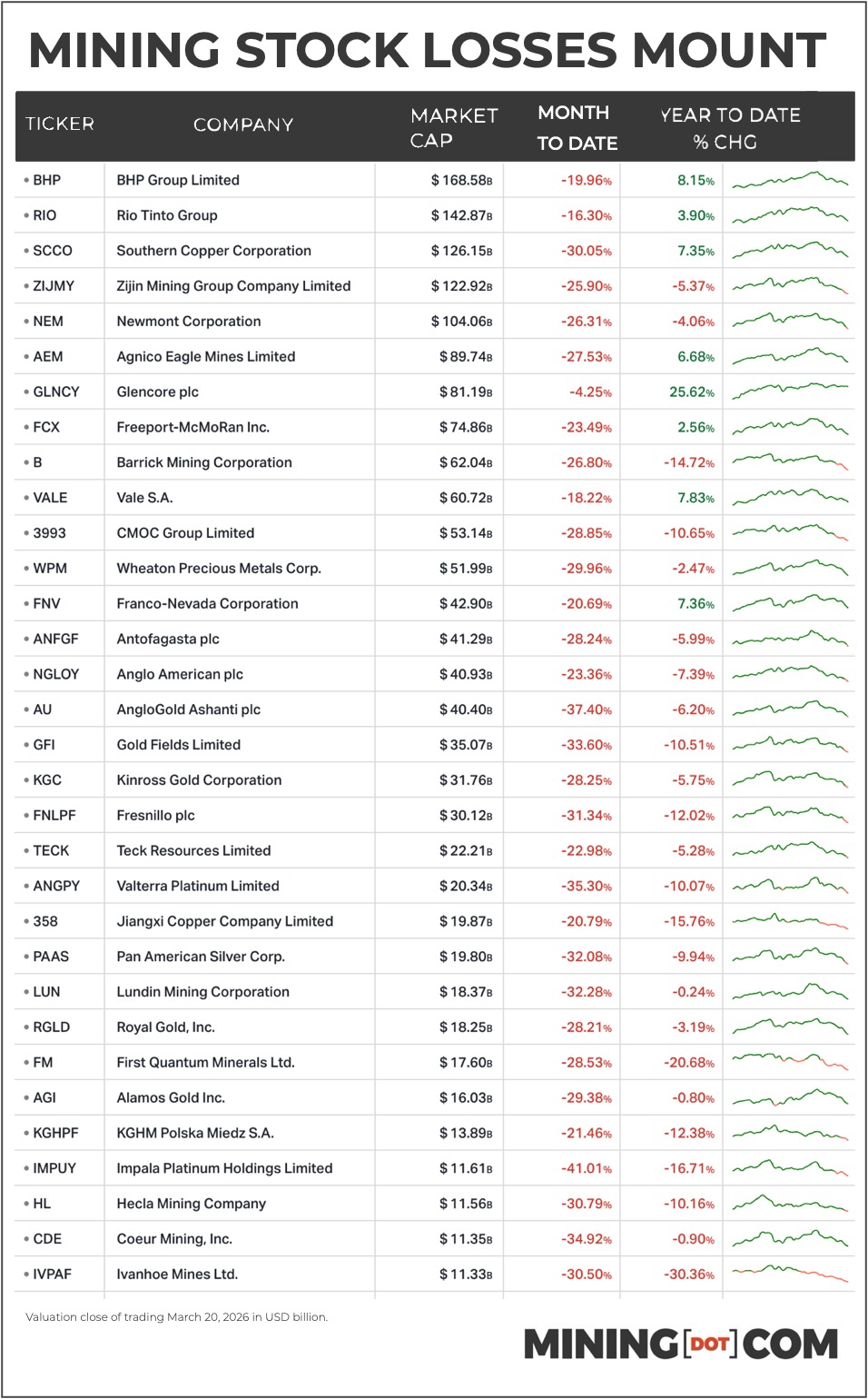
CHART: Billions wiped of mining stocks as gold, silver, copper prices plummet
Gold (and copper and silver) bears are out. Image: The Scott
Stock losses for world’s biggest mining companies near 30% since war’s start as copper enters bear market, silver falls 40% from high and gold suffers worst week in decades.
Gold futures in New York fell by $225 an ounce from opening levels to last trade at $4,492 an ounce by late afternoon, a 3.5% decline on the day and more than 11% for the week. As usual silver’s swings were wilder with the precious metal exchanging hands for $67.81 in after hours trade, a 6.9% drop from the start of trading on Friday.
Copper ended the day down 4.0% and was last worth 5.30 per pound ($11,690 a tonne), down 7.4% for the week. Gold, silver and copper entered a technical bear market with gold down more than $1,100 or just over 20% from its January 29 record, silver dropping 44% and copper giving up just shy of 20% or more than $2,800 per tonne from its all-time high struck at the same time.
Gold, silver and platinum stocks were hardest hit with Newmont (NYSE:NEM) now trading 26.3% below levels seen just before the start of the Iran war at the end of February after Friday’s heavy selling which saw 30.7 million shares traded.
Barrick Mining (NYSE:B) is down 26.8% over the same period with 29.1 million shares exchanging hands on Friday. Newmont is now worth $104 billion in New York down from a peak of $143 billion at the end of January while Barrick’s market worth is down $27 billion since then for a $62 billion market cap on Friday.
Shares in Anglogold Ashanti (NYSE:AU) are down an eye-watering 37.4% so far in March for a market value of $40 billion while Gold Fields (NYSE:GFI) has lost 33.6% to $35 billion. Kinross Gold’s slide reached 28.3% for a market cap of $32 billion.
Royalty and streaming companies Wheaton Precious Metals (NYSE:WPM) has fallen just under 30% since the start of hostilities in the middle east and is now worth $52 billion compared to a more modest drop of 20.7% for Franco-Nevada at a $43 billion evaluation.
Over the counter units of silver miner Fresnillo (OTCPK:FNLPF) trading in the US is down 31.3% in March shaving its market cap to $30 billion while Pan American Silver (NYSE:PAAS) has suffered a 32.1% decline to under $20 billion. Valterra Platinum (OTCPK:ANGPY) has been one of the worst performers dropping 35.3% from a multi-year high hit on the Friday before the bombing campaign started, ending up at a $20 billion market cap just three weeks later.
Some copper producers and diversified companies fared better than the precious metal sector but losses top 20% across the board with only a couple of exceptions.
BHP (NYSE:BHP) shares trading in the US have shed 20.0%, sliding from a record high valuation (for any mining stock in history) of $213 billion at the start of the war. Record profits for the Melbourne-based company and China as its main customer has not been enough to shield the firm from the broader fallout of the war.
Southern Copper (NYSE:SCCO) underperformed other copper majors, with losses for March of 31.1% to $126 billion, seeing the company in the Grupo Mexico stable lose its edge as the world’s second most valuable miner over Rio Tinto (NYSE:RIO) which has come of relatively lightly with a 16.3% decline to a $143 billion market cap.
Rio Tinto stock received a lift after the company said on Monday it has gained control of acreage in Arizona needed to build the Resolution mine, a project slated to become one of the largest US sources of copper. Rio Tinto said it would now embark on a $500 million drilling campaign to delineate the deposit which is co-owned by BHP.
Freeport-McMoRan (NYSE:FCX) was one of the most heavily traded mining stocks with more than 25 million shares exchanging hands. After a 23.5% retreat for March, Freeport is now worth $74 billion after briefly reaching the $100 billion mark (only the 8th mining stock to ever do so) in February.
A Chilean business paper earlier this week reported that the Phoenix-based company has begun the environmental permitting process for a $7.5 billion expansion of its majority owned El Abra copper mine in Chile. The expansion would increase annual copper output by more than 300,000 tonnes, compared with 91,000 tonnes produced last year.
Glencore (OTCPK:GLNCY) has managed to emerge relatively unscathed, only losing 4.3% since the start of US and Israeli operations in Iran in part to its extensive oil trading business which should do well as crude and gas prices jump. The Switzerland-headquartered company trades around 4 million barrels of oil equivalent per day. Glencore is now worth $81 billion and year to date the company is now the best performer among mining’s heavyweights with a 25.6% advance.
There was speculation last week from large investors in Glencore that a recent surge in coal prices will help bring Rio Tinto back to the table for a fresh attempt at creating the world’s biggest mining company after meeting with leaders of both companies in Australia.
Vale (NYSE:VALE) stock has declined by 18.2% for a market cap of $61 billion, one of the better performing large-cap miners. The CEO of Vale’s base metals spin-off, Shaun Usmar, told Bloomberg at the beginning of March the sprawling nickel-and-copper business is ready for a potential initial public offering by midyear, sooner than previously indicated. The task of bringing down costs, lowering capital intensity and accelerating the project pipeline is moving ahead at a faster clip than previously envisaged Usmar said.
Anglo American (OTCPK:NGLOY) losses since the beginning of the month have climbed to 23.4% matching the decline of merger partner Teck Resources (NYSE:TECK) affording the Canadian miner a $22 billion valuation compared to Anglo’s $41 billion.
Punter’s favourite Ivanhoe Mines (TSX:IVN) is now trading 30.5% lower for March at $11 billion while copper specialist First Quantum Minerals (TSX:FQM) has fallen by 30.5% to $18 billion over the same period. Pink sheets of Antofagasta (OTCPK:ANFGF), and KGHM (OTCPK:KGHPF) dropped 28.2% to $41 billion and 21.5% to $14 billion respectively.
Chinese heavyweight Zijin Mining (OTCPK: ZIJMY) has settled in as the world’s fourth most valuable mining firm despite its US over the counter units plunging by 30.2% since the start of the conflict for a $123 billion market value.
Gold price set for worst week in 4 decades as war curbs rate-cut bets
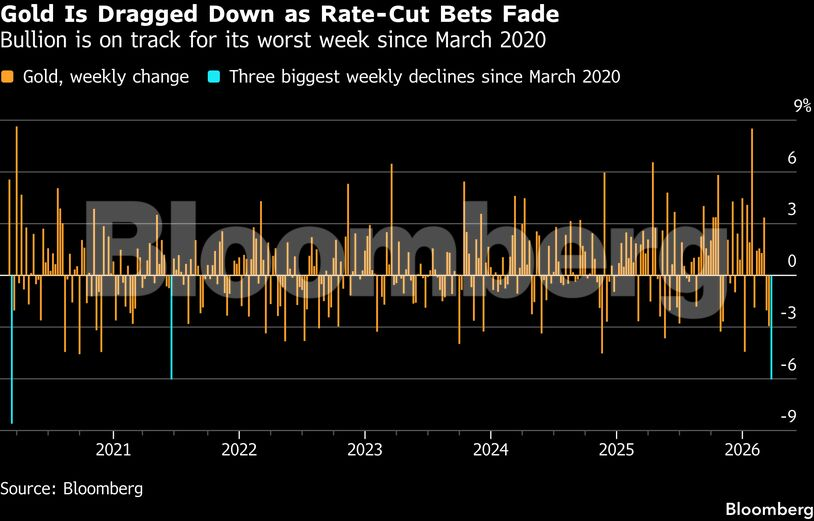
Gold headed for its biggest weekly loss since 1983, as war in the Middle East boosted energy prices and reduced expectations for interest-rate cuts.
Bullion’s decline deepened as the dollar and bond yields rallied after CBS reported that the US is preparing to potentially deploy ground forces into Iran. Traders increased their bets on rate hike to 50% by October amid concern that a protracted conflict could stoke inflation. Higher rates hurt gold as it doesn’t pay interest.
Iranian officials have become reluctant to even discuss reopening the Strait of Hormuz as they focus on surviving the attacks, according to a person involved in direct, high-level contacts with Tehran. The Wall Street Journal reported that the Pentagon is sending three warships and thousands of additional Marines to the Middle East.
Gold — widely viewed as a haven — has dropped every week since the US and Israel attacked Iran last month. The retreat has come as the US dollar gained ground while investors sold stocks and bonds amid concerns over the ripple effects of elevated energy costs to inflation and global growth.
Gold’s pullback reflects a combination of profit-taking and liquidation amid concerns about less monetary easing, according to Rhona O’Connell, an analyst at StoneX Financial.
Prices above $5,200 had attracted a lot of buyers, leaving the market vulnerable to correction, O’Connell said. When prices started to fall, many investors hit their stop-loss levels — automatic instructions to sell if prices drop to a certain point — so selling quickly accelerated, she said. Technical signals, particularly moving averages, added to the downward pressure, she added.
Forced selling tied to the equity rout may also have contributed to gold’s decline, while slower central bank buying and outflows from exchange-traded funds have further weighed on sentiment, according to O’Connell.
Bullion-backed ETFs are set for a third week of outflows, with holdings falling more than 60 tons in that period, data compiled by Bloomberg show.
Despite the recent pullback, gold remains about 4% higher this year. Prices touched a record just below $5,600 an ounce in late January, supported by a wave of investor enthusiasm, central-bank buying, and concerns over threats to the Fed’s independence posed by President Donald Trump.
Gold fell 3.1% to $4,508.96 an ounce as of 3:03 p.m. in New York, on course for a eight-day losing run, the longest since October 2023. That drop dragged the metal’s 14-day relative-strength index — a gauge of momentum — below 30, a level that some traders see as oversold.
In other precious metals, silver fell 6.3% to $68.20 an ounce, down by more than 15% this week. Palladium and platinum were also on track for weekly losses. The Bloomberg Dollar Spot Index rose 0.5%.
(By Yvonne Yue Li)
Gold mining stocks set to erase 2026 gains as rate cut bets fade
Global gold mining stocks tumbled, and are now in the red for this year, as traders ratcheted back expectations for interest rate cuts with oil prices surging amid the Iran war.
The NYSE Arca Gold Miners Index fell 6.6% on Thursday to the lowest level since December. The index, which includes companies from the US, Canada, the UK and Australia, is now down about 1.9% in 2026. It was up as much 35% on March 2, the first trading day after the US and Israel launched strikes on Iran, and as Iran retaliated.
The sector’s weakness deepened Thursday as escalating attacks in the Persian Gulf pushed up crude prices and drove down gold for a seventh session, marking the longest losing streak for the metal since October 2023.
The metal has declined about 12% since the start of the war as costlier energy risks sparking inflation and making it harder for central banks to reduce borrowing costs. That poses a risk for bullion, which performs better when rates are lower since it offers no yield. Traders no longer see Federal Reserve policy easing this year and some are hedging for a potential hike.
“For now, investor attention is on margins and the potential double whammy of lower gold prices and higher energy/consumable costs,” Christopher Lafemina, an analyst at Jefferies LLC, wrote in a note to clients. “In a prolonged conflict scenario, it’s possible to see more pressure on gold from higher rate expectations and a stronger US dollar.”
The other force working against gold in recent weeks is that the US dollar has emerged as a key haven during the conflict, with the Bloomberg Dollar Spot Index gaining 1.5% in March. Bullion is priced in dollars, so the precious metal has become relatively more expensive for buyers in other currencies.
Gold mining stocks saw large inflows in 2025, when the Bloomberg dollar index sank about 8%. Bullion gained 65% last year and hit a series of record highs. Newmont Corp., Agnico Eagle Mines Ltd. and Barrick Mining Corp. all rose over 115% in 2025 — the type of gains that are usually expected more from speculative assets than a metal seen as a haven. Now with the war dragging on, some investors are dumping the stocks.
“When volatility hits, the market sells anything liquid, and miners are liquid,” Matthew Tuttle, chief executive office of Tuttle Capital Management, wrote in a note to clients. “Add the fear that oil stays high, and you get a fast, ugly unwind — even in companies that are still printing cash.”
Barrick is expected to see annual earnings growth of 55% this year, while Agnico Eagle is projected to register a 72% year-over-year increase, according to analysts tracked by Bloomberg. Both companies are based in Toronto.
While lower gold prices would weigh on revenue, the large mining firms will likely be cushioned by the big run-up in the metal in recent years, analysts say.
After all, since the end of 2023, bullion prices have soared more than 120%, a major tailwind for the index of gold miners, which has gained more than 170% in that period.
If oil prices stabilize and pressure from interest rates and the dollar eases, miners with net cash, lower costs and high-quality assets like Newmont and Agnico Eagle will likely rebound, Tuttle wrote.
Gold exports from Switzerland in February fell 18% from the previous month to the lowest level since August as shipments to Britain and India slowed, Swiss customs data showed on Thursday.
Deliveries from Switzerland, the world’s biggest bullion refining and transit hub, to the UK fell to 20 metric tons last month from 43 tons in January. The UK is home to the world’s largest over-the-counter gold trading hub.
Supplies to India, a major bullion consumer, slowed to 13 tons in February from 23 tons with bullion trading at a discount in the local market amid subdued demand.
Kazakh construction tycoon buys gold miner Altynalmas
Kazakhstan Almaty city. (Stock image by podgorakz.)
One of Kazakhstan’s most prominent construction tycoons agreed to buy gold producer JSC AK Altynalmas and its units as he continues to expand his business interests.
Shakhmurat Mutalip’s Central Asia Resources Holding Ltd. signed a purchase agreement with majority owner Gouden Reserves BV and eight other shareholders, the company said in an emailed statement, without giving a value for the transaction. A representative of Altynalmas confirmed the deal.
“The acquisition of JSC AK Altynalmas is an important step in the implementation of the Holding’s long-term investment strategy,” Mutalip said in the statement Thursday. “This transaction reflects our confidence in the Group’s potential and its future development.”
Altynalmas is one of Kazakhstan’s largest gold producers, with output totaling 15.9 metric tons of gold in 2024.
Mutalip and Nurlan Artykbayev, who bought copper producer Kazakhmys in December, have emerged as prominent members of a business elite that’s become more influential since President Kassym-Jomart Tokayev consolidated power in the wake of riots in 2022. Since then, there has been a noticeable shift of wealth and authority away from circles that flourished during Nursultan Nazarbayev’s long-term rule.
Mutalip, the owner of infrastructure building group Integra Construction KZ, is in discussions with Glencore to purchase the miner’s 70% stake in zinc and gold producer Kazzinc Ltd., Bloomberg reported last month, citing people familiar with the matter. Mutalip is also in discussions to buy 40% of Eurasian Resources Group from the families of two of the Kazakh mining group’s founders, the people said.
.jpg)

 Stock image.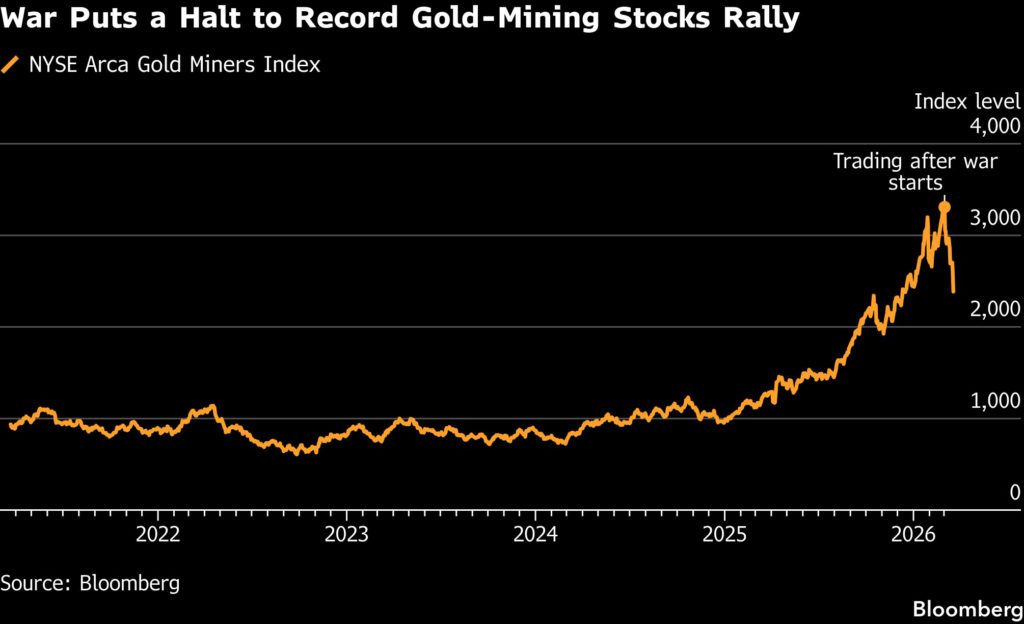
 Stock image.

No comments:
Post a Comment