Saturday, March 21, 2026

TotalEnergies Launches France’s First Advanced Plastic Recycling Plant

TotalEnergies has commissioned France’s first advanced plastics recycling facility at its Grandpuits site near Paris, with a processing capacity of 15,000 tons per year. The plant utilizes pyrolysis technology provided by Plastic Energy to convert hard-to-recycle household plastic waste into synthetic oil.

This synthetic oil is then reintegrated into the petrochemical value chain as a feedstock, enabling the production of recycled plastics that match virgin-grade quality, including for high-spec applications such as food packaging and medical use.

The startup represents a critical milestone in TotalEnergies’ broader transformation of its Grandpuits refinery into a “zero-crude” platform—an industrial hub designed to operate without traditional crude oil refining. Instead, the site is being repositioned around circular economy initiatives, biofuels, and low-carbon solutions.

By deploying advanced recycling, TotalEnergies is targeting waste streams that cannot be processed through conventional mechanical recycling, addressing a major bottleneck in plastic waste management.

The facility relies on pyrolysis, a thermochemical process that breaks down plastic waste at high temperatures in an oxygen-free environment. This method produces a liquid hydrocarbon output—often referred to as “pyrolysis oil”—which can substitute for fossil-derived feedstocks in petrochemical production.

To ensure feedstock supply, TotalEnergies signed agreements in 2023 with French recycling and waste management players Citeo and Paprec. These partnerships secure long-term access to post-consumer plastic waste streams that would otherwise be landfilled or incinerated.

Plastic Energy, the technology provider, is a key collaborator in scaling this advanced recycling pathway across Europe.

Advanced recycling—particularly pyrolysis—is gaining traction across the global petrochemical and energy sectors as companies seek to improve circularity and reduce reliance on virgin fossil inputs. Major oil and gas firms have increasingly invested in chemical recycling technologies to meet tightening regulatory pressures in Europe and growing demand for recycled-content plastics.

France, like much of the EU, faces stringent recycling targets and mounting pressure to reduce landfill use. The Grandpuits project positions TotalEnergies at the forefront of this transition domestically, while aligning with broader EU circular economy policies.

The development also reflects a wider trend among refiners repurposing legacy assets into low-carbon and circular platforms, as traditional fuel demand growth slows and sustainability mandates intensify.

The success of the Grandpuits facility could serve as a template for scaling advanced recycling across TotalEnergies’ global portfolio. While still nascent, chemical recycling technologies are expected to play a growing role in closing the plastics loop—particularly for complex and contaminated waste streams.

As regulatory frameworks evolve and demand for recycled plastics rises, early investments in advanced recycling infrastructure could offer both compliance advantages and new revenue streams for integrated energy companies.

By Charles Kennedy for Oilprice.com


The Significance of Israel’s Strike on Iran’s Largest Gas Field


  • The strike disrupted a field responsible for most of Iran’s gas supply, causing immediate economic and energy shocks.

  • Years of underinvestment and sanctions had already weakened South Pars, amplifying the impact of the attack.

  • Analysts warn that the consequences will heavily affect civilians and could reshape Iran’s post-conflict recovery for years.

When Israeli jets struck the South Pars gas complex near Asaluyeh, they hit more than pipes and compressors. They struck the single piece of infrastructure most essential to Iran's ability to function -- a field that provides 75 percent of Iran's domestic gas supply and powers roughly 80 percent of the country's electricity generation.

The strike halted output at two refineries with a combined daily capacity of around 100 million cubic meters, sending prices soaring and triggering Iranian retaliatory strikes on energy infrastructure in Gulf Arab states, including Qatar's Ras Laffan liquefied natural gas (LNG) terminal.

A Target Long in Decline

South Pars was already struggling before the first bomb fell. Straddling the maritime border with Qatar in the Persian Gulf -- where the same reservoir is known as North Dome and supplies roughly 20 percent of global LNG -- Iran's side of the field has suffered years of chronic underinvestment.

Since Washington withdrew from a nuclear deal in 2018 and imposed harsh sanctions on Tehran, international companies, including France's Total have departed, and the field's aging infrastructure has gone largely unrenewed.

Shahram Kholdi, a professor of international relations in Canada, says the field was already on borrowed time.

"The Islamic republic has invested very little in the oil and gas sector since Trump withdrew from the nuclear deal," he told RFE/RL's Radio Farda. "Many of these facilities were already in need of renovation. Qatar is extracting a far greater share of gas from the shared reservoir because our infrastructure has become outdated and deteriorated."

Even in peacetime, Iranians had experienced rolling gas shortages as the regime diverted supplies to petrochemical exports while running power plants on mazut -- a heavy fuel oil that blanketed Iranian cities in smog.

Strategic Logic, Human Cost

Israeli officials say the strike was coordinated with the United States and aimed at degrading the Islamic Republic's capacity to sustain its military. But analysts warn the damage is impossible to contain to the military sphere.

Umud Shokri, an energy security analyst and professor at George Mason University, argues the choice of South Pars as a target is about as consequential as it gets.

"Targeting South Pars is worst-case because it underpins most of Iran's gas supply, feeding power generation, heating, industry, and petrochemicals," he said. "Disruption doesn't just hit exports, it hits daily life. Expect outages, shortages, and inflation almost immediately, meaning ordinary Iranians absorb the shock first."

Since the launch of the military operation, Trump has said there can be "no deal with Iran except UNCONDITIONAL SURRENDER!" And while endorsing regime change as the "best thing that could happen," Trump has also noted that it may not occur "immediately."

On the political intent behind hitting civilian-adjacent infrastructure, Kholdi puts it bluntly: "I believe the intended or unintended goal is to bring the population to a point where they demand the overthrow of this regime. I see no other logic to it."

But both analysts are skeptical that such logic holds.

Shokri argued the strikes "don't neatly destabilize" the clerical establishment. "They weaken it, yes, but also give it justification to tighten control and externalize blame," he said.

The Day After

But he is skeptical that civilian pressure will translate into political change mid-conflict. "No, never," he said when asked whether people under active bombardment would take to the streets. The more lasting danger, in his view, is what happens after the war ends.

"Once a cease-fire is reached, the Islamic Republic will not be able to immediately restore [gas facilities at] Asaluyeh," Kholdi warned. "The country will face severe shortages, even if the Islamic Republic collapses and is gone."

Iran, he argues, would be forced to import gas from neighbors like Turkmenistan during any transition period, while reconstruction -- requiring advanced Japanese or South Korean technology and financing from the World Bank and International Monetary Fund -- could take years.

It is a challenge, he notes, that Iran's opposition movements have not planned for. Their transition frameworks were written before South Pars was a target.

"I think everyone's calculations included the hope that the leaders of the Islamic Republic would show some degree of rationality and simply let go and leave," he said. "Allow me to hold everyone responsible -- myself included."

By RFE/RL


Why the Global Oil System Cannot Replace Hormuz Flows

  • Even with maximum emergency measures, the world could face a supply deficit exceeding 10 million barrels per day.

  • Strategic reserves and alternative pipelines provide only temporary and partial relief.

  • Natural gas markets are especially vulnerable, with limited ability to replace disrupted Qatari LNG exports.

As the world braces for a potential “Battle of Hormuz” to reopen the world’s most important energy chokepoint, governments and energy markets are scrambling to answer a daunting question: What happens if the Strait of Hormuz stays closed for weeks or even months?

The narrow waterway between Iran and Oman is the most critical chokepoint in the global energy system. Roughly one-fifth of the world’s oil supply moves through it every day, along with enormous volumes of natural gas and petrochemical feedstocks.

In practical terms, that means that each day about 20 million barrels of oil and another 2 million barrels of oil equivalent in liquefied natural gas normally transit the Strait.


If those flows stop for an extended period, how does the world replace them?

The stark reality is that it can’t—at least not in the short term. The only realistic strategy is to plug as many holes as possible, add whatever incremental supply can be found, and buy time while efforts to reopen the Strait unfold.

Even under optimistic assumptions, the numbers are daunting. Of the roughly 22 million barrels of oil and oil-equivalent energy that normally pass through the Strait each day, coordinated releases from global strategic reserves might temporarily add around 6 to 7 million barrels per day. Alternative pipeline routes from the Persian Gulf could potentially add another 3 to 4 million barrels per day.

Even if every available lever is pulled simultaneously, the world could still face a supply gap of more than 10 million barrels per day.

That gap represents the scale of the challenge now confronting global energy markets.

The Emergency Toolkit

To understand how governments might respond, it helps to look at the physical plumbing of the global energy system. Several tools are available to offset lost supply, but each comes with important limitations.

Strategic Petroleum Reserve Releases

The fastest lever is the release of oil from emergency stockpiles. 

In mid-March, the International Energy Agency (IEA) announced a record-breaking coordinated release of 400 million barrels over 60 days. This adds roughly 6.7 million bpd to the global market—albeit it temporarily.

While this is the largest intervention in history, it covers only about one-third of the lost Hormuz volume. Furthermore, the U.S. SPR—currently at only about 58% capacity—faces its own logistical challenges. Even at a maximum drawdown rate of 4.4 million bpd, it takes nearly two weeks for those barrels to navigate the domestic pipe system and reach the Gulf Coast terminals for export. Strategic reserves are designed to buy time, not to serve as a long-term replacement for the world’s most vital petroleum artery.

Saudi Arabia’s East–West Pipeline

The most important non-reserve lever lies within Saudi Arabia itself.

The kingdom operates the East–West Pipeline, often referred to as Petroline, which moves crude oil from the Persian Gulf across the country to the Red Sea port of Yanbu. This allows Saudi exports to bypass the Strait of Hormuz entirely.

The pipeline has nameplate capacity of roughly 7 million barrels per day. However, part of that capacity is already utilized, and port logistics limit how much additional crude can be exported.

In practice, analysts estimate Saudi Arabia could increase exports through this route by roughly 2 to 3 million barrels per day during a crisis.

UAE and Iraqi Alternatives

Discover more

Machine Learning & Artificial Intelligence

The United Arab Emirates operates a smaller bypass route. The Habshan–Fujairah pipeline connects Abu Dhabi’s oil fields to the port of Fujairah, located outside the Strait of Hormuz.

This line can transport about 1.5 million barrels per day, although much of that capacity is already in use.

Iraq’s only meaningful alternative route runs north through Turkey to the Mediterranean port of Ceyhan. Years of political disputes with the Kurdistan Regional Government have limited flows along this pipeline, and infrastructure constraints mean that only modest volumes could realistically move through it in the near term.

Taken together, these alternative routes provide only partial relief compared with the massive volumes that normally transit the Strait.

The Hardest Gap: Natural Gas

Oil presents a major challenge, but natural gas will be even more difficult to replace.

Qatar is one of the world’s largest exporters of liquefied natural gas, accounting for roughly 20% of global LNG trade. Nearly all of those shipments normally pass through the Strait of Hormuz.

Unlike oil, LNG supply chains are highly specialized and inflexible. Production facilities, liquefaction plants, tankers, and receiving terminals must all operate in sync.

If Qatari LNG shipments are disrupted, there is little spare capacity elsewhere in the system that can quickly fill the gap. The likely result would be intense competition for cargoes from other exporters such as the United States and Australia, driving prices sharply higher and potentially forcing industrial consumers in some regions to curtail operations.

A Shortfall the Market Can’t Easily Close

Even after accounting for strategic reserve releases and alternative export routes, the numbers remain stark. Under the most optimistic scenario, emergency measures might replace roughly 10 million barrels per day of the energy that normally moves through the Strait of Hormuz.

That would still leave the global market short more than 10 million barrels per day.

History shows that disruptions to major energy chokepoints can have lasting consequences. The closure of the Suez Canal during the 1956 Suez Crisis and again after the 1967 Arab–Israeli War forced tankers to reroute around Africa, dramatically increasing shipping times and costs. During the Iran–Iraq “Tanker War” of the 1980s, attacks on oil shipping in the Persian Gulf rattled markets even though the Strait itself remained open.

But the scale of the Strait of Hormuz today is far larger. No country has ever before been in a position to shut down this much of the world’s energy supply.

A prolonged disruption would also ripple through global agriculture. Fertilizer feedstocks and petrochemical inputs that normally move through the Strait would become harder to obtain, raising the risk that an energy shock could eventually translate into higher food prices.

A supply shock of this scale typically ends in only two ways in the short term: either prices rise high enough to crush demand, or the disrupted routes are restored. Until one of those happens, the world is simply racing the clock.

Two additional variables could slightly soften the blow, but both remain major unknowns. One is whether Iran will continue exporting some oil to select customers despite a broader disruption. The other is the extent to which China might draw on its own strategic petroleum reserves to cushion the impact of rising prices.

Even taking both possibilities into account, however, they would do little to close the remaining supply gap.

By Robert Rapier

Norway’s Output Holds Steady—but Spare Capacity Is Gone

  • Norway’s oil and gas output dipped slightly in February but remains strong year-on-year.

  • As Europe’s top gas supplier since 2022, Norway continues to play a critical role in regional energy security, supplying over 30% of EU and UK gas demand.

  • However, Norway has no spare capacity to offset global supply shocks.

Norwegian oil production slipped 0.2 % in February as output fell slightly by 3,000 barrels per day (bpd) compared to January, averaging 1.97 million bpd, according to preliminary figures from the Norwegian Offshore Directorate. Production came in 262 kbpd higher than a year earlier, when oil output totaled 1.708 million bpd.

Total liquids production on the Norwegian continental shelf averaged 2.176 million bpd last month, including 1.97 million bpd of oil, 188,000 barrels of natural gas liquids (NGL), and 18,000 barrels of condensate.

Oil output came in 5.7 % above the Directorate`s forecast, exceeding expectations by 106 kbpd. Total liquids were 4% above forecast, or 83 kbpd above projections.


The Norwegian Offshore Directorate expects crude production to fall in the first half of 2026, before climbing after the maintenance season in the summer.

Gas Production

Norwegian gas output fell to 355.1 million standard cubic meters (Msm³) a day in February, down from 364.6 Msm³ in January. Production fell short of the Directorate’s forecast by 2.1%, with expectations set at 362.8 Msm³ a day for the month.

Forecasts indicate gas production will ease in the first half of 2026, averaging about 337 Msm³ a day in the first 6 months. After maintenance season, gas production is expected to climb to an average of 348 Msm³ a day in the second half of 2026.

No more spare capacity

During the 2022 energy crisis, Norway stepped in as Europe’s emergency supplier, boosting exports by nearly 10%. The Scandinavian producer ramped up production and adjusted maintenance schedules on the Norwegian continental shelf.

Since overtaking Russia as Europe’s biggest gas supplier in 2022, Norway has remained the backbone of European energy security. In 2024, the country exported gas volumes equal to more than 30% of total consumption in the EU and the UK. Crude flows are similarly critical: almost all Norwegian oil is exported, and Europe typically absorbs 70–80% of those barrels.

The escalating conflict in the Middle East has caused a 95% drop in traffic through the Strait of Hormuz, tightening supply and sending Brent back over the $100 mark. With key export routes under threat and volatility rising, traders have been looking for stable producers for relief.

They won’t find it in Norway

Equinor CEO Anders Opedal told Reuters that the state?controlled energy giant has no spare oil or gas capacity to bring online in response to the latest supply shock. After two years of elevated output, the Norwegian shelf is already running flat out

For a market once again facing geopolitical risk and tightening fundamentals, the message is clear:

Europe’s most reliable supplier has nothing left to give.

By Jan-Thore Bergsagel for Oilprice.com


Why This Energy Shock Will Hit Consumers Harder Than 2011

  • UBS Chief Economist Arend Kapteyn asserts that the current energy shock is unlike the 2011-2014 period due to the critical absence of a strong supply response from the US shale oil patch.

  • The oil sector is now less responsive to price increases, meaning the offset from booming domestic oil investment that helped the US economy a decade ago will be missing this time.

  • This lack of shale elasticity suggests the pain from higher energy prices is more likely to hit consumers directly through weaker spending power, potentially accelerating broader economic deterioration.

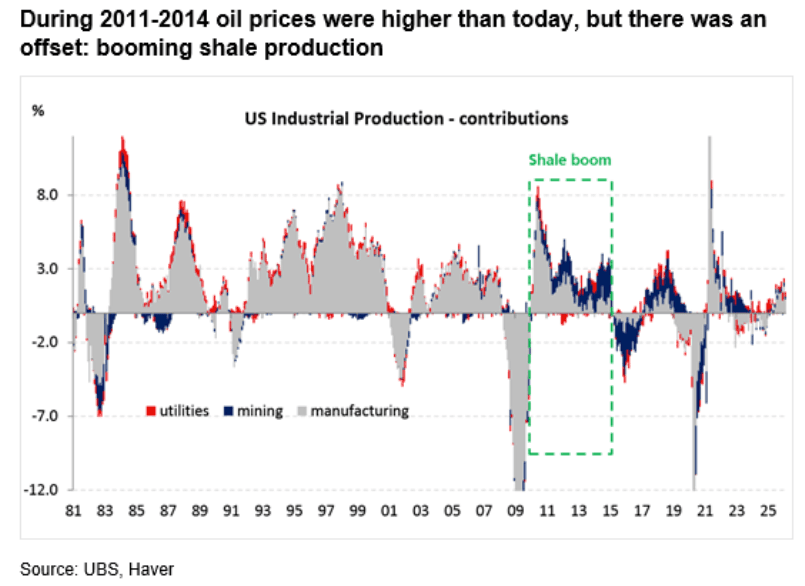
Arend Kapteyn, the global head of economics and strategy research and chief economist at UBS, told clients that one key reason the current Middle East conflict-driven energy shock "is not like 2011-2014" will be the absence of a comparable response from the shale patch, suggesting consumers are more likely to bear the brunt of the pain. 

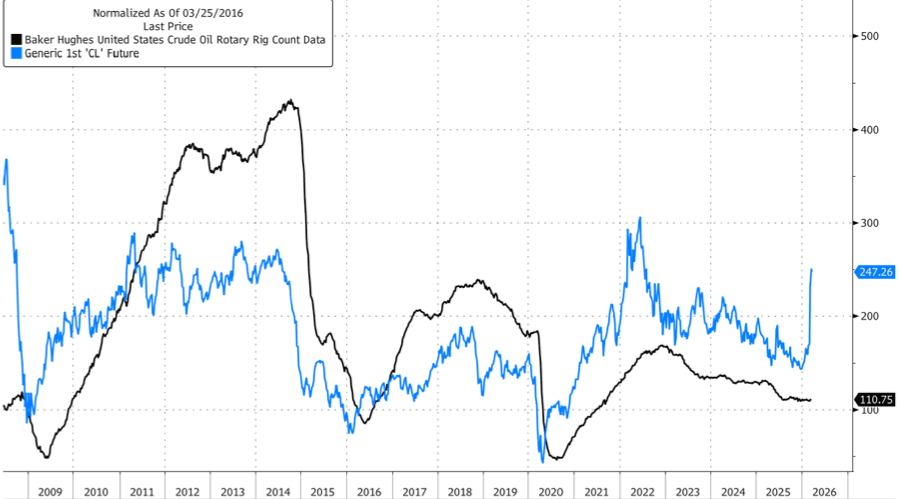
Kapteyn noted that, on an inflation-adjusted basis, oil prices in 2011-2014 were actually higher than they are today, yet the U.S. economy absorbed that shock because the shale boom provided a lift to the industrial base. Soaring WTI crude prices at the time spurred oil/gas companies to increase drilling activity, production growth, and energy-sector investment. This helped create a tailwind for the US' manufacturing base and offset some of the drag from higher fuel costs.

However, this is where the bullish U.S. economic case starts to look a little shaky. As Kapteyn noted, "The oil sector is much less responsive to prices than a decade ago." 


The Trump administration has indicated that the oil price shock is temporary, suggesting shale drilling is unlikely to increase meaningfully or provide much of a tailwind for the manufacturing base.

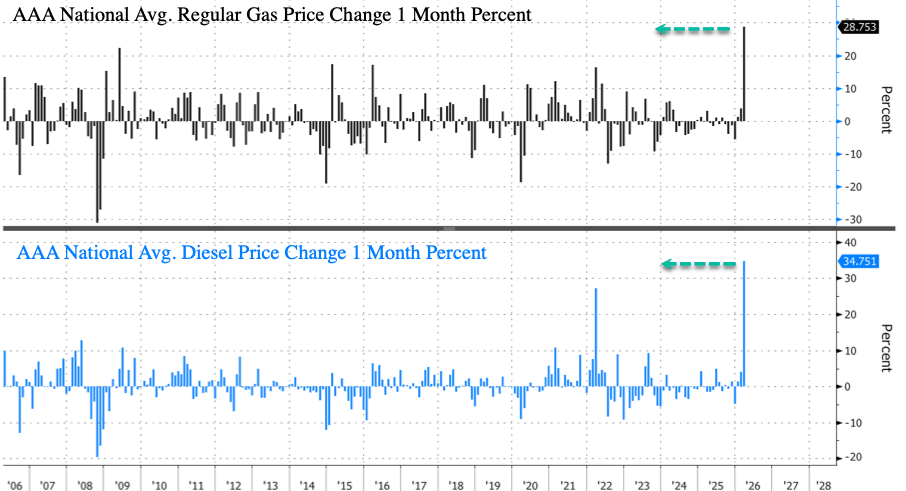
That means this time, the pain from higher energy prices is more likely to hit consumers directly through weaker spending power, with less offset from booming domestic oil investment.

The shock at the gas pump begins:

We warned:

Kapteyn continued:

A common question is why current oil prices should be a concern for the U.S. economy when prices were substantially higher in 2011-2014 and growth held up well. Over that earlier period, Brent averaged around $110/bbl—close to $145/bbl in today's dollars, roughly 23% above today's spot prices—yet U.S. GDP growth still averaged just over 2%.

There are, of course, many differences relative to then: today's labor market is weaker, households are more liquidity constrained, and the inflationary impulse is sharper, reflecting a much faster run-up in prices (oil prices never rose more than about 55% year-on-year in 2011-2014, versus close to 100% if today's prices are sustained). But the key difference—and the focus here—is shale.

At the start of 2010, the U.S. mining sector (largely oil and gas) accounted for roughly 14% of industrial production. By 2012-2013, it was generating well over half of total U.S. IP growth, with brief periods in which mining effectively accounted for all of it. After oil prices collapsed in 2015-2016, U.S. mining output rebounded mechanically from a low base—but shale did not return to its pre-2014 investment or rig intensity. Oil production still responds to prices at the margin—via well completions, higher utilization, and productivity gains—but investment has become far less elastic. In other words, if current oil prices are perceived as temporary, the U.S. is unlikely to see anything resembling the 2011-2014 shale-driven supply response to offset the net income erosion that is likely to hit consumers.

Overnight developments, including Israeli and Iranian retaliatory strikes on upstream energy infrastructure across the Gulf area and Qatar's warning that Iranian attacks on its LNG complex - the world's largest - could leave capacity offline for months, if not years, only reinforce the view that global energy markets are set to tighten further. The risk now is a pump price shock, which could begin to weigh on sentiment in the weeks ahead if energy market turmoil persists. At the same time, signs of stress are emerging in credit markets, adding to concerns that the broader economic outlook could deteriorate. 

By Zerohedge