Saturday, March 21, 2026

INTERVIEW


Cities can improve air quality ‘quite rapidly’ with political will


Air pollution is the leading environmental risk to human health, causing respiratory and cardiovascular disease as well as cancer in millions of people every year. Yet some cities are already managing to cut pollution significantly, new analysis by the environmental network Breathe Cities shows.


Issued on: 21/03/2026 - RFI


A view of Paris from the Generali balloon, which measures air quality. AP - Christophe Ena

Cities contend with the worst air quality, thanks to traffic, industry and dense populations. Yet they are also the places where anti-pollution measures can produce the fastest and most visible results.

Breathe Cities analysed the strategies used by 19 major cities that have significantly reduced pollution levels. Cecilia Vaca Jones, executive director of the organisation, says cities can improve air quality faster than many people think.

RFI: What do the 19 cities that have been most successful in reducing air pollution have in common?

Cecilia Vaca Jones: First of all, all these cities do an excellent job collecting reliable data. That data helps guide policies and shows where anti-pollution action should focus.

Cities that invest in infrastructure for cyclists and pedestrians understand that they can achieve two goals at once. They reduce polluting emissions and improve air quality, while also encouraging healthier behaviour.

Another point they all share is that they try to make air quality more tangible in people’s daily lives and show how improving it can directly benefit their health.

From food to transport, how cities are rewriting the climate playbook

RFI: How important is it to collect reliable data on urban air quality?

CVJ: We need to expand air quality monitoring systems because they help guide policies and programmes.

I am currently in Bangkok, where the authorities have tools that map in real time which parts of the city have the most polluted air and who is affected. This also allows them to predict pollution peaks and take very targeted action.

Having good data on a continuous basis also allows us to check whether the actions we take are really working – whether we are actually reducing emissions of fine particles and nitrogen dioxide. So it is very important to have data of that quality.

Finally, the data must be shared transparently with citizens. This information raises awareness and allows people to make informed decisions. Sometimes it also leads them to change their behaviour and help reduce air pollution.

RFI: What solutions have the cities you studied introduced that are proving effective?

CVJ: Several solutions have proved effective across all 19 cities. One example is the introduction of low-emission zones. These exist in London and also in Paris, where the city has closed streets in front of nursery and primary schools to traffic.

In Paris, as in other major European cities such as Amsterdam and Rotterdam, space for cars has been reduced to create cycle lanes, pedestrian areas and green spaces.

Public transport networks have been expanded and buses electrified, allowing residents to leave their personal vehicles at home. Reducing traffic in cities significantly improves air quality.

There are also measures targeting other sources of pollution. For example, Warsaw has banned coal as a heating fuel.

Paris mayoral race puts city's green transformation to the test

RFI: Governments clearly need to take action. But what role can citizens play in the fight against air pollution?

CVJ: What I find remarkable is that air quality is truly a public good – probably the only public good we share across the entire world.

Efforts to reduce air pollution often go beyond the boundaries of a single city. In Asia, for example, the air in many cities is badly affected by agricultural burning in surrounding rural areas. That means discussions have to go beyond the city itself.

Citizens also have a very important role to play. In Nairobi, for example, I recently met local organisations and communities working to manage waste. Burning waste is another major source of emissions.

But these communities have developed different waste management methods. They have changed their behaviour, and that also helps reduce air pollution. The first step – and the most important – is awareness. People need to understand the risk that poor air quality poses to their health and the health of their children.

New estimates show France still off track on climate goals

RFI: How long does it take to clean up the air in a city?

CVJ: People often think that improving air quality takes decades. But what we have learned from this study is that change can actually happen quite rapidly.

This is especially true when there is strong political will. But it also requires the right tools, reliable data and the right people to implement these programmes on the ground.

This interview has been adapted from the original version in French and lightly edited for clarity.

 NAKBA II


The West Bank, up against the wall: Illegal Palestinian workers face exploitation and danger


FRANCE24
Issued on: 20/03/2026
25:34 min


Our reporters in the Middle East went to meet Palestinians who are desperately trying to reach Israel to find work there. Before the October 7 attacks, 120,000 Palestinian workers held permits allowing them to enter Israel legally. Today, only a handful of permits are issued. Facing an economic crisis devastating the occupied West Bank, many have no choice but to take the illegal route.

Almost every day near Jerusalem, dozens of men try to scale an 8-metre-high concrete wall separating Israel from the West Bank. On the other side, Israeli soldiers respond with tear gas and, sometimes, with live ammunition.

WATCH MORE Settler violence surges in the West Bank

In this special report, "The West Bank, up against the wall", FRANCE 24's Claire Duhamel and Mohamed Farhat shed light on a lesser-known aspect of the Israeli-Palestinian conflict: how two previously intertwined economies are now drifting apart, and how Palestinian traffickers are profiting from desperate workers.


European nations condemn 'increasing settler terror' in West Bank

Diplomats from 13 European countries and Canada have condemned what they described as growing "settler terror" against Palestinians in the Israeli-occupied West Bank, after a surge in deadly attacks.


Issued on: 21/03/2026 - RFI

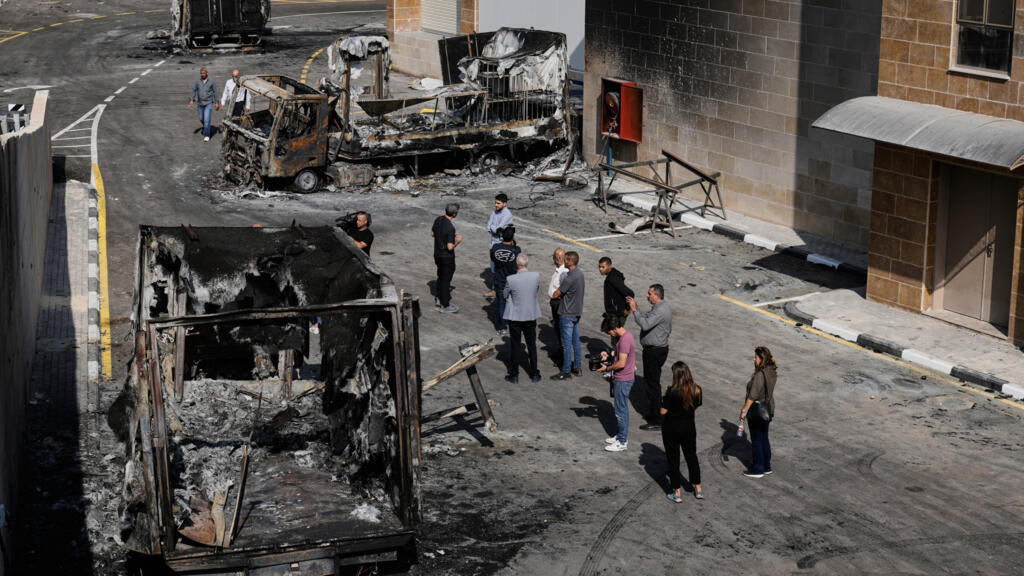
Palestinians and journalists survey damage in an industrial zone following an attack by Israeli settlers the previous day in the West Bank village of Beit Lid, near Tulkarm, 12 November, 2025. 5. AP - Majdi Mohammed

In a joint statement, diplomatic missions including France, Spain and Britain said they were "appalled" by the recent killings.

"We strongly condemn increasing settler terror and violence by the Israeli security forces inflicted upon Palestinian communities," the diplomats said.

"This violence by settler militias, aimed at taking over land and creating a coercive environment, forcing Palestinians to leave their homes, must end."

The statement called on the Israeli authorities to "prevent and prosecute the lethal violence, raids and attacks"

Since the start of March, six Palestinians have been shot dead in settler attacks in the West Bank, according to a tally of data from the Ramallah-based health ministry.
'Morally and ethically unacceptable'

On Wednesday, Israel's military chief Lieutenant General Eyal Zamir described the rise in settler violence in the West Bank as "morally and ethically unacceptable".

US broadcaster CNN recently reported the case of Palestinian Abu al-Kebash who claimed to have been sexually assaulted by settlers in his village of Khirbet Humsa, describing sexual assault as "a new weapon in these settlers’ arsenal of intimidation".

More than 500,000 Israelis live in settlements and outposts in the West Bank, which are illegal under international law, alongside roughly three million Palestinians.

On Tuesday, the UN urged Israel to immediately halt its dramatic settlement expansion in the West Bank, where it has raised concerns of "ethnic cleansing" with more than 36,000 Palestinians displaced in a single year.

Deadly Israeli settler violence surges in West Bank during Iran war


Sharp rise in violence

Violence in the West Bank, which Israel has occupied since 1967, has risen sharply since the 7 October, 2023 Hamas attack on Israel, which triggered the war in Gaza.

According to the Palestinian Authority, Israeli troops or settlers have killed at least 1,050 Palestinians – many of them militants, but also scores of civilians – in the West Bank since the start of the Gaza war.

Attacks have further spiked since the start of Iran war on 28 February.


Family members grieve over the bodies of four members of a Palestinian family, including two children, killed by Israeli soldiers in their vehicle on 15 March, in the occupied West Bank. Israel said troops had opened fire over a perceived safety threat. AFP - JAAFAR ASHTIYEH


'Not our war': Palestinians mourn first dead after Iran missile fire

Israeli troops last week shot dead two children and their parents in a car, Palestinian authorities said. The Israeli military and police said soldiers opened fire on the vehicle over a perceived safety threat.

Official Israeli figures say 45 Israelis, including soldiers and civilians, have also been killed in Palestinian attacks or during Israeli military operations.

(with newswires)
Kenya, Uganda open rail extension burdened by Chinese debt

Nairobi (AFP) – The presidents of Kenya and Uganda met near their shared border Saturday to mark the multi-billion-dollar, long-delayed extension of a Chinese-built railway that has left Kenya heavily in debt.


Issued on: 21/03/2026 - RFI


Kenyan President Ruto (L) and Ugandan President Museveni (R) launch construction of the Kisumu-Malaba Standard Gauge Railway (SGR) line in Kisumu, on 21 March, 2026. AFP - BRIAN ONGORO

The Standard Gauge Railway, built from 2013 to 2019, connects the Kenyan port of Mombasa to its capital Nairobi, and on to the lake town of Naivasha, but China refused further lending before it could be extended to Uganda as planned.

Kenya now spends roughly $1 billion a year servicing Chinese debt, most of it borrowed to build the railway.

That is far more than the line generates in revenue – around $165 million last year – even if passenger and cargo numbers have been growing strongly over the past year.

A report by Kenya's auditor general last year found more than $260 million had been wasted just on penalties and interest from late debt payments.


Generation-defining project

Yet despite the controversy over the cost, Kenya has been keen to finish the line.

Kenyan President William Ruto said the rail link will "define generations", speaking at a ceremony in grand pomp and circumstance with his Ugandan counterpart Yoweri Museveni in Kisumu, near the Kenya-Uganda border.

Ruto argued the line would slash logistics costs that "undermine competitiveness" in east Africa.

If the ambitious building schedule is to be believed, the line is due to reach Kisumu by June 2027. The next phase will then take the line to Malaba, a town on the border.

"Cargo takes an average of 80 hours to move from Mombasa to Malaba and more than 100 hours to reach Kampala," the Ugandan capital, Ruto said.

"We cannot build prosperity on inefficiency."

Kenya's then-president Uhuru Kenyatta officially launches Kenya's Standard gauge railway, linking Mombasa-Kampala-Kigali-Juba, 28 November 2013, but plans to expand further were halted due to lack of funding. AFP


China pledges to give Africa $51bn in fresh funding over next three years


'Irrational and wasteful'

Museveni said the line would reduce the inefficiencies in his own country's infrastructure.

"The railway is part of the rationalisation of our transport system, especially on the Uganda side, which is irrational and wasteful," the veteran leader told the ceremony.

Ruto broke ground on the next phase in Narok County on Thursday, arguing that it will create jobs and reduce road congestion.

"We have thought through this project (and)... its finance," he insisted.

Treasury estimates say the overall cost will be more than 500 billion shillings ($3.9 billion), according to Kenya's Business Daily.

China to the rescue of Zimbabwe's colonial-era rail network

Kenya is not taking more cash from Chinese banks this time – instead borrowing against future cargo taxes – though it is partnering with Chinese transport firms to build the new phase.

China lent Kenya $9.7 billion between 2000 and 2019, according to the Chinese Loans to Africa Database by Boston University, with around half of that going to the railway.

It stopped lending from 2020 to 2023 as Kenya struggled to make repayments, at a time when China revised its broader lending strategy in Africa.

Kenya considers the railway extension crucial for strengthening trade through east and central Africa, hoping to reach landlocked countries such as Uganda, Rwanda, South Sudan and the mineral-rich Democratic Republic of Congo.
Ugandan opposition leader Bobi Wine ‘ran away for safety’ to US

The leader of Ugandan opposition party, the National Unity Platform, Bobi Wine has resurfaced in the United States after days of uncertainty over his whereabouts, saying he fled for his life and is now seeking international backing against the government he accuses of repression.


Issued on: 20/03/2026 - RFI

Robert Kyagulanyi Ssentamu, known as Bobi Wine, seen arriving with his wife to vote at a polling station in Kampala during the general election on 15 January. AP - Brian Inganga

Wine appeared in Washington on Wednesday, ending almost a week of speculation as to his whereabouts, after quietly leaving Uganda.

A photo shared on social media showed him standing in front of the US Capitol, dressed in a suit and holding a laptop, as he announced the start of meetings in the American capital.

“I ran away from my country for safety. The military was looking for me to kill me," Wine told RFI. "But I also wanted to be able to speak to the international community, to engage international partners.”

The leader of the National Unity Platform had revealed on Saturday that he had left Uganda, where he had been living in hiding since the disputed presidential election in January.

His home had been surrounded by security forces, and his destination remained unknown until his reappearance in the United States.

'We have to free ourselves': Bobi Wine urges Ugandans to reject election result


Push for sanctions

Wine said his aim was to push foreign governments to act against the Ugandan authorities.

“We want to obtain sanctions,” he said. “We want the international community, the United States of America, the UK, the European Union, to stop sponsoring terror in Uganda, to stop sponsoring a dictator that has been in power for 40 years, to stop sponsoring a dictatorship that tortures people for fun on camera.”

He framed his trip as part of a wider effort to mobilise international pressure.

Wine had spent around two months in hiding before leaving Uganda. His departure last week was carried out discreetly, in what appeared to be a setback for Ugandan security forces.

The pressure on him had intensified not just because of the siege around his home, but also thanks to threats from President Yoweri Museveni's son, Muhoozi Kainerugaba, known for his aggressive posts on social media, who had publicly called for his death.

“I cannot give particulars and details because I don’t want to give an itinerary for my movement,” Wine said. “I know I’m being pursued.”

Ugandan opponent Bobi Wine receives threats from President Museveni's son


Lobbying abroad

Details of his stay in Washington remain unclear, including who he plans to meet and how long he will remain in the US.

His party said the trip abroad is temporary, and part of a broader effort to consult foreign political leaders in a bid to increase pressure on the Ugandan authorities.

Wine said he plans to meet key decision-makers linked to Uganda and challenge what he called misinformation about the situation in his country.

“I will be meeting the people that matter in regards to Uganda,” he said. “I want to go everywhere where the dictatorship has a footing to ensure that we undo the lies.”

He said he had already begun meetings on Capitol Hill in Washington, where US lawmakers shape foreign policy.

Despite the risks, Wine insisted he plans to return home. “Uganda is my home and I will be back,” he said. “Just like they don’t know how I left, I’m not going to brief them on my return.”

This story was adapted from the original version in French and edited for clarity.
French jihadist jailed for life for Islamic State crimes against Yazidis

Paris (France) (AFP) – A French jihadist was sentenced to life in jail on Friday for involvement in Islamic State group atrocities against Iraq's Yazidi minority, the first case in France to tackle the issue.


Issued on: 20/03/2026 - RFI

An image grab from a video reportedly released by IS and showing French jihadist Sabri Essid. © - / AL-FURQAN MEDIA/AFP/File

The Paris Assizes Court found Sabri Essid guilty in absentia of genocide, crimes against humanity and complicity in the crimes, committed between 2014 and 2016 when the jihadists occupied swathes of northern Syria and Iraq.

"Sabri Essid took part in the genocide perpetrated by Islamic State," presiding judge Marc Sommerer told the court.

"Essid became part of the criminal network repeatedly buying and reselling a very large number of Yazidi victims," he said, adding the court judged that the group had "specifically targeted" the Yazidi minority for its religious beliefs.

The Islamic State group regarded the Yazidis, who follow a pre-Islamic faith, as heretics.

Essid, a Frenchman born in 1984 and who joined IS in Syria in 2014, is presumed to have been killed in 2018. But without proof of his death, he was tried and convicted in absentia.

He is accused of buying several Yazidi women at markets and then repeatedly raping them, as well as depriving them of water and food.

IS seized large swathes of Syria and neighbouring Iraq in 2014, declaring a so-called caliphate there.

In August of that year, they murdered thousands of Yazidi men in Iraq's Sinjar province and took into Syria thousands of women and girls to sell them in markets as sex slaves to be abused by jihadists from around the world.

United Nations investigators have qualified these actions as genocide.

France begins landmark trial over Islamic State genocide of Yazidis
'Genocidal policy'

On Thursday, a Yazidi woman who was sold by IS as a sex slave described in stark detail to the Paris court the horrors she endured under jihadist captivity in Syria.

She said she was raped almost daily by her first two owners – a married Saudi man and then Essid. She was resold to six other men before escaping with her daughter and walking through the night to reach a post manned by Kurdish forces.

Sommerer said on Thursday he had overseen several trials for crimes against humanity but had "never heard before" the atrocities endured by the woman, whose name AFP is withholding to protect her privacy.

Known in Syria as Abu Dojanah al-Faransi, Essid was thought to be close to Jean-Michel and Fabien Clain.

The Clain brothers, now believed to be dead, claimed responsibility on behalf of IS for France's worst ever jihadist attacks in Paris in 2015.

Lawyers had earlier stressed the significance of the Essid trial.

"Given that in the past Islamic State fighters believed to be dead have resurfaced, it is essential that this trial take place," said Patrick Baudouin, a lawyer for France's Human Rights League.

"It is essential that it shed light on the particularly grave abuses committed against civilian populations and in particular the genocidal policy implemented against the Yazidi population," said Clemence Bectarte, a lawyer representing three Yazidi women survivors and their eight children


Trials throughout Europe

After Essid went to Syria, his wife, their three children and her son from a previous relationship joined him.

In an IS propaganda video released in 2015, Essid is seen pushing his 12-year-old stepson to shoot a Palestinian hostage in the head.

His wife has been jailed since returning to France.

Similar trials have taken place elsewhere in Europe.

In 2021, a German court issued the first ruling worldwide to recognise crimes against the Yazidi community as genocide.

It sentenced an Iraqi man to life in jail on charges that he chained a five-year-old Yazidi girl "house slave" outdoors in heat of up to 50C as punishment for wetting her mattress, leading her to die of thirst.

Last month, a Swedish court convicted a 52-year-old woman of genocide for keeping Yazidi women and children as slaves in Syria in 2015.

US-backed forces eventually defeated the IS proto-state in 2019, though isolated cells still operate in the Syrian desert.

Hussein Qaidi, who heads the Kidnapped Yazidi Rescue Office, told AFP last year that IS had abducted 6,416 Yazidis, more than half of whom had since been rescued.
Why the Sahel is now the world’s deadliest region for terrorism

The Sahel has become the world’s most deadly region for terrorism, with nearly half of all global deaths now taking place there. This marks a long-term shift away from the Middle East and North Africa, recent data shows.


Issued on: 20/03/2026 - RFI


The Tarikom camp in Ghana has a majority of women and children who fled jihadist violence in Burkina Faso. © RFI / Victor Cariou

By: Melissa Chemam


The Global Terrorism Index 2026, compiled by the Institute for Economics and Peace, said the region has led global figures for three consecutive years. Data from ACLED, a group that tracks conflict and violence worldwide, also point to high levels of violence across the Sahel.

"The epicentre of terrorism has shifted from the Middle East and North Africa, into the Sahel region of sub-Saharan Africa," the index said this week – adding "the Sahel has suffered a tenfold increase in terrorism fatalities since 2007".

In 2024, more than half of the 7,555 global deaths linked to terrorism were recorded in the Sahel. The trend continued in 2025, with nearly half of the 5,582 fatalities taking place there.

The index ranked 163 countries using data on attacks, deaths, injuries and hostages. It also noted that total fatalities in the region fell compared to the previous year.

The Sahel stretches along the southern edge of the Sahara desert, from the Atlantic Ocean to the Red Sea, and includes countries such as Mauritania, Mali, Niger, northern Nigeria, Chad and Sudan.

The Chief of staff of the Burkina Faso armed forces, colonel-major David Kabre attends the annual US led-FLINTLOOK military training closing ceremony at the International Counter-Terrorism Academy in Jacqueville in Ivory Coats on 14 March, 2023. AFP - ISSOUF SANOGO

Armed groups expanding

"The central Sahel countries were not only ranked in the top five but also experienced 12 of the 20 deadliest attacks globally," Heni Nsaibia, senior analyst for West Africa at ACLED, told RFI.

The rise in violence is largely linked to the growing presence of jihadist groups and changes in how they operate. Most attacks are attributed to Islamic State affiliates and JNIM, an Al-Qaeda-linked group active in Burkina Faso.

JNIM has shifted its focus towards targeting soldiers rather than civilians and has expanded operations in areas such as western and southern Mali.

"Both JNIM and Islamic State – Sahel Province (ISSP) have expanded in Niger’s southern Dosso region and into Nigeria, while Benin experienced its deadliest year to date as a result of JNIM’s violent activities," Nsaibia said – adding that the figures do not fully capture how the conflict is evolving.

"Numbers only tell a part of the story."

Burkina Faso filmmaker takes story of women resisting jihadists to Oscars

Different ways of counting violence can lead to different totals, Nsaibia explained, because some datasets include all forms of political or organised violence, such as battles, air strikes and drone attacks.

"While it is true that fatalities have generally declined and the number of violent deaths is a key measure of conflict, other observable dynamics must also be considered," he said.

"In 2025, there has been an all-time high in kidnappings of foreigners in both Mali and Niger. Economic warfare and its ramifications have become defining features, militant activities have increased in and around major population centers, and the use of drone warfare by non-state armed groups has proliferated."
Regional shifts

Twenty years ago, the Sahel accounted for just one percent of global terrorism deaths.

Burkina Faso, previously the most affected country, saw fatalities fall 45 percent in 2025 to 846, mainly due to an 84 percent drop in civilian casualties, the terrorism index found.

Niger rose to third place, with 703 deaths, more than half of them civilians, while Nigeria ranked fourth with 750 deaths, up 46 percent from the previous year.

Benin and Nigeria join forces to fight growing cross-border terrorism

"This marks the highest death toll since 2020, driven by internal instability as well as ongoing conflict between ISWAP and Boko Haram," the index said.

Mali dropped to fifth place, with 341 deaths compared to 604 the previous year.

The spread of violence has also reached coastal West Africa, particularly Benin, which rose to 19th place on the index.

"Benin also appears on the list and is now exposed to conflict dynamics similar to those observed for years among its northern neighbours," Nsaibia said.
Global picture

Worldwide, deaths linked to terrorism fell 28 percent in 2025 to 5,582, while the number of attacks dropped nearly 22 percent to 2,944.

Only 19 countries recorded worsening conditions, the lowest number since the index began, although several Western countries were among them.

Pakistan became the most affected country in 2025, overtaking Burkina Faso.

Spotlight on Africa: West African countries step up cooperation against spreading jihadist violence

"Deaths from terrorism in Pakistan are now at their highest level since 2013, with the country recording 1,139 terrorism deaths and 1,045 incidents in 2025," the index said.

"This follows a sharp resurgence in terrorist activity driven in part by the Taliban's return to power in Afghanistan in 2021," it added.

Nsaibia said global crises may be drawing attention away from Africa.

"A concern is that geopolitical changes and successive conflicts and wars elsewhere in the world have diverted attention from Africa in general and the Sahel in particular."

He also warned about the broader impact of violence. "The growing disregard for harm against civilians in the Sahel, in Africa but also globally is to him the biggest concern."


INTERVIEW

Congo's 'Nintendo election' was rigged from the start, observer says


Civil society groups in Congo-Brazzaville are challenging the integrity of last weekend's presidential election, which handed veteran leader Denis Sassou Nguesso a fifth term in office. Bertrand Menier Kounianga, spokesperson for the civil society platform CAPGED, tells RFI the vote was “rigged from start to finish”.


Issued on: 21/03/2026 - RFI


A man holds a newspaper that is announcing the reelection of Congo-Brazzaville's Denis Sassou Nguesso, in Brazzaville on 18 March 2026. © AFP - DANIEL BELOUMOU OLOMO

Observers say the polls were marked by a communications blackout, a lack of oversight in polling stations and turnout figures that do not match what they witnessed on the ground.

Sassou Nguesso was credited with 94.82 percent of the vote, while all other candidates remained below 2 percent.

A former French colony, Congo-Brazzaville has been independent since 1960, but 82-year-old Sassou Nguesso has dominated its politics for decades, ruling under a one-party system from 1979 to 1992 and again since 1997 under a multi-party system.

Following the vote, candidates now have until Sunday to challenge the results, after which the Constitutional Court has 15 days to review any complaints before announcing the final outcome.

Kounianga says the problems began well before polling day.

RFI: You refer to a "Nintendo election". What does that mean?

Bertrand Menier Kounianga: A Nintendo election is one that has been rigged from start to finish by the person in control of everything – from preparation through to the vote. We observed that nothing was clear, nothing was credible, and nothing could reassure the people.

RFI: The vote was marked by a widespread communications blackout on polling day. What difficulties did this cause for voters, candidates and observers?

BK: For the candidates it was very serious because it prevented them from coordinating with their teams on the ground. As a result, almost all opposition candidates had virtually no observers or delegates in polling stations.

For us voters, it was very serious because, whilst voting was taking place, we were in contact with our relatives and we saw cases of illness – people who fell ill and could not call an ambulance, could not reach family for help or even small amounts of money.

It was very distressing for both voters and candidates, and it is unacceptable.

Congo's Sasso Nguesso re-elected president in tightly controlled vote

RFI: Traffic was banned and shops were closed. CAPGED deployed observers to 49 polling stations in Brazzaville but could not obtain accreditation. Under these circumstances, how did you manage to carry out your work?

BK: We applied for accreditation a month in advance, but we did not receive it. So we decided to carry out citizen observation. We sent members of our platform who had valid voter cards and whom we had trained.

On polling day, they went to polling stations with their voter cards. They were able to check voting materials – whether the ink was indelible, whether registers were present, whether voter lists were displayed, and whether the booth and the ballot box were in the right place.

RFI: What stood out to you about how the voting process was conducted?

BK: Most candidates, apart from the president, did not have representatives in polling stations.

Secondly, almost all polling stations opened late and closed early. They were supposed to close at 5pm, but some closed at 4pm, and in one case at 11am – at Plateau A1 primary school. In polling station one, there were no more than three ballot papers.

In several polling stations, we observed that people were not motivated. Voting started late and there was no real enthusiasm. This was reflected when the results were announced – there was no celebration in the city, even though the president had won a landslide victory.

Congo-Brazzaville's Sassou Nguesso set to extend four-decade rule

RFI: Yet the authorities announced a turnout of over 84 percent. What do you make of that?

BK: The figures published by the authorities do not reflect reality on the ground. Most media and witnesses present will tell you there was no enthusiasm. From what we observed, turnout could not have exceeded 10 percent.

RFI: What else did you observe? There were reports of multiple voting – is that correct?

BK: Yes, there were cases of multiple voting. In some polling stations, particularly in Poto-Poto, we were told that militants who had voted on the 12th voted again in other polling stations.

Public officials responsible for distributing voter cards withheld them, but those cards ended up at the headquarters of the majority candidate. On polling day, people came to vote in place of others. That meant some individuals voted several times, creating duplicate votes.

I saw an official – a member of an advisory council – arrive late at a polling station. When police told him he could no longer vote, he said he had already voted elsewhere and wanted to vote again. He showed two voter cards, neither in his name.

There were also people who had moved and ended up with two voter cards – one for their old neighbourhood and one for their new one. They voted in both places. These incidents were repeated. There was also ballot box stuffing in some polling stations, and we documented it.

Details emerge about corruption surrounding 'Congo condo' and Sassou Nguesso's son

RFI: What did you see when the votes were counted after polling closed?

BK: In some polling stations, the count did not take place on site. After voting ended, law enforcement and administrative staff took ballot boxes away. That is worrying because the boxes could be tampered with outside the view of observers and candidates.

The law says results should be posted outside each polling station after counting. But in many places we observed, this was not done. These are serious irregularities because people are then forced to rely only on the results announced by the authorities, without any evidence to challenge them.

RFI: Were there any positive aspects regarding the organisation of this election?

BK: The election took place without incident, in a calm atmosphere compared to other elections. We did not document any cases of violence.

RFI: CAPGED says the election was not free, fair or transparent. What happens next?

BK: We will call for dialogue. When authorities are elected through a process that is neither credible nor transparent, they lack legitimacy.

Throughout this term, concerns will continue to be raised. When people do not identify with their leaders, it becomes difficult to govern.

We will continue to call for dialogue, to mobilise the population and rebuild trust. Perhaps this could lead towards a transition.

This interview has been adapted from an audio version in French and edited for clarity.
French police under fire over use of facial recognition during routine stops

A new report by investigative group Disclose reveals that police in France are using smartphones equipped with facial recognition technology to access sensitive records during routine identity checks, in what critics say is a breach of French law.


Issued on: 20/03/2026 - RFI

Police officers help passengers to go through a facial recognition verification system at Charles de Gaulle airport near Paris, on 3 July 2024. © AFP - DIMITAR DILKOFF

The investigation, published this week, claims officers are using police-issued mobile devices to search for people in a restricted database using only their photo.

The technology has been available to police since 2022 and gendarmes since 2020, according to Interior Ministry documents seen by Disclose.

The newsroom spoke to people in France's three largest cities – Paris, Marseille and Lyon – who said they had been photographed and identified by police in the past four years, in some cases without their consent.

Facial matching software installed on the devices allows police to identify individuals by cross-referencing their image with the criminal records database (TAJ), which holds millions of photos. The database contains information not only on people accused of offences, but also about victims and missing persons.

According to official procedure, only authorised police officers are supposed to access the database, and only when investigating an offence. Consulting it unlawfully is punishable by a fine or even prison time.

Yet Disclose obtained documents from France's police oversight body, the IGPN, that state officers "very frequently" open the database during identity checks – and raise concerns that access via smartphones will only increase the number of unjustified searches.

Privacy groups file complaint to EU countries over facial recognition technology


'Illegal surveillance'

France lacks a comprehensive legal framework regulating the use of facial recognition, says digital rights group La Quadrature du Net, which has sounded the alarm over unchecked use of the technology before.

In response to the latest revelations, it accused the Interior Ministry of knowingly organising "abusive and illegal surveillance".

A French gendarme next to a video surveillance camera in Sainte-Soline, central-western France, on 18 July 2024. @ AFP - PHILIPPE LOPEZ

Privacy fears grow as France extends AI surveillance beyond Olympics

Current French law only expressly authorises real-time facial recognition as part of investigations of serious crimes or during automated passport scans at border checkpoints.

While the country approved the use of artificial intelligence-powered video surveillance in the run-up to the Paris Olympics, legislators have remained more cautious about allowing widespread facial scans.

Limited experiments have taken place locally – notably in Nice, which was the first city to trial the technology when it scanned the faces of thousands of volunteers attending its carnival in 2019.

France's data protection watchdog, CNIL, has repeatedly warned against privacy risks. Last year, a proposal to ban facial recognition was submitted to parliament, but has not yet been passed.


Ode to Liberty

by Percy Bysshe Shelley

Yet, Freedom, yet, thy banner, torn but flying,
Streams like a thunder-storm against the wind.
—Byron

A glorious people vibrated again
The lightning of the nations: Liberty
From heart to heart, from tower to tower, o'er Spain,
Scattering contagious fire into the sky,
Gleamed. My soul spurned the chains of its dismay,
    And in the rapid plumes of song
    Clothed itself, sublime and strong;
As a young eagle soars the morning clouds among,
Hovering inverse o'er its accustomed prey;
Till from its station in the Heaven of fame
The Spirit's whirlwind rapped it, and the ray
Of the remotest sphere of living flame
Which paves the void was from behind it flung,
As foam from a ship's swiftness, when there came
A voice out of the deep: I will record the same.

The Sun and the serenest Moon sprang forth:
The burning stars of the abyss were hurled
Into the depths of Heaven. The daedal earth,
That island in the ocean of the world,
Hung in its cloud of all-sustaining air:
    But this divinest universe
    Was yet a chaos and a curse,
For thou wert not: but, power from worst producing worse,
The spirit of the beasts was kindled there,
And of the birds, and of the watery forms,
And there was war among them, and despair
Within them, raging without truce or terms:
The bosom of their violated nurse
Groaned, for beasts warred on beasts, and worms on worms,
And men on men; each heart was as a hell of storms.

Man, the imperial shape, then multiplied
His generations under the pavilion
Of the Sun's throne: palace and pyramid,
Temple and prison, to many a swarming million
Were, as to mountain-wolves their ragged caves.
    This human living multitude
    Was savage, cunning, blind, and rude,
For thou wert not; but o'er the populous solitude,
Like one fierce cloud over a waste of waves,
Hung Tyranny; beneath, sate deified
The sister-pest, congregator of slaves;
Into the shadow of her pinions wide
Anarchs and priests, who feed on gold and blood
Till with the stain their inmost souls are dyed,
Drove the astonished herds of men from every side.

The nodding promontories, and blue isles,
And cloud-like mountains, and dividuous waves
Of Greece, basked glorious in the open smiles
Of favouring Heaven: from their enchanted caves
Prophetic echoes flung dim melody.
    On the unapprehensive wild
    The vine, the corn, the olive mild,
Grew savage yet, to human use unreconciled;
And, like unfolded flowers beneath the sea,
Like the man's thought dark in the infant's brain,
Like aught that is which wraps what is to be,
Art's deathless dreams lay veiled by many a vein
Of Parian stone; and, yet a speechless child,
Verse murmured, and Philosophy did strain
Her lidless eyes for thee; when o'er the Aegean main

Athens arose: a city such as vision
Builds from the purple crags and silver towers
Of battlemented cloud, as in derision
Of kingliest masonry: the ocean-floors
Pave it; the evening sky pavilions it;
    Its portals are inhabited
    By thunder-zoned winds, each head
Within its cloudy wings with sun-fire garlanded,—
A divine work! Athens, diviner yet,
Gleamed with its crest of columns, on the will
Of man, as on a mount of diamond, set;
For thou wert, and thine all-creative skill
Peopled, with forms that mock the eternal dead
In marble immortality, that hill
Which was thine earliest throne and latest oracle.

Within the surface of Time's fleeting river
Its wrinkled image lies, as then it lay
Immovably unquiet, and for ever
It trembles, but it cannot pass away!
The voices of thy bards and sages thunder
    With an earth-awakening blast
    Through the caverns of the past:
(Religion veils her eyes; Oppression shrinks aghast:)
A winged sound of joy, and love, and wonder,
Which soars where Expectation never flew,
Rending the veil of space and time asunder!
One ocean feeds the clouds, and streams, and dew;
One Sun illumines Heaven; one Spirit vast
With life and love makes chaos ever new,
As Athens doth the world with thy delight renew.

Then Rome was, and from thy deep bosom fairest,
Like a wolf-cub from a Cadmaean Maenad,
She drew the milk of greatness, though thy dearest
From that Elysian food was yet unweaned;
And many a deed of terrible uprightness
    By thy sweet love was sanctified;
    And in thy smile, and by thy side,
Saintly Camillus lived, and firm Atilius died.
But when tears stained thy robe of vestal-whiteness,
And gold profaned thy Capitolian throne,
Thou didst desert, with spirit-winged lightness,
The senate of the tyrants: they sunk prone
Slaves of one tyrant: Palatinus sighed
Faint echoes of Ionian song; that tone
Thou didst delay to hear, lamenting to disown.

From what Hyrcanian glen or frozen hill,
Or piny promontory of the Arctic main,
Or utmost islet inaccessible,
Didst thou lament the ruin of thy reign,
Teaching the woods and waves, and desert rocks,
    And every Naiad's ice-cold urn,
    To talk in echoes sad and stern
Of that sublimest lore which man had dared unlearn?
For neither didst thou watch the wizard flocks
Of the Scald's dreams, nor haunt the Druid's sleep.
What if the tears rained through thy shattered locks
Were quickly dried? for thou didst groan, not weep,
When from its sea of death, to kill and burn,
The Galilean serpent forth did creep,
And made thy world an undistinguishable heap.

A thousand years the Earth cried, 'Where art thou?'
And then the shadow of thy coming fell
On Saxon Alfred's olive-cinctured brow:
And many a warrior-peopled citadel.
Like rocks which fire lifts out of the flat deep,
    Arose in sacred Italy,
    Frowning o'er the tempestuous sea
Of kings, and priests, and slaves, in tower-crowned majesty;
That multitudinous anarchy did sweep
And burst around their walls, like idle foam,
Whilst from the human spirit's deepest deep
Strange melody with love and awe struck dumb
Dissonant arms; and Art, which cannot die,
With divine wand traced on our earthly home
Fit imagery to pave Heaven's everlasting dome.

Thou huntress swifter than the Moon! thou terror
Of the world's wolves! thou bearer of the quiver,
Whose sunlike shafts pierce tempest-winged Error,
As light may pierce the clouds when they dissever
In the calm regions of the orient day!
    Luther caught thy wakening glance;
    Like lightning, from his leaden lance
Reflected, it dissolved the visions of the trance
In which, as in a tomb, the nations lay;
And England's prophets hailed thee as their queen,
In songs whose music cannot pass away,
Though it must flow forever: not unseen
Before the spirit-sighted countenance
Of Milton didst thou pass, from the sad scene
Beyond whose night he saw, with a dejected mien.

The eager hours and unreluctant years
As on a dawn-illumined mountain stood.
Trampling to silence their loud hopes and fears,
Darkening each other with their multitude,
And cried aloud, 'Liberty!' Indignation
    Answered Pity from her cave;
    Death grew pale within the grave,
And Desolation howled to the destroyer, Save!
When like Heaven's Sun girt by the exhalation
Of its own glorious light, thou didst arise.
Chasing thy foes from nation unto nation
Like shadows: as if day had cloven the skies
At dreaming midnight o'er the western wave,
Men started, staggering with a glad surprise,
Under the lightnings of thine unfamiliar eyes.

Thou Heaven of earth! what spells could pall thee then
In ominous eclipse? a thousand years
Bred from the slime of deep Oppression's den.
Dyed all thy liquid light with blood and tears.
Till thy sweet stars could weep the stain away;
    How like Bacchanals of blood
    Round France, the ghastly vintage, stood
Destruction's sceptred slaves, and Folly's mitred brood!
When one, like them, but mightier far than they,
The Anarch of thine own bewildered powers,
Rose: armies mingled in obscure array,
Like clouds with clouds, darkening the sacred bowers
Of serene Heaven. He, by the past pursued,
Rests with those dead, but unforgotten hours,
Whose ghosts scare victor kings in their ancestral towers.

England yet sleeps: was she not called of old?
Spain calls her now, as with its thrilling thunder
Vesuvius wakens Aetna, and the cold
Snow-crags by its reply are cloven in sunder:
O'er the lit waves every Aeolian isle
    From Pithecusa to Pelorus
    Howls, and leaps, and glares in chorus:
They cry, 'Be dim; ye lamps of Heaven suspended o'er us!'
Her chains are threads of gold, she need but smile
And they dissolve; but Spain's were links of steel,
Till bit to dust by virtue's keenest file.
Twins of a single destiny! appeal
To the eternal years enthroned before us
In the dim West; impress us from a seal,
All ye have thought and done! Time cannot dare conceal.

Tomb of Arminius! render up thy dead
Till, like a standard from a watch-tower's staff,
His soul may stream over the tyrant's head;
Thy victory shall be his epitaph,
Wild Bacchanal of truth's mysterious wine,
    King-deluded Germany,
    His dead spirit lives in thee.
Why do we fear or hope? thou art already free!
And thou, lost Paradise of this divine
And glorious world! thou flowery wilderness!
Thou island of eternity! thou shrine
Where Desolation, clothed with loveliness,
Worships the thing thou wert! O Italy,
Gather thy blood into thy heart; repress
The beasts who make their dens thy sacred palaces.

Oh, that the free would stamp the impious name
Of KING into the dust! or write it there,
So that this blot upon the page of fame
Were as a serpent's path, which the light air
Erases, and the flat sands close behind!
    Ye the oracle have heard:
    Lift the victory-flashing sword.
And cut the snaky knots of this foul gordian word,
Which, weak itself as stubble, yet can bind
Into a mass, irrefragably firm,
The axes and the rods which awe mankind;
The sound has poison in it, 'tis the sperm
Of what makes life foul, cankerous, and abhorred;
Disdain not thou, at thine appointed term,
To set thine armed heel on this reluctant worm.

Oh, that the wise from their bright minds would kindle
Such lamps within the dome of this dim world,
That the pale name of PRIEST might shrink and dwindle
Into the hell from which it first was hurled,
A scoff of impious pride from fiends impure;
    Till human thoughts might kneel alone,
    Each before the judgement-throne
Of its own aweless soul, or of the Power unknown!
Oh, that the words which make the thoughts obscure
From which they spring, as clouds of glimmering dew
From a white lake blot Heaven's blue portraiture,
Were stripped of their thin masks and various hue
And frowns and smiles and splendours not their own,
Till in the nakedness of false and true
They stand before their Lord, each to receive its due!

He who taught man to vanquish whatsoever
Can be between the cradle and the grave
Crowned him the King of Life. Oh, vain endeavour!
If on his own high will, a willing slave,
He has enthroned the oppression and the oppressor
    What if earth can clothe and feed
    Amplest millions at their need,
And power in thought be as the tree within the seed?
Or what if Art, an ardent intercessor,
Driving on fiery wings to Nature's throne,
Checks the great mother stooping to caress her,
And cries: 'Give me, thy child, dominion
Over all height and depth'? if Life can breed
New wants, and wealth from those who toil and groan,
Rend of thy gifts and hers a thousandfold for one!

Come thou, but lead out of the inmost cave
Of man's deep spirit, as the morning-star
Beckons the Sun from the Eoan wave,
Wisdom. I hear the pennons of her car
Self-moving, like cloud charioted by flame;
    Comes she not, and come ye not,
    Rulers of eternal thought,
To judge, with solemn truth, life's ill-apportioned lot?
Blind Love, and equal Justice, and the Fame
Of what has been, the Hope of what will be?
O Liberty! if such could be thy name
Wert thou disjoined from these, or they from thee:
If thine or theirs were treasures to be bought
By blood or tears, have not the wise and free
Wept tears, and blood like tears?—The solemn harmony

Paused, and the Spirit of that mighty singing
To its abyss was suddenly withdrawn;
Then, as a wild swan, when sublimely winging
Its path athwart the thunder-smoke of dawn,
Sinks headlong through the aereal golden light
    On the heavy-sounding plain,
    When the bolt has pierced its brain;
As summer clouds dissolve, unburthened of their rain;
As a far taper fades with fading night,
As a brief insect dies with dying day,—
My song, its pinions disarrayed of might,
Drooped; o'er it closed the echoes far away
Of the great voice which did its flight sustain,
As waves which lately paved his watery way
Hiss round a drowner's head in their tempestuous play.


Iran strikes Israeli nuclear town in retaliation for Natanz attack amid escalating conflict

An Iranian missile struck the Israeli town of Dimona, home to a nuclear facility, injuring dozens in what Tehran said was retaliation for strikes on its Natanz nuclear site. The attack comes amid escalating regional tensions, including two failed Iranian missile strikes on the US‑UK base Diego Garcia, some 4,000 km from Iran – launches that suggest Tehran’s missiles may have greater range than previously thought.


Issued on: 21/03/2026 -
FRANCE 24

An Israeli soldier uses a torch to inspect the damage after Iranian missile barrages struck Dimona, amid the U.S.-Israel conflict with Iran, in southern Israel March 21, 2026. © Ilan Assayag, Reuters

An Iranian missile on Saturday hit the Israeli town of Dimona, home to a nuclear facility, in what the Islamic republic said was retaliation for strikes on its own nuclear site at Natanz.

Dimona hosts a facility just outside the main town widely believed to possess the Middle East's sole nuclear arsenal, although Israel has never admitted to possessing nuclear weapons.

Iran's atomic energy organisation earlier accused the US and Israel of hitting the Natanz enrichment complex, but noted there was "no leakage of radioactive materials reported".

The Israeli army told AFP there had been a "direct missile hit on a building" in Dimona, with Magen David Adom first responders saying their teams treated 33 people injured at multiple sites, including a 10-year-old boy in serious condition with shrapnel wounds.

"There was extensive damage and chaos at the scene," paramedic Karmel Cohen said.

The Israeli military said that "interception attempts were carried out" after the missiles were detected.


Images shared by Israeli media showed an object hurtling out of the sky at high speed before crashing into the town.

Iranian state TV said the attack was a "response" to the earlier strike on Natanz.

Following that attack, UN nuclear watchdog chief, Rafael Grossi, had repeated a "call for military restraint to avoid any risk of a nuclear accident".

The Natanz facility hosts underground centrifuges to enrich uranium for Iran's disputed nuclear programme and was already damaged in last year's June war.

Asked about Natanz, the Israeli military said it was "not aware of a strike".

The Israeli military also said Saturday that it had struck a facility embedded within a Tehran university "utilised by the Iranian terror regime's military industries and ballistic missiles array to develop nuclear weapon components and weapons".
Hormuz base

Three weeks of heavy US-Israeli bombardment appear to have done little to blunt Iran's ability to retaliate with missile and drone attacks across the region.

The United Arab Emirates said Saturday it faced aerial attacks after Iran warned it against allowing attacks from its territory on disputed islands near the strategic Strait of Hormuz.

Iran has choked off the vital waterway, which is used for a fifth of global crude trade during peacetime.


Admiral Brad Cooper, head of US Central Command, said US warplanes had dropped 5,000-pound bombs on an underground facility on Iran's coast that was storing anti-ship cruise missiles, mobile launchers and other equipment, leaving Iran's ability to threaten the waterway "degraded".

"We not only took out the facility, but also destroyed intelligence support sites and missile radar relays that were used to monitor ship movements," Cooper said in a video statement, revealing details of a strike first announced on Tuesday.

A statement from the leaders of mainly European countries, including the UK, France, Italy and Germany, but also South Korea, Australia, the UAE and Bahrain, meanwhile condemned the "de facto closure of the Strait of Hormuz by Iranian forces".

"We express our readiness to contribute to appropriate efforts to ensure safe passage through the Strait," they said.

US President Donald Trump has slammed NATO allies as "cowards" and urged them to secure the strait.

Foreign Minister Abbas Araghchi said Tehran had only imposed restrictions on vessels from countries involved in attacks against Iran, and would offer assistance to others that stayed out of the conflict.

The standoff in the strait has sent crude oil prices soaring, with a barrel of North Sea Brent crude up more than 50 percent over the past month and now comfortably more than $105.
Remarkable endurance?

Analysts say Iran's Islamic government has survived the loss of its top leaders and that its strike capacity is proving more durable than expected.

"They're showing a lot of resilience that we didn't perhaps expect, that the US didn't expect, when it took this on," Neil Quilliam of Chatham House told the London-based think tank's podcast, adding the Islamic republic had deep roots.


Tehran, meanwhile, marked the end of Ramadan as the war was entering its fourth week.

Iran's supreme leader traditionally leads Eid al-Fitr prayers, but Mojtaba Khamenei, who came to power earlier this month after his father Ali Khamenei was killed, has remained out of the public eye.

Instead, the head of the judiciary, Gholam Hossein Mohseni Ejei, attended prayers at central Tehran's overflowing Imam Khomeini grand mosque.

"The atmosphere of the New Year was spreading through the city," said Farid, an advertising executive reached by AFP through an online message.

But "the thought that some people could be dying right at the New Year dinner table was painful", he added.

Shiva, a 31-year-old painter, told AFP that the "only common feeling these days is uncertainty".

"The only night we felt genuinely happy was the night Ali Khamenei was reportedly killed," she said.
Diego Garcia

Iran launched what a UK official told AFP was an "unsuccessful" ballistic-missile attack on the US-UK military base on Diego Garcia, an island in the Indian Ocean around 4,000 kilometres (2,500 miles) from Iran.

If the salvo had reached its target it would have been the longest-range Iranian strike yet. Before the war, according to the US Congressional Research Service, Washington was aware of Iranian missiles that could reach 3,000 kilometres.

Israel's military chief Eyal Zamir said Iran had used a "two-stage intercontinental ballistic missile with a range of 4,000 kilometers".

"These missiles are not intended to strike Israel," he added in a televised statement. "Their range reaches European capitals."

The attack "shows that they can still move these mobile launchers around, undetected, spin up and fire without being struck", former UK Royal Navy commander and defence expert Tom Sharpe told AFP.

On Friday, the UK government said it would allow Washington to use its bases in Diego Garcia and Fairford in England to launch strikes on Iranian sites targeting the Strait of Hormuz.

The UK official confirmed that the attempted missile strike took place before this announcement.

(FRANCE 24 with AFP)


'Projectile' hit 350 metres from Bushehr nuclear reactor - IAEA


The International Atomic Energy Agency has said that "following information from Iran of a projectile incident on Tuesday evening, the IAEA can confirm that a structure 350 metres from the Bushehr NPP reactor was hit and destroyed".

 
A file picture of Bushehr unit 1 (Image: ASE)

The statement, posted on social media channel X on Wednesday at 16:31 GMT, added Director General Rafael Mariano Grossi as saying: "Although there was no damage to the reactor itself nor injuries to staff, any attack at or near nuclear power plants violates the seven indispensable pillars related to ensuring nuclear safety and security during an armed conflict and should never take place."

There are no details from the IAEA about what the projectile was that struck the area of the Bushehr Nuclear Power Plant, which is on Iran's Persian Gulf coast, about 480 miles south of Tehran. The plant has one operating unit and two further Russian-designed units under construction.

Director General of Russian state nuclear corporation Rosatom, Alexei Likhachev, had earlier said the strike happened at 15:11 GMT on Tuesday, and hit the area near the facility's metrological service "in close proximity to an operating power unit".

He said: "The safety of human life is our absolute priority. We had previously partially reduced the number of personnel at the construction site of Bushehr Nuclear Power Plant Units 2 and 3. About 250 employees and their families were safely evacuated from Iran. Children of employees were preemptively evacuated before the armed conflict began. About 480 of our comrades remain there. Preparations for the third personnel evacuation are under way".

In the statement issued by Rosatom, he added that "we categorically condemn what happened and call on the parties to the conflict to make every possible effort to de-escalate the situation in the Bushehr nuclear power plant area".

Background

The USA and Israel launched attacks on Iran on 28 February, saying they were targeting Iran's leadership and its military infrastructure. Iran has retaliated and the conflict is on-going. IAEA Director General Grossi has urged a return to diplomacy, saying that "to achieve the long-term assurance that Iran will not acquire nuclear weapons and for maintaining the continued effectiveness of the global non-proliferation regime, we must return to diplomacy and negotiations".

The first unit at the Bushehr plant was connected to the grid in 2011. It is a Russian-designed VVER unit with a capacity of 915 MWe. Two further units featuring VVER-1000 units are under construction - unit 2 had first concrete poured in 2019 and the core catcher installed in 2024. In January the third tier of the inner containment building for unit 2 was installed.

At an event at the International Atomic Energy Agency's General Conference in September 2024, Iran suggested unit 2's then target date for operation was 2029. According to Russia's Rosatom, unit 3 is also under construction.

In September 2025, Rosatom and the Atomic Energy Organisation of Iran signed a memorandum of understanding for cooperation in the building of small modular reactors in Iran. The country says it has an ambition for 20 GW of nuclear energy capacity by 2041.

IAEA warning of risks of losing off-site power


The Zaporizhzhia nuclear power plant has had to rely on a single backup power line - and the subcritical Neutron Source Installation at the Kharkiv Institute of Physics and Technology and the Chernobyl site have both had to activate emergency backup diesel generators in recent days.
 
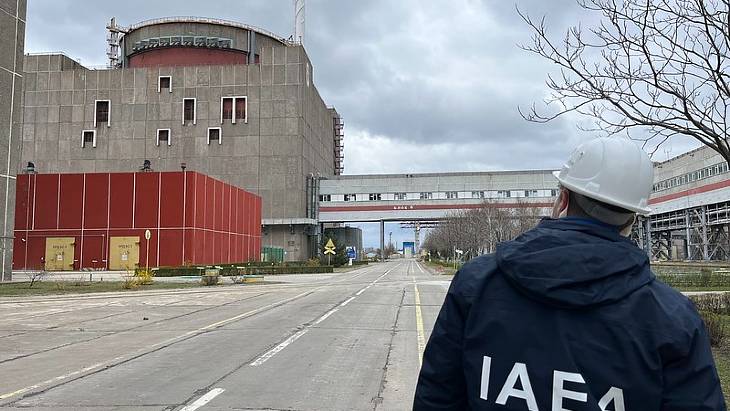
IAEA experts have been stationed at Zaporizhzhia since September 2022 (Image: IAEA)

In its latest update on the situation, the International Atomic Energy Agency (IAEA) said that the six-unit Zaporizhzhia plant, which has been under Russian military control since early March 2022, had to rely on its recently repaired 330 kV backup line for several hours to allow maintenance work on its main power line.

IAEA Director General Rafael Mariano Grossi said: "The ZNPP’s fragility in the face of limited off-site power options is putting constraints on electrical maintenance. It is another indication of the critical importance of robust, diverse and dependable off-site power infrastructure to ensure nuclear safety and security."

Since the war began, the Zaporizhzhia plant has lost access to off-site power 12 times, during which emergency backup diesel generators (EDGs) have had to provide the power required for essential safety functions.

The IAEA also reported that the State Nuclear Regulatory Inspectorate of Ukraine had informed it that "during the night of 11-12 March, attacks targeting and destroying an electrical substation close to the subcritical Neutron Source Installation at the Kharkiv Institute of Physics and Technology resulted in its disconnection from the electrical grid until 13 March. During this outage, the facility relied on EDGs".

IAEA officials at Chernobyl said that the following day, the site was disconnected from its main 750 kV transmission line for nearly 24 hours, with the Ukrainian nuclear regulator saying the cause was an attack on an electrical substation. The "disconnection and subsequent fluctuations in the electrical grid automatically activated the EDGs supplying the New Safe Confinement and Interim Spent Fuel Storage Facility 1. The generators were manually switched off after 15 minutes".

Grossi said: "These episodes underscore how grid instability and the vulnerability of off-site power is affecting nuclear safety and security at Ukraine’s nuclear facilities."