Monday, October 27, 2025


UK Sets £1.08 Billion Offshore Wind Budget In 2030 Push

The UK government will offer an annual £1.08 billion support budget for new offshore wind projects under its next renewable electricity auction, with £900 million dedicated to fixed-bottom developments and another £180 million for floating offshore wind farms to be delivered from 2028, the Independent reported. 

The government said the expanded budget aims to spur investment in clean power capacity as part of its wider ambition to decarbonize the UK’s electricity grid by 2030, cut household bills, and strengthen energy security. Developers will compete in the next round of Contracts for Difference (CfD) auctions to secure fixed prices per megawatt hour for the power they generate.

“Our competitive new auction process will allow us to buy the right amount of clean power at the right price on behalf of the British people, so we can take back control of our energy,” the Independent cited Energy Minister Michael Shanks as saying, adding that the plan represents “another step towards delivering the clean power this country needs to end our reliance on volatile global gas prices, ensuring our energy security and bringing down bills for good.”

According to Pranav Menon, senior researcher at Aurora Energy Research, the proposed funding may not be sufficient to achieve the government’s clean power targets. Menon told Bloomberg that if auction prices remain similar to last year’s, the allocation would likely secure around 4.9 GW of new capacity, which is well below the 7-9 GW needed to stay on course for the 2030 goal.

The UK aims to boost its offshore wind power capacity to between 43 GW and 50 GW by 2030, up from roughly 15 GW today. While the total CfD budget has increased from £800 million in 2024, the fixed-bottom portion has narrowed slightly as the government carved out a separate pot for floating projects. Industry analysts note that the move reflects a rebalancing of support rather than a cut.

The offshore wind sector continues to face headwinds from inflation, grid-connection delays, and supply chain constraints. These pressures have forced several major developers, including Ørsted, Shell, and Equinor, to cancel or delay high-profile projects in recent years.

Europe remains the world’s largest offshore wind market, accounting for roughly 92% of global floating wind capacity, while Asia-Pacific is projected to expand the fastest, growing nearly 160% annually through the end of the decade.

Support under the CfD scheme is funded through consumer energy bills rather than general taxation. If wholesale power prices fall below the guaranteed contract price, developers receive a top-up payment; if prices rise above it, the difference is returned to consumers.

While the increased budget marks a stronger push for clean energy, developers warn that persistently high costs and tightening supply chains could still make meeting the UK’s 2030 offshore wind targets an uphill task.

By Charles Kennedy for Oilprice.com


MEANWHILE IN THE U$A


COP30 Climate Summit Could Set Global Sustainable Biofuels Target

Next month’s global climate summit could debate and potentially adopt targets for sustainable biofuel production and use, Francesco La Camera, Director-General at the International Renewable Energy Agency (IRENA), said on Monday.

The COP30 climate summit will be held between November 10 and 21 in Belem, Brazil, which is a global leader in biofuels production and use.

“I think there will be more focus on the social aspect of the transition and also on the sustainable use of biomass,” La Camera said at an energy conference in Singapore on Monday, as carried by Reuters.

The participants in the summit would debate biofuels and potentially include a biofuels target in the final declaration, according to IRENA’s chief. The goal could be boosting biofuels production four times by 2035 or setting a target for sustainable aviation fuel (SAF) share in the global energy mix, La Camera said. 

Brazil last month launched the Belém Commitment for Sustainable Fuels—known as Belém 4x—an initiative aimed at building high-level political support for the global goal of quadrupling the production and use of sustainable fuels by 2035.

Last month, IRENA and the International Civil Aviation Organization (ICAO) launched a financing initiative to support SAF and clean aviation energy projects globally.

The push toward increased biofuel production and use comes amid major oil firms ditching biofuel projects. Shell last month abandoned plans to proceed with the construction of a biofuels facility at its Shell Energy and Chemicals Park in Rotterdam, amid challenging market conditions that makes the project uncompetitive.

BP also cancelled plans for a major biofuels facility at its Rotterdam refinery, scoring another setback for Europe’s drive to scale advanced biofuels.

Earlier this month, IRENA, the COP30 Brazilian Presidency, and the Global Renewables Alliance (GRA) said in a report that the world is falling behind on its renewable energy and efficiency goals despite record progress last year.

The global progress report flagged bottlenecks in investment, grids, and supply chains, and urged governments for bolder renewable targets before COP30.

By Charles Kennedy for Oilprice.com

The U.S. LNG Boom Could Make Energy More Expensive for Americans

  • U.S. LNG export capacity is set to double by 2029, diverting more gas from domestic markets to higher-paying foreign buyers.

  • Rising demand from power plants, manufacturers, and households is tightening supply and pushing prices upward.

  • Analysts warn that if production plateaus, America could face a domestic energy crunch—and possible political backlash over exports.

The noticeable upward tilt in graphs of the U.S. natural gas price since April 2024 is likely a hint of things to come for U.S. consumers of energy. That's because record amounts of U.S. natural gas are now being sent abroad in the form of liquefied natural gas (LNG). And much more export capacity is planned. The U.S. Energy Information Administration forecasts that U.S. LNG export capacity will double by 2029. That's all gas that cannot be delivered to American users.

I have written about these trends (see hereherehere and here) and predicted they would mean considerably higher heating and electricity costs for Americans and much higher costs for American-based chemical manufacturers; for industries that rely on natural gas for process heat in the manufacture of steel and other metals, concrete, and glass; and for farmers who use natural gas to dry crops.

There's been a lot of talk about U.S. "energy dominance" by which the current administration means policies that maximize production, maximize exports, and yet somehow "reduce energy costs" at the same time. It's the "reduce energy costs" part that is now running into trouble.

A central cause of rising U.S. natural gas consumption (and ultimately prices) is the vast expansion of natural gas-fired power plants by American utility companies. From 2001 through 2024 electricity generated by natural gas has almost tripled while coal-generated electricity has declined dramatically and nuclear and hydroelectric generation have plateaued.  Renewables (not including hydroelectric) grew 10-fold in that period, now nearly matching nuclear in percentage terms, nuclear at 18 percent and renewables at 17 percent. But, today natural gas is by far the leading fuel for electricity generation in the United States providing 43 percent of the country's electricity.

Cheap natural gas provided by the so-called "shale revolution" in the United States that began in the late 2000s has also prompted considerable expansion of the chemical industry which uses natural gas to make agricultural chemicals (especially fertilizers), methanol, and chemicals such as ethylene and propylene used to produce plastics.Related: Heat Pumps Face Their Toughest Test Yet

And, of course, Americans continue to use copious amounts of natural gas to heat their homes and businesses.

All that rising consumption spells trouble for American consumers when it comes to energy costs. The natural gas industry has been telling the public that domestic natural gas production will continue to rise dramatically through mid-century. But independent analysis based on the actual performance of gas wells suggests that production will plateau and then decline in the not-too-distant future. That would produce a double squeeze on natural gas supplies as LNG exports continue rise in the face of falling domestic natural gas production leaving less for U.S. natural gas consumers.

When the natural gas industry sold the story of endless abundance in order to get the U.S. Department of Energy to allow expansion of natural gas exports, it knew that such a move would increasingly link U.S. domestic prices to the much higher global prices. In fairness, the industry was simply asking for what had been granted to almost all other American industries, namely, the right to sell products to the highest bidders no matter where they may be.

In an age of increasing focus on the importance of domestic production of strategic resources, the U.S. government may yet come to regret its decision to commit so much of America's natural gas resources to other countries. Will there come a day when the anger of American consumers over high energy costs due to rising natural gas prices causes the government to force LNG exporters to abrogate their export contracts and keep that gas in America for consumption by American households and American businesses? The clock is now ticking.

By Kurt Cobb via Resource Insights


TotalEnergies’ $20 Billion Mozambique LNG Project Back on Track

TotalEnergies and its partners are close to restarting construction and engineering work on the huge $20-billion LNG export facility in Mozambique after the companies lifted the four-year-long force majeure on the project. 

The French supermajor and its joint venture partners lifted the force majeure in a notice sent to the government of Mozambique on Friday, a press officer for TotalEnergies has told Reuters.

The restart of the project hinges on Mozambican government approval and an updated budget and schedule.  

“Before fully relaunching the project, Mozambique's council of ministers needs to approve an addendum to the plan of development,” TotalEnergies press office said. 

The $20-billion LNG export project in Mozambique led by French supermajor TotalEnergies was halted four years ago due to a deteriorated security situation. The project site is close to the town of Palma in the Cabo Delgado province, where Islamic State-affiliated militants have been active for years.  

In the spring of 2021, following Islamist militant attacks in towns close to the site, TotalEnergies declared force majeure and suspended works on the project, which was Africa’s largest foreign investment when announced.  

Since 2021, TotalEnergies has waited for several conditions to be met to take a positive decision on resuming work on the project. The goal to achieve first LNG production has slipped, first to 2027, and later, to 2029. 

Initially, works on the Mozambique LNG project were set to restart by the end of 2024.  

But plans slipped amid a disputed presidential election in Mozambique at the end of 2024, continued violence, and concerns about the security situation. 

It appears that the project is now nearing restart.  

However, the four years of hiatus and delays have likely hiked the costs of the Mozambique LNG project by as much as $4 billion, India’s Bharat Petroleum, a minority shareholder in the project, estimated last year.  

By Michael Kern for Oilprice.com

Satellite Data Reveals Surge in Oil and Gas Methane Emissions

  • Regional differences are stark, with China's emissions surging by nearly one-third, the US seeing a 4% rise, and Russia experiencing a 5% drop due to lower production volumes; aging infrastructure in Central Asian and North African countries also contributes significantly to methane footprints.

  • Despite policy uncertainties and rollbacks in some regions, methane reduction has become a top priority for producers due to its high warming potential, with countries like India stepping up management efforts, while seasonal patterns and detection factors influence measured emissions.

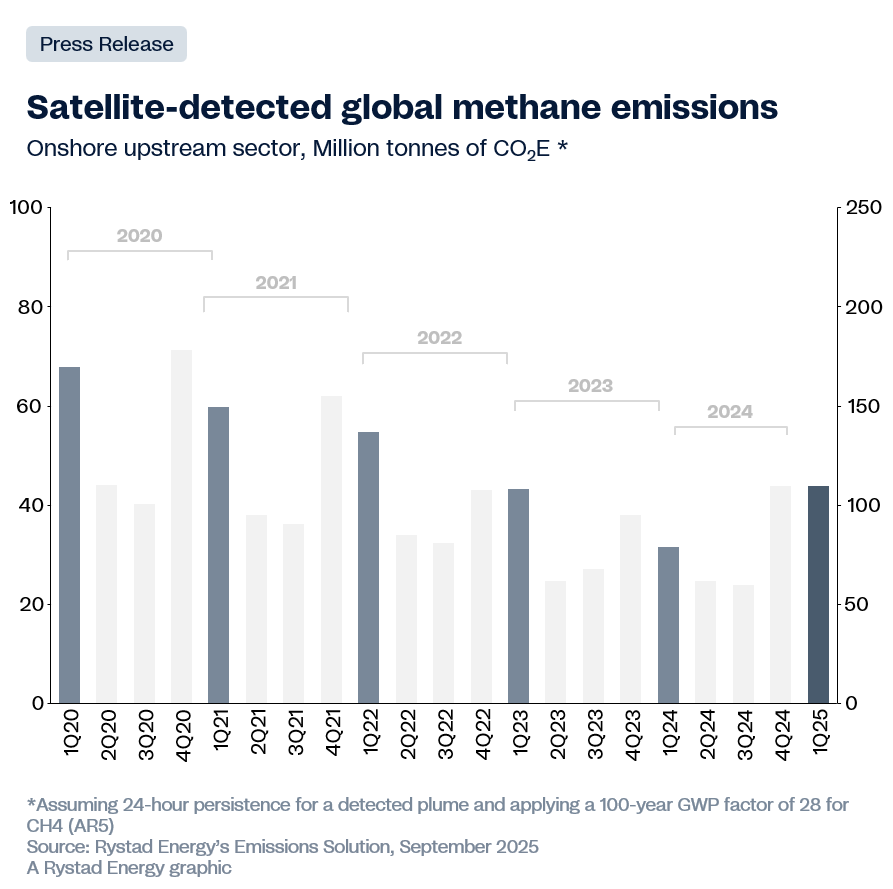
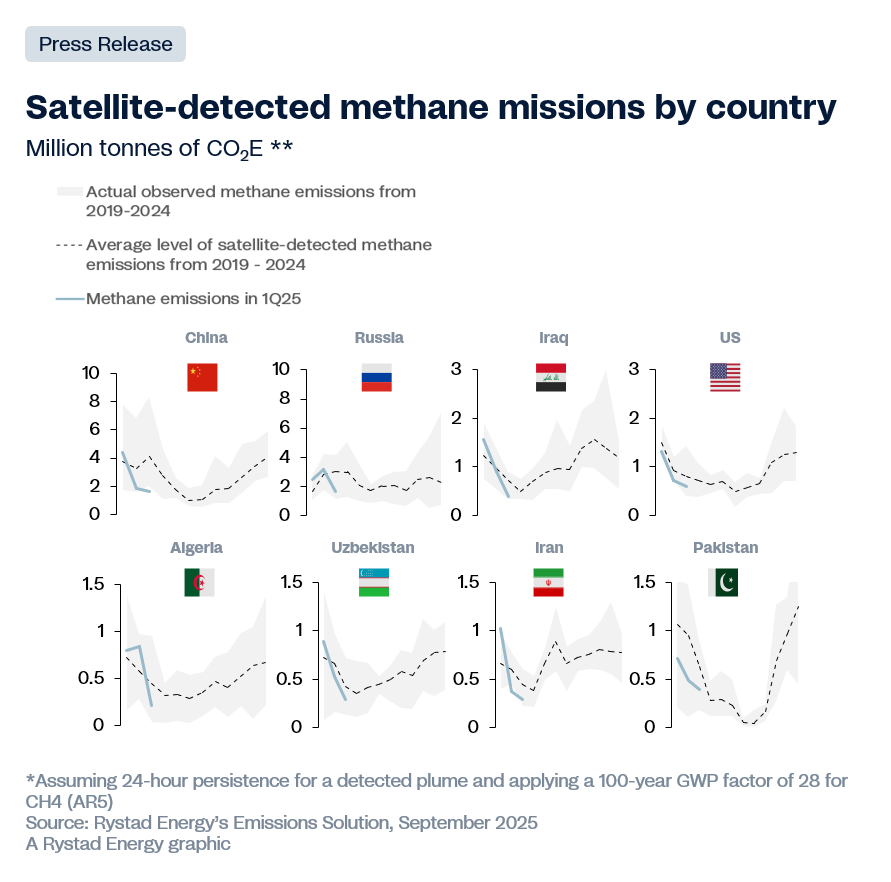
Global satellite-detected methane emissions from the onshore upstream oil and gas sector ticked up late last year and into the first quarter of 2025, reversing a steady decline since 2020. Rystad Energy analysis, supported by satellite detection, highlights stark regional differences: China’s emissions surged nearly one-third year on year, while the US recorded a smaller rise of 4%. Russia, on the other hand, posted a 5% drop in the first quarter, largely due to the ongoing Russia-Ukraine conflict leading to lower production volumes.

Detected methane plumes – clouds of concentrated methane (CH?) gas released into the atmosphere – revealed variations in emission density and rate for different regions. Roughly 45,000 plumes were detected in the first quarter of 2025, increasing by 14,000 from the same quarter in 2024. These plumes carried a combined carbon footprint of about 45 million tonnes of carbon dioxide equivalent (CO?e) – a 40% increase year on year.

A large portion of detected plumes can be seen in areas such as the Middle East, North Africa, China , Russia and North America – and several countries within these regions have high production volumes, which result in low methane intensity despite high absolute methane emissions. Conversely, aging infrastructure at processing facilities, compressor stations and well operations could be contributing a disproportionately high methane footprint in several Central Asian and North African countries relative to their share of global hydrocarbon production.

Upstream oil and gas production is a major source of emissions, responsible for about 20% of all human-caused methane leaks into the atmosphere. The biggest challenge is detection but, once found, most can be fixed, unlike carbon dioxide [CO?], which largely comes from combustion and is harder to avoid. That’s why methane reduction has become a top priority for producers. With a shorter atmospheric lifespan but far greater warming potential than CO?, companies need to shift from long-term strategies to immediate action, making methane abatement a near-term focus. A lot of large leak events are also not found in most exploration and production [E&P] company reporting, which needs to be addressed,

Patrick King, Vice President, Emissions Research, Rystad Energy

Learn more with Rystad Energy’s Emissions Solution.

Rystad Energy’s granularity with data shows that methane emissions follow a seasonal pattern in most countries. These variations likely reflect colder-climate impacts on operations and demand, regional differences and the timing of abatement efforts, but they could also be caused by detection-related factors such as cloud cover, wind, humidity and other atmospheric conditions that affect satellite measurements. China exemplifies this, recording the highest methane emissions from oil and gas production in 2025. Emissions in China typically peak in early winter and dip in summer, closely tracking natural gas production cycles. Despite a 50% increase in gas production since 2018, satellite-detected methane emissions have declined by 30%, indicating improved operational practices. This trend aligns with initiatives by state-owned oil companies China National Petroleum Corporation (CNPC) and Sinopec, which launched methane reduction programs in 2019 and 2020, respectively.

Methane emissions also increased in the West, driven largely by significant plumes over the Bakken shale in January, despite a milder winter than in 2022 and 2023. In the US, methane abatement has been a political priority, with measures such as the Waste Emission Charge finalized under the Biden administration in late 2024. However, the policy applied only to reported emissions, not those detected by satellites, and it was overturned in February 2025.

As the US shale industry has matured, the environmental impact of consolidation in 2023 and 2024 will be closely monitored. Large public E&P companies have expanded the scope of abatement programs, but their future under the Trump administration remains uncertain – especially with the movements to remove the US Environmental Protection Agency’s Greenhouse Gas Reporting Program. Rystad Energy expects minimal impact from new flaring restrictions.

Despite the limited scope of federal abatement policies and the likelihood of policy rollbacks, the US shale industry is expected to keep reducing its emissions intensity, building on the notable improvements achieved in 2023. Preliminary 2024 data from the Lower 48 supports this outlook, with methane emissions predicted to remain stable compared to 2023, even as production grows further.

Global figures point to an increase in the first quarter of 2025, but certain nations have continued the downward trend observed in previous years. Iraq, for example, has steadily reduced methane emissions year-on-year since 2019, during a period when oil production declined and gas output increased. However, in the first quarter of this year, emissions surged nearly 50% compared to the same period in the previous year – a rise likely linked to activity in the Zagros Foldbelt Basin in the Middle East, including flaring and production ramp-up.

In South and Central Asia, India, Uzbekistan and Pakistan all recorded declines in methane emissions between 2022 and 2024. After hitting record lows last year, emissions in the first quarter of 2025 rebounded closer to early 2023 levels. In Uzbekistan, the startup of the Tolibtepa gas field in 2023 contributed to higher emissions amid increased production. In India and Pakistan, methane levels show strong seasonal patterns, with almost no plumes detected during the summer months – a trend largely independent of production. India is also stepping up its focus on methane management, with plans underway for a National Inventory Management System, signaling a move toward more comprehensive and systematic tracking of greenhouse gas emissions.

By Rystad Energy


Geopolitical Tensions Drive U.S. Investment in Australian Rare Earths

  • The United States is actively shifting its critical mineral sourcing strategy, with Australia becoming a key partner, as evidenced by the US Export-Import Bank's commitment of up to $200 million for VHM's Goschen Rare Earths and Mineral Sands Project in Victoria.

  • This investment is part of Washington's "Supply Chain Resiliency Initiative," aimed at reducing reliance on China, which currently dominates over 80% of global rare earth processing, and follows a similar investment in Sunrise Energy Metals' scandium project.

  • The Goschen project, with its substantial rare earth oxide reserves and valuable mineral sands, is strategically important for industries like electric vehicles and defense systems, and these investments are seen as a geopolitical move to secure long-term supply from trusted allies like Australia.

While geopolitical tensions continue and rare earths supply chain vulnerabilities deepen, the United States is quietly redrawing the global map of critical mineral sourcing, and Australia seems to be emerging as a cornerstone. The latest development on this front is the U.S. Export-Import Bank (EXIM) issuing a letter of interest to fund up to US $200 million for VHM’s Goschen Rare Earths and Mineral Sands Project in Victoria.

This follows a similar move in September of this year, when EXIM backed US $67 million for Sunrise Energy Metals’ scandium project in New South Wales. Both projects are now part of Washington’s “Supply Chain Resiliency Initiative,” which sources say is designed to reduce dependence on China. The latter country currently dominates over 80% of global rare earth processing.

A New Strategic Rare Earths Asset

The Goschen Rare Earths and Mineral Sands Project, developed by VHM Limited in northwest Victoria, is rapidly emerging as a strategic asset in the global race to secure critical minerals. 

With over 413,000 tons of total rare earth oxide and a proven ore reserve of 199 million tons, Goschen is designed to supply both light and heavy rare earths. Alongside valuable mineral sands like zircon and rutile, these are essential for electric vehicles, defense systems and clean energy technologies.

The project has already cleared major regulatory hurdles, including environmental approvals and a mining license, and is positioned within a Tier 1 jurisdiction with robust infrastructure and logistics. Analysts note that its scalable design and dual revenue streams make it one of the most commercially and geopolitically attractive rare earth ventures outside of China.

One of Several Globally Significant Moves

VHM CEO Andrew King called EXIM’s decision a globally significant move to resolve current supply chain vulnerabilities. And it is not the only such endeavor. In September, the EXIM bank had issued a similar LoI to finance Sunrise Energy Metals’ Syerston scandium project, marking another strategic move to secure critical mineral supply chains outside China.

The funding would cover nearly half of the project’s development capital, pending the completion of a feasibility study, which is expected by late October. That analysis will incorporate updated ore reserve estimates as well as an optimized mine plan.

Part of a Strategic Realignment

Many experts following the rare earths sector believe these types of investments aren’t just financial, but geopolitical. By securing long-term supply from Australia, the U.S. is executing a “friend-shoring” strategy, rerouting critical inputs through trusted allies. 

For the U.S., the supply of critical rare earths has recently become a matter of even greater concern. In April 2025, Beijing imposed export controls on several rare earth elements, effectively weaponizing its mineral dominance amid rising global tensions. American industries, from aerospace to semiconductors, depend on rare earths for magnets, batteries and precision components.

Now it seems the U.S. has found a strategic way to bypass China by using financing as foreign policy. By offering 12–15 year repayment terms and streamlining approvals via the Single Point of Entry framework with Australia, the U.S. is accelerating project viability and locking in future supply as part of its Supply Chain Resiliency Initiative.

A final investment decision on Goschen and Syerston is expected within months. When that happens, these projects will become part of America’s overall industrial policy. There could also be more U.S.-backed Australian lithium, cobalt and other rare earth projects in the future. 

Meanwhile, in Greenland

In addition to Australia, the U.S. has intensified its interest in Greenland’s rare earth reserves. For instance, the Tanbreez deposit is particularly valuable because it contains a high proportion of heavy rare earth elements, which are more scarce and critical for high-performance applications.

However, Greenland’s geopolitical significance adds another layer to this endeavor. As a semi-autonomous territory of Denmark located in the Arctic, it offers both resource potential and strategic positioning.

By Sohrab Darabshaw


Rare earth producers look to US-led boom to blunt China’s power


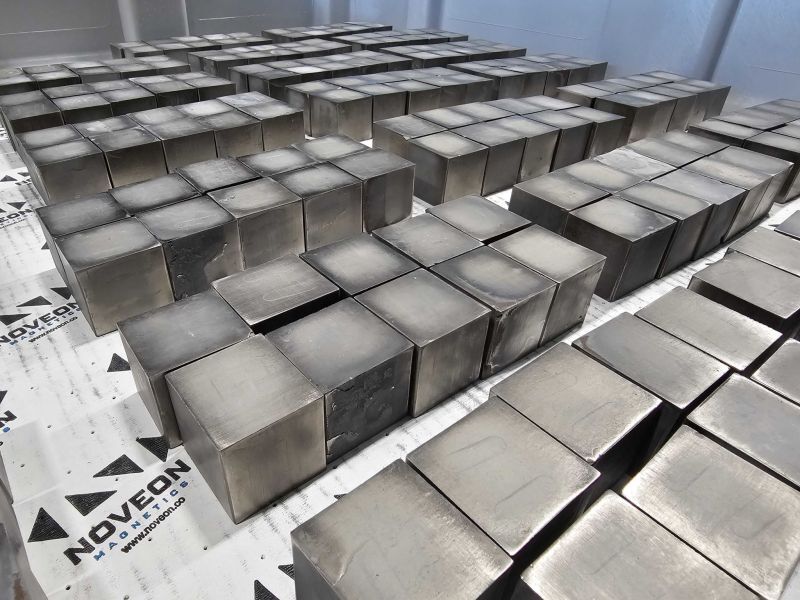
A Noveon Magnetics Inc. plant in Texas is at the vanguard of efforts to expand US supplies of the tiny but vital industrial components at the heart of a global trade showdown.

The company’s first facility, less than an hour from Austin, began selling rare-earth magnets commercially in 2023, after a decade of development. The operation is modest, but its ramp-up is emblematic of the shift taking place as the West scrambles to catch up with China’s vast rare-earths industry. After the Asian nation announced export controls earlier this year, Scott Dunn, Noveon’s co-founder, found himself inundated with calls.

“Not only were we being asked to do what we had planned, we were asked to increase those volumes for what was planned by multiples,” said Dunn, whose company has inked deals with customers from carmaker General Motors Co. to automation company ABB Ltd.

China, which produces the bulk of rare earths globally, unveiled supply curbs in April in response to a barrage of tariffs imposed by Washington. It outlined plans to expand the curbs this month, including by requiring overseas shippers of items that contain even small amounts of certain rare earths to have an export license. The fate of those measures remains unclear after US Treasury Secretary Scott Bessent said he expects China to offer a deferral of its curbs to seal a trade deal. President Donald Trump and his counterpart Xi Jinping are set to meet for trade talks later this week, and rare earths will be on the agenda.

Whatever happens, industry is betting the world won’t want to go back to one supplier. Conversations with more than a dozen rare earth executives and industry veterans describe a commercial landscape that is nascent but rapidly transforming as investor interest surges and governments — especially the US — launch more meaningful efforts to build a non-China supply chain.

Critical minerals consultancy Adamas Intelligence says that on paper, a wave of US magnet facilities underway could bring capacity high enough to offset imports by 2028. That requires everything to go to plan and operate at full tilt, and it won’t be a lasting fix as demand overtakes supply growth.

Still, it begins to suggest a path toward a meaningful and viable industry — even if it that goal is distant, thanks to the years it takes to build up mines, the expertise and technology required to produce magnets, and China’s decades-long lead.

“This year has been exhilarating, daunting, stressful, exciting, all of the adjectives,” James Litinsky, chief executive officer of MP Materials Corp., said in an interview.

MP operates the sole American rare earths mine. It received a landmark $400 million investment from the Pentagon in July, helping the company fund a new magnets plant in a deal that came with guaranteed purchases at minimum prices and effectively creating a national champion.

Government support was dialed up a notch this month, when Washington and Canberra agreed to jointly invest in Australian mines and processing projects. Both countries also pledged using trade measures like floor prices to help ward off competition.

Those deals signal a change in approach, with the rise of meaningful state support and intervention. Rare earth stocks globally have roared higher in response, sometimes to valuation levels that imply dramatic and almost improbable growth.

“To attract investors you need to do two things — to increase returns, but also to decrease risk,” said Nick Myers, chief executive officer of Phoenix Tailings, a rare earths refiner. “By saying another group like the US government is there with big dollars, that de-risks the space significantly.”

All of this is reminiscent of China’s playbook, said Ryan Castilloux, Adamas’s managing director. The country’s rare earths industry is highly regulated and state-dominated. Beijing has long supported strategic enterprises, either directly or through indirect means like inexpensive loans or a helping hand with permits, a far cry from the West’s economically driven approach.

“This moment creates discomfort for some, but I think it’s hard to argue that the alternative approach was bearing fruit,” he said. “Something new was needed.”

Rare earths, a group with obscure names like neodymium and samarium, are predominantly used to make super-strong, heat-resistant magnets. The governments’ interest stems from the sheer number of products that rely on them, from smartphones and vacuum cleaners to fighter jets.

Late last month, at the sector’s biggest gathering since China’s trade restrictions began, a canine-like robot called Spot — made by Boston Dynamics Inc. — posed and shook “paws” with attendees during a coffee break. That followed a speech by a former Canadian fighter pilot now running drone manufacturer Horizon Aircraft.

Magnets are essential in such industries because of the power they can deliver relative to their size and weight. In robots, magnets embedded in compact motors allow for precision and versatile movements; in missiles or drones, they’re essential in fine-caliber steering for a direct hit.

The industry has been on edge, waiting for more policy measures.

“I talk to folks in the administration frequently enough to know that a copy-and-paste of the MP deal is probably not going to happen,” Abigail Hunter, executive director of the SAFE Center for Critical Minerals Strategy, told the Rare Earth Mines, Magnets and Motors conference in Toronto. “But the important thing is the interest to meet the market and the companies with their specific challenges, to make sure that they’re sufficiently insulated and ultimately able to survive.”

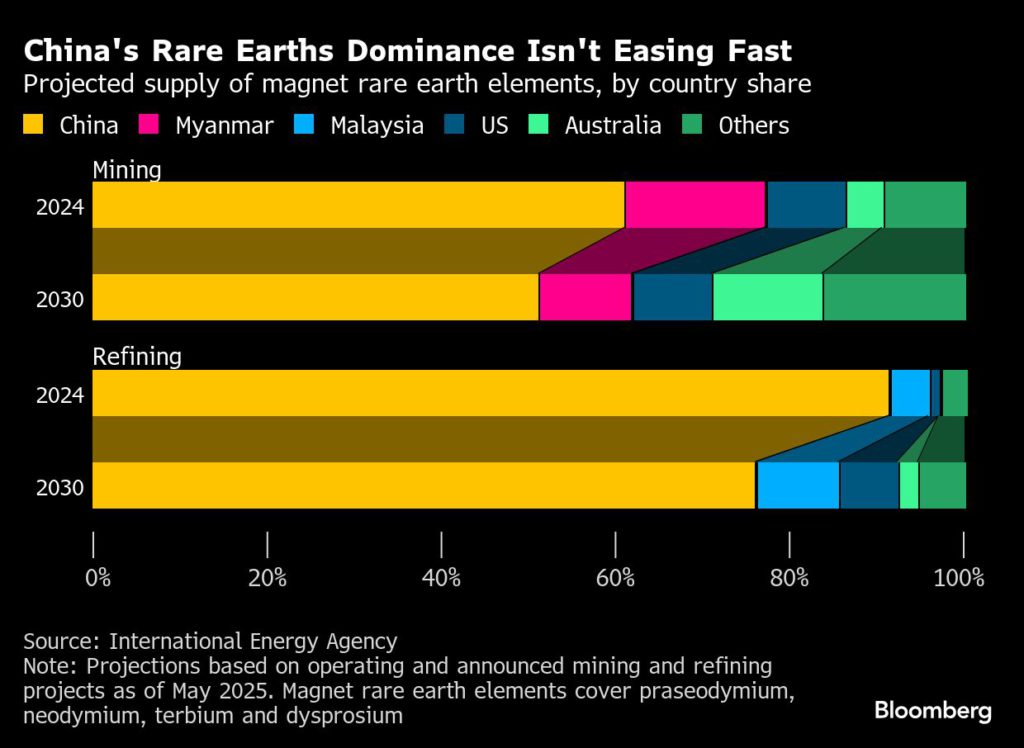
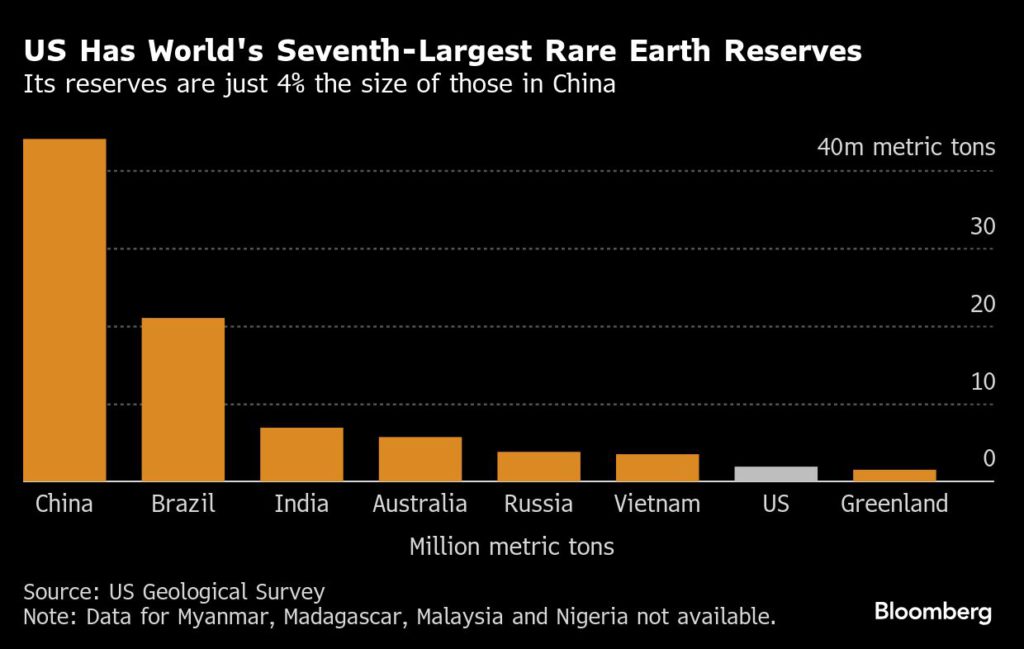
The question is how much the West can really do, and how fast. China is home to half the world’s rare earth reserves and much of its refining capacity. The Asian nation began scaling up in the 1980s and now sells more than 90% of all rare earth magnets.

Previous crises, like China’s 2010 embargo of exports to Japan, triggered a wave of global enthusiasm but did not ultimately crack Beijing’s dominance. Building a new mine can take eight to 10 years, and refineries about five, Goldman Sachs Group Inc. analysts said in a note.

Today, the sector is far smaller than almost any industrial metal — with production worth about $6.5 billion in 2024, according to Goldman, 33 times smaller than the copper market. The trade is also opaque and illiquid, curbing miners’ ability to hedge against price volatility.

Still, supply disruptions have immediate and far-reaching impact. Following China’s initial curbs in April, Ford Motor Co. temporarily shut a Chicago factory after running short of rare earth components, and assembly of Tesla Inc.’s Optimus humanoid robot was also hit. The European Union’s Chamber of Commerce in China said shortages caused seven production stoppages at companies in the bloc in August, and more are expected.

Even with the palpable enthusiasm in the corridors of the Toronto gathering, there’s no guarantee that planned American and other non-China plants underway will all be built on time — or able to deliver against wide-ranging customer requirements, given the complex processes involved in rare earth magnets.

“There’s not a cookbook for magnet production,” said David S. Abraham, a professor at Boise State University. “There’s time needed to ensure the product you are selling to customers meets their exact specifications.”

Noveon recently signed an accord with Australia’s Lynas Rare Earths Ltd. to collaborate on sourcing light and heavy rare earths and supply magnets for the US defense and commercial sectors. This year, the flood of inquiries the company received left it turning down more than it could pick up. Across the industry, Dunn acknowledged, installed capacity doesn’t equate to immediate capability.

“You’re dealing with requirements that are the result, in some cases, of decades of what China has delivered,” he said.

Sourcing so-called heavy rare earths, many of which were hit in the April restrictions, is another hindrance to further expansion. The metals are used as additives in magnetic materials to ensure performance even at high temperatures, but most come from China, or conflict-ridden parts of neighboring Myanmar, and are refined there.

Ultimately, it’s unclear if customers will be willing to bear the expense. Measures like floor prices for producers, intended to incubate the industry as it emerges, come at a cost for consumers. While some may in theory accept that as a hedge against geopolitical risk, government goals do not always align with those of purchasing managers. Several industry veterans said China would ultimately continue to dominate given its technical expertise, low costs and depth of supply offerings.

Still, entrepreneurs are jumping at the opportunity to promote alternatives to China.

In the US, a string of magnet facilities are in progress, including from USA Rare Earth Inc., Vulcan Elements Inc., Germany’s Vacuumschmelze GmbH & Co. KG, and South Korea’s JS Link Inc.

Others are working to reuse what is already out there. Cyclic Materials Inc., whose backers include Amazon.com Inc. and Microsoft Corp., aims to start producing magnet materials at a Canadian recycling facility next year.

At the Toronto event, a series of panels showcased companies developing projects from Africa to Australia. Adamas sees global use for rare earth magnets growing at 9% per annum over the next 10 years. Total US demand by 2033 will be five times today’s level, and demand in Europe will more than double.

By using the long-threatened critical mineral weapon once again in advance of this week’s talks, China has undoubtedly encouraged production outside its borders, and even collaboration. Trump is looking to sign critical minerals deals with trading partners during his trip to Asia, and that is unlikely to change even if a trade agreement is reached between Washington and Beijing.

At Noveon in Texas, Dunn is working to build magnet production up to the plant’s current annual capacity of 2,000 tons. There’s a burden on the many aspiring players outside China — and across all parts of the supply chain— to prove they can deliver, he said.

Customers want to know “that there is some sort of visibility and certainty and stability that they can pin their near-term future on,” he said.