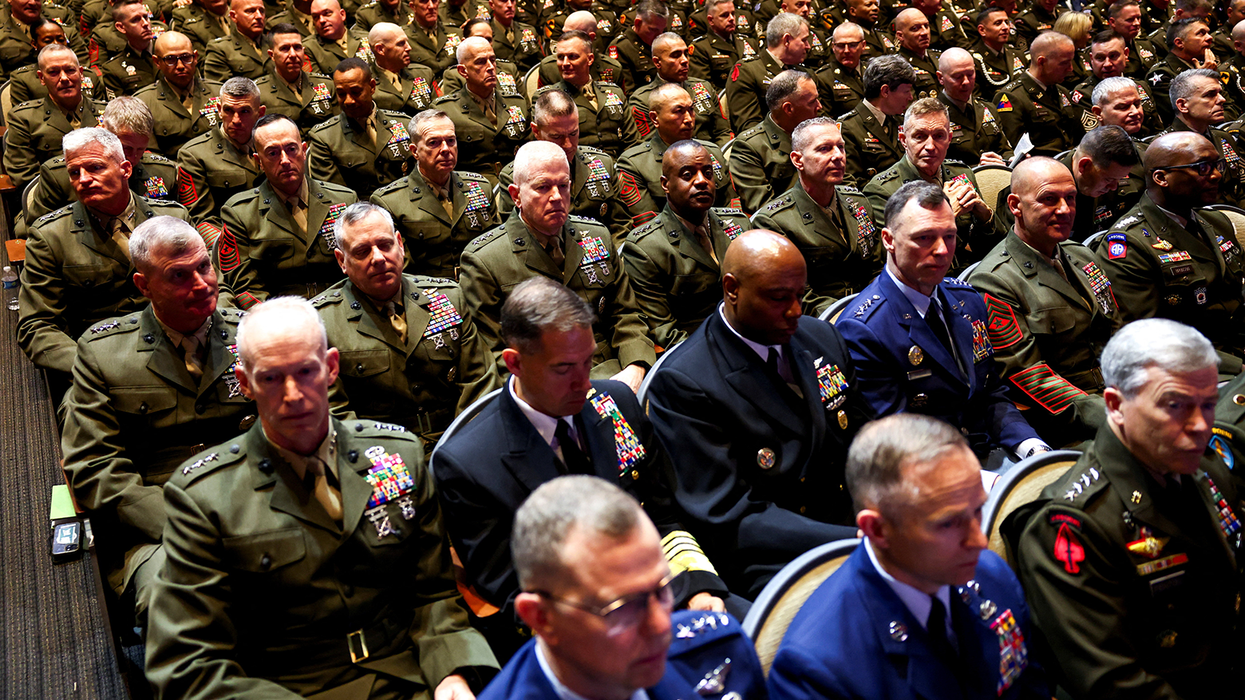
Members of the military wait for the U.S. President Donald Trump speech, as they attend a meeting convened by U.S. Defense Secretary Pete Hegseth, at Marine Corps Base Quantico, in Quantico, Virginia, U.S., September 30, 2025. REUTERS/Kevin Lamarque
March 09, 2026
ALTERNET
President Donald Trump’s “cavalier approach” to the Iran war is “recklessly endangering hundreds of thousands of Americans in the Middle East.”
That’s the opinion of two veteran Middle East hands revealed in a New York Times opinion piece. Jeffrey Feltman was the U.S. ambassador to Lebanon from 2004 to 2008, while Mara Karlin served as the Levant director for the Pentagon in 2006 and 2007.
They believe Trump’s inaction at the start of the Iran conflict is contradicting a key piece of his State of the Union message, wherein he opined, “the first duty of the American government is to protect American citizens.”
His conduct since then has put many in danger, Feltman and Karlin contend.
The Trump administration, despite weeks of war talk, did not give sufficient warning to its embassies so that preparations for evacuation could be made, the authors claim. Such a lack of care is “bewildering."
Instead of clear-eyed instructions, there was “disarray and confusion” when the Iran attacks began, leaving U.S. diplomats and their families — not to mention American civilians — on their own.
It was not hard to foresee, the authors contend, that Iran would retaliate against the Gulf states, Israel and soft targets like airports and hotels.
Even when evacuation orders finally arrived, they were lacking in details on how or even whether the U.S. would assist in evacuations. As for allies in the region, the U.S. provided “minimal” information to help them could protect their citizens. American civilians in the Middle East did not even receive that, they claim.
At the same time, the authors argue it seems clear the United States was not expecting the scale of the Iranian response, one that has largely shut down air travel across the region and targeted sites in the United Arab Emirates, Bahrain and Qatar, among other countries.
The authors pointed to their own experience with a crisis in the Middle East as an example of the way things were done in a prior administration.
In 2006, they were the U.S.ambassador in Lebanon and the Pentagon’s Levant director when Lebanon’s Hezbollah organization went to war against Israel. “We responded quickly, organizing what was then the largest noncombatant evacuation of Americans in U.S. history," they explained.
Such actions “were daunting,” but things moved quickly. The State Department, Pentagon and three military commands worked on evacuations, and consular officers activated a communications network. There was also coordination with Israel on evacuation routes. All told, nearly 15,000 American citizens were moved to safety, the authors claim.
That can-do activity is in sharp contrast to now. “The U.S. Embassy in Beirut is one of several in the region that have simply closed their doors, suspending consular operations at a time they are most needed," the authors said. It was three days after the Iran war started that the Trump administration urged American citizens to evacuate, all on their own using commercial transport that was “mostly unavailable.”
“So much of this was avoidable,” the authors explained, adding that such negligence appears “willful, perhaps intentional, ignorance.” Granted, many more people needed to be evacuated from the Iran conflict than during the Lebanon crisis. “But that makes the lack of planning even more bewildering," they noted.
The authors concluded with a callback to the State of the Union, which now appears to ring hollow. “When the administration began planning this war, it should have also planned to protect Americans — the ‘first duty of the American government,’ as the president said.”
That’s the opinion of two veteran Middle East hands revealed in a New York Times opinion piece. Jeffrey Feltman was the U.S. ambassador to Lebanon from 2004 to 2008, while Mara Karlin served as the Levant director for the Pentagon in 2006 and 2007.
They believe Trump’s inaction at the start of the Iran conflict is contradicting a key piece of his State of the Union message, wherein he opined, “the first duty of the American government is to protect American citizens.”
His conduct since then has put many in danger, Feltman and Karlin contend.
The Trump administration, despite weeks of war talk, did not give sufficient warning to its embassies so that preparations for evacuation could be made, the authors claim. Such a lack of care is “bewildering."
Instead of clear-eyed instructions, there was “disarray and confusion” when the Iran attacks began, leaving U.S. diplomats and their families — not to mention American civilians — on their own.
It was not hard to foresee, the authors contend, that Iran would retaliate against the Gulf states, Israel and soft targets like airports and hotels.
Even when evacuation orders finally arrived, they were lacking in details on how or even whether the U.S. would assist in evacuations. As for allies in the region, the U.S. provided “minimal” information to help them could protect their citizens. American civilians in the Middle East did not even receive that, they claim.
At the same time, the authors argue it seems clear the United States was not expecting the scale of the Iranian response, one that has largely shut down air travel across the region and targeted sites in the United Arab Emirates, Bahrain and Qatar, among other countries.
The authors pointed to their own experience with a crisis in the Middle East as an example of the way things were done in a prior administration.
In 2006, they were the U.S.ambassador in Lebanon and the Pentagon’s Levant director when Lebanon’s Hezbollah organization went to war against Israel. “We responded quickly, organizing what was then the largest noncombatant evacuation of Americans in U.S. history," they explained.
Such actions “were daunting,” but things moved quickly. The State Department, Pentagon and three military commands worked on evacuations, and consular officers activated a communications network. There was also coordination with Israel on evacuation routes. All told, nearly 15,000 American citizens were moved to safety, the authors claim.
That can-do activity is in sharp contrast to now. “The U.S. Embassy in Beirut is one of several in the region that have simply closed their doors, suspending consular operations at a time they are most needed," the authors said. It was three days after the Iran war started that the Trump administration urged American citizens to evacuate, all on their own using commercial transport that was “mostly unavailable.”
“So much of this was avoidable,” the authors explained, adding that such negligence appears “willful, perhaps intentional, ignorance.” Granted, many more people needed to be evacuated from the Iran conflict than during the Lebanon crisis. “But that makes the lack of planning even more bewildering," they noted.
The authors concluded with a callback to the State of the Union, which now appears to ring hollow. “When the administration began planning this war, it should have also planned to protect Americans — the ‘first duty of the American government,’ as the president said.”
'Draft-dodger' Trump fails 'to learn the most obvious lesson' of war: analysis
Thomas Kika
Donald Trump's handling of the war against Iran has shown that he, a "draft dodger" unfamiliar with "the terrible realities of war," has "failed to learn the most obvious lesson" of modern warfighting, according to a new analysis from The i Paper.
Writing for the outlet on Monday, columnist Ian Birrell argued that the conflict against Iran has shown how "the world's most powerful nation has failed to spot that warfare has changed." Despite the overwhelming power and resources wielded by the U.S. military, it has so far failed to bring about a meaningful regime change in the Middle Eastern nation, with the Iranian government withstanding bombardment and digging in its heels against the U.S. and Israel.
"They have responded by choosing [Ayatollah] Ali Khamenei’s son, Mojtaba, as new leader while inflicting death and destruction across their region with swarms of drones and missiles fired into the skies, striking as far afield as Azerbaijan and Cyprus while killing US troops and Israeli civilians," Birrell wrote. "The surviving remnants of the regime – despite relentless bombardment – have managed to launch more than 2,000 drones along with hundreds of missiles against at least 10 countries allied to their attackers. These have hit military bases, communication hubs, data centres, diplomatic buildings, energy infrastructure and even tourist facilities to set nerves jangling far beyond the theatre of war."
This resilience on the part of the Iranian government and military, Birrell argued, reflects the new reality of war in the 21st Century, where cheaper hardware has empowered smaller nations to hold their own against aggression from more powerful adversaries. This might have been clear to Trump — who was famously accused of fabricating a medical condition to avoid being drafted during the Vietnam War — if he had learned the major lessons of Russia's invasion of Ukraine.
"The world’s most powerful nation, with its formidable armed forces, deep-rooted intelligence, massive spending and unrivaled technology, has failed to learn the most obvious lesson of the Ukrainian war: that cheap, mass-produced drones have changed warfare by enabling weaker nations to resist stronger forces with attritional tactics," Birrell argued. "As a result the US – locked in the traditional mindset of military power – has burned at an alarming rate through its costly, limited stocks of advanced anti-aircraft weaponry to thwart these waves of Iranian drones."
While Iran has made do with its cheaper supply of drones, the U.S. has burned through over $2.5 billion worth of high-end munitions so far. Despite Trump's claim that the country has a "virtually unlimited supply" of this critical hardware, he has reportedly pressed defense contractors to ramp up production while his administration, as it so often does, has pinned the blame on Joe Biden for his support of Ukraine.
"Instead of its usual insults, the White House would have been wiser to seek Kyiv’s help since it is at the cutting edge of drone warfare in both attack and defense," Birrell suggested. "The country, fighting for survival, has become a world-leading innovator in the use of artificial intelligence, cheap interceptor drones, lasers, listening devices and even military procurement to rapidly develop methods to destroy Moscow’s airborne onslaught."
Thomas Kika
March 09, 2026
ALTERNET
Donald Trump's handling of the war against Iran has shown that he, a "draft dodger" unfamiliar with "the terrible realities of war," has "failed to learn the most obvious lesson" of modern warfighting, according to a new analysis from The i Paper.
Writing for the outlet on Monday, columnist Ian Birrell argued that the conflict against Iran has shown how "the world's most powerful nation has failed to spot that warfare has changed." Despite the overwhelming power and resources wielded by the U.S. military, it has so far failed to bring about a meaningful regime change in the Middle Eastern nation, with the Iranian government withstanding bombardment and digging in its heels against the U.S. and Israel.
"They have responded by choosing [Ayatollah] Ali Khamenei’s son, Mojtaba, as new leader while inflicting death and destruction across their region with swarms of drones and missiles fired into the skies, striking as far afield as Azerbaijan and Cyprus while killing US troops and Israeli civilians," Birrell wrote. "The surviving remnants of the regime – despite relentless bombardment – have managed to launch more than 2,000 drones along with hundreds of missiles against at least 10 countries allied to their attackers. These have hit military bases, communication hubs, data centres, diplomatic buildings, energy infrastructure and even tourist facilities to set nerves jangling far beyond the theatre of war."
This resilience on the part of the Iranian government and military, Birrell argued, reflects the new reality of war in the 21st Century, where cheaper hardware has empowered smaller nations to hold their own against aggression from more powerful adversaries. This might have been clear to Trump — who was famously accused of fabricating a medical condition to avoid being drafted during the Vietnam War — if he had learned the major lessons of Russia's invasion of Ukraine.
"The world’s most powerful nation, with its formidable armed forces, deep-rooted intelligence, massive spending and unrivaled technology, has failed to learn the most obvious lesson of the Ukrainian war: that cheap, mass-produced drones have changed warfare by enabling weaker nations to resist stronger forces with attritional tactics," Birrell argued. "As a result the US – locked in the traditional mindset of military power – has burned at an alarming rate through its costly, limited stocks of advanced anti-aircraft weaponry to thwart these waves of Iranian drones."
While Iran has made do with its cheaper supply of drones, the U.S. has burned through over $2.5 billion worth of high-end munitions so far. Despite Trump's claim that the country has a "virtually unlimited supply" of this critical hardware, he has reportedly pressed defense contractors to ramp up production while his administration, as it so often does, has pinned the blame on Joe Biden for his support of Ukraine.
"Instead of its usual insults, the White House would have been wiser to seek Kyiv’s help since it is at the cutting edge of drone warfare in both attack and defense," Birrell suggested. "The country, fighting for survival, has become a world-leading innovator in the use of artificial intelligence, cheap interceptor drones, lasers, listening devices and even military procurement to rapidly develop methods to destroy Moscow’s airborne onslaught."
Trump directly contradicts Pentagon chief on key element of Iran war — again
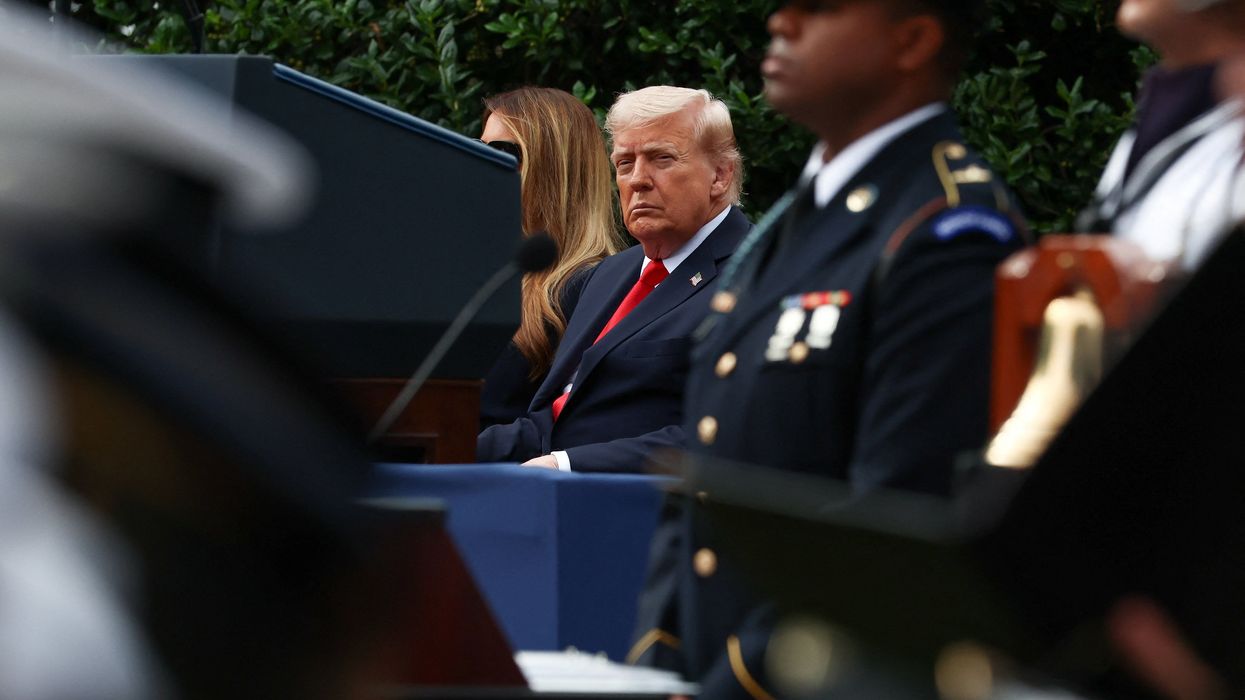
U.S. President Donald Trump and U.S. first lady Melania Trump attend a ceremony marking the 24th anniversary of the September 11, 2001, attacks on the United States at the Pentagon, in Washington D.C., U.S., September 11, 2025. REUTERS/Evelyn Hockstei
President Donald Trump told CBS News on Monday that his war in Iran could be almost over — just after the Pentagon tweeted, “We have Only Just Begun to Fight.”
“In a phone interview, President Trump told me the war could be over soon,” reported CBS’s Weijia Jiang on Monday afternoon, less than one hour after the social media post. “I think the war is very complete, pretty much. They have no navy, no communications, they’ve got no Air Force.”
Trump added that the U.S. is “very far” ahead of his initial 4-5 week estimated time frame,” Jiang added.
The Commander-in-Chief’s prediction also came just days after Secretary of Defense Pete Hegseth told CBS News’ “60 Minutes” that this is “just the beginning” of the war in Iran, as The Washington Post’s John Hudson reported.
Earlier on Monday, the Pentagon posted another Iran tweet: “This is just the beginning—we will not be deterred until the mission is over.”
Discover moreAmerican news digestAnti-extremism training workshops
Human rights documentaries
One week ago, after President Trump specifically alluded to the war in Iran being about regime change, Secretary Hegseth declared it was not.
“Trump repeatedly emphasized regime change was a goal — and possibly even the goal,” CNN reported.
“America is backing you with overwhelming strength and devastating force,” Trump said to the Iranian opposition in the early hours of the war. “Now is the time to seize control of your destiny and to unleash the prosperous and glorious future that is close within your reach. This is the moment for action. Do not let it pass.”
“When we are finished, take over your government,” Trump added. “It will be yours to take.”
Barely days later, Hegseth told reporters, “This is not a so-called regime change war.”
U.S. President Donald Trump and U.S. first lady Melania Trump attend a ceremony marking the 24th anniversary of the September 11, 2001, attacks on the United States at the Pentagon, in Washington D.C., U.S., September 11, 2025. REUTERS/Evelyn Hockstei
March 09, 2026
ALTERNET
President Donald Trump told CBS News on Monday that his war in Iran could be almost over — just after the Pentagon tweeted, “We have Only Just Begun to Fight.”
“In a phone interview, President Trump told me the war could be over soon,” reported CBS’s Weijia Jiang on Monday afternoon, less than one hour after the social media post. “I think the war is very complete, pretty much. They have no navy, no communications, they’ve got no Air Force.”
Trump added that the U.S. is “very far” ahead of his initial 4-5 week estimated time frame,” Jiang added.
The Commander-in-Chief’s prediction also came just days after Secretary of Defense Pete Hegseth told CBS News’ “60 Minutes” that this is “just the beginning” of the war in Iran, as The Washington Post’s John Hudson reported.
Earlier on Monday, the Pentagon posted another Iran tweet: “This is just the beginning—we will not be deterred until the mission is over.”
Discover moreAmerican news digestAnti-extremism training workshops
Human rights documentaries
One week ago, after President Trump specifically alluded to the war in Iran being about regime change, Secretary Hegseth declared it was not.
“Trump repeatedly emphasized regime change was a goal — and possibly even the goal,” CNN reported.
“America is backing you with overwhelming strength and devastating force,” Trump said to the Iranian opposition in the early hours of the war. “Now is the time to seize control of your destiny and to unleash the prosperous and glorious future that is close within your reach. This is the moment for action. Do not let it pass.”
“When we are finished, take over your government,” Trump added. “It will be yours to take.”
Barely days later, Hegseth told reporters, “This is not a so-called regime change war.”

No comments:
Post a Comment