Tuesday, December 30, 2025


Indigenous ASW Shallow Water Craft ‘ANJADIP’ Delivered to Indian Navy

Indian Register of Shipping
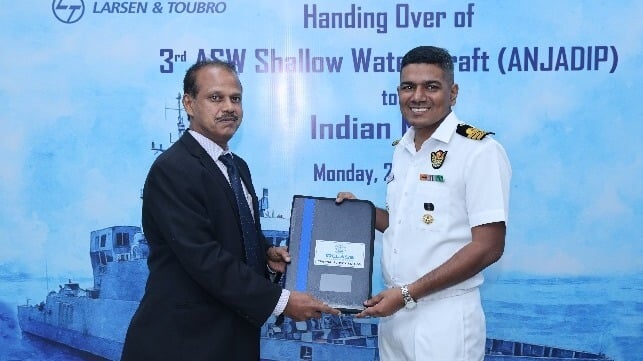
Delivery of the 'ANJADIP'

Published Dec 30, 2025 10:23 PM by The Maritime Executive


[By: Indian Register of Shipping]

The delivery of ‘ANJADIP’, the third of the eight Anti-Submarine Warfare Shallow Water Craft (ASW SWC) project, to the Indian Navy on 22 December 2025, at INS Adyar, Chennai, marks a moment of pride for Indian Register of Shipping (IRS). The warship has been indigenously designed and built by Garden Reach Shipbuilders and Engineers (GRSE) Ltd., Kolkata, in accordance with the IRS Naval Rules.

ANJADIP is named after Anjediva Island, located off Karwar, Karnataka, reflecting the island’s strategic significance in India’s maritime domain.

With an overall length of 77 metres, ANJADIP is the largest Indian Naval warship propelled by a Diesel Engine – Waterjet propulsion system, which provides superior manoeuvrability and performance in shallow waters. The vessel has been designed to undertake underwater surveillance and Anti-Submarine Warfare (ASW) operations in shallow coastal waters. It is also capable of conducting Low Intensity Maritime Operations (LIMO), advanced mine-laying missions and Search and Rescue (SAR) missions.

The induction of IRS-classed ASW SWC ships will significantly enhance the Indian Navy’s shallow water anti-submarine warfare capabilities, strengthening coastal security and maritime preparedness.

Cdr KK Dhawan, Head – Defence at IRS said, "IRS remains committed to supporting indigenous shipbuilding and naval capability development through robust classification, technical expertise, and assurance of safety and quality, in alignment with India’s vision of self-reliance in defence manufacturing (Atmanirbhar and Swavlambit Bharat)."

The products and services herein described in this press release are not endorsed by The Maritime Executive.


U.S. Awards Contracts for Six Arctic Cutters to Rauma Marine and Bollinger

Arctic Security Cutter
Finland's Rauma will build two cutters and Bollinger four using the design developed by Arker Technologies and Canada's Seaspan (Aker Technologies)

Published Dec 29, 2025 6:30 PM by The Maritime Executive


The U.S. Coast Guard has entered into the first six construction contracts for the new class of medium polar icebreakers envisioned as part of Donald Trump’s ambitious plan to rapidly accelerate the U.S. presence in the Arctic. The contracts follow the strategic agreements with Finland and Canada and the partnership between the U.S. and Finland announced in October, and calls for the first vessel in less than three years.

The contracts signed on Friday, December 26, award Finland’s Rauma Marine Constructions two vessels to be built in Finland, with the delivery of the first vessel expected in 2028. The Finnish company will also work with Bollinger Shipyard, which will leverage the Finnish design and expertise in building four Arctic Security Cutters at its shipyard in Houma, Louisiana. The first domestic cutter, they report, is expected in 2029, meaning it would likely come before the heavy Polar Security Cutter that is also being built by Bollinger and, after many delays, is now expected in May 2030.

“America has been an Arctic nation for over 150 years, and we’re finally acting like it under President Trump,” said Homeland Security Secretary Kristi Noem. “Our adversaries continue to look to grow their presence in the Arctic, equipping the Coast Guard with Arctic Security Cutters will help reassert American maritime dominance there.”

Noem asserts the cutters will defend U.S. sovereignty, secure critical shipping lanes, protect energy and mineral resources, and counter the growing presence of China and other nations in the Arctic. The Trump administration has said the vessels are vital to control, secure, and defend Alaskan borders, facilitate maritime commerce vital to economic prosperity and strategic mobility, and respond to crises and contingencies in the region.

To accelerate the program, the U.S. turned to Finland, which has long expertise in building icebreakers. The design for the class is being based on the Multi-Purpose Icebreaker developed by Canada’s Seaspan Shipyards and Aker Arctic Technology of Finland. 

Finnish leaders are hailing the contract a major achievement in the U.S.-Finland cooperation. They are highlighting that Rauma’s role will be central to the program and its schedule certainty, low technical risk, and use of mature, production-ready designs. 

“In the case of icebreakers, RMC’s preparatory work started in the autumn, but now we are moving towards full implementation,” announced Finland’s Minister of Economic Affairs, Sakari Puisto, on news of the contract signing. “The entity formed by the shipyard and an extensive network of subcontractors and partners is unique internationally. This will enable us to deliver even the most modern icebreakers quickly and with high quality.”

To support the objectives of the White House, Bollinger highlights that it is working in close partnership with Rauma Marine Construction to ensure that the U.S. receives the icebreaking capabilities as rapidly as possible. 

“The Arctic Security Cutter is one of the most consequential and time-sensitive shipbuilding programs in U.S. Coast Guard history,” said Ben Bordelon, President and CEO of Bollinger Shipyards.

Bollinger highlights that it will be the company’s fifth class of cutters built for the U.S. Coast Guard. It is currently implementing the Sentinel and Polar Security Cutter programs.

When the Arctic Security Cutter program was announced in October, they said it would ultimately field up to eleven vessels. Canada’s Davie group was believed to be negotiating for a second tranche that would combine its Helsinki Shipyard and its recently acquired shipyard in Galveston, Texas, which the company has said it plans to turn into an “icebreaker factory.”
 

Saudi Arabian Forces Bomb Port in Yemen Raising Tensions with UAE

Yemen port
Saudi forces targeted the military vehicles offloaded from the cargo ships (Saudi Press Agency)

Published Dec 30, 2025 6:01 PM by The Maritime Executive


Saudi Arabia, acting in the name of what it calls the “Coalition to Restore Legitimacy in Yemen,” launched what it is terming limited airstrikes on the Port of Mukalla in southeastern Yemen on the Gulf of Aden. Saudi officials accused the United Arab Emirates of having sent a large amount of unauthorized military equipment into the port and demanded that the UAE immediately withdraw its unauthorized forces.

The UAE and Saudi Arabia have long been at odds, supporting different factions within Yemen, but today’s actions are being seen as a major escalation that could threaten further destabilization in the region. The UAE supports the so-called Southern Transitional Council, which in recent weeks has been consolidating its positions and expanding in the south of the country, including encroaching toward Saudi Arabia, which supports the government of Yemen.

The Saudi Press Agency released statements asserting that over the weekend, two vessels had arrived at the Port of Mukalla from the Port of Fujairah, “without obtaining permits.” They asserted that close surveillance and cargo documentation showed the vessels were offloading weapons and combat vehicles for the Southern Transitional Council.


One of the vessels is being identified as the Greenland, a RoRo flagged in St. Kitts and Nevis and managed by a company with offices in the UAE and Dubai. Built in 1984, the 12,870-dwt vessel was acquired by UAE interests in 2021. Associated Press reports the second vessel could not be immediately identified.

The Port of Mukalla is located some 300 miles from Aden. It is in another region of the country, far away from the Houthi stronghold at Sanaa in the northwest of the country. Both the factions supported by the Saudis and the UAE oppose the Houthis.


UAE officials denied Saudi Arabia’s accusations, saying it had been sending materials to its limited forces in Yemen. It asserts its sole focus is counterterrorism in Yemen and had withdrawn its military forces in 2019. The officials said the UAE would voluntarily withdraw its remaining forces from Yemen after today’s attacks.

Saudi Arabia had given the UAE a 24-hour ultimatum to withdraw from Yemen. AP reports the Southern Transition Council forces had pushed out forces affiliated with the Saudi-backed National Shield Forces in recent weeks.

Analysts feared the confrontation between the two powerful nations could signal a new front in Yemen’s decade-long civil war.


China Conducts Live-Fire Exercises in Taiwan Strait

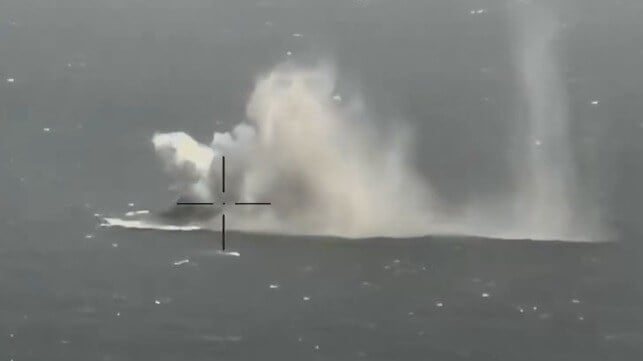
Rocket drill in the Taiwan Strait, Dec. 30 (PLA)

Published Dec 30, 2025 9:21 PM by The Maritime Executive


On Tuesday, China's military continued a series of large-scale live fire exercises around Taiwan, demonstrating its high-volume rocket fire capabilities by launching salvos into the Taiwan Strait. 

The exercises were announced after a record-setting U.S. arms sale agreement with Taiwan. At the same time, China also announced sanctions on 20 American defense tech companies, including some of the biggest names in next-generation technology for the U.S. Navy. 

The drills - dubbed "Justice Mission 2025" - are intended to send a message to Taiwan: that reunification with the mainland is inevitable, formal Taiwanese independence will not be allowed, and Taiwan's cooperation with foreign powers (the United States) will be punished. 

"Beijing at all times stands ready to crush any secession plot aiming to split Taiwan from the motherland. Each escalation in provocation will be met with stronger countermeasures. The PLA is ready to fight at any moment, and is certain to prevail if and when it does fight," Chinese state news outlet Xinhua said in a statement Tuesday. 


China has carried out large-scale live fire exercises near Taiwan before, and Western analysts have suggested that it is attempting to normalize large-scale Chinese activity near the island's shores. Tuesday's PLA Army rocket-launch drill sent rounds into the water near Taiwan's 24-nautical-mile line, Taiwan's defense ministry told AP, closer than ever before. About 130 Chinese aircraft were detected around the island's airspace on Monday, along with 22 Chinese warships and government vessels. 

The PLA rocket volley drill has meaning for naval operators. Video of the exercise shows a tight delivery pattern for the long-range guided rocket system, demonstrating guidance accuracy that could be used for strikes on ports or coastal defense batteries in Taiwan. In addition, the PLA Army's long-range rocket launch truck can deliver anti-ship cruise missiles with a range of 180 kilometers, enough to cover the Taiwan Strait. In a statement Tuesday, the PLA said that the overall training objective is to "explore how ports and choke-points could be sealed under duress" and to simulate strikes on ground targets. 

The U.S. supports Taiwan's defense with arms sales, but maintains strategic ambiguity about whether American assets would be dispatched to counter a cross-strait invasion. By contrast, Russian foreign minister Sergei Lavrov told TASS last weekend that Moscow supports China's position, and would provide "mutual support" to Beijing in the event of a conflict over the island's freedom. 

"As for the possible escalation in the Taiwan Strait, [Russian] procedure for acting in such situations is set forth [by a treaty with China]," Lavrov said. "One of the basic principles of that document is mutual support in defending national unity and territorial integrity."


China's Navy Conducts Final Test of Ship-Launched Hypersonic Missile

The Wuxi launches a YJ-20 ASBM (China Military Bugle)

Published Dec 29, 2025 10:05 PM by The Maritime Executive


On Sunday, Chinese state media unveiled the final test launch of a new maneuvering hypersonic missile from a multirole destroyer. The operational test shows that the PLA Navy will soon field a weapon that is far harder for American missile defense systems to intercept, augmenting the PLA's formidable anti-ship ballistic missile portfolio.

The test of the new YJ-20 hypersonic missile was announced by official military media outlet China Military Bugle, and was accompanied by video footage of the launch from a Type 055 destroyer, the Wuxi. The video suggests that the YJ-20 is ejected from a VLS cell before ignition of its rocket motor ("cold launch").

Capabilities like the YJ-20 could allow China to stretch its presence further out into the Pacific or the Indian Ocean, allowing the Type 055 class to operate with a top-of-the-line, long-range antiship missile system - if it works in practice. Hypersonics still require offboard surveillance of the target in order to complete the "kill chain," and U.S. defense officials have said that China's network of remote-sensing and guidance capabilities would be targeted in the event of a conflict.

In addition to the YJ-20, the PLA operates multiple distinct classes of antiship ballistic missiles, several designated hypersonic. (In the defense context, "hypersonic" means that the device is both faster than Mach 5 and maneuverable on terminal approach.) The YJ-17 sub-launched medium-range ballistic missile has a hypersonic glide vehicle payload and an antiship capability, with enough range to reach Yokosuka and Subic Bay. The DF-26, an intermediate range ballistic missile, can reach out to 4,000 kilometers - enough to range Guam, where the U.S. maintains key military installations.

The newly-produced DF-27 - not yet announced by China, but acknowledged by the Pentagon - is an intercontinental antiship ballistic missile with enough range to threaten U.S. Navy ships across half the world. Launched from a truck within China's borders, it could theoretically reach the North Atlantic, Europe, Australia, the Solomon Islands, Pearl Harbor, or San Francisco Bay. 

Now, with the YJ-20, China can bring an advanced antiship ballistic missile threat to any theater where the Type 055 destroyer can reach. Eight of these 12,000-tonne warships are in service, and eight more are planned.


MULTIPOLARITY; HALF A BRIC

Russia, China and Iran Join Naval Exercises off South Africa

Mosi-3 transit
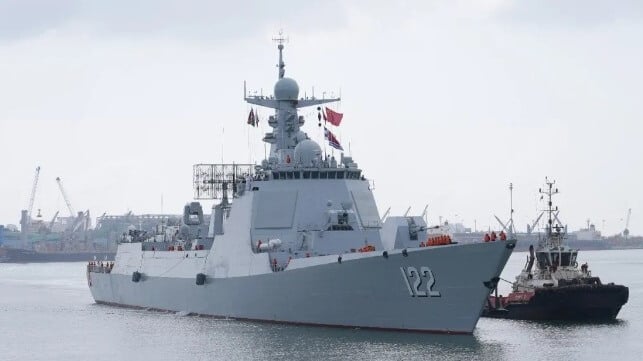
PLA Navy destroyer Tangshan calls Mombasa, Dec. 25 (PLA)

Published Dec 29, 2025 11:16 PM by The Maritime Executive


Naval contingents from Russia, China and Iran are converging in South Africa in anticipation of the start of Exercise Mosi-3 in early January. Mosi-3 is labelled a BRICS initiative, albeit participation identified so far seems rather thin.

Making a port call in Mombasa en route to South Africa on Christmas Eve were two naval vessels of the People Liberation Army (PLAN), the Type 052DL guided-missile destroyer Tangshan (D122) and the Type 903A replenishment ship Taihu (K889).  The remaining ship of the 48th Flotilla, the Type 054A guided-missile frigate Daqing (F576), appears to have been left behind to keep watch over the Red Sea and Gulf of Aden.

Heading down the west coast of Africa are the Russian Steregushchiy Class corvette Stoykiy (F545) with a Ka-27PL ASW helicopter on board, and its escorting Altay Class oiler Yelnya (A168). This flotilla came into Pointe-Noire, in the Republic of the Congo, on December 21, and is programmed to be away from its Baltic Fleet base for six months. It was tracked through the English Channel in late November, and after its participation in Exercise Mosi-3 is scheduled to make calls in Tanzania, Guinea, and Mozambique. It may well then provide the Russian participation in the Iranian annual Exercise Maritime Security Belt 2026, alongside vessels from the PLAN’s 48th Flotilla.

Somewhere out there are the 103rd and 104th Flotillas of the regular Iranian Navy (Nedaja), of which the 103rd is slated to take part in the exercise. The Nedaja may not follow the Chinese into Mombasa, as Iranian-Kenyan relations are somewhat poor; earlier this year the Kenyan Navy seized an Iranian-crewed ship smuggling a huge consignment of drugs off the Kenyan coast, which followed an incident when the Iranian ambassador attempted to fly out two members of the IRGC who had been arrested in Kenya on terrorism charges. The Iranians may be relying on resupply at sea rather than making landfall; the long-range resupply vessel IRINS Makran (K441) was still missing from its berth in Bandar Abbas late on December 28.

On a previous expedition to South Africa in January 2017, the Nedaja’s Bandar Abbas Class resupply vessel IRINS Bushehr (K422), which was escorting the Moudge Class frigate IRINS Alvand (F71), suffered hull damage after hitting a container adrift at sea, and was stranded in Durban for some time while the cost of repair was negotiated. In April 2023, when Nedaja vessels of the global circumnavigating 86th Flotilla were given permission to dock in Cape Town on the way back to Iran, the US Embassy warned the South African authorities that "entities and individuals that provide support, including maritime services to designated entities, could be subject to sanctions risk under US authorities." Similar issues may arise again over Exercise Mosi-3.

U.S. Coast Guard Saves (And Detains) Two Migrants Who Jumped Off a Barge

migrants
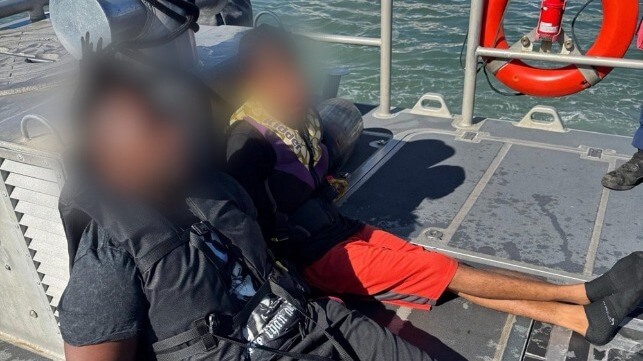
Courtesy USCG

Published Dec 29, 2025 3:48 PM by The Maritime Executive


A U.S. Coast Guard response team rescued two migrants who jumped into San Juan's harbor from a commercial barge, marking the latest in a series of incidents involving stowaways attempting to reach Puerto Rico.

The incident unfolded around mid-morning when a Coast Guard response vessel received an alert from the tug Southern Dawn's crew, who suspected that unwanted passengers might be concealed on board the barge, the Charlotte bridge. The migrants then leapt from the barge in an apparent escape attempt as the tow approached the port.

Coastguardsmen retrieved both of the men, handcuffed them and transferred them to shore, where immigration officials took them into custody. 

Commander Matt Romano, who oversees response operations for the regional maritime security command, emphasized the severe risks associated with such actions. "Attempting to board or abandon moving maritime vessels presents extreme peril," Romano stated, praising the effort that saved the two men while maintaining U.S. border controls.

Afterwards, multiple agencies carried out thorough inspections of the barge. Federal immigration enforcement, customs officers, criminal investigators, and local police searched it to make sure that no additional unauthorized passengers were still concealed.

San Juan Harbor has seen several episodes involving migrants hiding aboard commercial barges in recent years, and at least one incident in 2023 ended in a man-overboard situation, when three stowaways jumped off a barge under tow by the tug Sarah Dann. All would-be migrants face removal under federal policy, with repatriation either to their home nation or the place where they boarded as stowaways.


Three-Alarm Fire Damages Working-Waterfront Businesses in Portland, Maine

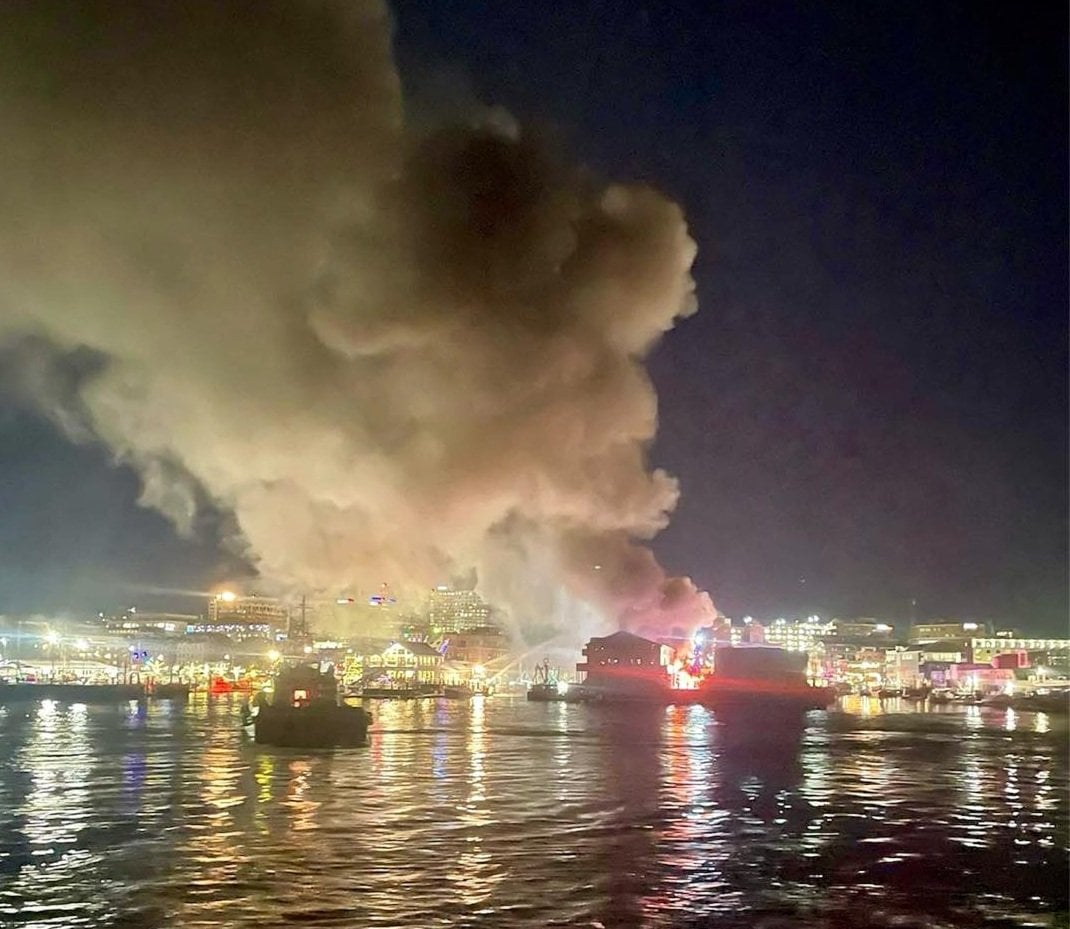
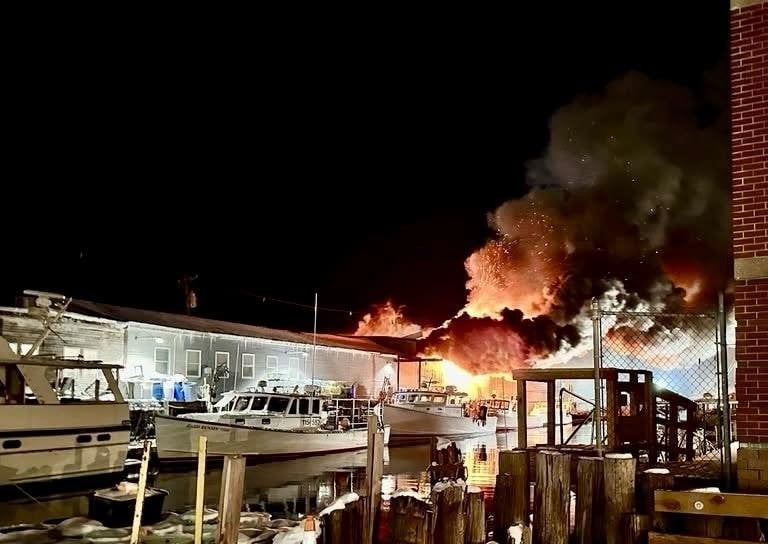
Firefighters climb atop one of the burning buildings in an attempt to control the blaze (PMFD)

Published Dec 29, 2025 7:33 PM by The Maritime Executive


A fire along the waterfront in Portland, Maine last weekend seriously damaged four businesses and multiple boats, causing hardship for more than a dozen lobstermen. 

At about 1730 hours on Friday, a fire was reported at downtown Portland's Custom House Wharf. Despite a rapid response, the blaze spread to four neighboring business establishments, burning their roofs off and causing extensive damage before the fire was put out at about 1920 hours. A maritime antique store, a nautical-themed bag shop, and a fishermen's gear storage building were affected by the fire. Several boats sank due to fire damage, a fishermen's association spokesperson told the Boston Herald, and others were damaged. 

The firemen had to deal with difficult conditions: restricted access to wharf-side structures, collapsing structures, freezing weather made operations challenging, and frozen-shut hydrants impeded firefighting from shore. A fireboat applied water from the harbor side to help douse the flames. Unfortunately, two responders sustained minor injuries, but no harm to occupants or bystanders was reported.

The wharf is used by more than a dozen lobstermen, according to the Portland Press Herald. Local businesses are stepping in to provide extra support to the lobster-boat operators as they look for alternatives. The Maine Coast Fishermen's Association has launched a fundraising page for the public to offer donations to help out. Over $12,000 has been raised so far, the association told the Boston Herald. 

So far, no foul play is suspected, according to the local fire department. An investigation into the cause of the blaze is under way.  


Passengers on Grounded Cruise Ship in Papua New Guinea Will be Flown Home

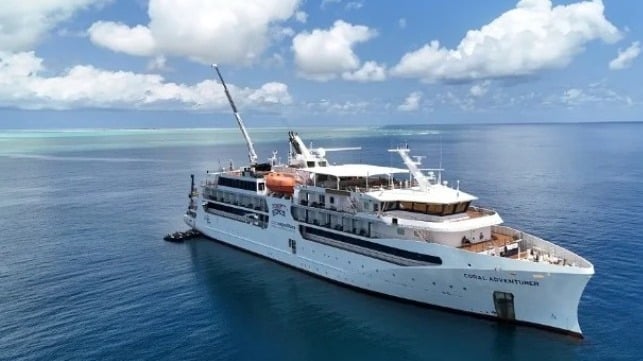
Coral Adventurer
Coral Adventurer (file image courtesy Coral Expeditions)

Published Dec 29, 2025 11:06 PM by The Maritime Executive


The cruise ship Coral Adventurer has been detained in Papua New Guinea after running aground on a reef, and the passengers will be flown home on a charter flight, according to the operator. 

The ship ran aground on a reef near Dreghafen Point off the east coast of the island, about 15 nautical miles from the port of Lae. Strong currents were a likely contributing factor, according to Travel and Tour World. The site of the grounding is known as a shallow coral ridge, and local navigators tend to avoid it, regional governor Rainbo Paita told ABC. On a nautical chart provided by Pole Star Global, the site is marked with the symbol for breakers, indicating shallow water. 

The cruise ship has a slight list of about six degrees to port, but no damage to the vessel has been found, nor has any pollution been reported, the master told local authorities. All 124 personnel aboard are safe, according to Papua New Guinea's National Maritime Safety Authority.

Separately, the Australian Maritime Safety Authority (AMSA) has detained Coral Adventurer on "reasonable suspicion that it is not seaworthy due to potential damage sustained during grounding." The ship is in foreign waters, but it is Australian-flagged and therefore within AMSA's jurisdiction. AMSA also asserted that Coral Adventurer is "sub?standard as a result of failures in the implementation of its Safety Management System under the International Safety Management Code," though did not provide further details. 

On Sunday, an initial high-tide refloat attempt using the ship's own engines was not successful. Another attempt is expected, and the operator is making contingency plans if this does not work, the authority said in a statement.


Kidnapped LPG Carrier Crew Released from Captivity in West Africa

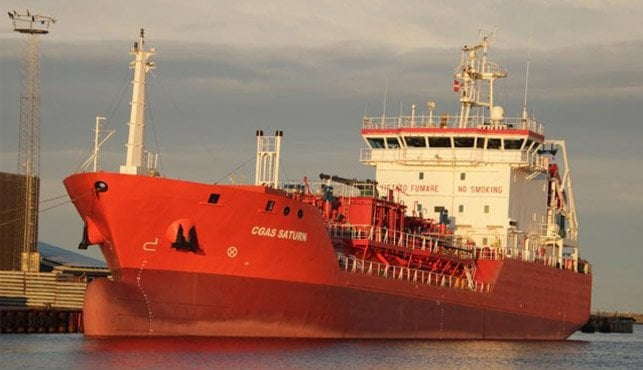
gas carrier
Nine kidnapped crewmembers from the CGAS Saturn were released (photo by René Nielsen, courtesy of VesselFinder)

Published Dec 30, 2025 6:14 PM by The Maritime Executive


The nine members of the crew aboard the LPG gas carrier CGAS Saturn have been released and are reported to be safe after their ordeal in West Africa. The owner of the vessel, Christiania Gas, announced on December 29 that the crew was released and being repatriated.

The incident began on December 3 while the CGAS Saturn (3,090 dwt) was underway approximately 50 nautical miles west of the African coast, bound for Malabo, Equatorial Guinea. The reports said the 13 crewmembers were rounded up by an unknown number of pirates who boarded the ship. Personal belongings were also stolen.

The pirates abducted nine of the crewmembers when they left the ship. They left four people behind on the ship, and Christiania later said that one of them had sustained light injuries. Initially, the injured individual was treated on the ship and later transferred for medical care in an onshore hospital. They were able to sail the vessel to a safe port in West Africa after the incident.

The company did not provide any details on the release of the individuals or their nationalities. Poland’s Ministry of Foreign Affairs, however, said today that a Polish sailor had been freed and was now home with family.

While the level of piracy activity has declined in the region, security consultants continue to emphasize that the danger remains high off West Africa. There were at least 17 armed robbery or piracy incidents reported in the Gulf of Guinea over the past 12 months, according to the Neptune P2P Group. Between January and September, the International Maritime Bureau calculated that a total of 14 crewmembers had been kidnapped. Robberies and kidnap-for-ransom remain a key threat to vessels operating in the region.
 

Top photo by René Nielsen, courtesy of VesselFinder