Tuesday, March 24, 2026


Tanker Rates for Red Sea-Loading Saudi Crude Plunge

Freight rates for tankers to ship Saudi crude from the Yanbu port on the Red Sea to Asia have slumped from the highs seen earlier this month, as more vessels are diverting to the Saudi export port that bypasses the Strait of Hormuz. 

Tanker rates on the Yanbu-Asia route have slumped from a high of over $450,000 per day in early March to about $200,000 per day for voyage agreed this week on a 2011-built very large crude carrier (VLCC), according to sources familiar with the deals and brokerage reports cited by Bloomberg.

With the Persian Gulf-Asia route effectively closed for most crude, especially the one from Saudi Arabia, the Yanbu port has become the go-to place for tankers to remain busy in the trade to ship crude from the Middle East to its key export region, Asia.  


Saudi Arabia is accelerating the shift from Strait of Hormuz to the Red Sea as commercial traffic through the strait remains near-collapse levels. 

“Iran continues to enforce a controlled transit model through Hormuz, enabling selective passage via IRGC-managed corridors based on cargo type and destination,” maritime intelligence firm Windward said in a note on Monday.   

With the Strait of Hormuz open only on the discretion of the Islamic Revolutionary Guard Corps (IRGC), Saudi Arabia is shifting as much of its crude exports as it can to the Red Sea route. 

In the week March 15 through 21, about 22.9 million barrels were loaded at Yanbu, which was a 20% jump compared to the previous week, Windward said, citing vessel-tracking data from Vortexa. 

“This acceleration reinforces Saudi Arabia’s strategic pivot toward Red Sea export routes to reduce reliance on Gulf transit corridors,” according to Windward.

Despite the pivot to Yanbu, Saudi Arabia cannot fully offset the loss of all the supply it was shipping through the Strait of Hormuz before the war.  

Saudi oil giant Aramco has reportedly notified customers of term supply in Asia that they would receive in April only the flagship Arab Light grade loaded at the Yanbu export port on the Red Sea. 

So far in March, Saudi Aramco has exported about 4.355 million barrels per day (bpd) of crude, according to Kpler data cited by Reuters. That’s way below the 7.1 million bpd in exports in February, before the de facto closure of the Strait of Hormuz.  

By Charles Kennedy for Oilprice.com


Saudi Pushes White House to Prolong Iran War as Brent Tops $100

Saudi Arabia is publicly calling for regional stability. Peace, even. But privately, the Kingdom is pushing the White House to press on with its campaign against Iran, with oil prices comfortably above $100—a move that could very well trigger oil demand destruction.

According to multiple reports out of Washington on March 24, Crown Prince Mohammed bin Salman has been urging the Trump administration to stay the course in its campaign against Iran, framing the current conflict as a rare window to reshape the regional balance of power, worried, according to NYT sources, that a prolonged conflict could result in further attacks on Saudi oil infrastructure.

MBS has even pushed for ground operations, sources suggested.

Saudi officials have denied the allegations that MBS is lobbying the White House to take a harder stance on Iran. “The kingdom of Saudi Arabia has always supported a peaceful resolution to this conflict, even before it began,” an official Saudi statement reads.

The White House refused to comment, the NYT said.

Brent is holding above $100 per barrel, with WTI in the low $90s, as disruptions tied to the Strait of Hormuz move from risk premium into actual supply constraint. Flows through the region remain impaired, and while Saudi Arabia can reroute some barrels via its East-West pipeline to Yanbu, that system maxes out well below normal export volumes. In other words, it’s softening the blow but hardly a sufficient substitute.

The higher prices help offset budget pressures and support its aggressive spending plans tied to Vision 2030. But the same disruption driving those prices is hitting The Kingdom directly, with Iranian retaliatory strikes already targeting regional energy infrastructure. A half-finished war, the sources suggest, could open Saudi Arabian oil infrastructure up to further attacks.

Washington is weighing options that range from de-escalation to more aggressive targeting of Iranian export infrastructure, including key nodes like Kharg Island. Each carries obvious risks, including one of the biggest risks of all: sustained triple-digit prices that start to threaten demand as much as they support supply-side revenues.

Saudi Arabia’s fears go beyond oil—a prolonged war could undermine investor confidence for many of the ambitious projects in the works that would transform Saudi Arabia from oil-dependent economy to global business hub.

By Julianne Geiger for Oilprice.com

Robotaxi Price War Threatens London’s Taxi Industry

  • Addison Lee warns that tech giants could use subsidized fares to undercut traditional taxi operators.

  • Autonomous ride-hailing services are expected to launch in London soon, with prices potentially 20% lower.

  • Regulators are being urged to introduce minimum fares and licensing limits to protect existing drivers.

London’s cabbies could be priced out of the market unless regulators step in to curb “predatory pricing” from deep-pocketed tech giants, the boss of Addison Lee has warned.

Chief executive Liam Griffin said companies like Waymo, Wayve, or Tesla risk undercutting traditional operators by subsidising fares to win market share, echoing concerns from the early days of Uber’s expansion.

“We do feel that there is a danger that the big players can come in and ride roughshod over the existing industry”, Griffin said.


He called for a minimum fare for robotaxi services and limits on operating licences.

The warning comes as London prepares to become a key battleground for autonomous vehicle firms, with Waymo, China’s Baidu, and Uber-backed partners all planning to launch in the UK once regulation allows for commercial deployment, expected from this year.

Griffin said regulators, including Transport for London (TfL), should consider measures similar to those already applied to black cabs, which operate with a minimum fare of £4.20.

“There are livelihoods on the line here”, he said, adding that without intervention, “a handful of players” could make it “unachievable” for existing operators to compete.

Regulatory approval

Analysts expect autonomous ride-hailing to become significantly cheaper over time, particularly as companies scale fleets and remove driver costs.

In China, early robotaxi services are already being heavily discounted to attract users, while forecasts suggest fares could fall by as much as 20 per cent, compared with human-driven services.

This model follows a familiar pattern, where subsidised pricing is used to gain dominance, which is then followed by consolidation.

But the difference in this scenario is the scale of capital behind the entrants, with firms like Waymo and Tesla having the financial backing to absorb losses far longer than traditional taxi operators.

The UK government has been actively encouraging the sector, estimating autonomous vehicles could add £42bn to the economy and create up to 40,000 jobs by 2035.

Pilot schemes are already underway, with vehicles mapping London streets ahead of commercial launches.

London’s taxi and private hire ecosystem, from black cabs to the likes of Addison Lee, has already been reshaped once by ride-hailing platforms.

Disruption ahead

The arrival of driverless fleets risks accelerating that disruption, particularly if pricing becomes the primary competitive lever.

There are also concerns that cheaper, more convenient robotaxis could draw passengers away from buses, cycling, and walking, potentially increasing traffic and undermining environmental goals.

At the same time, autonomous vehicles could improve safety by reducing human error and increasing efficiency by optimising routes.

Uber has struck partnerships with multiple robotaxi developers rather than backing a single provider, effectively positioning itself as a marketplace for an autonomous fleet, rather than a direct operator.

Griffin showed Addison Lee is likely to adopt a similar approach, suggesting future fleets could include vehicles from multiple autonomous providers, too.

“In the same way that we currently have Volkswagens, Mercedes and Audis in our fleet, I see the future being that we will have Pony.ai, Waymo and Wayve”, he said.

By City AM

Europe’s Air Pollution Crisis Persists Despite Progress on Emissions

  • Air pollution caused 182,000 deaths in the EU in 2023, with most urban residents exposed to unsafe levels.

  • The EU is tightening guidance through the new Cancer Code, urging both policy reform and behavioral changes.

  • Failure by several member states to meet emissions targets highlights enforcement gaps and the need for faster clean energy transition.


Air pollution has become a growing concern around the globe, with several governments now acting to improve air quality. The new European Cancer Code addresses the problem of air pollution directly and suggests that greater action must be taken. However, several EU countries are failing to properly manage air pollution, resulting in a multitude of health conditions and contributing to global warming.

A 2025 report from the European Environment Agency (EEA) suggests that, between 2005 and 2023, air pollution in the EU contributed to thousands of preventable deaths. While premature deaths linked to fine particulate matter fell by 57 percent during this period, according to the report, air pollution still contributed to 182,000 deaths in 2023. Italy reported the highest number of deaths, at 43,083 in 2023. This was followed by Poland, with 25,268 attributable deaths, and Germany, with 21,640 attributable deaths.

Particulate matter consists of tiny particles in the air that have a diameter of 2.5 micrometres (PM2.5) or less. If inhaled, these particles can lead to severe health issues, such as asthma, ischemic heart disease, and lung cancer. Most PM2.5 comes from human sources, such as vehicle emissions, air fresheners, and emissions from manufacturing. They can also come from natural events, such as wildfires, which are becoming more common due to climate change.


At present, around 95 percent of Europeans living in urban areas are exposed to air pollution levels “considerably” higher than the recommendations set out by the World Health Organisation (WHO) in 2021.

The European Code Against Cancer, 5th edition (ECAC5), which was published in January, includes recommendations for individuals and policymakers, aimed at reducing the cancer burden from both outdoor and indoor air pollution. The report recommends that individuals should limit car use, avoid second-hand smoke, refrain from burning wood or coal indoors or outdoors, and limit walking or cycling along heavily trafficked routes.

The authors also call on policymakers to align EU air quality limit values with WHO recommendations, as well as introduce stricter regulations on combustion emissions, promote active and environmentally friendly transportation, and incentivise the use of cleaner energy sources for heating and cooking. By cutting air pollution, governments can help reduce the prevalence of certain types of cancer, such as bladder, kidney, and brain cancers, according to the report. 

In the publication of ECAC5, it is the first time that the authors of the report have given clear direction to governments to reduce air pollution, rather than solely focusing on the individual. Sylvia Jochems, who is part of the expert team that established the code, stated, “The key message is that this needs action at the EU, national and local level.”

To reduce air pollution, several experts suggest that we need to change our energy usage by transitioning more rapidly to clean energy sources. The energy sector contributes over three-quarters of total greenhouse gas emissions globally, and, at present, much of the world continues to rely heavily on fossil fuels, which release harmful pollutants into the atmosphere when burned.

Shifting to a reliance on cleaner energy sources could help significantly reduce air pollution. This can be achieved by deploying more renewable energy capacity and electrifying energy-intensive sectors such as industry, transport, and building.

Several EU countries are still failing to properly manage air pollution, according to recent reports. For example, the European Commission (EC) referred Bulgaria, Lithuania, Portugal, and Sweden to the Court of Justice of the European Union for not respecting their emission reduction commitments for several air pollutants as required by the Directive on the reduction of national emissions of certain atmospheric pollutants (the NEC Directive).

The NEC Directive establishes emission reduction commitments for a range of air pollutants, which must be achieved by every EU member state each year between 2020 and 2029, and introduces more ambitious aims beyond 2030. Member states are also required to establish and update National Air Pollution Control Programmes to demonstrate how they plan to achieve their reduction commitments.

In 2025, the EC found that Bulgaria, Portugal, and Sweden had failed to meet the emission reduction commitment for ammonia (NH3), and Lithuania for nitrogen oxides (NOx) and non-methane volatile organic compounds (NMVOC) in the emission data provided up to 2023.

Environmental reform is a core condition of EU membership; as such, European countries looking to join the EU must meet certain environmental standards to be considered. North Macedonia, which is an applicant for EU accession, is at risk of losing credibility as a candidate for failing to meet basic air quality standards. In its most recent progress report, the EC warned that despite receiving significant funding, North Macedonia’s reforms continue to be hampered by a lack of ownership among authorities, weak coordination, and limited administrative capacity.

The EU is increasingly focused on reducing air pollution across the region, which can lead to or exacerbate a wide range of health conditions, as well as contribute to global warming. However, achieving this reduction relies heavily on the commitment of member state governments to taking meaningful action to align national environmental policies with EU standards and effectively implement these policies.

By Felicity Bradstock for Oilprice.com

Gemfields flags 2025 loss amid delays, weak prices

Gemfields’ emeralds. (Image courtesy of Gemfields.)

Coloured precious stones miner Gemfields (LON: GEM) (JSE: GML) warned on Tuesday it expects to post a loss for its 2025 financial year as weaker gemstone prices, project delays and operational disruptions weigh on performance.

The company guided for a loss per share of 2.6¢ for the year ended December, narrowing from 7¢ cents in 2024, while headline loss per share is estimated at 1.3¢ versus 2.1¢ previously, as interruptions at its Montepuez ruby mine in Mozambique and Kagem emerald mine in Zambia reduced output and cash generation.

“It has been a difficult year,” CEO Sean Gilbertson said in the statement, adding that delays to Montepuez’s second processing plant, illegal mining and grade volatility curtailed premium ruby production and disrupted auction timing.

The update underscores ongoing pressure on coloured gemstone producers as volatile pricing, operational risks and geopolitical uncertainty cloud earnings visibility, even as selective strength emerges for higher-quality stones.

Gemfields said the commissioning delays to Montepuez’s second processing plant will extend well into the first half of 2026 despite rubies being produced since September 2025, limiting near-term recovery in volumes.

Auction performance was mixed, with seven auctions generating $129 million in 2025, down 34% from $195.9 million a year earlier, though the company noted improving prices for higher-quality emeralds and rubies.

Geopolitics weigh

The company also flagged rising geopolitical risks, saying escalating conflict in the Middle East has added uncertainty to global energy markets and could affect operating costs, though impacts remain unclear.

Shares rose 1.5% to 5 pence in midday London trading following the update, though the stock remains down 20% over the past year, leaving Gemfields with a market capitalization of about ZAR 2 billion ($117.4 million).

Gilbertson said reducing debt remains a priority after a $30 million rights offer and the $50 million sale of the Fabergé brand, with management focused on strengthening the balance sheet and preserving flexibility for future capital allocation.

Gemfields plans to release full annual results on March 26.

ZN

Korea Zinc faces fresh vote challenge in long-simmering dispute


Korea Zinc chairman Yun Choi. Credit: Bloomberg TV via YouTube.

More than a year after an upstart coalition of activist investors attempted to wrest control of Korea Zinc Co. from its chairman, shareholders will vote on his fate Tuesday.

Chairman Yun B. Choi’s bid for re-election to the board has faced last-minute setbacks after South Korea’s powerful National Pension Service abstained and the California Public Employees’ Retirement System, the largest US public pension fund, opted to vote against him.

The decisions are raising the stakes for Tuesday’s annual general meeting, turning a boardroom power struggle into a broader test of activist influence and investors’ ability to challenge Korea’s traditionally management-friendly culture.

While Choi’s side holds a majority on the board, his fate will be decided by minority investors. If the activist alliance led by MBK Partners Ltd. and Young Poong Corp. — which together control more than 41% of the company’s voting stake, according to Yonhap — prevails, it would mark a rare shift of power for shareholders in Korea.

“From a corporate governance perspective, there are big questions about the current management,” said Namuh Rhee, chair at the Korean Corporate Governance Forum. “It is a tight contest, and the key issue is whether shareholder and investor protections are being properly upheld.”

The episode dates back to September 2024, when MBK and Young Poong launched a hostile takeover attempt, arguing that executives had violated their fiduciary duties and saddled the company with debt to bolster Choi’s control. While the bid drew intense investor scrutiny, the pair failed to topple Choi.

With a 5.2% stake, the NPS — currently the fourth biggest holder — is a key swing voter. Its decision not to back Choi — while also opposing some audit committee nominees — is being interpreted differently by the two camps. MBK and Young Poong called it a “de facto negative assessment” of Choi’s leadership, while Korea Zinc described it as a “balanced and neutral” stance.

The pension fund cited concerns over “past records of infringement of corporate value and shareholder rights” in explaining its stance on key nominees.

Following NPS’s decision, CalPERS said it voted against the management proposal to elect Choi. Its exact holdings are undisclosed.

Global proxy advisers have issued conflicting guidance ahead of Tuesday’s meeting. Institutional Shareholder Services recommended a vote against Choi’s reappointment, identifying governance issues as the primary concern. In contrast, Glass Lewis advised in favor of his reappointment.

The timing is critical for Korea Zinc, one of the world’s biggest zinc refiners, as it pushes ahead with plans to build a US smelter backed by the US government and other investors, part of broader efforts to secure critical mineral supply chains.

The two sides have been locked in disputes over Korea Zinc’s third-party share issuances tied to the establishment of a US joint venture, though the activist alliance has said it supports the US smelter project.

Tuesday’s meeting also features a hefty and contested agenda, underscoring the broader questions about governance for investors. Proposals include changes to board size under cumulative voting, a 10-for-1 stock split, expanding separate elections for audit committee members, imposing fiduciary duties on directors, and altering who chairs shareholder meetings.

NPS has said it would back competing proposals on board size and split votes evenly between rival slates tied to four director candidates.

“Korea Zinc received more than 50 shareholder proposals with most focusing on a potential lack of governance,” said Yasutake Homma, a Bloomberg Intelligence ESG strategist, in a report. “The firm is now under shareholder pressure over investment in the US.”

(By Haram Lim)

FE

India’s iron ore imports set to hit 7-year high in 2025–2026

Stock image.

India’s imports of iron ore, a key raw material in steelmaking, are set to rise to a seven-year high in the fiscal year ending on March 31, driven by a shortage of high-grade ore and demand from JSW Steel, analysts and industry executives said.

Overall imports are likely to reach 12 million to 14 million metric tons in 2025-26, more than doubling from a year earlier, analysts and trade officials said.

JSW Steel, India’s biggest steelmaker by capacity, was a key driver of iron ore imports for its mills in the western state of Maharashtra and the southern state of Karnataka, said Lalit Ladkat, a senior analyst at London-based consultancy CRU.

A cargo of BHP’s Jimblebar Fines iron ore is heading to India in a rare sale, driven by discounts on the product that was banned for sale in China, Reuters reported last week.

The bulk of India’s iron ore imports in the fiscal year originated from Brazil and Oman, which together accounted for about 70% of total shipments, Ladkat said.

Iron ore output in India, the world’s second-largest crude steel producer, is expected to reach 305 million tons in the 2025–26 fiscal year, up from 289 million metric tons a year earlier, according to commodities consultancy BigMint.

But exports of iron ore are expected to reach 29 million metric tons, up 26% from a year earlier, with 85% of shipments going to China, Ladkat said.


India mainly exports low-grade iron ore that is generally not used by steel mills in the country, mining officials said.

In the fiscal year that begins on April 1, India’s iron ore output is expected to rise as mines ramp up production, although imports may continue depending on grade requirements and plant-level supply dynamics, said Sumit Jhunjhunwala, vice president at ICRA Ratings.

Iron ore pellet imports to drop

India, which has been importing cheaper iron ore pellets – processed or value-added products – from Iran since last year, is likely to see volumes decline due to the conflict in the Middle East, analysts said.

“Indian pellet imports from Iran could decline amid heightened geopolitical tensions and associated trade uncertainties, while ample domestic pellet availability is likely to constrain import demand,” BigMint said.

From April to February, India imported 1.88 million metric tons of iron ore pellets, up six times from a year earlier.

(By Neha Arora; Editing by Mayank Bhardwaj and Thomas Derpinghaus)


Fortescue bets on China ties as CMRG broadens iron ore influence


Fortescue Metals and Operations CEO Dino Otranto. (Image by Kristie Batten.)

Fortescue Ltd. expects its extensive use of Chinese capital and mining equipment to set it apart from rival iron ore producers as Beijing seeks to extend its influence in the market, chief executive officer Dino Otranto said in an interview.

Speaking on Bloomberg Television, Otranto said state-backed iron ore buyer China Mineral Resources Group Co. had told him from the start that it wanted better terms, and to bring in more investment.

“The message was very clear. We procure all of your iron ore; You get all your money from the US, you get all your equipment from the US. We need to look at opening up that relationship,” he said on the sidelines of the China Development Forum.

Otranto added that Fortescue had already taken significant steps to source equipment from Chinese suppliers, including by placing a large order for trucks. Last August, the company also secured a 14.2 billion yuan ($2 billion) loan from lenders including mainland banks, in an effort to diversify away from the US. This could position Fortescue as a “unique offering in the market compared to some of our peers,” Otranto said.

CMRG has disrupted the global iron ore market with its effort to increase the clout of the world’s top consuming nation. It has been locked in months of pricing negotiations with BHP Group, a dispute that has resulted in steel mills being told to halt purchases of certain types of ore produced by the miner.

Fortescue and Rio Tinto Group have already switched the index they use to price some of its iron ore contracts under agreements with CMRG.

(By Katharine Gemmell, Paul-Alain Hunt and Stephen Engle)


BHP sees potash heading toward deficit as demand outpaces supply

Jansen potash mine is more than 50% ready, with phase 2 underway. (Image courtesy of BHP.)

BHP Group, the world’s largest mining company, expects the global potash market to tighten over the next decade as demand grows and geopolitical risks strain fertilizer supply chains.

With demand for the crop nutrient rising 2% to 3% annually, there is limited additional supplies beyond BHP’s Jansen potash project.

That adds to a fertilizer supply shock triggered by the war in the Middle East, as farmers worldwide rush to secure critical nutrients. A market deficit is expected by 2035, according to Karina Gistelinck, the group’s head of potash. 

“We expect a tight market, with significant pressure on the supply side,” she said in an interview Tuesday. 

Jansen, in Saskatchewan, Canada, is scheduled to begin operations in mid-2027, reaching 4.1 million tons of annual capacity within two years. A second phase would lift output to about 8.5 million tons early next decade. 

Gistelinck is in Brazil seeking to convert preliminary commercial agreements into binding contracts ahead of Jansen’s startup. 

The South American nation — which imports almost all of its potash — is set to be a key market, reflecting its roughly 20% share of global demand. The miner is also targeting Southeast Asia, China, India and US as major buyers. 

BHP has “learned a very expensive lesson” as it has blown past cost estimates for Jansen, raising projected investment in the first phase to $8.4 billion, the executive said. She described potash as “the iron ore of the future” for BHP, signaling its ambition to build a major new earnings driver.

(By Mariana Durao)

AU

Central banks’ gold buying momentum carries into 2026


Stock image.

Central banks remained firm buyers of gold in 2026, even as prices were skyrocketing to records in January, though the institutions’ appetite for bullion could face a stern test amid rising geopolitical tensions in the Middle East.

After surging to an all-time peak of nearly $5,600 an ounce earlier this year, gold has come under immense pressure in recent weeks as elevated energy prices from the ongoing Middle East war sparked fears of global inflation and reduced expectations of lower interest rates — a scenario that hurts the safe-haven metal.

At the same time, official-sector demand remains resilient in the first few months, according to the World Gold Council, which forecasts central banks to purchase roughly 850 tonnes of gold in 2026 — almost the same as last year.

WGC data shows countries such as China and Kazakhstan remained active buyers in 2026, extending a multi-year trend of strong official demand, while countries like Indonesia and Malaysia have also turned into buyers after a long hiatus.

“A phenomenon we’ve been seeing in the last few months is new central banks, or central banks that have been inactive or absent from the gold market for a long time, entering the gold market,” Shaokai Fan, global head of world banks for the WGC, said on Tuesday.

“I think that might be a trend that will continue into 2026,” Fan added.

2025: another year of central bank buying

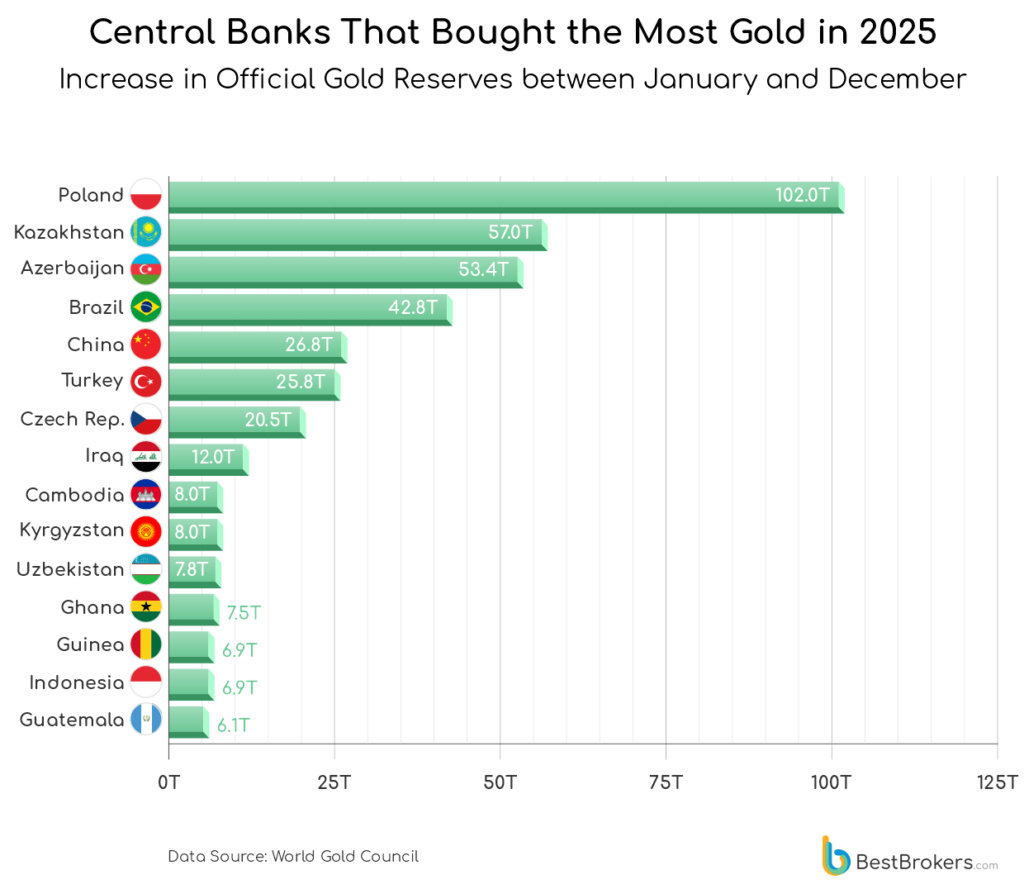
The buying momentum seen this year follows a sustained wave of purchases in 2025, when central banks again ranked among the largest sources of gold demand globally. Total official-sector buying reached about 863 tonnes for the year, according to WGC, slightly below the record levels of 2022–2023 but still historically strong.

Based on WGC data, analysts at investing research platform BestBrokers compiled the top buyers of gold in 2025:

Credit: BestBrokers

Poland emerged as the standout buyer, adding more than 80 tonnes to its reserves, while Kazakhstan and Brazil also posted significant increases. China and Turkey continued to accumulate gold as well, albeit at a slower pace compared to prior years.

The buying spree comes amid a broader trend that has seen central banks collectively add large volumes of gold since 2020, helping drive prices higher and reinforcing bullion’s role as a strategic reserve asset.

Analysts point to a combination of factors behind the trend, including geopolitical uncertainty, concerns over currency debasement, and a desire among emerging economies to reduce reliance on the US dollar.

Who holds the most gold today

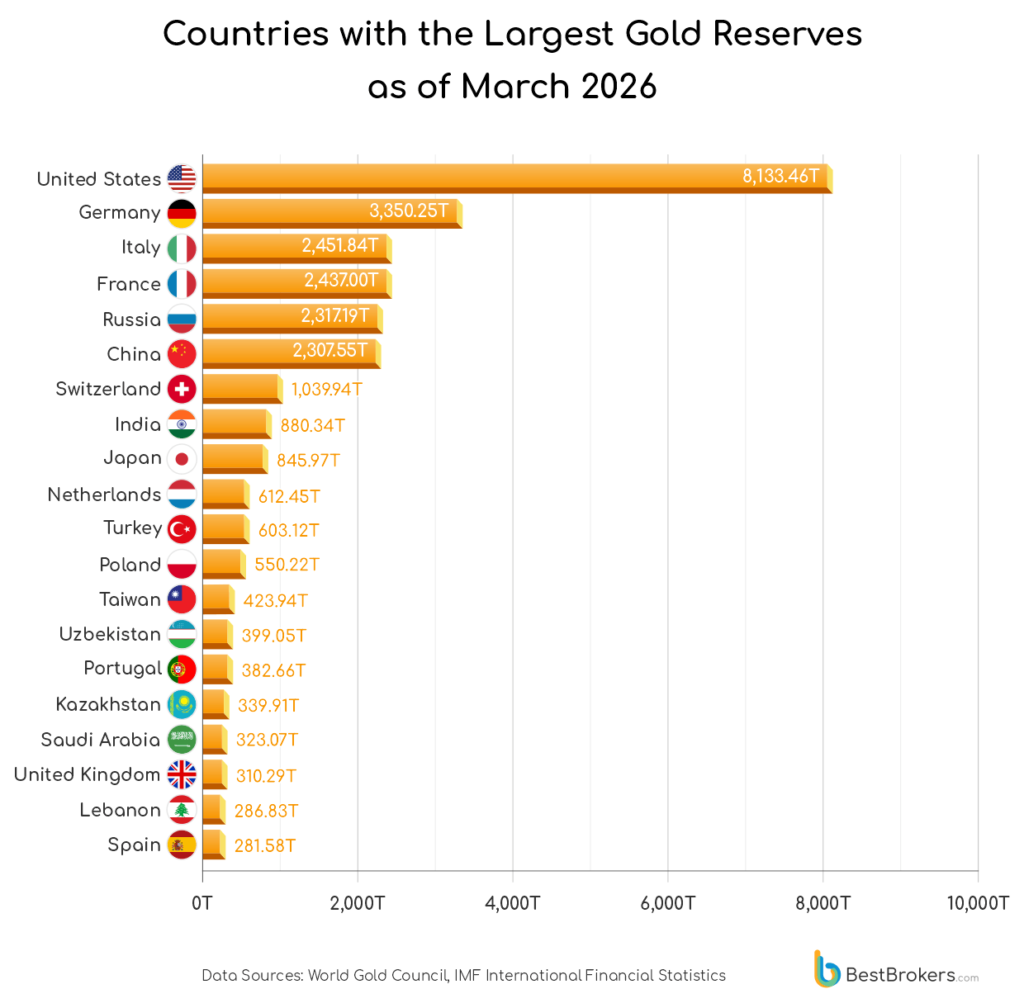
Despite the surge in buying from emerging markets, global gold reserves remain heavily concentrated among advanced economies.

Credit: BestBrokers

The US continues to hold by far the largest stockpile, with more than 8,100 tonnes of gold, followed by Germany at roughly 3,350 tonnes. Italy and France rank next, each holding around 2,400–2,450 tonnes, while Russia and China have built reserves exceeding 2,300 tonnes apiece.

Other major holders include Switzerland, India and Japan, each with several hundred tonnes of gold in their central bank reserves.

Collectively, the US and European nations still account for a dominant share of global gold holdings, though emerging markets have been steadily increasing their positions over the past decade.

Short-term uncertainty

However, as some analysts have pointed out, the war in the Middle East may have forced some states to sell some of their gold to shore up foreign exchange reserves amid elevated oil prices — despite the underlying fundamentals of holding the metal remaining intact.

“Gold’s recent plunge marks a dramatic shift in investor sentiment, with the metal facing one of its sharpest weekly declines and edging toward bear-market territory,” Alan Goldberg, lead data analyst at BestBrokers, said.

“While some market participants view this as a temporary correction following record highs in early 2026, others warn that volatility could persist, testing central banks’ appetite for continued accumulation,” he added.

“It’s too early to see if the same phenomenon has occurred with this month’s rout,” WGC’s Fan said.


Additional central banks to buy gold on geopolitical risks, WGC says


Stock image.

Gold’s role as a hedge against de-dollarization and geopolitical risk is expected to spur central banks who have been absent from the market to buy the precious metal this year, a World Gold Council (WGC) executive said on Tuesday.

In recent months, central banks from Guatemala, Indonesia and Malaysia have all bought gold, either following a long hiatus or for the first time ever, Shaokai Fan, global head of world banks for the WGC said on Tuesday.

“A phenomenon we’ve been seeing in the last few months is new central banks, or central banks that have been inactive or absent from the gold market for a long time, entering the gold market,” he said.

“I think that might be a trend that will continue into 2026,” he said.

Some central banks are also buying gold from small-scale domestic producers to support the local industry and to stop those gold sales going to “bad actors”, Fan added without elaborating.

This month, gold prices have plunged by more than a $1,000 per troy ounce to last trade around $4,340, and historical trends suggest it’s partly due to margin call-related selling, Fan told Reuters on the sidelines of Minerals Week in Canberra.

The record peak for gold was just shy of $5,600 in late January.

During a gold selloff in October, central banks stocked up on the metal, but it’s too early to see if the same phenomenon has occurred with this month’s rout, Fan said.

Central bank demand for gold may decline because higher prices not only deter new buying but also increase the weight of existing gold holdings relative to total reserves, he added.

The WGC expects record gold prices to slow purchases by central banks to 850 metric tons this year from 863 tons in 2025, even though their buying remains elevated when compared to the pre-2022 level, the industry group said in January.

According to WGC figures, central bank buying accounted for some 17% of total demand last year.

(By Melanie Burton; Editing by Kevin Buckland)

South Africa’s gold producers stay in the shallows as prices surge

Sibanye-Stillwater’s Kloof gold mine, in South Africa. (Credit: Sibanye-Stillwater).

Record gold prices are pushing South Africa’s beleaguered mining industry to find new ways to recover the metal that sidestep the costly deep-shaft mining of old, industry executives said.

But with no boom in new mine development expected, they’re unlikely to add enough production any time soon to significantly lift the stubbornly low output of a country that for more than a century was the world’s biggest gold producer.

South Africa’s gold exploration has dropped nearly 90% from the 1990s, with spending on mineral exploration declining to just $43 million in 2025 from $900 million in 2006, according to Statistics South Africa.

Its gold production has plummeted to 90 metric tons annually from a 1970 peak of 1,000 tons on dwindling economically viable reserves, labour unrest, and the geologically taxing conditions in the world’s deepest mines.

Gold prices meanwhile have surged, climbing about 60% in 2025 to a series of all-time highs on trade tensions, central bank buying and expectations of US rate cuts. But rising prices are yet to entice South African miners to invest significantly in new output.

Producers favour shallower projects

As prices climb, diversified miner Sibanye Stillwater is prioritizing shallow, high-margin projects to boost its gold output. Its plans centre on Burnstone, a development project it says will be a low-cost, long-life operation.

It is also pursuing growth opportunities with its 50%-owned DRDGold, which recovers gold from waste dumps, CEO Richard Stewart said on a February 20 results call.

Harmony Gold, South Africa’s biggest gold producer, is looking to potentially recover 5.7 million ounces through waste retreatment, CEO Beyers Nel told analysts on March 11.

Underground mining expansion remains unlikely for Harmony.

“Given the lead time it takes to develop into an area, you will possibly only start mining there in about two to three years’ time,” finance director Boipelo Lekubo told Reuters. “Who knows what the gold price will be then?”

New mine in iconic basin

West Wits Mining launched South Africa’s first new underground mine in 15 years last October. The Qala Shallows mine taps into the Witwatersrand basin, reputed to have produced about half of all the gold ever mined in the world.

The mine is shallower than more established shafts and has access to existing infrastructure, cutting capital costs. It is also mechanized, reducing labour costs, and uses hydropower to extract ore, instead of the more expensive traditional compressed air.

“We actually got a very, very economical project, given the new gold prices,” West Wits Mining CEO Rudi Deysel told Reuters during a tour of the mine.

The company plans an initial annual output of 70,000 ounces and envisions scaling to 200,000 ounces in future phases.

But in the short term, not much change is expected in South African output. Next year the Minerals Council of South Africa expects gold production to remain at around 90 metric tons – not far from levels at which it has bumped along for the last five years.

(By Nelson Banya; Editing by Olivia Kumwenda-Mtambo and Jan Harvey)


Risk-off trade keeps gold price volatile as Iran war spooks investors


Stock image.

Acute volatility in gold prices is set to persist in the short term as investors cut risk, with the Iran war boosting inflation fears, curbing bets on interest rate cuts, and weighing on the outlook for global growth, analysts said.

However, in the long term its role as a store of wealth will reassert itself, they said.

With the Iran conflict entering its fourth week, spot gold is down 15% since hostilities began on February 28, and 22% below its January record high.

Gold is used as a hedge against inflation, but an increase in bets on rates staying higher for longer in the short- to medium-term due to the energy price jump is a headwind for bullion as an asset which pays no interest.

“Gold should do well in a stagflationary environment, it always has, but there may be more profit taking and liquidation first,” said John Reade, senior market strategist at the World Gold Council.

“2025’s trades are being unwound, and we are yet to see 2026 stagflationary trades.”

Liquidity needs outweigh safe-haven demand

Gold’s one-day jump at the start of the Iran war followed by a period of falls is consistent with previous episodes of extreme shocks, where liquidity needs outweigh safe-haven demand in the early stages, analysts at ANZ said.

When Russia invaded Ukraine in February 2022, gold prices rose initially but then fell back as the inflation shock fed through to rates.

Gold’s price rally from $1,650 per ounce in November 2022 to a record $5,595 in January 2026 was driven by demand from central banks and institutional investors, before a wave of speculative retail demand, particularly in Asia, became a feature of the market.

“The bigger picture remains intact: ballooning G7 budget deficits, sticky inflation and central bank foreign reserve diversification amid sustained deglobalization,” said SP Angel analyst John Meyer.

Gold-backed ETFs seen outflows

Gold touched a four-month low of $4,098 in early hours on Monday as stock markets in China – the world’s leading buyer of gold – tumbled by the most in a year.

Spot gold prices were last down 2.5% at $4,377 an ounce, having trimmed losses after US President Donald Trump said he would delay any strikes on Iran’s energy infrastructure.

On the global demand side, gold-backed exchange-traded funds have seen outflows of $7.9 billion, or 54.8 metric tons, mainly in the US, to 4,117.9 tons since the conflict in the Middle East started, according to the WGC data.

(By Polina Devitt; Editing by Jan Harvey)